Showing posts with label Elliott Kurta. Show all posts

Saturday, February 10, 2024

ROSIE WOODS IN LITTLE RED WRITING HOOD: Book Review and Author Interview by Guest Blogger Elliott Kurta


I'm pleased to have Elliott Kurta return to my blog. He is now a busy sophomore so I appreciate him taking time from his studies and volunteer work to share his thoughts about Rosie Woods in Little Red Writing Hood.

Audience: 1st – 5th graders; teachers

In 3 Words: imaginative, bite-sized, funny

One Sentence Synopsis: Rosie Woods explores the five steps of the writing process, using the story of Little Red Riding Hood as an example.

Final Verdict: 4.5/5 stars


 REVIEW

            Rosie Woods has a problem. A big problem: a bout of writer’s block is stopping her from writing a story for her English class. If only her friend Wolfie would stop talking, she might be able to spin an idea together! Under the guidance of her teacher, Mrs. Marshall, Rosie chips away at her writer’s block, in the process learning about the five elements behind every great story and retracing the path of another familiar hero—Little Red Riding Hood. Studded with illustrator Eleanor Howell’s soft watercolor drawings, Maya Myers' novel is an engaging exposé into the writing process.

            Bringing a new twist to a centuries-old tale, Rosie Woods breaks the art of story-telling into five simple components: setting, hero, problem, solution, and a twist ending. Our story starts as Rosie receives an assignment to write a creative short story. As the novel progresses, she explores the five elements one by one, slowly incorporating each into her own work-in-progress. Each new discovery is similarly mirrored in the novel: the chapter that sees Rosie learn about setting also introduces readers to Rosie’s schoolhouse and briefly explores the nature of Rosie and Wolfie’s friendship. Little Red Riding Hood ultimately forms the backbone for this story, echoed in Rosie’s personal character arc and in the short story she’s writing. While admirably ambitious, the story’s heavy stack of allegories and analogies seems as precarious and towering as a stack of forty mattresses, and after three concurrent retellings, Little Red Riding Hood’s story starts to feel as lumpy and out of place as a pea. Overall, each plotline contains far too many working parts for most kids to keep track of, making it difficult to focus on the writing process the book is trying to teach. 

            Although the plot of Rosie Woods may be lacking, author Maya Myers' writing certainly is not. From start to finish, Rosie remains a likeable, shy heroine every reader can rally behind and relate to, especially if they’ve ever struggled to tell a story of their own. Myers is able to effortlessly relate to elementary school kids, offering them a story with stakes they can understand. Her prose meets readers at their level of experience, neither attempting to gloss over harder concepts nor shoving readers headfirst into the world of creative writing. Unlike the blocky, predigested sentences of most kids’ books, Rosie Woods features whimsical turns of phrase and clever wordplay, keeping kids engaged and entertained. For example, as Rosie considers raising her hand in class to talk about plot twists, we learn that “her tummy made a different kind of twist.” Later, on page fifty-nine, as Rosie worries about accidentally hurting Wolfie’s feelings, it feels “like there… was a storm in her brain.”

            There’s no doubt that Rosie Woods in Little Red Writing Hood is a great introduction to the world of writing. By breaking down a story into five simple ideas, Maya Myers eases kids into the role of storytellers. In presenting the dichotomy between Rosie and Wolfie’s writing styles—Rosie takes all week to finish her story; Wolfie is done after a day or two—she reinforces the idea that no two writers are alike and that everyone is allowed to work at their own pace. While at times confusing, the book imparts several valuable lessons and leaves kids with the impression that anyone can be a writer—all it takes is passion and perseverance.

AUTHOR INTERVIEW 

ELLIOTT: What inspired you to write Rosie Woods in Little Red Writing Hood

MARA: The title came to me first, as a pun, and I thought surely someone must have written this book already, but they hadn’t, not quite. I wrote it as a picture book first, and my agent suggested I adapt it for older readers. I had never written a chapter book before, and I was resistant . . . for about a year. Then I gave in and tried it, and it was so much fun!

ELLIOTT: What did your writing process look like? Are you a “plotter”, a “pantser”, or somewhere in between? 

MARA: I guess I’m somewhere in-between. I often know where I want a story to end up before I know anything else, and it’s usually easy for me to figure out where it starts, but I don’t always know what will happen in between. With the Rosie Wood series, I felt my way in the dark for the first book. I made plot-point outlines before starting the other three.

ELLIOTT: Do you find it challenging to cast yourself back into the perspective of a child when writing? Do you have any ‘beta readers’—like a few kids or fellow elementary-school writers—that you test your books out on? 

MAYA: I used to teach elementary school, so I’m quite familiar with the kid mindset, and I often approach a character or a scene from the perspective of a kid I know. My husband, who also writes for kids, is always my first reader, and I have a few other writer friends I bounce things off of

ELLIOTT: How has your experience within the field of education shaped the stories you write? 

MAYA: This was the first time I’ve really gone into teaching mode in a book, and it was fun. I had to do some research to see how curriculum points have changed since I was teaching, but I think my time in the classroom helped me write pretty realistically about assignments and conflicts that come up for kids this age.

ELLIOTT: In your book, you use an elaborate allegory to teach kids about the different elements of storytelling. Why do you feel it is important that we continue to teach the next generation how to read and write great stories?

MAYA: I didn’t really think of it as an allegory; it was pretty straightforward in its intention, which is to engage readers in learning the elements of storytelling. I think it’s a kind of superpower to understand the components that make a story compelling. I want kids to want to write because it’s a great way to process the world, to understand ourselves and build empathy for the people around us. It’s incredibly rewarding to create something that brings joy and understanding to other people. And I love to read, so I want more writers making more stories!

ELLIOTT: What books did you adore as a child? Have any of them influenced your own writing style? 

MAYA: I loved everything by Beverly Cleary, especially Ramona the Pest. I liked classic series I could dive into for long periods—Anne of Green GablesLittle House on the PrairieThe Chronicles of Narnia. I have no doubt that all those stories are inside and guiding me.

ELLIOTT: When did you first realize you wanted to become a writer? 

MAYA: I think I probably thought about it when I was around 8 or 9. But it wasn’t a dream that stayed with me throughout my life. I did other things and then wrote my first picture book when I was almost 40. So, it’s never too late to start!

ELLIOTT: Do you plan to continue Rosie Woods’ saga or start any new projects or novels? 

MAYA: Three other books are coming in the Rosie Woods series (Jack and the Bean Shock Rosielocks and the Three Bears, and The Three Billy GOATS Graph), and I have a few other picture books in the pipeline. I’m hoping to return soon to working on a chapter book series I started a while ago, about two kids who are enemies at school and wind up step-siblings—stay tuned!

GIVEAWAY

Maya is giving away a copy of Rosie Woods to one fortunate reader. Please leave a comment by February 14 to enter; U.S. addresses only. This is a great book for 3-4th grade classrooms so educators and librarians will get an extra chance. Make sure you leave your email address if you are new to my blog. 


Saturday, July 15, 2023

FIND ME IN THE TIME BEFORE: Review by Guest Blogger, Elliott Kurta and a Giveaway


While traveling through time, teen scientist Charley Morton has met Leonardo da Vinci, explored the Renaissance, and even been tried for witchcraft. Now, on her most daring adventure yet, she sets her eyes on journeying back in time to 17thcentury to meet her “shero”, Émilie du Châtelet. After receiving a distress call from a fellow time traveler, Carolina, Charley is determined to make her way back to medieval Paris in order to rescue her friend and meet her STEM idol. In order to make the journey, she recruits Billy, her best friend and partner in time travel, and Beth, a fashion-obsessed classmate. Will Charley be able to save Carolina without endangering herself in the process?


REVIEW

            Find Me In the Time Before by Robin Stevens Payes, owes a lot of its appeal to its unique writing style. Among other YA novels, the book is set apart by Charley’s narrative voice in her use of slang and cultural references. Whether she’s explaining how Émilie du Châtelet’s commentary of Newton’s Principia revolutionized physics or who she plans to go to homecoming with, Charley effortlessly incorporates mentions of popular memes, uses texting abbreviations, and remains clear and relatable. As a scientist and historian, Charley’s voice is a blend of subtle references to both modern and ancient works. The book references Shakespeare’s plays, Leonardo da Vinci’s notebooks, and The Thinker by Rodin, making Charley’s adventures just as engaging as they are educational. Much like Percy Jackson in The Lightning Thief, a sarcastic and whip-smart narrator sets this book apart as a teen novel.

            Despite the net historical accuracy of the novel, there are quite a few moments that stretch disbelief in Find Me In the Time Before. For example, Charley’s time travel is enabled by an AI assistant that her best friend and computer enthusiast Billy manages to program in just a few weeks. Similarly, despite being stranded in time, Charley is able to receive text messages from her friends, often at key moments in the plot. These moments are easily glossed over, but still take away from the overall authenticity of the book. However, the novel remains mostly accurate, with the dialogue of historical characters, such as Voltaire, made up of famous quotes that fit seamlessly into the conversation.

RECOMMENDATION

            In conclusion, Find Me In the Time Before is an engaging book for teens, featuring an absorbing protagonist and incorporating many historically important characters and topics. Charley’s witty comments and endless curiosity help drive the book forward, while the varied characters she meets while journeying through time, including Émilie du Châtelet and Voltaire, will inspire teens to tackle history with a new zeal. Additionally, the book is the latest in the Edge of Yesterday quartet, each of which features Charley’s latest adventure through time. With a passion for learning and a witty remark at the ready, Charley’s adventures make for perfect reading material for reluctant teen readers.

GIVEAWAY

I think this would be a fabulous book for upper middle-grade and teens who love adventures, history, and STEM. Leave me a comment by July 19 and I'll enter your name. If you share this post on social media please let me know and I'll enter your name twice. U.S. addresses only. If you prefer to email your entry, send it to me here.

Make sure you check out Greg Pattridge's Always in the Middle blog for other book recommendations.


Thursday, March 23, 2023

DOWN TO EARTH: A Middle Grade Book Review by Guest Blogger, Elliot Kurta and a Giveaway

As a freshman in high school, Elliott Kurta, one of my first student guest bloggers, is pretty busy with his academic workload and volunteer work at the library. But he returns to my blog today with a book he genuinely enjoyed, Down to Earth by Betty Culley


REVIEW

In Down to Earth, Henry Bower, an aspiring scientist, and water dowser, witnesses a meteorite fall from the sky and land in his backyard. Henry, his sister Birdie, and his best friend, James, are at first in awe of the gigantic, space-borne stone. But soon, as the meteorite draws attention around his rural Maine town from the press and the scientific community alike, the meteorite is cast in a negative light. A gushing river has spouted near where the meteorite has landed, forcing the Bower family to evacuate their home, and all of the wells in town have begun to run dry. As the community begins to turn on the Bowers, Henry finds his voice to stand up to what he knows to be right. Aided by his sister, parents, best friend, and a genteel museum curator, the meteorite inspires Henry to find his place in the world.

Henry, the intrepid protagonist of the novel, is without a doubt the heart of the story. His curiosity and earnestness serve to heighten the story; this novel is worth reading for his narration alone. One example of Henry’s simultaneously warm and analytical voice is his use of percentages to measure his emotions as he tries to work through his conflicting feelings. Henry’s narration is light-hearted but realistic, even as the townspeople become disgruntled that Henry’s family happened to recover the meteorite, for which a large reward has been offered. Despite the optimism expressed by the Bowers throughout the novel, the arrival of the meteorite is foreshadowed by tragedy, as the Bowers lose their home early in the story due to flooding caused by the meteorite’s landing.

            An important, recurring element in Down to Earth is the connection Henry and his family share with nature. Henry has grown up watching his mother forage for food in the nearby forest, collecting fiddleheads and cattails. His father is a dowser, and works alongside his brother, Henry’s uncle, to drill wells for the townspeople. The deep respect Henry feels for the natural world can be seen when he first greets the meteorite, on page 24.

            I want to say something to the big rock myself, to welcome it the way my parents make visitors, or even strangers, feel at home. Then I remember what my mother says when she finds a mushroom or fern she can’t identify.

            “I don’t know your name, but I’m glad to meet you,” I say to the big rock.  

            Down to Earth is written for the natural scientist in each of us, and recaptures the wonders of childhood while at the same time showing Henry’s journey as he finds his place in the world. Henry’s optimism and respect for the natural world around him serve to root the story, and his narration makes even the most prosaic of things—such as a seemingly ordinary rock—take on a new life. The novel, through Henry’s exuberant narration and the coincidences that lead Henry to discover his voice, makes a powerful case for living life down to earth. 

Elliott is a prolific reader of various genres who is more than happy to share his opinions on books. In his free time, he enjoys writing, reading, and running. He is a 9th-grade student in Charlotte, NC.    


GIVEAWAY

If you are interested in winning this book, please leave a comment by March 28. Make sure to include your name and email address if you are new to my blog. U.S. addresses only. Please note that your comment will not show up until I approve it. 

Don't forget to check out the other wonderful middle-grade books on Greg Pattridge's MMGM site. 


Saturday, January 14, 2023

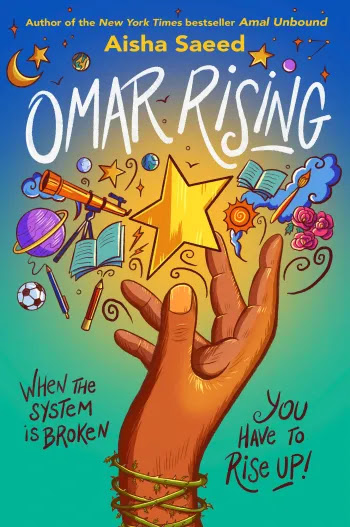
OMAR RISING: A MG Review by Teen Guest Blogger, Elliott Kurta


Omar Rising is the latest middle-school book from Aisha Saeed, featuring twelve-year-old Omar as he fights for justice at Ghalib Academy, an elite boarding school in Pakistan.


Despite having stayed at Ghalib over the previous summer, Omar is overwhelmed by the opulent campus. There’s a dining hall, soccer field, library, rec room, and walking paths. But Omar quickly realizes that he won’t be able to enjoy any of the luxuries in the Ghalib campus. As a scholarship student, he’s not only expected to maintain an A+ average in every subject, but is also required to complete five service hours a week while doing so. Worst of all, he’s not allowed to join the soccer or astronomy club, which he’s been waiting to join since the summer. As Omar struggles to keep up, he notices that none of his peers are held to the same standards that he is. Inspired by the artist and female rights activist Shehzil Malik, Omar decides to stand up for himself and rebel against the system that put him in Ghalib but is now doing its best to throw him out.

Omar Rising features a primarily Arabic characters and a corrupt school system as well as teachers that, frankly, have it out for their students. While this combination may seem too mature or complicated for middle schoolers, this novel perfectly packages real-world themes into digestible, easy-to-understand portions. Readers won’t just find themselves sympathizing with Omar, they’ll find themselves empathizing with him. It’s pretty easy to see yourself in Omar; he’s smart, a soccer-fanatic, sanguine, into science, and artistic. The poster child for childhood.

The rest of the characters are similarly likable. Kareen and Naveed, Omar’s roommates, add levity to each chapter. Similarly, Omar’s peers and soccer buddies, Humza, Jibril, and Marwan, give a more detailed glimpse into what the rest of the school looks like; carefree and preppy. Meanwhile, Omar struggles to keep up with his studies and manage his five weekly hours of chores, as he points out on pp. 80-81:

            “There are so many people who keep this school running. Gardeners. Cooks. Maintenance people. … They don’t need us to do this work. They just want to make sure we remember our place.”

Without delving too deep into the fact that he’s at the bottom of the hierarchy, Omar still delivers a poignant, impactful statement. This is only a small example of Omar’s emotional narration. Keeping pace with a fast-paced story, the middle-schooler’s monologues effortlessly switch from discussing soccer practice to elaborating on the pressure to succeed at Ghalib academy.

Omar Rising is an impactful and realistic novel, a call to action for any middle-schooler who has ever felt like an outsider. Through Omar, readers are educated about life in Pakistan and are inspired to make a difference in their own communities, just like the protagonist. The book is a reminder of how powerful resistance can be, even in the face of a system designed to create and widen inequalities. Overall, Omar Rising is a novel rooted in change and justice but still easily relatable to kids, perfect for young activists and innovators.

                                                ***

Congratulations to Connie Saunders who won DAISY AND THE MONA LISA. 

Don't forget to check out other great Middle-Grade books on Greg Pattridge's MMGM blog.


Saturday, November 12, 2022

SUPERPOWER? A MIDDLE-GRADE STEM BOOK REVIEW by ELLIOTT KURTA, AUTHOR INTERVIEW, and GIVEAWAY!

Here is Elliott Kurta's first foray into reviewing nonfiction. He wants more opportunities--so I'm on the lookout for books to recommend to him. If you have a favorite nonfiction middle-grade, please leave the title in the comments.

REVIEW

If you could have any superpower, what would it be? In Elaine Kachala’s debut book, Superpower?,  (Orca Books: 2022) kids learn about wearable technology, or wearables, that make it possible to have super strength, flight, telepathy, and more! Distilling a complicated topic into an enlightening and profound book, Superpower? explains not only what wearables are but how they’re affecting our society.

Overall, Superpower? is the quintessential nonfiction book. Not only does it cover a cool topic—real-life superpowers—it does so with easy-to-understand explanations and eye-catching illustrations. Each of the chapters is rife with intriguing examples of wearables in use today, and will capture the imaginations of readers. This book is ideal for 9-12 year-olds kids, although it could be read to much younger kids. However, as new and challenging words and terms are occasionally introduced without contextual definitions, parental help may be needed either way.

Illuminating the world of wearables, Superpower? addresses the technologies that are turning science fiction into reality. Covering VR, prosthetics, fitness trackers, smart clothing, and more, the book addresses some of the obvious—and not-so-obvious—examples of wearables already in use today. The book also addresses not only the history of wearables and early examples of technologies but also a glimpse of what we can hope to develop in the future. Additionally, the book features interviews with young scientists and inventors working towards a brighter future. Below, you can see an example found on pages 22 and 23, in which Christina Mann demonstrates her invention, a sonar collar that encourages social distancing.


 A bubble ball? A spiked collar? Finally, a 3-D printed prototype. Christina Mann constructed and tested different designs to spark discussion about COVID-19 and social issues and create practical technologies to keep people safe while protecting their privacy and sensory rights.
Photo credit: Steve Mann and Christina Mann

However, the wearables in development are only half of the story. Superpower? also delves into how wearables have affected our lives, our interactions, and most importantly, our privacy. Despite being a children’s book, Superpower? isn’t afraid to talk about the ethical concerns regarding these new technologies. In between describing what fitness trackers and brain-computer interfaces are, Kachala takes a moment to remind readers what might happen if corporations have unlimited access to our data or if an AI “goes rogue” and takes over. In order to spur further thought, at least once or twice per chapter the book also includes sidebars reminding the readers to “slow down and think human.”

Overall, Superpower? sets itself apart in how it addresses the dilemmas surrounding controversial new technology. While the material is adjusted to a younger audience, quality is not compromised. The photos and illustrations throughout the book expedite the process, renewing engagement throughout each of the chapters. All in all, Superpower? is a great way to introduce middle-schoolers to non-fiction, encouraging the use of critical thinking while remaining an enlightening, exploratory book.


Elliott is a prolific reader of various genres who is more than happy 
to share his opinions on books.
In his free time, he enjoys writing, reading, and running. 
       He is a 9th-grade student in Charlotte, NC.  


AUTHOR INTERVIEW 


CAROLHow did your science background feed your interest in writing this book? 


ELAINE: I have a science and social sciences background. Back at the University of Toronto,, I took a Sociology of Health and Illness course, which hooked me and led me to a new career path. I'd worked as a medical technologist, made my way into hospital management, and considered doing a master's in health care administration. This sociology course started me thinking about the social, economic, and environmental issues that affect our health, well-being, and quality of life. 


CAROL: Did you write the book first or contact a publisher with a proposal?


Outside of picture books, writers usually develop a proposal for nonfiction. But crafting a nonfiction proposal is pretty intense! I had to do a lot of research to write the proposal. It included several elements:


  • An overview with a captivating hook and summary, noting the genre, key concepts, target age group, who would buy the book, and word count.
  • How the book compares to, and is different from, other books in the market.
  • Table of Contents, followed by a detailed outline of each chapter.
  • Three sample chapters (I had to do three because this was my first book so the publisher would see my writing style and voice).
  • Bibliography.
  • Marketing and promotion plan.
  • My bio.


Ted Staunton critiqued it. We made some tweaks, but overall, he thought it was great and recommended that I reach out to Kirstie Hudson at Orca Book Publishers. As luck would have it, Superpower? was a perfect fit for Orca Think, a new nonfiction series that looks at issues making headlines to give kids the tools to think critically. I am beyond grateful for Ted's support and Kirstie's interest in the book! Then, the research and revising continued!  


CAROL: Superpower? is remarkably up to date—including Covid in 2020. Was this a challenge?


Yes! It was my biggest challenge. As time went on while writing the book, I learned of new devices and made some replacements. Covid wearables are a perfect example. I did not have this in my nonfiction proposal, but since I wrote the book throughout Covid, I ran into fascinating information which demanded to be included.   


CAROL: Out of curiosity, did you meet the Manns?


ELAINE: No, not yet, but I'm looking forward to it. Because I wrote the book during Covid, this wasn't possible. But we corresponded regularly, and Dr. Mann graciously took an incredible amount of time to answer all my questions and send many fabulous photos. Also, he was one of the experts to fact-check the manuscript. I hope we'll meet up soon.   


Want to know how Elaine got interested in wearables? On Monday, I'll 

post her answer to that question on the Talking Story Facebook 

group. Not a member? Let me know in the comments and I'll send you

an invitation. 

GIVEAWAY

To enter this giveaway leave a comment by November 16. If you are new to my blog, please include your name and email address. For each time you share this post on social media I'll give you another chance; just let me know what you do. U.S. addresses only. If you prefer, you can email me with your contact information.

Congratulations to Hewi Mason who won MEOW! from last week's blog. 

For more great middle grade books, check out Greg Pattridge's blog on Monday. He features lots of fine books!


Saturday, October 29, 2022

STARFISH: A Teen Review of a Middle-Grade Book


My teen blogger Elliott Kurta is now busy being a freshman in high school and doing his volunteer job at the library. So, we'll enjoy his book reviews whenever he has time to get them to me.

                                                    ****

REVIEW

           Young Elle is constantly shamed for being overweight; at school, in public, and even at home. To make matters worse, her mother obsessively monitors what she eats and her brother and sister poke fun at her. It’s no wonder the only place Elle feels safe is in her pool, where her weight doesn’t matter, and she can take up as much space as she wants. In this middle-grade novel, Elle finally decides to fight back with the support of her father, a new friend, and her therapist.

            Bringing a rarely seen viewpoint to a young audience, Starfish does a commendable job of not only approaching a sensitive topic but relating the perspective of a young, overweight girl to middle-schoolers. Elle’s bullies are painfully realistic, and so is the fatphobia she experiences every day. Additionally, the book is primarily presented in verse, which forces readers to slow down in order to absorb the cadence and message of each sentence. The poetic format also allows for certain dramatic flourishes in word placement which leaves a lasting impact on readers.

            At times, Elle’s narrative style can lead to confusion while reading. For a pre-teen, Elle uses uncharacteristically sophisticated terms to describe her own emotions and has an unusually mature awareness of her feelings. In her afterword, Lisa Fipps mentions that Starfish was originally going to be a YA novel, which explains why the book reads like one. This instance, found on page 34, highlights the discrepancy in Elle’s age and maturity present throughout the book:


            The first Fat Girl Rule

            you learn hurts the most,

            a startling, scorpion-stinging soul slap.


             Aside from the inconsistencies in Elle’s narration, there’s a subtler flaw in the book. Starfish focuses entirely on Elle’s body, her perception of it, and how it affects her life. Each of the one- or two-page long chapters either shows Elle being bullied at school, talking with her friend about her body, or fighting with her mom over her weight. In fact, one of the major sources of tension in the book is that Elle’s mother wants her to undergo bariatric surgery, a reference that would fly over the heads of most middle schoolers. The singular focus of the book is overwhelming and could even be considered in contrast with the novel’s message. By focusing entirely on one aspect of Elle, her weight, Lisa Fipps undermines the idea that Elle is more than her body.

            Regardless, there’s a reason that Starfish won a Printz award. Line for line, Lisa Fipps’ debut novel is nothing short of extraordinary, bringing the issues of a tween who’s more than her body weight front and center. For middle-schoolers everywhere, Starfish will make them reconsider how they see their friends, family, and most importantly, themselves.


A QUESTION FOR OUR READERS

Have you read this book? Elliott and I would like to know what you thought of it.

ALL ABOUT ELLIOTT

Elliott is a prolific reader of various genres who is more than happy to share his opinions on books. In his free time, he enjoys writing, reading, and running. He is a 9th-grade student in Charlotte, NC.                                                

                                                ****

Congratulations to Kathy Wiechman who won TEDDY, LET'S GO! from last week's blog.


Don't forget to check out the other wonderful middle-grade books on Greg Pattridge's MMGM site.


THE NIGHT WAR: A MG Historical Novel Review

  By now you should have received an email from my new website about my review of THE NIGHT WAR by Kimberly Brubaker Bradley. (It'll com...