Showing posts with label books for boys. Show all posts

Wednesday, July 24, 2013

Chicken Boy and a Giveaway!

I would like to think that I would have enjoyed Frances O'Roark Dowell's book, Chicken Boy, even if it wasn't set in North Carolina. 


But it sure helped to be able to picture the rural farm areas around the triangle region of North Carolina that are slowly being gobbled up by suburban development. Fifteen years ago I visited a goat farm in Durham that no longer exists. 

But I digress.

Like North Carolina itself, the author skillfully intertwines modern people and places with Southern folk and settings. 

Tobin Mccauley, the 12-year-old protagonist, is a lonely outcast in 7th grade. His mother has been dead five years and no one in his dysfunctional family ever talks about her. Tobin longs to live in a "normal" home--one where  his father talks to him and his family does more than eat together in front of the television. His best friend is his wacky Granny, who loves trucks, fishing, and her privacy; but who is also grieving the loss of her daughter.

Into this picture walks a new boy in school. Henry not only befriends Tobin, but encourages him to join him in his chicken-raising venture--despite the fact that Tobin hates chickens ever since watching Granny ring one's neck with her bare hands. 

Through Henry's friendly perseverance, Tobin sheds his skin of his old self, discovers he likes chickens, realizes that he has athletic and academic abilities, and begins to have friends at school. Henry is a powerful secondary character who comes alongside of Tobin, accepts him for who he was, and nudges him out of isolation.    

I also loved Granny. Since I listened to this book on CD, I can't quote any of her lines, but trust me, she is a Southern Toyota-truck-fixing character you won't forget. Other secondary characters including Tobin's foster parents, school teacher, social workers, and family therapist are also skillfully portrayed. 

O'Roark Dowell created original, quirky characters that stick in the reader's mind. Do you know a grandmother who drives up on the sidewalk in front of her grandson's middle school? Or a boy who wants to prove that chickens have souls? Or a 7th-grader who notices his teacher smells like lemons and likes to sniff the oil and grease on a tool? These people were real.

Vivid details bring Chicken Boy's characters to life.  As I move into my next round of revision of Half-Truths, I want to bring more depth to my characters. In order to do that, I've decided to use my daybook to start recording random characteristics of people I meet and know. 

Watch out. You know that quirky jerk of your head or the way you fling your hands out when you talk? You never know. I might just be watching...and taking notes about you. 

                                           *********
AND...Frances O'Roark Dowell is donating either a copy of this book or audio book to one lucky reader! Leave me a comment by the evening of July 27th (with your email address if you are new to this blog) and you might win!
  

Thursday, April 7, 2011

Two Boy Geniuses & One Book Giveaway

I discovered Freak the Mighty (Blue Sky Press, 1993) and The Reinvention of Edison Thomas (Front Street Books/Boyds Mills Press, 2010) when I was preparing for recent workshops at NCRA. Both books feature strong boy protagonists and include science and math elements.


FreakTheMightyBookCover.jpg


Conventional writing wisdom is that the first few lines of  a story should grab the reader. Consider this opening paragraph:
    
I never had a brain until Freak came along and let me borrow his for a while, and that's the truth, the whole truth. The unvanquished truth, is how Freak would say it, and for a long time it was him who did the talking. Except I had a way of saying things with my fists and my feet even before we became Freak the Mighty, slaying dragons and fools and walking high above the world.

From there, Rodman Philbrick, the author, leads readers through a story of two boys who individually confront traumatic pasts as well as struggle day-to-day with their disabilities. Maxwell is a huge 7th grader who is diagnosed with a learning disability; his father killed his mother and is prematurely released on parole. Kevin is a genius dwarf with Morquio Syndrome; his father also abandoned him and his battle is against time and the limitations of his diseased body. Together they become an inseparable team.

With Kevin riding high on his shoulders, Maxwell learns he not only can "slay dragons," but defeat town bullies and overcome his fears about his father and school. Kevin finds an invaluable friend who loves and respects him.

Philbrick weaves their stories together masterfully. I love the voices of the two characters, the layers of meaning, and how Philbrick brings us a story about friendship and acceptance, as well as about death and healing.  


Like Kevin, Edison Thomas is also a boy genius with a problem. Here is the opening:

Eddy sat on the steps outside Drayton Middle School, where the noise from the science fair in the gym still roared in his head. Tiffany always told him to picture a calm place when he felt stressed....

Tiffany's strategy wasn't working; his heart was still beating too fast. His body would have to be under control for him to go back into that gym full of people...

New calming strategy: think about the science fair project.


The author, Jacqueline Houtman, has begun to paint a picture of a middle school boy who has Asperger's syndrome. Eddy has a million scientific facts at his fingertips but is unable to relate socially to his peers and is happy in his own world of experiments and science. The book is full of personal conflicts: disappointment when his science fair project does not win first prize, not understanding why his former friend Mitch now teases him, and obsessive fears over children being killed when a crossing guard loses his job.  

Two turning points occur that change things for Eddy. When he figures out how to stand up to Mitch's bullying and when he accepts the friendship of two other scientifically-minded peers, Eddy's life begins to change. Houtman, provides the reader with a satisfying ending when Eddy is allowed to compete at the regional science fair, but realizes that he no longer needs to win it - he has already won some major battles in his young life.

                     ****************
By the way, both books have great appendices that add much to the the books' content.

In the spirit of books which incorporate science into their stories, I am giving away an autographed copy of Bonnie Doerr's book, Island Sting. If you are between the ages of 11-16, please share this blog with your friends (talk about it, e-mail it, Facebook, or Twitter) and then leave me a comment on this blog. I'll enter your name for a drawing on April 15.  


Monday, April 5, 2010

A Southern Smorgasbord

Following Karen Hesse's advice that aspiring historical fiction writers should read novels from the same time period and place that they're writing about, I have read several books to inform my own work. Here is a smorgasbord of books that take place in the south during the last 60 years; with a rating (5 *'s is the highest) following each.

Bone by Bone by Bone by Tony Johnston

In Tennessee in the early 1950's, nine-year-old David suspects that his father, the town's well-respected physician, is a member of the KKK. Despite knowing his father's feelings towards "niggers," David's best friend, Malcom, is black. He knows he can never bring Malcom home because his father has threatened to shoot any black person who comes into the house. The two boys enjoy one another's company until David is picked to be on the neighborhood baseball team while Malcom, clearly the better player, is not. Although the book is a good depiction of racial relations and bigotry during this time and place, I felt that the repeated foreshadowing of the terrible event that would happen, spoiled the predictable ending for me. I would recommend it as a good 4-7th grade book to be read in conjunction with a social studies unit about segregation in the South.***

Belle Prater's Boy by Ruth White.

This novel is told through the eyes of Gypsy Arbutus, cousin to Woodrow Prater who moves in next door after his mother disappears. Set in the 50's in rural Virginia, I appreciated how White gradually unveils both Gypsy's and Woodrow's stories, against the background of Woodrow's adjustment to life in the small town of Coal Station. Woodrow gains notoriety because of his ability to tell outlandish tales--including his own idea of where (and how) his mother left him. Gypsy lives with her mother and step-father; the reader is not told how her father died. The book's powerful climax is how both children face up to the truth of their missing parents. When the taunting of a peer at school brings up memories, Gypsy remembers: "He shot himself in the face. He killed himself. Of course I knew it all the time. I was there. I saw what happened. But how can a thing like that be in your head and you go on talking and eating and sleeping. It's the thing you can't really look at. So you hide it away and pretend it never happened. You have to. Only in my dreams did the truth look out at me."*****

My Louisiana Sky by Kimberly Willis Holt


In rural Louisiana in the 1950's, Tiger Ann is the smart daughter of two mentally challenged parents. Although she is embarrassed by her parents, she manages to live comfortably in the safety and protection of her strong maternal grandmother, Granny. When Granny dies, Tiger Ann's Aunt Doreen swoops in and takes her back to Baton Rouge; insisting that Tiger Ann would have more opportunities with her. Tiger Ann is torn. She loves the modern city, the clothes, and fun life her aunt promises, but when she comes back to visit her mother, Tiger Ann finds her depressed and unable to even get out of bed. This sensitive book shows a situation not often portrayed in books; Tiger Ann's conflicts are real and sympathetically described. ****

When Zachary Beaver Came to Town by Kimberly Willis Holt

The place is the south, the Texas town of Antler, but the time period has moved up about 20 years. This is a story of an unlikely friendship between three boys: Toby, his best friend Cal (whose brother, Wayne, is serving in Vietnam); and the sideshow star, Zachary Beaver, who comes to town and is billed as the "fattest boy in the world." Ostensibly, Zachary is trying to eat his way into the Guinness Book of World Records and is hostile to the boys' feeble attempts to befriend him. It's not until Cal's older sister genuinely shows interest in him, that the ice is broken between the boys. There is an undercurrent of lies and dishonesty throughout the story. Toby comfortably lies about his mother, but is bothered about Zachary's obvious lies about his own past. When Wayne dies, Toby can't bring himself to attend the funeral. Zachery confronts him which proves to be a turning point for all three boys. Recommended for 4-8th graders, this book can help students think about honesty, stereotypes, and friendship.*****

Missing May by Cynthia Rylant


Set in rural West Virginia, the main theme of this contemporary, intermediate novel is how the main character, Summer, deals with the death of her beloved Aunt May. Orphaned, Summer comes to live with Aunt May and Uncle Ob (a whirligig artist) as a young child. They love her completely and when May suddenly dies, she and Ob are left bereft and helpless. As Ob sinks deeper into depression, Summer's fear of losing her only remaining relative increases. When Cletus, a peer at school, suggests they consult a medium to see if they can reconnect with May, Ob and Summer agree. I found Summer's gullibility as a 12-year-old to be a little far-fetched. On the other hand, I loved how at the end, the three "planted" Ob's whirligigs in May's garden-- setting them, and their grief free. A good book to open up discussion about death.****

Both Bone by Bone by Bone and When Zachary Beaver Came to Town are books with strong male protagonists that would appeal to boy readers.
Technorati Tags:

Friday, April 24, 2009

The Gatekeepers

Normally I wouldn't recommend ending a story with the words, "To be continued." But when the story weaver is Anthony Horowiz then I throw my hands up in the air. I can only hope that my library has the 4th book of the series on CD, or I'm in trouble.


I am generally not a fan of epic fantasies, but I am inexorably hooked on The Gatekeepers that should capture the attention of any middle schooler -- boys particularly. Horowitz masterfully interweaves the lives of five 14-year-olds (four boys and one girl--thus the draw for male readers) who have been chosen to save the world from the "Old Ones." These are powerful evil forces that "feed on human misery" as Scar, the female character relates.

Each of "The Five", as the young adults are referred to in the books, have paranormal powers. An intrinsic part of each book is how the characters come to grips with his or her powers and learns how to use them in this colossal struggle of good vs. evil. There is a great deal of leaving one part of the world and ending up on the other side of the globe, but for the most part, Horowitz has prepared the reader to successfully suspend disbelief and the ways in which the characters end up connecting with one another is convincing.


Horowitz is a masterful storyteller and suspense is hardly a big enough word to describe the predicaments which the characters face. Each main character is always facing imminent danger but the author "somehow" (a word he uses a lot) safely brings him through. These are great books for the writer-to-be to study and see how the author is constantly "upping the ante" through physical danger, time running out, or impossibly close calls. And talk about cliff hangers! The ending of each book entices the reader to go to the next.


Although I have obviously enjoyed these three books, I felt as if the detour in the third book into a time 10,000 years ago and the introduction of characters who mirrored "The Five" was a bit of a stretch. If I could discuss the books with Horowitz, more then once I would have said to him, "Is this really necessary?" But although it seemed long and drawn out, afterwards I understood how Horowitz used this detour to add another dimension to the saga.

Christians who read the books can have some interesting dicussions on the religous themes that run throughout all of them. There is a strong message of "this is what was meant to be" which Calvinists call "predestination." In the same way, there is also a theme of sacrifice as the characters consider that they might have to give up their lives to save the world. On the other hand, some Christian parents might be uncomfortable with the characters' paranormal abilities.


Overall, I highly recommend the books for adventure, descriptive writing, and a story that hooks the reader's imagination. But I'm in trouble. Book 4, Necropolis, isn't even at my library yet and there are 18 people ahead of me waiting to read it! To be continued....
Technorati Tags:
, , , , ,

Friday, February 29, 2008

A Small White Scar


If boys can keep reading beyond the first few chapters which tell the back story of "A Small White Scar", they will find rattlesnake bites, a dangerous flash flood, and a rodeo that is so real you can hear the calves bawling in their pens. Boys who like action from the first paragraph will have to wait for the story to unfold. But, it’s worth it. Readers will identify with Will, the 15-year-old protagonist who itches to carve a life out for himself separate from Denny, his mentally retarded twin brother. Both characters are well developed; Will’s anger is consistent with his life experiences and Denny’s thoughtful yet child-like responses are consistent with a person who has Down Syndrome.

My favorite line is towards the end of the book when their father reveals that although Will sees himself as Denny’s surrogate parent, Denny is the one who has taught Will about self-sacrifice, responsibility, and love. K.A.Nuzum
uses beautiful figurative language to describe Colorado in the 1940’s; teachers could use this book as a mentor text and ask students to find the similes and metaphors, as well as to identify the various types of conflicts which confront Will and Denny. Recommended for boys and girls from 6th grade and upwards. (Harper Collins, 2006).Technorati Tags:
, , , , ,

Wednesday, September 12, 2007

Alabama Moon


Conventional wisdom among children's writers is that the protagonist of your novel should be older than your intended reader's age. That's at least one rule that Alabama Moon successfully breaks. Right from the beginning of this poignant, survival/adventure story, 10-year-old Moon faces the death of his father from whom he has learned everything he "needs" to survive in the Alabama forest. Moon discovers that although his Vietnam veteran father may have chosen to live alone with his wife and son, a life of loneliness is not what he wants to choose for himself.

This is author Watt Key's first novel and he generously uses memories from his own childhood growing up in the swamps and forests of Alabama. The interview on his website is eye-opening for both young adult readers as well as for writers who want to learn how to mine their own life experiences. With the strong survival theme, this book will appeal to middle school boys, but I believe girls (who often read books with boys as the main character) will also appreciate it.

I believe Key did an excellent job of weaving the themes of death, friendship, and family, into this well-written book. Parents should be advised that there is rough language—which is true to the character of a child raised in a forest by an angry father—but some readers may find that objectionable. (Farrar Straus Giroux, 2006)

Saturday, August 4, 2007

Harlem Summer


Since I'm in the middle of working the kinks out of writing a juvenile historical fiction novel, I'm impressed with Walter Dean Myers' ability to convey a sense of history and place, through a believable character living in Harlem in 1925. Both boys and girls will enjoy reading about the "life of crime" that Mark Purvis inadvertently slips into—and will cheer along with him when he finds his way out. I would recommend this Newberry Honor Winner for students in grades 5-8. Check out this interview with him for background information on where he gets ideas for his stories, his feelings about poetry, his relationship to his family, and more. (Scholastic, 2007)

P.S. The back of the book includes a pictorial directory to the "real" people and places in Harlem Summer. This is an added bonus for kids (like mine) who always want to know what "really" happened.

Tuesday, July 24, 2007

The Looking Glass Wars


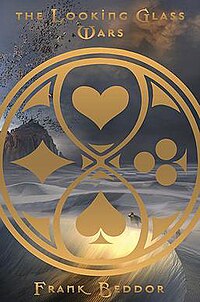
If you're looking for an entertaining, incredibly clever, and thought provoking book for boys and girls from age 11 and up, then check out The Looking Glass Wars by Frank Beddor (Dial Books, 2006). Falling into the category of "Why couldn't I have thought of that?" Beddor's book is built on the premise that Alice Liddell "fell" into this world from her world of Wonderland. Alyss's world (her "real" name) is full of castle intrigue, power politics, cards that are soldiers with amazingly effective weapons (I was partial to the AD52 that carried quite a punch), battles between good and evil, and even a hint of romance (but not so much that boys will gag!). Adult and young adult readers will enjoy the wordplay which Beddor threads throughout the book: both card and chess metaphors are seamlessly interwoven into the plot. The author does such a good job of creating this fantasy world, that by the end you will wonder which world is truly real. And in fact, the chronology at the end of the book comes as a surprise. There are so many more layers built into this book then I first realized, that readers may have to start all over again. Fortunately, this is the first book in a trilogy and I am hooked. I can't wait to get my hands unto Seeing Redd which is due out in August, 2007.

Monday, July 9, 2007

Blood Red Horse

I haven't been deliberately picking out books with colors in the title, but I'm always excited when my local library adds new YA books on CD's to their collection. I picked up Blood Red Horse by K.M. Grant and was not disappointed to listen to a book that would appeal to both boys and girls. (The SCBWI-Carolinas listserve has been having a lively discussion on what types of books appeal to boys and whether we as writers write to their interests, or write what we feel passionately about. Interesting dilemma for writers!)

This first book in the de Granville Trilogy recounts (in vivid, gory detail- thus the boy interest!) is written from the perspective of two young men during the 12th century Crusade. One, a Christian knight, the other a Muslim emir. Through the events which are shown in remarkable, historic detail, they both end up loving the same "blood red horse." The valued animal ends up being a catalyst for partial reconciliation between the two enemies. The author not only portrays the conflicts and experiences of both young men, but it is also an eye-opening account of the Crusades. I highly recommend it for readers in middle school and high school. Younger mature readers might also appreciate it, although given the nature of the subject, there is quite a bit of violence.

Thursday, June 14, 2007

Some Recent Reads

I recently finished listening to Rash by Peter Hautman. Although the language might offend some readers, the plot, story, and writing are excellent. Fast forward the calendar about 70 years and you'll see Hautman's view of the future. In this way, Rash provides a clever commentary on our present society which is preoccupied with health and safety. In addition, the manner in which Bo Marsten, the main character, handles conflicts with his family, peers, school, and government are true to life and lead to a satisfying resolution. I believe this book will appeal to boys and girls from ages to 11-15.

Copper Sun by Sharon Draper was the winner of the Coretta Scott King Literary Award in 2007. It is told from the perspectives of an African slave girl and an indentured girl whose lives intersect in a South Carolina rice plantation in the early 1700's. Although I found some of the story predictable, the vivid horrors of slavery and the cruelty of slave owners definitely made this book a worthwhile read. In addition, the girls' journey south to Florida and to Fort Mose was a departure from the stories of slaves escaping to the north. The girls' emotions, interactions, and the development of their friendship are portrayed well. There are several references to sexuality as the main character is bought as a 16th birthday present for the masters' son, so parents should use discernment in recommending this book for younger readers.

THE NIGHT WAR: A MG Historical Novel Review

  By now you should have received an email from my new website about my review of THE NIGHT WAR by Kimberly Brubaker Bradley. (It'll com...