Showing posts with label informational picture book. Show all posts

Monday, December 19, 2022

TWO HISTORICAL PICTURE BOOK by MEGAN HOYT

 Today I'm proud to share two informational picture books by my SCBWI-Carolinas colleague, Megan Hoyt. No giveaways this week--my grandchildren will be the proud recipients of these fine books. But in case you need one (or two!) more gifts for the young reader in your life, check out these marvelous books.

Megan Hoyt discovers small pieces of history that are stories begging to be told and then writes them in a way that engages both children and adults. These picture books are for slightly older readers and can be used as classroom resources in grades 1-3. Both books have extensive back matter which include Megan's interest in the topic, additional information about the subject, timelines, and sources. BARTALI'S BICYCLE also includes a letter to the reader from Gino's granddaughter, Lisa. THE GREATEST SONG OF ALL includes the petition which Isaac Stern wrote to save Carnegie Hall. 

REVIEWS

BARTALI'S BICYCLE is stunningly illustrated by Italian illustrator, Iacopo Bruno.

Gino Bartali thought of himself as an ordinary bicyclist in Italy in the 1930s. But he was far from ordinary.

For eight years he trained along Italy's mountains and rugged paths. He won race after race, including the prestigious Tour de France in 1938. 

When World War II broke out, Gino refused to believe the lies that leaders were spreading about the Jews. 

He watched as Jews were rounded up and taken away on trucks. He wanted to help--but how?

A priest contacted him and asked him to deliver secret identity papers to Jews who were trying to escape. Although he was afraid of getting caught, he decided to help. "Some medals are pinned to your soul, not your jacket," he said. 

He stuffed the fake identity papers into his hollow bicycle bars and delivered them to hundreds of families, he hid his friend's family in his cellar, and rescued prisoners. 

Gino was a humble man who didn't want to be recognized.

"Good is something you do, not something you talk about," he said. 

But stories trickled out. Children came forward. 

Grateful families remembered the remarkable Gino Bartali, the Tour de France winner, Italian sports hero, and...secret champion.


THE GREATEST SONG OF ALL is brought alive by talented illustrator, Katie Hickey.
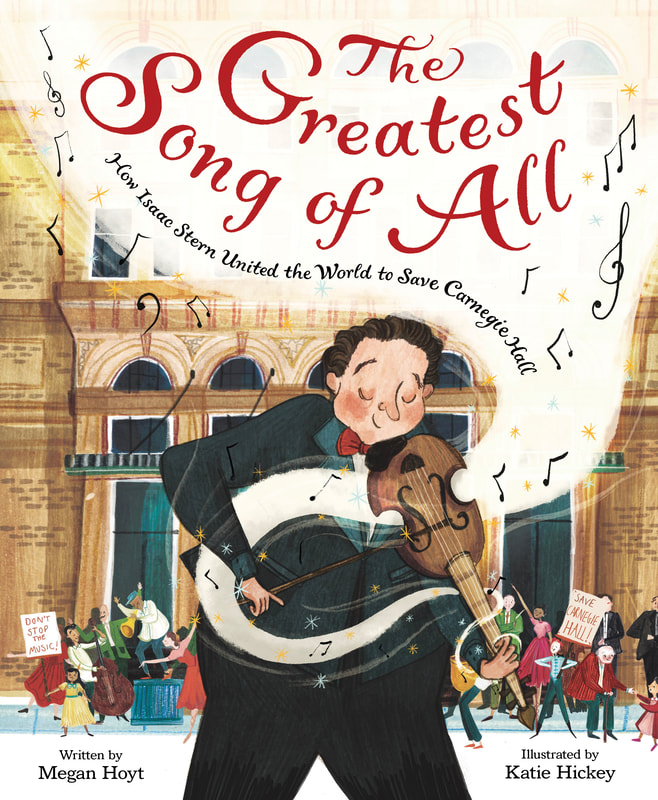

When Carnegie Hall opened in 1891 in New York City, Issac Stern wasn't even born yet. He was a young promising violinist in 1934 when Albert Einstein educated the audience with theories of splitting atoms and bending time.

But someone new would soon step onto the legendary stage. Without him, Carnegie Hall's story might have ended right there.


Issac was talented, but his parents were poor Jewish immigrants from Ukraine. They scrimped and said until pennies became dollars. Then they sent their son to the best violin teacher in town."

Issac practiced for years and at 23, made his Carnegie Hall debut. He ended up playing there more than fifty times. This cavernous ruby-colored room felt like a second home to Issac.  Little did Issac know that a powerful city planner, Robert Moses, had other plans for Carnegie Hall. 

His mind swirled with grids and sketches and pans. It may have looked like he was making the city more beautiful, but when Mr. Moses decide Manhattan needed a new, bigger, music hall, he didn't mind knocking down eighteen city blocks to make room for it.

The wrecking ball was scheduled for March 31, 1960. But Mr. Moses hadn't met Issac Stern's opposition.


Music lovers, musicians, and dancers protested against the demolition. But to no avail... Issac couldn't persuade the mayor to preserve the Hall--and he didn't have the five million dollars that was needed to purchase it. 

But Jacob Kaplan, a wealthy business man did! In the nick of time, Issac and his supporters were able to save the magnificent hall and...

Carnegie Hall opened its doors to talented performers from all over the world--rich and poor, young and old, American-born or immigrants seeking a better life, like Issac Stern's family did many years ago.


                                                    ***

Megan told me that she is attracted to stories that hold a personal connection.  For Megan's connection to each topic (and a hint at what she is working on next), please visit the Talking Story Facebook page. (Interviews will be posted on December 20 and 21. If you aren't a member yet, just request to join and I'll approve you.)

                                                    ***

Congratulations to Danielle Hammelef who won The Snowman's Waltz and to Marci Whitehurst who won Baa, Baa, Tap, Sheep 

Monday, October 3, 2022

A PLANET LIKE OURS: A Picture Book Review and Giveaway

 My long-time blog readers will recognize the author and illustrator of A PLANET like OURS. I have reviewed other books by author Frank Murphy that are illustrated by Kayla Harren and published by Sleeping Bear Press: A Boy like You, A Girl like You, A Friend like You, and A Teacher like You.  Like those other four books, A Planet like Ours includes curriculum-rich content that preK-first grade teachers can use in their classrooms. It is co-written with Charnaie Gordon.  Here are some sample illustrations and quotes from the text. 


We need a planet like ours

to nourish us, protect us, and give us life.

A place to call home.

Our planet. Our Earth.

That is one of the opening pages which succinctly states the theme of this informational picture book: respect our planet. The following pages mention six different resources which we must protect.

SOIL


It helps grow our food. 

Pollution and chemicals can ruin our soil and our groundwater.

Let's protect our soil

WATER

Without water there would be no plants... no animals...no people! 
 So we must take care of lakes, rivers, and streams.


I loved this illustration of a child fishing the litter out of the water--what a great message and perspective.

ALL LIVING THINGS


Taking care of creatures means taking care of their 
habitats. Let's protect all living things.

TREES 

Our trees help keep the atmosphere cool. 
They grow branches that grow leaves that give us shade.


AIR

Earth's atmosphere needs clean air.

Pollution comes from factories and energy power plants.


PEOPLE

Our cities, towns, and neighborhoods.

                    ...... 

We build communities, together.  

                    We learn new things, together. 


The back matter includes personal notes from the authors and illustrator as well as several easy-to-implement activities. Click this link for another Activity page

GIVEAWAY

If you're interested in winning this book, please leave a comment with your email address by October 6. Educators (home or school) and librarians get an extra chance as do new followers to my blog. Just let me know what you've done in the comments. U.S. addresses only. 


Saturday, June 11, 2022

GRACE BANKER AND HER HELLO GIRLS ANSWER THE CALL Part I- A Review and Informational Picture Book Giveaway

Claudia Friddell is no stranger to my blog. A year ago I featured her book, Saving Lady Liberty: Joseph Pulitzer Fight for the Statue of Liberty. Today I have another fantastic informational picture book, Grace Banker and Her Hello Girls (Calkins Creek, 2021). In Part II Claudia and illustrator Elizabeth Baddeley provide the back story to this glimpse into the women who served behind the scenes in World War I. 


REVIEW

Drawing upon Grace's diaries and interviews, the story opens in December 1917 with Grace reading how the commander of the U.S. troops in Europe was issuing a call for female telephone operators. 

That was not the only way that women were called to help with the war effort,

but it was the one Grace acted on.

As a telephone operator, she had the skills and she also knew French and English. But, women had never been allowed in the army.


Grace was thrilled not only to be accepted into the Signal Corps, but she was named the chief operator of the first group of thirty-seven women to go overseas. After two months of drills and classes, the Signal Corps Girls headed to France on board the troop ship Celtic.


By U.S. Navy photo NH 912, Public Domain,
https://commons.wikimedia.org/w/index.php?curid=8664455 

The minute the Signal Corps Girls started plugging in cords and connecting calls at General Pershing's headquarters in France, calls poured in from homesick doughboys missing the voices of their mothers, sisters, wives, and sweethearts.

Grace loved her busy twenty-four-hour days. She wrote in her journal, "Never spent more time at the office and never enjoyed anything more. My girls work like beavers."

When General Pershing moved his headquarters to the front, Grace and her girls followed--with gas masks and helmets hanging from their chairs. Grace was almost hit by shrapnel but nothing kept the women from making sure that every call was connected. "Any missed command could lose the battle."

At one point General Pershing moved the unit to a top-secret location. 

Like the conductor of an orchestra, Grace directed her girls from the top of a crate. With fingers flying over the fighting lines' switchboards, the operators barely noticed the bitter winds or leaky barracks.


When a fire broke out in the barracks, the girls wouldn't leave their posts. Only when they were threatened with court-martial did they leave their switchboards!

Finally, on November 11, 1918, a captain of the Signal Courts picked up Grace's phone and made an urgent call--


On May 22, 1919 Grace was the first woman soldier to receive the U.S. Army's Distinguished Service Medal. She wrote in her journal:

There are many who saw far more service than I, and many who earned medals even if they did not receive them. Mine I consider as a tribute to the girls who worked under me at the First Army and to the Signal Corps men operators scattered throughout the tiny tiny field offices. 

BACK MATTER

Seven pages of back matter include a timeline, the fight to obtain full veteran's benefits for the operators, relevant statistics, information on how a switchboard worked, an extended bibliography and interesting artist's notes. There's no question that this book is an excellent curriculum resource for 1st-3rd graders. 

Come back next week to read about how Claudia obtained this amazing story and more information on Elizabeth's process of researching and creating the illustrations.

GIVEAWAY

Leave me a comment along with your email address and I'll enter your name once. Leave a second comment on Part II and you'll be in twice. U.S. addresses only. If you prefer, send me an email to enter. 


Thursday, May 26, 2022

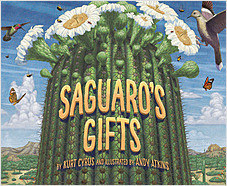
SAGUARO'S GIFTS: A Informational PIcture Book Review and Giveaway

 I'm always impressed with the scope of picture books that Sleeping Bear Press publishes. Today's book is no exception.  SAGUARO's GIFTS should adorn elementary school classrooms and family bookshelves with its evocative yet child-friendly poetry by Kurt Cyrus and gorgeous illustrations by Andy Atkins


REVIEW


That opening page is followed by 

The world is dark. The bloom is white.
A bat emerges from the night.
"Hello, Saguaro!"
Every year I find the sweetest nectar here.
And happy birthday, by the way.
One hundred years, this very day!

Throughout the book, desert animals, birds, and insects pay homage to the cactus on its' 100th birthday. Play a game with young readers and ask them to find the hummingbird, woodpecker, owl, butterflies, a coyote, and a tortoise. 


All the animals pause when they hear,

A bobcat races up the trail

with javelina on his tail.

"Clear the way!" the bobcat screeches,

scrambling to the highest reaches.


The tortoise ends the day:

Another day is done old friend.

One hundred years have come and gone.

but you and I go on and on.


The book ends with a spread showing a meteor lighting up the night sky and the words, 
Another gift exchange tomorrow--
Happy birthday, dear Saguaro.
By the way, the flowers appear from April through June and are open for less than 24 hours. On a trip to Arizona nine years ago, I saw how huge these cacti are but unfortunately did not see their beautiful flowers.


GIVEAWAY

Leave me a comment by May 30 to enter this giveaway. Please leave your full name and email address if you are new to my blog. You can also email me if you prefer. Become a new follower or share this on social media and I'll enter your name twice. Make sure you tell me what you did! U.S. addresses only. 

Congratulations to Marci Whitehurst who won So Much More to Helen from last week's blog.

Thursday, April 28, 2022

TAD LINCOLN'S RESTLESS WRIGGLE: A Informational Picture Book Review, Giveaway, and Author Interview

 "I don't know but I may succeed in governing the nation, but I do believe I shall fail in ruling my own household." Abraham Lincoln

Author Beth Anderson uses that quote to draw readers into the life of Abraham Lincoln's boisterous son, Tad. You'll see why that quote is a fitting preface to another great picture book published by Calkins Creek.


REVIEW

Thomas Lincoln wriggled from the moment he was born. 
Like a tadpole, thought Abraham, and he called his son "Tad." 
The name stuck. 
So did the wriggle.

In that simple manner we meet Tad. 

Since he was born with an opening in the roof of his mouth, Tad's words were hard to understand. Although he had difficulty communicating clearly, his energy was quite obvious. 

Tad careened through the East Room in his chariot, scattering shrieking ladies not corners. "Get out of my way!" 

The staff huffed. Children should not be seen--and certainly not heard!

I LOVE the horrified looks on the ladies, don't you?

 The same was true in the classroom:

Illustrator S.D. Schinder captured Tad's movement!

Tad ran through the house, yard, and stables, tore through his father's important meetings, and even went to a soldier's camp. 

Unlike today when presidents are closely guarded, Abraham Lincoln walked Washington's streets accompanied by his son. Tad learned how to comfort wounded soldiers and listened as his father chatted with storekeepers and war volunteers. 

Visitors poured into the White House requesting time with the President. Lincoln didn't turn anyone away. 

Women requested passes across enemy lines. 

Families begged for money. 

Politicians wanted favors.

President Lincoln watched his young son's compassion for soldiers, homeless men, stray dogs and kids, and even for the Christmas turkey (who had become one of his pets). Despite his difficulty with language, Tad managed to convince his papa to rescue the turkey from being served as dinner. 

When Tad received more books as Christmas presents than his father would have time to read to him, he decided to share them with injured soldiers. He filled a big box with books and goodies and delivered them to the hospital. 

Although he couldn't write, "his message was clear as he filled the very big box... 


S.D. Schindler's illustrations are magnificent and highlight the story in a superb manner. 

BACKMATTER

Beth Anderson shares an interesting assortment of information in her Author's Note. She began researching the first presidential turkey pardon and became entranced with the close father-son relationship between President Lincoln and his fourth son, Tad. Readers will learn about how Tad's partial cleft palate would be surgically repaired today. Personally, I was intrigued by Beth's bibliography. Her primary sources include several books written in the 19th century as well as those published in the first part of the 20th century. 

AUTHOR INTERVIEW

CAROL: You started to write a book about pardoning the Thanksgiving turkey and that concept changed as you got to know Tad better. Can you explain how that happened?


BETH: The turkey pardon story was a tender bit of father and son with some humor that resulted in the national tradition, but…I wasn’t finding a special heart angle to make the story resonate and matter in a special way. As I learned more about the antics of Tad Lincoln, how his mother referred to him as her “troublesome sunshine," his executive mansion adventures, his disabilities, rejection by others, and his joyful heart, I knew there was so much more to this little human than met the eye. As a teacher who has experienced the discovery of unexpected talents, depth, and humor beneath challenging behavior, I wanted to know more about this complicated child and showcase the contradictions he seemed to embody. Because we’re all complicated, right?


CAROL: Your bibliography is fascinating. Can you speak about your research process and how you found those primary sources?


BETH: Once I start digging in, I follow the trail of breadcrumbs from sources in bibliographies and search out the various names I encounter. It’s fortunate there are so many resources about Lincoln and so many accounts left by those who spent time with the Lincoln family. Most of those sources are people who were on the staff or frequently there covering the President. Tad never failed to make an impression of some sort, so he is often mentioned. A few of the officials loved him and doted on him, like Stanton who gave him a Union uniform. Tad often accompanied his father on outings, so journalists often noted incidents with Tad. There are Tad anecdotes sprinkled through writings from Lincoln’s secretaries, the boys’ baby sitter, Mary’s dressmaker, and more. Once you find who was with the family in the President’s House, you can search out those, and most are referenced in other books about Lincoln. 


CAROL: Why did you pick 1863? 


BETH: Scope is always an issue with an historical picture book. I like to take a short piece of time if possible so I can really delve into character. As I gathered the stories about Tad, and looked at how they fell on a timeline, I could see that during the year 1863 he transformed under the loving guidance of his father. Once I saw that, I dug for more from 1863, looking for the pieces of the puzzle, choosing the most meaningful, to make my heart thread sing. That was the year after Willie’s death (Tad’s brother), so both were grieving and they needed each other more than ever. Their relationship was intense and vital, humorous and joyful, tender and nurturing. 1863 also allowed me to focus on the relationship and all they brought to each other without having to bring in Willie’s death or the assassination. And at the end of 1863, Christmas, I had the climax moment with the turkey, and I found the perfect incident to use as the ending to tie that heart thread tightly and let it resonate. 


CAROL: How have kids reacted to the book?


BETH: Kids have really loved the book! They totally understand the WRIGGLE! And some of the historical details are great surprises for them. I haven’t been able to experience their reactions in person due to the release during the pandemic, but the feedback I’ve gotten virtually has been wonderful!


GIVEAWAY

Leave a comment (along with your name and email address if you are new to my blog) to enter the giveaway. If you follow my blog, I'll enter your name twice. Become a NEW follower and you'll also get a second chance. Giveaway ends May 2. Continental U.S. addresses only. If you're uncomfortable leaving your email address, please email me. 

Saturday, April 2, 2022

A PENNY'S WORTH: A Picture Book Review, Giveaway, and Mini-Author & Illustrator Interviews


"Hot off the minting press, Penny sparkled." That's the first line of Kimberly Wilson's debut picture book, A PENNY'S WORTH (Page Street Kids, 2022). With engaging illustrations by Mark Hoffman, this STEM story of a pretty copper penny will find a special place in a preschool - second grader's heart. 

REVIEW

Penny launches into life ready to be spent. But she soon finds out that while other money appears useful, she is ignored, forgotten, or worse--stuck to a piece of gum. "This is non-cents! she thought."

She sets off on a journey to prove her worth. 

First she tries her hand at following Quarter into an arcade slot. CLINK, CLANK, CLUNK Penny is returned. "I wish I measured up, Penny thought."

Next, she tries her hand at buying some penny candy. 


But, as Dime points out, a penny won't buy a lollipop like it used to. 

Penny takes a tailspin and goes over the edge when she reads this headline:


She peers down and imagines life as a sewer cent...


"....Ignored. Forgotten. Stuck." (I assume if this was a novel this would be her "Dark Night of the Soul" moment.)

A friend comes alongside and leads her out of despair. "Heads up," another penny said, "we're good luck when we put our best face forward!" 

Penny follows and finds herself by the side of a fountain filled with pennies. A little boy picks her up and she listens to his whispered wish. 
"She beamed. He can count on me!"


As you can tell, Kimberly is a punny writer (Sorry! I couldn't help it!) and includes world play and puns so that adults will enjoy reading it also. To find out more of Kimberly's "Two Cents on Picking the Perfect Pun," click here for her recent SCBWI-Carolinas post.

AUTHOR & ILLUSTRATOR INTERVIEW

Carol to Kimberly: How did you come up with the idea for A Penny's Worth?

Kimberly: A Penny’s Worth began as a Storystorm 2019 idea. I looked at the coin jug on my kitchen counter and saw something more––a plucky penny on a mission to prove she’s cent-national, despite her face value. Through Penny’s journey, I realized I not only had the opportunity to make readers laugh with countless puns and introduce them to money math, but also to show them the importance of self-worth.

Carol: What was your path to publication?

Kimberly: The writing journey for this book took me to a NJ SCBWI conference in June 2019 where I was asked to revise and resubmit to Page Street Kids. I was thrilled, and after working with them on a few rounds of revisions, they made an offer approximately a year later!

Carol: What did you think of Mark Hoffman's illustrations?

Kimberly: I am a huge fan! When I first saw the character sketches, I was captivated by the colors, dimension, and expressions––and who doesn’t love a penny in pants! When I saw the final art, one of many things I was taken with was the retro feel Mark gave to the arcade and candy shop. 

Carol: What's next?

Kimberly: A DOLLAR'S GRAND DREAM (Spring, 2023, Page Street Kids).

                                                                                ****

Carol to Mark: What medium did you use?

Mark: Acrylic.

Carol: What was it like illustrating this book?

MarkThe book was a lot of fun to work on because it had so much going on with each spread. This meant I got to think of the page like a collage of moments. Hopefully that comes across in the reading of it. 

CarolWhy did you use green so much in the illustrations?

Mark: I wanted to capture a hint of the oxidized copper.

(Carol to herself: And I thought it was because the book was about money!)


A Penny's Worth comes out April 5! Join Kimberly and Mark for their virtual launch which will be moderated by SCBWI-Carolina's own Ashley Belote. And, if you're in Charlotte, NC, come meet Kimberly at Park Road Books (THE independent bookstore in Charlotte) on April 24 for story time and reading. 


GIVEAWAY

To enter this giveaway, just leave me a comment. MAKE SURE YOU LEAVE YOUR EMAIL ADDRESS IF YOU ARE NEW TO MY BLOG! If you already subscribe to my blog, I'll put your name in twice. If you don't already subscribe but decide to follow my blog, I'll add your name for a second chance. Giveaway ends April 7.

Congratulations to Gail Cartee, who edged her way to the front of the crowd last week and won THE VERY OLDEST PEAR TREE.

Monday, March 28, 2022

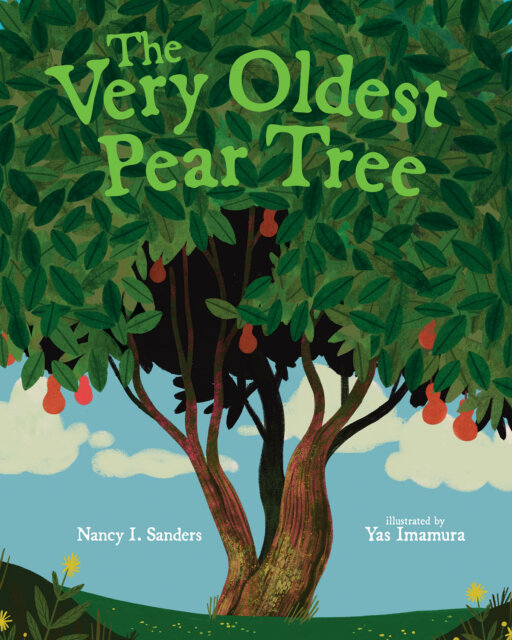
THE VERY OLDEST PEAR TREE: A Picture Book Review, Mini-Author Interview, and Giveaway

 I'm delighted to introduce you to a new author friend of mine, Nancy I. Sanders. Nancy has published scads of books and her blog is full of information for writers, teachers, and readers. Take your time to look around her site and you'll be impressed as I am with her experience and generosity! If you want to get to know more about Nancy's passion for picture books, check out this interview. 

In today's post I'm highlighting one of her picture books, The Very Oldest Pear Tree (Albert Whitman & Co., 2020). This informational book for readers from 5-8 years old, tells the inspirational story of how the Endicott pear tree grew up with our nation. Click here for links to classroom resources.


REVIEW

The year is 1630. The main character is a pear tree sapling that is shipped to the governor of Salem, John Endecott.  He has missed the fruit trees in England and is determined to start an orchard.


Governor Endecott picked the little pear tree to grow right in front of his house, hoping that it would live a long time. "The tree was small yet strong. Though young, its roots reached deep."

Twelve years later a fire blew through the orchard, destroying hundreds of trees--but the Endecott pear was spared. Generations passed. The family changed the spelling of their last name, the Governor's house crumbled, but the Endicott pear tree--with its new name, stood.  

By the time our second president of the United States, John Adams, ate one of its pears, the tree had become a legend. It inspired Massachusetts poets like Henry Wadsworth Longfellow and  Lucy Larcom. 


The tree survived a hurricane in 1938 and vandalism in 1964. Tree experts were unable to graft new branches. But, the Endicott pear tree tree sent out roots and "almost miraculously, a hundred tiny branches sprouted along the trunks. It survived!"


In 1997 a cutting was used to grow a new Endicott pear tree. Clones were made, seeds stored in a storage bank, and now Endicott pear trees have been planted across the nation--including this one, that Nancy planted and is now six feet tall!


Today, about four hundred years old, the Endicott pear tree is the oldest living tree cultivated in America. When John Endecott first planned it in front of his house, he expected the pear tree to outlive him by more than a hundred years. But no one imagined its story could still be told today.

The Endicott pear tree is a survivor. It's older than America itself. And it's still standing strong.

MINI-AUTHOR INTERVIEW

CAROL: How did you get interested in this topic? 

NANCY: I wanted to write a picture book every elementary teacher would want to use in the classroom. I figured that would be a highly commercial topic. So I knew children study Pilgrims in Kindergarten/first grade. So I started reading about Pilgrims to see if I could find any new topics about Pilgrims that hadn't been written about before. I discovered they planted an orchard of apple trees!

I started researching their orchard of apple trees because I love trees...and each time I searched for that on the Internet, links would come up for a pear tree that the Puritans had planted...that was still alive and growing strong! I started clicking on those links, learned about the Endicott Pear Tree, and was hooked. I fell in love with it right from the start!

CAROL: What type of research did you do?

NANCY: First I read everything I could about it. There's actually a lot online from the historical society that still helps care for it.

Then I contacted Bill Endicott, the president of the family's descendants who originally planted the tree. He gave me a lot of information.

Then I took a trip to Boston and Salem and Danvers to actually visit the tree and take lots of photographs. That was so exciting to actually touch the tree and sit near it!

CAROL: What was your path to publication? 

NANCY: This was one of the rare times in my career that I wrote the entire book before I queried a publisher. I sent the manuscript to my agent Cyle Young who submitted it. And Albert Whitman picked it up!

CAROL: Any thoughts on the illustration style?

NANCY: I was so excited to learn that Yas Imamura was picked up to illustrate this book. I was already familiar with her name and her style because she had illustrated some very nice nonfiction picture books at that time. I love her style which has a nice Americana and historic feel.

GIVEAWAY

Leave me a comment with your email address if you are interested in winning a copy of this book; U.S. addresses only. Giveaway ends April 2. This will make a great homeschool or classroom resource--or just a wonderful book for your bookshelf!

Congratulations to Natalie Aguire who won Picturing a Nation from last week's post.

THE NIGHT WAR: A MG Historical Novel Review

  By now you should have received an email from my new website about my review of THE NIGHT WAR by Kimberly Brubaker Bradley. (It'll com...