Showing posts with label marketing books. Show all posts

Monday, June 29, 2015

SCBWI Florida Workshop Part IV- Marketing Yourself and Your Work


This is my fourth blog post from the 2015 Florida SCBWI young adult workshop. Erica Rand Silverman is an agent with Sterling Lord Literistic and Jacquelyn Mitchard is a prolific author as well as an editor-in-chief at Merit Press. Click here for Part I  (Why Write Young Adult); Part II (Querying), and Part III (Pitches).
*********
"Connect-Be Authentic-Be Creative-Give Back-Enjoy"
by Erica Rand Silverman


  • Connecting means finding your readers and other writers.
  • Writers can be creative even in marketing.
  • When you help others (give back to the writing community) you move your self forward.
  • Be open-minded, set goals and constraints for yourself. Marketing should not be about wasting your time away from writing. It is about finding a place in the writing community.


Image courtesy Nikki Woods
http://www.nikkiwoodsmedia.com/blog/wp-content/uploads/2015/01/6-
Sure-Fire-Ways-to-Market-Your-Book-on-a-Budget.jpg
  • Explore yourself as an author. Pay attention to your thoughts and ideas.  When you have a thought about writing- share it! Break down thoughts that go into your head, and think of possible ways of giving these to others. Post nuggets that will interest others. In other words, "feed the hamster." (Note: I'm trying to use Twitter for that purpose. Follow me at CbaldwinCarol)
  • Use social media to engage with your audience and market yourself. (Have you seen my Facebook posts with snippets from Half-Truths?)
  • Be yourself when you go out to schools. "Do you."
  • Consider who your readers are. How will you find them? Social media, schools, libraries?
  • Reach out to adults who work with young people. (i.e., media specialists and educators. Keeping in mind that you are giving back).
  • Have an engaging presentation which links to Common Core.  Your presentation should develop certain skills, educate, inspire, and entertain. Here are examples from Linda Phillips' book Crazy and from Joyce Hostetter's book Blue.
  • Develop a one page handout. Among other things, it can focus on comprehension, the author’s use of language, as well as figurative language. 
  • Hook up with a local book store. A bookseller will tell you who buys the most books. Start where you live or where you grew up. 
  • Create downloadables for kids. 
  • WhereYouTube is for the retail market, SchoolTube reaches the institutional market. Create an appropriate video and educators may find you there.
  • Share travel plans with your publisher who should help you find out bookstores. 
  • Do blog tours. Get interviewed on teen blogs such as The Teen Book Guru. Be available to teen reviewers; here is a youtube book review by one of my favorite teen readers and writers, Anna Graham.
  • Make a video of yourself so your publisher sees you are comfortable with public speaking and will send you out.
  • Writing is a performing art. You have to put your shyness on hold and invite readers into your world.
Image courtesy of Robert Bidinotto
http://www.bidinotto.com/2013/03/10-winning-marketing-strategies-for-your-self-published-book/ 

Tuesday, April 29, 2014

Christy Allen: Guest Instructor #3 and a Giveaway!

Congratulations to Wendy Hostetter Davis who won an autographed copy of Tameka Brown's picture book, My Cold Plum Lemon Pie Bluesy Mood. Wendy is not only the daughter of one of my close writing friends, Joyce Hostetter, but she is a "closet singer-songwriter." I love having such talented people as my blog readers!

Christy was my third guest instructor at my CPCC Writing for Children class. I met Christy through the Charlotte WNBA and when I heard her experiences with self-publishing I knew she had a lot to share with my writing students.


Christy Allen is a self-published author who has worked hard at writing and publishing her first middle grade book and is now  working hard at marketing it. In this blog she responds to questions my students and I posed. 

Q: Do you have general advice for new writers?
AWhen the writing starts, listen. Close the door when you write. Initially, the only voice in your head should be your own. As Stephen King wisely suggests in his book, On Writing, open the door and share your work only after your first draft is complete—and only then with your "first reader . . . someone who believes in you." Take advantage of opportunities to receive professional feedback on your work (e.g. writing contests, courses that offer agent feedback, etc.)

Q: Can you tell us a little about your self-publishing journey?
A: When I self-published, I was well aware of the stigmas of self-published work—primarily that the work product doesn't look professional. And I knew that marketing would be an even steeper uphill battle that I’d be going alone. Thus, after an initial stint with the self-publishing company Lulu (Pros: No upfront costs. Cons: High print-on-demand costs and limited distribution), I selected Amazon’s self-publishing arm, CreateSpace, to create an eye-catching, professional product—virtually indistinguishable from traditionally published books—and offer it at a competitive price across multiple channels.

For me, self-publishing has been a safe playground and a way to explore the industry.  It's given me the chance to see if I enjoy all aspects of being a writer, including the business and marketing demands—and the answer is "Yes!"


Q: Is there any thing a writer who wants to self-publish should be aware of?
A: You will get out of the process what you put into it. It takes time and money to create a quality product. Do not skimp on professional editing, cover illustration/design, or interior layout.  And, if you decide to use CreateSpace, as I did, understand that you are one of many customers—you must be your own advocate and stay on top of every process detail to prevent time delays and added costs.

Q: I see where one of your Amazon reviewers received a book "free of charge." Is this a way to entice reviewers to write a review, i.e. get some press? Every Amazon reviewer gave the book high marks.
A: Yes, like many reviewers out there, the children's book blogger whom I enlisted (Savannah Mae) offers to post an honest review on Goodreads, Amazon, and Barnes and Noble in exchange for a free book. Amazon has strict guidelines regarding reviews and requires that such arrangements be plainly stated. Be selective when soliciting reviews. Whenever possible, choose an established, credible reviewer in your genre. An honest, balanced review is worth much more than a fluffy "this book is great for anyone who likes to read." 

Less than half of my reviews are from family members and friends. The rest are the result of readers and parents who discovered me via Amazon, Kindle campaigns, Twitter marketing, and local school events/workshops/fairs. I also purchased a Kirkus review: as a reputable reviewer in the publishing industry, Kirkus now offers reviews to self-published authors (a tremendous benefit for those wanting industry street cred), promising an unbiased review that authors can choose to use/publish or not.

Lastly, you don't want every review to be five-star ratings. Four- star ratings and a sprinkling of three-star help your credibility. 


Q: What's an Indie Author? Mike Coker says that Indie Authors will capture 50% of the eBook market by 2020. Your thoughts? 
A: Definitions vary, but in its purest form, an Indie Author is independent, one who represents him or herself, not published by one of the "big five." With regard to Mike Coker's article, his logic and assumptions are in synch with everything I've read and heard over the past two years on the topic. Today's consumers care more about quality content than they do about the source. My personal belief is that traditional publishers will ultimately recognize that self-publishing is here to stay, and that the publishers who will endure will be those who incorporate self-publishing into their model, perhaps by offering resources, establishing standards, and promoting strong Indie work under a new imprint or as a feeder pool to existing.


Q: How are you marketing your eBooks? Recently I read where Amazon Publishing is no longer looking for new submissions. Is this a different venue than what you use?
A: I don't necessarily market my paperback and digital book any differently from one another, but Amazon's KDP program (Kindle Direct Publishing) has been valuable to me. (In return for 90-day cycles of exclusivity on Kindle and pricing my digital book at $2.99 or less, I keep 70% of my royalties.) The ability to offer free promotions or Kindle Countown Deals, as well as the existence of the Kindle Lending Library (where Amazon Prime customers can borrow my digital book for free) all increase my book's exposure. Twitter has also been a viable marketing avenue for promoting these types of campaigns.

Regarding Amazon Publishing, this is Amazon's own version of traditional publishing, which is different than self-publishing through CreateSpace, Amazon's self-publishing arm, like I did.

Q: Do you set writing goals, e.g. X pages a day, etc?
A. I target Stephen King's "1000 words" recommendation for newbie writers in his indispensable book, On Writing. I don't sweat the word count, however. My goal is to write something/anything every day, with the goal being to work on my novel(s) five days out of seven, even if somedays all that I have time for is fifteen minutes of revision or outlining.

**********
Check out this well-done video for more information about the inspiration for Christy's book and her fun events for children.


***********
I am giving away an autographed copy of Book #1 in the Samantha Green Mysteries series. Leave me a comment by May 3 (U.S. addresses only) and I'll enter your name. If you are new to my blog, please make sure I have your email address also. 

Wednesday, March 14, 2012

From Book Idea to the Book Shelf: The Process & Business of Publishing

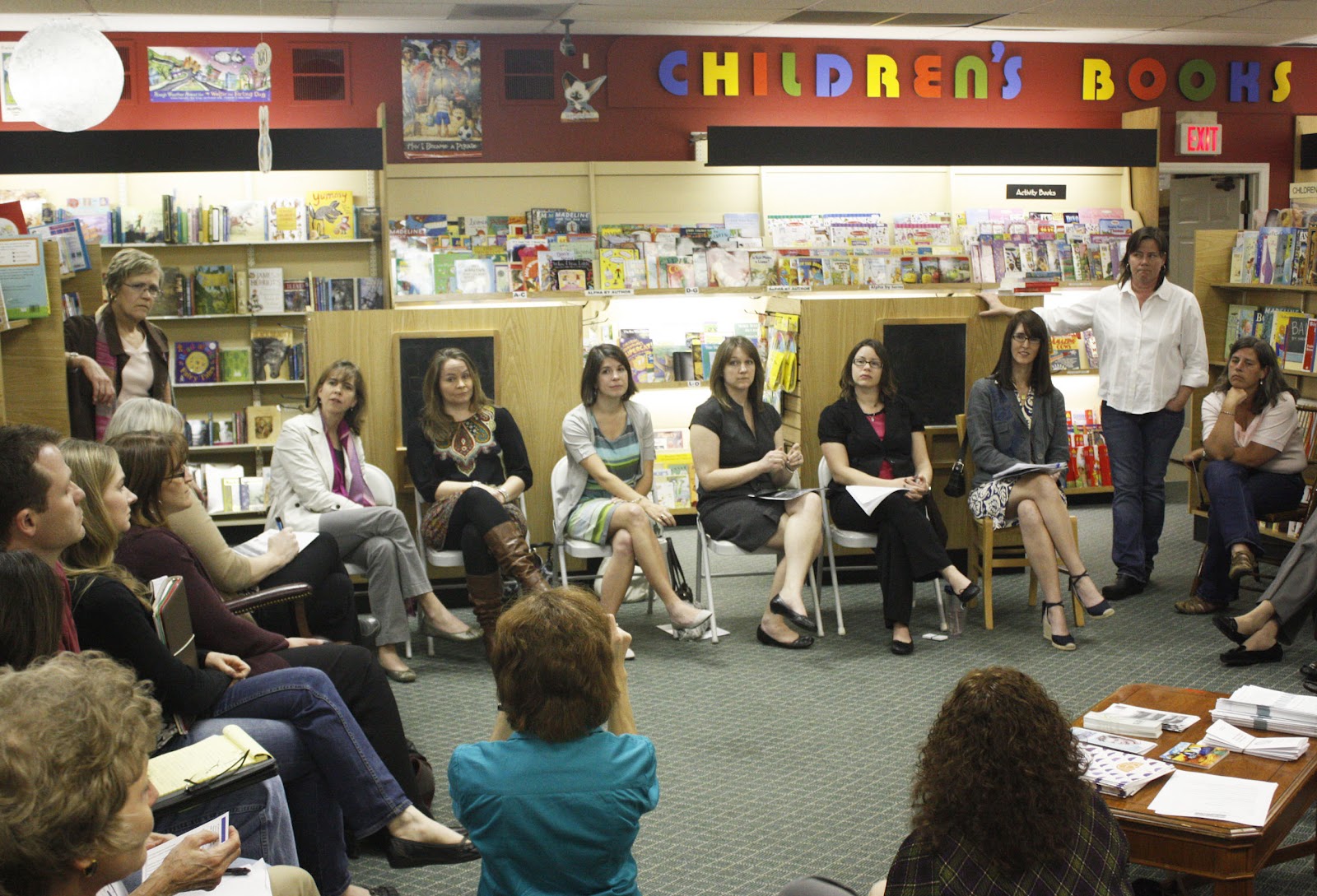
From left to right: (standing) Susan Walker, Quinlan Lee, MaryBeth Whalen, Carin Siegfried
Angela Harwood, Amanda Phillips, Nancy Clare Morgan, (standing) Sally Brewster
photo courtesy of Daniel Coston
www.danielcostonphotography.com
Recently the Charlotte chapter of the WNBA hosted a soup-to-nuts panel on the publishing industry. The panel was moderated by chapter president, Susan Walker. 

Quinlan Lee, an agent with Adams Literary, serves the children’s and young adult market. She defined her job as a matchmaker. “I dig for gold all day long,” she said. She finds authors and illustrators and matches them with editors. Despite the fact that the agency receives 7000 manuscripts a year, and each agent only signs about ten new clients a year, she encourages writers to “beat the odds!” In her spare time, Lee goes into the local Barnes and Noble store and re-shelves Adams Literary books so that their covers are facing out.

Marybeth Whalen, author of She Makes it Look Easy and The Mailbox, advised writers to “work on your hook!” In her book, the mailbox was an inanimate object that drew people together; an idea which editors latched on to. When asked how much an author can estimate to earn she said, “Authors can figure they get about a $1 a book. For me, it’s either this or WalMart. I feel blessed to be writing from home rather than taking on a part time job.” 

Carin Siegfried is a freelance editor with Carin Siegfried Editorial who also has worked at St. Martin’s Press. She shared how many professional readers and editors, as well as members of the marketing and sales departments, weigh in on manuscripts.  Books are often shopped around to several publishers before acquired. Confessions of a Sociopathic Social Climber made the publishing rounds for four years before being purchased by Carin at St. Martin's. It went on to become a NY Times bestselling book and a television film starring Jennifer Love Hewitt and Joey Lawrence. 

Nancy Clare Morgan
brought her expertise as the former Publicity Manager with Random House, Inc. to the panel. As a publicist she always thinks about how to get free media attention for a book. A publicist asks the editor, “What make this book stand out?” She asks the author:

  • What inspired your book? What are its talking points?
  • What pre-marketing work have you done?
  • What is your media profile?
  • Who are your contacts?
  • Do you know any bookstore owners?
  • Do you have an Internet/social network presence?
  • Who should get the galleys and review the book?


Morgan advised authors to be involved, respond to all fan mail, and be ready to create a “Media fire storm” the week your book comes out. 

Angela Harwood, the VP of Sales and Marketing at John F. Blair Publisher spoke about marketing. Her days consist of working on databases and Excel worksheets; she typically works on a book six to twelve months before it is scheduled for release. “We have hoops to jump through to make a book available; we want to make sure that it’s for sale everywhere there’s a potential audience.” She works with the author to develop a marketing plan and agreed with Morgan about the importance of an online presence, a significant fan base, and potential readership before a book comes out. 

Amanda Phillips is the MarComm Manager at wholesaler Baker and Taylor. This well-known distributor buys books from publishers and resells them to schools, stores, and libraries. “This streamlines the ordering process for the buyer,” Phillips said. “We also offer collection development service, e-commerce solutions, as well as additional advertising.” The company also generates preorders, which helps publishers decide how many books to print. Distributors such as Baker and Taylor also foster relationships with niche stories such as Michael’s or other specialty markets. 


Independent bookseller, Sally Brewster, hosted the event at Park Road Books. “Book publishing is the weirdest industry in the world—but we do it because we love it,” she said. She encouraged writers in the group to keep writing and to remember that publishers don’t want to publish just one book; have at least two or three ideas ready. Her store is one of the few in the country that carries self-published books. “I want to give writers a chance.” Although she agreed with other presenters that traditional book tours might be dead, an author who takes the time to talk to a bookseller will find that her books will be more likely to be recommended and sold. 


The next meeting of the Charlotte WNBA chapter is on April 9 and will feature SCBWI Crystal Kite winner, Monika Schroeder.


Tuesday, August 11, 2009

Target Your Book


If you've never published a book, you might not realize the behind-the-scenes effort that goes into getting your book into the hands of potential readers. Beyond the traditional methods such as catalog sales or book reviews in respected journals, my e-mail box is always full of other suggestions from fellow writers: You Tube trailers, networking on Facebook or Twitter, how to create virtual library visits through online chat rooms.

An article in this morning's paper provided a new venue for aspiring authors: try selling your book at Target. The column, "Target Can Make Sleepy Titles Into Best Sellers" first ran in the NY Times on July 21. The author, columnist Motoko Rich, sites the runaway success story of "Sarah's Key." This story of an American journalist who investigates the 1942 roundup of Jews in Paris, was written by first-time novelist Taitiana De Rosnay. Sales were less than noteworthy until a committee of Target employees recommended it as a Bookmarked Club Pick.

The result? The publisher, St. Martin's Press, has sold 145,000 paperbacks which were produced exclusively for Target. The ordinary paperback edition has sold an additional 200,000 and it has spent months on the New York Times trade paperback fiction best-seller list.
Unlike a chain bookstore such as Barnes & Noble which carries about 200,000 titles in each location, Target only offers 2,500. Rich says, "By assembling a collection of books by unheralded authors, Target behaves more like an independent bookstore than like a mere retailer of mainstream must-haves..."

I find this thought intriguing. Here are employees of the nation's #2 discount store reading and selecting books which may have been neglected by major reviewers. Books which, if the numbers are correct, are hugely popular among mainstream readers.

It makes me wonder. Can I get my book about a fragile friendship between a 13-year-old white girl and a 14-year-old light skinned African American girl in the South in 1950 into this committee's hands? It's something to target.
Technorati Tags:
, , , , ,

THE NIGHT WAR: A MG Historical Novel Review

  By now you should have received an email from my new website about my review of THE NIGHT WAR by Kimberly Brubaker Bradley. (It'll com...