Showing posts with label writing across the curriculum. Show all posts

Monday, July 31, 2017

SmartARTS: Art Integration in Greenville, SC

Congratulations to Sandra Warren who won "JUST FLY AWAY" from last week's giveaway.


********

Some of you have seen my previous blogs about how I'm getting involved in the arts community in my new hometown, Greenville, SC. Today you'll get a glimpse into an amazing arts integration program sponsored by the Metropolitan Arts Council


When I first moved to Greenville, I looked for opportunities to teach writing and was excited to discover the Council's program of training artists to work with teachers in the classroom. An organization committed to enhancing content instruction through the vehicle of visual arts, drama, music, dance and writing? Sign me up! Based on my enthusiasm (and maybe because I wrote Teaching the Story: Fiction Writing in Grades 4-8), Gayla Day, Director of Arts Education, asked if I wanted to attend their summer training. That's like asking if I love chocolate!

Last week I participated in my first SmartARTS Institute, a four-day instructional event for teachers and teaching artist candidates. Our first day we considered the inquiry question, "What is Arts Integration?" True to the emphasis on experiential learning (students learn content more effectively when they are active physically, mentally, and emotionally) we were given a variety of tasks to perform. One activity was answering with a team "What is Arts Integration?" by ONLY considering sensory information. (My contribution was that it was like a smorgasbord or stir fry. The texture person thought it was like layering fabrics or weaving metal pieces into cloth). In small groups, we created tableaux to answer that same question by using only three words and one phrase: Noun, Verb, Adjective, and Prepositional Phrase. 

The dance class introduced us to a variety ways of moving through space using various body parts and then we choreographed small dances out of tableaux. In a group of four, two students received locomotion cards (examples: hop, gallop, slither, skip) and two non-locomotor (examples: whirl, explode, rise, jump). Our task was to first order the words and then create a tableau going from one word to another. Our group ordered reach, close, creep, and hustle. I'm proud to say we were the only group that created a story: a burglar reached for a open window, closed it, crept, and then hustled away. What a way to teach vivid verbs!

Tuesday we attended theater and music immersion workshops, as well as a session entitled "What is Inquiry?" 
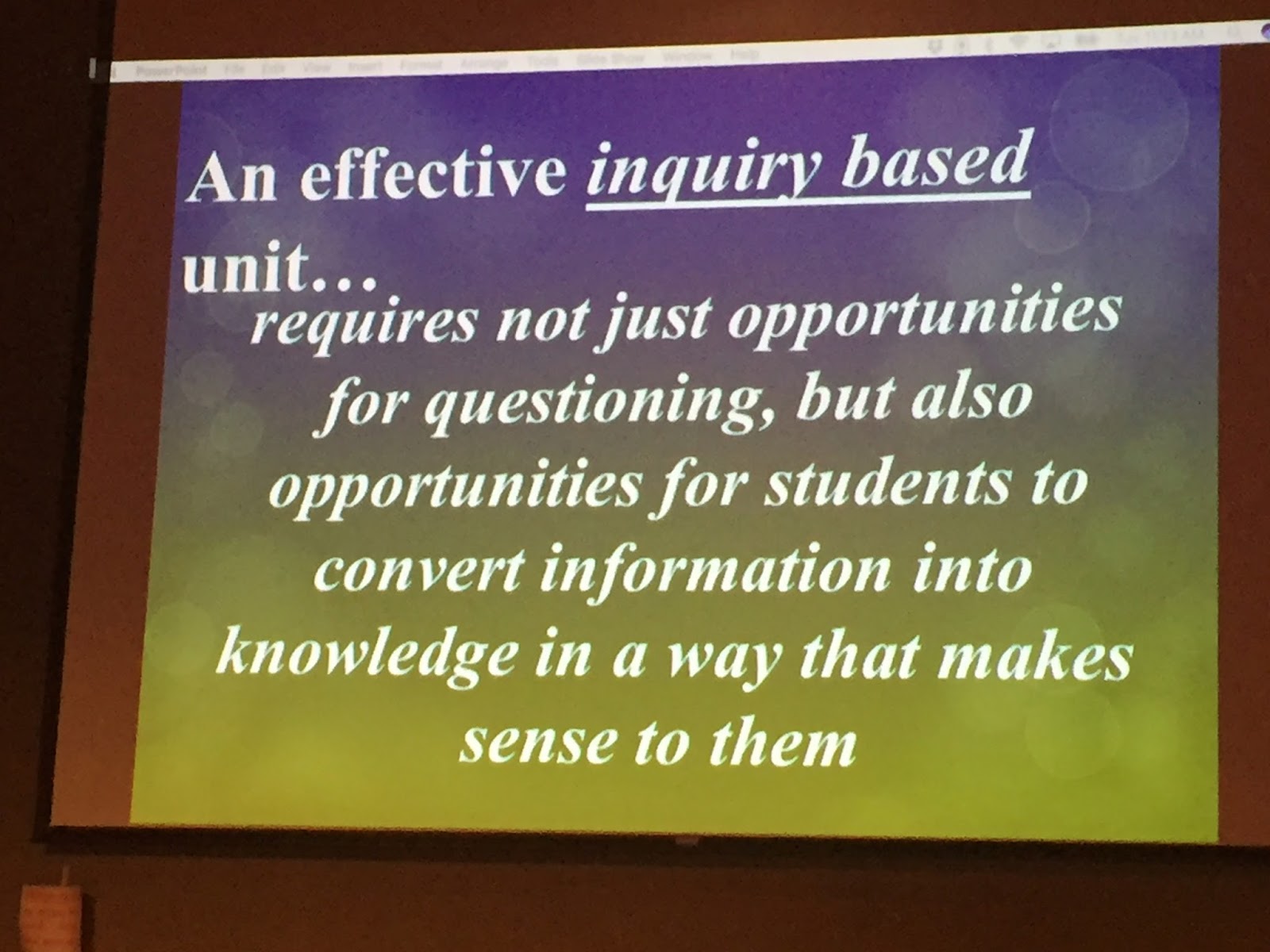


We watched a powerful powerpoint about Hurricane Katrina and in groups of four created tableaux that showed what it looked like before, during, and after the storm hit. 

Here is one group's interpretation of during:


And after. 


After written reflections and group sharing we found out that the inquiry question for our "unit" had been, "What is community?"

We made books on Wednesday in the art immersion:


I enjoyed seeing the variety of ways the teachers covered their papers with color.  The facilitator's instruction that "there's no right or wrong" freed us all, even as we considered the elements of art we incorporated.


 Our instructor showed us how to fold, cut, and glue the 18x24 watercolor paper.

The end products were as diverse as the teachers themselves. The books could be used as a journal for a field trip, a repository of poems or stories, or a collection of recipes.

Throughout the art immersion classes the instructors gave examples of how to integrate their discipline into content areas. I heard about teaching fractions and a number timeline through music; how the Pythagorean Theorem could be applied to imagining, conceiving, and building a structure that would withstand an earthquake; how dance movements could teach South Carolina history; and how poetry could be used to explain science and reflect on history (think: layering meaning about light and dark times in history with the upcoming solar eclipse.) 

I watched Vera Gomez, the poet who I will shadow this fall, teach the writing immersion and then plan a unit with a second-grade teacher. I was impressed with how she responded to the teacher's goal (showing her students how to include more details in their writing) with a wide variety of written, art, and dramatic activities that will meet second grade standards.  


In the role of student, I learned and practiced new concepts. I considered other art disciplines that will invigorate me as a writer. And I'm about to enter a new phase of teaching writing: becoming a teaching artist in the classroom. My brain is stuffed with new ideas that keep me awake at night.

I'm pumped! 


Tuesday, September 7, 2010

Science in a 17-Syllable Setting

Science, poetry, and short stories. You might not ordinarily put those three together in the same sentence, let alone in the same curriculum. Here is a suggestion that could be used in your language arts or science classroom.


On a recent drive at dusk from North Carolina into Tennessee, I saw beautiful gray clouds that resembled feathers. They reminded me of arrows and as night descended, I began playing with the image, wondering how I could use it in a poem. Since I couldn’t get beyond the clouds themselves, I thought it might make a good haiku. Here is the first result:

Gray feathered clouds

shot from hidden bow. Puncture

blood-red dying sun.

In Teaching the Story I discuss how setting should help create a story’s mood. The same can be applied to poetry. Since I used a metaphor and compared the clouds to an arrow, the verb “puncture” followed which led to the creation of a dramatic, violent setting with an ominous mood.

Could I change that mood? Here is the second haiku:

Gray feathered clouds

line rose-kissed skyscape. Blue

hills embrace twilight.

I started with the same prompt but instead of a setting which reflected war and destruction; I created a soft, romantic mood by using the image “rose-kissed skyscape,” and using personification by suggesting that the hills “embrace” the twilight. The haiku format forced me to choose verbs and adjectives which enhanced each specific mood.

Since I didn’t take a picture of the clouds, when I decided to write this blog I googled “gray clouds + feathers” to search for an illustration. Although I didn’t find a picture of the clouds that streamed over the Smokey Mountains, I discovered that these clouds are called cirrus virtebratus—and were an identifiable subspecies of Cirrus clouds.
Photo by Michael Grossman, taken in Germany

Suddenly, my interest in clouds sky-rocketed (forgive the pun!) and I began wondering about other clouds outside the car window. Science exploration had begun.

You can do the same. Use a visual prompt in your classroom, either from pictures your students bring in or from a website like Google images. Exercise muscle words, play with verbs, and brainstorm moods.

Science, poetry, and short stories. Why not?

technorati tags: writing across the curriculum, haiku, clouds, cirrus virtebratus, Exercise Muscle Words, Teaching the Story: Fiction Writing in Grades 4-8


del.icio.us tags: writing across the curriculum, haiku, clouds, cirrus virtebratus, Exercise Muscle Words, Teaching the Story: Fiction Writing in Grades 4-8


icerocket tags: writing across the curriculum, haiku, clouds, cirrus virtebratus, Exercise Muscle Words, Teaching the Story: Fiction Writing in Grades 4-8


keotag tags: writing across the curriculum, haiku, clouds, cirrus virtebratus, Exercise Muscle Words, Teaching the Story: Fiction Writing in Grades 4-8

Friday, July 16, 2010

Thinking Out Loud on Paper

There are books that you read and wonder, "Why didn’t I think of this?"  Thinking out Loud on Paper: The Student Daybook as a Tool to Foster Learning   (Heinemann, 2008) is one of those books. 

Used in all grades, the daybook is a marvelous way to hook students in all subject areas to "think out loud" through writing. I resonate with the concept since it fits with my own experience as a writer. I remember things better when I write them down and I process my thoughts and experiences by writing about them (as readers of this blog know!). Now with my own daybook, I have a place to keep my random thoughts and jottings all in one place.

The book is co-authored by five members of the UNC Charlotte Writing Project. As such, each author has contributed his or her experiences with using daybooks personally and in the classroom. The result is an easy-to-read guide on how to implement daybooks. Chapters include how to organize, sustain, and assess the books; as well as the advantages and disadvantages of going digital.  

From the introductory chapter, the authors explain their thinking. "Daybooks have helped us foster ways of learning that allow students the space and freedom to be silly and messy, to be thinkers and writers just for the sake of thinking and writing, to be miners of their thoughts even if just to dig out a golden line from something that they read....The daybook breaks down the typical disconnect that occurs in schools: disconnects between theory and practice, between one grade and the next, between one subject and another, and between the way people really learn and how we often feel obligated to make our students learn in very specific and predetermined ways."  (p.1, 2)

This book takes the simple, ordinary composition book and elevates it to a position of central importance in the classroom. More than a journal, it not only is a way for students to record random thoughts which they might use in a poem, essay or story; but is also a place to store favorite quotes ("golden lines"),  new vocabulary words (which they pick and share with their peers), questions for book discussions, revision strategies,  focused quickwrites, maps of complex texts, metawriting musings, as well as "ordinary" writing assignments. 

One invaluable aspect of the daybook is how students reflect upon patterns and themes they discover in their own writing. As Karen Haag, one of the authors writes, “A key component of daybooks is self-assessment. By having their thinking in one central place, students can refer back to their ideas through the year. Writers look back over the pages and see progress…I ask my students to reflect on what is happening in their daybooks and document what they see. Students build this reflectiveness over time through daily, weekly, and quarterly assessments. These assessments become as important for growth as the work itself.” (p.85)

Using the daybook concept, teachers are creating creative and inquisitive writers.  As a result, these students go into standardized testing with confidence and smiles. “Becoming a writer and feeling the joy of writing is how we spend 99 percent of our time. Only 1 percent of our time is spent on the test—and in that time, we are showing them that they already know everything they need to know.” (p. 46)

To sum it up: “Daybooks make visible students’ thinking and learning.” (p.61)

Now, why didn’t I think of that? 
Technorati Tags:

Friday, March 26, 2010

Reading & Writing Across the Curriculum


One of my popular workshops at teachers conferences is "Writing Across the Curriculum: How Short Fiction Supplements Science and Social Studies Instruction." In one hour I review the main elements of short stories and read from mentor texts which exemplify well-written characters and settings. We discuss how language arts teachers can collaborate with social studies and science teachers to help students write a story taking place in another country or time period, or one that includes scientific facts.

During the workshop I assign the teachers a writing task. I give them reproducibles from my book, Teaching the Story, and ten minutes to brainstorm a character from another time or place, and another ten minutes to begin developing a scientific setting. These teachers at the North Carolina Reading Association Conference, several of whom serve young adults in the juvenile justice system, enjoyed the activity. One said that it was the most useful workshop she had attended in two days, another wished it had been longer (a frequent "complaint,") and a third said he would try it in his world history and US history classes.

Here are some examples of what teachers at the Virginia Gifted & Talented Conference wrote during this same workshop:

SOCIAL STUDIES EXAMPLE #1
"As the night wore on, she continued to walk; exhausted by the miles behind her, yet encouraged by the thoughts of her final goal…freedom! She got her bearings from the Drinking Gourd and reflected back on the letter that started this journey…

Dear Brother,
I cannot believe that the purveyor of our goods was, in fact, a Negro man by the name of Thomas Bethune."

by Elizabeth Bourie, Norfolk Public Schools; Martha Nicholson, Alleghany Count Public Schools; Anne H. Moore Robious Middle School, Chesterfield County Public Schools.

SOCIAL STUDIES EXAMPLE #2
"Maria Rosetti takes a wheezing breath and hoists her grandson onto her lap. He goes gazes into her red-rimmed eyes and asks her why his last name is being made fun of.
Maria gazes into the distance and the memories come flooding back…

She is 11-years-old and still walking wobbly-legged from the month long boat ride from Italy to Ellis Island. She straightens her skirts and smoothes over the tatters. Maria feels the gap in her teeth from losing her back molar. She feels the rosary beads around her neck and gains strength from that. Glancing around, she makes sure her two younger brothers and sisters are following her parents and grandmother."

by Amanda Prettyman Rude

SCIENCE EXAMPLE #1
"Shortly before earth rise, the only thing they could hear was the sound of their breath from the re-breather. He had long since learned how to bound over the dusty surface in spite of his awkward suit.

Soon he was far from the safety of the dome and his destination loomed closer. Standing at the rim of the deep, dark crater, he gazed down at the wreckage."

by Jacqui Cecalupo , Holeymead Elmentary, Albermarle County; Liana Spring, Baber Buter Elementary, Albermarle County.

SCIENCE EXAMPLE #2
"He was 6’ 4” looming in the doorway, adorned with a large scary gun, his walkie-talkie strapped to his hip and a strange looking meter around his neck. The lead filled walls silenced the outdoors. As we settled into our seats, the quiet was punctured by an occasional electrical zapping- like a huge bug zapper for humans."

by Anne Moore, Chesterfield County Public School and CBG Teacher at Robious Middle School; Martha Nicholson, Allegheny County Public Schools; Elizabeth Bourie, Gifted & Talented for Norfolk Public Schools.
********************************************************
Teachers are frequently amazed at the ideas which they generate and agree that writing short fiction would reinforce language arts, social studies, and science skills. For more information on this topic, see the most recent issue of Talking Story, where Joyce Hostetter and I highlight several books and activities which reinforce reading and writing across the curriculum.
Technorati Tags:

Friday, June 26, 2009

Wikis & Writing Across the Curriculum


What could be a more engaging way to reinforce science and social studies facts (and to simultaneously stretch under-used imaginations) then to teach students how to write short stories that incorporate either scientific, historic, or cultural data into fiction? Yesterday at NWRESA, I taught a group of North Carolina teachers how to create and use wikis as a tool to accomplish this goal.

These are the wikis which they collaborated on. As you look through them, realize that these are "works in progress" and that they were each created and assembled in under two hours. As we reviewed them at the end of the day, I was impressed with the way each group of teachers came up with unique historical characters and science-inspired settings. If a random assortment of teachers can generate these story starters, what could your students produce?

As you navigate through these wikis, click on the blue hyperlinks. These are links which the teachers embedded to websites or other pages within their wiki.

http://ashleytrivette.pbworks.com/

http://frazierscience.pbworks.com/

www.wikhump.pbworks.com

http://rountreeclass.pbworks.com/A-Trip-through-the-body

http://mv6eagles.pbworks.com/Social-Studies-Character

http://evasreadingclass.pbworks.com/A-Soldier's-Dream

http://birdlady11.pbworks.com/George-Cousins

http://mrsklutzmusic.pbworks.com/Rockin'-Rollin'-and-Readin'

Part of my pleasure in training teachers is to watch them get excited about new concepts to use in the classroom. These teachers used a feedback form in which they answered, "I came expecting...." and "I got....."

One teacher wrote, "I came expecting something that would not help me in the classroom;" and "I got a thoroughly developed higher order thinking activity that I will use extensively."

Another shared, "I came expecting nothing;" and "I got a useful way to encourage students to write."

A third said, "I came expecting to read stories and write about them in some way;" and I got a great tool that I can use in my self-contained EC room."

I was pleased that several teachers valued the hands-on experience of learning a new technology tool which they could use to develop writing skills across subject areas.

As you look through these wikis I hope you will find ideas for how to start a wiki of your own. Feel free to contact me at cbaldwin6@carolina.rr.com for information on a writing workshop using wikis in your school or district. Technorati Tags:
, ,

Monday, December 29, 2008

Aleutian Sparrow


Karen Hesse, known for the award-winning free verse book, Out of the Dust, used the same poetic style to write this poignant description of the effects of World War II on the Aleutian Islands. As a fan of historical fiction, I probably wouldn't have considered using poetry to tell the story of the displaced Aleut people. But Hesse, using the voice of the young girl Vera, paints a complete picture of displacement, suffering, and homelessness with sparse language and beautiful imagery.

Her poems speak for themselves:

"Leveling the World of the Aleut"

We hear the white people at the Institute talk. They say

whenever the fog clears over Attu and Kiska,

American fighter planes race out to the very end of the

Aleutians, releasing their bombs on the Japanese

intruders.

I tremble beside Eva, imagining American bombs dropping

like deadly seeds on our emerald earth.

"Oh, Eva," I say, "the bombs are taking root in our place."


"The Value of an Aleut"

Pari and I want to go out and gather the dead grass,

To light a cooking fire outside the tent.

This is the Aleut way. On the chain there are no trees,

Driftwood is scarce:

We make fires from bundles of dry grass.


The man from Indian Affairs

Stitches his net around us:

Aleuts go nowhere without permission, he says.

Aleuts go nowhere.


And we submit.

We stay in a bundle at the Institute.

But our dreams are ravens

Flying west over Shoemaker Bay.


Aleutian Sparrow would be a great supplement for upper elementary and middle school students who are studying the Pacific Theater of Operations in World War II or the Aleutian Islands. This would be an opportunity for Social Studies teachers, who want to integrate literacy practices into their classrooms, to point out Hesse's use of figurative language. The disconcerting image of bombs planting seeds in the first poem, and the metaphors of bundles and nets in the second, are examples of topics that could promote discussion and prompt poetry writing in the history classroom. Recommended for ages 10-14, this book is also available through Listening Library. Although I enjoyed listening to it, students who are studying Hesse's poetic devices should read the hard copy. (Simon & Schuster Children's Books, 2003)

Technorati Tags:
, , , , ,

Monday, June 23, 2008

A Tale of Two Swamps


Last week my husband and I biked the Tunnel Hill trail, visited the Cache River State Natural Area, toured the Barkhausen Wetlands Center and ended by walking along the Heron Pond Boardwalk through the wetlands swamp of Southern Illinois. This past week, 1100 miles away, we walked along a boardwalk through the wetlands by the banks of the Yampa River in Steamboat Springs, Colorado. Two communities linked by their desire to preserve the ecological balance that development threatens— and yet worlds apart.

Here are a few pictures of the Illinois swamp--some of the cypress trees have been living here for 1000 years. Walking the length of the boardwalk through these wetlands was like walking through a Tolkien-like landscape. I wouldn't have been surprised to see a hobbit perched on one of the conical "knees" which are part of the cypress trees' root system.

Now take a look at these shots- taken about 8000 feet higher in the middle of the Rocky Mountains. The pictures look out from the wetlands to the snow tipped mountains in the distance. Cottonwoods and wildflowers replace cypress trees; a free-flowing river replaces a forested swamp.


Although most of you won't have the opportunity to take your students on field trips to observe such contrasting landscapes, you can visit many of them online. Beyond an interesting compare and contrast essay, what other activities can language arts teachers cull from field trips such as these? If you're committed to writing across the curriculum, then the possibilities are endless. Consider a few ideas:

NONFICTION:

Travel brochure
Persuasive letter to a legislator supporting
relevant legislation
Blog with uploaded pictures or movies
Power point presentation
Design a game

FICTION:

Fantasy --What type of creature might live here? What problems would he/she experience as a result of living in this setting/environment?
Historical fiction--Who or what used to live in this area of the country? What made survival difficult?

CREATIVE:

Poetry (shape, haiku, limerick, free verse)

Puppet show

Picture book

If all else fails, you can ask your students to peruse a list of young adult books such as this one, or a classical literature list such as this one and find a title that relates to their field trip(s) which can be creatively renamed and voila´- they'll have something catchy like, "A Tale of Two Swamps."

E-mail me if you have other ideas of how to correlate science, social studies, and language arts. I'll post a blog for other teachers to use.

Technorati Tags:
, , , , ,

Friday, January 25, 2008

From the Mountains to the Sea


Two weeks ago I was in Cullowhee, NC for the NCCAT seminar; today I'm in Kiawah, SC presenting at the South Carolina Council of the Teachers of English. Believe it or not, it is colder along the coast of South Carolina than it was in the mountains! Such is the unpredictability of Carolina weather. Highlights of this conference have been:

  • The genuine warmth and hospitality of the SC teachers. They are an enthusaistic group of educators.
  • Meeting Art Young, the keynote speaker and one of the leaders in the field of Writing across the Curriculum. This morning he addressed the links between reading, writing, technology, and conversational learning. I was fascinated by the interaction of SC high school students; Clemson University students; and Sweden's Chalmers University of Technology students as they read T.S. Elliot's "The Love Song of J. Alfred Prufrock" and discussed it through a blog. What a remarkable way for students to think critically and be challenged by students from other peer groups and cultures!
  • Meeting a friend of Julie Graddy, Maupin House's publisher, from 30 years ago when they were friends in Gainesville, Florida. I sat next to her at lunch and within 3 minutes we'd found a connection. Small world.
  • Signing Teaching the Story—always fun!
  • Learning more about wikis and blogs. Technology in the classroom, as many of you know, is staring us in the face. The second edition of Teaching the Story will have several mini-lessons on using technology to teach students how to write fiction. Stay tuned for more details!
  • Walking by the ocean at sunset, where waves combed the beach leaving tendrils of sand to be washed away in tomorrow's tide.
  • Finding a perfect miniature conch shell which I will save for my granddaughter, Ebby.

Saturday, November 10, 2007

On the way to San Antonio

Not only am I addicted to writing and blogging, but apparently I have a growing hobby of talking about literacy with the person sitting next to me on an airplane. Today, as I flew to San Antonio to visit family, I met a professor who formerly taught business management and business statistics at Northeastern Oklahoma State. When she discovered my passion for writing she said that she always told her students that, "When you leave here you'll have to be a writer and a reader or else you won't succeed in business." Quizzes regularly included questions based on their reading of the Wall Street Journal. When she taught college Algebra at Texas Lutheran, she always asked her students to write a research paper on a famous mathematician-- despite their groans and complaints.

Three cheers for writing across the curriculum--on the college level no less!

THE NIGHT WAR: A MG Historical Novel Review

  By now you should have received an email from my new website about my review of THE NIGHT WAR by Kimberly Brubaker Bradley. (It'll com...