Showing posts with label biography. Show all posts

Saturday, December 3, 2022

2 Picture Books by Shannon Hitchcock, 1 Giveaway

 If you've been following my blog for a while, you may remember my post on Shannon Hitchcock's book, Saving Grandaddy's Stories. I'm happy to share two more books that Shannon has written about unsung Appalachian artists. I love these books so much that I'm saving one for my granddaughter who I'm teaching to sew. 

The illustrator is mixed-media artist Sophie Page. Sophie used clay, fabric, paper, and wire to bring these stories to life. Both books are published by Reycraft Books.

As you read my reviews, notice Shannon's poetic text that emphasizes the importance of each word and Sophie's illustrations that show depth, color, and texture. Her images are like mini-stories.

REVIEWS


SHE SANG FOR THE MOUNTAINS: The Story of Singer, Songwriter, Activist Jean Ritchie.


The book opens with a simple line that says so much about Jean Ritchie.


Jean came from a large family who loved to sing while they worked. In the evenings, they rested on the porch swing and sang accompanied by their father's dulcimer.


Jean wished she could turn back time.

Her brothers and sisters left home one by one.
Finally, it was Jean's turn to go.


Jean taught the songs of the hills
to the children of the city--
songs that had echoed 
through the mountains for generations.
In the process, Jean was noticed by a song collector. 


Jean was far from the home she loved in Kentucky, but when she heard about companies that mined coal and then moved on--leaving men sick or unemployed--she realized that she wanted to protest too.


She sang about the unemployed coal miners and the strip mining that poisoned the water. 


Jean never stopped singing important songs which inspired others. Even when she was old and moved back to Kentucky, she kept 

singing for the mountains
and heard music everywhere.
                    ......

To this day, Jean's music lives on,
in the hearts of folksingers,
dulcimer players
and activists
who raise their voices and sing for the mountains.
The author's note includes more information about Jean. To hear her sing and play, click on this youtube video.


STORY QUILTS: Appalachian Women Speak


Here's the opening page that says so much:


The women had large families and worked hard. Their days were filled with cooking, cleaning, gardening, and canning.

Then, at day's end, they threaded their needles,
reached for their rag bags,
pieced colorful squares
and turned scraps into quilts that told stories.
Daughters watched their mothers until they were old enough to create a quilt of their own.

Sometimes, the daughter watched her mother pull out scraps from an apron that once looked like this:


Blue was special because,


Scraps of pillowcases became clouds or snow; other scraps became wildflowers.


She would move her quilt squares like puzzle pieces,
until they told a story.


The author's note includes Shannon's inspiration for this beautiful story of forgotten women. Sophie lists some of the quilters who inspired her illustrations.

Shannon is giving an extensive interview--plus information on her next book in this series--on the Talking Story Facebook page on Monday. (Not a member? Click on the link and ask to be admitted and you'll be in!). But she told me that she is drawn to writing about the past because she grew up on a farm in the foothills of the Blue Ridge Mountains. "We lived primitively compared to lots of families. My grandparents were farmers. They raised cows, pigs, and chickens. My grandma churned butter, had a large vegetable garden, canned, and quilted. Writing these books reminds me of home and a way of life that I want to preserve in my stories."


GIVEAWAY


If you have never won a book from my blog or are a new subscriber, I'll put your name in twice for SHE SANG FOR THE MOUNTAINS. Make sure you leave me a comment by December 7 with your name and email address if you are new to my blog.

Eileen Heyes entered last week's giveaway and told me that since she didn't have any "littles" in her life to give it to a library. Per her request, I gave Christmas with Auntie to Matthews Elementary School. Congratulations to Barbara Younger who won Miss Mary's Mittens


Thursday, June 16, 2022

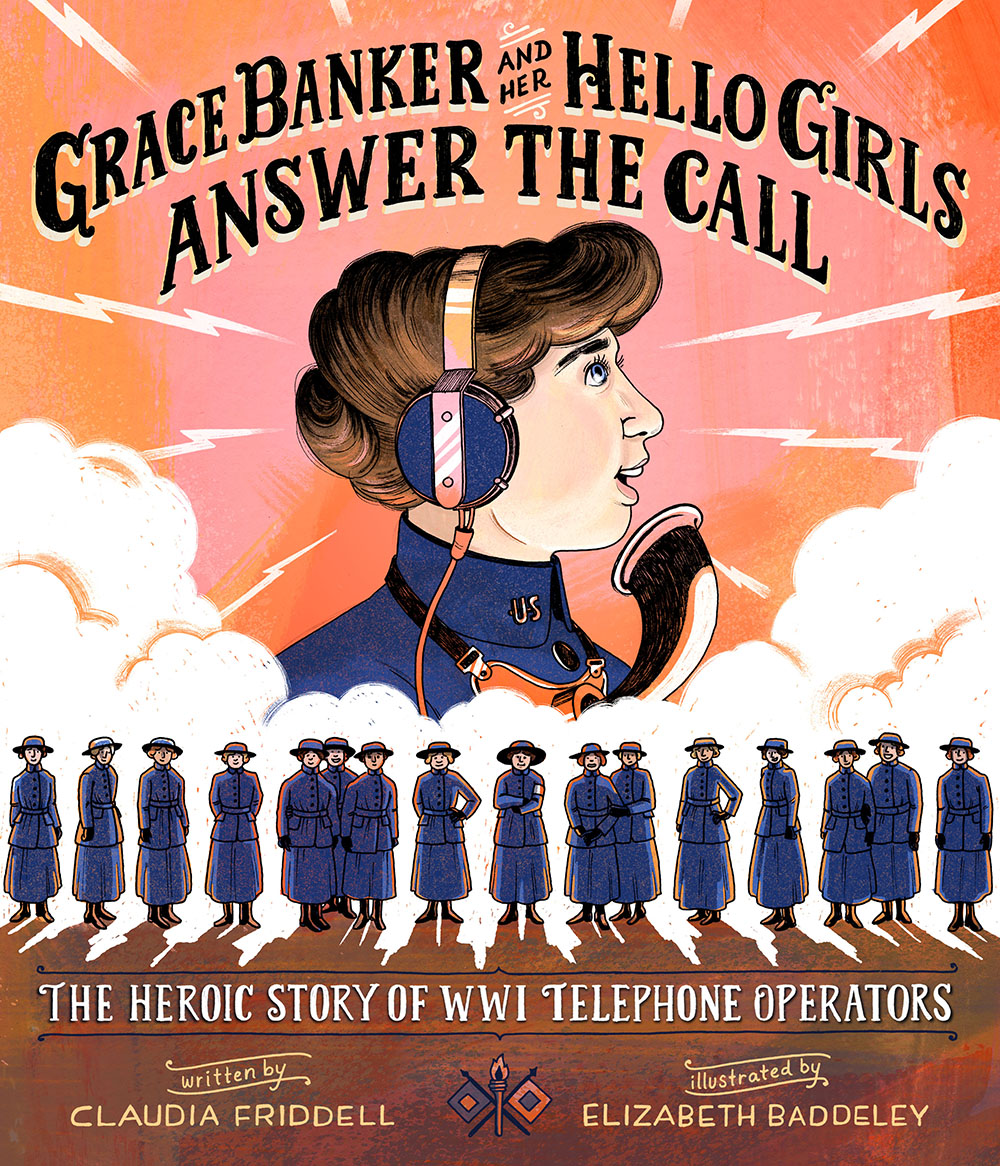
GRACE BANKER AND HER HELLO GIRLS ANSWER THE CALL- Part II. Author & Illustrator Interviews + Giveaway

 Last week I introduced you to Claudia Friddell's book, Grace Banker and Her Hello Girls. Today you're going behind the scenes on the story as well as learn interesting tidbits about the illustration process from the illustrator, Elizabeth Baddeley.  There is one thing that all of the nonfiction authors I have interviewed have in common: curiosity. Claudia's backstory is a great example of that!

AUTHOR INTERVIEW


CAROL: I understand that reading the book, The Hello Girlswas what prompted you to write this picture book. But what led you to that book? 

CLAUDIA: I found Elizabeth Cobb’s book when I was researching the story of Thomas Edison making up the word ‘hello’ to use as a telephone greeting. Elizabeth’s book The Hello Girls popped up and the blurb intrigued me so I preordered it. As soon as I got it, I read it in two sittings and was completely captivated by these remarkable women and their pioneering contributions to the military and our country which were unrecognized for 60 years. I thought Grace Banker was an inspiring leader and role model for kids today, so I decided to make her the subject of my kid-friendly version of the Hello Girls’ story. 


CAROL: Was it difficult tracking down Elizabeth Cobbs?

CLAUDIAI thought it might be tricky to connect with Elizabeth, but I very much wanted her to be my expert if she was willing. It was not difficult to find her academic email address so I wrote her. She was incredibly gracious and helpful. When I spoke to her on the phone she invited me to join her in Washington DC for the screening of Jim Theres’ award-winning documentary, also called The Hello Girls. (I recommend everyone see it.  It’s fabulous!) There, I did not only meet Elizabeth and Jim, but I connected with Grace Banker’s niece, Carolyn Timbie, who was an invaluable contributor for my book. She shared Grace’s treasure chest of WWI mementos as well as Grace’s personal diary which I incorporated into my text. 

Carolyn invited me to her family’s lake cabin that her grandmother Grace and her grandfather built before Carolyn was born. There, at the same table where Grace sat, I found so many treasures—one of which was the faded handwritten Soldier’s Poem that is included in the back matter. I think that’s proof enough that the male soldiers considered these female telephone operators who enabled battlefield communications to be US soldiers as well!


As an aside and shout out to the importance of research—a nonfiction author’s treasure hunt—while I was researching Edison’s ‘hello’ story, I not only found the Hello Girls’ story, but I also learned about the camping trips of Thomas Edison and Henry Ford that pioneered recreational camping. You never know what treasures you’ll find when you dig into history!

CAROL: That is so amazing and so true!

By the way, Claudia's next book from Calkins Creek (releasing in October) is Road Trip: Camping with the Four Vagabonds: Thomas Edison, Henry Ford, Harvey Firestone, and John Burroughs!


ILLUSTRATOR INTERVIEW


CAROL: What medium did you use?

ELIZABETHThe medium is a combination of acrylic paint and ink drawings that I composited in Photoshop and added more color to.

CAROL: It seemed like there is a patriotic color theme going on. Am I right?

ELIZABETH: The red-white-blue theme was not intentional. I did intentionally use blue because the uniforms were a dark navy. As for the red, I just like it and tend to use it a lot! 


Here are some notes about Elizabeth's research from the Artist's Note which is part of the Back Matter.

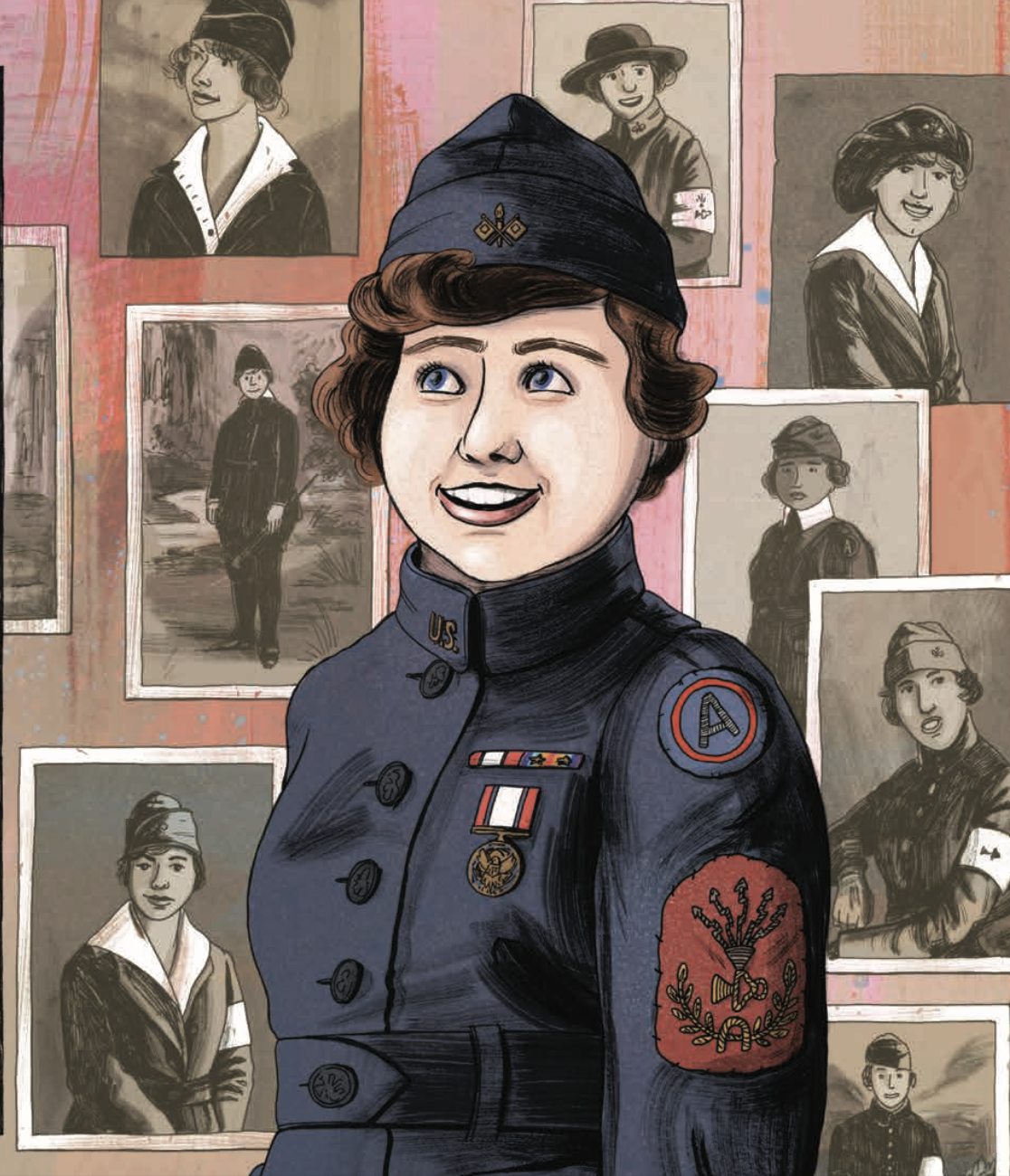
As it so happens, I live in Kansas City, Missouri--the home of the National World War I Museum and Memorial. When I first began working on this book, I paid a visit to the museum. They have everything you could possibly want to see related to WWI, but most importantly for me, Grace Banker's actual uniform and helmet! I was able to sit and draw her uniform standing right in front of me...I looked at photographs, postcards, and even diary entries before ever putting pencil to paper. I love to be creative and have fun getting messy with ink and paint, but the real work always starts with the research.

GIVEAWAY

Leave me a comment by June 20 to enter this giveaway. If you haven't already left a comment on the first blog, do so now and you'll have two chances! If you prefer, email me at cbaldwin6@me.com. U.S. addresses only. 

Wednesday, September 15, 2021

Without Separation: Prejudice, Segregation, and the Case of Roberto Alvarez- Picture Book Biography and Giveaway

I am happy to be part of the Calkins Creek blog tour for Larry Dane Brimner's new informational book, Without Separation


INTRODUCTION

Since I'm interested in writing nonfiction picture books, I've taken several webinars recently with The Writing Barn. (BTW, they're affordable and a fantastic way to learn a new genre!). The last one I took was with Liz Garton Scanlon on "Openings and Endings".

According to Scanlon, the opening of the book is a "promise to the reader. This is a story about a problem and we’re going to get to the end and it’ll be okay." After looking at several picture book beginnings, she showed how the ending brings the story full circle and fulfills that initial promise. In fact, if you only read the beginning and the ending of a picture book, you can guess what you might find in the middle. (Try it sometime with a picture book off your shelf. You'll be amazed at how this works!)

Why am I explaining all of this? Because that's what I found in Without Separation.

REVIEW

On January 8, 1931, Roberto was happy to go back to Lemon Grove Grammar School outside San Diego California.

His friends were happy to see him, but he and his Mexican friends were not welcomed by the principal. He told them that their teachers were waiting for them in the Mexican school on Olive Street.


As it turns out, in the summer of 1930, the board of trustees of the school district had met and complained about the Mexican children. They claimed that they held back the white students, were unclean, and a danger to the health of others. A decision was made to build a separate school--but no one told the Mexican parents.

Roberto and his friends refused to go to the new school which they called la caballeriza--the barnyard.  Roberto was a good student and didn't want to attend a separate school. His family agreed. The Mexican families met and recognized that the new school was meant to segregate--not to provide English language instruction. 

Roberto was chosen to be the lead plaintiff in the case against the school district. Roberto was perfect for the job: he had been turned away from Lemon Grove, was a good student, and fluent in English. His case could prove that the school board's justification for a new school was false. 


On March 11, 1931 a Supreme Court Justice of California ruled: "The Lemon Grove School District had no power to set up a separate school for Mexican children." 

Roberto had won! Not only was this a victory for him, but also for all the Mexican and Mexican American children within the school district. 


The story comes full circle. At the end, all are welcomed.

As I mentioned in the introduction, Larry Brimner fulfilled his promise to the reader. There is a problem that gets solved and in the end...everything is okay. 

CURRICULUM RESOURCE

This book can be used in 2-4th grade classrooms as classes discuss immigration, prejudice, and segregation. The Author's Note is geared towards older readers and goes into extensive detail about Roberto's case and the historical and geographical context of the court decision. In particular, the author mentioned that this ruling was cited as a precedent before the US Supreme Court made its historical landmark decision of 1954 known as the Brown v. Board of education of Topeka (Kansas).

The acrylic illustrations by Maya Gonzalez are vivid and colorful in keeping with Mexican art and Mexican folk art.


GIVEAWAY

Leave a comment by 6 PM on Friday, September 17 to enter. PLEASE leave your email address if you are new to my blog. In honor of National Hispanic American Heritage Month, if you are Hispanic let me know and I'll enter your name twice.

                                                    ****

Congratulations to Margo Jantzi, a librarian who took advantage of having two chances to win last week. She won June Almeida: Virus Detective from last week's blog.

Wednesday, June 9, 2021

DOROTHEA'S EYES: A Picture Book Biography and Giveaway

 I hope you are enjoying hearing about terrific curriculum resources as much as I am enjoying sharing them. It's a win-win! I learn about how to write an inspirational and informative nonfiction picture book, and you have a chance to win one! Today's selection, Dorothea's Eyes (Calkins Creek, 2016) features iconic photographer, Dorothea Lange, and is written by talented author, Barb Rosenstock with period-perfect illustrations by Gérard DuBois. In the text and illustrations, see if you notice something a little bit different about how this biography is written. (Note: The quotations in red are the way they appear in the book--that's not the answer!)


REVIEW

Dorothea Lange's grey-green eyes look at the world around her and sees "dimpled shadows scattering an orange peel. Swirled-pattern pricks in a walnut sewing table. Repeating rectangles of New Jersey row homes."


After her parents split up, her mother finds a job in a city library and Dorothea attends a school full of poor immigrants. She is Different and Lonely.

But, she is also Watchful. Curious. So, after school she,
spies into crowded tenements where fathers, home from peddling, read newspapers, and mothers wash dishes, clothes, and babies in rusty sinks--happy and sad mixed together. 
Dorothea pretends she's invisible all the time.


And all the time, Dorothea sees with her eyes and her heart.

As a teenager, she announces she is going to be a photographer. Despite her mother's resistance ("It...it isn't ladylike!") Dorothea gets work at photographer's studios and learns everything she can about cameras and darkrooms. 

She loves faces, but is restless to see places too. She sets off from New Jersey to travel around the world but stays in San Fransisco after her money is stolen. She starts her own portrait studio and becomes successful. She marries and has children. But, she keeps asking herself, 

        Am I using my eyes and my heart?

One day during the Depression she looks outside her window and sees men searching for work. She focuses on one man in particular:


                                Dorothea's heart won't let her stop.


White Angel Breadline, 1933 
Dorothy Lange Collection
Oakland Museum of California
https://artmuseum.princeton.edu/collections/objects/135245

Dorothea leaves her comfortable life and takes her camera on the road. She scans dirt lanes, peers down back paths, and squints up broken steps. Fathers stoop in fields, working for pennies. Mothers nurse sick children, lying thirsty in makeshift tents. Whole families in jalopies--blown out by the dust storms wracking the land.


Migrant Mother, 1936
Nipomo, California

"Of the 160,000 images taken by Lange and other photographers for the
Resettlement Administration, Migrant Mother has become the most iconic picture
of the Depression. Through an intimate portrait of the toll being exacted across the land, Lange 
gave a face to a suffering nation."
http://100photos.time.com/photos/dorothea-lange-migrant-mother


Her heart knows all about people the world ignores.

Dorothea doesn't just photograph the people she meets. She understands how ashamed and invisible they feel. For five years despite a leg that always hurts, she photographs people for the world to see. "The jobless. The hungry. The homeless."

Newspapers and magazines publish these pictures. Dorothea's eyes won't let the country look away. Her photographs help convince the government to provide parents with work, children with food, and families with safe, clean homes.

        The truth, seen with love, becomes Dorothea's art. 


BACK MATTER and CURRICULUM RESOURCE

As you may expect, the back matter is a rich collection of photographs, information on Lange, bibliography, and timeline. Click on these links for more resources: the Educator Guide and Barb's Pinterest Board.

Although this book is recommended for ages 8-12, I think high school students (and adults!) would also learn not only about a woman who followed her passion and made a difference in this country, but about the effects of the Depression. 

GIVEAWAY and ANSWER

Please leave a comment (with your email address if you are new to my blog) by 6PM June 9. Start following my blog and I'll put your name in twice. Continental U.S. addresses only. 

So, can you tell what is different about this biography? It might be hard from just a few quotes--but this historical picture book is written in present tense. Kudos to Barb Rosenstock for a creative way to write nonfiction!


                                                ****

Congratulations to Dee Romito who won OCEAN SOUP on last week's blog.

Wednesday, April 28, 2021

Lincoln Clears A Path: A Picture Book Biography

Congratulations to Kathleen Burkinshaw and Carolyn Frazier who won autographed copies of Halli Gomez's book, LIST OF TEN from last week's blog.


                                                                    *******

In Lincoln Clears A Path (Calkins Creek, 2021) a new picture book by talented picture book author Peggy Thomas, our 16th president's accomplishments are presented from a different perspective. Although he is known for his stance against slavery, how many students know about his agricultural legacy?  In a book well-suited for home and classroom libraries, readers from 7-10 years of age are introduced to the many other paths which Lincoln cleared.


The book opens with seven-year old Abe arriving in the middle of the Indiana wilderness. This was not a farm. Not yet.

His family got to work.


Along with his father, Abe felled trees, cleared brush, pulled stumps and plowed fields. At night he studied stars, math and poetry...Abe marveled at how the founding fathers--Thwack! Swish! Thwump Yah!--cleared a path for folks like him.

In New Orleans Abe saw how slaves were auctioned off and he wondered, Could anyone clear a path for them?

Back home in Illinois, his friends urged their talented friend to run for office. He was poor and uneducated. But his friends provided books to read, tutoring in math, and even a suit to wear.

In the Illinois legislature he cleared paths for better schools and more roads. He stood against slavery. "There is no reason in this world why the negro is not entitled to all the natural rights enumerated in the Declaration of Independence, the right to life, liberty, and the pursuit of happiness."

But soon after he was elected president, South Carolina seceded and the Civil War began (see this timeline for more information.)

In the middle of the war, Lincoln did something that was seemingly unrelated to the North-South conflict. He created the United States Department of Agriculture to support the farmers who were supporting the troops.


But that was not all.


With a stroke of his pen, he signed the Homestead Act and cleared a path west. "New free States are the places for poor people to go to and better their condition," he wrote.


Then he signed the Pacific Railway Act and cleared a path across the nation.


In addition, Lincoln created land-grant colleges which cleared a path for students to learn more about agriculture.

He cleared a final path when he signed the Emancipation Proclamation and created a path to freedom for slaves. 


By Lincoln, Abraham, 1809-1865 - http://www.wdl.org/media/2714/service/thumbnail/6000x6000/1/1.jpgGallery: http://www.wdl.org/en/item/2714/, Public Domain, https://commons.wikimedia.org/w/index.php?curid=31578413 

"'Liberty to all'....clears the path for all--gives hope to all." 

The onomatopoeia of the four words--Thwack! Swish! Thwump! and Yah! which repeat throughout the story will keep even younger readers engaged. The simple, yet profound message of what Abraham Lincoln accomplished is communicated through the text, his quotes, and interesting facts distributed throughout the book. 

Nine pages of back matter include highlights from Abraham's childhood and adult years; how the Civil War affected U.S. agriculture; and a bibliography. There is additional information about the four acts; the author made sure to show how Native Americans were unfairly impacted by these acts. 

I was particularly impressed with how Thomas discovered the theme by noticing Lincoln's phrase "clearing the path" in his writing. She writes, "Sometimes he was referring to the removal of rocks and stumps so a wagon could pass, but other times he was thinking about ways to remove much bigger obstacles like poverty, racism, and ignorance so that all Americans could lead a better life." She challenges readers by asking, "How could you clear a path?" 

Illustrator Stacy Innerst's sepia watercolors evoke an "old-timey" feel which lends a distinct flavor to this historical picture book biography. 

No giveaway this week! I'm saving this book for my grandchildren. 

Here is a short video by Carolyn Yoder, Peggy Thomas's editor at Calkins Creek.


Wednesday, July 29, 2020

Author Interview with Kirsten Larson + Another Opportunity to win WOOD, WIRE, & WINGS!

Congratulations to Rosi Hollenbeck who won OUR WORLD: A First Book of Geography. (Psst, children's writers, if you haven't discovered Rosi's blog, you need to head on over there. She is my west coast counterpart with book reviews as well as links to other great writing blogs.)

******

I started chatting with Kirsten Larson, the author of WOOD, WIRE, WINGS, about what led up to her writing about Emma Lilian Todd. Since so many of you were interested in this biography, I thought you would enjoy hearing Kirsten's publication journey and have another opportunity to win a copy. Boyds Mills & Kane was happy to oblige, so make sure you leave a comment at the end of this post along with your email address if you are new to my blog.


Without further ado, here is Kirsten!

CAROL: Tell us a little about your career. How did you go from working at NASA to writing children’s books? Would you also share some of your own childhood/teenage interests that prompted you to work with rocket scientists and become a writer? In other words, what about your life experiences led you up to writing a picture book?

Like Lilian, airplanes were in Kirsten's blood. Here she is
trying on her father's Air Force helmet. 

KIRSTEN: I’ve always been interested in science, though I never pictured myself becoming a scientist. I remember being enthralled by Sagan’s THE COSMOS in middle school and captivated with particle physics after writing a paper about neutrinos.

At the same time, I was always a journalist in some way, whether it was creating family newsletters with hard-hitting headlines like “Family Goes to the Dentist”, reviewing movies for the local paper in high school, or working at the college newspaper. 

When I got an internship in public affairs at NASA in college (where I studied both history and English), all my interests came together. Explaining complex science and engineering concepts to the news media and the general public was great practice for explaining them to young readers.

CAROL: How did you research WOOD, WIRE, WINGS?

KIRSTEN: Normally I start my research by reading secondary sources about my subject. For me, I can better understand primary sources when I can fit them into some kind of context. I use those secondary sources to point the way to primary sources, and I am always thankful for books filled with footnotes, indices, and bibliographies. I find primary sources most helpful for hearing my main character’s voice and for providing sensory details needed to build scenes. Primary sources aren’t always reliable for facts like dates, for example, and I always look for corroborating sources.

With that said, my process for WOOD, WIRE, WINGS was different. There really weren’t any secondary sources about Lilian Todd specifically, just a few pages in a biography about her funder, Olivia Sage, and a mention of Lilian in a history of the Aeronautic Society in New York, of which she was a member. So while I say my normal process is to start with secondary sources, with Lilian I had to start with newspaper and magazine articles from the early 1900s, which is where I found the bulk of the information about her. At the same time, I read secondary sources about the early history of flight to gain a broader understanding of the period and how Lilian’s work fit into it.

CAROL: Why did you decide to write about Emma Lilian Todd?  

KIRSTEN: In 2014, I was exploring an idea I’d jotted down in my writer’s notebook: Rosie the Riveter. I had a stack of books from the library including Andrea Beaty’s Rosie Revere, Engineer, illustrated by David Roberts, which included Lilian Todd in a list of female aviation firsts. Though I have lived and worked around airplanes my entire life, I had never heard of Lilian Todd. Nor had my husband, an early aviation buff. I knew I had a story.


In Kirsten's first job after college, she traveled to air shows like
the Reno Air Races to talk to the public about NASA and its aviation programs.
It was good training for writing a picture book
about airplanes!

CAROLHow many drafts did you write? How long was it from inspiration to publication? 

KIRSTEN: After six months of research and writing, I had a solid draft. In response to critiques from my critique group and professionals, I continued to revise the draft over the next couple of years.  The book underwent so many revisions over the years, it’s really difficult to count. You can see some of my other opening lines here. I even wrote it as a middle-grade historical fiction (only a chapter). Just like inventors, writers never get things right the first time. We have to keep tweaking.

CAROL: I love that comparison--I totally agree! Do you belong to a critique group? If so, what part did your critique partners play in your journey?

KIRSTEN: I am in two critique groups — one focused on nonfiction, and another focused primarily on picture books. I can’t overstate the importance of having good critique partners. No matter how practiced you are, there’s always a gap between what you think you wrote, and how it comes across on the page. Critique partners help you find these gaps. And occasionally, when you can’t figure out a way to fix things, they can help spark new ideas and ways forward.

CAROL: What were the bumps in the road for you?

KIRSTEN: Sure, I’ve had plenty of bumps. Rejection is the lifeblood of book creators. WOOD, WIRE, WINGS sold only after a revise and resubmit from my fabulous editor, Carolyn Yoder at Calkins Creek. And even then I revised it again after it sold, and one more time after we had Tracy Subisak’s dummy, and I could cut quite a few words. 

And then perhaps the biggest bump was the book released just before COVID-19 resulted in shelter-in-place orders across the country, which forced the cancellation of in-person events.

Yet, the bottom line is there are always opportunities for creators who are willing to remain flexible. I’ve been able to participate in events teacher and librarian events in Pennsylvania, Connecticut, and Missouri virtually, which I never would have been able to do in pre-pandemic times. Much of this has been made possible by partnering with other book creators, particularly the Soaring 20s debut picture book group. 

CAROL: Was it difficult finding an agent? Any recommendations on that process?

KIRSTEN: I got lucky and was working on a popular theme--women-in-STEM at a time that the market was hot. I sent this manuscript to six agents over a couple of years. (I queried a fiction STEM book too.) The first time I queried in 2014, my work was far from ready. By 2016 my work was much improved. The best resource I know of for querying is SubItCub.com. You’ll find excellent advice on writing queries, tracking queries, researching agents, and so much more. There’s also a Facebook support group.

CAROL: How did publishing your school and library books prepare you for writing and publishing WOOD, WIRE, WINGS?

KIRSTEN: They taught me not to be too precious with my words, to see editors as collaborators who could help me make my work stronger. 

CAROL: Are you a member of SCBWI? If so, how has that been a part of your journey?

KIRSTEN: I’ve been a member of SCBWI since the beginning, and especially value the regional conferences for the craft focus and the camaraderie of my local “Mingle” (monthly gathering). My editor, Carolyn Yoder actually critiqued WOOD, WIRE, WINGS at an SCBWI CenCal Writers’ Day Conference. So yes, SCBWI has been a critical part of my success story.

CAROL: What advice would you offer writers who want to write nonfiction picture book biographies?

KIRSTEN: I summed up my best advice for writing nonfiction picture book biographies in 5 Tips for (Un)Writing Narrative Nonfiction. At the end of the day, we have to remember biographies are stories first and need to contain all the elements of fictional stories — strong characters and character arcs, meaningful takeaways, etc.


Kirsten used to work with rocket scientists at NASA. Now she writes books for curious kids. Kirsten is the author of WOOD, WIRE, WINGS: EMMA LILIAN TODD INVENTS AN AIRPLANE, illustrated by Tracy Subisak (Calkins Creek, February 2020), A TRUE WONDER: The Superhero Who Changed Everything (Clarion, 2021), illustrated by Katy Wu, and THE FIRE OF STARS: The Life and Brilliance of the Woman Who Discovered What Stars Are Made Of, illustrated by Katherine Roy (Chronicle, Fall 2021), as well as 25 nonfiction books for the school and library market. Learn more at kirsten-w-larson.com or on social media @kirstenwlarson


Headshot: credit Tammie Holcomb

Wednesday, July 15, 2020

WOOD, WIRE, WINGS: A Review and a Giveaway

Congratulations to Jo Lynn Worden who won Will You Be My Friend? from last week's blog.

I have received a number of picture books from publishers recently, so if you love picture books...stay tuned!

WOOD, WIRE, WINGS: Emma Lilian Todd Invents an Airplane by Kirsten W. Larson (Calkins Creek, 2020) is a picture book biography that will entertain and educate elementary school readers. Because of its historicity and accessible language, I think it could also be useful for reluctant readers in middle school classrooms. You will find a teacher's guide here and a hands-on engineering activity here.


REVIEW

"To Emma Lilian Todd, problems were like gusts of wind: they set her mind soaring. 

Sometimes the problems seemed small, like where to find metal cans to craft her inventions. (Solution: she saved tin cans from her supper.)

But soon Lilian's challenges ballooned." 

In this way, the author immediately invites the reader to see Emma's character and conflicts. The time period is invoked on the cover illustration, promising readers the type of story they will find within the covers. 

Early in the book, the reader discovers that Lilian's role model was her grandfather, who invented his own carriage wheel. Like him, she also whittled and fiddled and dreamed of inventing something useful. (Hooray for great family role models!)


Her first invention was a weather vane that she made out of a broken toy and Christmas ball from their tree.

It worked!

One day she took apart a clock and enjoyed the challenge of putting it back together again. (sounds like Benjamin Banneker, doesn't it?).  Her mother encouraged her by making sure she had the tools she needed. (Hooray for great mothers!)


Since inventing things wasn't women's work at the end of the nineteenth century, Lilian worked at the U.S. Patent Office, typing up plans for new machines. "While Lilian's fingers raced across the keys, she constructed each contraption in her mind."


Pretty soon, she was working on creating blueprints for her own fantastic flying machines. After long days of typing, she built small airships in her Manhatten apartment. 

In 1908 she read about the Wright brothers flying machine in which the operator had to lie flat. She wanted to build a machine that was operated by a woman who would swing in a basket from a balloon below the machine. Lilian studied birds and pretty soon airplanes took over her apartment and her life. 


Lilian experienced many failures but she learned from each one. She was mocked by men but in 1908 she wrote, "they admit that my ideas are all right and that a full sized aeroplane built in accordance with these same despised models will fly---which is the principal thing after all, isn't it?"

One of the richest women in the world at the time, Olivia Sage, provided much needed financial support. Lilian found a space to assemble her design, she hired men to build it and bought supplies. 
Although she experienced many set-backs, in November 1910, she watched from the ground as the pilot took off in the air. 


I doubt Emma Lilian Todd envisioned the future of flying which included her own contribution, but she looked forward to "driving" an aeroplane at some point. That same year her plane successfully got up in the air, she wrote, "There is no work so exasperating, so delightful, so mean, so difficult, so exhilarating, as building aeroplanes..." 

Although I found this picture on Wikipedia, it is unclear if Lilian ever flew the plane herself. What is clear, is that she was the first woman to design a successful airplane on her own. 

http://f8.ifotki.info/org/458d57edd9d32c491cc269fd8ceb012c558d8f92112654.jpg


I believe this is a much-needed story of determination and perseverance. The next generation--girls and boys--needs role models of adults who do not easily give up and diligently work to fulfill their dreams. The detailed illustrations by Tracy Subisak complement the text beautifully. Teachers and home school educators will appreciate the endnotes showing the early days of airplanes, as well as the extensive bibliography. 


GIVEAWAY

Leave a comment (with your email address if you are new to my blog) by Friday, July 17 at 5 PM if you would like to enter this drawing. As usual, if you become a new subscriber or share on social media, I'll add your name twice--but make sure you tell me what you do! U.S. addresses only. 


THE NIGHT WAR: A MG Historical Novel Review

  By now you should have received an email from my new website about my review of THE NIGHT WAR by Kimberly Brubaker Bradley. (It'll com...