Showing posts with label North Korea. Show all posts

Saturday, February 12, 2022

I ESCAPED NORTH KOREA: A Review by Guest Blogger, Elliott Kurta

I'm happy to have Elliott Kurta back for another book review. Since he's enjoying the opportunity to read and review a variety of books, you can look forward to more of his reviews in the future.

REVIEW

            I Escaped North Korea is an informative book about the struggles North Koreans faced during 2007. Dae-hyun, the protagonist, is only fourteen when his father is arrested and his mother journeys to Pyongyang to save her husband. Dae-hyun realizes his mother isn’t coming back, so he tries to survive by stealing coal and food. Soon, Dae-hyun longs to leave his country and journey to China, where there is hot running water and readily available food. He’s offered a job which would pay well and send him to China--at the cost of endangering his life. He accepts the job and is charged with delivering medicine across the frozen Yalu river. Once in China, Dae-hyun finds he doesn’t want to leave, even if he’d be staying as an illegal citizen and an orphan. While looking for other work, Dae-hyun stumbles upon a minister who offers to send him to Mongolia in order to obtain political asylum—thus beginning the journey of  his life and for his life.

            Throughout their first novel together, Ellie Crowe and Scott Peters provide an ideal example of ‘show, don’t tell’. Unlike most middle-school books, information is not presented in a manner that tells readers what they should think. Instead, they will come to their own conclusions about life in North Korea as they read about Dae-hyun going to school and being asked to share a personal failure in a class exercise. However, I Escaped North Korea is not overly graphic, except for two minor expletives in the first twenty pages. While themes such as corrupt governments, violent and cruel police officers, and starving families are present throughout this historical narrative, Dae-hyun also experiences the kindness of strangers. From the kotjebi or orphan Ki-moon who helps Dae-hyun find food and shares his stolen goods to the South Korean minister who brings Dae-hyun on a journey to seek political asylum, Dae-hyun’s journey is spectacular. 

            Seeing North Korea through Dae-hyun’s eyes makes the struggles of citizens in another country personal for the reader. With an average of four pages per chapter, I Escaped North Korea will ensnare reluctant readers from the first page with increasingly high-stakes action.

            Even with all the captivating action present, I Escaped North Korea is still a heartfelt and emotional novel. The brevity of the novel does not take away from its descriptions, like when Dae-hyun describes how his father’s crimes have brought his family ‘low’. Even though most readers will not be able to relate to Dae-hyun as he’s chased across a frozen river, when they read the sentence below they will find themselves running alongside him.


 "With a sickening snap, the ice beneath his feet moved.

            He pictured the water beneath the splitting surface. Black. Cold. Deadly.

            'Dae!' Ki-moon screamed…”

            On top of the facts presented in this book, at the end there is a sheet of additional information and a brief appendix with a study guide and more books to read. After the study guide, there is an afterword that further explains the route to Mongolia and what life is like in North Korea. There’s even a website link at the back of the book that directs to study questions for each chapter and a coloring sheet of North Korea and surrounding countries.

        For 8–12-year-old reluctant readers, this book will serve as a great introduction to the historical fiction genre. The short chapters of this book are both engaging and informative. Be prepared for a barrage of questions after your child, friend, sibling, or students breathlessly finish reading I Escaped North Korea. For another, equally thrilling read, check out the rest of the I Escaped nine-book series, which ranges from surviving the brutal Salem Witch Trials to escaping the ruthless pirates of the Caribbean.   
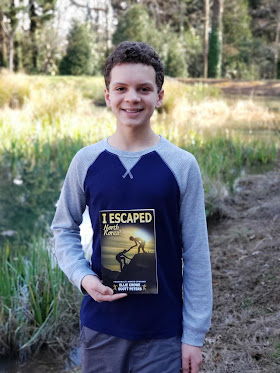

Elliott is a prolific reader of various genres who is more than happy to share his opinions on books. In his free time, he enjoys writing, reading, and running. He is an 8th grade homeschool student in Charlotte, NC.          

GIVEAWAY

Please leave a comment by 6 PM on February 17 with your email address, or send me an email. If you share this on social media, you will get one extra chance; if you follow my blog you will get another chance. Tell me what you have done and I will enter your name accordingly. U.S. addresses only. 

Congratulations to Tiffany Slack who won Rock and Vole for the Matthews Christian Library and to Rosi Hollenbeck who won Where is My Cow? By the way, Rosi also reviews and gives away lots of children's books!


Wednesday, March 3, 2021

The Korean War by Bruce Cummings: An Audio Book Review and Giveaway

Congratulations to Danielle Hammelef who shared Stompin' at the Savoy in three places on social media--and won my copy of the book.


                                                     ****

It's been awhile since I've reviewed an audio book because of my new-found fascination with nonfiction picture books. I initially ordered The Korean War from Audible Books to gain a better perspective on what Ben Dinsmore, my protagonist in Half-Truthsfather, experienced during and after the war. 


Bruce Cummings, author of The Korean War (Penguin Random House, 2011), is an award-winning professor and lecturer of East Asian studies. At 350 pages (eight hours) this book is not an easy read, but provides a lot of information and a different perspective of the "Forgotten War." 


MY TAKEAWAYS

The following points helped me understand what Kate's father witnessed.


  • Cummings detailed the “dirty history” of both Communist and South Korean atrocities. 
  •  Cummings believed that American soldiers who fought on behalf of defending the United States against the much-feared Communists, shouldered a thankless task. He also thought that Dean Acheson  arrived at the decision to enter the war alone. It was a question of defeating Russia and obtaining prestige for the United States.
  • South Koreans were trying to go against centuries of inequities of social structure. The state squelched the middle class so there were two classes: peasants and aristocracy.  There was a tiny elite of rich but the vast majority of Koreans were poor. 
  • To Americans, the task of trying to create democracy for South Korea seemed impossible. Their ostensible vision was to bring freedom and liberty to servants who were under Japanese imperialism. 
  • Americans underestimated the enemy, North Korea. American GI’s were infected by the racism they knew in the States. They saw all Koreans as unreliable allies, primitive people of color, who lived in mud and squalor. 
  • Cummings provides the historic context for the conflict both in Korean history, as well as showing American political and military agendas after WWII. He includes a lot of information about what led up to the war: MacArthur's background,  Korean's history with Chiang Kai-Shek), Korean blood lines, how the monarchy was influenced by Confucianism, nationalism in the North... You get the picture. There's a ton of information. 

    Circa 1950: An elderly woman and her grandchild wander among the debris of their wrecked home in the aftermath of an air raid by U.S. planes over Pyongyang, the Communist capital of North Korea. (Photo by Keystone/Getty Images)

  • During the first two years of war, the American perception was that south Koreans weren’t trained well and just broke and ran in combat situation. 
  • American GIs were constantly threatened by guerillas. 
  • MacArthur contributed to this dehumanization of the "gooks." In the "Naked Parade of Shame," 2000 POW’s were paraded naked after capturing Inchon. The war atrocities came out years later. All sides violated conventions of protecting civilians, women and children. It didn’t dawn on Americans that South Koreans wouldn’t like to be called gooks. 
  • Korea was a picture of extreme brutality. Upward of 100000 Koreans were killed before the war began. Another 100,000 afterwards.  As in Germany during WWII, incendiary bombing was also used in in Korea. Oceans of napalm were dropped on Korea. Depending on which side of the weapon you were on, it was either an infernal jelly or a wonder weapon. 

                                  https://www.youtube.com/watch?v=ig4XOziHC2Q
                                  North American F-100 Super Sabre deploying napalm.

  • The air war was awful. Many innocent civilians were killed in saturation bombing that was unimaginably destructive. 
  •  

  • In 1951, newspaper journalism was put under the jurisdiction of the U.S. army and articles were censored. American journalists were cowed and useless. McCarthy used labels instead of arguments during this destructive era--evidence made no difference. 
  • Korea was the place to where the Cold war first came and never left. Seven decades later there is still oriental bigotry.
  • Soldiers were there to kill, but also to save and protect. They are supposed to protect the weak and unarmed. When he violates that, he threatens the fabric of international society. 
  • Cummings argued that journalists and historians misread and misreported the Korean war so that it was slanted against North Korea. Atrocities were hidden and classified for 50 years, such as the systematic slaughter of political prisoners in 1950. He feared American complicity in this and believed the Joint Chiefs of Staff repressed photos for 50 years.  
  • Cummings noted some of the results of the Korean conflict including more U.S. army bases around the world. The military industrial complex rose in the 1950’s with a larger standing army as a result. The armaments industry grew after Korea. 
  • Cummings thought the war was never won. "If you look at the Washington Memorial, you will see mysteries and unresolved tensions on the stone faces". He felt as the war failed to liberate the north. In fact, our war with North Korea continues with fears of nuclear warheads. "Someday archives will open and someday there will be a full understanding of the war."
  • Cummings advocated that the United States find ways to acknowledge past crimes and to reconcile with victims. "Forgetting is a gate keeper of conscience." He favored seeking reconciliation, not placing blame and understanding of one’s former enemy. Techniques of requiem, trial, reparations, and apology will help the country put ghosts to rest.
  • "There is no military solution in Korea, and there never was."


MY THOUGHTS

It would have helped if Cummings had placed the history of the area and of American involvement in the first part of the book. Since there was a lot of material, important facts were given in the middle of the book. That made the chronology difficult to follow. 

It was clear by the end of the book that Cummings did not favor American involvement in the war. As it turned out, the day I finished listening to this I met someone who immigrated to America from South Korea many years ago. His opinion was very different. He was vehement in his appreciation of American involvement. 

I recommend this book for any young adult or adult who is interested in learning more about this time period. 

The narrator, David de Bries did a fine job of reading this book. Here is an audio snippet: https://tinyurl.com/yb5xlsf4.

GIVEAWAY

If you would like to win a copy of this audio book, please leave your name and email address in the comments and Recorded Books will provide a download code for you. This could be a great gift for the history lover in your life, Giveaway ends March 5 at 6 PM.


THE NIGHT WAR: A MG Historical Novel Review

  By now you should have received an email from my new website about my review of THE NIGHT WAR by Kimberly Brubaker Bradley. (It'll com...