Showing posts with label Half-Truths. Show all posts

Friday, May 3, 2024

I've Moved!


I look forward to reading your comments on my new website, Carolbaldwinbooks. Please follow me there for book reviews and Half-Truths updates. Be patient with me as I iron out some kinks in the subscription process.


If you did not receive an email notification today from Carol Baldwin Author, Teacher, Speaker please check your spam or junk box. If you didn't receive a notification please email me

If you want to enter my current MG giveaway, click here. If you want to subscribe to my new blog, click here


Saturday, November 11, 2023

YOU HEARD IT HERE FIRST- HALF-TRUTHS HAS A HOME!

It's been a long time since I've published a "You Heard It Here First" blog post

It's been an even longer time since I first began writing Half-Truths


My first blog was in 2007 when I wrote about attending a SCBWI-Carolinas conference and finding my character's voice. Since then, I've written over 100 blog posts about this writing journey. The list includes the books I've read, 


a few of the over 100 people I interviewed, the workshops I took, and some of my major revisions. I applied for several SCBWI WIP grants and queried agents and publishers. Although I never won a contest or received a bite (although a few rejections were encouraging and personal), my vision for my book became clearer. 

One of my special interviewees, Price Davis.
He is standing in front of his childhood home in Cherry, NC.

Ask me how many drafts I've completed and I can't answer. Officially, I have ten drafts in Word and fourteen in Scrivener. Each of these drafts was revised countless times. 

One way of visualizing where scenes would go.

Sixteen years is a long time to be working on one book, but as I soon realized after beginning this task, I didn't know what I didn't know. There were times that I took breaks and worked on other projects too. Each time I returned to the manuscript, I still loved the characters and the plot. 

In the beginning, I had an idea about a white girl (Kate) who moved to the Myers Park neighborhood of Charlotte, NC from a farm in either South Carolina or North Carolina. She would feel like an outsider as she tried to figure out where she belonged in the world of 1950s debutantes. Soon after moving to her grandmother's home, she would meet a Black girl, Lillian. They would have an off-and-on friendship but would eventually bond over finding a remedy for Kate's goat's ringworm. There would be betrayal, the uncovering of long-buried family secrets, and clandestine trips to a funeral home and a cemetery. 

All that has stayed the same. But, so much has changed. 

I wrestled with how to begin the story and rewrote the beginning at least 50 times. I put in the murder of Lillian's brother and then took it out. I gave each girl a boyfriend and then, based on Rebecca Petruck's advice that I was getting too far away from my theme, I took them out. I spent two years writing it from both girls' POVs and then abandoned that idea. I made up a fictional town named Crossroads, NC until my mentor, Joyce Hostetter, convinced me that there was real history in Tabor City, NC that I should use. I changed the names of characters, deleted scenes that I loved, battled confusion and discouragement, and tried to figure out if this was a middle-grade or young adult book.

Until I found Monarch Educational Services in July. 

My Talking Story newsletter partner, Rebecca Wheeler, published her debut YA novel, WHISPERING THROUGH WATER with Monarch in January. She recommended querying the publisher, Jennifer Lowry. Despite being afraid of another rejection, within thirty minutes of sending my query, Jennifer responded that it was stellar. A few minutes later she asked for the full manuscript. That was beyond my craziest dream!

In September Jennifer provided detailed editorial input. One of her first reactions was that she saw Half-Truths as a young adult book and not as middle grade. Monarch is committed to clean reads and provides content ratings for all of their books. Since Half-Truths includes a reference to a sexual encounter between a slave owner and his slave, Jennifer felt strongly that it is a young adult novel. Since I've debated this issue so many times I'm happy to identify it as YA and for this conflict resolution! By the way, I've seen this book as upper middle-grade and expect that it will interest readers from 12 and up. 

Finally, after years of writing, rewriting, planning, and proofreading, I'm thrilled to announce, that Half-Truths will be published in June 2025. 

If you're my Facebook friend, you may have wondered why the picture of Blue Willow china has been my profile picture for all these years. If you want to be one of the first to find out its role in Half-Truths, leave me a comment (including your email address if you think I might not have it) and I'll send you a digital ARC (Advanced Reader's Copy) about six months before the book releases. The only qualification is that you post a review on Goodreads, Barnes & Noble, or Independent Book Review.  (Amazon won't allow you to post a review until the book's release.)


Thank you for joining me in this publication journey. 

Friday, January 27, 2023

On Submission


This post has been a long time coming. About 16 years long. There have been times when I thought I was ready to submit my middle-grade novel, HALF-TRUTHS. But now I KNOW it. 

IN THE BEGINNING

From the beginning, I imagined a story about a white girl and a light-skinned Black girl discovering that they were second cousins. That premise, which consistently elicits a "WOW!" response, has remained the same throughout my book journey.  

Having written dozens of articles and two nonfiction books, (Friendship Counseling, Teaching the Story: Fiction Writing in Grades 4-8)  I had confidence in my writing skills. But I knew nothing about writing fiction. It felt like jumping into deep water without knowing where I'd find the bottom. 


I wanted it to be a pre-civil rights story but Harold Underdown, my mentor at a Highlights Foundation workshop in 2009, informed me that was only the setting. For years I wrestled to answer the question he posed: What does your character want

EVERYONE HAS A STORY 

In the summer of 2007, I started thinking about my story and began interviewing "experts." My friend and mentor, Joyce Hostetter, encouraged me to research far and wide. What was happening in the world? In North Carolina? In Charlotte? She suggested that I find people who lived in the area and listen to their histories. Since I was just discovering my story, those initial interviews were broad. It's funny to reread them and see some of the questions I asked. 

Even though I often got off track and wanted to include every story I heard--I absorbed a time and place that was new to me. (In a future post I'll share some of the stories that I wanted to include but didn't.) 

I'm working on my 20+ page bibliography which includes 100 expert interviews. Some interview notes are less than a page. One of my experts is a man who graduated high school the same year my protagonist was in middle school. His notes are over 90 pages. Skimming through these interviews, I found details that made it into my story. I'd forgotten where and how I learned things such as what was served for lunch in the school cafeteria, the Black help's relationship with their employers, what it felt like to sit at the back of the bus, the used books and sports uniforms passed to the Black schools, the discussions about school integration, the peasant dresses worn to dances. You name it. It's one thing to read about these things in history books. It's another thing to have someone tell you how they felt as they experienced Jim Crow and/or chose not to become a debutante. 


Dorothy Counts, one of my experts, walking to Harding High School in 1957.
She was the first Black to attend the school.  
The photo originally appeared in The Charlotte Observer. 

People often wonder how I found these experts. I learned to ask everyone, "Who else should I talk to?". Tom Hanchett, Charlotte's local historian recommended several individuals. Others were patients of my dentist husband who were long-time Charlotteans. Others were parents of friends. These became my experts whose stories were woven together to create Half-Truths.

WHERE DID I FIND THIS STORY?

As the (working) title indicates, this book is about secrets and "white lies." Ben Franklin wrote in the Farmer's Almanac in 1758, "Half a truth is often a great lie." Over the years, I've thought about the secrets that people choose to conceal or at least, not talk about. I've often wondered what effect that has on the following generations.  As a Christian, I'm committed to telling the truth as commanded in the ninth commandment: "Thou shalt not bear false witness." As I wrote this novel, I had to think about my own "little" half-truths that I tell, and the reasons for them.

One elderly woman, a former debutante, suggested that I not pry into Charlotte in the 1950s and instead, write about my own life. (Who would want to read about growing up in South Jersey? Boring!) I was fascinated by my adopted new hometown and walked and biked around South Park and Myers Park thinking, "What is the story that could have happened here?" When I visited the former Rosenwald School in Grier Heights and saw the picture of a light-skinned Black principal, I found a key part of my story.

Billingsville School in Grier Heights. 
Now a community center. 

JOURNEY HIGHLIGHTS 

 INovember 2008, following Joyce's advice, I joined NaNoWriMo for the first time. I didn't feel ready, but it helped me create a first draft.

Pretty soon I realized that I didn't know what I didn't know. I attended workshops and webinars, conferences, and classes. I read books and blogs on plotting, conflict, and character; participated in several critique groups, and received critiques from industry professionals. Throughout this time, my best writing buddy, Linda Phillips, and Joyce encouraged me, asked me pointed questions, and provided feedback.


From the left: Joyce Hostetter, myself, and Linda Phillips
 at a writer's retreat in 2011.


But why did it take 16 years? First, I spent a long time trying to figure out where the story began. HALF-TRUTHS takes place in 1950, but at one point I started it with the protagonist's father in WWII. Not even close to the inciting event--which I didn't know a novel needed! 

Despite the fact that I wrote several outlines, I kept getting off track. Whenever I heard a feasible suggestion, "Someone should die," or, "Write it from the points of view of both girls," or, "Include romance," I spent time incorporating these ideas and going down rabbit holes of research. Combine that with going back and forth on whether or not this was a young adult or middle-grade book, I often strayed from my original vision: two girls--one white, one Black, discovering they are related. 

Enter Rebecca Petruck.  Rebecca critiqued several drafts and offered great insight into character arcs, plot points, and internalization. After I had spent a lot of time writing boyfriends for each main character (when I was thinking HALF-TRUTHS was a young adult book), Rebecca told it to me straight. I had lost the essence of the story--the girls' relationship.  


Rebecca helped me construct a plot chart in October 2013. 
I learned about Save the Cat! for the first time.

Since all of my readers were saying the book sounded more middle-grade, I ditched the boyfriends and the young adult genre. Along the way, I continued to interview folks and read and review middle-grade books. I particularly enjoyed Kathy Weichman's historical novels. Winner of the first Grateful American Book Prize, Kathy used to joke that she is the poster child for perseverance. I think I might be tying her for that distinction. 

Joyce Hostetter and I have swapped manuscripts over the years. Last February she suggested that I hire an editor to bring the book to the next level. I asked several trusted professionals in the Kidlit community for recommendations and found Deborah Halverson. She is a treasure.

In June 2022, I shared one page from Deborah's comprehensive editorial letter. For the next six months, I worked on incorporating her suggestions. I took out Kate's free verse poetry and changed it to journal-type entries in her steno pad. This fits Kate's goal of becoming a journalist. I worked on more youthful language, made Kate the instigator for the major change in her life, tightened the ending, and strengthened the City Girl vs. Country Girl motif as Rebecca had suggested years ago--but I'd forgotten!

In other words, I revised. A few weeks ago I was rewarded with these words from Deborah: 

In this revision, I feel you have accomplished your goals with this project, creating an entertaining, enlightening, compelling, and satisfying story for middle graders. I believe young readers will connect with Katie immediately and root for her throughout. Her growth is inspirational, showing the triumph of a flawed but earnest young person. 


Deborah's words gave me a boost of confidence that finally brought me to the...


of this stage. But it is also the beginning of an exciting time--being on submission!

WHAT'S NEXT?

For my friends and family who are reading this and aren't writers, you may be wondering what happens next. Remember those conferences and webinars I mentioned? At each one, I collected the names of agents and editors who expressed interest in the manuscript. Many said they didn't care how long it took. They just wanted to see it when it was the best I could make it. 

Now I take out that list, organize it through Query Tracker, and start sending out the manuscript.

If you are a writer, how did you feel when you began submitting your work? Please share your experiences in the comments. 

GIVEAWAY

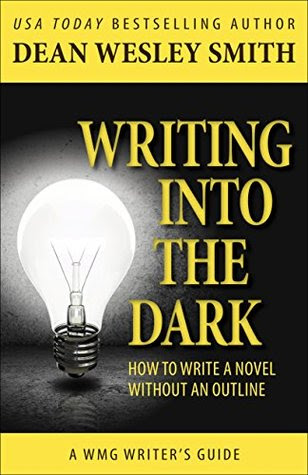
Obviously, I don't have a copy of Half-Truths to give away, but I'm cleaning off my bookshelves to make room for the books I'll need for my next project. Over the last 16 years, I learned that I'm definitely a plotter, rather than a panster. For those of you who abhor outlines, I'm giving away my (slightly marked-up) copy of WRITING INTO THE DARK. Leave me a comment with your email address by February 1 and it could be yours.


Congratulations to Emily Weitz who won MY SCHOOL IN THE RAIN FOREST.

Please take a minute to see views about other middle-grade books on Greg Pattridge's Always in the Middle blog.


Saturday, June 25, 2022

BLUE WILLOW: A Book that Lillie and Kate Read-- Part II and Insight into Revision

 Back in 2014, I posted this:

As some of my faithful blog readers know, my story includes Lillie and Kate uncovering a china cup that belongs to both their families. Over the process of writing Half-Truths, I've played with different china patterns. My friend and writing mentor, Joyce Moyer Hostetter, suggested the popular Blue Willow pattern. When I posted this picture on Facebook, several friends commented about their grandmothers' collections. 


Becky Levine and Joyce chimed in that I really needed to read the book, Blue Willow, which they remembered from their own childhoods. After reading it I realized I'd found a book that both girls would have enjoyed and a story that could provide a rich subtext for Half-Truths.


Winner of the Newbery Honor in 1941, Blue Willow recounts the story of a family shaped by the Great Depression. Ten-year-old Janey Larkin longs for a permanent home for herself and for her most beloved possession, a blue willow china plate that belonged to her great-great-grandmother. Her father is an itinerant farm worker who struggles to support Janey and her stepmother.  When the family moves from one farm to another, the plate goes with them but stays packed away. "…never, Mrs. Larkin had declared long ago, would it be put out as a household ornament until they had a decent home in which to display it. In the meantime, it was kept sadly tucked away, a reminder of happier days before its owners had become wanderers in search of a livelihood." (p. 23)

Because the plate had belonged to Janey's mother, it had become a part of her memories that were mixed up with "Mother Goose rhymes and gay laughter and a home of their own.  And because the willow plate had once been a part of all this, it had seemed actually to become these things to Janey. It was the hub of her universe, a solid rock in the midst of shifting sands." (p.23)

That draft was from both girls' POVs. As I wrote in 2017, I returned to writing from Kate's POV alone.  In the current draft, Blue Willow china is still an important link between the girls. But my young beta readers and Deborah Halverson said that the china did not clearly reveal how the girls were related. If more than one reader has a problem with something in my manuscript--I need to fix it!

So, how to tackle this? I did some brainstorming and side writing. I started a new document and recorded every time I mentioned the china. That helped me to see the gaps where Blue Willow fell off the story radar and where I needed to build more connections between the china and the characters. 

I found several places where I could add internalization and dialogue showing Kate's assumptions and false conclusions. It was like figuring out where the puzzle pieces should fit. By the time I had worked through this brainstorming exercise, Blue Willow had gained more importance in the story. In the end, the girls discover how the china is the clue that solves their ancestry mystery.

This blog took a few hours to write. Inserting more information about the china connection took many more; it is just one of the story threads I am deepening in Half-Truths.

And that my friends, is what re-vision is all about. 

By the way, during a recent visit to Joyce's house, I ate from Blue Willow,


and discovered that the pattern adorns other things besides plates!


Do you have a favorite revision story? Or, maybe you enjoy Blue Willow too. Please share in the comments!


Saturday, June 4, 2022

The Next Step: The Editorial Letter

A few weeks ago I posted my You're Almost in Labor! blog. I shared that the next step in my publishing journey was engaging Deborah Halverson to help get my "baby" ready to send to agents and/or publishers. 

As I waited for her feedback and editorial letter, I got nervous. What if she didn't like HALF-TRUTHS? Or worse, what if she liked the concept but suggested a major overhaul? I've been there a few times and didn't want to go back. 

When I told Deborah how I felt, she tried to reassure me. "Don’t feel worried. It’s a great story. My job is to help it to its best incarnation, so readers can get the most enjoyment from it. This is about moving it forward!"

My good friend Linda Phillips tried to reason with me. "You want Deborah to be tough; that’s what you paid her for, and it will only make it better.  And since this is a one-time deal, you want her to give you as many suggestions as possible and then you can spend the time making the corrections.

I knew Linda was right and I reread Deborah's email a few times. But still, "what if's" plagued me the whole night before I anticipated receiving Deborah's letter. I literally tossed and turned that night in bed.

But guess what? The next day, when I received Deborah's editorial letter, I teared up. Deborah not only deeply understood what I was trying to accomplish, but she also called my characters sweet and said it was easy to root for their dreams and for their friendship! 

As I read through her letter I knew that every single one of her points were what she had promised--editorial suggestions that would move Half-Truths forward. 


That night I couldn't sleep because I was so excited that her suggestions were ones I could implement!!

Some of you are readers and curious about the steps involved in writing and publishing a book. Others of you are also writers. For both groups of blog readers, I thought I'd share some of Deborah's points that resonated with me. 

First point:

  • This story is Katie’s first-person POV narration. The narrative sensibility absolutely feels like a thirteen-year-old. That is, her level of wisdom, her manner of viewing the world, the things she cares about, and the way she evaluates others’ needs and motives all feel right for someone her age. My concern is that sometimes the language and phrasing feel a bit too sophisticated, sounding “adulty.” 

I was happy to hear that the way Kate sees the world was consistent for a thirteen-year-old. But when I started looking through the manuscript, I was surprised at the many examples of "adulty" language that Deborah found! Descriptions like "grim eyes" or "his furrowed brow" or an action like, "I inhale a whiff of lavender" all take readers out of a young teen's POV. It'll be fun to track down these words and translate them into more teen-like vocabulary. 

Second point:

One of the things I'd included in the manuscript were Kate's poems. For me, they were exercises in getting more in touch with Kate's thoughts and emotions. They had been my side writing technique, as Mary Jane Nirdlinger wrote about in a recent Carolinas-SCBWI blog. But as Deborah observed, 

  • Katie doesn’t read poetry. She doesn’t talk about poetry. She doesn’t talk about the world like a poet, and doesn’t talk about becoming a professional poet. She talks about the world like a reporter, and wants to become a professional reporter. She reads newspapers. The books she does read are novels, not poetry collections. In my estimation, the poetry and journalism elements don’t sync. Simply put, I don’t see the point for the poetry.
When I wailed to Linda that I didn't know how I could take out my beloved poems, Linda (who IS a poet and wasn't impressed with my poems but was too nice to say that) excitedly pointed out ways in which those poems could be recycled as narrative or -- maybe even articles which Kate writes. Stay tuned. 

Third Point:

I was concerned I didn't have enough stakes in the story. In a stroke of genius, Deborah showed me how to empower Kate, give her more skin in the game, and solve a sub-plot point problem. Sorry, I don't have a quote to substantiate this third point. As they say, you'll have to read the book!

Deborah made several other observations which will strengthen the story. By the time you get to hold HALF-TRUTHS in your hand (as so many of you said you wanted to do-thank you!) those changes (and others) will be integrated into the final product. 

I appreciate sharing my story-behind-my story with all of you. As Elliot Kurta said after I sent him the editorial letter, "Writing a book is a complicated business!"

                                                    ****
Congratulations to Janet Sheets who won SOUNDS ALL AROUND. 

Saturday, May 14, 2022

"You're Almost in Labor!" A Celebration of Stages

 If you're reading this and have been pregnant for nine long months, or if you've been close to someone during that-seemingly-endless amount of time waiting for a baby, then you know how pregnant mamas look forward to their delivery date.

Many people compare publishing a book to having a baby. So, when I contacted Rebecca Kurta, Elliott Kurta's mom (my frequent middle grade guest blogger) about giving a copy of Half-Truths to Elliott, she made the baby comparison. When I explained that although I'm close, my book is still not ready to be delivered, she wanted to know what else was left for me to do. 

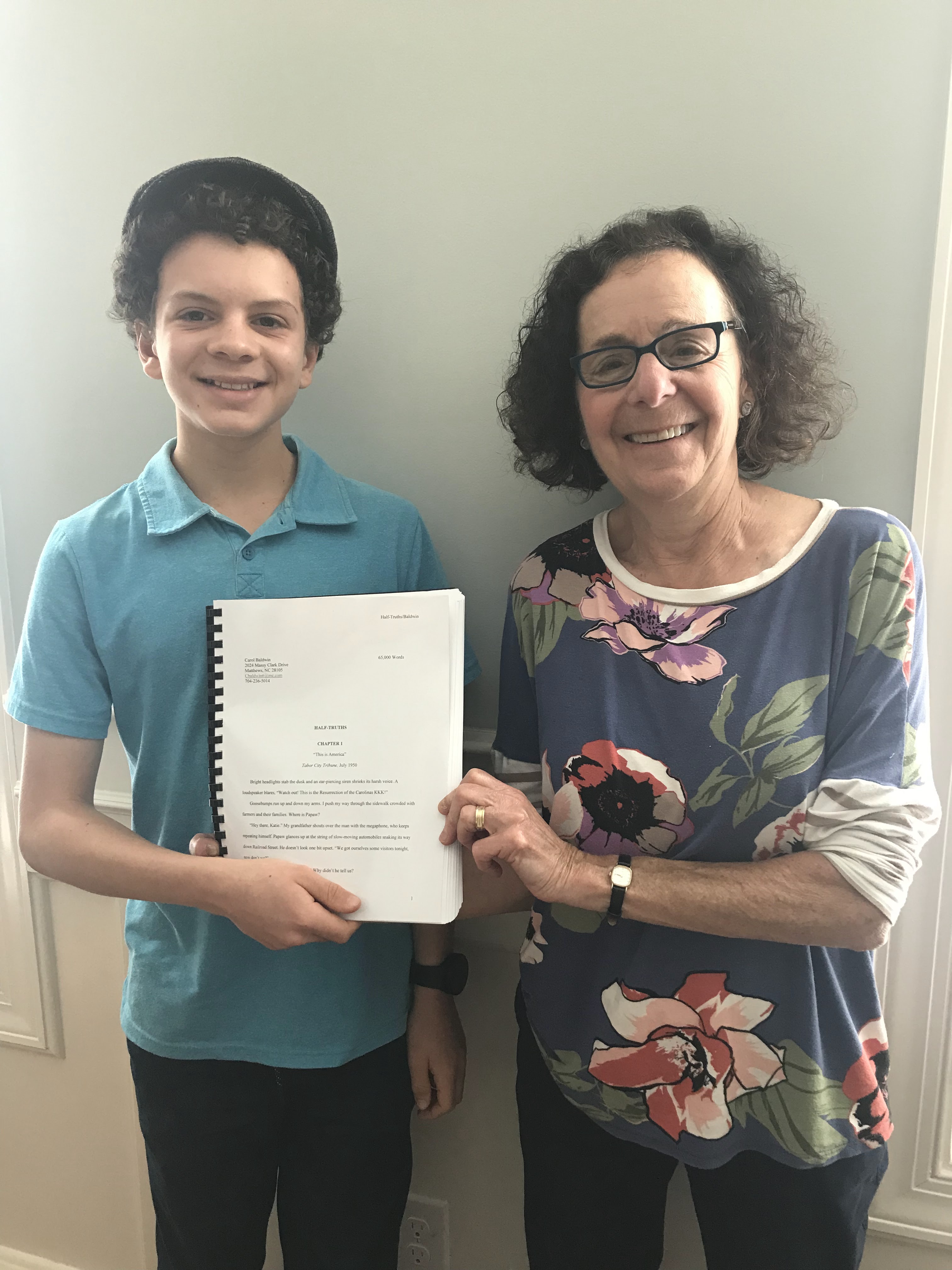
Thanks to Lori Steel, who suggested printing out
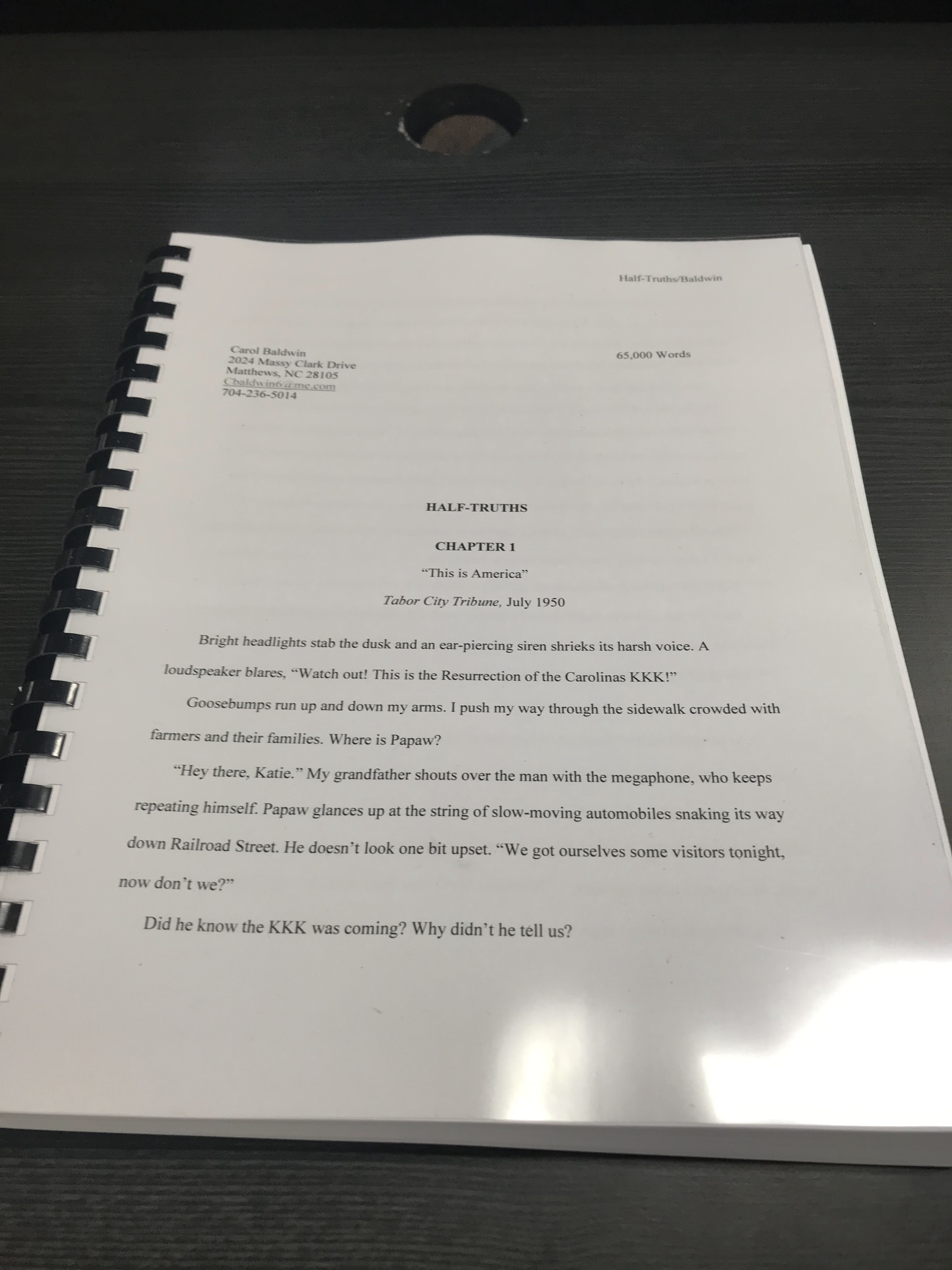
a close-to-final draft so it looks and feels like a book.

I told her there are just a few "simple" things that happen next.

  • I've hired Deborah Halverson, a free-lance editor (who came  highly recommended from Harold Underdown) to comb through the manuscript and find any issues with the plot, the character's voice, deep point-of-view, tension, stakes, etc. 
  • Once Deborah returns the manuscript, she and I will talk.
  • I'll incorporate her feedback. I will get my baby as spotless as possible.
  • I'll hire a copy editor to make sure it's formatted perfectly.
  • THEN...I'll start submitting to agents. Over the years I've assembled a list. Now will be the time to perfect my query letter and polish my synopsis.
  • THEN...I'll get busy with my next project and try not to obsessively check my email for agent responses. I have 3 picture books that I'm working on as well as an idea for a nonfiction graphic novel. 
  • And THEN...I hope my agent-to-be finds a publishing house who will embrace Half-Truths.
  • And THEN...I tell y'all about it! 
After I sent the manuscript to Deborah this week, I felt empty. The next day I felt relieved as I realized just how much Half-Truths has consumed my thinking for umpteen years!

Yesterday I celebrated this step of my writing journey by delivering the manuscript to two teen beta readers.


I gave one copy to my granddaughter
Caitlin K.,


and another to Elliott.


On my way out the door, Rebecca said, "You're almost in labor!" Thanks, Rebecca, for that reminder to celebrate every stage of my writing journey.

And today, I'm sharing this milestone with you, my faithful blog readers. 
      
                                                *****

Congratulations to Lisa Fowler who won EQUAL from the "Pick-Your-Own-Book" post.

Remember! Look for more Middle Grade posts on Greg Pattridge's MMGM blog on Monday!


Friday, May 6, 2022

STORIES IN JOYCE'S BACKYARD: A "PICK-YOUR-OWN" GIVEAWAY!

 "This is the house that the Hinkle sisters lived in, and that's the muddy river where Thomas and Jackie fished together." Joyce Hostetter pointed out the car window as we drove around around her hometown, Hickory, NC--the setting for her Bakers Mountain Series. "See that old building? That's the hosiery factory where Junior worked for a few days. Over there is where the car mechanic lived who helped him fix his truck."


The Honeycutt family and their friends, who already had a special place in my heart from reading AIM, BLUE, COMFORT, DRIVE and EQUAL, became even more real as I saw the places where they lived, played, and worked--all within sight of Bakers Mountain. 

Bakers Mountain, photo courtesy Joyce Hostetter

How did Joyce end up writing a series of books that rose up out of what was once a rural community? It all began when Carolyn Yoder, senior editor at Calkins Creek, suggested that Joyce find the story in her own backyard. When Joyce began researching the history of Hickory, NC, she discovered the Miracle of Hickory at her local library.

Mural in downtown Hickory. Do you see Joyce?

She researched, read old papers, interviewed polio patients...and BLUE was born. Read some of Joyce's thoughts on the process of discovering her stories here

Part of Joyce's real backyard. Photo courtesy Joyce Hostetter

A few years after BLUE was published, I met Joyce in Birmingham, Alabama at a literacy conference. She was presenting on BLUE, I was presenting on Teaching the Story: Fiction Writing in Grades 4-8.  


We bonded over reading and writing. We co-presented several times and continue to publish a quarterly newsletter, Talking Story. We are critique partners and good friends. 

I felt Joyce's influence when I began brainstorming my own first novel. I rode my bike, walked, and drove through neighborhoods. What could have happened here? Half-Truths incubated. Ideas hatched. A novel slowly took shape. It changed. Got revised (many times!). Was reborn. 

What did Carolyn mean when she gave Joyce that assignment? Possibly she was not only talking about an actual backyard but was also encouraging Joyce to reach inside of her own experiences to find something she could relate to and authentically show in her writing.  

Let's face it. There might not be a compelling story about polio or pre-civil rights tension in your community, city, or state. Or, maybe you write science fiction or fantasy that's not even rooted in this continent or world--let alone in your neighborhood! How are you going to find that "backyard" story?

At the foot of Bakers Mountain and staring at Joyce's budding trees and the grass turning green I thought--my backyard is bigger than the crazy intersecting streets of Myers Park, NC. where my characters live. 

It's my whole life. 

It's writing what I know with a twist. 

It's taking my grief over losing someone I loved and embedding that in Kate, my protagonist's heart when she leaves home. It's realizing how making choices is not always very linear and conveying it on the page; it's understanding how gut-wrenching it is to feel betrayed--or be the betrayer. 


How about you? What have you used in your life--whether it's a place, person, event, or experiences--that has made it's way into your book? 

What is in your own backyard? 

Some backyards are under construction,
like mine is!

GIVEAWAY

For the first time on my blog, one fortunate blog reader will be able to pick which book in the Bakers Mountain Series they want to win! Leave me a comment by May 11 to enter this giveaway and tell me which book you are interested in. U.S. addresses only. Make sure you leave me your full name and email address if you are new to my blog.
Make sure you check out the other great books on Greg Pattridge's MMGM blog! 


Wednesday, March 17, 2021

The Other Madisons: An Audio Book Review

 For those of you who know me and my journey with Half-Truths, you will appreciate that when I heard of Bettye Kearse's book, The Other Madisons: The Lost History of a President's Black Family, I knew I had to read it. Since I am way behind on my to-be-read books, I was fortunate to receive a review copy from Recorded Books. See the giveaway notes at the bottom to see how you can receive a copy of this rich memoir. 


I heard Bettye speak at a webinar sponsored by the Charlotte chapter of the Women's National Book Association. After I heard Bettye's compelling talk I reached out to her and we met virtually and have exchanged emails and phone calls. I am thrilled to share her book with you, as well as a few thoughts about her writing journey. Let's just stay that I'm not alone in investing over fifteen years into a project I love.

REVIEW

Few of us can trace our ancestry as Bettye Kearse has.  She is a eighth-generation griotte and her mother said to her from the time she was a child, "Always remember--you are a Madison. You come from African slaves and a president." 

Bettye unpacks the full implication of this family credo when her mother passes on to her a box full of ancestral documents, priceless mementoes, and photographs.  At the time, Bettye was a successful pediatrician in Boston. Her life was about to change.

Bettye (around four or five) standing with her mother .

This rich, sensory memoir begins and ends with the voice of Mandy, Bettye's enslaved ancestor stolen from Ghana. Kidnapped from her home, Mandy is crammed into a slave ship. The reader feels the splinters in her hands in the hold of the ship, smells the reek of urine and feces, and feels the horrific chains binding her. 

When she gets to Montpelier, James Madison's Virginia plantation, Mandy's agonies have only just begun. Sexually assaulted by James Madison senior, she gives birth to their daughter Coreen. James Madison's son, James junior, is attracted to Coreen and he takes her for himself--despite the fact that she is his half-sister. (Bettye explains these complicated relationships in this interview.)

Having grown up in the sixties, Bettye is uncomfortable with her mother's unflinching pride in being a descendent of the Madisons. President James Madison had owned and abused her ancestors! How could she be proud of that? 

Knowing that she was challenging parts of her family history that her mother hadn't, Bettye wonders what she can contribute to the family legacy. Though hesitant, Bettye determines to uncover the truths about her ancestors and becomes the first person to write the family history down. 


An 1860 slave census listing Bettye's 
great-great-grandparents
and their children.


Bettye was very close to her grandfather, and the book is full of their relationship. He frequently told her mother, "Our white ancestors laid the foundation of this country, but our dark-skinned ancestors built it." Another time he commented, "Racism is just another challenge, and challenges make us strong." 

Bettye's research into her past takes her to Lagos, Portugal. What she finds rocks her to the core. The people who live in this tourist town are oblivious to the slave trade that had begun there in 1441. "There wasn't one morsel of information about slave stockades. The erasure was complete."


Bettye visits the Elmina Castle in Ghana and imagines what it was like for the enslaved men and women who were stolen, separated from their families, and kept in bondage. Her description of these atrocious events is complete. 150-300 women stood pressed together in "rooms of deep sorrow." They were marched through a "gate of no return" to a slave ship. "The ocean wiped away their footprints."


When Bettye comes back to the states, she visits the National Black Wax Museum in Baltimore. On board a replica of a slave ship, Bettye puts herself into Mandy's horrific experiences of possibly being raped, sick, and close to death. She wonders if she would have made it to the New World. 


There is much more to this book: Bettye's conversations with her mother over the nature of the sexual relationships between owners and slaves (her mother called it "visiting"),  Bettye's first encounter with Jim Crow when she was five-years-old, the racism she still experiences, Bettye's pride for her family and other enslaved Blacks, how she feels holding the picture of her great-great-great grandmother--the first ancestor she could see. 


This is an important book and one you won't quickly forget. 


IN HER OWN WORDS

In one of our conversations, Bettye told me that the hardest part of writing this memoir was what to do with the "rich material" she had received from her mother. Initially, Bettye wrote the book the way her mother wanted, as a record of their family stories. Then, she realized that her story wasn't unique to her and a mentor recommended that she write it as fiction; but that came out "flat." Her mentor then suggested Bettye write a memoir. Inserting her own feelings was difficult, but that process breathed life into the narrative. "It was very rewarding to discover my purpose by writing this as a memoir and realizing that I had a message for others."

AUDIO and VIDEOS

The narrator, Karen Chilton, has a beautiful reading voice and immersed me in the memoir. Sometimes I forgot that it wasn't Bettye speaking. Here is an audio snippet to show you how well Chilton reads the book:

https://soundcloud.com/recorded_books/audiobook-excerpt-the-other-madisons


Here is a video sequence narrated by Bettye and other historians.


A VIRTUAL SCREENING

Join Bettye for a virtual screening of the Eduardo Montes-Bradley documentary, The Other Madisons. There are several opportunities to view the film over the next few weeks.

GIVEAWAY


Leave me a comment by March 20 at 6 PM if you would like to enter this giveaway. PLEASE leave me your email address if you are new to my blog. 

DISCUSSION GUIDE

This book is a great book club selection. Download the discussion guide here.

THE NIGHT WAR: A MG Historical Novel Review

  By now you should have received an email from my new website about my review of THE NIGHT WAR by Kimberly Brubaker Bradley. (It'll com...