Showing posts with label Rebecca Petruck. Show all posts

Saturday, November 11, 2023

YOU HEARD IT HERE FIRST- HALF-TRUTHS HAS A HOME!

It's been a long time since I've published a "You Heard It Here First" blog post

It's been an even longer time since I first began writing Half-Truths


My first blog was in 2007 when I wrote about attending a SCBWI-Carolinas conference and finding my character's voice. Since then, I've written over 100 blog posts about this writing journey. The list includes the books I've read, 


a few of the over 100 people I interviewed, the workshops I took, and some of my major revisions. I applied for several SCBWI WIP grants and queried agents and publishers. Although I never won a contest or received a bite (although a few rejections were encouraging and personal), my vision for my book became clearer. 

One of my special interviewees, Price Davis.
He is standing in front of his childhood home in Cherry, NC.

Ask me how many drafts I've completed and I can't answer. Officially, I have ten drafts in Word and fourteen in Scrivener. Each of these drafts was revised countless times. 

One way of visualizing where scenes would go.

Sixteen years is a long time to be working on one book, but as I soon realized after beginning this task, I didn't know what I didn't know. There were times that I took breaks and worked on other projects too. Each time I returned to the manuscript, I still loved the characters and the plot. 

In the beginning, I had an idea about a white girl (Kate) who moved to the Myers Park neighborhood of Charlotte, NC from a farm in either South Carolina or North Carolina. She would feel like an outsider as she tried to figure out where she belonged in the world of 1950s debutantes. Soon after moving to her grandmother's home, she would meet a Black girl, Lillian. They would have an off-and-on friendship but would eventually bond over finding a remedy for Kate's goat's ringworm. There would be betrayal, the uncovering of long-buried family secrets, and clandestine trips to a funeral home and a cemetery. 

All that has stayed the same. But, so much has changed. 

I wrestled with how to begin the story and rewrote the beginning at least 50 times. I put in the murder of Lillian's brother and then took it out. I gave each girl a boyfriend and then, based on Rebecca Petruck's advice that I was getting too far away from my theme, I took them out. I spent two years writing it from both girls' POVs and then abandoned that idea. I made up a fictional town named Crossroads, NC until my mentor, Joyce Hostetter, convinced me that there was real history in Tabor City, NC that I should use. I changed the names of characters, deleted scenes that I loved, battled confusion and discouragement, and tried to figure out if this was a middle-grade or young adult book.

Until I found Monarch Educational Services in July. 

My Talking Story newsletter partner, Rebecca Wheeler, published her debut YA novel, WHISPERING THROUGH WATER with Monarch in January. She recommended querying the publisher, Jennifer Lowry. Despite being afraid of another rejection, within thirty minutes of sending my query, Jennifer responded that it was stellar. A few minutes later she asked for the full manuscript. That was beyond my craziest dream!

In September Jennifer provided detailed editorial input. One of her first reactions was that she saw Half-Truths as a young adult book and not as middle grade. Monarch is committed to clean reads and provides content ratings for all of their books. Since Half-Truths includes a reference to a sexual encounter between a slave owner and his slave, Jennifer felt strongly that it is a young adult novel. Since I've debated this issue so many times I'm happy to identify it as YA and for this conflict resolution! By the way, I've seen this book as upper middle-grade and expect that it will interest readers from 12 and up. 

Finally, after years of writing, rewriting, planning, and proofreading, I'm thrilled to announce, that Half-Truths will be published in June 2025. 

If you're my Facebook friend, you may have wondered why the picture of Blue Willow china has been my profile picture for all these years. If you want to be one of the first to find out its role in Half-Truths, leave me a comment (including your email address if you think I might not have it) and I'll send you a digital ARC (Advanced Reader's Copy) about six months before the book releases. The only qualification is that you post a review on Goodreads, Barnes & Noble, or Independent Book Review.  (Amazon won't allow you to post a review until the book's release.)


Thank you for joining me in this publication journey. 

Friday, January 27, 2023

On Submission


This post has been a long time coming. About 16 years long. There have been times when I thought I was ready to submit my middle-grade novel, HALF-TRUTHS. But now I KNOW it. 

IN THE BEGINNING

From the beginning, I imagined a story about a white girl and a light-skinned Black girl discovering that they were second cousins. That premise, which consistently elicits a "WOW!" response, has remained the same throughout my book journey.  

Having written dozens of articles and two nonfiction books, (Friendship Counseling, Teaching the Story: Fiction Writing in Grades 4-8)  I had confidence in my writing skills. But I knew nothing about writing fiction. It felt like jumping into deep water without knowing where I'd find the bottom. 


I wanted it to be a pre-civil rights story but Harold Underdown, my mentor at a Highlights Foundation workshop in 2009, informed me that was only the setting. For years I wrestled to answer the question he posed: What does your character want

EVERYONE HAS A STORY 

In the summer of 2007, I started thinking about my story and began interviewing "experts." My friend and mentor, Joyce Hostetter, encouraged me to research far and wide. What was happening in the world? In North Carolina? In Charlotte? She suggested that I find people who lived in the area and listen to their histories. Since I was just discovering my story, those initial interviews were broad. It's funny to reread them and see some of the questions I asked. 

Even though I often got off track and wanted to include every story I heard--I absorbed a time and place that was new to me. (In a future post I'll share some of the stories that I wanted to include but didn't.) 

I'm working on my 20+ page bibliography which includes 100 expert interviews. Some interview notes are less than a page. One of my experts is a man who graduated high school the same year my protagonist was in middle school. His notes are over 90 pages. Skimming through these interviews, I found details that made it into my story. I'd forgotten where and how I learned things such as what was served for lunch in the school cafeteria, the Black help's relationship with their employers, what it felt like to sit at the back of the bus, the used books and sports uniforms passed to the Black schools, the discussions about school integration, the peasant dresses worn to dances. You name it. It's one thing to read about these things in history books. It's another thing to have someone tell you how they felt as they experienced Jim Crow and/or chose not to become a debutante. 


Dorothy Counts, one of my experts, walking to Harding High School in 1957.
She was the first Black to attend the school.  
The photo originally appeared in The Charlotte Observer. 

People often wonder how I found these experts. I learned to ask everyone, "Who else should I talk to?". Tom Hanchett, Charlotte's local historian recommended several individuals. Others were patients of my dentist husband who were long-time Charlotteans. Others were parents of friends. These became my experts whose stories were woven together to create Half-Truths.

WHERE DID I FIND THIS STORY?

As the (working) title indicates, this book is about secrets and "white lies." Ben Franklin wrote in the Farmer's Almanac in 1758, "Half a truth is often a great lie." Over the years, I've thought about the secrets that people choose to conceal or at least, not talk about. I've often wondered what effect that has on the following generations.  As a Christian, I'm committed to telling the truth as commanded in the ninth commandment: "Thou shalt not bear false witness." As I wrote this novel, I had to think about my own "little" half-truths that I tell, and the reasons for them.

One elderly woman, a former debutante, suggested that I not pry into Charlotte in the 1950s and instead, write about my own life. (Who would want to read about growing up in South Jersey? Boring!) I was fascinated by my adopted new hometown and walked and biked around South Park and Myers Park thinking, "What is the story that could have happened here?" When I visited the former Rosenwald School in Grier Heights and saw the picture of a light-skinned Black principal, I found a key part of my story.

Billingsville School in Grier Heights. 
Now a community center. 

JOURNEY HIGHLIGHTS 

 INovember 2008, following Joyce's advice, I joined NaNoWriMo for the first time. I didn't feel ready, but it helped me create a first draft.

Pretty soon I realized that I didn't know what I didn't know. I attended workshops and webinars, conferences, and classes. I read books and blogs on plotting, conflict, and character; participated in several critique groups, and received critiques from industry professionals. Throughout this time, my best writing buddy, Linda Phillips, and Joyce encouraged me, asked me pointed questions, and provided feedback.


From the left: Joyce Hostetter, myself, and Linda Phillips
 at a writer's retreat in 2011.


But why did it take 16 years? First, I spent a long time trying to figure out where the story began. HALF-TRUTHS takes place in 1950, but at one point I started it with the protagonist's father in WWII. Not even close to the inciting event--which I didn't know a novel needed! 

Despite the fact that I wrote several outlines, I kept getting off track. Whenever I heard a feasible suggestion, "Someone should die," or, "Write it from the points of view of both girls," or, "Include romance," I spent time incorporating these ideas and going down rabbit holes of research. Combine that with going back and forth on whether or not this was a young adult or middle-grade book, I often strayed from my original vision: two girls--one white, one Black, discovering they are related. 

Enter Rebecca Petruck.  Rebecca critiqued several drafts and offered great insight into character arcs, plot points, and internalization. After I had spent a lot of time writing boyfriends for each main character (when I was thinking HALF-TRUTHS was a young adult book), Rebecca told it to me straight. I had lost the essence of the story--the girls' relationship.  


Rebecca helped me construct a plot chart in October 2013. 
I learned about Save the Cat! for the first time.

Since all of my readers were saying the book sounded more middle-grade, I ditched the boyfriends and the young adult genre. Along the way, I continued to interview folks and read and review middle-grade books. I particularly enjoyed Kathy Weichman's historical novels. Winner of the first Grateful American Book Prize, Kathy used to joke that she is the poster child for perseverance. I think I might be tying her for that distinction. 

Joyce Hostetter and I have swapped manuscripts over the years. Last February she suggested that I hire an editor to bring the book to the next level. I asked several trusted professionals in the Kidlit community for recommendations and found Deborah Halverson. She is a treasure.

In June 2022, I shared one page from Deborah's comprehensive editorial letter. For the next six months, I worked on incorporating her suggestions. I took out Kate's free verse poetry and changed it to journal-type entries in her steno pad. This fits Kate's goal of becoming a journalist. I worked on more youthful language, made Kate the instigator for the major change in her life, tightened the ending, and strengthened the City Girl vs. Country Girl motif as Rebecca had suggested years ago--but I'd forgotten!

In other words, I revised. A few weeks ago I was rewarded with these words from Deborah: 

In this revision, I feel you have accomplished your goals with this project, creating an entertaining, enlightening, compelling, and satisfying story for middle graders. I believe young readers will connect with Katie immediately and root for her throughout. Her growth is inspirational, showing the triumph of a flawed but earnest young person. 


Deborah's words gave me a boost of confidence that finally brought me to the...


of this stage. But it is also the beginning of an exciting time--being on submission!

WHAT'S NEXT?

For my friends and family who are reading this and aren't writers, you may be wondering what happens next. Remember those conferences and webinars I mentioned? At each one, I collected the names of agents and editors who expressed interest in the manuscript. Many said they didn't care how long it took. They just wanted to see it when it was the best I could make it. 

Now I take out that list, organize it through Query Tracker, and start sending out the manuscript.

If you are a writer, how did you feel when you began submitting your work? Please share your experiences in the comments. 

GIVEAWAY

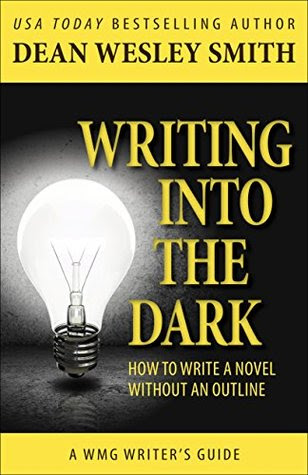
Obviously, I don't have a copy of Half-Truths to give away, but I'm cleaning off my bookshelves to make room for the books I'll need for my next project. Over the last 16 years, I learned that I'm definitely a plotter, rather than a panster. For those of you who abhor outlines, I'm giving away my (slightly marked-up) copy of WRITING INTO THE DARK. Leave me a comment with your email address by February 1 and it could be yours.


Congratulations to Emily Weitz who won MY SCHOOL IN THE RAIN FOREST.

Please take a minute to see views about other middle-grade books on Greg Pattridge's Always in the Middle blog.


Tuesday, December 21, 2021

Revision Revisited

 If you're a writer, then someone has probably said to you: "So, are you done with your book yet?" If the person who you are talking to loves you then he may say, "How's the book coming along?" Which is a softer, kinder way of saying the same thing. 

Either way, most people who are not in the writing/publishing world have NO idea how much writing and re-writing goes into creating a book. And either way, you'll feel a little defensive as you try to explain why it's taken years to create a finished product.

REVISION BLOGS

Revision happens on so many levels. There are drafts when a writer is just getting the story out. There are big picture revisions when a writer has to re-vision her entire novel. And then of course, there are a host of "minor" revisions to make your characters and story authentic.


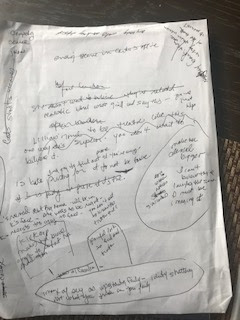
A page of side notes on Kate's character development.

I've blogged about the revision process several times. Here is one from the Free Expressions workshop I took ten years ago. And here is a blog with Harold Underdown's advice on not submitting until your work is ready. Mary Jane Nirdlinger wrote an excellent post about revision for the SCBWI-Carolinas region. I highly recommend it.

TRUE CONFESSION

I started Half-Truths over 15 years ago. I knew I could write, but I'd never written a novel AND I took on a topic that was much bigger (and more difficult to write) than I realized.  Here is the updated blurb for my middle grade book:

In the Jim Crow south, thirteen-year-old Kate Dinsmore meets two people who challenge her world view: a small-town newspaper editor determined to stop the KKK and a young Black maid who proves to be her second cousin. Told through narrative, letters, newspaper headlines, and poetry, Kate comes to grips with her identity, decides what she will stand for, and takes risks to become a journalist who will make a difference. 

Although I imagined the girls' relationship since the book's inception, I went off in many different directions as I wrestled with writing the book. Rebecca Petruck, one of my early critiquers, kept encouraging me to return to that relationship--even when I included murders, boyfriends, and information about the Korean war. (Did I say this was my first novel?)

Joyce Hostetter, a wonderful historical middle grade author has been my mentor throughout the process. Under her guidance, I researched widely and found tremendous experts who informed my knowledge of the time period and the plot. I visited places on the Charlotte African American tour. I talked to people who went to the same high school as my characters, Meet My Experts III- Vermelle Diamond Ely and Meet my Experts

In 2016 I sent the manuscript to beta readers (check out the picture of of my technique for plotting my book). I incorporated their feedback and kept on going. Along the way I received editorial advice to write the book from both girls' POV's. I was reluctant to do that since I'm white, but Rebecca encouraged me in that direction. By the time I was ready to submit that version, the publishing industry had changed and that was no longer an option. In 2017 I made the difficult decision to start over from Kate's POV.

It was hard to give up all the work I had done to write Lillian's story, but it was the right decision. I re-outlined the book and started a new version focusing on Kate's journey. In doing that, I still went off on too many rabbit trails! 

Finally, last year (based on Joyce's encouragement) I took Kathy Temean's whole novel workshop. I received excellent feedback from three peers, incorporated their suggestions, and then sent it to an agent who read the entire 78,000 word manuscript.

The agent's insightful feedback provided a TON of things to work on--including deciding if this is a middle grade or young adult book. Ittook several months to incorporate her suggestions--including showing more of Kate's life before she moves to Charlotte. After re-writing the beginning, I realized that I had painted an overly optimistic ending and that needed changing! I decided the book needed to stretch out over an entire year and that required rearranging chapters.

Yesterday, I reached another milestone. I sent the revised 64,000 word manuscript to Joyce. She will go through it with a fine-tooth comb and I will revise it again.

And only after that--will I send it out.

So, that is why this book has taken me so long to write!

https://www.123rf.com/photo_128021414_word-writing-text-revision-business-photo-showcasing-action-of-revising-over-someone-like-auditing-o.html

Yesterday I texted Kathryn Frye, a Charlotte videographer who produced and directed the documentary, African American Album: Charlotte, NC Mecklenburg History.  She and Vermelle Ely, have been cheering for my book ever since I met them. I told her I feel that it's risky for a white woman to write about race, She responded: 

"It’s a great story from its creator, no matter what shade of human she is! We have always been fully confident that we will hold the book one day."

HOW ABOUT YOU?

Do you have a revision story? Please share in the comments!                                                       

Congratulations to Terri Michels for winning Janine Yordy's book, Jellyfish Wishes and Poems About Fishes. After entering my giveaways many times, she finally won!

ON A PERSONAL NOTE

I have grandchildren coming to visit so I'll be taking a short holiday from blogging. But I'll be back in your inbox soon!

Monday, September 3, 2018

Triple Play @ ALA!


Earlier this summer three of my friends attended the American Library Association's Annual Conference in New Orleans. I asked Jo Hackl, Rebecca Petruck, and Linda Phillips to share their perspective on presenting their books to thousands of librarians.

I found this picture on Facebook. A writer just happened to be
in New Orleans during the conference and shared this photo.
Isn't it terrific?

I asked them the following questions: 
1. What was the highlight of your experience? 
2. What did you learn? 
3. What would you pass on to other authors?

Jo Hackl


Librarians and educators are my favorite kinds of people and the highlight of my experience was connecting with school media specialists interested in exploring ways to engage students in reading. I also loved connecting with other authors. And seeing my book in the Random House booth was a thrill.  All in all, an amazing experience.

I learned more about the incredible array of resources the ALA offers. I thoroughly enjoyed each session and made some great connections with librarians and media specialists.

My top pieces of advice:
     * Wear comfortable shoes. You’ll do a LOT of walking. At one point my “voice to text” wrote “exhausted all” instead of “exhibit hall.”  I don’t think that was that far off. The convention center was over a mile long.
      * Bring business cards and small swag.
            
The ALA community is the best in the world. Where else can you connect with thousands of librarians passionate about getting books in the hands of readers?


You can read my review of Jo Hackl's debut novel, SMACK DAB IN THE MIDDLE OF MAYBEhere

Rebecca Petruck


The highlight of ALA is always the librarians. Not only because it's ALWAYS fun to meet librarians and geek out talking books, but also because I love to hear what kids are REALLY reading and why.

It's not so much what I learned as what I was reminded to remember and cherish: Librarians LOVE books, and they love SHARING books. They are classic "Connector" personality types, and that's a lucky thing for all us readers!

Because today's authors generally have to do a lot of self-promotion, we can get overwhelmed and start behaving like newsboys, shouting, "Read all about it! Read my book!" For me, this happens when I've worked myself into a panic state that I'm not doing "enough." Attending ALA reminded me to LISTEN. Connection is a two-way experience, and listening filled me with inspiration and renewed energy to write. 

ALA typically chooses "cold" locations for the winter conference and "hot" locations for the summer conference because they are less-expensive times for the convention center and hotels. Talking with an author at ALA, he was genuinely taken aback to learn this information and admitted he thought organizers were sadists. Ha! We all love librarians, but I think many of us have a memory of that ONE librarian who terrified us about being quiet and not damaging the books. :) 


You can read my review of Rebecca Petruck's book, BOY BITES BUG here.

Linda Phillips

Rebecca and Linda found each other
in the miles of books!

This was my first ALA experience, and you’re going to laugh, but I didn’t realize it was one huge giveaway (duh). Somehow I thought we would be selling books, and honestly, that put a huge pit in my stomach.  What if I was in the next booth over from Kwame?  My line would never compare!  First of all, my booth was a safe distance from Kwame as it turns out, and secondly, even I had a line.  Statistics aside, no bookstore experience will ever compare to the exhilaration of seeing your books evaporate in less than a half hour.  

Back to Kwame.  Four years ago, when my first book (Crazy) came out, verse novels were at best a hard sell.  But I was elated to hear from librarians and young folks who were excited and eager to read a novel in verse.  You know that feeling about being in the right place at the right time?  So as soon as my signings were done I hightailed it to Kwame’s line to personally shake his hand (and subtly drop one of my books on his table) and thank him for what he has done for verse novels.  I may be wrong, but I think his influence has made a big difference.  Even middle school boys, for heaven’s sake.  

I’m a small fish in a very big pond. The first half day I spent wandering around the maze of thousands of books and hundreds of publishers in a daze, wondering where to start and how to take it all in. At first, admittedly, I felt like I was swimming upstream against a swiftly moving current full of overwhelmingly big fish. But in between all the wandering, I got to hear some really big fish who, amazingly, made me feel so connected to the human stream and so proud to be in the pond at all.  Michelle Obama, Doris Kearns Goodwin, Salley Field, Gayle Donley—each shared her wisdom, told down-to-earth, heartwarming parts of her story, assured all of us that telling the story IS a big thing to be doing no matter who you are.  

Don’t worry about where you are in the scheme of things in this world, in this industry, in this line of authors and potential authors.  If you have a story that is burning inside of you, don’t hold it back, don’t hide it under a bushel, and don’t let the tide of others overwhelm you.  Your story is important, otherwise it wouldn’t be pushing to get out.  Take it one step at a time, and don’t try to do it alone.  Get into a critique group, go to conferences, read as much as time allows, and write every day.  I’m sure some of you have heard this before, but maybe you needed to hear it one more time?


You can read my review of Linda Phillips second novel in verse, BEHIND THESE HANDS, here


Monday, March 5, 2018

Boy Bites Bug: A Review and an E-Book Giveaway!

Congratulations to Rosi Hollinbeck who won BACKFIELD BOYS from last week's blog. Rosi is my California counterpoint since she reviews and gives away books too. You might want to follow her blog!

Many of my faithful blog followers have read about how Rebecca Petruck has mentored me while I've written Half-Truths. She's guided me through countless revisions with an amazing talent to see the forest and tell me which trees need to be felled.

Rebeca can do this, because she's a gifted author. (Here's my review of her first middle grade book,  Steering Toward Normal.)

Now I have the privilege of introducing her second book, BOY BITES BUG (Abrams, May, 2018)


Although you might look at this amazing cover and fun title and think this is simply a humorous book for boys. But I can assure you that the story takes the reader on a much deeper journey than that.  And of course, girls will enjoy it too!

REVIEW

Seventh grader Will Nolan has a problem. In fact, he has more than one. Stinkbugs have invaded the school library "bobbling like weather-worn boats on a calm sea." (p. 5) His best friend, Darryl, decides to squash them using Will's copy of Wrestling for Dummies. 

Knowing the stench that would produce, the new kid, Eloy, intervenes with, 
"Are you crazy?!" 
"No one asked you, cholo," Darryl snapped back.
Will inhaled sharply. It felt like the world went into slo-mo. (p.6)

Will is caught off guard. There are other Hispanics in their Minnesota school, but Darryl's attitude makes Will uncomfortable. Things go from bad to worse when the boys start daring each other to eat a stinkbug. When Darryl responds with,  
"Me? No way. Dare the Mexican. I've seen stuff on TV--they eat bugs all the time." 
"Dude, I'm from Rochester," Eloy said. 
Will didn't say anything. His tongue was frozen in shock at hearing the friend he'd known since kindergarten talk like that. The Mexican?... He knew better than to talk trash about people because of where they came from. (pp. 9-10)
Will takes the heat in order not to look like a prejudiced redneck, tosses the stinkbug into his mouth, and "Bug Boy" is born.

But not without serious fall-out.

Rebecca skillfully portrays Will's journey of self-discovery and figuring out who his friends are in the events that follow like falling dominoes. This serious theme is against the backdrop of Will's development as a wrestler and the humorous interplay and drama of boy vs. boy. 

In this snippet, you'll glimpse how Rebecca accurately captures the boy's voices and Will's internalization. This scene takes place after Simon, one of Will's friends, anonymously sends him 1000 crickets.
Back at school Monday morning, Will unloaded books from his backpack. 
And freed half a dozen crickets.
He banged his forehead on a locker door, repeatedly.
"Bug Boy strikes again!" Simon said. He nudged a cricket that hadn't taken off yet and hooted when it arced through the air. He poked into Will's backpack. "What are you doing with the others?"
Will froze, head still pressed against the metal lockers, cold seeping into his brain. He turned slowly. "So it was you?"
 "A thousand crickets? Of course it was me! So what will you do with them?"
Will imagined "nudging" Simon and watching him arc through the air. "Why didn't you warn me?"
"Are you kidding? I wish I could have seen your face. A thousand crickets are funny!"
"Not when they escaped in my house and I had to kill them!" 
.........
"What did you do now, losers?" Darryl leaned against a locker, acting extra casual.
Will darted an instinctive glance toward Eloy's locker, but he wasn't around, which was strange but for the moment kind of OK.
Ever since Darryl had stomped off to the library last week, he and Will had been weird together but trying to act normal until they got back to normal. Calling one another losers was an ordinary thing, a razz just because.
But after killing all those crickets, Will felt like a loser for real. He tried to shrug it off. (p.116-118) 
As I mentioned, Rebecca has helped me dig deeper into Half-Truths. As I read BUG, I realized that Will's journey into discovering his own subtle prejudices was similar to what Rebecca encouraged me to probe about Kate Dinsmore, my protagonist.

With the risk of including a spoiler, towards the end of the book, Will has the following "Aha!" moment:

Eating grasshoppers wasn't exactly part of Eloy's day-to-day life, but it wasn't weird, either. It was even ordinary when he visited his family in Mexico. But Will had treated it like it was weird and worse than weird, a trick to get back at someone. 
Eloy had put up with Will a lot longer than Will would have if the situation was reversed. The only person who had done anyone a favor was Eloy. He'd given Will the benefit of the doubt, trying to make him see. (p.198-9)

As I teach my writing students, figurative language, or Muscle Words, are the engines that drive good writing. Here are three of my favorites. Can you guess what the first one describes?

Brown-and-beige banded antennae twitched at Will from a too-small head resting on extra-wide shoulders. It looked like a miniature football player in pads. Speckles like dimples on a golf ball dotted its brown body and thick outer wings. (p.9)
The day had started so normal. But it had gotten chased around the mat and pinned like a lightweight taken down by a heavyweight. (p. 30)  (Note: I love how Rebecca used the wrestling theme to highlight what Will was feeling.)
When Mr. Taylor took attendance, Will felt as if someone were pulling his belly button through his back. (p.136) 
There are tons more examples in the book--you'll just have to get a copy to discover them yourself!

For fans of STEERING TOWARD NORMAL, the ending of BUG ties neatly back into Rebecca's first book. And since a book on entomophagy would be incomplete without recipes, Rebecca has included three that are from The Eat-a-Bug Cookbook  by David George Gordon.


A WORD FROM THE AUTHOR

I asked Rebecca why she chose wrestling as the boys' sport. She responded: "I fell into wrestling simply because I wanted to do something I don't see as often as other sports in books, and then it ended up being perfect for the story. Wrestling is all about the mindabout committing to those six minutesYou can lose a match before ever stepping on the mat if you don't believe in your skills or yourself. It's a wonderful metaphor for Will's journey because he's made a commitment to not only Eloy but also to himself and the kind of person he wants to be, and he has to see it through. On one hand, it is him alone on the mat, but he also has the support of his coaches and teammates so he's never alone, and that's true for Will off the mat, too."


PRE-ORDER BOY BITES BUG


One way we support authors is by pre-ordering their books. You can find BOY BITES BUG on Amazon or on Bulk Book Store if you want to order it for your classroom. It would make a great classroom resource to open up conversations about prejudice as well as ways to feed the planet in the future!

GIVEAWAY

I can't give away my arc because the book is "on tour" and goes to the next reader. 
Rebecca encouraged all readers to write
comments in the arc. What a great idea!

But, Rebecca is giving away an e-copy. Leave a comment by March 9 and I'll enter your name. Share this on social media (and tell me what you did) and I'll enter your name twice. If you are new to my blog--welcome!--and please leave your email address.


Monday, February 19, 2018

Four Writers and Four Writing Stages--Part II

As I mentioned last week, this is the second post in a two-part series on the variety of stages writers go through when producing a book. Thanks to Jean Hall who said that she is "always in the middle of creation or revision of picture books." Julian Daventry said, "I'm about to start editing my trilogy, after getting all three books drafted. There's still much to be done, but reaching the 'all books are drafted' is a nice milestone. I'm ready for the next step!" Gray Marie contributed, "Sadly school has been detaining me, but I hope to speed up my progress this summer. I am currently outlining and writing out a few of the scenes in my attempt to piece together this puzzle of a story in my head." Sheri Levy wrote, "I am writing the my first draft of the third novel in the Trina Ryan series, For Keeps. My ideas are moving in the story, and I'm trying to write to the end before I start restructuring the plot. This part of writing is fun, but a long process."


JOYCE HOSTETTER


My book, DRIVE, (a story of twins, NASCAR, the Cold War, and competition) is in the design phase so it came back to me recently formatted by a typesetter.  At this point my task was to read through in search of typos, misplaced quotation marks, spacing issues, etc.  Of course, we writers are always tweaking so I slipped in quite a few requests for other small changes.

I began writing DRIVE in August 2016 at a Highlights workshop with my editor, Carolyn Yoder. Since it’s part of a series, I submitted a query and received a contract within a few months. I submitted it within seven months but should have allowed more time in my contract because writing two viewpoints is so hard!  I revised and resubmitted in July and it went through another round of revisions after that. All told – about a year and a half.

My first draft was a mess. Someone died who I decided not to kill after all. Also the twin protagonists weren’t attracted to the same boy and in the final version they are. Polio figures into the final version more than it did previously. The final version feels much more cohesive and I think the twins are more differentiated. Hopefully you still won’t know who to pull for.

After the latest changes have been applied by the typesetter I’ll be rereading again for nitpicky formatting issues. I’m quite certain if I ask for other changes my editor will disown me.

Here is the opening of DRIVE:
As terrible as it sounds, I wanted to rip the ribbons right off my twin sister’s drawing. First place in still life and grand prize! 
Ida stood beside me in the hallway at Mountain View School. She wasn’t saying much even if she was thrilled—which of course she was. But I knew she felt guilty about me only winning honorable mention in my category. For some reason I’d thought a portrait of Dwight D. Eisenhower would help me take first place. 
“I’m sorry, Ellie,” whispered Ida. 
“It’s okay,” I said. But I had to bite my lip to keep it from trembling. 
“Maybe you should’ve submitted that drawing of the red high heels. It was really good.” 
“No,” I said. “Because that would have been a still life and I wasn’t about to compete in the same category as you. But of course you beat me anyway.”

In her award winning BLUE, Joyce told the story of her hometown’s compassionate response to a polio epidemic. The characters of this quiet neighborhood took up residence in the hearts of readers so that now Bakers Mountain Stories include AIM, BLUECOMFORT and the forthcoming DRIVE. When Joyce isn’t writing, researching, or speaking about her books she is usually living the quiet friends-and-family lifestyle exemplified in her stories. She does, however, enjoy travel because the world is actually so much bigger than where she is from!  

CAROL BALDWIN 


Last June I switched over to writing Half-Truths from Kate's POV. That required digging deeper into Kate's backstory, re-thinking, moving chapters, writing new ones, and deleting a lot of material. I'm now close to the end of that draft. Next, I'll print the  manuscript and read it out loud. I'll fill in details that I hadn't taken time to research, check character arcs, hunt down cliche's, tighten, and polish. It will then go to a few beta readers, my two critique partners, and Rebecca Petruck, my wonderful writing coach. After that...I hope it'll be time to start querying agents! 

As some of you know, it has taken me over ten years to get to this point. Although the story takes place sixty years ago, I hope the themes of friendship, racism, and generational legacies will inspire introspection and communication among today's readers.

Here is a snippet from one of the ending chapters. This follows Kate's conversation with her grandmother about their family history:
I ache for my grandmother. For the little girl who was ripped away from her mother and grew up with half-truths fencing her in.  
Half-truths like long spindly fingers that reached out from the grave and strangled us all.


Monday, June 12, 2017

Re-Vision

Congratulations to Joan Edwards who won a critique from Gayle Krause from last week's blog.
*******
You pick up a book at the library or bookstore and start reading it. Maybe it catches your interest, maybe it doesn't. But one thing is for sure, if you're not a writer, you have no idea how much time and effort have gone into writing that book.

Maybe even years.

FEEDBACK

The last time I blogged about Half-Truths, I was excitedly sending my manuscript to beta readers. Since then I have received feedback from teens, adults, critique partners, and several sensitivity readers. I learned that Kate's character wasn't developed enough and there wasn't enough tension in the first half of the book. I was well into revision when I heard back from my last sensitivity reader. 

Here are some of her comments:


Since you are in the process of revising now, I wanted to take a few moments to share some macro-level thoughts you might take into consideration as you work. I know you have been working on this labor of love for more than 10 years and you probably feel that it is close to where you want it. If that is the case, I'm sure you're hoping to enter the submissions process sooner rather than later, so feel free to keep the following comments as reference material in the event that you don't find an editor for the manuscript. 
My first suggestion is to consider writing this manuscript from the perspective of Kate alone. Your grasp of Kate's life and voice are more authentic than your grasp of Lillie's and honestly, I'm not sure a sensitivity reader is going to be able to help you add the authenticity needed. At best, we can alert you to potential areas of offense--but even in that, it won't be full-proof because African-Americans are not a monolith and things I might not flag as offensive might turn out to be offensive to others. Which brings me to my next point....
Your writing HALF-TRUTHS from Lillie's perspective might not go over well in today's social and political climate. The movement for "own voices" (which I admittedly support) grows stronger by the day, and people of color are hyperaware of works being published by white people that star POC main characters. Yes you have two main characters, but Lillie is especially main. The book even opens from her perspective. The honest truth is that even if you got Lillie's story 90% right, you would likely get called out for the 10% of missteps. Because I know you personally, I know your intentions with this story are nothing but honorable (and I think your overall plot is interesting). I would hate for your book to end up the target of a negative campaign because of inadvertent missteps. For many reasons, today's kidlit atmosphere is fraught, and the cultural scrutiny/backlash of this moment is pretty unrelenting. There is no patience for mistakes of any kind. 
Her feedback stopped me cold.

I was shocked, overwhelmed and discouraged. I first wrote Half-Truths from Kate's POV and would never have considered writing it any other way if an editor hadn't suggested the two points-of-view during a SCBWI-Carolinas conference. 

Did I really have to start all over again? Did I waste eight years pursuing an unreachable goal? Were all these books and all of my expert interviews with African Americans a waste of time?


Even bigger, how was I going to face people in my family, like my brother who never failed to ask, "So, how is the book coming along? You ready to publish it?" And how would I tell you, my faithful blog followers?  I felt like a failure. 


ADVICE AND VIRTUAL HUGS

I shared my news with my writing friends who commiserated, advised, and told stories of their own not-so-smooth path to publication. Linda Phillips (author of CRAZY) said she had worried about me taking on the black POV but figured an editor would give me that feedback. Joyce Hostetter wrote, "Don’t forget that I have abandoned two books that I spent about 4 years each on.  And I have lots of other abandoned projects from back before BLUE.  That might be called failure but I learned tons while writing those books.  So I call it an education."

Augusta Scattergood said, "After almost eight years of writing, revising, and submitting, I was critiqued by an agent I truly clicked with at an SCBWI regional conference in Maryland. She eventually decided that novel (which would much later become my second published book, THE WAY TO STAY IN DESTINY) wasn't for her. A year later, I dusted off GLORY BE, sent it to her, and the rest is my publishing history."

I chatted with Kathy Wiechman, author of the award winning book, LIKE A RIVER, on Facebook. After reminding me that this was an opportunity to make my book better she said,"Enjoy working on the revision. That is my favorite part of the process, and I do truly enjoy it. It was that love of doing it that helped me stick with it for 39 years of not being chosen."

Rebecca Petruck, who read multiple drafts of the story and loved the two points-of-view, checked with her agent to make sure I should follow this advice. She also suggested I ask an industry professional. We both received the same response: This wasn't a good time for me, a white author, to write from Lillie's POV. 


What was next? Should I trash this project and start something new? But I loved my premise and every time I shared the pitch with strangers, their eyes got big and they'd say, "Wow!"

While my brother was more empathetic than I expected, my sister, Barbara, advised:


  • You may need to develop a new way of seeing this story.
  • There’s not something wrong with you that you're starting over.  
  • The process is as important as the product.

RE-VISION

I took a week off--I had important family concerns to attend to--and then reread a book that a member of my critique group gave me. 


Published in 1957, the twelve essays were a response to the Supreme court's "edict" (as one writer described it) of 1954. The Brown vs. Board of Education decision led to school desegregation. This largely anti-integration pamphlet was written predominantly by white men (three women are listed in the table of contents, I presume all the authors were white because of the point of view they espoused). 

Suddenly, I realized that any of these anti-integration writers could have been Kate's grandfather. Growing up in rural North Carolina in the 40's with him, racism would have been as much a part of Kate's environment as raising goats and attending 4-H. 

Eureka! 


I spent another week re-outlining and figuring out how and what Kate would learn from Lillie and how Kate's backstory is going to impact Half-Truths and, voila--I'm back in business.


Whenever I teach writing, I use this graphic organizer from my previous book, TEACHING THE STORY: Fiction Writing in Grades 4-8.

The  Writing-Revising Cycle

(Click here for your copy of this handout.)


As I re-vision and rewrite Half-Truths as Kate's story, I'm back at the "Start", but yet I'm not. All the information I've gleaned and all those previous drafts aren't worthless-they will enrich my story. 

Thanks to all of you for your support. Your encouragement on my journey means more to me than you can imagine. 

Stay tuned!


THE NIGHT WAR: A MG Historical Novel Review

  By now you should have received an email from my new website about my review of THE NIGHT WAR by Kimberly Brubaker Bradley. (It'll com...