Showing posts with label NC. Show all posts

Friday, May 6, 2022

STORIES IN JOYCE'S BACKYARD: A "PICK-YOUR-OWN" GIVEAWAY!

 "This is the house that the Hinkle sisters lived in, and that's the muddy river where Thomas and Jackie fished together." Joyce Hostetter pointed out the car window as we drove around around her hometown, Hickory, NC--the setting for her Bakers Mountain Series. "See that old building? That's the hosiery factory where Junior worked for a few days. Over there is where the car mechanic lived who helped him fix his truck."


The Honeycutt family and their friends, who already had a special place in my heart from reading AIM, BLUE, COMFORT, DRIVE and EQUAL, became even more real as I saw the places where they lived, played, and worked--all within sight of Bakers Mountain. 

Bakers Mountain, photo courtesy Joyce Hostetter

How did Joyce end up writing a series of books that rose up out of what was once a rural community? It all began when Carolyn Yoder, senior editor at Calkins Creek, suggested that Joyce find the story in her own backyard. When Joyce began researching the history of Hickory, NC, she discovered the Miracle of Hickory at her local library.

Mural in downtown Hickory. Do you see Joyce?

She researched, read old papers, interviewed polio patients...and BLUE was born. Read some of Joyce's thoughts on the process of discovering her stories here

Part of Joyce's real backyard. Photo courtesy Joyce Hostetter

A few years after BLUE was published, I met Joyce in Birmingham, Alabama at a literacy conference. She was presenting on BLUE, I was presenting on Teaching the Story: Fiction Writing in Grades 4-8.  


We bonded over reading and writing. We co-presented several times and continue to publish a quarterly newsletter, Talking Story. We are critique partners and good friends. 

I felt Joyce's influence when I began brainstorming my own first novel. I rode my bike, walked, and drove through neighborhoods. What could have happened here? Half-Truths incubated. Ideas hatched. A novel slowly took shape. It changed. Got revised (many times!). Was reborn. 

What did Carolyn mean when she gave Joyce that assignment? Possibly she was not only talking about an actual backyard but was also encouraging Joyce to reach inside of her own experiences to find something she could relate to and authentically show in her writing.  

Let's face it. There might not be a compelling story about polio or pre-civil rights tension in your community, city, or state. Or, maybe you write science fiction or fantasy that's not even rooted in this continent or world--let alone in your neighborhood! How are you going to find that "backyard" story?

At the foot of Bakers Mountain and staring at Joyce's budding trees and the grass turning green I thought--my backyard is bigger than the crazy intersecting streets of Myers Park, NC. where my characters live. 

It's my whole life. 

It's writing what I know with a twist. 

It's taking my grief over losing someone I loved and embedding that in Kate, my protagonist's heart when she leaves home. It's realizing how making choices is not always very linear and conveying it on the page; it's understanding how gut-wrenching it is to feel betrayed--or be the betrayer. 


How about you? What have you used in your life--whether it's a place, person, event, or experiences--that has made it's way into your book? 

What is in your own backyard? 

Some backyards are under construction,
like mine is!

GIVEAWAY

For the first time on my blog, one fortunate blog reader will be able to pick which book in the Bakers Mountain Series they want to win! Leave me a comment by May 11 to enter this giveaway and tell me which book you are interested in. U.S. addresses only. Make sure you leave me your full name and email address if you are new to my blog.

Make sure you check out the other great books on Greg Pattridge's MMGM blog! 


Tuesday, December 21, 2021

Revision Revisited

 If you're a writer, then someone has probably said to you: "So, are you done with your book yet?" If the person who you are talking to loves you then he may say, "How's the book coming along?" Which is a softer, kinder way of saying the same thing. 

Either way, most people who are not in the writing/publishing world have NO idea how much writing and re-writing goes into creating a book. And either way, you'll feel a little defensive as you try to explain why it's taken years to create a finished product.

REVISION BLOGS

Revision happens on so many levels. There are drafts when a writer is just getting the story out. There are big picture revisions when a writer has to re-vision her entire novel. And then of course, there are a host of "minor" revisions to make your characters and story authentic.


A page of side notes on Kate's character development.

I've blogged about the revision process several times. Here is one from the Free Expressions workshop I took ten years ago. And here is a blog with Harold Underdown's advice on not submitting until your work is ready. Mary Jane Nirdlinger wrote an excellent post about revision for the SCBWI-Carolinas region. I highly recommend it.

TRUE CONFESSION

I started Half-Truths over 15 years ago. I knew I could write, but I'd never written a novel AND I took on a topic that was much bigger (and more difficult to write) than I realized.  Here is the updated blurb for my middle grade book:

In the Jim Crow south, thirteen-year-old Kate Dinsmore meets two people who challenge her world view: a small-town newspaper editor determined to stop the KKK and a young Black maid who proves to be her second cousin. Told through narrative, letters, newspaper headlines, and poetry, Kate comes to grips with her identity, decides what she will stand for, and takes risks to become a journalist who will make a difference. 

Although I imagined the girls' relationship since the book's inception, I went off in many different directions as I wrestled with writing the book. Rebecca Petruck, one of my early critiquers, kept encouraging me to return to that relationship--even when I included murders, boyfriends, and information about the Korean war. (Did I say this was my first novel?)

Joyce Hostetter, a wonderful historical middle grade author has been my mentor throughout the process. Under her guidance, I researched widely and found tremendous experts who informed my knowledge of the time period and the plot. I visited places on the Charlotte African American tour. I talked to people who went to the same high school as my characters, Meet My Experts III- Vermelle Diamond Ely and Meet my Experts

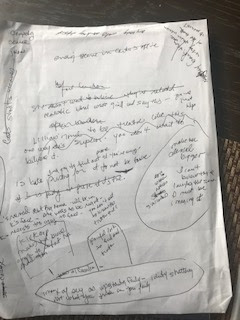
In 2016 I sent the manuscript to beta readers (check out the picture of of my technique for plotting my book). I incorporated their feedback and kept on going. Along the way I received editorial advice to write the book from both girls' POV's. I was reluctant to do that since I'm white, but Rebecca encouraged me in that direction. By the time I was ready to submit that version, the publishing industry had changed and that was no longer an option. In 2017 I made the difficult decision to start over from Kate's POV.

It was hard to give up all the work I had done to write Lillian's story, but it was the right decision. I re-outlined the book and started a new version focusing on Kate's journey. In doing that, I still went off on too many rabbit trails! 

Finally, last year (based on Joyce's encouragement) I took Kathy Temean's whole novel workshop. I received excellent feedback from three peers, incorporated their suggestions, and then sent it to an agent who read the entire 78,000 word manuscript.

The agent's insightful feedback provided a TON of things to work on--including deciding if this is a middle grade or young adult book. Ittook several months to incorporate her suggestions--including showing more of Kate's life before she moves to Charlotte. After re-writing the beginning, I realized that I had painted an overly optimistic ending and that needed changing! I decided the book needed to stretch out over an entire year and that required rearranging chapters.

Yesterday, I reached another milestone. I sent the revised 64,000 word manuscript to Joyce. She will go through it with a fine-tooth comb and I will revise it again.

And only after that--will I send it out.

So, that is why this book has taken me so long to write!

https://www.123rf.com/photo_128021414_word-writing-text-revision-business-photo-showcasing-action-of-revising-over-someone-like-auditing-o.html

Yesterday I texted Kathryn Frye, a Charlotte videographer who produced and directed the documentary, African American Album: Charlotte, NC Mecklenburg History.  She and Vermelle Ely, have been cheering for my book ever since I met them. I told her I feel that it's risky for a white woman to write about race, She responded: 

"It’s a great story from its creator, no matter what shade of human she is! We have always been fully confident that we will hold the book one day."

HOW ABOUT YOU?

Do you have a revision story? Please share in the comments!                                                       

Congratulations to Terri Michels for winning Janine Yordy's book, Jellyfish Wishes and Poems About Fishes. After entering my giveaways many times, she finally won!

ON A PERSONAL NOTE

I have grandchildren coming to visit so I'll be taking a short holiday from blogging. But I'll be back in your inbox soon!

Thursday, January 7, 2021

Thereasea Elder Wore Many Hats

 One of the good things about writing historical fiction set in the not-so-distant past is that you can interview people who lived through the conflicts you are writing about. 

One of the hard things about writing "recent" historical fiction is that the people you interview--your experts--are elderly and die. 

Ten years ago I posted my first blog about six people I interviewed for Half-Truths. Only one is still alive. In 2014 I wrote about four women who shared their histories with me. Only two are still living. 

Yesterday, I heard that one of these women, Thereasea Elder, passed away on January 5, at the age of 93.

                                Thereasea as a U.S. Nurse cadet in World War II.

Thereasea's Legacy

I met Thereasea in 2011. With open arms and a smile that never quit, she welcomed me into her home. At the same time, she welcomed Half-Truths into her life. A conversation wasn't complete without her asking, "How is the book coming along?" She encouraged me every time I visited her.

As I tried to understand the city of Charlotte in which she grew up, there were no questions or topics that were off-limits. She told me about the dangers she faced as the first nurse to integrate Mecklenburg County's Public Health Service and the asbestos waste products which coated their window screens from the factory in their Greenville neighborhood.  


In 2014 she proudly showed me the exhibit she helped put together at Johnson C. Smith University honoring those who integrated the medical profession in Charlotte. 

Thereasea's list of accomplishments is long. She was a strong advocate for public health, helped register Black voters, served as president of the Greenville Historial Association, was active in the National Association of Negro Business and Professional Women, served on the board of the Greater Carolinas Chapter of the American Red Cross, and started the Black Heritage Committee in Charlotte. 

Whenever we talked she had a new cause or passion. She was concerned about local drug dealers and gun violence; government officials heard her concerns over the phone and through letters. She received innumerable awards for her service to the city of Charlotte, including the Order of the Long Leaf Pine (North Carolina's Highest Civilian honor) and the Maya Angelou/Elizabeth Ross Dargan Life Time Achievement Award. 

But man, oh man, she loved her hats.


Dozens and dozens of hats were stacked in boxes in her closets. She wouldn't go out without one on her head that of course, coordinated with her outfit.


One day we had a "photoshoot" and Thereasea enjoyed every minute of it.


So did I.

Thereasea was brave and courageous. The same things my protagonist, Kate Dinsmore, wants to be. The same things I want to be.

In 2013 her biography, T.D.'s Truths was published. She was so proud!


The author's note includes an observation that resonated with me:

I was mesmerized by our first meeting. I was struck not only by the power of her narrative, but her ability to cause transformational change in our community. Her nurturing attitude was characterized by unselfish caring, supportiveness, and a willingness to share her time.  

Thereasea's inscription to me reads:

Dearly Beloved Carol,

God has blessed me with your Friendship and Love. To God be the Glory and Power always. 


On a Personal Note


Thereasea quoted this Bible verse to me when she was talking about some of the prejudice she faced growing up:

"For I know the plans I have for you, declares the Lord. Plans to prosper you and not to harm you plans to give you hope and a future. Jeremiah 29:11

Certainly, the Lord used Thereasea's talents, energy, and love.

One time my husband and I took her out to dinner at a favorite fish restaurant. After that, she never failed to end our conversations by sending him her love. She always reminded me to give him a hug and a kiss; her love for family inspired me.

I will miss Thereasea's hand clasping mine when we gave thanks for our food. I will miss her hug and her voice. I will miss her encouragement and pride in what I was doing. 

And I will miss her beautiful hats.


"Precious in the sight of the Lord is the death of His saints." Psalm 116: 15.

Monday, August 19, 2019

TOMORROW'S BREAD: A Review and Giveaway

Congratulations to Gail Cartee who won The End of the World and Beyond on last week's giveaway.

When I began researching Half-Truths someone--I'm afraid I don't remember who it was--told me about how Brooklyn, an African American neighborhood in Charlotte that was leveled as a part of urban renewal.  Tomorrow's Bread by Anna Jean Mayhew, breathes life into that vital, bygone neighborhood. 


This story of a community affected by urban renewal is not unique to Charlotte, NC; but it is told in such well-researched detail that people living in Detroit, Philadelphia, St. Louis --any area that was torn down and cleared out--will resonate with the book. As A.J. points out in her Author's Note, there were homes that would meet the definition of blight. 


This photo, taken in the old Brooklyn neighborhood, was typical of the image often presented of Charlotte's historically black neighborhood near uptown. In reality, the area was made up of mixed-income residences and businesses.  COURTESY OF CHARLOTTE-MECKLENBURG LIBRARY


But, there were also business, churches, theaters, and spacious brick homes that were destroyed. 


https://www.charlotteobserver.com/news/local/article66934337.html
Business district in Brooklyn.


REVIEW

This historical novel for adults is told through three different points of view. We see the destruction of the neighborhood primarily through the eyes of Loraylee, a single black mother who lives with her son, uncle and grandmother. Loraylee is in love with a white man, but in the sixties, it is against the law for them to get married. Everyone in Loraylee's family is attached to their friends, fellow church-goers, schools and businesses in Brooklyn; all four can't imagine life elsewhere. Her hard-working and matter-of-fact manner made her a person I would have liked to know. 


Reverend Ebenezer Gabriel Polk ("Eben") is the faithful pastor of St. Tim's and unofficial church historian of the church cemetery and the 151 slaves that were buried there. His third-person account of watching his cemetery and community bulldozed is gripping and poignant. (Personal note: Since I have included  a cemetery disinterment in Half-Truths, I was interested in how Mayhew incorporated that into the story.) Eben's own family history (most likely descended from President Polk), his sorrow over his deceased wife and his brother's tragedies, and his commitment to his community weave throughout the book. 


Persy, a white woman who has had struggles of her own, is the third point-of-view in the story. Her childless and loveless marriage contrasts with the loving family relationships in Brooklyn. Her husband is on the committee for urban renewal and she is as helpless to stop him as she is to heal their failing marriage. Although Persy is mainly on the periphery of the story, her life intersects with Loraylee's when they both are at the beach, and Persy is instrumental in saving Loraylee's son's life in a near-drowning. 

Half-Truths takes place about ten years before Brooklyn's urban renewal. Although it is in a different area of the city, Black leaders were concerned about how urban renewal would not provide relocation to the families and businesses. In this article, local NAACP leader, Mr. Kelly Alexander (who makes a cameo appearance in Half-Truths) stated some of his concerns.  


GIVEAWAY

Next week, I am interviewing A.J. on my blog. Leave me a comment on this blog and I'll enter your name in the giveaway. Enter again next week, and you're in twice! Tomorrow's Bread could be yours! Make sure you leave your email address if you are new to my blog. 


Monday, December 31, 2018

Run to the Light: A Review and Giveaway

Congratulations to Deborah Allmand for winning THE PLAYER KING from last week's blog post.

********
My blog readers know that I generally read and review books for children and teens. Every once in awhile I come across a book for adults that I want to share with you. Run to the Light (Bedazzled Ink, 2018) by Laura King Edwards is one of those. 

But first a disclaimer: Laura Kings Edwards' book about her sister Taylor's battle against Batten Disease is not an easy book to read. Batten, a rare inherited neurological condition that causes vision loss, progressive cognitive and motor decline, and seizures, usually strikes children between the ages of 5-10 and is always fatal. Laura does not hold back on describing her fear, anger, depression, and anguish during the twelve years that Taylor bravely fought the Batten monster. But she also eloquently shares the joy she experienced in the moments she shared with her brave little sister. 

If you've been reading my blog long enough, you will recognize this story. Laura gave me the privilege of hosting her cover reveal on my blog last March. Now, you'll hear about the story. Read it, and be inspired.


Read the story behind this cover here.

THE REVIEW

In 2006 Taylor was not quite eight when her family realized that her vision and school problems signified something far worse than any of them imagined--they were Taylor's first symptoms of Batten Disease. In evocative detail, Laura shows the reader the disease's progression, how it impacted Taylor and her family, Laura's journey to find acceptance, and most of all--how Taylor became a symbol of courage to her Charlotte, NC community and to the Batten world at large. 

Throughout the progression of the disease Taylor never asked, "Why me?" "Even as her body started failing her, she sought a normal life and never asked for extra help or attention." (p. 26) Taylor's resilience amazed Laura more than anything else.

Although there were the common stages of denial and numbness that we all experience when we receive shocking news, the King family--particularly Laura and her mother Sharon, turned their anger towards fighting the disease. Several months after the diagnosis, Sharon invited a small group of women to come for lunch. Laura listened as Sharon "declared war on Batten disease and urged the rest of us to join her on the battlefield."

"The doctors said there's nothing we can do," she said. "But I'm not going down without a fight." Her voice cracked as she described our opponent, ticking off the symptoms that had crept into my sister's life and the awful ones yet to come. But her resolved never wavered. "Nothing about this will be easy. There's little being done for Batten disease. There aren't many kids like Taylor. But we have to start somewhere. Someone has to take a stand." 
.......
In that moment, Taylor's Tale was born. (p. 29)

Taylor's family enjoying
The Magic Kingdom post- diagnosis. 2006

Sharon's decision to fight Batten led to taking Taylor cross-country to participate in a clinical trail to receive purified neural stem cells at Oregon Health and Science University in Portland. It led to raising thousands of dollars for research, attending umpteen Batten disease conferences, and learning the foreign language of medicine and science. It even led to a new North Carolina law that established the first rare disease advisory council in the country.

At the same time, Laura joined the battle by educating others by blogging, attending conferences, meeting leading scientists in the field, and working hard to raise money for research. Laura's personal journey intermingles with her running career which became a metaphor for her own fight. She was afraid to give up, thinking that Batten would win. "All my life I'd been running; I wasn't about to lose this race." (p. 54)

Two years later Taylor inspired Laura by running a 5K-- the only blind person in the race. Taylor ran tethered to her running buddy by a bungee cord.

Whereas I'd often felt only anger toward Batten disease, my sister had beaten her demons by ignoring them--by focusing not on what she'd lost, but on what she could still do. She didn't waste her time worrying about what Batten disease had taken from her. She paid it no mind, and she ran her race. 
Before the trees bloomed in the spring, I'd started running for her. ( 101)
Although Laura began running for something greater than herself, the specter of not crafting the perfect blog post or not answering an email to Taylor's Tale on time haunted her. Would she hurt her sister's chance of survival? As she moved from being a sprinter into a long-distance runner, Laura realized,
I'd come to understand the value of a long-term plan. I'd learned how to push my body past the limits of what I'd previously believed it could achieve. 
And yet, my sister's body was failing her. (p. 129)

Taylor and her dad on a family trip to
the U.S. Virgin Islands, 2010.
It took me a long time to learn that Batten disease is more like a marathon [than a sprint]. You start off strong, with lots of energy. You have runner's highs and lows. Some days you think you could run forever. But then some days you feel like when you cross the finish line, you'll be so glad to see it--so exhausted--you'll just be happy it's over. Some families, families whose kids have died, have told me in the end that it's like that. It's so bad, so freaking ugly, they can't face it anymore. It isn't even about making happy memories at that point. it's about their kid's dignity and their own survival, and about finding peace. (p.209)

Taylor's Fletcher School classmates raised $3500 for Taylor's Tale in 2013.
Taylor is third from the right.
The last race that Laura describes in the book is the one she ran blind--just like Taylor did. She trained for five months and used the same bungee cord that Taylor had used several years prior. She was cheered on by other runners, the media, and her family.

I'd run 13.1 miles in the dark But I didn't take a single step alone. As I ran the final stretch of Thunder Road, led by the voice of a friend and the courage of a dying girl, I understood: Batten disease may have cast a dark shadow on our world, but I wasn't running away any longer. 
I was running to the light. 
I believed.
And I felt free. (p. 225)


Taylor in 2016

WANT TO KNOW MORE?

"Together with other dedicated advocates, Taylor’s Tale is uniting elected officials, healthcare providers, public health officials, researchers, biotech industry representatives and patient advocates. This important work is creating real, lasting progress in the development of breakthrough treatments and life-changing legislation for rare disease patients."


Also, Linda Phillips most recent YA novel in verse, Behind These Hands, is a story of a young girl struggling with the fact that her two siblings are diagnosed with Batten. It is based loosely on a family in Charlotte. 


GIVEAWAY


This giveaway began in March with Laura's cover reveal. Add your name to that list by January 3 and you'll be in the drawing also. This time you have an extra chance to win since both Laura and I are giving away a copy. Please leave me your email address if you are new to my blog.

Monday, June 25, 2018

Behind the Scenes with Donna Everhart- Part II

Last week Donna Everhart, author of The Road to Bittersweet, relayed how she discovered her story, why she made Laci Stamper autistic, and why she included a traveling carnival. Thanks for coming back for this concluding post as we look behind the scenes of her writing process.


QUESTION #1

CAROL Were you conscious of the themes you wanted to include as you wrote, or did they come out of the story?

I was not, at first, conscious of any themes and I didn't write with this in mind at all.  This is something that often happens for me through the simple process of beginning to explore a story.  I've said in the past I'm a true pantster sort of writer,  (i.e. write by the seat of my pants) and although I'm writing to a contract - meaning I have to put together a proposal for each book consisting of a synopsis and the first three chapters -  there are still many aspects to each story not covered when it's sent off to my editor.  My synopses tend to run about five pages, but then I have to sit and write about three hundred pages and while I have the overall main ideas down, there's still plenty of room to explore. This is usually how I end up with something happening like a theme.  

In this story, I began recognizing there was an overarching theme and in this case, it was obviously the water.  As I began to put together the instances where it had a significant impact to my characters, the most obvious was the flood.  Then there was the necessity of drinking it for survival.  That, along with the fact that (without giving away any spoilers) it can kill us by drinking it, this all began to surface (no pun intended!) as a true foundation of this story.  Then I began to view the waterfall as having significance, as if their lives were in a free-fall, and that they really had no sense of control for much of what happened to them.  I love when I have those unanticipated moments in writing where something unexpected adds in a layer, making it more meaningful and significant. Those are the moments which I find truly magical, and I wish they'd happen more often!  
CAROL: That's interesting because for me, the theme was about Wallis Ann accepting herself. I loved the carnival chapters becausetthen she was forced to think about who was "normal" and who the "freaks" were. The ending was perfect!

QUESTION #2

CAROL: What can you share about your research process?

DONNA: I hope this doesn't come as a disappointment, but I mostly relied on good old Google.  I did speak to one person on the phone who was a lifelong resident in Jackson County and I needed her to clarify how the bridges that were out impacted the flow of traffic - although highly unlikely that there was "traffic," per se.  I found her on some site that blogged about Jackson County, and it was really happenstance to find her and that site. She confirmed you could go northbound, but not southbound on Highway 107 for instance. Little details like that matter.  

I also spent an extensive amount of time researching about dialect for that timeframe too.  What's been amusing to me, is when I talk about the dialect used in the book at a book event, and I tell those who came just before I read the book that Wallis Ann will say things like, "I won't going there," instead of "I wasn't going there."  Some laugh and shake their heads and say, "Well shoot, that's how I talk anyway."  (and they're not from the mountains.  :)   

One particularly helpful site where I studied about dialect was done by the University of South Carolina, College of Arts and Sciences.  I listened to actual recordings taken in 1939 of residents in various mountain counties of North Carolina, and Tennessee.  This work was done by a gentleman by the name of Joseph Sargent Hall or his assistant Bill Moore, and the transcriptions and recordings are available to listen to and read.  They have done an extensive amount of work on this site for the speech patterns of Appalachia - which the pronunciation of in of itself can get people worked up, as in whether you say App-a-LAY-cha, or App-a-LATCH-a.  

I always find this part of the work really interesting, and feel as if I
come away from each book with a little bit of knowledge I'd never had before.  Like the fact they called Coca-Cola "dope."  The fact that Wallis Ann and Laci could have Snickers, or Lays potato chips, and what cotton candy was called back then (spun sugar).  I learned about making a log cabin, and how to start a fire like Wallis Ann did - using "punk wood" and quartz rock.  Other parts of the research had to do with studying topography maps as I wrote (click on the link to see the map Donna consulted), so that I could put Wallis Ann and her family into certain areas with some sense of what they might have experienced while traveling. One part that I studied long and hard was along the Tuckasegee River, as well as the ridges nearby like Cherry Gap and Cullowhee Mountain.  I will be going to that area later this year, and can't wait to take pictures of the river and possibly some of the other spots mentioned in the book.
Donna Everhart

A SONG INSPIRED BY THE BOOK

Last week I shared a picture depicting Laci. Here is "The Pretty One" written by Pam Tillis. This is part of Shari Smith's ingenious TRIO exhibits: "One book is given to both a songwriter and a visual artist. They write a song and create a work of art inspired by the book they read fulfilling their TRIO. Each TRIO selection will be installed as part of an exhibit debuting at the Southern Independent Booksellers Alliance in September of 2017 and traveling to museums, galleries, and literary events throughout the following year."


Donna is working on her fourth book, SHINE MOUNTAIN (working title). The main character, Jessie Sasser, is sixteen years old, who is quite unhappy with her lot in life.  Born into a family legacy of moonshining, she wants no part of it because she's certain it killed her mother. The story takes place in 1960, in Wilkes County, in an area known as the Brushy Mountains. 

GIVEAWAY

This is your last chance to enter the giveaway for the Audiobook fantastically performed by Amy Melissa Bentley. Random.org will select a winner on Thursday, June 28. Leave me your email address and name and I'll add your name to the list. If you've already entered that's okay, I'll add your name again!

And one last thing. Check out the cover reveal for Donna's next book, The Forgiving Kind. It's gorgeous!

Monday, June 18, 2018

Behind the Scenes with Donna Everhart--Part I

Congratulations to Darlene who won the seven audio book giveaway last week.

*************
As promised two weeks ago, Donna Everhart generously agreed to give us a glimpse into how she developed THE ROAD TO BITTERSWEET. (If you haven't had a chance to read my review, I hope you will now. This interview will make a lot more sense if you do!) I find it fascinating to see how authors come up with their stories and I bet many of you do too. 


QUESTION #1

CAROL: How did you decide on the main idea for the story? Was it hearing about the flood of 1940 in Silva, NC?  

DONNA: I was nervous about coming up with an idea for my second book after my debut, THE EDUCATION OF DIXIE DUPREE was so well-received.  It's hard to follow up a story like that, one that's gritty, graphic, and delivers such a gut punch. 

One thing I did know; I wanted to write something very different, and I wanted to set the story in the North Carolina mountains, first, because I love the region, second, because it has so much history.  I've stood at many a lookout on a bright day with the sun shining, staring at the peaks and valleys, watching the shadow of clouds passing over the hillsides, enjoying the beauty of the scenery, yet, I have also felt a sense of the mysterious, and an appreciation for the rugged hardiness of those who came and made a life for themselves in the area.

Back in the late 90s, my husband and I hiked to a preserved, historic cabin in Doughton Park, called the Caudill Cabin.  It's maintained by descendants of the Caudill's and North Carolina's Parks and Recreation system.  The hike, which totaled fifteen miles, was strenuous, but worth it.  Getting to see something built in the early 1900s and that was still standing, was extraordinary.  This cabin, as the signage says, is one of the only remaining structures left standing from the 1916 Basin Cove flood. It housed a total of eight people, two parents, and six children. The number of inhabitants originally was thought to have been sixteen, but someone at some point (maybe a member of the Caudill family) corrected that.  The interior of the cabin couldn't have been more than about 150 square feet, and it was mind boggling to think about it sheltering eight individuals. 


Caudill Cabin, Hikers of Iredell Club

I am fascinated by this sort of thing, a piece of history right before my very eyes, and I have always had this tendency to want to let my mind wander about, thinking about the people who lived in it, how they managed to survive, picturing what their lives must have been like.  On top of that, there was the flood that forced this family to move.  I did some research on flooding in the western part of North Carolina and learned there had not only been the 1916 flood, which the Caudills were part of, but one in 1940, which was just as devastating. I began to think, "what if a family tried to make it after this sort of devastation happened?"  I had to believe there were some who did, and then I began to think, "exactly how would that work? If they had nothing?"
Pictures from Donna's hike with her husband. Look carefully at the picture on the lower right
 and you can see Donna peeking out from the cabin doorway.
The combination of my love for this part of my home state, the interesting hike to a cabin that depicted the reality of the lifestyle, and the floods all provided the inspiration. That was a LOT of material to work with, and after I settled on the 1940 event as the timeframe I wanted to write about, I began writing. 


Near Marshall, NC 1944

QUESTION #2

CAROL: Why (and perhaps how) did you decide to make Laci autistic? 

DONNA: The why likely comes from the fact I like to work in areas where I have little knowledge, to explore differences in order to better understand them. A lot of progress has been made with regard to autism, but just like those who first began to diagnose it in the 1800s, who knows where the research will be fifty years from now.  The term "idiot" was used in earlier time frames for those who appeared to have strange behaviors, and seemed incapable of learning in the same way as the rest of society.  I researched about autistic savants, those who have an uncanny ability for mathematics, music, or memory.  We likely all think about the movie RAIN MAN when we think of an autistic savant.   

According to the Autism Research Institute, "The reason why some autistic individuals have savant abilities is not known... Dr. Rimland speculates that these individuals have incredible concentration abilities and can focus their complete attention to a specific area of interest. Admittedly, researchers in psychology feel that we will never truly understand memory and cognition until we understand the autistic savant."

How I decided is the desire to include what might offer a different twist, to explore a uniqueness in a very different setting from today, to consider unusual situations a family might encounter with others, and their perspectives. I began to think what if there was a young girl in 1940 in a remote area, with extraordinary musical talents, who'd been diagnosed as an "idiot savant."  What would this mean to the family dynamic, and in particular, how would it impact a younger sibling?  


Laci by Cyndi Hoelzle
This picture is a part of Trio.

QUESTION #3

CAROL: Why and how did you decide to include a traveling carnival? 

DONNA: Although I haven't been to our state fair in about twenty years, I do remember how captivated I was as a child when my parents would take me and I'd see all of those mysterious colorful banners and the carnies screaming about "Freaks!" and "Come see them all!" There was this air of suspense, and intrigue as I passed by the tents.  My parents never allowed my brother or I to go see the Man With The Alligator Skin, or, "The Two-Headed Goat," for instance, but I sure wanted to. People who were being exploited back then, like the bearded woman, (androgen excess, or hypertrichosis) can today be explained away by a medical reason, but there is this wish as a kid to believe in the bizarre, the inexplicable, when it comes to the "attractions" that were and are so typical of those traveling shows or carnivals. Because of Laci's situation, it seemed like this would make for an interesting dynamic to the story, to have them experience something they'd never experienced before, yet to have it sort of backfire when one of their own is used for that exploitation.

Aside from that, it was also the fact this family had been through so much post-flood, and I needed some way to give them a break, a reprieve.  Because they performed in some sort of musical capacity from the beginning, I felt it could work as a natural progression for the story.  I actually thought about having them stick to what Wallis Ann feared - go around the countryside "begging."  However, this was just coming into the post-Depression era, and while I knew people of the mountains would gladly give what they had, they wouldn't have much to spare.  In reality, the Stampers wouldn't be able to do this for long and get anywhere.  I could see early on if I wrote it like that, I was setting them up for more failure and when would the starvation, hardships ever end?  How would I turn the story so they stood the chance to not only survive, but to recover what they'd lost?  


                             Clogging Video by David Hoffman, shot in 1964

Come back next week for Part II when Donna shares some aspects of her research.


GIVEAWAY

If you are interested in winning the audio book of THE ROAD TO BITTERSWEET (courtesy Tantor Audio) please leave me your name and email address, particularly if you are new to my blog. I'll draw a winner on June 28.


DONNA'S NEXT BOOK! 


THE FORGIVING KIND, will go on sale, January 29th, 2019, with an official publication date of February 5th, 2019. That story is also a southern fiction coming of age novel, and is about a
twelve year old young girl called Sonny Creech, who lives with her family in Jones County NC, on a cotton farm. Sonny has the special gift of water divination, a talent she shares with her father.  After a tragic accident claims his life, she and her family become entangled with a reclusive neighbor named Frank Fowler who offers to finance that year's cotton crop. It's set in 1955.


THE NIGHT WAR: A MG Historical Novel Review

  By now you should have received an email from my new website about my review of THE NIGHT WAR by Kimberly Brubaker Bradley. (It'll com...