
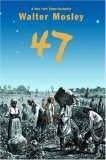
I was initially attracted to 47
since I thought that it might inform the historical fiction which I am working on. Unfortunately, I was seriously disappointed. I found Walter Mosley's strange mixture of historical fiction and speculative fiction confusing and an obstacle in depicting the serious theme of slavery in the antebellum South.
Originally I was drawn into the narrator's story of how he, Forty-seven, (the number with which he is branded with which becomes his name) meets Tall John, a young man who develops into his best friend. Although portrayed as an escaped slave from a nearby plantation, the reader and Forty-seven slowly discover that Tall John is no ordinary human being. His extraordinary powers include being able to fly between galaxies, heal people with vials of medicine which he has hidden away, inexplicably transport people over miles of land, and read dreams. None of these extraordinary talents are fully explained in the text and in fact, some "facts" such as Tall John arriving in a "sonship" are revealed late into the story. Mosley does not provide enough textual clues to make this alien super-hero, his former world, or his mission, make sense to the reader. Although Tall John has a wonderful message to 47: "No nigger or master be," this message is diluted as the reader tries to figure out the convulsions of a science fantasy world that never makes sense juxtaposed against a Southern plantation.
When I teach the science fiction or fantasy genre I always emphasize that the world which the author creates must make sense to the reader. If a reader has to stop reading to try and figure out what is going on in the story, then the author has not adequately done his job. Unfortunately, I feel as if Mr. Mosley's book for young adults falls into this category. In addition, I listened to the book on AudioBooks and found Ossie Davie's (the narrator) voice difficult to understand; I think middle grade students probably would not persevere and return the book to the library without listening to it. (Little, Brown and Company, 2005)
Technorati Tags:
47, Walter Mosley, historical ficiton, speculative fiction, antebellum South


1 comment:
That's interesting. I just finished my first middle grade historical novel, and I plan to workshop it in NYC at SCBWI in a couple of weeks. I'm always on the look out for books in my genre. Like you, I cringe at the thought of mixing the old south with sci-fi. That would be the equivalent of peanut butter spinach.
Post a Comment