
Alice Faye Duncan reached out to me through Twitter and asked if I was willing to review her two new picture books. Since I'm always interested in highlighting new books for you, of course I said yes! Here's the first one, MEMPHIS, MARTIN, AND THE MOUNTAINTOP: The Sanitation Strike of 1968, illustrated by R. Gregory Christie. (Boyds Mills Press, 2018)

This historical fiction picture book aimed at upper elementary or middle school readers, is based on the life of Memphis teacher, Dr. Almella Starks Umola. Her father was a pastor, community organizer, and strategist for the sanitation strike. Dr. Umola walked with her parents during the protests and heard Dr. Martin Luther King, Jr. deliver his "I've Been to the Mountaintop" speech.
Here's a great interview with Ms. Duncan that includes the many revisions that went into this story told from the fictional character, nine-year-old, Lorraine Jackson's POV.
REVIEW
I remember Memphis.
I remember the stinking sanitation strike.
Alley cats, rats, and dogs rummaged through the trash.
Black men marched through Memphis with protest signs raised high.
I also marched in '68 with red ribbons in my hair.That is the stark opening to Memphis, Martin, and the Mountaintop. Lorraine relates that the garbage trucks were old, rusty, and not well maintained. On a rainy, bleak day in Memphis, two black sanitation workers--working for $1.70 an hour--were crushed when a packer blade malfunctioned.
 |
"Slop dripped down their clothes." |
In the morning and afternoon for sixty-five days, sanitation workers marched fourteen blocks through the streets of downtown Memphis...My daddy marched in that number. He marched for better pay. He marched for decent treatment. My daddy marched for me.It was a difficult winter for young Lorraine, her parents, and the other strikers' families. But everyone was encouraged when they heard Martin Luther King, Jr. was coming to Memphis.
 |
| "Dr. King said, 'All labor has dignity,' Dr. King's voice was loud and stirring." |
That night, Mayor Loeb declared a state of emergency. "From my bedroom window, I saw soldiers in big green tanks creep slowly up the street. I waved to my friend Jan who sat in her window too."
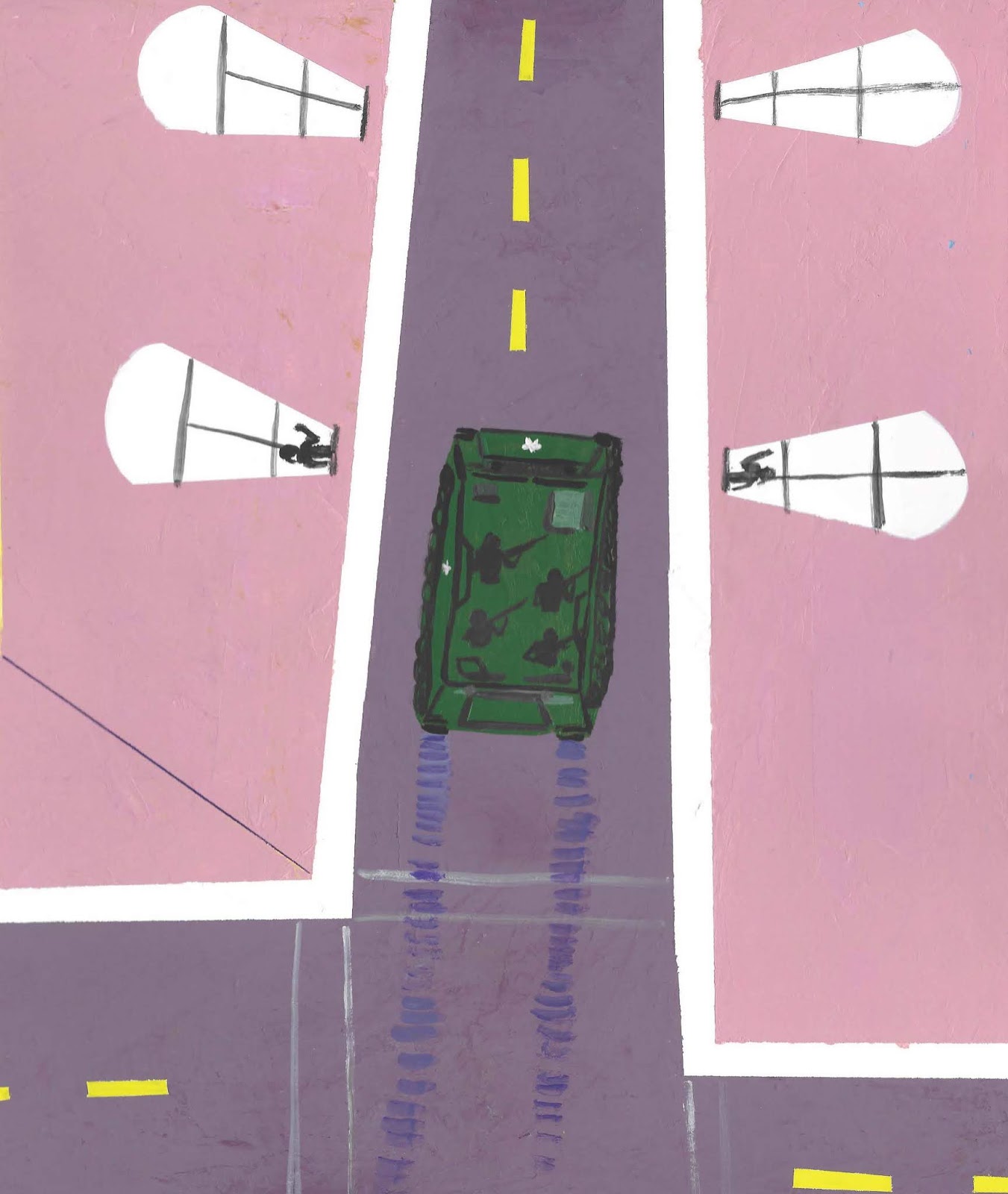 |
| "Nobody played outside that day. Fear locked us in our houses." |
In April, Dr. King returned to Memphis but became sick and was unable to speak in person. His speech was broadcast to those who had gathered together at Mason Temple Church. "In the face of death threats, Dr. King spoke boldly. He encouraged Memphis strikers and strike supporters to march, boycott, and raise their voices for workers rights until victory was won."
That night, he was gunned down when a "bullet pierced the dreamer's neck." Afterwards, Lorraine Jackson wrote this poem and her mother hung it up on the crumbling walls of their rental home:
The King Is Dead
Not long ago,
There lived a King.
He did not live in a castle.
He did not wear a crown.
He did not rule a royal court
Or ride in chariots.
The King marched in the streets.
He lived to help the poor.
He lived for peace and love.
Hate killed the King.
The King is dead.
What will the people do?
The sanitation strike ended eight days later when President Lyndon B. Johnson sent in a labor official to negotiate a settlement. In the deal, the city recognized the labor union, the sanitation workers received 15 cents an hour more, and they were promised job promotions based on merit--not race.
 |
"So much was won. So much was lost. Freedom is never free." |
That hopeful yet sobering thought helps conclude this informative picture book. Ms. Duncan, as a librarian for the last 25 years in the Memphis public schools, included a timeline and annotated source list at the back of the book. I recommend this book as a curriculum resource for grades 4-7. There is a lot to learn within these pages and R. Gregory Christie's illustrations amplify the text.
Having recently listened to Eyes on the Prize, Memphis, Martin and the Mountaintop helped me visualize this particular event on the civil rights timeline.
Having recently listened to Eyes on the Prize, Memphis, Martin and the Mountaintop helped me visualize this particular event on the civil rights timeline.
GIVEAWAY
Ms. Duncan is giving away a personally autographed copy of this book to one fortunate winner. As she said in an email to me, "Readers deserve kindness and an extra 'oopmh'." Please leave me a comment by November 8 and your email address if you are new to my blog. If you share this post on social media and let me know what you did, I'll enter your name twice.


