Showing posts with label Mightier than the Sword. Show all posts

Monday, October 25, 2021

Playing with Writing Types by Guest Blogger, Rochelle Melander

Last week when I introduced Rochelle Meander's new book, Mightier than the Sword, I promised a follow-up blog by Rochelle. In this post, Rochelle takes her suggestions for students and challenges writers to try their hands (and computers!) at using a different format. 


In the comments, let me know how you might change up your writing. So, without further ado...here's Rochelle.


Several years ago, the artist Jessica Hagy suggested that dangerous habits emerge at the intersection of the “tried, tired, and true.” No kidding. As a freelance writer, I’ve written dozens of profiles, hundreds of how-to blog posts, and more essays than I can count. These familiar formats come easily to me. Do they work? Yes. But are they tried and tired? Yup. 


I admire writers who play with form. Jennifer Egan put a power point presentation into her novel, A Visit from the Goon Squad. Amy Krouse Rosenthal used an encyclopedia format to tell her life’s story in Encyclopedia of an Ordinary Life.


Playing with the form of your piece, even just for fun, can help you break with “tried and true” habits. Even if you don’t end up using the new format in your finished piece, the work you put in will add richness to your writing and possibly ignite your creativity.


When I invite my students to play with new formats, it has an additional benefit. Many students feel daunted by traditional formats with stringent requirements. They get stuck on the mechanics and cannot access their creativity. But introducing a format with different or fewer rules can bypass the panic and unlock their playfulness. 


Here are three ways you might play with form. Use these ideas to play with your current project, create a new piece, or simply as writing practice. If you’re a teacher, each of these can be used as a mini-lesson.


Play with Poetry

The last time I taught poetry, I had to convince a seven-year-old boy that the poems he was about to hear were not just about love and other disgusting emotions. It took about seven “gross” poems to get him to believe me. 


Even though I know the many uses of poetry, I tend to save it for my more emotional moments. I rarely use poems to write a profile of an artist or a how-to piece. But I should! In Infinity: Beyond the Beyond the Beyond, the mathematician Lillian R. Lieber used poetry to explain the mathematical concept of infinity. (It’s brilliant!)


Your turn: Consider your work in progress: could you write it as poetry? Or do you have an essay you might write as a poem? Japanese writers link together several haiku to tell a story. (This is called Renga—and is usually done collaboratively, with writers alternating stanzas.)


Make your Manifesto

Throughout the centuries, people have written manifestos to protest injustice, declare their rights, and announce their vision for a better future. The French playwright and political activist Olympia de Gouges wrote her manifesto to challenge inequality: Declaration of the Rights of Woman and of the Female Citizen (1791). At the Senaca Falls Convention held in 1848, Elizabeth Cady Stanton and others wrote their manifesto expressing the injustices against women and demands for equality. In recent years, people have written manifestos on creativity (How to Be Creative by Hugh McLeod) and Design (The Design Funnel by Steven Hay).


Your turn: But what about you? If you or your character could write a manifesto, what would you declare? You don’t have to write about the most serious problems in the world. You could simply write a manifesto about the dirty socks littering your floors or the horrible food in the cafeteria. What do you need to declare?


Create a Speech

Have you ever watched a TED Talk and wondered what it would be like to give a speech like that? The Rev. Dr. Martin Luther King, Jr. wrote books and letters—but he was known for delivering riveting speeches that helped people see a new and different world. The young people from Marjory Stoneman Douglas High School survived a horrific shooting then used their visibility to give speeches against gun violence.


Your turn: Take your best personal story, your favorite topic, or a cause you care about, and write a speech. You get bonus points if you create a talk that doesn’t use a power point presentation!


What next?


Oh, the fun you can have! There are so many forms you can play with—cross-examination, instructions, recipes, plays, texting, and more. Make it a part of your writing practice to try a new form each week—and see if it changes what or how you write. You might just land on a mash-up that works!


 Maybe you'll try writing a rap, like Sonita Alizadeh did!


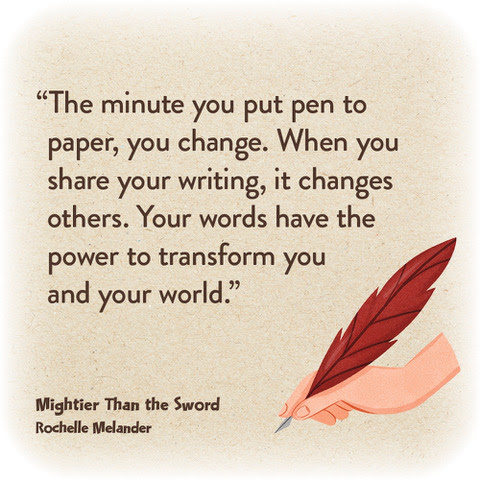
Throughout history, people have picked up their pens and wielded their word - transforming their lives, their communities, and beyond. Representing a diverse range of backgrounds and experiences, Mightier Than the Sword connects over forty inspiring biographies with life-changing writing activities and tips, showing readers just how much their own words can make a difference.


About the author: Rochelle Melander wrote her first book at seven and has published 11 books for adults. Mightier Than the Sword: Rebels, Reformers, and Revolutionaries Who Changed the World through Writing is her debut book for childrenShe’s a professional certified coach, an artist educator and the founder of Dream Keepers, a writing workshop for young people. She lives in Milwaukee, Wisconsin with her husband, children, and two dogs. Visit her online at writenowcoach.com or rochellemelander.com


GIVEAWAY

Leave a comment by 6 PM on October 27 to enter; continental U.S. addresses only. If you are a writer, tell me your plans to switch up something you're writing and I'll enter your name twice. PLEASE leave your email address if you are new to my blog.

Congratulations to Rosi Hollenbeck who won The Ghoul's Guide to Grammar and to Connie Saunders who won The Lady of the Library in last week's giveaway. BTW, if you don't already follow Rosi's blog you should--she has lots of great giveaways and reviews too!


Monday, October 18, 2021

MIGHTIER THAN THE SWORD: AN ELA RESOURCE, AUTHOR INTERVIEW and A GIVEAWAY!

 In the "it's a small world department," my sister Barbara (who lives in Milwaukee) met Rochelle Melander at a July 4th picnic this past summer. After hearing Rochelle speak about her book, Mightier than The Sword (Beaming Books, 2021). Barbara told her that she should contact me because I love encouraging kids to write. (In case you didn't know, my second book was Teaching the Story: Fiction Writing in Grades 4-8.)  After the picnic, Rochelle looked me up and realized that I was on her list of people to contact to be part of her blog tour!

I am proud to introduce you to Rochelle's inspirational and educational new book.  Rochelle has so much to say about teaching writing to kids, that today I'm reviewing her book and interviewing her. Next week she will guest blog about, "Playing With Writing Types."


REVIEW

From Murasaki Shikibu, a Japanese novelist and poet who lived from 978-1016 to Malala Yousafzai, a contemporary Pakastani activist, writer, and the youngest person to win the Nobel Peace Prize, Mightier Than the Sword highlights men and women throughout history and from diverse cultures who changed the world through their writing.

Rochelle's list includes well-known figures who you may or may not think of as writers: Charles Darwin, Frederick Douglass, Zora Neale Hurston, Nellie Bly, Ida B. Wells, and Rachel Carson. But there are also many lesser-known individuals such as Abu Abdullah Muhammad Ibn Battuta, Wang Zhenyi, Ada Lovelace, Mary Garber, and Sequoyah and many more. 


In addition to the short easy-to-read essays about each writer and the ways in which the individual's writing affected the world, there are suggested writing activities and a pithy quote from the writer.

"If you want to change the world, pick up your pen and write." - Martin Luther

Martin Luther was a German theologian who wrote in the early16th century. After his biography and work as a writer, his entry includes the development of Gutenberg's printing press which enabled more people to read the Bible. Luther's Ninety Five Thesis against the Catholic Church invited debate and promoted change. The author uses that point in history to challenge readers to find ways to invite debate.

This is the "Write to Create" activity for Luther: 
Martin Luther used repetition and rhythm so people would enjoy reading his words aloud. He used relatable images to explain complex topics: “A lie is like a snowball: the further you roll it, the bigger it becomes.” Keep a notebook to record juicy words, favorite phrases, and interesting snippets of conversation. p. 17

Mightier Than the Sword is a rich curriculum resource for grades 4-8. Besides the writing activities associated with each writer, the book ends with ten more pages of activities! There are ideas to get the reluctant writer going, revision ideas, advice from the featured writers, and of course, a list of books about writing.

                                                *****


AUTHOR INTERVIEW

CAROL: Did you write the book or the pitch first?

ROCHELLEI wrote the pitch first. When an agent expressed interest, I wrote the proposal. (I did that quickly, in about 6 weeks.) When the publisher accepted it, I wrote the book.


CAROL: How did persistence help you sell your book?


ROCHELLE:  As an artist educator, I’ve longed for a book like Mightier Than the Sword. I believed the book would help me introduce young people to writing mentors from a variety of disciplines and support students in writing their stories. When I hit obstacles, connecting to this purpose kept me going. 


Researchers call this grit. According to psychologist Angela Duckworth, “Grit is passion and perseverance for long-term goals. … Grit is about having what some researchers call an 'ultimate concern'—a goal you care about so much that it organizes and gives meaning to almost everything you do.” 


When I first pitched the book in early 2018, an agent loved the idea and requested the proposal. But she rejected it—because she wanted more of a deep dive into history. I revised and submitted it to more agents—only to get a slew of rejections. Many of them said the book was too educational—and not right for the trade market! Then an agent requested a revise and resubmit—which I did. As I waited for their response, I sent it out to just a few more agents. When an agent I met at a conference offered representation, I sent a note to the agents who’d been sitting on the proposal for months. They all rejected it. I wasn’t keen on the representing agent, so I tried #PitMad. Surprise! I had four hearts from four different editors. One of those, Beaming Books, offered a contract. Woot!


For me, grit meant repeatedly reminding myself of my purpose—to help young people fall in love with writing. Once I got the contract, I still had hours of research and writing ahead of me—and that purpose helped me shape every single essay in the collection. If you’re stuck or struggling, consider your ultimate concern: why is this project important? Who will it serve?


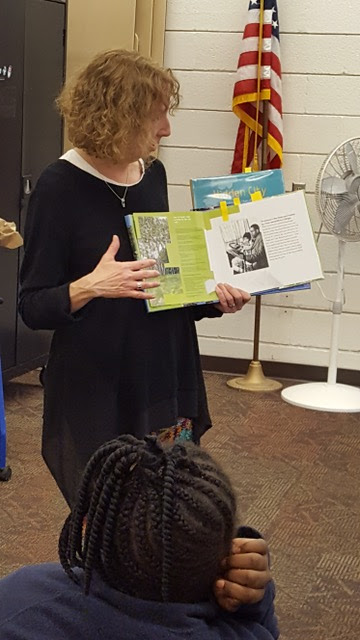
Rochelle teaching
young writers.

CAROL: How did you come up with these particular writers? You had centuries and the whole world to choose from!

ROCHELLE: The writers! I first came up with the idea for the book in 2009 and started collecting names. When I decided to get serious about the book, I searched online, read anthologies and talked to professors to find names. Once the publisher accepted the book, we worked together on finalizing the list. I wanted to make sure the list was diverse in multiple ways: disciplines, gender, race, culture, writing genres, and more. The book includes 40 writers, 5 interludes, and many short profiles!

CAROL: What were the lessons about writing that you learned while researching and writing this book?


ROCHELLE: I learn from every book I write, but Mightier Than the Sword brought so many more lessons—probably because I was researching and writing about people who used their writing to make a difference in their worlds. Here are three of them:


  • It’s okay if you weren’t a successful student. Follow your passion. Many of the writers I featured did poorly in school. Charles Darwin skipped out on grade school lessons and dropped out of medical school. But when he discovered his passion for nature, he succeeded.

  • Write about what matters to you. Passion drives persistence. When congresswoman Patsy Mink was in college, she started a letter campaign to protest segregated student housing. She succeeded—and the college changed their policy.

  • Writing is difficult. Do it anyway. Because of social media, we see writers celebrating their wins, but we don’t see the sweat equity that went into their work. It took James Baldwin ten years to write his autobiographical novel, Go Tell It on the Mountain. During that time, he struggled to earn money and deal with self-doubt. 

GIVEAWAY

Leave a comment to enter the giveaway. You'll have a second chance to enter after  Rochelle's next post. A winner will be drawn after 6 PM on October 27. If you are a media specialist, home school educator, or ELA teacher let me know--I'll give you another chance to win this book. AND if you compare Mightier than the Sword to What's in Your Pocket? from last week's blog, you get an additional chance!

PLEASE LEAVE YOUR EMAIL ADDRESS IF YOU ARE NEW TO MY BLOG.

Congratulations to a new subscriber, Suzy Leopold, who won WHAT'S IN YOUR POCKET? from last week's blog. 

THE NIGHT WAR: A MG Historical Novel Review

  By now you should have received an email from my new website about my review of THE NIGHT WAR by Kimberly Brubaker Bradley. (It'll com...