Showing posts with label teaching writing. Show all posts

Friday, April 5, 2024

UPCOMING EVENTS!

Here are some upcoming writing events that might interest you or the teen in your life.

Ten Steps on Your Path to Publication

When I moved to Matthews, NC a few years ago I was delighted to discover Matthews Christian library walking distance from my home. Of course, I introduced myself to the librarian, Tiffany Slack, and told her about my passion for books and writing. 

Recently, Tiffany contacted me and asked if I would be willing to participate in their 25th anniversary celebration. She asked if I would talk about getting published since many of their patrons ask about that.

It just so happened that had been my topic at a recent workshop for a library in the Charlotte Mecklenburg system, and so I replied with a proposal.

And just like that, this is going to happen in May!


                                        🖊🖊🖊🖊🖊

WOW! A Week of Outstanding Writing


Do you have a tween or tween who loves writing? In June I will lead a fun writing camp for kids. Please pass this information along to teachers or parents who know a child who might love learning more about writing a short story. I'll use activities from my book, Teaching the Story: Fiction Writing in Grades 4-8.


                                        🖊🖊🖊🖊🖊

Writing Christian MG or YA Fantasy

If you dream of writing middle-grade or young-adult fantasy, the virtual Write2Ignite Master Class still has a few spots open. For an interview with speaker Amy Earls, click here


Questions about any of these events? Feel free to email me.

Congratulations to Marci Whitehurst who won a copy of Linda Phillips' book, CRAZY.


Saturday, February 10, 2024

ROSIE WOODS IN LITTLE RED WRITING HOOD: Book Review and Author Interview by Guest Blogger Elliott Kurta


I'm pleased to have Elliott Kurta return to my blog. He is now a busy sophomore so I appreciate him taking time from his studies and volunteer work to share his thoughts about Rosie Woods in Little Red Writing Hood.

Audience: 1st – 5th graders; teachers

In 3 Words: imaginative, bite-sized, funny

One Sentence Synopsis: Rosie Woods explores the five steps of the writing process, using the story of Little Red Riding Hood as an example.

Final Verdict: 4.5/5 stars


 REVIEW

            Rosie Woods has a problem. A big problem: a bout of writer’s block is stopping her from writing a story for her English class. If only her friend Wolfie would stop talking, she might be able to spin an idea together! Under the guidance of her teacher, Mrs. Marshall, Rosie chips away at her writer’s block, in the process learning about the five elements behind every great story and retracing the path of another familiar hero—Little Red Riding Hood. Studded with illustrator Eleanor Howell’s soft watercolor drawings, Maya Myers' novel is an engaging exposé into the writing process.

            Bringing a new twist to a centuries-old tale, Rosie Woods breaks the art of story-telling into five simple components: setting, hero, problem, solution, and a twist ending. Our story starts as Rosie receives an assignment to write a creative short story. As the novel progresses, she explores the five elements one by one, slowly incorporating each into her own work-in-progress. Each new discovery is similarly mirrored in the novel: the chapter that sees Rosie learn about setting also introduces readers to Rosie’s schoolhouse and briefly explores the nature of Rosie and Wolfie’s friendship. Little Red Riding Hood ultimately forms the backbone for this story, echoed in Rosie’s personal character arc and in the short story she’s writing. While admirably ambitious, the story’s heavy stack of allegories and analogies seems as precarious and towering as a stack of forty mattresses, and after three concurrent retellings, Little Red Riding Hood’s story starts to feel as lumpy and out of place as a pea. Overall, each plotline contains far too many working parts for most kids to keep track of, making it difficult to focus on the writing process the book is trying to teach. 

            Although the plot of Rosie Woods may be lacking, author Maya Myers' writing certainly is not. From start to finish, Rosie remains a likeable, shy heroine every reader can rally behind and relate to, especially if they’ve ever struggled to tell a story of their own. Myers is able to effortlessly relate to elementary school kids, offering them a story with stakes they can understand. Her prose meets readers at their level of experience, neither attempting to gloss over harder concepts nor shoving readers headfirst into the world of creative writing. Unlike the blocky, predigested sentences of most kids’ books, Rosie Woods features whimsical turns of phrase and clever wordplay, keeping kids engaged and entertained. For example, as Rosie considers raising her hand in class to talk about plot twists, we learn that “her tummy made a different kind of twist.” Later, on page fifty-nine, as Rosie worries about accidentally hurting Wolfie’s feelings, it feels “like there… was a storm in her brain.”

            There’s no doubt that Rosie Woods in Little Red Writing Hood is a great introduction to the world of writing. By breaking down a story into five simple ideas, Maya Myers eases kids into the role of storytellers. In presenting the dichotomy between Rosie and Wolfie’s writing styles—Rosie takes all week to finish her story; Wolfie is done after a day or two—she reinforces the idea that no two writers are alike and that everyone is allowed to work at their own pace. While at times confusing, the book imparts several valuable lessons and leaves kids with the impression that anyone can be a writer—all it takes is passion and perseverance.

AUTHOR INTERVIEW 

ELLIOTT: What inspired you to write Rosie Woods in Little Red Writing Hood

MARA: The title came to me first, as a pun, and I thought surely someone must have written this book already, but they hadn’t, not quite. I wrote it as a picture book first, and my agent suggested I adapt it for older readers. I had never written a chapter book before, and I was resistant . . . for about a year. Then I gave in and tried it, and it was so much fun!

ELLIOTT: What did your writing process look like? Are you a “plotter”, a “pantser”, or somewhere in between? 

MARA: I guess I’m somewhere in-between. I often know where I want a story to end up before I know anything else, and it’s usually easy for me to figure out where it starts, but I don’t always know what will happen in between. With the Rosie Wood series, I felt my way in the dark for the first book. I made plot-point outlines before starting the other three.

ELLIOTT: Do you find it challenging to cast yourself back into the perspective of a child when writing? Do you have any ‘beta readers’—like a few kids or fellow elementary-school writers—that you test your books out on? 

MAYA: I used to teach elementary school, so I’m quite familiar with the kid mindset, and I often approach a character or a scene from the perspective of a kid I know. My husband, who also writes for kids, is always my first reader, and I have a few other writer friends I bounce things off of

ELLIOTT: How has your experience within the field of education shaped the stories you write? 

MAYA: This was the first time I’ve really gone into teaching mode in a book, and it was fun. I had to do some research to see how curriculum points have changed since I was teaching, but I think my time in the classroom helped me write pretty realistically about assignments and conflicts that come up for kids this age.

ELLIOTT: In your book, you use an elaborate allegory to teach kids about the different elements of storytelling. Why do you feel it is important that we continue to teach the next generation how to read and write great stories?

MAYA: I didn’t really think of it as an allegory; it was pretty straightforward in its intention, which is to engage readers in learning the elements of storytelling. I think it’s a kind of superpower to understand the components that make a story compelling. I want kids to want to write because it’s a great way to process the world, to understand ourselves and build empathy for the people around us. It’s incredibly rewarding to create something that brings joy and understanding to other people. And I love to read, so I want more writers making more stories!

ELLIOTT: What books did you adore as a child? Have any of them influenced your own writing style? 

MAYA: I loved everything by Beverly Cleary, especially Ramona the Pest. I liked classic series I could dive into for long periods—Anne of Green GablesLittle House on the PrairieThe Chronicles of Narnia. I have no doubt that all those stories are inside and guiding me.

ELLIOTT: When did you first realize you wanted to become a writer? 

MAYA: I think I probably thought about it when I was around 8 or 9. But it wasn’t a dream that stayed with me throughout my life. I did other things and then wrote my first picture book when I was almost 40. So, it’s never too late to start!

ELLIOTT: Do you plan to continue Rosie Woods’ saga or start any new projects or novels? 

MAYA: Three other books are coming in the Rosie Woods series (Jack and the Bean Shock Rosielocks and the Three Bears, and The Three Billy GOATS Graph), and I have a few other picture books in the pipeline. I’m hoping to return soon to working on a chapter book series I started a while ago, about two kids who are enemies at school and wind up step-siblings—stay tuned!

GIVEAWAY

Maya is giving away a copy of Rosie Woods to one fortunate reader. Please leave a comment by February 14 to enter; U.S. addresses only. This is a great book for 3-4th grade classrooms so educators and librarians will get an extra chance. Make sure you leave your email address if you are new to my blog. 


Friday, January 28, 2022

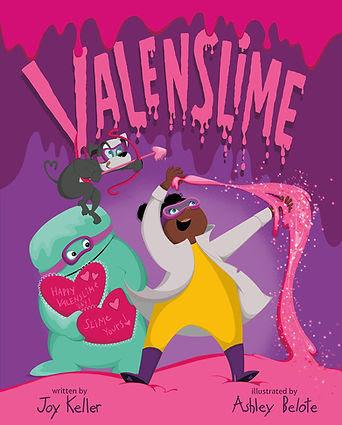
VALENSLIME: A Picture Book Review and an Autographed Giveaway

Do you remember back in July when I reviewed Joy Keller's book Frankenslime that is illustrated by my SCBWI-Carolinas friend, Ashley Belote?

I had announced that the next book in this series, Valenslime (Feiwel and Friends, 2021), would be ready in time for Valentine's Day. I am here today with a review and the perfect present for your little sweetheart!


REVIEW

Here is the opening paragraph that tells us about the main character:


Victoria Franklin was a 

slime scientist.

She loved her slime

Her slime, Goop,

loved her back. 


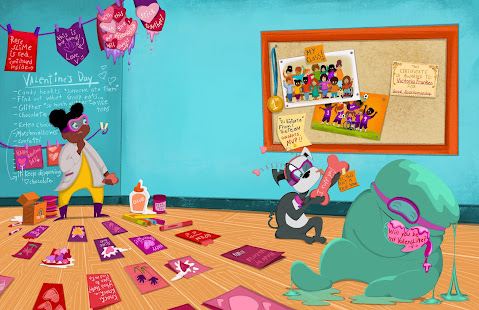
The next two pages show the reader the many ways in which Victoria and Goop love each other--the fun they have together in her lab, the science books they enjoy together, and their joint affection for Victoria's dog, Igor.

BUT...there's a problem. (Of course! There has to be a problem, right?) 

Victoria realizes that she has lots of friends to send Valentines to--but poor Goop, only has one friend. Her. It just isn't fair.

Victoria takes the problem into her capable hands. 

If Goop couldn't make a new friend,

She would make a new friend for him!

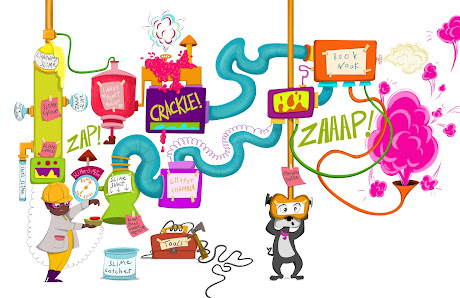
As any good scientist does, Victoria brainstorms slime recipes in order to make the perfect combination to make a friend for Goop. Finally, she assembles the perfect ingredients. Then she waits for lightening to strike so her creation will jolt to life. 

But there's no lightening! 

So, how does a scientist like Victoria solve that problem?

You create your own electricity!


But...that's when Victoria's slime solution grows into unmatched proportions and complicates Victoria's goal of creating a friend for Goop.

I don't want to give away the ending or spoil the surprise of Ashley's clever, colorful illustrations. Let's just say Victoria's slime solution ensures that everyone is happy.


This book is not only a cute Valentine read, it is also a fun way to teach young children about writing. Did you catch what I said in the first two paragraphs of this review? On the first page Ms. Keller tells the reader about Victoria's friendship with Goop. Then the author follows that with showing what this friendship looks like. 

The character then encounters a problem which she attempts to solve. This is a great way to show young writers that the main character is ALWAYS the one to solve her problem! Victoria meets obstacles but eventually obtains her goal-creating a special friend for Goop.

Three new slime recipes--including one that is edible--will delight young scientists. 

GIVEAWAY

Ashley is giving an autographed copy of VALENSLIME  to one fortunate reader. The giveaway ends on Tuesday, February at 9 AM. 

For a chance to win, leave a comment with your email address, or send me an email if you prefer. If you share this on social media, you will get one extra chance; if you follow my blog you will get another chance. Tell me what you have done and I will enter your name accordingly. Winner must live in the continental U.S.


Congratulations to Tiffany Slack, head librarian at the Matthews Christian Library, who won Photo ARK ABC on last week's blog and Danielle Hammelef who won The Short Life of Krill. By the way--Danielle's secret for winning so many books is that whenever she can. she shares my posts on social media. 

Monday, October 18, 2021

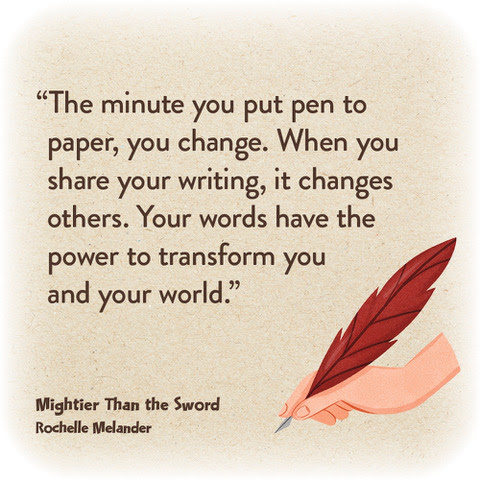
MIGHTIER THAN THE SWORD: AN ELA RESOURCE, AUTHOR INTERVIEW and A GIVEAWAY!

 In the "it's a small world department," my sister Barbara (who lives in Milwaukee) met Rochelle Melander at a July 4th picnic this past summer. After hearing Rochelle speak about her book, Mightier than The Sword (Beaming Books, 2021). Barbara told her that she should contact me because I love encouraging kids to write. (In case you didn't know, my second book was Teaching the Story: Fiction Writing in Grades 4-8.)  After the picnic, Rochelle looked me up and realized that I was on her list of people to contact to be part of her blog tour!

I am proud to introduce you to Rochelle's inspirational and educational new book.  Rochelle has so much to say about teaching writing to kids, that today I'm reviewing her book and interviewing her. Next week she will guest blog about, "Playing With Writing Types."


REVIEW

From Murasaki Shikibu, a Japanese novelist and poet who lived from 978-1016 to Malala Yousafzai, a contemporary Pakastani activist, writer, and the youngest person to win the Nobel Peace Prize, Mightier Than the Sword highlights men and women throughout history and from diverse cultures who changed the world through their writing.

Rochelle's list includes well-known figures who you may or may not think of as writers: Charles Darwin, Frederick Douglass, Zora Neale Hurston, Nellie Bly, Ida B. Wells, and Rachel Carson. But there are also many lesser-known individuals such as Abu Abdullah Muhammad Ibn Battuta, Wang Zhenyi, Ada Lovelace, Mary Garber, and Sequoyah and many more. 


In addition to the short easy-to-read essays about each writer and the ways in which the individual's writing affected the world, there are suggested writing activities and a pithy quote from the writer.

"If you want to change the world, pick up your pen and write." - Martin Luther

Martin Luther was a German theologian who wrote in the early16th century. After his biography and work as a writer, his entry includes the development of Gutenberg's printing press which enabled more people to read the Bible. Luther's Ninety Five Thesis against the Catholic Church invited debate and promoted change. The author uses that point in history to challenge readers to find ways to invite debate.

This is the "Write to Create" activity for Luther: 
Martin Luther used repetition and rhythm so people would enjoy reading his words aloud. He used relatable images to explain complex topics: “A lie is like a snowball: the further you roll it, the bigger it becomes.” Keep a notebook to record juicy words, favorite phrases, and interesting snippets of conversation. p. 17

Mightier Than the Sword is a rich curriculum resource for grades 4-8. Besides the writing activities associated with each writer, the book ends with ten more pages of activities! There are ideas to get the reluctant writer going, revision ideas, advice from the featured writers, and of course, a list of books about writing.

                                                *****


AUTHOR INTERVIEW

CAROL: Did you write the book or the pitch first?

ROCHELLEI wrote the pitch first. When an agent expressed interest, I wrote the proposal. (I did that quickly, in about 6 weeks.) When the publisher accepted it, I wrote the book.


CAROL: How did persistence help you sell your book?


ROCHELLE:  As an artist educator, I’ve longed for a book like Mightier Than the Sword. I believed the book would help me introduce young people to writing mentors from a variety of disciplines and support students in writing their stories. When I hit obstacles, connecting to this purpose kept me going. 


Researchers call this grit. According to psychologist Angela Duckworth, “Grit is passion and perseverance for long-term goals. … Grit is about having what some researchers call an 'ultimate concern'—a goal you care about so much that it organizes and gives meaning to almost everything you do.” 


When I first pitched the book in early 2018, an agent loved the idea and requested the proposal. But she rejected it—because she wanted more of a deep dive into history. I revised and submitted it to more agents—only to get a slew of rejections. Many of them said the book was too educational—and not right for the trade market! Then an agent requested a revise and resubmit—which I did. As I waited for their response, I sent it out to just a few more agents. When an agent I met at a conference offered representation, I sent a note to the agents who’d been sitting on the proposal for months. They all rejected it. I wasn’t keen on the representing agent, so I tried #PitMad. Surprise! I had four hearts from four different editors. One of those, Beaming Books, offered a contract. Woot!


For me, grit meant repeatedly reminding myself of my purpose—to help young people fall in love with writing. Once I got the contract, I still had hours of research and writing ahead of me—and that purpose helped me shape every single essay in the collection. If you’re stuck or struggling, consider your ultimate concern: why is this project important? Who will it serve?


Rochelle teaching
young writers.

CAROL: How did you come up with these particular writers? You had centuries and the whole world to choose from!

ROCHELLE: The writers! I first came up with the idea for the book in 2009 and started collecting names. When I decided to get serious about the book, I searched online, read anthologies and talked to professors to find names. Once the publisher accepted the book, we worked together on finalizing the list. I wanted to make sure the list was diverse in multiple ways: disciplines, gender, race, culture, writing genres, and more. The book includes 40 writers, 5 interludes, and many short profiles!

CAROL: What were the lessons about writing that you learned while researching and writing this book?


ROCHELLE: I learn from every book I write, but Mightier Than the Sword brought so many more lessons—probably because I was researching and writing about people who used their writing to make a difference in their worlds. Here are three of them:


  • It’s okay if you weren’t a successful student. Follow your passion. Many of the writers I featured did poorly in school. Charles Darwin skipped out on grade school lessons and dropped out of medical school. But when he discovered his passion for nature, he succeeded.

  • Write about what matters to you. Passion drives persistence. When congresswoman Patsy Mink was in college, she started a letter campaign to protest segregated student housing. She succeeded—and the college changed their policy.

  • Writing is difficult. Do it anyway. Because of social media, we see writers celebrating their wins, but we don’t see the sweat equity that went into their work. It took James Baldwin ten years to write his autobiographical novel, Go Tell It on the Mountain. During that time, he struggled to earn money and deal with self-doubt. 

GIVEAWAY

Leave a comment to enter the giveaway. You'll have a second chance to enter after  Rochelle's next post. A winner will be drawn after 6 PM on October 27. If you are a media specialist, home school educator, or ELA teacher let me know--I'll give you another chance to win this book. AND if you compare Mightier than the Sword to What's in Your Pocket? from last week's blog, you get an additional chance!

PLEASE LEAVE YOUR EMAIL ADDRESS IF YOU ARE NEW TO MY BLOG.

Congratulations to a new subscriber, Suzy Leopold, who won WHAT'S IN YOUR POCKET? from last week's blog. 

Monday, August 27, 2018

Fundamental STEPS to Writing Historical Fiction-- Highlights 2018

Congratulations to Joyce Hostetter who won THE HERO TWO DOORS DOWN and to Clara Gillow Clark who won PACO'S PAINTBRUSH. Clara Gillow Clark is the blogger from whom I won FOOD FIGHT FIESTA. (And no, I didn't rig the contest. Random.org always picks my winners!)

*******
Several weeks ago when I blogged about teaching at Write 2 Ignite, I mentioned that I have another opportunity to teach this fall. I'm thrilled to share that I'll be part of the faculty for Highlights Foundation's Historical Fiction Workshop led by my friend and mentor, Joyce Hostetter


Following the acronym STEPS, this is what Joyce and her team will cover:


STORY: Finding stories embedded in history and embedding history into our stories.

TIME: Allowing the historical era to shape characters, dialogue, actions, and more. Lila Weaver will present a talk on going from an eyewitness to a story teller.

EXPERTS: Seeking insight from archivists, specialists, eyewitnesses, and survivors. This is MY talk!! (I guess Joyce decided that after hearing my excitement over finding each new expert for Half-Truths, she would have me share my experience with others.)

PLACE: Infusing the story with a sense of locality and culture. This talk is by Julie Chibbaro.

SOURCES: Researching history and documenting resources.


Check the schedule and you'll see that besides talks on these subjects, participants will meet one on one with Joyce. They will have time to work on their manuscript and receive input from the faculty and other attendees. Carolyn Yoder, Joyce's editor, will also join the group for a question and answer session. 

 If you don't know Joyce, then here's the link to the Highlights blog where she talks about her journey as an historical fiction novelist. It's always fun to hear how she wrote BLUE without a thought that it would turn into a series. DRIVE is coming out this fall and Joyce is now writing her fifth book in the Bakers Mountain Series!


If you want to make history come alive to middle grade or young adult readers, then this is the workshop for you. To read more about the workshop and enter the great giveaways that Joyce is offering, click here for the special newsletter on the workshop. 

Hurry! The workshop is limited to eight students and is filling up--but Joyce and I would love to see you there too!

Monday, August 6, 2018

Coming Up on Write 2 Ignite!

Congratulations to Deb Allmand who won the Audio book of Between the Lines on last week's blog.

I'm excited about several upcoming teaching opportunities. In September I'll be presenting three workshops at the Write2Ignite ConferenceGeared towards Christian writers who want to write for the children's and young adult market, as well as to teen writers, Write2Ignite is a day and a half of learning, networking and encouragement. 


I hope these teasers will inspire you--or a writer you know--to register for the conference.


Strangers in a Strange Land

In Exodus 2:22. Moses named his son Gershom because he was a stranger in a strange land. As Christians, in some ways, we are also "strangers" in the secular publishing world. 

How do we honor Christ as writers in a largely non-Christian domain? What is our calling as Christian writers? What is our privilege?  How do we fit in--or don't fit in--to the secular publishing world? There are no easy answers. But in this interactive workshop we’ll examine ourselves, what this "strange" land is, the ways we can integrate our faith into our writing, and our presence in the secular world.


Fiction Writing (Teen Track)

I love teaching teens--they have out-of-this-world ideas for their characters and plots. True, sometimes their lack of inhibition has to be tempered by plausibility--but their enthusiasm is contagious and inspirational! 

For my part, I'll teach them to,
  • Exercise their muscle words (all groans aside, this does involve actual EXERCISE!).
  • How and why writers need to use mentor texts.
  • How the red pencil is their best friend.
  • How to jazz up their writing through "Show, Don’t Tell."
  • How details make the difference when crafting genre fiction.


Writing Historical Fiction

I love historical fiction almost as much as I love teaching teens! 😁


This hands-on workshop will include: 

  • RResearch. Should you read newspapers? Magazines? Books? Fiction or nonfiction? Microfilm? How do you know when your research is done? 
  • EExperts. How to find experts for your story? What do you ask? How do you use your expert's story to inform yours?
  • AArrange. Create a system to keep track of notes, interviews, and photos. 
  • DDetails and Drafts. What details do you need to create an authentic story? How do you move from rough drafts to honing on your story?

If you plan to attend this workshop, please bring your favorite historical novel. If you're working on a project, bring one or two pages of your work.


**************

Please share this post with a writer or teen who might be interested in attending the conference. And stay tuned. In a few weeks I'll share my other teaching opportunity coming up in October!

Monday, July 9, 2018

Smack Dab in the Middle of Maybe: A Review and ARC Giveway

Introducing Jo Hackl

Over two years ago I had the pleasure of sharing Jo Hackl's path to publication. (Both Part I and Part II are great reading; Jo shared how she came up with the ideas for the book and the process of acquiring a publisher). Jo and I have been friends through SCBWI-Carolinas for over ten years, and now that her hometown of Greenville, SC is also mine, I proudly claim her as my critique partner also.

It is with great joy and pride in her publishing accomplishment that I share my review of Jo's debut middle grade novel, SMACK DAB IN THE MIDDLE OF MAYBE. 


Review


Read these opening paragraphs and hear voice oozing out of every sentence:
Turns out, it's easier than you might think to sneak out of town smuggling a live cricket, three pocketfuls of jerky, and two bags of half-paid-for-merchandies from Thelma's Cash 'n' Carry grocery store.
The hard part was getting up the guts to go.
 It happened like this: There I was in Thelma's produce section, running my fingers up and down a bundle of collards. Collards never did make for good eating, but I was wondering if maybe they were some kind of sign that it was time for me to skedaddle. Collards always reminded me of Mama. She used to make me drawing paper out of collards, sumac seeds, dryer lint, and newspaper Daddy chopped up in his wood chipper. She plunked things in her paper the way other people stuck things in scrapbooks. Thread from the hem of her wedding dress, a four-leaf clover, Daddy's first gray hair. Mama's paper held so much life, it made my drawings pop off the page.
That was the kind of Mama and Daddy I used to have.  (p.1-2)

Who wouldn't keep reading after a hook like that?

Soon the reader discovers that Cricket is on a quest to find Mama who ran off and left her with Aunt Belinda. Taking a cricket who she names Charlene, a little bit of food, her father's pocketknife, a doogaloo, and a small notebook full of Mama's paper, she sets off. 

By nightfall she gets to the woods near her family's property. Here is a setting description that I used in my writing classes this summer: "The woods smelled like a hundred and fifty years of dark. A goose-bumpy ghost-town kind of dark."(p. 19)

She climbs into the tree house that "smelled like cedar, clean and wild," which her father built before he died. There, she reviews a letter addressed to her mother indicating her Grandmother's tombstone was to be placed on March 1-- in exactly eleven days. On it her mother had scrawled before, "I'm off looking for my birds." This brings back memories of all the times her mother left to find the "Bird Room" so she could prove it was real. 

With her few supplies, Charlene to keep her company, hope, and a pocketful of clues, Cricket begins her quest--but first she has to learn how to survive living outdoors. 

Like all good stories, Cricket's search has several twists and turns that test her gumption:  raccoons steal her food, snow, and a copperhead bite. The last is too much for her to deal with alone and she seeks help from Miss V., an eccentric woman who provides more answers about her mother and the bird room than Cricket could have dreamt of. At the same time that the story moves forward, the author provides bits and pieces of backstory that help put the puzzle pieces together. 

SMACK DAB is not only a story of outdoor survival or putting puzzle pieces together. It is also a story of a young person coming to grips with her mother's mental illness. Beautifully woven into the text is Cricket's slow realization that her mother's behavior was eccentric, unexplainable, and unstable. Like Laura in CRAZY by Linda Phillips, Cricket begins to see a different picture:
What about all the sharp looks in the grocery store? The looks at Mama. The looks at me. 
If my mama was crazy, just what exactly did that make me? 
The floorboards felt like they were shifting. Nothing felt solid. I grabbed hold of the wall. 
Is this what going crazy feels like? (p. 141)


After I finished reading SMACK DAB I told Jo, "When I grow up I want to be like Cricket." Readers young and old will be inspired by Cricket's courage and spunk--as well as her love for her mother and the truth. And of course, also for her love for the outdoors.


Trailer

Just in case my review didn't sufficiently entice you, here is the trailer:


Giveaway
I took this picture when Jo hand-delievered
the ARC to my house!


Please leave your name and email address (if you don't think I have it) in the comments for my gently read autographed copy of this ARC. Winner will be drawn on July 13. Jo, our expert for the summer issue of Talking Story is also giving away a personally autographed copy too (anyone see an outdoors theme here?). Share this post on social media (and tell me what you do) and I'll enter your name twice. 

Monday, May 14, 2018

SmartARTS: Art Integration at Work

I last blogged about my training to be a SmartARTS teaching artist last summer when I attended their training institute. Here's a column I wrote for The Greenville Journal about my first assignment.

*********

Five minutes after I started talking to Gayla Day, the Administrator of the SmartARTS program at the Metropolitan Arts Council, I knew I’d found a place to share my writing skills. This organization believed in integrating arts education into school curriculum—on a scale I had never imagined. SmartARTS uses artists like myself—writers, painters, dancers, fiber artists, musicians, poets, actors and actresses—to enhance math, social studies, science, and language arts instruction.

In order to receive my first teaching assignment, I was required to attend the Arts Integration Training Institute. Last summer I spent four days of immersive training in the SmartARTS vision and methodology. This included talks by Greenville County teachers who successfully enhanced their classroom instruction by teaming with artists. Along with sixty teachers who wanted an artist in their classroom, I participated in acting exercises, a poetry workshop, a painting activity, and a dance lesson. I learned how the students’ needs would determine how my writing skills would be used in the classroom. 

This past March I met Melody Powell, the third-grade teacher at Stone Academy who I was paired with. As we planned the unit, she said she wanted to prepare her students for the state writing assessment by focusing on narrative writing. Here was an opportunity to use my book, Teaching the Story: Fiction Writing in Grades 4-8 precisely how I envisioned it. My excitement as an author and writing instructor soared!

Ms. Powell hoped I would reinforce concepts that she had previously taught including the parts of speech, theme, and adding sensory details. Since the classes are teacher-driven, our planning didn’t stop at that initial meeting. She gave me feedback throughout the unit so that I continued to tweak upcoming lessons. 
Students critiquing each other's work.

This type of collaboration is at the heart of SmartARTS. The-give-and take in the classroom between Ms. Powell and myself was like a dance that may have looked choreographed, but in fact, was a perfect example of collaborative work. As I taught the unit, “What Is A Story?” we amplified one another’s skills and knowledge base. 
I used a simple picture book, "Emma's Pet" to demonstrate
how what the character wants drives the story. (Thanks Harold Underdown!)
The SmartARTS Training Institute reinforced the idea that linking a physical activity to content area helps students retain material. Each day I opened the class with “Exercising Muscle Words.” Parts of speech and figurative language were combined with movements. Quickly students learned to pair vivid verbs with jumping jacks; specific nouns with deep knee bends; image-driven adjectives with arm circles; similes, metaphors, personification with arm punches and leg kicks; and onomatopoeia and alliteration with finger dancing. 


Another day I used tableaux, an activity that I had learned at the Institute. This dramatic exercise helps students use their bodies and facial expressions to connect to a concept. In small groups, the students created tableaux that showed an emotion such as anger or sadness. It was exciting to see their enthusiastic efforts and the connections they made to portraying a character’s emotions. 
Two third-graders collaborating on their tableau.

Teachers enjoy seeing light bulb moments—times when students link ideas to new concepts. I was privileged to experience several. A student recalled a passage in our mentor novel, Because of Winn Dixie, specifically because the author used the same figurative language the student was “exercising.” Others proudly incorporated muscle words into their work. After showing them several drafts of my work-in-progress Half-Truths, students realized how “real writers” revise. Several experienced the benefit of reading their work out loud to catch mistakes. One student recognized that although he didn’t want to hurt his friend’s feelings while critiquing his work, feedback made the piece stronger. 
Giving and receiving feedback. All writers revise!

I am thrilled that my book, Teaching the Story, was an asset in the SmartARTS program.  It was a privilege and pleasure to watch children shape their ideas and transform them into a story of their own. 


THE NIGHT WAR: A MG Historical Novel Review

  By now you should have received an email from my new website about my review of THE NIGHT WAR by Kimberly Brubaker Bradley. (It'll com...