I always enjoy supporting my fellow SCBWI-Carolinas writers, particularly those who live in Charlotte. Today I'm bringing you Chrystal D. Giles' debut novel, TAKE BACK THE BLOCK (2021: Random House Books for Young Readers).
Saturday, December 31, 2022
TAKE BACK THE BLOCK: A MIDDLE GRADE REVIEW AND GIVEAWAY
REVIEW
Saturday, October 29, 2022
STARFISH: A Teen Review of a Middle-Grade Book
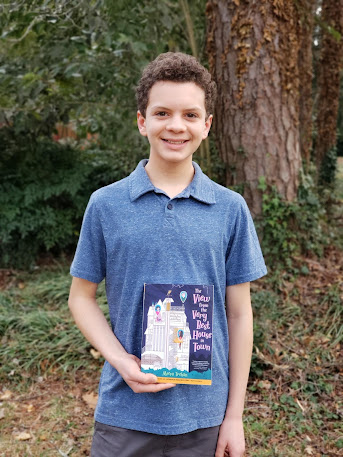
My teen blogger Elliott Kurta is now busy being a freshman in high school and doing his volunteer job at the library. So, we'll enjoy his book reviews whenever he has time to get them to me.
****
REVIEW
Young Elle is constantly shamed for being overweight; at school, in public, and even at home. To make matters worse, her mother obsessively monitors what she eats and her brother and sister poke fun at her. It’s no wonder the only place Elle feels safe is in her pool, where her weight doesn’t matter, and she can take up as much space as she wants. In this middle-grade novel, Elle finally decides to fight back with the support of her father, a new friend, and her therapist.
Bringing a rarely seen viewpoint to a young audience, Starfish does a commendable job of not only approaching a sensitive topic but relating the perspective of a young, overweight girl to middle-schoolers. Elle’s bullies are painfully realistic, and so is the fatphobia she experiences every day. Additionally, the book is primarily presented in verse, which forces readers to slow down in order to absorb the cadence and message of each sentence. The poetic format also allows for certain dramatic flourishes in word placement which leaves a lasting impact on readers.
At times, Elle’s narrative style can lead to confusion while reading. For a pre-teen, Elle uses uncharacteristically sophisticated terms to describe her own emotions and has an unusually mature awareness of her feelings. In her afterword, Lisa Fipps mentions that Starfish was originally going to be a YA novel, which explains why the book reads like one. This instance, found on page 34, highlights the discrepancy in Elle’s age and maturity present throughout the book:
The first Fat Girl Rule
you learn hurts the most,
a startling, scorpion-stinging soul slap.
Aside from the inconsistencies in Elle’s narration, there’s a subtler flaw in the book. Starfish focuses entirely on Elle’s body, her perception of it, and how it affects her life. Each of the one- or two-page long chapters either shows Elle being bullied at school, talking with her friend about her body, or fighting with her mom over her weight. In fact, one of the major sources of tension in the book is that Elle’s mother wants her to undergo bariatric surgery, a reference that would fly over the heads of most middle schoolers. The singular focus of the book is overwhelming and could even be considered in contrast with the novel’s message. By focusing entirely on one aspect of Elle, her weight, Lisa Fipps undermines the idea that Elle is more than her body.
Regardless, there’s a reason that Starfish won a Printz award. Line for line, Lisa Fipps’ debut novel is nothing short of extraordinary, bringing the issues of a tween who’s more than her body weight front and center. For middle-schoolers everywhere, Starfish will make them reconsider how they see their friends, family, and most importantly, themselves.
A QUESTION FOR OUR READERS
ALL ABOUT ELLIOTT
Elliott is a prolific reader of various genres who is more than happy to share his opinions on books. In his free time, he enjoys writing, reading, and running. He is a 9th-grade student in Charlotte, NC.
****
Congratulations to Kathy Wiechman who won TEDDY, LET'S GO! from last week's blog.
Don't forget to check out the other wonderful middle-grade books on Greg Pattridge's MMGM site.
Saturday, August 27, 2022
HURRICAMP A MG Book Review by Guest Blogger, Elliott Kurta
REVIEW
It’s summer, and eleven-year-old Laura Newman, “Noodle” to her friends, is excited to arrive at Camp Hillside, where she’ll stay for four weeks. Unfortunately, the trip goes awry before it even begins. Noodle’s sister, Jill, can’t come to summer camp with her, which means Noodle is going to be left by herself for an entire month. Wallowing in her loneliness, Noodle writes letters and ignores the other girls in her cabin. After two weeks of feeling sorry for herself, a hurricane changes Noodle’s routine. With Hurricane Hilda on the way, Noodle’s cabin, the Sandpipers, is moved into a basement after their cabin nearly collapses. Forced into close confines, Noodle starts to open up to her cabinmates. As the Sandpipers grow closer, they begin to rely on each other and bond over food fights, skunk attacks, and failed pranks. Told through Noodle’s perspective and sprinkled with illustrations, Hurricamp is a tale of one girl’s wacky summer.
Perfect for middle schoolers, Noodle’s adventures are as unpredictable as they are memorable. Noodle’s witty and at times cynical monologue guides readers through her burgeoning relationships with fellow Sandpipers and gives insight into her emotions. But the best part of Noodle’s narration would have to be her clever alliterations and comparisons. Using analogies that won’t fly over the heads of young readers, Hurricamp features all manner of scintillating language. Take, for instance, this short and yet powerful example from page 48, in which Noodle is praised by her cabin counselor:
“It felt like the sun shone straight down on me.”
Even without a cast of intriguing characters and Noodle’s revealing dialogue, Hurricamp would still be engaging. As the 162 pages of Hurricamp may prove a challenge to elementary-school readers, six illustrations are spread throughout this novel, providing relief without being distracting. And, of course, that’s to say nothing of the mischief that the Sandpipers engage in. Noodle’s adventures serve to add even more fun to Hurricamp, but they’re also a valuable lesson about what happens when rules are broken. For example, the Sandpipers’ food fight results in finding a bear licking up their mess in the morning.
With Noodle’s immersive descriptions leading the way, Hurricamp introduces a theme that many middle-schoolers are beginning to struggle with: self-reliance. While at first Noodle uses all her free time writing letters to her parents to complain, she matures as the story progresses and learns to solve her own problems. For example, after their cabin is soaked by rain after its roof springs a leak, Noodle immediately takes charge and gets help. While Noodle’s self-confidence grows and she becomes more optimistic, her cabinmates take notice. She quickly becomes the leader of her cabin, and gains popularity at camp.
The other Sandpipers all serve important parts in this book, and the author Steph Katzovi does a great job of introducing them and more importantly distinguishing each one. All of the girls in Noodle’s cabin are introduced in one scene, the stereotypical camp introductory activity in which everyone shares their name, where they’re from, and an interesting fact. While this set-up might seem chaotic, Noodle’s internal monologue eases each introduction. In just three pages, Noodle familiarizes herself and her audience with her cabinmates and counselor. However, each of the Sandpipers’ contrasting personalities make introducing them an easy task. From Noodle’s best-friend, Aries, to her nemeses, Holly and Tara, not a single Sandpiper fades into the background over the course of this story.
In conclusion, this novel teaches kids to problem solve and improvise while taking Noodle and the Sandpipers through a crazy series of adventures. Noodle’s inner monologue, each of her friends’ bold personalities, and the everyday obstacles the Sandpipers face all make this book a realistic and yet engaging tale. With a blend of wit and whimsy, Hurricamp is sure to please anyone who’s gone to camp or wished they could’ve.
GIVEAWAY
Tuesday, February 22, 2022
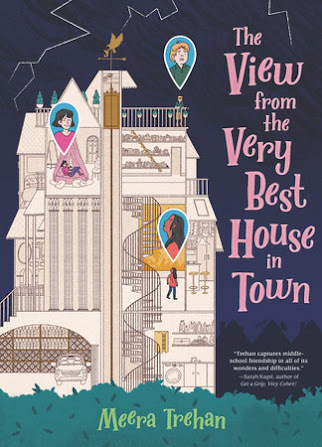
THE VIEW FROM THE VERY BEST HOUSE IN TOWN: A Middle Grade Review by Guest Blogger, Elliott Kurta
REVIEW
The View from the Very Best House in Town (Walker Books, 2022) is a tale of friendship, told with a twist. Sam and Asha are both autistic and ostracized as a result. They’re each other’s best friends, playing soccer and their favorite videogame, Househaunt, together.
As the summer ends and Sam and Asha are preparing to begin seventh grade, they’re suddenly separated by Sam’s acceptance into the most prestigious school in Coreville, Castleton Academy. When Sam is pushed into the privileged world of Castleton, more of an outsider than ever, he meets Prestyn Donaldson. Prestyn is the most popular girl in school, and her family lives in the biggest mansion in Coreville—Donnybrooke. Meanwhile, Asha makes new friends and does her best to forget about Sam, but she can’t stop worrying about him. He’s been hanging out with Prestyn, who happens to be Asha’s nemesis ever since a disastrous party years ago. Is that why Sam’s been skipping soccer practice every Thursday--to go to Donnybrooke? But why does Sam keep going to the best house in town if he looks miserable every time he leaves?
Meera Trehan’s debut novel sets itself apart with its original premise. Not only does she have two incredible protagonists with touching journeys, but her book also includes thirteen chapters from the viewpoint of Donnybrooke itself! As the main characters of The View from the Very Best House in Town are portrayed as middle-schoolers, their descriptions and phrasing can at times be simplistic. Even so, no detail is left out of the narrative. A well-thought-out video game that serves as an analogy for friendship and a weathervane containing an important message, are both examples of the book’s multiple layers. Older or experienced readers are best suited for this book, as they will recognize and understand the underlying themes.
Even though friendship is the driving force of The View from the Very Best House in Town, there is another, underplayed but equally important message. Asha and Sam are both subject to discrimination because of their autism. In Asha’s case, she was humiliated by the Donaldsons during their housewarming party, while Sam is made fun of and called the ‘Miracle Boy’ after his classmates find out about an embarrassing article. Despite having good intentions, Asha’s mom doesn’t understand her daughter’s pain and can’t relate to how Asha’s feeling. Sam’s parents try to encourage their son, but inadvertently push him to remain silent about how he’s feeling. Asha and Sam are both struggling, and they need each other’s support.
This tween drama is slow to develop, but will entrance readers with a mix of drama and personal growth. A spotlight on what it means to be different, The View from the Very Best House in Town is a necessary read for anyone who has felt lonely or has felt the need to belong. No matter who reads this touching book about friendship, the moral of this story will stay with them long after the end of the book—always remember who your friends are.
GIVEAWAY
****
Find this review and other great books on Greg Pattridge's terrific blog.
Friday, February 4, 2022
UNDER THE TANGERINE TREE: Author Interview with Esther Bandy
Elliott Kurta, who reviewed Under The Tangerine Tree on my last post, decided to follow up with an interview with the author, Esther Bandy. Take it away, Elliott and Esther!
INTERVIEW
ELLIOTT: What inspired you to write Under the Tangerine Tree? Was it a single moment, conversation, or photo, or did it take a larger experience for the ideas in your book to come together?
ESTHER BRANDY: I began writing Under the Tangerine Tree after my dad died in 2005. I loved my dad, and even though I knew he was in heaven, I still missed him. I’d also met many children who lost their fathers due to death or divorce. I wanted to write a book that would help children deal with their grief and allow me to express my own feelings of missing my dad. In addition, I had a desire to share God’s love and help children understand the gospel. It’s such a blessing to know that when a person receives the Lord Jesus as Savior, he becomes a child of God and has a heavenly father who loves him and will always be there.
ELLIOTT: What does your writing process look like, and how long did it take you to write Under the Tangerine Tree?
ESTHER BANDY: I have many medical problems, and Under the Tangerine Tree is my debut novel, so it took a very long time to write, revise, research, and edit my novel. I started writing it in 2005 after my dad died, but I often set it aside for long periods of time due to personal and family health problems. In addition, we sold our home in Washington state and moved to North Carolina during those years. I was often so busy or sick that I neglected my writing completely. Even when I wasn’t writing, I often thought about my novel. I remembered moments from my life, historical events, and inspirational themes I wanted to include.
ELLIOTT: In ‘Under the Tangerine Tree’, Angie Mangione moves to Florida to start a new life, one that more intimately involves God. Are her experiences in any way reflective of your own?
ESTHER BANDY: Angie’s faith journey is different from mine since I was saved in a Good News Club when I was five. However, several of Angie’s experiences are echoes from my life. I never lived in New York City, but my dad was Italian, and he was born and raised in NYC. Mom was southern born and raised near Tampa, FL. We often visited NYC to see dad’s family, but I was born in Tampa. Dad was in the Air Force, so we lived in several places when I was young. Like Angie, I didn’t like moving and being the new kid at school. I was glad when dad retired, and we moved next door to Granny’s house on a country lake in Florida.
ELLIOTT: Did you have to do any research before or during writing?
ESTHER BANDY: I remembered many of the historical events from my childhood, including President Kennedy’s visit to Tampa and his assassination four days later. I did extensive research to make sure I had the facts right.
ELLIOTT: Did Under the Tangerine Tree start out with the same plot line and characters it has now, or were there unused ideas, and if there were, can you share some of them?
ESTHER BANDY: It had the same general plot line and characters, but some have been added and others have been deleted. I had several more scenes from Angie’s school with a variety of other characters, but I finally deleted about 10,000 words with scenes and characters that seemed to weaken the overall story.
ELLIOTT: What made you choose Under the Tangerine Tree as the title for your first book?
ESTHER BANDY: There was a tangerine tree at the end of my dirt road in Tampa when I was growing up. It had the best tangerines I’ve ever eaten. I walked past that tree on the way to and from my elementary school, and my best friend and I often sat under that tree while we talked and ate tangerines.
ELLIOTT: What message or messages do you want each of your readers to leave your book with?
ESTHER BANDY: I hope my readers will understand that even though this life is filled with challenges, life is good, and they can have hope. Why? Because God loves them, and He has a wonderful plan for their lives. When they understand the gospel and receive Christ, their sins are forgiven, and they become children of God. They also have the Holy Spirit who indwells them and helps them understand the Bible and have victory over sin.
ELLIOTT: What made you decide to start off Under the Tangerine Tree with the main character’s father dying?
ESTHER BANDY: When I began writing Under the Tangerine Tree, my dad had just died, and I knew children who had lost their fathers due to death or divorce. I wanted to offer people hope while they were grieving, and I needed to express my own feelings of grief. I want my readers to know that even when the challenges of life are difficult to deal with, we can still have hope for a better tomorrow.
ELLIOTT: Have you always wanted to be a writer?
ESTHER BANDY: When I was in second grade, I wanted to be a nurse, a missionary, a teacher, or a writer. My teacher said I had to choose one, but I couldn’t. I wanted to do all of them. Over the years I’ve worked as a nurse, a missionary, and a Spanish teacher. When I became disabled, I realized that it was time to write.
ELLIOTT: How difficult was publishing your first book?
ESTHER BANDY: I submitted it to several traditional publishers who rejected it, so I finally decided to self-publish it. I’m thankful to my wonderful son and to several friends who have encouraged me and helped me publish it.
Thank you Esther and Elliott for this informative interview. You can find Esther on her website or connect with her on Facebook .
GIVEAWAY
I am giving away a copy of Under the Tangerine Tree. Leave me a comment on this blog and you'll receive one chance; leave another on the review and you'll receive a second chance. U.S. addresses only. If you prefer not to leave a comment, email me and I'll enter your name. PLEASE LEAVE YOUR NAME AND EMAIL ADDRESS IF YOU ARE NEW TO MY BLOG. Giveaway ends on Wednesday, February 9 at 12 PM.
Wednesday, January 1, 2020
Snakes & Stones: A Middle Grade Review and Giveaway
I'll start the new year with a review of Lisa Fowler's debut middle grade book, Snakes and Stones (Sky Pony, 2016). I'm holding onto my copy so I can review Fowler's great use of dialect, narration, and voice, but see below for Lisa's generous offer.
REVIEW
You may have heard how a book's setting can act like a character in a story. Although the setting for this book changes as twelve-year-old Chestnut Hill and her younger triplet siblings (Hazel, Filbert, and Macadamia) and their traveling salesman father go from southern town to southern town peddling his elixir, it also stays the same. It's 1921 and their old horse-drawn circus wagon is their home, storefront, and stage for their "show." Chestnut's job--which she hates--is to testify that the elixir has worked for her and to spot the doubters in the crowd.When her family isn't working a crowd, Chestnut tries to keep order among her siblings, convince her father that selling his fake elixir is a lie, and somehow make it back to their mother--who will fix everything. All of this is told in Fowler's love-for-the-North Carolina-mountains voice. Chestnut's Southern narration helps create the setting for the book. Here's an example from the beginning:
I'm crouched in the corner of the wagon, huddled on top of the triplets the same way a mother hen would gather her brood up and under her wings for protection--way too much responsibility for an ordinary twelve-year-old in a dirty, torn dress, frumpled hair, and shoes with holes in them the size of Missouri. Especially a girl that's been snatched from her mama against her will. (p. 2)Her father gets run out of one town after another and Chestnut devises a plan to help her mother find them. She tacks up flyers in each town with a picture of their wagon with the name of the elixir painted on the side, and the name of the town they're headed to. She's not proud of keeping a secret from her father, but rationalizes he's the one who taught her to lie.
Her desire to find her mama rules her day and night and leads her to a decision she regrets. Alone in a store, she sees a wide open cash register with more paper money than she can imagine. An internal dialogue ensues:
But you need that money to buy a train ticket to get back to your mama. Girl being with her mama's not wrong. Girl going back to where she was when she got snatched away from her home's not wrong. Stealing's wrong but only if you don't have a good enough reason. (p. 115)Suddenly, life gets a lot more complicated as Chestnut's guilt eats a hole in her gut. The family is joined by Abraham, an old friend of their father who worked the coal mines with him before they lost their jobs. He provides another perspective.
"Mama didn't do nothing. It was Daddy who stole us away. Mama went to town, and while she was in the store, Daddy run off with us."
"You sure 'bout dat?" Abraham asks with raised eyebrows and more questions than answers on his face.
"Well yes, sir; I was there."
"Maybe you was, but things not always de way dey seem. You think about dat, missy. Jes' you think. Dat's all ol' Abraham say." (p. 157)
Abraham reveals that he and her father were raised together in an orphanage. Slowly, Chestnut begins to see her father in a new light. When he is put in jail because he's falsely accused of stealing the money which Chestnut took, her life unravels.
Without including a spoiler, her mother's return isn't at all what Chestnut imagined. Truth is spoken between her and her father. Forgiveness is given and received. The reader is left with a sense of closure for a story that will resonate in hearts and minds after the book ends.
Lisa Fowler's apt use of similes and metaphors makes the book a pleasure to read. Descriptions like, "My face is as hot as a fresh-pulled log from a fire." (p. 129); "Once we're in the heart of town, Daddy hops from the wagon and weaves like a bobwhite in an open field, trying his best to see if anyone's watching." (p.66); "Everyone knows adults stick together like warts on the back of an old toad." (p. 181) inspire me as a writer and add to the authenticity of this middle grade historical fiction.
GIVEAWAY
Monday, July 9, 2018
Smack Dab in the Middle of Maybe: A Review and ARC Giveway
Introducing Jo Hackl
Over two years ago I had the pleasure of sharing Jo Hackl's path to publication. (Both Part I and Part II are great reading; Jo shared how she came up with the ideas for the book and the process of acquiring a publisher). Jo and I have been friends through SCBWI-Carolinas for over ten years, and now that her hometown of Greenville, SC is also mine, I proudly claim her as my critique partner also.It is with great joy and pride in her publishing accomplishment that I share my review of Jo's debut middle grade novel, SMACK DAB IN THE MIDDLE OF MAYBE.
Review
Read these opening paragraphs and hear voice oozing out of every sentence:
Turns out, it's easier than you might think to sneak out of town smuggling a live cricket, three pocketfuls of jerky, and two bags of half-paid-for-merchandies from Thelma's Cash 'n' Carry grocery store.
The hard part was getting up the guts to go.
It happened like this: There I was in Thelma's produce section, running my fingers up and down a bundle of collards. Collards never did make for good eating, but I was wondering if maybe they were some kind of sign that it was time for me to skedaddle. Collards always reminded me of Mama. She used to make me drawing paper out of collards, sumac seeds, dryer lint, and newspaper Daddy chopped up in his wood chipper. She plunked things in her paper the way other people stuck things in scrapbooks. Thread from the hem of her wedding dress, a four-leaf clover, Daddy's first gray hair. Mama's paper held so much life, it made my drawings pop off the page.
That was the kind of Mama and Daddy I used to have. (p.1-2)
Who wouldn't keep reading after a hook like that?
Soon the reader discovers that Cricket is on a quest to find Mama who ran off and left her with Aunt Belinda. Taking a cricket who she names Charlene, a little bit of food, her father's pocketknife, a doogaloo, and a small notebook full of Mama's paper, she sets off.
By nightfall she gets to the woods near her family's property. Here is a setting description that I used in my writing classes this summer: "The woods smelled like a hundred and fifty years of dark. A goose-bumpy ghost-town kind of dark."(p. 19)
She climbs into the tree house that "smelled like cedar, clean and wild," which her father built before he died. There, she reviews a letter addressed to her mother indicating her Grandmother's tombstone was to be placed on March 1-- in exactly eleven days. On it her mother had scrawled before, "I'm off looking for my birds." This brings back memories of all the times her mother left to find the "Bird Room" so she could prove it was real.
With her few supplies, Charlene to keep her company, hope, and a pocketful of clues, Cricket begins her quest--but first she has to learn how to survive living outdoors.
Like all good stories, Cricket's search has several twists and turns that test her gumption: raccoons steal her food, snow, and a copperhead bite. The last is too much for her to deal with alone and she seeks help from Miss V., an eccentric woman who provides more answers about her mother and the bird room than Cricket could have dreamt of. At the same time that the story moves forward, the author provides bits and pieces of backstory that help put the puzzle pieces together.
SMACK DAB is not only a story of outdoor survival or putting puzzle pieces together. It is also a story of a young person coming to grips with her mother's mental illness. Beautifully woven into the text is Cricket's slow realization that her mother's behavior was eccentric, unexplainable, and unstable. Like Laura in CRAZY by Linda Phillips, Cricket begins to see a different picture:
What about all the sharp looks in the grocery store? The looks at Mama. The looks at me.
If my mama was crazy, just what exactly did that make me?
The floorboards felt like they were shifting. Nothing felt solid. I grabbed hold of the wall.
Is this what going crazy feels like? (p. 141)
After I finished reading SMACK DAB I told Jo, "When I grow up I want to be like Cricket." Readers young and old will be inspired by Cricket's courage and spunk--as well as her love for her mother and the truth. And of course, also for her love for the outdoors.
Trailer
Giveaway
![]() |
| I took this picture when Jo hand-delievered the ARC to my house! |
Monday, August 21, 2017
Life After Publication: A Conversation with Kathleen Burkinshaw and a Great Giveaway!
It is my pleasure to host Kathleen Burkinshaw on her TLCB Blooming Anniversary Tour.
What has life been like for you since The Last Cherry Blossom was published?
What events and/or marketing have you done?
I had bookmarks printed while my ARCs were being prepared. My agent suggested that my publisher give out the bookmarks at the 2016 BEA, ALA, and BookCon in New York, since they would not be giving out copies of my ARCs. This built some buzz for the book.Which would you not repeat?
What advice would you give for the year(s) following publication?
THE NIGHT WAR: A MG Historical Novel Review
By now you should have received an email from my new website about my review of THE NIGHT WAR by Kimberly Brubaker Bradley. (It'll com...
-
Congratulations to Janet Davis-Castro who won HER FEARLESS RUN on last week's blog. No giveaway this week, but I hope you...
-
This is a busy week on my blog. TWO giveaways running concurrently! WARNING : Reading this book will make you stay up late and the chara...