Showing posts with label deep POV. Show all posts

Monday, December 26, 2022

EVERY MISSING PIECE: A Middle-Grade Review by Debut Tween Blogger, Olivia A.

 Today I have the pleasure of introducing a new tween blogger, Olivia A. She's a granddaughter of a friend of mine, and a bibliophile. (When her family moved from North Carolina to Texas she brought along her 1000-book library!).  Let's help her celebrate her book-reviewing career with her thoughts on EVERY MISSING PIECE by Melanie Conklin.


Maddy has trouble with anxiety; when her dad dies it gets even worse. Whenever she feels like something bad is going to happen, she has the urge to call the police. She decides to stuff those feelings down inside of her and hold back these urges. Six months later, a boy goes missing. A mysterious kid named Eric starts living on the neighbor’s property and Maddy suspects it's the missing boy. She believes it’s him because he looks like the missing boy that she researched on her computer. She thinks to herself, “It can’t be him, it’s not possible!” and she resists the urge to call the police. Is it the missing boy? Or is it just a normal kid? I guess you will find out, but only if you read the book!    


Maddy is sparky, kind, and loving. The author, Melanie Conklin, makes her imperfect because she has normal kid problems that other kids can relate to. Like a jigsaw puzzle, the author fits pieces of the action and Maddy’s everyday life together perfectly. It seems as if the story is coming alive in front of your eyes.  She is not a suspenseful author, but the book is so descriptive that she hooks you almost immediately. Here’s a quote from the book that grabbed me:


“That you Diesel?” A lanky pale-haired boy popped out from behind the tree in front of me like a ghost appearing out of thin air. White blond hair, skinny arms, stick-out ears.” I love how the author writes with so much conversation. It's so inviting to people, it’s as if you are in Maddy’s world just quietly standing beside them while everything is happening.


I didn’t believe I would like Every Missing Piece at first, because I normally prefer fantasy and adventure over realistic fiction. But this book surprised me, it had mystery, action, and everyday problems like dealing with fights with your friends. Normally, realistic fiction has a lot less action and more regular life stories that readers can relate to easily. This book had surprising twists, when I thought I had figured the plot out, it turned a different way. The twists astonished me, and I couldn’t put the book down. If you’re a fan of fantasy and adventure books (and realistic fiction) then you should definitely give this book a try! 


Olivia is 10 and has one little brother, Liam. She has 2 dogs Baxter and Cookie.

She likes Star Wars, softball, and of course, she loves reading.


Sunday, January 9, 2022

AIR: A MIDDLE GRADE REVIEW AND GIVEAWAY-- PART I

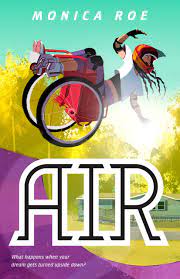
I am thrilled to share with you my friend Monica Roe's, upcoming novel, Air (Farrar Straus Giroux Books for Young Readers, March 15, 2022)Today you are going to hear about a book that her publisher describes as,
"a smart, energetic middle grade debut about thinking big, working hard, and taking flight."

On Thursday you'll get a glimpse behind the scenes in my interview with Monica. She'll share the book's backstory and her road to publication.

But for now, sit back and enjoy hearing about a book that I hope, will fly off the bookshelves.


                                    (Is this an amazing cover, or what?)

REVIEW

From the second page of this book for boys and girls, the reader hears voice, courage, and a good dose of Southern chutzpah, and a touch of sadness. The main character, Emmie, and her best friend, Ale, are setting her up for a launch off of the wheelchair ramp her father built.  As they prepare she thinks, 

"We [her father and her] used to be out here together, instead of me having to sneak around." 

I read that sentence and thought, "What happened to change things?" 
What a great way to insert backstory to make the reader keep going! 

The internalization continues:

I pull on my padded gloves, bring my front wheels to the edge, and breathe. The view from the top of a drop--even a basic one like this--gets me going every time. Those tadpoles swimming in my chest and the sweat on my palms are the best kind of rush. Now that added jump waiting at the bottom makes my guts fizz like I ate a handful of live bees and chased them with a bottle of Coke.

Right. Let's do this. (p. 4)

A few pages later the chapter ends with:

I'm Emelyn Ethridge. I'm twelve-and-a-half years old. Alejandra Che is my best friend.

I like Flamain' Hot Cheetos.

And I love speed. (p.8)


As a reader, I'm hooked. And I won't let go until I find out what this daring young wheelchair athlete is going to do.

As speedy as Emmie herself, this book moves. The author doesn't take much space on the page to let the reader know, "Baby Emmie's spinal cord left the factory with a design glitch." Her parents "never let me get away with acting like I was some miracle for getting out of bed...They put me on wheels, had me popping curbs by the time I was six." (p. 19-20)

Early on the reader discovers that her mom recently died and her father  has changed--he doesn't seem to believe in her anymore. "He was my biggest cheerleader--my partner in high-speed mischief. Since Mom's been gone, he's so...different. Cautious. Scared even. (p. 22) Her father's work, night classes, and overtime hours don't give them the time together she wants. 

I admire the way in which Monica uses deep point-of-view to show who Emmie is and what she wants. For example, when she witnesses an argument between her father and Nonny, her maternal grandmother, she thinks:
Sometimes I think it's too bad Dad and Nonny don't have wheels, too. Moving fast is the best way I know to keep ahead of feelings you'd rather shake off. (p. 34)

When she dresses up and attends a fairy festival with Ale, she observes:
Nobody's paying us any mind. One thing I love about the festival is that pretty much nobody pays attention to my chair. It's almost like it's a part of my costume--like those people riding in the wooden troll wagon or bounding around on their spring-loaded stilts while telling fortunes. Everyone blends right in. (p. 101)
Without knocking the reader over the head and telling her that Emmie wants to be treated like a kid--not a person with a disability--Monica shows it. This theme is deeply embedded in Air and is crucial to the ending which I didn't foresee. Afterwards, I realized it is a perfect conclusion to a story where the character reaches both her internal and external goals

In addition to a well-developed character, Monica includes some terrific secondary characters who contribute mightily to the plot. There's a budding romance with a cute, rodeo "prince" (with all the miscommunication that comes with a first-time crush); an annoying aide who is assigned to Emmie but who proves her worth as a friend; and a spit-firing Alaskan Granny who orders custom wheelchair bags from Emmie.  (I forgot to tell you--Emmie and Ale have an online shop to raise money: Emmie craves a high-end, multi-link-suspension stunt chair and Ale is working towards getting a new hive. They sell bags that Emmie sews and natural stuff which they salvage from the South Carolina scrub between their houses).

Did I love this book? Guess that's obvious. Am I going to study it to see how Monica portrayed Emmie's voice so well? You bet.

Come back on Thursday and find out more about Monica and why she was in a unique position to write about a young person with a disability and why bees and Alaska found a perfect place in the world of Air

GIVEAWAY

You have THREE chances to enter this giveaway. Leave a comment here and you get one chance. Leave a comment on Thursday's author interview with Monica and you get a second chance. If you click here and discover how I met Monica and leave a comment there--your name goes in the hat three times! U.S. addresses only. Giveaway ends January 17th at 6PM. If you don't want to leave your email address, please email me and I'll enter your name. Make sure you leave your name and email address if you are new to my blog!

And if you don't win, I hope you consider purchasing this book for yourself, a young reader in your life, or a library. Pre-orders help authors!

Congratulations to Danielle Hammelef who won SEEKING FREEDOM. 


Monday, November 22, 2021

THE MEANS THAT MAKES US STRANGERS: Author Interview with Christine Kindberg and Giveaway--Part II

Last week in Part I, I reviewed Christine Kindberg's debut novel, The Means That Make Us Strangers. Today she shares her passion for racial equality and her path to publication. And as promised, I'll tell you how she and I are connected. 


AUTHOR INTERVIEW


CAROL: Everyone always wants to know how author’s get their ideas for their stories. What experiences did you have growing up as a TCK (Third Culture Kid) that influenced the creation of this story? Any parts of this autobiographical? Why did you pick this particular time period? 


CHRISTINE: I usually describe the book as exploring questions from my life in more extreme circumstances. A lot of Adelaide's feelings as she navigates the transition from Ethiopia to the US come straight from my experience as a TCK. The disorientation, the desperation to find people to connect with, the grief that sometimes attaches itself to little things, the embarrassment that comes from not understanding a new culture, the anger... I was definitely tapping into some of my own memories when writing about what Adelaide was feeling. I moved several times, back and forth between the US and Latin America, so I didn't have one long-term home the way that Adelaide does in Ethiopia, but I did transition to the US in high school. It's particularly rough moving when you're a teenager.


But the inspiration for the book actually came from a different angle. The original germ was a desire to explore the American rules around race and what would happen if someone broke those rules without realizing. As a TCK, I sometimes feel more comfortable with people who don't look like me, but skin color is too often the cause of deep divisions, changing everything from where someone is likely to grow up to where they go to church or school and how comfortable they feel shopping in certain stores. As a Christian, it matters to me when I see brothers and sisters with darker skin treated unfairly, and I want to know how to live faithfully as a white person, with all the privilege that comes from this skin color.


There are still lots of problems around racial divisions today, but I chose to set the book in the 1960s because I wanted to increase the danger around breaking the racial rules. The consequences for breaking racial barriers then was way higher than it is now, and I knew that would raise the stakes of the story to make it more interesting.


CAROL: Similarly, did any of the characters reflect people you know? 


CHRISTINE: I didn't consciously base any characters on real people...but I've been told more than once that Adelaide sounds a lot like me! I did borrow the name Kinci from a nickname my best friend from high school gave herself.


CAROL: Why did you pick Ethiopia as the country where Adelaide's family lived? 


CHRISTINEMy connection with Ethiopia came through research. I knew I wanted to give Adelaide connections to a rural village somewhere in Africa, and as I researched different countries, Ethiopia stood out as unique in ways I thought would be helpful for my book. It's the only country that wasn't colonized by Europeans, so I assumed Adelaide's white skin would carry fewer political connotations. It also has a history of Christianity that goes back for millenia, and that fascinated me. The more I learned about Ethiopia, the more I wanted to learn. And then the neighborhood I moved to in Chicago had a significant Ethiopian influence, with lots of Ethiopian restaurants, grocery stores, and cultural gatherings--and an Oromo church that met right across the street from my apartment. I read a lot and talked to people for my research, and hopefully someday I'll get to travel there!


CAROL: Why did you choose Greenville, South Carolina as the setting for the story? (I loved the reference to a few locales that I could relate to!). 


CHRISTINE: Greenville has a history of teenagers being on the front lines of the push for Civil Rights, which I found pretty inspiring. This wasn't unique to Greenville, but Sterling High seems to have provided a training ground for emerging leaders. There were a few incidents in particular that caught my imagination, like the desegregation of the library in 1960 thanks to nine black teens who were willing to be arrested over a request for reading materials. The youngest was fifteen at the time. And the court case of Whittenberg v. Greenville County Public Schools, in 1963--spearheaded by the father of seventh-grader Elaine Whittenberg--gave me the historical context I needed for the first steps of school integration that form the backdrop of my book. Greenville is also a beautiful city that I loved exploring and learning more about!


CAROL: As a former Greenville, SC resident--I agree! To switch subjects, I loved the deep first person POV. Was that a choice that came naturally to you, or did you play around with several POV first?


CHRISTINE: Thanks for saying that! I'm glad you enjoyed it. The choice of first-person narration did come naturally, maybe because this was my first book and I unconsciously put a lot of myself in Adelaide. But I did a lot of refining and deepening of the POV as I revised. There were at least four rounds of major revisions, so plenty of opportunities to refine!


CAROL: As I said in my first blog, I’ve never read a self-published book that is so good as yours. Why did you choose to self-publish it? Can you share any aspects of that road to publication? You acknowledge several people who helped with the proofreading and editing process- they did a great job!


CHRISTINE Thank you again! One of the reasons I was willing to consider self-publishing is that my day job is at a publishing house (I'm a Spanish-language editor at Tyndale), and I knew I could get help from friends who are talented professionals. For a long time, I was pretty resistant to self-publishing, so it definitely wasn't my first choice. But after trying for about four years to get the attention of agents and editors, I finally decided to listen to the advice of a mentor and take the risk of publishing it myself. I knew it would be a ton of work to produce and promote a quality self-published book, but I didn't want this story to languish on my hard drive. I decided to dedicate a year or so to giving this a try and seeing what would happen. I filled out the paperwork to register my own imprint as a business, and I called up my friends to ask for help with the cover design, editing, proofreading, typesetting, etc. (I did pay them, for the record!) I also learned everything I could about how to promote a self-published book. I made a lot of mistakes along the way, but I'm glad I went ahead and tried.


CAROL: What response have you received? Is your audience mostly adults? Teens? 


CHRISTINE: It's been such a privilege to hear from readers who have resonated with the story. And I've been surprised at how wide-ranging the readership has been! I've heard from thirteen-year-olds who loved it and from a ninety-seven-year-old who couldn't put it down. My audience is probably mostly adults who enjoy YA books, but their kids and grandkids seem to enjoy it too. I'm passionate about writing for a general audience, but this book seems to have gotten good traction in Christian circles, like when it won the Christy Award for Young Adult and the Honorable Mention for the Selah Award for Young Adult. Those awards have definitely helped with visibility!


CAROL: Did you Christian faith influence the story? If so, how?


CHRISTINE: I'd say everything I do is influenced by my Christian faith--at least, that's how I'm trying to live! My faith definitely influences what I think about the issues of racial justice and why I think everyone should be asking what it means to love our neighbors in a society that's deeply divided by race. That said, faith really isn't a part of the story in The Means That Make Us Strangers--church is mentioned a few times, but it's more of a social backdrop because faith isn't really on Adelaide's radar. Some of that was a conscious choice on my part, like when I chose to make Adelaide's dad an anthropologist rather than a missionary because I didn't want to have elements that could potentially be distracting for readers who aren't Christians. But mostly I wanted to be faithful to the story and true to the characters as I got to know them. With my next two books I wrestle a lot more with questions of faith through the stories, but whatever I'm working on, I'm passionate about writing books that come from a place of deep faith but aren't just for fellow Christians. My dream is to write honestly about faith and life in a way that fosters conversations about faith with people who would never walk into a church or a Christian bookstore.


CAROL: What’s next?


CHRISTINE: I'm currently waiting to hear back from potential publishers about my second book--I'm trying to go the traditional route this next time. Here's hoping there's news soon! That book is historical fiction set in England in the 1530s, about a nun who has to find a new purpose and way of living after the closing of monasteries and convents under Henry VIII. 

And I'm about three chapters in on my third book, which is set in the southern tip of South America in the 1860s-1970s, about the first white family to settle among the indigenous people in that part of the world. Very different settings and time periods for these next books! But a lot of the themes will continue and carry over.

CAROL: Thank you Christine, for writing this beautiful book and providing a giveaway to one of my fortunate blog readers. 

                                                ***

Christine and I emailed back and forth several times after I read her book. Since I read on her website that she went to Queens University in Charlotte, I asked her when she was in my hometown. She replied that she graduated from Covenant Day in 2005-2006 and I asked her if she knew my daughters, Lisa and Lori, who went to school there. 

She wrote back: 

"You’re Lisa’s mom! How funny—I was actually thinking of Lisa when I saw your name and that you were from Charlotte, but I thought there was little chance you’d be related. Lisa and I became friends the year I was at CDS, our senior year, and I remember going over to your house at least a couple of times. I was in the play that year with Lori."

It's a small world!


Christine Kindberg
Photo by Lindsey Bergsma

Christine would enjoy connecting with you on social media: 
Leave a comment on my blog and I'll add your name to the list of readers interested in winning The Means That Makes Us Strangers. (If you entered last week, you can enter again.) U.S. addresses only. If you are new to my blog, PLEASE LEAVE YOUR NAME AND EMAIL ADDRESS. A winner will be drawn on Thanksgiving.

Congratulations to Rosi Hollinbeck who won THE UNIVERSE AND YOU for her great-grandkids. 

Friday, November 19, 2021

THE MEANS THAT MAKE US STRANGERS: A YA Debut Novel Review and a Giveaway- Part I

Here is my criteria for loving a book: I don't want it to end so I drag out reading the last few chapters. That was the case with my most recent read, The Means that Make Us StrangersChristine Kindberg's debut novel. 

The book caught my attention when a friend tweeted that it had won the 2020 Christie Award and Honorable mention for the Selah Award

Here is the book's description from the author's website:

Adelaide has lived her whole life in rural Ethiopia as the white American daughter of an anthropologist. Then her family moves to South Carolina, in 1964.

Adelaide vows to find her way back to Ethiopia, marry Maicaah, and become part of the village for real. But until she turns eighteen, Adelaide must adjust to this strange, white place that everyone tells her is home. Then Adelaide becomes friends with Wendy and the four other African-American students who sued for admission into the white high school. Even as she navigates her family's expectations and her mother's depression, Adelaide starts to enjoy her new friendships, the chance to learn new things, and the time she spends with a blond football player. Life in Greenville becomes interesting, and home becomes a much more complex equation.

Adelaide must finally choose where she belongs: the Ethiopian village where she grew up, to which she promised to return? Or this place where she's become part of something bigger than herself?

I knew this book, with its hint of racial overtones and set in the civil rights period in the South, would become another mentor text for Half-Truths. What I didn't realize, is that it would also also provide vivid examples of deep first person point of view (POV)--something I'm working on while I polish my book.


REVIEW

You may be wondering now that I've told you what this book is about, what is left for my review?

Plenty.

Try this for an opening which demands that you read further:

A tangle of arms reaching toward the fig tree. Among the thicket of deep-black arms stretching toward the fruit, two arms stood out, pale as a moon.

I remember thinking how different those arms looked, while waiting for fruit to drop as Maicaah shook the branch. A fig hit the white hands and fell to the ground, and it was with shock that I felt the pain in my hands. (p.1)

Do you see the sensory information conveyed through this beautiful language? The tangle of arms, pale as a moon, and the shock of pain. These marvelous descriptions prepare the reader to be immersed in Adelaide's deep POV.  

That section ends with the children chasing after an ostrich.

We never caught an ostrich, despite the number of times we tried. We sometimes got close, but never close enough to touch, not even the dirty-white tail feathers.  (p.3)

There is something hauntingly poignant about that last sentence that shows the reader how Adelaide feels--without once using the word "feel."

Here's a later example, after she has moved in with her grandmother and aunt in South Carolina. Here, the author uses the word "feeling" but in a unique way. This comes after her aunt reprimands Adelaide for not saying "Yes, ma'am or No, ma'am."

I bunched my anger into a fist, feeling pride for the way I kept it in check. Marmee [her sister] would laugh with me about it later, and the edges of my anger slowly smothered and hardened as I held on to it. (p. 29)

See what I mean about deep POV? 

At school, Adelaide feels acutely that she doesn't fit in with other whites. When she sees a black girl, she assumes the girl must be from the Oromo ethnic group that she knew in Ethiopia. She tries speaking to her in Ormiffa but the girl and her friends misunderstand her friendly advances and tell her to seek her own kind. 

I turned my back to them and sat on the bottom steps, huddled against the railing. I didn't want to cry... This girl had looked so familiar, it had been like a taste of home. But the reality was that no one here knew what my life was like. No one had any idea where I'd come from. (p.41)

Later in the book, she walks home after school and spends her pent-up emotions in a deserted cornfield. By the time she comes home, her face is covered with dirt and tears. She goes to the bathroom to wash up before dinner.

There was a line on my neck showing where I hadn't yet washed. For a second, I stared at the line. Which was my real skin color: the speckled brown-and-tan or the smooth white? Which was the layer I was washing away? I blinked and the illusion was gone. I bent to continue washing, turning myself white again. (p. 83)

I could go on and on, but I'll end with a quote from one of her black friends, Nathan. The group of friends has come through a horrendous riot in which several whites ganged up on the black boys. A white girl, Emily Rose, invited the other girls to her house for a sleep over. One of the black girls thinks they'd just be asking for trouble. 

Emily Rose shook her head. "This is exactly the right time," she said quietly. "Besides it's just having friends over to my house for a party. Why shouldn't I?"

It's being together in the simple, common things that's most radical," said Nathan. He didn't look up from his sandwich. It was the first time he'd spoken all day.

"What does that mean? said Wendy. "It sounds like a quote."

"It means that basic, everyday things are the last barrier. When it's not strange for us to eat lunch together or spend the night at each other's houses or get married--then we'll really see each other as people, over and beyond our differences."  (p. 239-40)

Obviously, I love this book. Even though it's considered young adult, I recommend it for middle graders through adults. Anyone who wants to read a well-written book about segregation in the south--this is for you. The book is by far the best self-published book I've ever read. I can see why it won an Honorable Mention in Writer's Digest self-published books.

On Monday, come back to my blog for Part II when Christine talks about her inspiration for The Means that Makes Us Stranger, her path to publication, what she's working on next, and a funny way in which Christine and I are connected.

GIVEAWAY

Leave a comment (with your name and email address if you are new) and I will enter your name once. You'll have another chance next week to win a personally autographed copy of the book. If you are new to my blog or share this on social media, I'll give you an extra chance. Winner's name will be drawn on Thanksgiving Day!

                                                ******

Macduff                        See who comes here.
Malcom           My countryman; but yet I know him not.
Macduff           My ever gentle cousin, welcome hither.
Malcom           I know him now. Good God betimes remove
                         The means that makes us strangers.
                                (MACBETH, ACT IV, SCENE 3)

Wednesday, January 1, 2020

Snakes & Stones: A Middle Grade Review and Giveaway

I hope you enjoyed your holiday as much as I did. Mine was full of family and good food; now I'm back into my writing routine including sharing more books with you. Sandra Warren won Miep and the Famous Diary and Voices: The Final Hours of Joan of Arc. Barbara Younger won Everyone Says Meow and Susan Rice won America, Here I Come! 

I'll start the new year with a review of Lisa Fowler's debut middle grade book, Snakes and Stones (Sky Pony, 2016). I'm holding onto my copy so I can review Fowler's great use of dialect, narration, and voice, but see below for Lisa's generous offer. 


REVIEW

You may have heard how a book's setting can act like a character in a story. Although the setting for this book changes as twelve-year-old Chestnut Hill and her younger triplet siblings (Hazel, Filbert, and Macadamia) and their traveling salesman father go from southern town to southern town peddling his elixir, it also stays the same. It's 1921 and their old horse-drawn circus wagon is their home, storefront, and stage for their "show." Chestnut's job--which she hates--is to testify that the elixir has worked for her and to spot the doubters in the crowd.

When her family isn't working a crowd, Chestnut tries to keep order among her siblings, convince her father that selling his fake elixir is a lie, and somehow make it back to their mother--who will fix everything. All of this is told in Fowler's love-for-the-North Carolina-mountains voice. Chestnut's Southern narration helps create the setting for the book. Here's an example from the beginning:
I'm crouched in the corner of the wagon, huddled on top of the triplets the same way a mother hen would gather her brood up and under her wings for protection--way too much responsibility for an ordinary twelve-year-old in a dirty, torn dress, frumpled hair, and shoes with holes in them the size of Missouri. Especially a girl that's been snatched from her mama against her will. (p. 2)
Her father gets run out of one town after another and Chestnut devises a plan to help her mother find them. She tacks up flyers in each town with a picture of their wagon with the name of the elixir painted on the side, and the name of the town they're headed to. She's not proud of keeping a secret from her father, but rationalizes he's the one who taught her to lie.

Her desire to find her mama rules her day and night and leads her to a decision she regrets. Alone in a store, she sees a wide open cash register with more paper money than she can imagine. An internal dialogue ensues:


But you  need that money to buy a train ticket to get back to your mama. Girl being with her mama's not wrong. Girl going back to where she was when she got snatched away from her home's not wrong. Stealing's wrong but only if you don't have a good enough reason. (p. 115)
Suddenly, life gets a lot more complicated as Chestnut's guilt eats a hole in her gut. The family is joined by Abraham, an old friend of their father who worked the coal mines with him before they lost their jobs. He provides another perspective.


"Mama didn't do nothing. It was Daddy who stole us away. Mama went to town, and while she was in the store, Daddy run off with us." 
"You sure 'bout dat?" Abraham asks with raised eyebrows and more questions than answers on his face. 
"Well yes, sir; I was there." 
"Maybe you was, but things not always de way dey seem. You think about dat, missy. Jes' you think. Dat's all ol' Abraham say." (p. 157)

Abraham reveals that he and her father were raised together in an orphanage. Slowly, Chestnut begins to see her father in a new light. When he is put in jail because he's falsely accused of stealing the money which Chestnut took, her life unravels. 

Without including a spoiler, her mother's return isn't at all what Chestnut imagined. Truth is spoken between her and her father. Forgiveness is given and received. The reader is left with a sense of closure for a story that will resonate in hearts and minds after the book ends.

Lisa Fowler's apt use of similes and metaphors makes the book a pleasure to read. Descriptions like, "My face is as hot as a fresh-pulled log from a fire." (p. 129); "Once we're in the heart of town, Daddy hops from the wagon and weaves like a bobwhite in an open field, trying his best to see if anyone's watching." (p.66); "Everyone knows adults stick together like warts on the back of an old toad." (p. 181) inspire me as a writer and add to the authenticity of this middle grade historical fiction. 

GIVEAWAY

Lisa is giving away a personally autographed copy of this book. Please leave me a comment (with your email address) by 6 PM on January 4th to enter. Share this on social media (or follow my blog) and I'll enter your name twice. 


Monday, April 29, 2019

The Forgiving Kind: A Review and Audio Book Giveaway


Donna Everhart warned me that her newest book, The Forgiving Kind (Kensington, 2019) had some tough parts.

She was right. 


Like her previous book, The Road to Bittersweet, The Forgiving Kind  also features a young woman coming of age in rural North Carolina. The time is the 1950's and the place is 300 acres of Jones County--cotton territory. Although both books have young protagonists, the serious content of each novel lends themselves more to an adult rather than teen audience. 


REVIEW


Twelve-year-old Sonny Creech loves the land as much as her father and like him, has the ability to dowse water. Although her two brothers Ross (16) and Trent (14) work the farm alongside their father, Sonny's passion runs deepest and Donna Everhart brings this to life through a deep point of view showing Sonny as she runs through the soft mud, inhales the smells of the fields, and experiences the woods like an extension of herself. 

Tragedy strikes early in the book. Sonny father dies unexpectedly and her mother is "layered with sadness" as she and the children shoulder the burden of struggling to keep their cotton farm financially afloat. 

A wealthy neighbor, Frank Fowler, shows up and worms his way into the family by lending them money. From the start, Sonny distrusts him: "Mr. Fowler's work clothes were spotless and pressed. He was the type who lifted a finger only to say, do this, do that." Repeatedly Sonny observed that Mr. Fowler was nice to her mother, but spoke and acted as if she wasn’t there.


Before his sudden death, Sonny's father gave her his willow branch that he used to dowse water. Everhart describes it as, "Tugging on my lower leg muscles. The willow branch dipping to water. She couldn’t have pulled it up if she tried." The branch is a deep connection to her father but Mr. Fowler, and her peers at school make fun of her ability. When Sunny finds the burnt branch in the trash bin outside, Mr. Fowler denies his actions. 
Along the way, Mr. Fowler meets Sonny's close friend, Daniel. He reacts strongly to him and is verbally abusive. Sonny finds herself attracted to Daniel, but her attraction is not reciprocated. The two end up meeting secretly to avoid Mr. Fowler's fury.

Sonny worries about her mother not seeing Mr. Fowler's intentions: "I couldn't explain my worry anymore than I could explain how the dowsing stick worked." When they marry, Sonny's fears and unhappiness increase as she feels like her mother has betrayed her and the memory of their father. 

Through the use of deep point of view, the reader is privy to Sonny's anger, fear, conflicts, and pain. Sonny hears and sees the results of Mr. Fowler's abusing her mother. "Mama's life is getting eaten up." Her hatred towards Mr. Fowler grows when she realizes he and his friends are members of an evil white supremacist group. She and her brothers are forced to observe his gross mistreatment of Daniel and fear what might happen to any of them if they speak of it. Everhart paints a picture of a deeply disturbed antagonist that is gripping and unforgettable. Readers who are in an abusive relationship might resonate with how Sonny's mother tries to be the peacemaker and placate her new husband. 


Some readers will find the way in which Sonny's mother resolves her situation to be satisfactory and they may also be sympathetic to Daniel's plight as a homosexual. Although I thought that The Forgiving Kind is written extremely well, as a committed Christian I am uncomfortable with these aspects of this book. 

Donna was right. This is a tough book to read and digest. But a book worth reading, thinking, and talking about. 
  

GIVEAWAY


I am giving away my Audio CD, which is narrated beautifully by Tiffany Morgan, courtesy of Tantor AudioLeave me a comment by May 2 and I'll enter your name in the giveaway. 

Here is an audio snippet from the book that will give you a flavor of the book and the narration. 

THE NIGHT WAR: A MG Historical Novel Review

  By now you should have received an email from my new website about my review of THE NIGHT WAR by Kimberly Brubaker Bradley. (It'll com...