Showing posts with label mining your life. Show all posts

Friday, May 6, 2022

STORIES IN JOYCE'S BACKYARD: A "PICK-YOUR-OWN" GIVEAWAY!

 "This is the house that the Hinkle sisters lived in, and that's the muddy river where Thomas and Jackie fished together." Joyce Hostetter pointed out the car window as we drove around around her hometown, Hickory, NC--the setting for her Bakers Mountain Series. "See that old building? That's the hosiery factory where Junior worked for a few days. Over there is where the car mechanic lived who helped him fix his truck."


The Honeycutt family and their friends, who already had a special place in my heart from reading AIM, BLUE, COMFORT, DRIVE and EQUAL, became even more real as I saw the places where they lived, played, and worked--all within sight of Bakers Mountain. 

Bakers Mountain, photo courtesy Joyce Hostetter

How did Joyce end up writing a series of books that rose up out of what was once a rural community? It all began when Carolyn Yoder, senior editor at Calkins Creek, suggested that Joyce find the story in her own backyard. When Joyce began researching the history of Hickory, NC, she discovered the Miracle of Hickory at her local library.

Mural in downtown Hickory. Do you see Joyce?

She researched, read old papers, interviewed polio patients...and BLUE was born. Read some of Joyce's thoughts on the process of discovering her stories here

Part of Joyce's real backyard. Photo courtesy Joyce Hostetter

A few years after BLUE was published, I met Joyce in Birmingham, Alabama at a literacy conference. She was presenting on BLUE, I was presenting on Teaching the Story: Fiction Writing in Grades 4-8.  


We bonded over reading and writing. We co-presented several times and continue to publish a quarterly newsletter, Talking Story. We are critique partners and good friends. 

I felt Joyce's influence when I began brainstorming my own first novel. I rode my bike, walked, and drove through neighborhoods. What could have happened here? Half-Truths incubated. Ideas hatched. A novel slowly took shape. It changed. Got revised (many times!). Was reborn. 

What did Carolyn mean when she gave Joyce that assignment? Possibly she was not only talking about an actual backyard but was also encouraging Joyce to reach inside of her own experiences to find something she could relate to and authentically show in her writing.  

Let's face it. There might not be a compelling story about polio or pre-civil rights tension in your community, city, or state. Or, maybe you write science fiction or fantasy that's not even rooted in this continent or world--let alone in your neighborhood! How are you going to find that "backyard" story?

At the foot of Bakers Mountain and staring at Joyce's budding trees and the grass turning green I thought--my backyard is bigger than the crazy intersecting streets of Myers Park, NC. where my characters live. 

It's my whole life. 

It's writing what I know with a twist. 

It's taking my grief over losing someone I loved and embedding that in Kate, my protagonist's heart when she leaves home. It's realizing how making choices is not always very linear and conveying it on the page; it's understanding how gut-wrenching it is to feel betrayed--or be the betrayer. 


How about you? What have you used in your life--whether it's a place, person, event, or experiences--that has made it's way into your book? 

What is in your own backyard? 

Some backyards are under construction,
like mine is!

GIVEAWAY

For the first time on my blog, one fortunate blog reader will be able to pick which book in the Bakers Mountain Series they want to win! Leave me a comment by May 11 to enter this giveaway and tell me which book you are interested in. U.S. addresses only. Make sure you leave me your full name and email address if you are new to my blog.

Make sure you check out the other great books on Greg Pattridge's MMGM blog! 


Saturday, April 30, 2022

THE CAPTAIN'S DAUGHTERS- PART II: An Interview by Guest Blogger Elliott Kurta with Author Doreen Berger


If you missed Elliott's review of The Captain's Daughters click here.


INTERVIEW

ELLIOTT: What inspired you to write The Captain’s Daughters?


DOREENThe Captain’s Daughters was inspired by my life-long friendship with my best friend Robin.  As kids, we were always getting into some kind of mischief. We met in the third grade and we both loved science-fiction and dreamed about living on a starship and how cool that would be. That became the basis for the book. 


         ELLIOTTI didn’t know The Captain’s Daughters had such a fascinating origin story. This novel must have been in the brainstorming phase for quite some time!


ELLIOTT: Is William Marsh, Diane and Robin’s father, based on a person you know? For that matter, are any of the rest of the characters?


DOREEN: Since the book was inspired by my friendship with Robin, and a few of Diane and Robin’s escapades actually came from some of the trouble we got into, it only seemed natural to base some of the other characters in the book on people we know. Captain Marsh is based on my dad, who was my hero, with a lot of other influences thrown in! He was a fun character to write.


ELLIOTT: How long did it take you to write The Captain’s Daughters, and how has the book changed during the writing and publishing process?


DOREEN: The Captain’s Daughters took about six months to write.


ELLIOTT: What inspired you to name the Polaris—The ship that Robin and Diane’s father pilots—after the north star?


DOREEN: Polaris can be found almost directly above the North Pole and is nicknamed the North Star. It is the brightest star in the constellation Ursa Minor (the Little Bear). As the Earth turns, Polaris appears to remain stationary and all the stars appear to rotate around it. It is the only star in the sky to have this unique characteristic, and since its stationary position points due north, Polaris can be used for navigation in the Northern Hemisphere. As it says in the introduction to the book, “For centuries, explorers need only look to the heavens and to Polaris, to find their way safely home.” It seemed appropriate to name the starship Polaris, as Captain Marsh will always bring his crew, and his daughters, safely home.


ELLIOTT: How would you describe The Captain’s Daughters in one sentence?


DOREEN: A fun romp through the cosmos with two mischievous sisters!


ELLIOTT: What scenes were the most fun to write? Do you have a favorite scene out of the whole book?

DOREEN: Without a doubt, the scenes when the girls get themselves into trouble were so much fun to write! I especially like the one where the girls sneak into the secondary control room and send out emergency orders for pizza. It always makes me giggle.

ELLIOTT: What does your writing process look like, from start to end?


DOREEN: I am an undisciplined writer! I only write when the mood strikes, but when the story starts to fit into place, I can’t stop and will sometimes write from morning to bedtime. 


ELLIOTT: Robin and Diane don’t get to spend much time with their father because of his responsibilities as captain of the Polaris. What does a typical day look like for Marsh, and what are his responsibilities as captain?


DOREEN: The second book, Beyond the Stars, describes more of Captain Marsh’s routine. He is an early riser, spends at least an hour every morning in the gym and then meets his daughters and senior staff in his private dining room for breakfast. His day is spent navigating his ship and overseeing the 2000+ crew members on the Polaris. He is renowned for his negotiating skills and the planets he has brought into the LUP (League of Universal Planets). If all is calm on the Polaris, he has dinner with his daughters and senior staff. Before his last shift on the bridge, he stops in to say goodnight to his daughters and chat about their day. 


ELLIOTT: There are mentions of a third world war, the League of Universal Planets, and a war with a species called the Frazons who take over other planets. These events aren’t explained but seem to be important. Could you give us a brief history of the universe in which your book takes place?


DOREEN: In my imagination, there is a third World War sometime in the twenty-second century. Almost 900 million people die in that war and there is hardly a family on Earth that does not lose a loved one. Society finally realizes the need for global peace, and though it takes a while, the goal is realized and war on Earth ceases to exist. This peace brings global cooperation and through joint efforts, space exploration is finally realized. Other planets and alien races are contacted and the LUP (League of Universal Planets) is formed. But, there has to be an enemy to make life interesting (at least for a book!), and that is where the Frazons come in. 


ELLIOTT: Could you give us a summary of the sequel to The Captain’s Daughters?

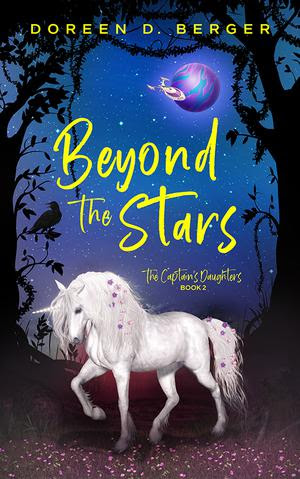
DOREEN: The sequel is Beyond the Stars. Mischievous sisters Diane and Robin are already in trouble with their father for a stunt they just pulled. Their punishment (grounded…again!) is cut short with the arrival of Jannel, a soft-spoken, shy girl roughly their age, and the future ruler of the planet Lasusia. Jannel has been sent to the Polaris for safekeeping from a deadly virus running rampant on her home world. As Diane and Robin learn about their new friend and the problems she faces on her war-torn planet, they vow to help her, even though they understand it means getting deeper into trouble with their father. But they are soon in over their heads, stricken by the virus, and trapped by their father’s mortal enemy. They must use all their instincts and resources to escape before they perish from the virus, along with all hopes of planetary peace.


ELLIOTT: Who designed the cover for The Captain’s Daughters? How much of a role did you play in the design process?


DOREEN: The cover for The Captain’s Daughters was designed by a company in New Zealand called Damonza. In my mind I knew basically what I wanted (the Santa Fe landscape fading into a night sky, horses that resemble Pepper and Cloud, the different planets, and the space station). I gave them this info and they ran with it. I think they did a fabulous job…I love the cover! And the cover for Beyond the Stars is just as nice!


GIVEAWAY


Leave a comment by May 5 to enter this giveaway. (If you already entered the first part you'll have 2 chances). Please leave your name and email address if you are new to my blog. Continental US addresses only. 

REMEMBER! You'll find more great MG reviews on Greg Pattridge's ALWAYS IN THE MIDDLE blog. 


Friday, December 3, 2021

MIGHTY INSIDE: A Middle Grade Historical Novel Review and Giveaway

Although I've never met Sundee Frazier in person, I feel as if I know her. When I first started researching Half-Truths, I read her autobiographical book, Check All That Apply: Finding Wholeness as a Multiracial Person (InterVarsity, 2002. The daughter of a white mother and a Black father, Sundee wrote candidly about her struggles to fit in, to feel accepted as a multiracial person, and how her Christian faith helped her in her journey to wholeness.

Fast forward several years, and Sundee wrote The Other Half of My Heart (Random House, 2010) about twin girls--one who is "milky white" and the other is "cinnamon brown." Their Black grandmother insists that both girls enter the Black Pearls of America pageant--which produces high drama for both girls! (Click here for my interview with Sundee about this book and how she mined her life to write it.)

Sundee's most recent book, Mighty Inside  (Levine Querido October, 2021) also draws from her own life--this time most specifically about her father's and grandparents' experiences in Spokane, Washington in 1955. After you read my review, please click on the video. Sundee and her family share some of the stories that informed this wonderful middle grade novel.

(Please see Sundee's website for her other children's books.)

REVIEW


Every time he opened his mouth, his words backed away like a kid afraid to jump off the high dive--running to the end and then stopping, over and over--until he could feel the pulsing of an artery in his forehead. His tongue felt as heavy and solid as a brick. (p. 17)

That's how Melvin Robinson describes his "traitor mouth" that trips over "sticky" letters like "T" "P" or "B." It's the Stutter that has been with him ever since he was a little kid; the mouth that prevents him from speaking his mind; the tongue that will embarrass him as he enters high school. 

He makes it through his first day of school with one big accomplishment: he meets Lenny--a talkative, Jewish, white sax player who sticks to Melvin like a burr. But, as Melvin finds out, Lenny ends up being the best friend a kid could have. 

As the book progresses, Sundee skillfully weaves in backstory. Melvin overhears an argument between Melvin's father and his Uncle T.:

"Why you think that boy got that stutter? 'Cause he's surrounded by all these white folks, that's why. You shouldn't be here. You should be on the east side. Or do you think you're too good for that?" 

....

Pops had crossed a line. Was Melvin suffering because of it?" (p. 52)

School is a mixture of pain with some spots of pleasure. Despite faithfully doing his tongue exercises, Melvin messes up frequently--and is teased by several bullies. But, his day is brightened by brief glimpses and interactions with his crush, Millie, a Japanese American. Science (taught by a veteran who lost a hand in WWII) and choir are highlights. When he sings the Stutter never appears. 

But where Melvin really begins to shine, is playing accordion alongside of Lenny. The two become so good that Lenny convinces Melvin that they should try out for a television show featuring local kid performers. Although Melvin is scared, he realizes that his accordion speaks better than he does.  

I don't want to include any spoilers, so I'll just say:

  • I really appreciated how Sundee threads Melvin's Christianity--as well as his questions into the novel. During a stressful time, Melvin recites portions of Psalm 23. Although he wonders why God gave him a "broken tongue," his faith helps him conquer his fears. 
  • Other plot points about Emmett Till, Lenny's father, and Millie's experience in Japanese internment camps enrich the book.  
  • I liked the metaphor of the "walls" of prejudice that Melvin keeps running into.
  • And finally, just like Jackie in Joyce Hostetter's latest novel, Equal, Melvin also discovers: 
He knew he would get stuck on some of his words, and it was all right. He had decided the best way to deal with an enemy, if he could, was to make that enemy his friend. The Sutter was a part of what made him him and he was okay. Just the way he was. (p.229)


The Author's Note includes how Sundee's grandparents acquired their home and some of the family stories she drew from. Here's the promised video: 

                                            https://youtu.be/4SOq6Fw0NDk

GIVEAWAY

To enter this giveaway, please leave a comment by December 7 at 9 AM. If you decide to follow my blog for the first time or share this on social media, I'll put your name in twice--just let me know what you did. If you are new to my blog, please leave your name and email address.  

Congratulations to Amy Houts, who won Dear. Mr. Dickens from last week's blog.

Monday, November 22, 2021

THE MEANS THAT MAKES US STRANGERS: Author Interview with Christine Kindberg and Giveaway--Part II

Last week in Part I, I reviewed Christine Kindberg's debut novel, The Means That Make Us Strangers. Today she shares her passion for racial equality and her path to publication. And as promised, I'll tell you how she and I are connected. 


AUTHOR INTERVIEW


CAROL: Everyone always wants to know how author’s get their ideas for their stories. What experiences did you have growing up as a TCK (Third Culture Kid) that influenced the creation of this story? Any parts of this autobiographical? Why did you pick this particular time period? 


CHRISTINE: I usually describe the book as exploring questions from my life in more extreme circumstances. A lot of Adelaide's feelings as she navigates the transition from Ethiopia to the US come straight from my experience as a TCK. The disorientation, the desperation to find people to connect with, the grief that sometimes attaches itself to little things, the embarrassment that comes from not understanding a new culture, the anger... I was definitely tapping into some of my own memories when writing about what Adelaide was feeling. I moved several times, back and forth between the US and Latin America, so I didn't have one long-term home the way that Adelaide does in Ethiopia, but I did transition to the US in high school. It's particularly rough moving when you're a teenager.


But the inspiration for the book actually came from a different angle. The original germ was a desire to explore the American rules around race and what would happen if someone broke those rules without realizing. As a TCK, I sometimes feel more comfortable with people who don't look like me, but skin color is too often the cause of deep divisions, changing everything from where someone is likely to grow up to where they go to church or school and how comfortable they feel shopping in certain stores. As a Christian, it matters to me when I see brothers and sisters with darker skin treated unfairly, and I want to know how to live faithfully as a white person, with all the privilege that comes from this skin color.


There are still lots of problems around racial divisions today, but I chose to set the book in the 1960s because I wanted to increase the danger around breaking the racial rules. The consequences for breaking racial barriers then was way higher than it is now, and I knew that would raise the stakes of the story to make it more interesting.


CAROL: Similarly, did any of the characters reflect people you know? 


CHRISTINE: I didn't consciously base any characters on real people...but I've been told more than once that Adelaide sounds a lot like me! I did borrow the name Kinci from a nickname my best friend from high school gave herself.


CAROL: Why did you pick Ethiopia as the country where Adelaide's family lived? 


CHRISTINEMy connection with Ethiopia came through research. I knew I wanted to give Adelaide connections to a rural village somewhere in Africa, and as I researched different countries, Ethiopia stood out as unique in ways I thought would be helpful for my book. It's the only country that wasn't colonized by Europeans, so I assumed Adelaide's white skin would carry fewer political connotations. It also has a history of Christianity that goes back for millenia, and that fascinated me. The more I learned about Ethiopia, the more I wanted to learn. And then the neighborhood I moved to in Chicago had a significant Ethiopian influence, with lots of Ethiopian restaurants, grocery stores, and cultural gatherings--and an Oromo church that met right across the street from my apartment. I read a lot and talked to people for my research, and hopefully someday I'll get to travel there!


CAROL: Why did you choose Greenville, South Carolina as the setting for the story? (I loved the reference to a few locales that I could relate to!). 


CHRISTINE: Greenville has a history of teenagers being on the front lines of the push for Civil Rights, which I found pretty inspiring. This wasn't unique to Greenville, but Sterling High seems to have provided a training ground for emerging leaders. There were a few incidents in particular that caught my imagination, like the desegregation of the library in 1960 thanks to nine black teens who were willing to be arrested over a request for reading materials. The youngest was fifteen at the time. And the court case of Whittenberg v. Greenville County Public Schools, in 1963--spearheaded by the father of seventh-grader Elaine Whittenberg--gave me the historical context I needed for the first steps of school integration that form the backdrop of my book. Greenville is also a beautiful city that I loved exploring and learning more about!


CAROL: As a former Greenville, SC resident--I agree! To switch subjects, I loved the deep first person POV. Was that a choice that came naturally to you, or did you play around with several POV first?


CHRISTINE: Thanks for saying that! I'm glad you enjoyed it. The choice of first-person narration did come naturally, maybe because this was my first book and I unconsciously put a lot of myself in Adelaide. But I did a lot of refining and deepening of the POV as I revised. There were at least four rounds of major revisions, so plenty of opportunities to refine!


CAROL: As I said in my first blog, I’ve never read a self-published book that is so good as yours. Why did you choose to self-publish it? Can you share any aspects of that road to publication? You acknowledge several people who helped with the proofreading and editing process- they did a great job!


CHRISTINE Thank you again! One of the reasons I was willing to consider self-publishing is that my day job is at a publishing house (I'm a Spanish-language editor at Tyndale), and I knew I could get help from friends who are talented professionals. For a long time, I was pretty resistant to self-publishing, so it definitely wasn't my first choice. But after trying for about four years to get the attention of agents and editors, I finally decided to listen to the advice of a mentor and take the risk of publishing it myself. I knew it would be a ton of work to produce and promote a quality self-published book, but I didn't want this story to languish on my hard drive. I decided to dedicate a year or so to giving this a try and seeing what would happen. I filled out the paperwork to register my own imprint as a business, and I called up my friends to ask for help with the cover design, editing, proofreading, typesetting, etc. (I did pay them, for the record!) I also learned everything I could about how to promote a self-published book. I made a lot of mistakes along the way, but I'm glad I went ahead and tried.


CAROL: What response have you received? Is your audience mostly adults? Teens? 


CHRISTINE: It's been such a privilege to hear from readers who have resonated with the story. And I've been surprised at how wide-ranging the readership has been! I've heard from thirteen-year-olds who loved it and from a ninety-seven-year-old who couldn't put it down. My audience is probably mostly adults who enjoy YA books, but their kids and grandkids seem to enjoy it too. I'm passionate about writing for a general audience, but this book seems to have gotten good traction in Christian circles, like when it won the Christy Award for Young Adult and the Honorable Mention for the Selah Award for Young Adult. Those awards have definitely helped with visibility!


CAROL: Did you Christian faith influence the story? If so, how?


CHRISTINE: I'd say everything I do is influenced by my Christian faith--at least, that's how I'm trying to live! My faith definitely influences what I think about the issues of racial justice and why I think everyone should be asking what it means to love our neighbors in a society that's deeply divided by race. That said, faith really isn't a part of the story in The Means That Make Us Strangers--church is mentioned a few times, but it's more of a social backdrop because faith isn't really on Adelaide's radar. Some of that was a conscious choice on my part, like when I chose to make Adelaide's dad an anthropologist rather than a missionary because I didn't want to have elements that could potentially be distracting for readers who aren't Christians. But mostly I wanted to be faithful to the story and true to the characters as I got to know them. With my next two books I wrestle a lot more with questions of faith through the stories, but whatever I'm working on, I'm passionate about writing books that come from a place of deep faith but aren't just for fellow Christians. My dream is to write honestly about faith and life in a way that fosters conversations about faith with people who would never walk into a church or a Christian bookstore.


CAROL: What’s next?


CHRISTINE: I'm currently waiting to hear back from potential publishers about my second book--I'm trying to go the traditional route this next time. Here's hoping there's news soon! That book is historical fiction set in England in the 1530s, about a nun who has to find a new purpose and way of living after the closing of monasteries and convents under Henry VIII. 

And I'm about three chapters in on my third book, which is set in the southern tip of South America in the 1860s-1970s, about the first white family to settle among the indigenous people in that part of the world. Very different settings and time periods for these next books! But a lot of the themes will continue and carry over.

CAROL: Thank you Christine, for writing this beautiful book and providing a giveaway to one of my fortunate blog readers. 

                                                ***

Christine and I emailed back and forth several times after I read her book. Since I read on her website that she went to Queens University in Charlotte, I asked her when she was in my hometown. She replied that she graduated from Covenant Day in 2005-2006 and I asked her if she knew my daughters, Lisa and Lori, who went to school there. 

She wrote back: 

"You’re Lisa’s mom! How funny—I was actually thinking of Lisa when I saw your name and that you were from Charlotte, but I thought there was little chance you’d be related. Lisa and I became friends the year I was at CDS, our senior year, and I remember going over to your house at least a couple of times. I was in the play that year with Lori."

It's a small world!


Christine Kindberg
Photo by Lindsey Bergsma

Christine would enjoy connecting with you on social media: 
Leave a comment on my blog and I'll add your name to the list of readers interested in winning The Means That Makes Us Strangers. (If you entered last week, you can enter again.) U.S. addresses only. If you are new to my blog, PLEASE LEAVE YOUR NAME AND EMAIL ADDRESS. A winner will be drawn on Thanksgiving.

Congratulations to Rosi Hollinbeck who won THE UNIVERSE AND YOU for her great-grandkids. 

Monday, August 14, 2017

Not On Fifth Street: An Interview with Kathy Cannon Wiechman

As promised last week, here is my follow up interview with Kathy Wiechman, author of NOT ON FIFTH STREET.


CAROL: Just like in LIKE A RIVER, you wrote NOT ON FIFTH STREET from two points of view. What led to that decision? 

KATHY: NOT ON FIFTH STREET is about a rift between two brothers. When I was a kid and got into a dispute with one of my siblings, my mother always said "There are two sides to every story." And she wanted to hear them both. I felt the only way to give Pete and Gus an equal chance to tell their sides was to write it that way. Since doing that had worked well for me in LIKE A RIVER, I felt comfortable doing it again.

CAROL: Unlike RIVER, Gus’s POV doesn’t follow after Pete’s. You go back in time and show the reader what everything looked like from Gus’s POV. What led you to writing it in that manner? Why didn’t you flip-flop chapters between the two?

KATHY: Part of Pete's worry in Part 1 was due to him not knowing where Gus was or if he was all right. If I had alternated chapters, the reader would have known more than Pete about Gus's circumstances and wouldn't be able to commiserate with him about it, and I think empathy with the POV character is always one of an author's goals. I felt it was a good way to add to the suspense in Part 1.

CAROL: This conflict between Pete and Gus is crucial to this story. How did you come up with that? 

KATHY: When I wanted to write a book about the '37 flood, I knew the flood itself wouldn't provide enough conflict. I grew up in a house with six siblings, my husband grew up with six siblings, and together we raised four children. I am quite familiar with sibling rivalry and the rifts that can cause conflict in a large household. It felt natural for the brothers' feud to be the key to the story. When I began my first draft, the first line I wrote was "Pete had never seen his brother so mad." In the final draft, that line appears in Chapter 2, but I let those words set the mood for the story.

CAROL: Did using your father’s story make writing this book more or less difficult?

KATHY: I was surprised at how much more difficult it was to get into Pete's head because he was based on my dad. I created Pete and he had to be Pete, not Dad. But that was tough to do. The part that was easier was knowing Dad's story so well, I always knew what would happen next. I also spent a lot of time in my grandma's house as a child, and I could always picture my setting so clearly, from the homemade picnic table in the sunroom to the back bedroom overlooking the garage to the mantel clock in the living room.

CAROL Can you give us some idea of how much is fiction and how much is fact? Obviously the flood and the fact that your father evacuated his family was fact. What else?

KATHY: Much of what Pete does, like taking the motor out of the refrigerator, my dad did. And like Gus, he was listed as missing. And my grandmother dug in her heels about evacuating because she didn't know where he was. His family did have his name mentioned on the radio as missing, and that call was put out by WLW from Cincinnati. Dad was not 14 or 15 like Pete and Gus. He was 20, but my Uncle Bill who marked the garage wall with the height the flood reached was only 12.

CAROL: How has life changed for you since receiving the Grateful American Prize?

KATHY: My day-to-day life is the same. I write or work on some part of the process every day. It might be research or promotional, but it's for my books. What has changed is my connection to the phenomenal team of people with the Grateful American Book Prize, who believe, as I do, that knowing American history is essential for today's young people. This group pays attention to what I am doing and they continue to help promote LIKE A RIVER even two years after it won the award. And the cash prize that came with the prize helps to fund my research trips.

CAROL: What’s next?

KATHY: I am working on another Civil War novel. This one takes place in Wilmington, North Carolina during the final months of the war. And I am doing a bit of preliminary research for a possible sequel to LIKE A RIVER.

******
For a chance to win my ARC, please leave me a comment along with your email address if you are new to my blog. A winner will be chosen on August 17. 

My husband's uncle, Robert Toupal, is
always eager to read well-written historical novels. He often
greets me with, "Got any new books?"


Monday, November 17, 2014

Movies, Horses, Runaway Piglets--and a Giveaway!

Congratulations to Linda Phillips for winning a copy of Grace Ocasio's book, The Speed of Our Lives. 

In August I reviewed Maggie Dana's book,  Turning On a Dime. When I asked her if she would share about her love for all things equine, she sent me this post which first appeared on Tudor Robins' blog. I know you will enjoy this glimpse into how Maggie used her life experiences to inform her writing. 
*******

As I writer, I am often asked, “What got you started and how do you come up with ideas for stories?”

The first question has many answers; so does the second, and writers have covered most of them, such as: I’ve always wanted to write . . . my high-school/college English teacher told me I was a natural . . . friends can’t wait to read my next story . . . I have so many ideas, I can’t keep up with them.

And they apply to me, too. But my favorite questions, though, are these:“How old were you when you learned to ride?” and “Where did you do that?”

Being a rider and a writer, I couldn’t wait to answer.

* * *

Back in the dark ages, when helmets weren't required and we all rode in whatever outfits we could cobble together, my first riding lesson scared me so much that I didn’t try again for another three years. But all it took was the right instructor at the right stable, and I was hooked on horses for life.

My new riding teacher, Tom Taylor, was strict, but he understood kids. He drilled us on the flat and over jumps, relentlessly, without reins and stirrups — we knew better than to complain — and when we flubbed up, Tom climbed onto our horses and showed us how it should be done. No matter how cranky our horses had been, they were complete angels with Tom.

A humbling experience.

On top of all that, Tom's stable was slap bang in the middle of Pinewood Studios, England’s version of Hollywood (now home of the James Bond films, Superman, and several other blockbusters)...

 . . . complete with gigantic sound stages, odd-looking props, and movie stars wandering about in full makeup and costume. Just imagine being eight years old, riding a scruffy pony, and seeing ALL THIS AMAZING STUFF as you trotted toward the paddock where your riding lessons were held.


In addition to horses and ponies, the stable boasted a Jersey cow, two belligerent sheep, and a gigantic pig that had one litter after another. Added to this mix were numerous chickens, ducks, and turkeys that pecked at your feet if you weren’t super careful.

Us kids -- the stable rats -- took care of them all. To pay for our riding lessons, we also mucked stalls, groomed horses, stacked hay bales, helped beginners tack up and mount, and made sure the animals didn’t escape.

So, of course, they did.

One afternoon, Mother Pig and her ten piglets got gloriously loose among tea roses, herbaceous borders, and topiary trees at Pinewood's most prestigious garden party.

Picture, if you will, starlets with flowery hats and six-inch heels. Imagine film producers in tuxedos, sporting gold chains and Rolex watches, glad-handing gossip columnists and wealthy investors. Think about starched waiters circling with trays of chilled champagne. Then conjure up Mama Pig and her exuberant offspring zooming among designer-clad legs, upending buffet tables, and disappearing into the well-ordered shrubbery . . . all pursued by us delighted stable rats.


We made it last as long as we could. The last piglet wasn’t captured until well after supper.

But my best memory is about Maud, the Jersey cow, when I was put in charge of leading her from the stable and onto the set of a war film that involved rescuing a valuable cow from the German-occupied Channel Islands.


Only one problem.

The story (based on a best-selling book) called for a Guernsey cow — brown with white patches — and Maud was a Jersey (think Exmoor pony for color, as in beige). Now, this was a black-and-white film. The shade of brown wasn’t crucial, but the white patches were. So the film crew got to work with brushes and buckets of white paint while I held the cow … and it took rather a long time.

All this was heady stuff, especially for me — an awkward eleven-year-old — and I was beginning to relax when Maud ruined her moment in the spotlight by relieving herself all over the sound stage’s concrete floor.

A cow plop would've been bad enough, but this was urine.

Oh, horrors.

It splashed, it ran everywhere. I thought I would die of embarrassment. Everyone doubled up with laughter, even the tight-lipped director. David Niven, the movie's star, collapsed into his canvas folding chair and insisted the scene be written into the script.

It wasn’t, thank goodness.

A few years later, when I wound up working at the studios for Richard Attenborough and Jack Hawkins, I worried that someone would bring up the Maud incident, but nobody did.


Now that you’ve heard all this, you might wonder how I’ve used it in TIMBER RIDGE RIDERS, my horse books for kids. Mostly, I’ve pulled on my riding experience, the lessons I learned from talented instructors, and the experiences I’ve had at horse shows. But in the third Timber Ridge Riders book I was able to use my knowledge of the movie industry. The book is called RIDING FOR THE STARS, and it’s one of my favorites of the series.


Leave a comment by 6 PM on November 20 for a chance to win an autographed copy of RIDING FOR THE STARS. It would make a great holiday present for your daughter, granddaughter or niece!
 *******
Maggie Dana also writes women’s fiction. Her novel, Painting Naked, published by Macmillan, is available on Amazon and other e-book sites.


THE NIGHT WAR: A MG Historical Novel Review

  By now you should have received an email from my new website about my review of THE NIGHT WAR by Kimberly Brubaker Bradley. (It'll com...