Showing posts with label writing journey. Show all posts

Saturday, March 11, 2023

What's Next?

 Six weeks ago, I shared my excitement that HALF-TRUTHS was finally on submission. At that point, the answer to the question, "What's Next?" was to query agents and editors. For those of you who are writers, you know that process can take a long time. Agents and editors are backed up and although I've sent the full manuscript in response to a few requests, it can still be months before I hear back from anyone.

Meanwhile, the best antidote to obsessively checking my email is to get busy with a new project. Without further ado, I want to introduce you to my next WIP (Work in Progress) a middle-grade graphic novel that I've tentatively titled ESCAPE FROM NURENBERG. The story is based loosely on my father's and grandfather's experiences in Germany from 1935 to 1938.

When my parents died, I became the keeper of their papers. These included an assortment of documents and photographs. There were several versions of my father's autobiography, personal letters, my grandfather's report cards from medical school in the early part of the 20th century (that a friend translated), and a speech he gave to doctors in Ohio after he immigrated to the United States. 

My father, Henry Federlin, is on the left. He is standing with
 his mother Elsie and his father Sigmund.
Circa 1945
As I looked through these precious documents and pictures I wondered if there was a story that I could write. I usually answered that question with "no" because there are already so many Holocaust stories for kids. But there was one unique event in my grandfather's life that occurred before he left Germany. It wasn't a story by itself. But maybe it was the ending. And when I thought about my father's account of how he was bullied in the public school I thought--that could be the beginning. 

All I needed was the middle.

I made a note to myself in my phone:

  • Learn how to use Scrivener for writing a script.
  • Learn how to write a graphic novel.
  • Learn what was happening in Germany during this time period.
  • Come up with a story arc. 

In the last six weeks, I've done all four.

SCRIVENER

Based on what I read online, Scrivener's scriptwriting program was ideal for writing a graphic novel. The only problem was that I had no idea how to write a script! Fortunately, I found a ton of images and tutorials online and within the Scrivener software itself. Since I learn better by trying my hand at something rather than reading about it, I jumped in and created a project. Like all software there's a learning curve, but I'm getting there. I love keeping track of my research, the story, and images all in one project--with the ability to simultaneously work in two documents:


WHY A GRAPHIC NOVEL?

I spent 16 years writing HALF-TRUTHS and I wanted a break from that form of storytelling. I also asked the KidLit 411 Facebook group how to tell if an idea was better suited for a "regular" novel or for a graphic novel. I tagged Kirsten W. Larson and she responded, "I would think about the visual possibilities for your story. Like picture books, graphic novels are visually driven. You have to ask yourself the same questions about whether you have scenes that are visually interesting and distinct from each other." Since I was already picturing the action in many of the scenes, I thought I was on the right track. 

This blog post describes the process that I stumbled into. A graphic novelist imagines each panel as the reader will encounter it.  Kirsten Larson told me that the process of "paneling" takes time. I believe it. Imagining what will be shown on a page of panels can easily take hours of research. 

I'm also studying graphic novels and seeing how the author employs transitions, and shows dialogue, captions, and narrative information. As I did with HALF-TRUTHS, I'll be reviewing some of these books here. 

LEARN ABOUT GERMANY

I'm a hands-on learner. Whereas some novelists may choose to research and then write, I prefer to jump in, learn, save new information, and incorporate it into my WIP.

Although my parents were both born in Germany and had family who died in the Holocaust, by the time my brother and sister were born in 1950, my parents were ready to put those events in the past. I came along three years later and my parents rarely talked to any of us about their childhood growing up in Germany. My best friend's mother had a tattoo on her arm from being in a concentration camp--but we never talked about it. I knew the names of the cities where my parents grew up, but it wasn't until I was an adult, that my father started sharing some of his experiences before leaving Nuremberg. 

Fortunately for my siblings and I, my father composed several short, type-written autobiographies. My mother's memory wasn't as good as my father's, but I interviewed her a few times and have some glimpses of her life as a child in Speyer.

I'm embarrassed to admit it, but I knew only a thimbleful of information about the Holocaust. I am rapidly rectifying that situation through books and amazing websites like the United States Holocaust Museum with information such as this about children. When I enter various museum websites it's like diving into a deep hole. I go from link to link and come back to Scrivener having forgotten what I was looking for. 

When my dad told me he grew up in Nuremberg, I didn't realize how Hitler used that centrally-located city as his propaganda launching pad. Not only did it have a huge park that Hitler transformed into his political Rally grounds, his antisemitic follower Julius Streicher, published the virulent Der Stürmer newspaper there. 

This is what my father had to say about Striecher:

"My public elementary school was right across the street from an anti-Semitic weekly newspaper, Der Stürmer published by one of Hitler's favorite cronies, Julius Streicher, Nazi boss of Franconia, a noted pervert and one of the most unsavory characters in the Third Reich."

As I pictured my father attending school across the street from a widely-read tool of Nazi propaganda--my story became more real. 

A group of young German boys view Der Stürmer, Die Woche, and other propaganda posters that are posted on a fence in Berlin.
A group of young German boys view Der Stürmer, Die Woche, and other propaganda posters that are posted on a fence in Berlin. ——US Holocaust Memorial Museum, courtesy of Julien Bryan Archive

THE STORY

I had story nuggets for the beginning and the end but I didn't know what was going to happen from Point A to Point Z.  My unofficial "research assistant," my sister Barbara Federlin, and I brainstormed possibilities.  The more I read, researched, and imagined what my father's and grandparents' lives were in Nuremberg, the more a story began to take shape.


Fifteen years ago I toured Nuremberg with
my oldest daughter, Lisa, and my husband.
We visited the medieval city and saw the street
where my father grew up. These images help construct my story too.

WHAT'S NEXT?

Kirsten W. Larson is mentoring me as I plunge into the graphic novel world. I took a webinar with her last year which convinced me that the Kidlit publishing world is wide open to this genre. She encouraged me to create a synopsis using this template. You can use it at any step of your writing process. Filling it out even if your WIP is not a graphic novel and even if it might change, will help you imagine your entire story arc.

Thanks for joining me on my next writing journey. I'll be sure to let you know what happens next. 

                                                ****

GIVEAWAY NEWS

Congratulations to Becky Scharnhorst who won THREE CANADIAN PIGS and to Marci Whitehurst who won GOOD MORNING, SUNSHINE. Thanks to everyone who entered. Stay tuned for more contests--I have a stack of books to review and give away!


Friday, January 27, 2023

On Submission


This post has been a long time coming. About 16 years long. There have been times when I thought I was ready to submit my middle-grade novel, HALF-TRUTHS. But now I KNOW it. 

IN THE BEGINNING

From the beginning, I imagined a story about a white girl and a light-skinned Black girl discovering that they were second cousins. That premise, which consistently elicits a "WOW!" response, has remained the same throughout my book journey.  

Having written dozens of articles and two nonfiction books, (Friendship Counseling, Teaching the Story: Fiction Writing in Grades 4-8)  I had confidence in my writing skills. But I knew nothing about writing fiction. It felt like jumping into deep water without knowing where I'd find the bottom. 


I wanted it to be a pre-civil rights story but Harold Underdown, my mentor at a Highlights Foundation workshop in 2009, informed me that was only the setting. For years I wrestled to answer the question he posed: What does your character want? 

EVERYONE HAS A STORY 

In the summer of 2007, I started thinking about my story and began interviewing "experts." My friend and mentor, Joyce Hostetter, encouraged me to research far and wide. What was happening in the world? In North Carolina? In Charlotte? She suggested that I find people who lived in the area and listen to their histories. Since I was just discovering my story, those initial interviews were broad. It's funny to reread them and see some of the questions I asked. 

Even though I often got off track and wanted to include every story I heard--I absorbed a time and place that was new to me. (In a future post I'll share some of the stories that I wanted to include but didn't.) 

I'm working on my 20+ page bibliography which includes 100 expert interviews. Some interview notes are less than a page. One of my experts is a man who graduated high school the same year my protagonist was in middle school. His notes are over 90 pages. Skimming through these interviews, I found details that made it into my story. I'd forgotten where and how I learned things such as what was served for lunch in the school cafeteria, the Black help's relationship with their employers, what it felt like to sit at the back of the bus, the used books and sports uniforms passed to the Black schools, the discussions about school integration, the peasant dresses worn to dances. You name it. It's one thing to read about these things in history books. It's another thing to have someone tell you how they felt as they experienced Jim Crow and/or chose not to become a debutante. 


Dorothy Counts, one of my experts, walking to Harding High School in 1957.
She was the first Black to attend the school.  
The photo originally appeared in The Charlotte Observer. 

People often wonder how I found these experts. I learned to ask everyone, "Who else should I talk to?". Tom Hanchett, Charlotte's local historian recommended several individuals. Others were patients of my dentist husband who were long-time Charlotteans. Others were parents of friends. These became my experts whose stories were woven together to create Half-Truths.

WHERE DID I FIND THIS STORY?

As the (working) title indicates, this book is about secrets and "white lies." Ben Franklin wrote in the Farmer's Almanac in 1758, "Half a truth is often a great lie." Over the years, I've thought about the secrets that people choose to conceal or at least, not talk about. I've often wondered what effect that has on the following generations.  As a Christian, I'm committed to telling the truth as commanded in the ninth commandment: "Thou shalt not bear false witness." As I wrote this novel, I had to think about my own "little" half-truths that I tell, and the reasons for them.

One elderly woman, a former debutante, suggested that I not pry into Charlotte in the 1950s and instead, write about my own life. (Who would want to read about growing up in South Jersey? Boring!) I was fascinated by my adopted new hometown and walked and biked around South Park and Myers Park thinking, "What is the story that could have happened here?" When I visited the former Rosenwald School in Grier Heights and saw the picture of a light-skinned Black principal, I found a key part of my story.

Billingsville School in Grier Heights. 
Now a community center. 

JOURNEY HIGHLIGHTS 

 In November 2008, following Joyce's advice, I joined NaNoWriMo for the first time. I didn't feel ready, but it helped me create a first draft.

Pretty soon I realized that I didn't know what I didn't know. I attended workshops and webinars, conferences, and classes. I read books and blogs on plotting, conflict, and character; participated in several critique groups, and received critiques from industry professionals. Throughout this time, my best writing buddy, Linda Phillips, and Joyce encouraged me, asked me pointed questions, and provided feedback.


From the left: Joyce Hostetter, myself, and Linda Phillips
 at a writer's retreat in 2011.


But why did it take 16 years? First, I spent a long time trying to figure out where the story began. HALF-TRUTHS takes place in 1950, but at one point I started it with the protagonist's father in WWII. Not even close to the inciting event--which I didn't know a novel needed! 

Despite the fact that I wrote several outlines, I kept getting off track. Whenever I heard a feasible suggestion, "Someone should die," or, "Write it from the points of view of both girls," or, "Include romance," I spent time incorporating these ideas and going down rabbit holes of research. Combine that with going back and forth on whether or not this was a young adult or middle-grade book, I often strayed from my original vision: two girls--one white, one Black, discovering they are related. 

Enter Rebecca Petruck.  Rebecca critiqued several drafts and offered great insight into character arcs, plot points, and internalization. After I had spent a lot of time writing boyfriends for each main character (when I was thinking HALF-TRUTHS was a young adult book), Rebecca told it to me straight. I had lost the essence of the story--the girls' relationship.  


Rebecca helped me construct a plot chart in October 2013. 
I learned about Save the Cat! for the first time.

Since all of my readers were saying the book sounded more middle-grade, I ditched the boyfriends and the young adult genre. Along the way, I continued to interview folks and read and review middle-grade books. I particularly enjoyed Kathy Weichman's historical novels. Winner of the first Grateful American Book Prize, Kathy used to joke that she is the poster child for perseverance. I think I might be tying her for that distinction. 

Joyce Hostetter and I have swapped manuscripts over the years. Last February she suggested that I hire an editor to bring the book to the next level. I asked several trusted professionals in the Kidlit community for recommendations and found Deborah Halverson. She is a treasure.

In June 2022, I shared one page from Deborah's comprehensive editorial letter. For the next six months, I worked on incorporating her suggestions. I took out Kate's free verse poetry and changed it to journal-type entries in her steno pad. This fits Kate's goal of becoming a journalist. I worked on more youthful language, made Kate the instigator for the major change in her life, tightened the ending, and strengthened the City Girl vs. Country Girl motif as Rebecca had suggested years ago--but I'd forgotten!

In other words, I revised. A few weeks ago I was rewarded with these words from Deborah: 

In this revision, I feel you have accomplished your goals with this project, creating an entertaining, enlightening, compelling, and satisfying story for middle graders. I believe young readers will connect with Katie immediately and root for her throughout. Her growth is inspirational, showing the triumph of a flawed but earnest young person. 


Deborah's words gave me a boost of confidence that finally brought me to the...


of this stage. But it is also the beginning of an exciting time--being on submission!

WHAT'S NEXT?

For my friends and family who are reading this and aren't writers, you may be wondering what happens next. Remember those conferences and webinars I mentioned? At each one, I collected the names of agents and editors who expressed interest in the manuscript. Many said they didn't care how long it took. They just wanted to see it when it was the best I could make it. 

Now I take out that list, organize it through Query Tracker, and start sending out the manuscript.

If you are a writer, how did you feel when you began submitting your work? Please share your experiences in the comments. 

GIVEAWAY

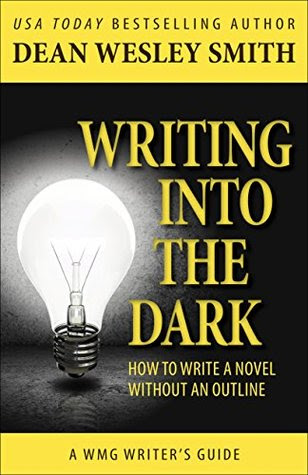
Obviously, I don't have a copy of Half-Truths to give away, but I'm cleaning off my bookshelves to make room for the books I'll need for my next project. Over the last 16 years, I learned that I'm definitely a plotter, rather than a panster. For those of you who abhor outlines, I'm giving away my (slightly marked-up) copy of WRITING INTO THE DARK. Leave me a comment with your email address by February 1 and it could be yours.


Congratulations to Emily Weitz who won MY SCHOOL IN THE RAIN FOREST.

Please take a minute to see views about other middle-grade books on Greg Pattridge's Always in the Middle blog.


Saturday, June 4, 2022

The Next Step: The Editorial Letter

A few weeks ago I posted my You're Almost in Labor! blog. I shared that the next step in my publishing journey was engaging Deborah Halverson to help get my "baby" ready to send to agents and/or publishers. 

As I waited for her feedback and editorial letter, I got nervous. What if she didn't like HALF-TRUTHS? Or worse, what if she liked the concept but suggested a major overhaul? I've been there a few times and didn't want to go back. 

When I told Deborah how I felt, she tried to reassure me. "Don’t feel worried. It’s a great story. My job is to help it to its best incarnation, so readers can get the most enjoyment from it. This is about moving it forward!"

My good friend Linda Phillips tried to reason with me. "You want Deborah to be tough; that’s what you paid her for, and it will only make it better.  And since this is a one-time deal, you want her to give you as many suggestions as possible and then you can spend the time making the corrections." 

I knew Linda was right and I reread Deborah's email a few times. But still, "what if's" plagued me the whole night before I anticipated receiving Deborah's letter. I literally tossed and turned that night in bed.

But guess what? The next day, when I received Deborah's editorial letter, I teared up. Deborah not only deeply understood what I was trying to accomplish, but she also called my characters sweet and said it was easy to root for their dreams and for their friendship! 

As I read through her letter I knew that every single one of her points were what she had promised--editorial suggestions that would move Half-Truths forward. 


That night I couldn't sleep because I was so excited that her suggestions were ones I could implement!!

Some of you are readers and curious about the steps involved in writing and publishing a book. Others of you are also writers. For both groups of blog readers, I thought I'd share some of Deborah's points that resonated with me. 

First point:

  • This story is Katie’s first-person POV narration. The narrative sensibility absolutely feels like a thirteen-year-old. That is, her level of wisdom, her manner of viewing the world, the things she cares about, and the way she evaluates others’ needs and motives all feel right for someone her age. My concern is that sometimes the language and phrasing feel a bit too sophisticated, sounding “adulty.” 

I was happy to hear that the way Kate sees the world was consistent for a thirteen-year-old. But when I started looking through the manuscript, I was surprised at the many examples of "adulty" language that Deborah found! Descriptions like "grim eyes" or "his furrowed brow" or an action like, "I inhale a whiff of lavender" all take readers out of a young teen's POV. It'll be fun to track down these words and translate them into more teen-like vocabulary. 

Second point:

One of the things I'd included in the manuscript were Kate's poems. For me, they were exercises in getting more in touch with Kate's thoughts and emotions. They had been my side writing technique, as Mary Jane Nirdlinger wrote about in a recent Carolinas-SCBWI blog. But as Deborah observed, 

  • Katie doesn’t read poetry. She doesn’t talk about poetry. She doesn’t talk about the world like a poet, and doesn’t talk about becoming a professional poet. She talks about the world like a reporter, and wants to become a professional reporter. She reads newspapers. The books she does read are novels, not poetry collections. In my estimation, the poetry and journalism elements don’t sync. Simply put, I don’t see the point for the poetry.
When I wailed to Linda that I didn't know how I could take out my beloved poems, Linda (who IS a poet and wasn't impressed with my poems but was too nice to say that) excitedly pointed out ways in which those poems could be recycled as narrative or -- maybe even articles which Kate writes. Stay tuned. 

Third Point:

I was concerned I didn't have enough stakes in the story. In a stroke of genius, Deborah showed me how to empower Kate, give her more skin in the game, and solve a sub-plot point problem. Sorry, I don't have a quote to substantiate this third point. As they say, you'll have to read the book!

Deborah made several other observations which will strengthen the story. By the time you get to hold HALF-TRUTHS in your hand (as so many of you said you wanted to do-thank you!) those changes (and others) will be integrated into the final product. 

I appreciate sharing my story-behind-my story with all of you. As Elliot Kurta said after I sent him the editorial letter, "Writing a book is a complicated business!"

                                                    ****
Congratulations to Janet Sheets who won SOUNDS ALL AROUND. 

Saturday, May 14, 2022

"You're Almost in Labor!" A Celebration of Stages

 If you're reading this and have been pregnant for nine long months, or if you've been close to someone during that-seemingly-endless amount of time waiting for a baby, then you know how pregnant mamas look forward to their delivery date.

Many people compare publishing a book to having a baby. So, when I contacted Rebecca Kurta, Elliott Kurta's mom (my frequent middle grade guest blogger) about giving a copy of Half-Truths to Elliott, she made the baby comparison. When I explained that although I'm close, my book is still not ready to be delivered, she wanted to know what else was left for me to do. 

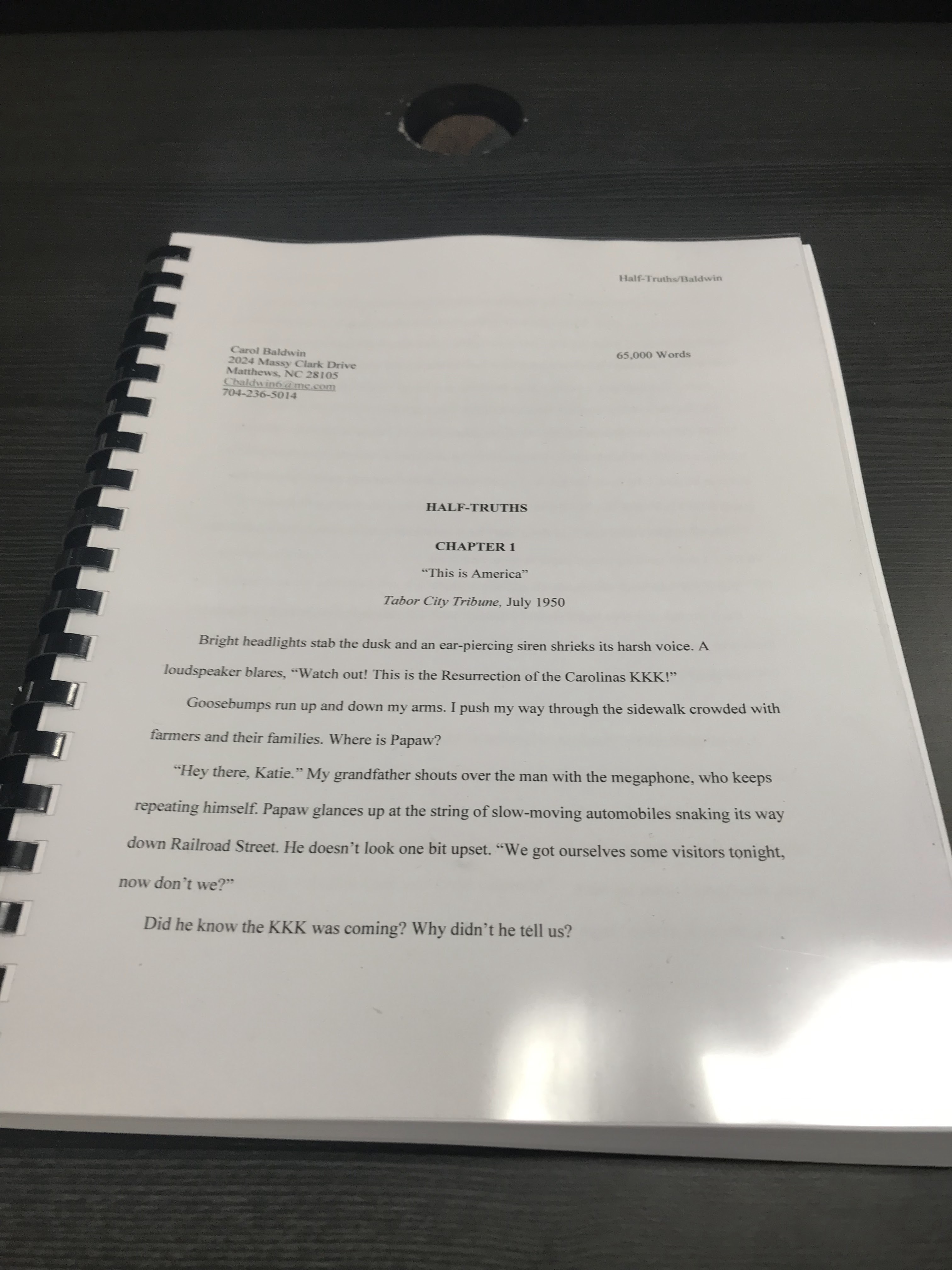
Thanks to Lori Steel, who suggested printing out
a close-to-final draft so it looks and feels like a book.

I told her there are just a few "simple" things that happen next.

  • I've hired Deborah Halverson, a free-lance editor (who came  highly recommended from Harold Underdown) to comb through the manuscript and find any issues with the plot, the character's voice, deep point-of-view, tension, stakes, etc. 
  • Once Deborah returns the manuscript, she and I will talk.
  • I'll incorporate her feedback. I will get my baby as spotless as possible.
  • I'll hire a copy editor to make sure it's formatted perfectly.
  • THEN...I'll start submitting to agents. Over the years I've assembled a list. Now will be the time to perfect my query letter and polish my synopsis.
  • THEN...I'll get busy with my next project and try not to obsessively check my email for agent responses. I have 3 picture books that I'm working on as well as an idea for a nonfiction graphic novel. 
  • And THEN...I hope my agent-to-be finds a publishing house who will embrace Half-Truths.
  • And THEN...I tell y'all about it! 
After I sent the manuscript to Deborah this week, I felt empty. The next day I felt relieved as I realized just how much Half-Truths has consumed my thinking for umpteen years!

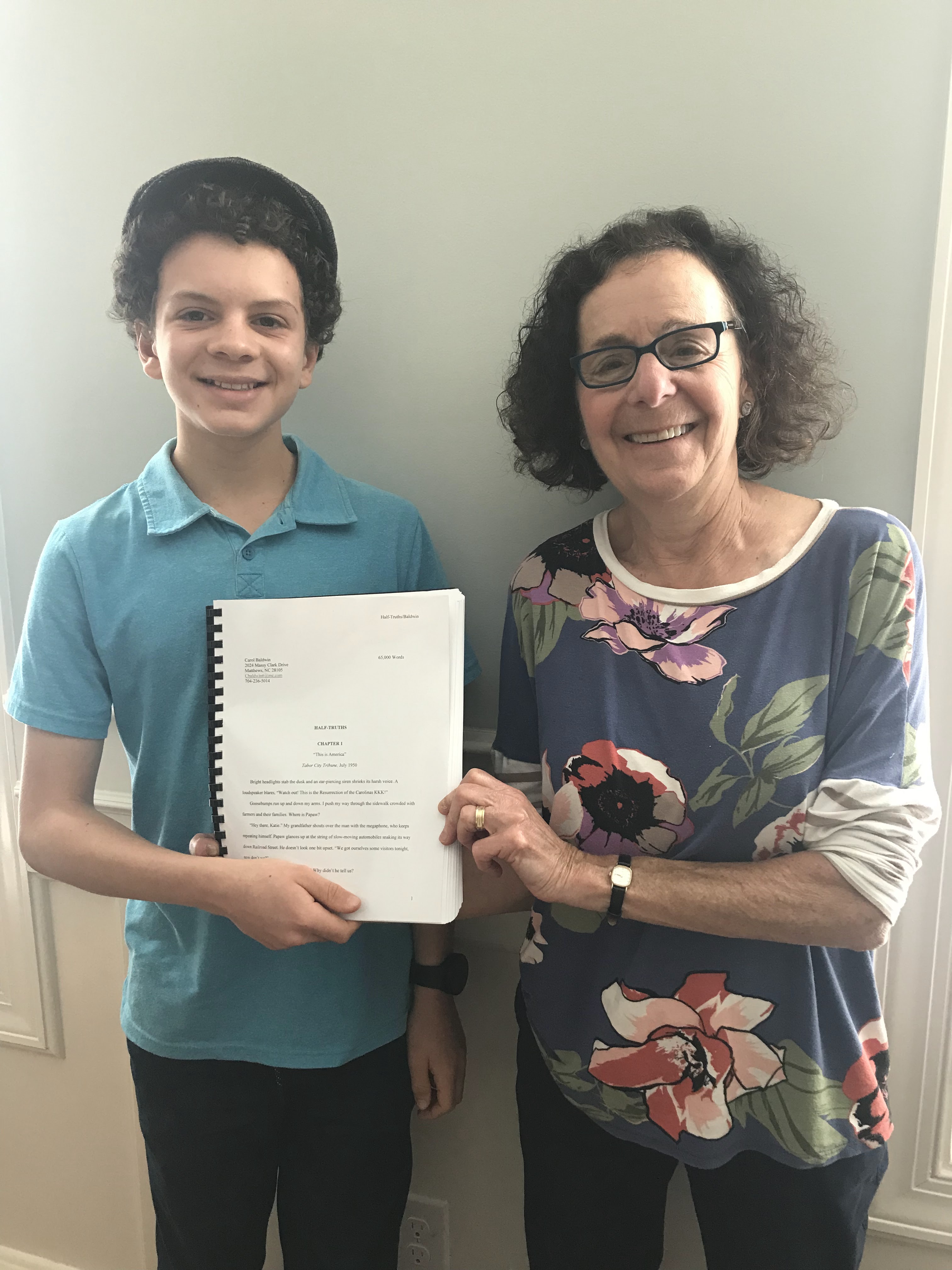
Yesterday I celebrated this step of my writing journey by delivering the manuscript to two teen beta readers.


I gave one copy to my granddaughter
Caitlin K.,


and another to Elliott.


On my way out the door, Rebecca said, "You're almost in labor!" Thanks, Rebecca, for that reminder to celebrate every stage of my writing journey.

And today, I'm sharing this milestone with you, my faithful blog readers. 
      
                                                *****

Congratulations to Lisa Fowler who won EQUAL from the "Pick-Your-Own-Book" post.

Remember! Look for more Middle Grade posts on Greg Pattridge's MMGM blog on Monday!


Friday, May 6, 2022

STORIES IN JOYCE'S BACKYARD: A "PICK-YOUR-OWN" GIVEAWAY!

 "This is the house that the Hinkle sisters lived in, and that's the muddy river where Thomas and Jackie fished together." Joyce Hostetter pointed out the car window as we drove around around her hometown, Hickory, NC--the setting for her Bakers Mountain Series. "See that old building? That's the hosiery factory where Junior worked for a few days. Over there is where the car mechanic lived who helped him fix his truck."


The Honeycutt family and their friends, who already had a special place in my heart from reading AIM, BLUE, COMFORT, DRIVE and EQUAL, became even more real as I saw the places where they lived, played, and worked--all within sight of Bakers Mountain. 

Bakers Mountain, photo courtesy Joyce Hostetter

How did Joyce end up writing a series of books that rose up out of what was once a rural community? It all began when Carolyn Yoder, senior editor at Calkins Creek, suggested that Joyce find the story in her own backyard. When Joyce began researching the history of Hickory, NC, she discovered the Miracle of Hickory at her local library.

Mural in downtown Hickory. Do you see Joyce?

She researched, read old papers, interviewed polio patients...and BLUE was born. Read some of Joyce's thoughts on the process of discovering her stories here. 

Part of Joyce's real backyard. Photo courtesy Joyce Hostetter

A few years after BLUE was published, I met Joyce in Birmingham, Alabama at a literacy conference. She was presenting on BLUE, I was presenting on Teaching the Story: Fiction Writing in Grades 4-8.  


We bonded over reading and writing. We co-presented several times and continue to publish a quarterly newsletter, Talking Story. We are critique partners and good friends. 

I felt Joyce's influence when I began brainstorming my own first novel. I rode my bike, walked, and drove through neighborhoods. What could have happened here? Half-Truths incubated. Ideas hatched. A novel slowly took shape. It changed. Got revised (many times!). Was reborn. 

What did Carolyn mean when she gave Joyce that assignment? Possibly she was not only talking about an actual backyard but was also encouraging Joyce to reach inside of her own experiences to find something she could relate to and authentically show in her writing.  

Let's face it. There might not be a compelling story about polio or pre-civil rights tension in your community, city, or state. Or, maybe you write science fiction or fantasy that's not even rooted in this continent or world--let alone in your neighborhood! How are you going to find that "backyard" story?

At the foot of Bakers Mountain and staring at Joyce's budding trees and the grass turning green I thought--my backyard is bigger than the crazy intersecting streets of Myers Park, NC. where my characters live. 

It's my whole life. 

It's writing what I know with a twist. 

It's taking my grief over losing someone I loved and embedding that in Kate, my protagonist's heart when she leaves home. It's realizing how making choices is not always very linear and conveying it on the page; it's understanding how gut-wrenching it is to feel betrayed--or be the betrayer. 


How about you? What have you used in your life--whether it's a place, person, event, or experiences--that has made it's way into your book? 

What is in your own backyard? 

Some backyards are under construction,
like mine is!

GIVEAWAY

For the first time on my blog, one fortunate blog reader will be able to pick which book in the Bakers Mountain Series they want to win! Leave me a comment by May 11 to enter this giveaway and tell me which book you are interested in. U.S. addresses only. Make sure you leave me your full name and email address if you are new to my blog.

Make sure you check out the other great books on Greg Pattridge's MMGM blog! 


Monday, February 18, 2019

Celebrate Black History Month With These Books

Congratulations to Connie Saunders who won Vijaya Bodach's new novel, BOUND. Thanks to all of you for your comments the last three weeks; both Vijaya and I appreciated hearing from you.


*******

Many of you have been following my blog for years and some of you are new readers. My "old" followers are familiar with the books that have helped me write Half-Truths. To recognize Black History Month, I thought I'd provide links to these past reviews, particularly for my new readers. I hope you'll add some of them to your "to-be-read" list. 

The order in which the books are displayed reflects the order in which I read them; most recent book is on top.

Mothers of Massive Resistance: White Women and the Politics of White Supremacy  Written by North Carolina professor, Elizabeth Gillespie McRae, this book opened my eyes to the role that white women in the South played in maintaining segregation.

Memphis, Martin, and the Mountaintop Alice Faye Duncan's debut picture book told from the perspective of a young girl who "meets" Martin Luther King.

Eyes on the Prize This excellent book on the Civil Rights decade is written by Juan Williams. If you're looking for an in-depth overview of the Civil Rights movement, then you've come to the right book.

Be Free or Die: The Amazing Story of Robert Smalls' Escape from Slavery to Union Hero. This is a great panoramic view of South Carolina before, during, and after the Civil War and an eye-opening biography of an amazing man.

Crossing Ebenezer Creek This middle grade novel, based on true events, deepened my understanding of what ex-slaves experienced after "freedom."

Midnight Without a Moon. This book takes place in Mississippi in the mid-50's. Linda Williams Jackson's debut novel uses Emmitt Till's murder as a background for Rose Lee Carter's decision not to flee the South. 

Loving vs. Virginia. This is a great curriculum resource written in free verse which shows Mildred and Richard Loving's struggles to legalize their marriage in Virginia. 

The Lions of Little Rock This classic civil rights book is set in Little Rock, AK in 1958. I now use it as a comp title in my pitch for Half-Truths!

Carver: A Life in Poems. Lillian, my most important secondary character, wants to be a scientist. Reading about George Washington Carver helped me think more deeply about Lillian.

Primary Lessons: A Memoir by Sarah Bracey White Sarah grew up in the Jim Crow south and here I share excerpts describing her experiences. 

Dear Senator: A Memoir by the Daughter of Strom Thurmond. This book was a fascinating look into Strom Thurmond's bi-racial daughter and the many challenges she and her mother faced. I blogged about it extensively. 

The Color of Love. This is an autobiographical account of a boy whose mother falls in love with a black man in the Jim Crow South. 

Mixed: My life in Black and White  A candid autobiography written by Angela Nissel. She describes what it was like to grow up in Philadelphia as a bi-racial child during the second half of the 20th century.

Fly Girl A beautifully written YA novel about a young black woman who becomes a pilot during WWII.

A Lesson Before Dying. A book review of a powerful book portraying racism in Louisiana in the 1940's.

Here are a few of the books that didn't make it into this list!

Have you read any books about African American history that you would recommend? Please share in the comments below. 

(This post was originally published on the Write2Ignite blog.)

Monday, January 21, 2019

Plan to Persevere

Congratulations to Becky Scharnhorst for winning A Tough Act to Follow and Acting Innocent and to Mel Hager for winning WONDERLAND.


    One of my favorite stories to listen to as a child was, The Little Engine That Could. The voice of the little blue engine who took on the insurmountable challenge of bringing toys, dolls, and “good things to eat to the good boys and girls on the other side of the mountain,” still echoes in my head: “I think I can, I think I can, I think I can.” 


      Fast forward 60 years. I’m a grandmother with dozens of articles and two non-fiction books under my belt. For the last ten years I’ve been working on my first young adult novel, Half-Truths. I have revised the story fourteen times; not including the hundreds of times I’ve rewritten scenes and chapters. 

      Did I know what I was getting into when I first started this project? Definitely not.

      So, besides hearing the little blue engine in my head, what has kept me going for all these years? What keeps me chugging along from one revision to another?

      Perseverance.

      Plus, a healthy dose of belief in my story.

      Take a minute to list your definition of perseverance as it relates to your writing career. Here’s mine:

1. Not giving up on a reasonable goal. 

2. Making sure that my goal is God-honoring and worth completing.

3. Not allowing myself to be distracted from that goal by other activities.

4. Being willing to sacrifice (time, ego, money, etc.) to complete my goal.

    Now, consider what is the opposite of perseverance? In other words, what will keep you from being the little blue engine who climbs that "I'm published!' mountain? 

     Here are some obstacles I thought of:

1. Abandoning the idea because it takes too much time and effort.

2. Listening to self-doubts and fears.

3. Listening to the nay-sayers who mock the goal. 

4. Not being willing to make changes suggested by serious, constructive feedback.

5. Not being willing to put in the time and effort it will take to revise, revise, revise.

6. Not having the tools and abilities to reach your goal AND not trying to obtain them. (i.e., diligently practicing all types of writing, take classes, attend conferences, join a critique group)

7. Rejections from agents and/or publishers.

     When I began my novel, I didn’t know what I didn’t know. But I had an idea that I loved: a story set in the early 50’s in Charlotte, North Carolina about the unlikely friendship between Kate Dinsmore, the granddaughter of a rich, society woman, and Lillian Harris, her grandmother’s teenage black help. Their friendship uncovers a century worth of secrets, including their shared ancestry.

     Although I’d written two non-fiction books, when I began Half-Truths, I didn’t know how to write a novel. So, I did what you’re supposed to do: I read craft books, attended writing conferences, and received dozens of critiques. I also didn’t know much about African American or southern history. So, I read books (many of which are listed here) and interviewed African Americans who lived in Charlotte during the time period. Each book and interview took time, but they all enriched my work.

      One of the influential books I listened to was Eyes on the Prize: America’s Civil Rights Years 1954-1965 by Juan Williams. Besides giving me a fuller understanding of the scope of the civil rights struggle, it also provided a meaningful example of perseverance.

     Civil rights activists, including Martin Luther King, had their eyes on the prize of obtaining equal rights for blacks. Did they always know what they were getting into? Maybe not. Certainly some, like Dr. King, Medgar Evers, and the protestors who were beaten and imprisoned, ended up losing more than they’d anticipated. But did they believe in the equality they were working towards? 

    Without a doubt, they did. 

    I for one, am glad they persevered. 

     My need to persevere as a writer is minuscule compared to those who unfailingly fought for equality and persevered in the face of discrimination, danger, and death. 

    But, as I begin the next step of my publishing journey—finding an agent--I have a plan: I must persevere. I have no choice.


    And I must believe in my story.

    I'm looking forward to being able to repeat the little blue engine's refrain as she came down the mountain:


    What about you? How will you persevere in meeting your writing goals in 2019?

    If you are reading this blog and aren't a writer, I'd love to hear your stories of perseverance also!

********

(This post first appeared on Write2Ignite's blog.)

THE NIGHT WAR: A MG Historical Novel Review

  By now you should have received an email from my new website about my review of THE NIGHT WAR by Kimberly Brubaker Bradley. (It'll com...