Showing posts with label Charlotte. Show all posts

Friday, January 27, 2023

On Submission


This post has been a long time coming. About 16 years long. There have been times when I thought I was ready to submit my middle-grade novel, HALF-TRUTHS. But now I KNOW it. 

IN THE BEGINNING

From the beginning, I imagined a story about a white girl and a light-skinned Black girl discovering that they were second cousins. That premise, which consistently elicits a "WOW!" response, has remained the same throughout my book journey.  

Having written dozens of articles and two nonfiction books, (Friendship Counseling, Teaching the Story: Fiction Writing in Grades 4-8)  I had confidence in my writing skills. But I knew nothing about writing fiction. It felt like jumping into deep water without knowing where I'd find the bottom. 


I wanted it to be a pre-civil rights story but Harold Underdown, my mentor at a Highlights Foundation workshop in 2009, informed me that was only the setting. For years I wrestled to answer the question he posed: What does your character want

EVERYONE HAS A STORY 

In the summer of 2007, I started thinking about my story and began interviewing "experts." My friend and mentor, Joyce Hostetter, encouraged me to research far and wide. What was happening in the world? In North Carolina? In Charlotte? She suggested that I find people who lived in the area and listen to their histories. Since I was just discovering my story, those initial interviews were broad. It's funny to reread them and see some of the questions I asked. 

Even though I often got off track and wanted to include every story I heard--I absorbed a time and place that was new to me. (In a future post I'll share some of the stories that I wanted to include but didn't.) 

I'm working on my 20+ page bibliography which includes 100 expert interviews. Some interview notes are less than a page. One of my experts is a man who graduated high school the same year my protagonist was in middle school. His notes are over 90 pages. Skimming through these interviews, I found details that made it into my story. I'd forgotten where and how I learned things such as what was served for lunch in the school cafeteria, the Black help's relationship with their employers, what it felt like to sit at the back of the bus, the used books and sports uniforms passed to the Black schools, the discussions about school integration, the peasant dresses worn to dances. You name it. It's one thing to read about these things in history books. It's another thing to have someone tell you how they felt as they experienced Jim Crow and/or chose not to become a debutante. 


Dorothy Counts, one of my experts, walking to Harding High School in 1957.
She was the first Black to attend the school.  
The photo originally appeared in The Charlotte Observer. 

People often wonder how I found these experts. I learned to ask everyone, "Who else should I talk to?". Tom Hanchett, Charlotte's local historian recommended several individuals. Others were patients of my dentist husband who were long-time Charlotteans. Others were parents of friends. These became my experts whose stories were woven together to create Half-Truths.

WHERE DID I FIND THIS STORY?

As the (working) title indicates, this book is about secrets and "white lies." Ben Franklin wrote in the Farmer's Almanac in 1758, "Half a truth is often a great lie." Over the years, I've thought about the secrets that people choose to conceal or at least, not talk about. I've often wondered what effect that has on the following generations.  As a Christian, I'm committed to telling the truth as commanded in the ninth commandment: "Thou shalt not bear false witness." As I wrote this novel, I had to think about my own "little" half-truths that I tell, and the reasons for them.

One elderly woman, a former debutante, suggested that I not pry into Charlotte in the 1950s and instead, write about my own life. (Who would want to read about growing up in South Jersey? Boring!) I was fascinated by my adopted new hometown and walked and biked around South Park and Myers Park thinking, "What is the story that could have happened here?" When I visited the former Rosenwald School in Grier Heights and saw the picture of a light-skinned Black principal, I found a key part of my story.

Billingsville School in Grier Heights. 
Now a community center. 

JOURNEY HIGHLIGHTS 

 INovember 2008, following Joyce's advice, I joined NaNoWriMo for the first time. I didn't feel ready, but it helped me create a first draft.

Pretty soon I realized that I didn't know what I didn't know. I attended workshops and webinars, conferences, and classes. I read books and blogs on plotting, conflict, and character; participated in several critique groups, and received critiques from industry professionals. Throughout this time, my best writing buddy, Linda Phillips, and Joyce encouraged me, asked me pointed questions, and provided feedback.


From the left: Joyce Hostetter, myself, and Linda Phillips
 at a writer's retreat in 2011.


But why did it take 16 years? First, I spent a long time trying to figure out where the story began. HALF-TRUTHS takes place in 1950, but at one point I started it with the protagonist's father in WWII. Not even close to the inciting event--which I didn't know a novel needed! 

Despite the fact that I wrote several outlines, I kept getting off track. Whenever I heard a feasible suggestion, "Someone should die," or, "Write it from the points of view of both girls," or, "Include romance," I spent time incorporating these ideas and going down rabbit holes of research. Combine that with going back and forth on whether or not this was a young adult or middle-grade book, I often strayed from my original vision: two girls--one white, one Black, discovering they are related. 

Enter Rebecca Petruck.  Rebecca critiqued several drafts and offered great insight into character arcs, plot points, and internalization. After I had spent a lot of time writing boyfriends for each main character (when I was thinking HALF-TRUTHS was a young adult book), Rebecca told it to me straight. I had lost the essence of the story--the girls' relationship.  


Rebecca helped me construct a plot chart in October 2013. 
I learned about Save the Cat! for the first time.

Since all of my readers were saying the book sounded more middle-grade, I ditched the boyfriends and the young adult genre. Along the way, I continued to interview folks and read and review middle-grade books. I particularly enjoyed Kathy Weichman's historical novels. Winner of the first Grateful American Book Prize, Kathy used to joke that she is the poster child for perseverance. I think I might be tying her for that distinction. 

Joyce Hostetter and I have swapped manuscripts over the years. Last February she suggested that I hire an editor to bring the book to the next level. I asked several trusted professionals in the Kidlit community for recommendations and found Deborah Halverson. She is a treasure.

In June 2022, I shared one page from Deborah's comprehensive editorial letter. For the next six months, I worked on incorporating her suggestions. I took out Kate's free verse poetry and changed it to journal-type entries in her steno pad. This fits Kate's goal of becoming a journalist. I worked on more youthful language, made Kate the instigator for the major change in her life, tightened the ending, and strengthened the City Girl vs. Country Girl motif as Rebecca had suggested years ago--but I'd forgotten!

In other words, I revised. A few weeks ago I was rewarded with these words from Deborah: 

In this revision, I feel you have accomplished your goals with this project, creating an entertaining, enlightening, compelling, and satisfying story for middle graders. I believe young readers will connect with Katie immediately and root for her throughout. Her growth is inspirational, showing the triumph of a flawed but earnest young person. 


Deborah's words gave me a boost of confidence that finally brought me to the...


of this stage. But it is also the beginning of an exciting time--being on submission!

WHAT'S NEXT?

For my friends and family who are reading this and aren't writers, you may be wondering what happens next. Remember those conferences and webinars I mentioned? At each one, I collected the names of agents and editors who expressed interest in the manuscript. Many said they didn't care how long it took. They just wanted to see it when it was the best I could make it. 

Now I take out that list, organize it through Query Tracker, and start sending out the manuscript.

If you are a writer, how did you feel when you began submitting your work? Please share your experiences in the comments. 

GIVEAWAY

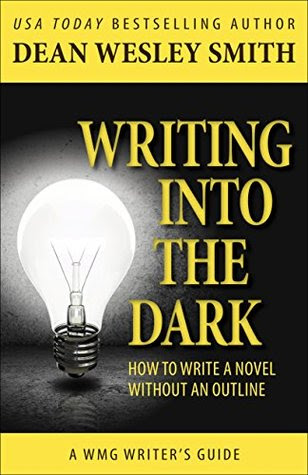
Obviously, I don't have a copy of Half-Truths to give away, but I'm cleaning off my bookshelves to make room for the books I'll need for my next project. Over the last 16 years, I learned that I'm definitely a plotter, rather than a panster. For those of you who abhor outlines, I'm giving away my (slightly marked-up) copy of WRITING INTO THE DARK. Leave me a comment with your email address by February 1 and it could be yours.


Congratulations to Emily Weitz who won MY SCHOOL IN THE RAIN FOREST.

Please take a minute to see views about other middle-grade books on Greg Pattridge's Always in the Middle blog.


Tuesday, December 21, 2021

Revision Revisited

 If you're a writer, then someone has probably said to you: "So, are you done with your book yet?" If the person who you are talking to loves you then he may say, "How's the book coming along?" Which is a softer, kinder way of saying the same thing. 

Either way, most people who are not in the writing/publishing world have NO idea how much writing and re-writing goes into creating a book. And either way, you'll feel a little defensive as you try to explain why it's taken years to create a finished product.

REVISION BLOGS

Revision happens on so many levels. There are drafts when a writer is just getting the story out. There are big picture revisions when a writer has to re-vision her entire novel. And then of course, there are a host of "minor" revisions to make your characters and story authentic.


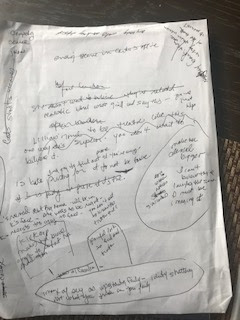
A page of side notes on Kate's character development.

I've blogged about the revision process several times. Here is one from the Free Expressions workshop I took ten years ago. And here is a blog with Harold Underdown's advice on not submitting until your work is ready. Mary Jane Nirdlinger wrote an excellent post about revision for the SCBWI-Carolinas region. I highly recommend it.

TRUE CONFESSION

I started Half-Truths over 15 years ago. I knew I could write, but I'd never written a novel AND I took on a topic that was much bigger (and more difficult to write) than I realized.  Here is the updated blurb for my middle grade book:

In the Jim Crow south, thirteen-year-old Kate Dinsmore meets two people who challenge her world view: a small-town newspaper editor determined to stop the KKK and a young Black maid who proves to be her second cousin. Told through narrative, letters, newspaper headlines, and poetry, Kate comes to grips with her identity, decides what she will stand for, and takes risks to become a journalist who will make a difference. 

Although I imagined the girls' relationship since the book's inception, I went off in many different directions as I wrestled with writing the book. Rebecca Petruck, one of my early critiquers, kept encouraging me to return to that relationship--even when I included murders, boyfriends, and information about the Korean war. (Did I say this was my first novel?)

Joyce Hostetter, a wonderful historical middle grade author has been my mentor throughout the process. Under her guidance, I researched widely and found tremendous experts who informed my knowledge of the time period and the plot. I visited places on the Charlotte African American tour. I talked to people who went to the same high school as my characters, Meet My Experts III- Vermelle Diamond Ely and Meet my Experts

In 2016 I sent the manuscript to beta readers (check out the picture of of my technique for plotting my book). I incorporated their feedback and kept on going. Along the way I received editorial advice to write the book from both girls' POV's. I was reluctant to do that since I'm white, but Rebecca encouraged me in that direction. By the time I was ready to submit that version, the publishing industry had changed and that was no longer an option. In 2017 I made the difficult decision to start over from Kate's POV.

It was hard to give up all the work I had done to write Lillian's story, but it was the right decision. I re-outlined the book and started a new version focusing on Kate's journey. In doing that, I still went off on too many rabbit trails! 

Finally, last year (based on Joyce's encouragement) I took Kathy Temean's whole novel workshop. I received excellent feedback from three peers, incorporated their suggestions, and then sent it to an agent who read the entire 78,000 word manuscript.

The agent's insightful feedback provided a TON of things to work on--including deciding if this is a middle grade or young adult book. Ittook several months to incorporate her suggestions--including showing more of Kate's life before she moves to Charlotte. After re-writing the beginning, I realized that I had painted an overly optimistic ending and that needed changing! I decided the book needed to stretch out over an entire year and that required rearranging chapters.

Yesterday, I reached another milestone. I sent the revised 64,000 word manuscript to Joyce. She will go through it with a fine-tooth comb and I will revise it again.

And only after that--will I send it out.

So, that is why this book has taken me so long to write!

https://www.123rf.com/photo_128021414_word-writing-text-revision-business-photo-showcasing-action-of-revising-over-someone-like-auditing-o.html

Yesterday I texted Kathryn Frye, a Charlotte videographer who produced and directed the documentary, African American Album: Charlotte, NC Mecklenburg History.  She and Vermelle Ely, have been cheering for my book ever since I met them. I told her I feel that it's risky for a white woman to write about race, She responded: 

"It’s a great story from its creator, no matter what shade of human she is! We have always been fully confident that we will hold the book one day."

HOW ABOUT YOU?

Do you have a revision story? Please share in the comments!                                                       

Congratulations to Terri Michels for winning Janine Yordy's book, Jellyfish Wishes and Poems About Fishes. After entering my giveaways many times, she finally won!

ON A PERSONAL NOTE

I have grandchildren coming to visit so I'll be taking a short holiday from blogging. But I'll be back in your inbox soon!

Thursday, January 7, 2021

Thereasea Elder Wore Many Hats

 One of the good things about writing historical fiction set in the not-so-distant past is that you can interview people who lived through the conflicts you are writing about. 

One of the hard things about writing "recent" historical fiction is that the people you interview--your experts--are elderly and die. 

Ten years ago I posted my first blog about six people I interviewed for Half-Truths. Only one is still alive. In 2014 I wrote about four women who shared their histories with me. Only two are still living. 

Yesterday, I heard that one of these women, Thereasea Elder, passed away on January 5, at the age of 93.

                                Thereasea as a U.S. Nurse cadet in World War II.

Thereasea's Legacy

I met Thereasea in 2011. With open arms and a smile that never quit, she welcomed me into her home. At the same time, she welcomed Half-Truths into her life. A conversation wasn't complete without her asking, "How is the book coming along?" She encouraged me every time I visited her.

As I tried to understand the city of Charlotte in which she grew up, there were no questions or topics that were off-limits. She told me about the dangers she faced as the first nurse to integrate Mecklenburg County's Public Health Service and the asbestos waste products which coated their window screens from the factory in their Greenville neighborhood.  


In 2014 she proudly showed me the exhibit she helped put together at Johnson C. Smith University honoring those who integrated the medical profession in Charlotte. 

Thereasea's list of accomplishments is long. She was a strong advocate for public health, helped register Black voters, served as president of the Greenville Historial Association, was active in the National Association of Negro Business and Professional Women, served on the board of the Greater Carolinas Chapter of the American Red Cross, and started the Black Heritage Committee in Charlotte. 

Whenever we talked she had a new cause or passion. She was concerned about local drug dealers and gun violence; government officials heard her concerns over the phone and through letters. She received innumerable awards for her service to the city of Charlotte, including the Order of the Long Leaf Pine (North Carolina's Highest Civilian honor) and the Maya Angelou/Elizabeth Ross Dargan Life Time Achievement Award. 

But man, oh man, she loved her hats.


Dozens and dozens of hats were stacked in boxes in her closets. She wouldn't go out without one on her head that of course, coordinated with her outfit.


One day we had a "photoshoot" and Thereasea enjoyed every minute of it.


So did I.

Thereasea was brave and courageous. The same things my protagonist, Kate Dinsmore, wants to be. The same things I want to be.

In 2013 her biography, T.D.'s Truths was published. She was so proud!


The author's note includes an observation that resonated with me:

I was mesmerized by our first meeting. I was struck not only by the power of her narrative, but her ability to cause transformational change in our community. Her nurturing attitude was characterized by unselfish caring, supportiveness, and a willingness to share her time.  

Thereasea's inscription to me reads:

Dearly Beloved Carol,

God has blessed me with your Friendship and Love. To God be the Glory and Power always. 


On a Personal Note


Thereasea quoted this Bible verse to me when she was talking about some of the prejudice she faced growing up:

"For I know the plans I have for you, declares the Lord. Plans to prosper you and not to harm you plans to give you hope and a future. Jeremiah 29:11

Certainly, the Lord used Thereasea's talents, energy, and love.

One time my husband and I took her out to dinner at a favorite fish restaurant. After that, she never failed to end our conversations by sending him her love. She always reminded me to give him a hug and a kiss; her love for family inspired me.

I will miss Thereasea's hand clasping mine when we gave thanks for our food. I will miss her hug and her voice. I will miss her encouragement and pride in what I was doing. 

And I will miss her beautiful hats.


"Precious in the sight of the Lord is the death of His saints." Psalm 116: 15.

Monday, August 19, 2019

TOMORROW'S BREAD: A Review and Giveaway

Congratulations to Gail Cartee who won The End of the World and Beyond on last week's giveaway.

When I began researching Half-Truths someone--I'm afraid I don't remember who it was--told me about how Brooklyn, an African American neighborhood in Charlotte that was leveled as a part of urban renewal.  Tomorrow's Bread by Anna Jean Mayhew, breathes life into that vital, bygone neighborhood. 


This story of a community affected by urban renewal is not unique to Charlotte, NC; but it is told in such well-researched detail that people living in Detroit, Philadelphia, St. Louis --any area that was torn down and cleared out--will resonate with the book. As A.J. points out in her Author's Note, there were homes that would meet the definition of blight. 


This photo, taken in the old Brooklyn neighborhood, was typical of the image often presented of Charlotte's historically black neighborhood near uptown. In reality, the area was made up of mixed-income residences and businesses.  COURTESY OF CHARLOTTE-MECKLENBURG LIBRARY


But, there were also business, churches, theaters, and spacious brick homes that were destroyed. 


https://www.charlotteobserver.com/news/local/article66934337.html
Business district in Brooklyn.


REVIEW

This historical novel for adults is told through three different points of view. We see the destruction of the neighborhood primarily through the eyes of Loraylee, a single black mother who lives with her son, uncle and grandmother. Loraylee is in love with a white man, but in the sixties, it is against the law for them to get married. Everyone in Loraylee's family is attached to their friends, fellow church-goers, schools and businesses in Brooklyn; all four can't imagine life elsewhere. Her hard-working and matter-of-fact manner made her a person I would have liked to know. 


Reverend Ebenezer Gabriel Polk ("Eben") is the faithful pastor of St. Tim's and unofficial church historian of the church cemetery and the 151 slaves that were buried there. His third-person account of watching his cemetery and community bulldozed is gripping and poignant. (Personal note: Since I have included  a cemetery disinterment in Half-Truths, I was interested in how Mayhew incorporated that into the story.) Eben's own family history (most likely descended from President Polk), his sorrow over his deceased wife and his brother's tragedies, and his commitment to his community weave throughout the book. 


Persy, a white woman who has had struggles of her own, is the third point-of-view in the story. Her childless and loveless marriage contrasts with the loving family relationships in Brooklyn. Her husband is on the committee for urban renewal and she is as helpless to stop him as she is to heal their failing marriage. Although Persy is mainly on the periphery of the story, her life intersects with Loraylee's when they both are at the beach, and Persy is instrumental in saving Loraylee's son's life in a near-drowning. 

Half-Truths takes place about ten years before Brooklyn's urban renewal. Although it is in a different area of the city, Black leaders were concerned about how urban renewal would not provide relocation to the families and businesses. In this article, local NAACP leader, Mr. Kelly Alexander (who makes a cameo appearance in Half-Truths) stated some of his concerns.  


GIVEAWAY

Next week, I am interviewing A.J. on my blog. Leave me a comment on this blog and I'll enter your name in the giveaway. Enter again next week, and you're in twice! Tomorrow's Bread could be yours! Make sure you leave your email address if you are new to my blog. 


Monday, December 31, 2018

Run to the Light: A Review and Giveaway

Congratulations to Deborah Allmand for winning THE PLAYER KING from last week's blog post.

********
My blog readers know that I generally read and review books for children and teens. Every once in awhile I come across a book for adults that I want to share with you. Run to the Light (Bedazzled Ink, 2018) by Laura King Edwards is one of those. 

But first a disclaimer: Laura Kings Edwards' book about her sister Taylor's battle against Batten Disease is not an easy book to read. Batten, a rare inherited neurological condition that causes vision loss, progressive cognitive and motor decline, and seizures, usually strikes children between the ages of 5-10 and is always fatal. Laura does not hold back on describing her fear, anger, depression, and anguish during the twelve years that Taylor bravely fought the Batten monster. But she also eloquently shares the joy she experienced in the moments she shared with her brave little sister. 

If you've been reading my blog long enough, you will recognize this story. Laura gave me the privilege of hosting her cover reveal on my blog last March. Now, you'll hear about the story. Read it, and be inspired.


Read the story behind this cover here.

THE REVIEW

In 2006 Taylor was not quite eight when her family realized that her vision and school problems signified something far worse than any of them imagined--they were Taylor's first symptoms of Batten Disease. In evocative detail, Laura shows the reader the disease's progression, how it impacted Taylor and her family, Laura's journey to find acceptance, and most of all--how Taylor became a symbol of courage to her Charlotte, NC community and to the Batten world at large. 

Throughout the progression of the disease Taylor never asked, "Why me?" "Even as her body started failing her, she sought a normal life and never asked for extra help or attention." (p. 26) Taylor's resilience amazed Laura more than anything else.

Although there were the common stages of denial and numbness that we all experience when we receive shocking news, the King family--particularly Laura and her mother Sharon, turned their anger towards fighting the disease. Several months after the diagnosis, Sharon invited a small group of women to come for lunch. Laura listened as Sharon "declared war on Batten disease and urged the rest of us to join her on the battlefield."

"The doctors said there's nothing we can do," she said. "But I'm not going down without a fight." Her voice cracked as she described our opponent, ticking off the symptoms that had crept into my sister's life and the awful ones yet to come. But her resolved never wavered. "Nothing about this will be easy. There's little being done for Batten disease. There aren't many kids like Taylor. But we have to start somewhere. Someone has to take a stand." 
.......
In that moment, Taylor's Tale was born. (p. 29)

Taylor's family enjoying
The Magic Kingdom post- diagnosis. 2006

Sharon's decision to fight Batten led to taking Taylor cross-country to participate in a clinical trail to receive purified neural stem cells at Oregon Health and Science University in Portland. It led to raising thousands of dollars for research, attending umpteen Batten disease conferences, and learning the foreign language of medicine and science. It even led to a new North Carolina law that established the first rare disease advisory council in the country.

At the same time, Laura joined the battle by educating others by blogging, attending conferences, meeting leading scientists in the field, and working hard to raise money for research. Laura's personal journey intermingles with her running career which became a metaphor for her own fight. She was afraid to give up, thinking that Batten would win. "All my life I'd been running; I wasn't about to lose this race." (p. 54)

Two years later Taylor inspired Laura by running a 5K-- the only blind person in the race. Taylor ran tethered to her running buddy by a bungee cord.

Whereas I'd often felt only anger toward Batten disease, my sister had beaten her demons by ignoring them--by focusing not on what she'd lost, but on what she could still do. She didn't waste her time worrying about what Batten disease had taken from her. She paid it no mind, and she ran her race. 
Before the trees bloomed in the spring, I'd started running for her. ( 101)
Although Laura began running for something greater than herself, the specter of not crafting the perfect blog post or not answering an email to Taylor's Tale on time haunted her. Would she hurt her sister's chance of survival? As she moved from being a sprinter into a long-distance runner, Laura realized,
I'd come to understand the value of a long-term plan. I'd learned how to push my body past the limits of what I'd previously believed it could achieve. 
And yet, my sister's body was failing her. (p. 129)

Taylor and her dad on a family trip to
the U.S. Virgin Islands, 2010.
It took me a long time to learn that Batten disease is more like a marathon [than a sprint]. You start off strong, with lots of energy. You have runner's highs and lows. Some days you think you could run forever. But then some days you feel like when you cross the finish line, you'll be so glad to see it--so exhausted--you'll just be happy it's over. Some families, families whose kids have died, have told me in the end that it's like that. It's so bad, so freaking ugly, they can't face it anymore. It isn't even about making happy memories at that point. it's about their kid's dignity and their own survival, and about finding peace. (p.209)

Taylor's Fletcher School classmates raised $3500 for Taylor's Tale in 2013.
Taylor is third from the right.
The last race that Laura describes in the book is the one she ran blind--just like Taylor did. She trained for five months and used the same bungee cord that Taylor had used several years prior. She was cheered on by other runners, the media, and her family.

I'd run 13.1 miles in the dark But I didn't take a single step alone. As I ran the final stretch of Thunder Road, led by the voice of a friend and the courage of a dying girl, I understood: Batten disease may have cast a dark shadow on our world, but I wasn't running away any longer. 
I was running to the light. 
I believed.
And I felt free. (p. 225)


Taylor in 2016

WANT TO KNOW MORE?

"Together with other dedicated advocates, Taylor’s Tale is uniting elected officials, healthcare providers, public health officials, researchers, biotech industry representatives and patient advocates. This important work is creating real, lasting progress in the development of breakthrough treatments and life-changing legislation for rare disease patients."


Also, Linda Phillips most recent YA novel in verse, Behind These Hands, is a story of a young girl struggling with the fact that her two siblings are diagnosed with Batten. It is based loosely on a family in Charlotte. 


GIVEAWAY


This giveaway began in March with Laura's cover reveal. Add your name to that list by January 3 and you'll be in the drawing also. This time you have an extra chance to win since both Laura and I are giving away a copy. Please leave me your email address if you are new to my blog.

Thursday, September 8, 2011

Or, if You Prefer Food & Travel Writing....

Yesterday I posted information about my writing classes. Here are other writing classes in the Charlotte, NC area focusing on book publishing, food writing and travel writing. Classes start Sept. 13 and 20, Oct. 11 and are led by author/teacher Jodi Helmer. 

Pre-registration is required for all classes; email jodi@jodihelmer.com to register.

Travel Writing: Write Your Way Around the World (four sessions)
When: 7 to 9 p.m. September 13, 20, 27 and October 4
Where: The Last Word, 230 East W.T. Harris Blvd., Suite B11 (Behind Walgreens on the corner of WT Harris and Hwy 29), Charlotte, NC Cost: $125
 
Travel writing is a job most people dream about – learn how to make that dream come true. This class will help new writers learn how to develop ideas, approach editors, write articles and (of course) travel the world for free. In-class exercises, homework and thoughtful critiques will help you hone your writing skills and get one step closer to getting published.
 
Coffee & Critiques/Questions (four sessions)
When: 10 a.m. to noon September 15, October 13, November 17 and December 15
Where: Charlotte area, exact location TBA
Cost: $150 for all four sessions; $50 for a single session (pre-registration required)
 
Spend the morning building the confidence, skills and information you need to achieve publishing success. In monthly sessions, I’ll critique queries, help brainstorm the best markets for your ideas, answer questions about the publishing process or provide an old fashioned kick in the pants to help you reach your goals. These sessions are designed for those with some publishing experience/knowledge.
 
Book Publishing: Go from Idea to Author (four sessions)
When: 10 a.m. to noon September 20, 27, October 4, 11
Where: The Warehouse Performing Arts Center, 9216-A Westmoreland Rd., Cornelius, NC
Cost: $125
 
You’ve dreamed of writing a book but have no idea how turn your idea into a published book available on the shelves at Barnes and Noble. During this four-week class, you’ll learn how to tailor a book idea so it’s irresistible to agents and publishers, craft a successful book proposal and determine whether to work with an agent (and how to find one). The class will also cover the basics of self-publishing and book marketing.
 
Food Writing: Eat Your Words (three sessions)
When: 7 to 9 p.m. October 11, 18 and 25
Where: The Last Word, 230 East W.T. Harris Blvd., Suite B11 (Behind Walgreens on the corner of WT Harris and Hwy 29), Charlotte, NC
Cost: $95
 
Food nurtures and sustains us; it also serves as the backdrop for some of our favorite memories. Learn how to turn your love of food into published articles and essays. Whether you want to write a memoir based on family recipes, cover trends in urban agriculture or become a successful restaurant reviewer and recipe developer, this class will provide the ingredients you need to succeed.

About the instructor:

Professional writer Jodi Helmer is the author of three books, including Moon Handbooks' guide to Charlotte, as well as hundreds of magazine articles for publications includingWomen's HealthShapeFamily Circle, and Backpacker
 
When she's not writing, Jodi loves to share her knowledge of the writing business with others, through classes and one-on-one coaching. Students who have taken Jodi's classes have been published in regional and national magazines and books, including Natural HealthEatingWell,  and Chicken Soup for the Soul.

Learn more at www.jodihelmer.com.

Tuesday, August 2, 2011

Two Tech Toys and One Book

It has been quite awhile since I have posted about a technology tool that I have found useful. In the last ten days I've used two that I want to share with you.


During a recent class at Central Piedmont Community College on "Crafting Characters that Connect" I brought Joyce Hostetter into the classroom via this wonderful tool, a Microsoft RoundTable camera.


Photograph courtesy Saad Khan

The students enjoyed interacting with Joyce as she answered questions about character development, staying focused as a writer, and receiving critiques. 

Photograph courtesy Saad Khan

A week later, I spent time researching for Half-Truths in the Carolina Room at the Charlotte Mecklenburg Public Library. Hours sped by as I looked through the Charlotte News (Charlotte's afternoon paper) and the State of Zion (the weekly newspaper of the African Methodist Episcopal Zion church) from 1950 on this machine:


A teenager walked by and asked me what it was. Microfilm machines aren't new technology, but they're helpful for reading old newspapers and magazines to gain an understanding of a time period. Unfortunately, they don't have "search" functions and this type of research feels very similar to sifting through sand to find treasure. 


But the real treasure that I found was this book:


The Charlotte City Directory for 1950 provided such interesting details as the names of the jailer and sheriff  as well as a list of area dentists. I found a listing for the Coca-Cola company that will play a small role in my book. Each page was packed with information.


Not only were people listed with their phone numbers, but there were also street listings that included an assortment of information. A small icon of a telephone indicated whether or not an individual had a phone,  a "r" showed that the person lived in the rear of the building, occupations such as maid, cook, lawyer, or company president were listed, and a c with a circle around it stood for "colored."


Technology carries us forward providing many new educational possibilities. But history provides a great many lessons too. 


THE NIGHT WAR: A MG Historical Novel Review

  By now you should have received an email from my new website about my review of THE NIGHT WAR by Kimberly Brubaker Bradley. (It'll com...