Showing posts with label African American history. Show all posts

Saturday, September 24, 2022

EVICTED! The Struggle for the Right to Vote: A Middle Grade Picture Book Review, A Giveaway, PLUS MORE!

Every once in a while you read a book and feel the passion that the author brings to the topic. That is the way EVICTED! (Calkins Creek, 2022) struck me. This upper-level narrative nonfiction will be a welcome addition to classrooms when studying African American history and civil rights.  I have featured both the author, Alice Faye Duncan, and the illustrator, Charly Palmer, in previous posts. Click here for a review of Alice Faye's book, A Song for Gwendolyn Brooks, and click here for Charly's illustrations in The Teachers March!


REVIEW

EVICTED! opens with a not-to-be-missed page of Acknowledgments. Ms. Duncan writes, "In 2006, Ernest Withers gifted me a photography book about the Tent City Movement. His images demanded that I write about this history for young people."

Here is one of the pictures from that album:


Now you know exactly why Ms. Duncan interviewed farmers and activists in order to bring this story to life. 

EVICTED! is bookended by the life of James Junior Jamerson.  The narrative begins with Prologue to Freedom. "This is the story of a battle, a boy, and his broken-hearted blues." Following this introduction, the reader meets the people who were important in the story of Tent City. Charly Palmer's illustrations begin the story. 


Each page is a different vignette telling what led up to the creation of Tent City and what happened afterward. Here are some highlights from those events.
  • In 1959 there were no black jurors to serve in the trial of a Black man wrongfully accused of murder. Farmer John McFerren realized that justice was in the ballot box--and Blacks needed to register to vote. 
  • After Harpman Jameson came home from serving in WWII and wasn't allowed to vote he said, "'A man and woman don't have no country if they don't have no vote.""
  • In 1959 "Entire families were forced out their homes when Black parents registered to vote in Fayette County."
  • In 1960 Mary and Earlie B. Williams were the first family to move into a tent on Papa Towles' land. As more Blacks registered to vote, more were evicted from their homes. "Tent City" was named by TV broadcasters and national newspapers.

"Their hiding place was a cross of unmerited suffering."

https://www.memphis.edu/tentcity/moving-shacks-tents.php

  • In 1962 after John Doar of the Justice Department's Civil Rights Division filed a lawsuit to block white landowners from evicting Black sharecroppers, the landowners finally agreed to stop evictions. 
  • In 1964 Black voters cast their ballots while white locals stuffed the ballot boxes with illegal votes. In spite of that, the work for equality pushed forward. 
  • In 1965 President Lyndon Johnson signed the Voting Rights Act. "Black Americans voted in record numbers and won political seats."
James Junior is a grandfather now. "He says the past is the present, and it is urgent they [his grandchildren] understand, 'Every life is a battlefield and freedom is a golden prize.'"

The Epilogue concludes with, 
Despite his young age, James Junior served the freedom struggle with conquering faith and courage. He accepted the charge to rise and change history for good.  

Today--it is your turn.

                    Now is your time. 

Back matter includes photographs, a detailed timeline, resource guide, and bibliography. 

Viola McFerren talks about sharecropping and living in Tent City. 


ON A PERSONAL NOTE

I am drawn to this book for many reasons. When I set out to write Half-Truths I wanted to write a book that explored what led up to the civil rights period in my "own backyard"--Charlotte, NC. (Early on Harold Underdown pointed out that this was only the historical setting of my novel--not the book itself. That is another story.) In a graphic manner, EVICTED! uncovers an important part of what led up to the civil rights movement in Alice Faye's own "backyard." As a writer, I'm drawn to narrative nonfiction and enjoy learning how other authors master this genre. 

MINI-AUTHOR INTERVIEW

CAROL: Since you grew up in Memphis not far from Fayette County, were you aware of Tent City as a child or teenager?    


ALICE FAYE: Nope.  Not at all. Ironically, I visited Fayette County often as a child because my Great Uncle Buck and Great Aunt Boots lived in the community. They were former sharecroppers and both were dead by 1979 when I was in middle school. So, Tent City was not a discussion that I ever had with them. I was not astute enough at that time to broach such a conversation. I regret that today. Wisdom comes slowly. 


CAROL: How did you decide on the written format of narrative plus free verse poetry? 


ALICE FAYE: For children, I think that tragic and painful histories are shared best in the form of poetry and music. Poetry like blues music is optimism in the face of adversity. 


CAROL: Was that combination your vision from the beginning? 


ALICE FAYE: The combination of poetry with prose was my vision. It is a form that I originated for myself in 2018 when I wrote MEMPHIS, MARTIN AND THE MOUNTAINTOP.  I will use this form again in my new book, CORETTA'S JOURNEY--THE LIFE AND TIMES OF CORETTA SCOTT KING (Calkins Creek/ September 2023). 


GIVEAWAY

Alice Faye is the author expert in the fall issue of Talking Story on Voting Rights. She also provided a classroom activity. Leave one comment here and you'll be entered once to win EVICTED! Leave a second comment through the newsletter and you'll be entered a second time. To subscribe to the newsletter, click here. Educators and librarians automatically have their name entered twice. PLEASE LEAVE YOUR NAME AND EMAIL ADDRESS IF YOU ARE NEW TO MY BLOG. If you prefer, you can email me. Giveaway ends October 8. U.S. addresses only. 

Congratulations to Terri Michels who won the four-book set of Jalen's Big City Life.

                                                *******

Click on over to Greg Pattridge's awesome Always in the Middle blog post on Monday for a new list of great MG books.


Tuesday, December 21, 2021

Revision Revisited

 If you're a writer, then someone has probably said to you: "So, are you done with your book yet?" If the person who you are talking to loves you then he may say, "How's the book coming along?" Which is a softer, kinder way of saying the same thing. 

Either way, most people who are not in the writing/publishing world have NO idea how much writing and re-writing goes into creating a book. And either way, you'll feel a little defensive as you try to explain why it's taken years to create a finished product.

REVISION BLOGS

Revision happens on so many levels. There are drafts when a writer is just getting the story out. There are big picture revisions when a writer has to re-vision her entire novel. And then of course, there are a host of "minor" revisions to make your characters and story authentic.


A page of side notes on Kate's character development.

I've blogged about the revision process several times. Here is one from the Free Expressions workshop I took ten years ago. And here is a blog with Harold Underdown's advice on not submitting until your work is ready. Mary Jane Nirdlinger wrote an excellent post about revision for the SCBWI-Carolinas region. I highly recommend it.

TRUE CONFESSION

I started Half-Truths over 15 years ago. I knew I could write, but I'd never written a novel AND I took on a topic that was much bigger (and more difficult to write) than I realized.  Here is the updated blurb for my middle grade book:

In the Jim Crow south, thirteen-year-old Kate Dinsmore meets two people who challenge her world view: a small-town newspaper editor determined to stop the KKK and a young Black maid who proves to be her second cousin. Told through narrative, letters, newspaper headlines, and poetry, Kate comes to grips with her identity, decides what she will stand for, and takes risks to become a journalist who will make a difference. 

Although I imagined the girls' relationship since the book's inception, I went off in many different directions as I wrestled with writing the book. Rebecca Petruck, one of my early critiquers, kept encouraging me to return to that relationship--even when I included murders, boyfriends, and information about the Korean war. (Did I say this was my first novel?)

Joyce Hostetter, a wonderful historical middle grade author has been my mentor throughout the process. Under her guidance, I researched widely and found tremendous experts who informed my knowledge of the time period and the plot. I visited places on the Charlotte African American tour. I talked to people who went to the same high school as my characters, Meet My Experts III- Vermelle Diamond Ely and Meet my Experts

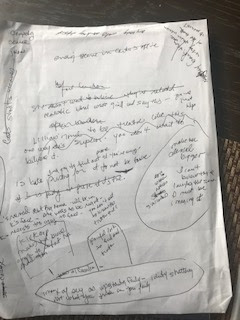
In 2016 I sent the manuscript to beta readers (check out the picture of of my technique for plotting my book). I incorporated their feedback and kept on going. Along the way I received editorial advice to write the book from both girls' POV's. I was reluctant to do that since I'm white, but Rebecca encouraged me in that direction. By the time I was ready to submit that version, the publishing industry had changed and that was no longer an option. In 2017 I made the difficult decision to start over from Kate's POV.

It was hard to give up all the work I had done to write Lillian's story, but it was the right decision. I re-outlined the book and started a new version focusing on Kate's journey. In doing that, I still went off on too many rabbit trails! 

Finally, last year (based on Joyce's encouragement) I took Kathy Temean's whole novel workshop. I received excellent feedback from three peers, incorporated their suggestions, and then sent it to an agent who read the entire 78,000 word manuscript.

The agent's insightful feedback provided a TON of things to work on--including deciding if this is a middle grade or young adult book. Ittook several months to incorporate her suggestions--including showing more of Kate's life before she moves to Charlotte. After re-writing the beginning, I realized that I had painted an overly optimistic ending and that needed changing! I decided the book needed to stretch out over an entire year and that required rearranging chapters.

Yesterday, I reached another milestone. I sent the revised 64,000 word manuscript to Joyce. She will go through it with a fine-tooth comb and I will revise it again.

And only after that--will I send it out.

So, that is why this book has taken me so long to write!

https://www.123rf.com/photo_128021414_word-writing-text-revision-business-photo-showcasing-action-of-revising-over-someone-like-auditing-o.html

Yesterday I texted Kathryn Frye, a Charlotte videographer who produced and directed the documentary, African American Album: Charlotte, NC Mecklenburg History.  She and Vermelle Ely, have been cheering for my book ever since I met them. I told her I feel that it's risky for a white woman to write about race, She responded: 

"It’s a great story from its creator, no matter what shade of human she is! We have always been fully confident that we will hold the book one day."

HOW ABOUT YOU?

Do you have a revision story? Please share in the comments!                                                       

Congratulations to Terri Michels for winning Janine Yordy's book, Jellyfish Wishes and Poems About Fishes. After entering my giveaways many times, she finally won!

ON A PERSONAL NOTE

I have grandchildren coming to visit so I'll be taking a short holiday from blogging. But I'll be back in your inbox soon!

Wednesday, March 17, 2021

The Other Madisons: An Audio Book Review

 For those of you who know me and my journey with Half-Truths, you will appreciate that when I heard of Bettye Kearse's book, The Other Madisons: The Lost History of a President's Black Family, I knew I had to read it. Since I am way behind on my to-be-read books, I was fortunate to receive a review copy from Recorded Books. See the giveaway notes at the bottom to see how you can receive a copy of this rich memoir. 


I heard Bettye speak at a webinar sponsored by the Charlotte chapter of the Women's National Book Association. After I heard Bettye's compelling talk I reached out to her and we met virtually and have exchanged emails and phone calls. I am thrilled to share her book with you, as well as a few thoughts about her writing journey. Let's just stay that I'm not alone in investing over fifteen years into a project I love.

REVIEW

Few of us can trace our ancestry as Bettye Kearse has.  She is a eighth-generation griotte and her mother said to her from the time she was a child, "Always remember--you are a Madison. You come from African slaves and a president." 

Bettye unpacks the full implication of this family credo when her mother passes on to her a box full of ancestral documents, priceless mementoes, and photographs.  At the time, Bettye was a successful pediatrician in Boston. Her life was about to change.

Bettye (around four or five) standing with her mother .

This rich, sensory memoir begins and ends with the voice of Mandy, Bettye's enslaved ancestor stolen from Ghana. Kidnapped from her home, Mandy is crammed into a slave ship. The reader feels the splinters in her hands in the hold of the ship, smells the reek of urine and feces, and feels the horrific chains binding her. 

When she gets to Montpelier, James Madison's Virginia plantation, Mandy's agonies have only just begun. Sexually assaulted by James Madison senior, she gives birth to their daughter Coreen. James Madison's son, James junior, is attracted to Coreen and he takes her for himself--despite the fact that she is his half-sister. (Bettye explains these complicated relationships in this interview.)

Having grown up in the sixties, Bettye is uncomfortable with her mother's unflinching pride in being a descendent of the Madisons. President James Madison had owned and abused her ancestors! How could she be proud of that? 

Knowing that she was challenging parts of her family history that her mother hadn't, Bettye wonders what she can contribute to the family legacy. Though hesitant, Bettye determines to uncover the truths about her ancestors and becomes the first person to write the family history down. 


An 1860 slave census listing Bettye's 
great-great-grandparents
and their children.


Bettye was very close to her grandfather, and the book is full of their relationship. He frequently told her mother, "Our white ancestors laid the foundation of this country, but our dark-skinned ancestors built it." Another time he commented, "Racism is just another challenge, and challenges make us strong." 

Bettye's research into her past takes her to Lagos, Portugal. What she finds rocks her to the core. The people who live in this tourist town are oblivious to the slave trade that had begun there in 1441. "There wasn't one morsel of information about slave stockades. The erasure was complete."


Bettye visits the Elmina Castle in Ghana and imagines what it was like for the enslaved men and women who were stolen, separated from their families, and kept in bondage. Her description of these atrocious events is complete. 150-300 women stood pressed together in "rooms of deep sorrow." They were marched through a "gate of no return" to a slave ship. "The ocean wiped away their footprints."


When Bettye comes back to the states, she visits the National Black Wax Museum in Baltimore. On board a replica of a slave ship, Bettye puts herself into Mandy's horrific experiences of possibly being raped, sick, and close to death. She wonders if she would have made it to the New World. 


There is much more to this book: Bettye's conversations with her mother over the nature of the sexual relationships between owners and slaves (her mother called it "visiting"),  Bettye's first encounter with Jim Crow when she was five-years-old, the racism she still experiences, Bettye's pride for her family and other enslaved Blacks, how she feels holding the picture of her great-great-great grandmother--the first ancestor she could see. 


This is an important book and one you won't quickly forget. 


IN HER OWN WORDS

In one of our conversations, Bettye told me that the hardest part of writing this memoir was what to do with the "rich material" she had received from her mother. Initially, Bettye wrote the book the way her mother wanted, as a record of their family stories. Then, she realized that her story wasn't unique to her and a mentor recommended that she write it as fiction; but that came out "flat." Her mentor then suggested Bettye write a memoir. Inserting her own feelings was difficult, but that process breathed life into the narrative. "It was very rewarding to discover my purpose by writing this as a memoir and realizing that I had a message for others."

AUDIO and VIDEOS

The narrator, Karen Chilton, has a beautiful reading voice and immersed me in the memoir. Sometimes I forgot that it wasn't Bettye speaking. Here is an audio snippet to show you how well Chilton reads the book:

https://soundcloud.com/recorded_books/audiobook-excerpt-the-other-madisons


Here is a video sequence narrated by Bettye and other historians.


A VIRTUAL SCREENING

Join Bettye for a virtual screening of the Eduardo Montes-Bradley documentary, The Other Madisons. There are several opportunities to view the film over the next few weeks.

GIVEAWAY


Leave me a comment by March 20 at 6 PM if you would like to enter this giveaway. PLEASE leave me your email address if you are new to my blog. 

DISCUSSION GUIDE

This book is a great book club selection. Download the discussion guide here.

Wednesday, March 10, 2021

Born to Swing: A Picture Book Review and Giveaway

As I mentioned a few weeks ago, I have a shelf full of picture books to review, use as mentor texts, and to give away. In honor of Women's History month, here's my next one, Born to Swing (Calkins Creek, 2018) by Mara Rockliff and illustrated by Michele Wood. (Images courtesy of Calkins Creek.)


"I was born to swing, that's all. Call it what you want, blues, swing, jazz, it caught hold of me way back in Memphis and it looks like it won't ever let go." Lil Hardin Armstrong

REVIEW

In this vivid picture book biography, Lillian Hardin Armstrong's life and love of music is depicted on every page.

From the time she was a child, Lillian loved to listen to the Father of the Blues, Mister W.C. Handy's band playing outside her Memphis boarding house window.

Although her mother called it "Devil's music," she couldn't keep Lillian away from the family organ. Her legs were too short, so her cousin played the pedals for her!


Lillian played hymns for Sunday School--albeit with a beat. She didn't know it at the time, but she was playing jazz! During a piano contest she lost her place, improvised, and won!

When the Great Migration north started, she and her mother headed to Chicago. There she strolled up and down the Stroll listening to music at all hours of the day and night. 

She got a job playing piano in a music store and earned the tile, "The Jazz Wonder Child."


She met Jelly Roll Morton (who said he invented jazz) and despite being a woman, started playing with the New Orleans Creole Jazz Band.

She was "swinging with the swingingest band in Chicago. I laid those rhythms down so hot, they called me Hot Miss Lil." That's when she met Louis Armstrong. 

"Louis was not a handsome man. His clothes were out of style. But when he blew his horn, oh, gee!"

Of course, they had a jazz wedding! No honeymoon for the two of them, they were too busy touring across the country with the band.


Lil and Louis wrote songs and put a band together they called the Hot Five. Their marriage lasted for 14 years; the author reporting their divorce as Louis moving on. 

Lil continued to write songs and play piano. She also started her own band, ran a restaurant, designed clothes, and traveled to Paris where the French had flipped for le jazz hot. 

When she returned home, the country was wild about rock and roll. She thought maybe everyone had forgotten her, but she was labeled a "living legend" and she was on television-- a new type of entertainment media back in the day!


Interestingly, the book ends with Lil saying,

You won't believe me, but I died at the piano, playing that "St. Louis Blues"--playing hard. Oh boy, I went out swinging.

Right up to the end, I had the widest smile and the biggest brightest eyes.

In 1971, shortly following Louis's death, Lillian collapsed at the piano and had a heart attack on the way to the hospital. Wikipedia notes that the autobiography she was working on, and her personal letters, disappeared shortly after her death.


END PAGES & CURRICULUM RESOURCE

The back of the book notes include five pages of information including a timeline, bibliography of both primary and secondary sources, and a list of her songs to find online. This is a great curriculum resource for Kindergarten-third graders studying women in the arts, jazz, and African American history. Reluctant readers in fourth-sixth grades will also enjoy the text and pictures.

Here is a youtube short video showing Lil at the piano.


The text is very reader friendly and inspirational. The illustrator's use of yellow throughout the book was magnificent. From Lillian's dresses, to the color of the horns, to the background of several pages--it makes the story pop from the pages. 

GIVEAWAY

Leave me a comment by 6 PM on March 12 along with your email address (if you are new to my blog) and I'll enter your name. If you choose to follow my blog, let me know and I'll put your name in twice. U.S. addresses only. 

Wednesday, February 3, 2021

BUZZING WITH QUESTIONS: The Inquisitive Mind of Charles Henry Turner- A Picture Book Review and Giveaway

 I received a record number of comments on last week's blog. Congratulations to Danielle Hammelef for winning GRANDDADDY'S STORIES.

                                                                            *****


At the moment I am studying picture book biographies, with the hope of writing one or two myself. That means you will meet some notable dreamers, scientists, and artists through the words of talented authors and illustrators. Buzzing with Questions (Calkins Creek, 2019) written by poet, author, and creative writing instructor, Janice Harrington, is the story of Charles Henry Turner, a 19th-century scientist. Vivid, joyful illustrations by Theodore Taylor III bring Charles' quest for understanding the natural world accessible to young readers. 

REVIEW

Without a doubt, Charles was a boy with questions.


His teacher encouraged him to search for his answers. And that's exactly what he did. After finishing high school, Charles Henry Turner did what very few African Americans did in 1886 -- he went to college. 

He was the only brown-skinned man in the class and his white professor was worried about how he would be received. But the other students enjoyed the company of their fellow hard-working student.


Charles spent hours "peering through microscopes, planning experiments, gathering specimens, keeping records, drawing charts, ad reading scientific papers." His curiosity knew no limits.

  • Could spiders learn, or were they only weaving machines that made the same web over and over?
  • How did ants find their way home? Did the sun guide them? Did they follow a trail? 

Searching for answers led to devising experiments. Which led to more information and more discoveries.

Along with his high school students, Charles investigated bee behavior. First, they fed them at breakfast, lunch, and dinner. When they only set out jam at breakfast, the bees still buzzed and circled at other meal times. From that, they deduced that bees had a sense of time.  

Bees, giant water bugs, whirligig beetles, dragonfly nymphs, water striders, paper wasps, hornets, or tent caterpillars. Charles studied them all.
....

His mazes, spider jars, paper circles, and cardboard stages toppled old ideas about insects. He never stopped inventing new ways to study the smallest creatures, searching for new ideas, or asking new questions.

Despite facing racial prejudice, Charles became an integral part of his St. Louis community. He hoped that by studying biology, people could see the connections between all living things. 


Charles Henry Turner, the boy whose teacher urged him "to go and find out," grew into a teacher himself, a devoted scholar who taught students to look closely, to find the webs that connect us all, and--just as he did--to fill the world with questions, questions, questions. 

BACK MATTER

Resources at the back of the book include why Ms. Harrrington wrote this book, a timeline, and other resources.  It is a great curriculum resource for Kindergarten-third grade classrooms and STEM book. 

For a Buzzing with Questions read aloud, watch this:


For another great video about Charles Turner's experiments, watch this:


GIVEAWAY

Please leave a comment along with your email address by 6 PM on February 6. It's a great addition to your classroom or home library. 

Wednesday, January 6, 2021

For to See the Elephant: A Novel in Verse and an Autographed Giveaway

 Congratulations to Tricia Clark who won Letters from Space.


Six months ago, author Tammi J. Truax contacted me after reading my review of Orchards on Goodreads. She deduced that I liked free verse historical novels and offered to send me a copy of her book, For to See the Elephant (Piscataqua Press, 2019) Come with me into the pages of this amazing chronicle of the first two elephants who came to America, their keeper, and the people whose lives these honorable animals touched. This is a work of fiction, but as the author notes, "the found poems included in the work are taken from diaries, newspaper articles, advertisements, and songs from the time period." It is a saga of the enslaved.


REVIEW

For to See the Elephant is written from several different points of view including the men who purchased the elephants, the slave boy William who is their keeper, the elephants, and Hachaliah Bailey. A different font is used for each point of view and their voices are all distinctive. To best see the beauty of the poetry, I'm sharing excerpts from several different entries. The elephants' POV are written in narrative.

GAJA, At leaving Bengal, India, October 1795

My mahout was conflicted that day. I could tell by the silent language of his body. Further, I could tell that he needed me to go where he was leading me, but that in his heart he did not really want me to go. I also knew I had been sold...I let out a trumpeting roar, one I knew he could hear as his little bare feet flew across the wharf in the opposite direction that I was headed. I was but a baby and had never been left alone before. (p. 2, 5)


Captain Jacob Crowinsheild at sea. December 1795


I say with certainty

I've never heard 

a sadder sound 

than the cry of 

The Elephant.

Adding to the misery

of the cries,

the beasts thrusts itself

in rhythm with the rise

and fall of the sea,

against the pen

built to hold her.... (p. 9)


William at sea 1795


captain said
I'm to take care of
the Elephant
me
the smallest one here
captain said
I'm African 
so I should know-
what that mean

captain said

get the beast 
to calm down
and clean up
all her mess

captain ain't said
how (p. 11)

Mister Welshaven Owen, Philadelphia, Pennsylvania. June 1976


Tonight she makes
her stage debut!
I have rented out
the Elephant
to the Philadelphia Theatre.

I'll have the boy
wash and oil her all up.
Not sure if I'll let the boy
take her on stage
or if I'll do it. 

She seems to like the boy
much more than me. (p. 21)

William on the Maine/New Hampshire border. late 1802


i know why 
folks call her
ugly or beast
or whatnot
i been called
lots of names too
some folks just dont
see things proper
sure she all wrinkled
an got a funny nose
an ears big enough
to make lookers laugh
but they missing somethin
so important

they not having
a good up-close
honest look
in her eye
all her beauty there
in her eye
it looks like
a topaz marble
a boy once showed me

an her pretty eye
have long lashes
that flutter like
a little birds wing

a big beautiful
round eye
full of feelings
.....(pp.54-55)

[Gaja is seriously injured when she falls from a bridge spanning the Connecticut River. ]

William, Amherst, Massachusetts. November 1803


she was hurt bad
I tole em all
she couldn't get up
gave her what comforts I could

I was so sorry
for what happened
but what I mos felt
was angry

I couldn't barely
stand for it
when they drug her
up the hill like that

finally got her
in the barn
master said hes
going to charge

people a nickel
for to see
the dying elephant
an he did...

....me and gaja
we lived likewise lives
I think she knew it  (pp. 74-76)

BIG BETTE IN A BARN AT BOSTON, MASSACHUSETTS. January 1804


I CAN TELL THIS IS NOT MY HOMELAND. I DIDN'T THINK I COULD BEAR IT WHEN I DETERMINED THAT FACT SHORTLY AFTER OUR ARRIVAL. I REALLY DID NOT. WHEN I WAS DELIVERED TO MORE STRANGERS AND MY LEG WAS CHAINED IN THIS NEW BARN I CALCULATED HOW I COULD TEAR DOWN THE WALL WITH MY LEG IF I USED ALL OF MY STRENGTH, AND PICK UP ANY OF THE MEN THAT CAME NEAR ME. SIMPLY PICK THEM UP AND CRACK THEM AGAINST A BEAM IN THEIR OWN FILTHY BUILDING....

AND THAT IS WHEN I MADE THE ACQUAINTANCE OF THE NEW MAHOUT I BELIEVE HIM TO BE FROM MY HOME LAND. HE DOESNT SEEM TO BELONG HERE EITHER. HE SHOWED ME THAT THE MEASURE AND CONTENT OF HIS HEART IS THE SAME AS MY OWN... (P. 84)

Hachaliah Bailey in a tavern at Danbury Ct. Spring, 1806


Of course I need to make some changes.
This is my livelihood.
I need the keeper to understand that.
I want him to teach
the Elephant
some more amusing tricks.

I intend to purchase more animals
we can pull along in cages.
And we must take to traveling by night.
Far too many people
are getting a free look at
the Elephant. (p.92)

[Big Bess is shot by a man who had been drinking. William is forced to help dig her grave.]

William, April 1816


...the thought that struck me was
maybe its just time

for me to go
to walk away
theres no more elephants

for me to take care of
this is a place
where maybe
maybe I can
make my own way
in the world

those merry dancers [Shakers]
told me I'd be welcome
at their holy land
and theres indians
up in the woods
where a man can live free
some kind of way
....

dug the dang hole
dug til my hands bled
   my back ached
but my back
wasnt the part of me
   hurtin most

(p. 173-4)


Hachaliah Bailey, Town Hall at Alfred, Maine. April 1816


I can't state plainly enough
that I want that man, that criminal
brought to justice. Further I expect 
to be reimbursed for my losses
which since I came to this town
have been egregiously high.
That elephant was worth
more than a thousand dollars!
And how my elephant keeper
has gone missing!
He's worth nearly that much.
My stop in your town
may just bankrupt me. (p. 176)

Boston, 1797


THE END...PERHAPS THE SPIRIT OF BIG BETTE THE MATRIARCH TODAY


I WAS MURDERED, WITHOUT CAUSE, AND, JUST LIKE GAGA, MY SKIN AND BONES WERE TAKEN IN A GRUESOME WAY AND PUT ON DISPLAY. OLD MAN BAILEY STILL PROFITED BY MY EXHIBITION, DRAGGING THE DEAD ME FROM PLACE TO PLACE. UNTIL AT LAST MY FLESH AND BONES WERE SOLD TO P.T. BARNUM, TO BE SHOWN FOR PROFIT, IN HIS LITTLE MUSEUM OF ODDITIES...IT IS OFT CLAIMED THAT MY REMAINS WERE LOST TO A FIRE THAT CONSUMED BARNUM'S BUILDING AND CREMATION IS AT LEAST, A MORE RESPECTFUL WAY TO TREAT SACRED REMAINS....  (P.191)


CURRICULUM RESOURCE


This novel would be an excellent curriculum resource for middle and high school language arts or history classes. I would love to hear students discuss the content as well as the beautiful way in which Ms. Truax delivered the story.  For more information on her other poetry projects, please consult her website.

BACKSTORY


When I asked Ms. Truax what inspired her to write this story she replied, "I had interviewed an elderly woman who still lived on property that had been in her family for a couple of hundred years. She told me that once long ago "an elephant had stopped by to drink from the well". I was intrigued by that but didn't get serious about research until I heard about the murder of an elephant in Maine and thought that must have been the same elephant. Then I took in on as a NaNoWriMo project in 2015."

                                      Tammi J. Truax next to the roadside marker
                                      in Alfred, Maine where Big Bette was killed.


GIVEAWAY


I have an autographed copy ready to be mailed to one of you. Please leave me a comment (along with your email address if you are not a frequent commenter) by 6 PM on January 8. If you subscribe to my blog I'll enter your name twice!

Wednesday, September 9, 2020

The Teachers March! A Picture Book Review + Giveaway

Congratulations to Jolene Guiterrez who won Maiden of Iron from last week's blog.

******

The Teachers March! (Boyds Mills & Kane, 2020) is a nonfiction picture book that many of you will be interested in adding to your home or school library.


This is the story of Reverend F.D. Reese's activism and how it led to obtaining equal rights for African Americans. Set in 1965 in Selma, Alabama, co-authors, Sandra Neil Wallace and Rich Wallace use storytelling techniques to bring history alive. 


REVIEW


The first line hooked me right away.

Reverend F.D. Reese taught science at R.B. Hudson High School, but his favorite subject was freedom.

Reverend Reese loved teaching science, but he was passionate about teaching his students that under the Constitution, they had the same rights as whites. 


He led marchers to the courthouse to register to vote but was met by Sheriff  Clark who swung his billy club and threatened harm to the Negroes. Reverend Reese knew that even if they registered, they would be forced to take a voting test that Whites didn't have to take--and that was impossible to pass. 

Reverend Reese thought about how the Black teachers were respected in their community. They were the somebody somebodies. College educated. Shiny leather shoes. Suits and Sunday brooches seven days a week. No group like that had marched for freedom before.

(Side note: When I interviewed people for Half-Truths this was the attitude that was expressed toward the Second Ward High School teachers. They were respected and loved.)

But how would he convince the teachers to march? They were frightened. Reverend Reese needed a "glorious opportunity" and a "triumphant idea." 

He discovered he had both. After hearing Dr. Martin Luther King talk on television, he decided to write to him and ask for help with the teachers.

The night that Dr. King spoke at Brown Chapel, seven hundred people packed the auditorium. Two people from the community came also, 15-year-old Joyce Parrish, and her mother "Too Sweet."


Despite their fears of going to jail or losing their jobs, one by one, over a hundred teachers agreed to march for the cause: they were leaders of the community and they would come forward and demonstrate their commitment to gaining the right to vote. 

As a teacher, Too Sweet had a difficult choice to make. She was a single parent. Who would take care of Joyce if she went to jail? More than a hundred teachers pledged to march, and Too Sweet was one of them.

On the morning of January 22, 1965, the teachers who had said they would march packed a peanut butter sandwich and a toothbrush. They would need them if they were arrested. Reverend Reese was worried. He'd seen other individuals arrested as they tried to register. Would the teachers show up for the march?

They did!


When they arrived at the courthouse, they were greeted by the same sheriffs who had angrily confronted Reverend Reese before. 

But this time, the sheriff and his deputies faced a huge crowd of teachers. If they all got arrested, who would teach the students? The superintendent would have to close the schools. The sheriff knew that and had to put away his billy club.


Reverend Reese and his triumphant idea had gained a glorious victory.

Afterward, Joyce was relieved when she found her mother amidst the group of marchers. She and her mother hugged; Dr. King came back and praised the teachers.

Because the teachers marched, other groups marched also. Beauticians and barbers. Undertakers. Even the students.


Many of the Selma marchers were arrested and the nation took notice. They wondered why respectable citizens in suits and dresses, and school kids carrying books, were jailed.

In the summer of 1965, the Voting Rights Act passed. In August, Reverend Reese, Too Sweet, and other teachers climbed the steps to the courthouse. There were no voting tests or bully clubs. 


And the first thing they did, was vote Sheriff Clark out of office. 

AUTHORS AND ILLUSTRATORS NOTES

The back pages of the book are filled with information. The authors, Sandra Neil Wallace and Rich Wallace discuss their interviews with Reverend Reese, Joyce Parrish O' Neal, and Lawrence Huggins, another teacher mentioned in the book. In addition, the illustrator, Charly Palmer, discusses his use of photographs to create his unique illustrations. A detailed timeline and bibliography make this an excellent curriculum resource for students in 2nd-5th grades. 

GIVEAWAY

Leave me your name and email address (or email me privately) by September 11 to enter the giveaway. For an extra chance to win, share this post on social media and let me know what you do.

WHAT'S NEXT?

Since I am also working on a book related to civil rights, I was very interested in how the Wallaces became interested in this story. Because I'm running a series on writing collaboratively (check out the first post here) I asked them about that too. Look for their responses to these questions on a bonus blog post on Saturday. (And a second chance to win The Teachers March!)


THE NIGHT WAR: A MG Historical Novel Review

  By now you should have received an email from my new website about my review of THE NIGHT WAR by Kimberly Brubaker Bradley. (It'll com...