Showing posts with label Half Truths. Show all posts

Tuesday, December 21, 2021

Revision Revisited

 If you're a writer, then someone has probably said to you: "So, are you done with your book yet?" If the person who you are talking to loves you then he may say, "How's the book coming along?" Which is a softer, kinder way of saying the same thing. 

Either way, most people who are not in the writing/publishing world have NO idea how much writing and re-writing goes into creating a book. And either way, you'll feel a little defensive as you try to explain why it's taken years to create a finished product.

REVISION BLOGS

Revision happens on so many levels. There are drafts when a writer is just getting the story out. There are big picture revisions when a writer has to re-vision her entire novel. And then of course, there are a host of "minor" revisions to make your characters and story authentic.
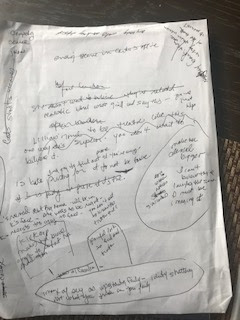

A page of side notes on Kate's character development.

I've blogged about the revision process several times. Here is one from the Free Expressions workshop I took ten years ago. And here is a blog with Harold Underdown's advice on not submitting until your work is ready. Mary Jane Nirdlinger wrote an excellent post about revision for the SCBWI-Carolinas region. I highly recommend it.

TRUE CONFESSION

I started Half-Truths over 15 years ago. I knew I could write, but I'd never written a novel AND I took on a topic that was much bigger (and more difficult to write) than I realized.  Here is the updated blurb for my middle grade book:

In the Jim Crow south, thirteen-year-old Kate Dinsmore meets two people who challenge her world view: a small-town newspaper editor determined to stop the KKK and a young Black maid who proves to be her second cousin. Told through narrative, letters, newspaper headlines, and poetry, Kate comes to grips with her identity, decides what she will stand for, and takes risks to become a journalist who will make a difference. 

Although I imagined the girls' relationship since the book's inception, I went off in many different directions as I wrestled with writing the book. Rebecca Petruck, one of my early critiquers, kept encouraging me to return to that relationship--even when I included murders, boyfriends, and information about the Korean war. (Did I say this was my first novel?)

Joyce Hostetter, a wonderful historical middle grade author has been my mentor throughout the process. Under her guidance, I researched widely and found tremendous experts who informed my knowledge of the time period and the plot. I visited places on the Charlotte African American tour. I talked to people who went to the same high school as my characters, Meet My Experts III- Vermelle Diamond Ely and Meet my Experts

In 2016 I sent the manuscript to beta readers (check out the picture of of my technique for plotting my book). I incorporated their feedback and kept on going. Along the way I received editorial advice to write the book from both girls' POV's. I was reluctant to do that since I'm white, but Rebecca encouraged me in that direction. By the time I was ready to submit that version, the publishing industry had changed and that was no longer an option. In 2017 I made the difficult decision to start over from Kate's POV.

It was hard to give up all the work I had done to write Lillian's story, but it was the right decision. I re-outlined the book and started a new version focusing on Kate's journey. In doing that, I still went off on too many rabbit trails! 

Finally, last year (based on Joyce's encouragement) I took Kathy Temean's whole novel workshop. I received excellent feedback from three peers, incorporated their suggestions, and then sent it to an agent who read the entire 78,000 word manuscript.

The agent's insightful feedback provided a TON of things to work on--including deciding if this is a middle grade or young adult book. Ittook several months to incorporate her suggestions--including showing more of Kate's life before she moves to Charlotte. After re-writing the beginning, I realized that I had painted an overly optimistic ending and that needed changing! I decided the book needed to stretch out over an entire year and that required rearranging chapters.

Yesterday, I reached another milestone. I sent the revised 64,000 word manuscript to Joyce. She will go through it with a fine-tooth comb and I will revise it again.

And only after that--will I send it out.

So, that is why this book has taken me so long to write!

https://www.123rf.com/photo_128021414_word-writing-text-revision-business-photo-showcasing-action-of-revising-over-someone-like-auditing-o.html

Yesterday I texted Kathryn Frye, a Charlotte videographer who produced and directed the documentary, African American Album: Charlotte, NC Mecklenburg History.  She and Vermelle Ely, have been cheering for my book ever since I met them. I told her I feel that it's risky for a white woman to write about race, She responded: 

"It’s a great story from its creator, no matter what shade of human she is! We have always been fully confident that we will hold the book one day."

HOW ABOUT YOU?

Do you have a revision story? Please share in the comments!                                                       

Congratulations to Terri Michels for winning Janine Yordy's book, Jellyfish Wishes and Poems About Fishes. After entering my giveaways many times, she finally won!

ON A PERSONAL NOTE

I have grandchildren coming to visit so I'll be taking a short holiday from blogging. But I'll be back in your inbox soon!

Wednesday, March 25, 2020

Including "Real" People In Historical Fiction And A Book Review of WAR IN KOREA

One of the cool things about writing historical fiction is the people I have "met" in my research. Some are relatively well-known, some are names buried in history. It is especially cool if I'm able to include their stories in my WIP, Half-Truths.


HALF-TRUTHS

For those of you who are unfamiliar with the plot, Kate Dinsmore, my protagonist, moves to Charlotte, NC in 1952 to live with her paternal grandparents. Her father has just left for the Korean conflict. Soon after moving in, Kate meets Lillian Harris, the granddaughter of her grandmother's cook. The girls uncover family secrets that bind them together in ways neither can ignore. 

There are several "real" people who I've included in my story. Carolina Israelitepublished by Harry Golden  is a newspaper that Kate's grandfather reads. Kate is a budding journalist and at the end of the book gets a job working in his office.  Kelly Alexander, the NAACP leader in Charlotte, NC from 1940-1980, is someone Lillian admires; his voice is heard in Half-Truths. The DeLaine case in South Carolina led to the landmark Supreme Court decision to integrate schools in 1957; Mrs. Harris reports about it at a NAACP meeting the girls overhear. (You'll have to read the book to find out how they're able to finagle that!) 

And then there is Marguerite Higgins


Kate first reads about Miss Higgins when she reads this quote in the New York Herald Tribune: I wouldn’t be here if there was no trouble. Trouble is news, and gathering it is my job.” Kate is inspired by Higgins' courage and bravery. 

By the way, Higgins covered WWII, Korea, and Vietnam and in 1951 was the first woman to win the Pulitzer Prize for Foreign Correspondence. The Pulitzer Prize jury wrote, “She is entitled to special consideration by reason of being a woman since she had to work under unusual dangers.”


Now, back to Half-Truths. At one point in my book, Kate chides herself for her lack of bravery. She writes this poem in her steno pad:


Daddy and Marguerite Higgins  
face bombs      
hidden mines       
swarms of enemy soldiers       
that kill, maim, and destroy.    
Thousands of miles away  
I’m safe    
from death’s grenade.  
I wanted to know more about Higgins and ordered her .25 cent autobiography, War in Korea, (Doubleday, 1951) off Amazon (now worth a bit more!) Her reporting was amazing given the dire circumstances within which she worked. As I often do with nonfiction books, I'm going to quote some of her outstanding observations of the war between June and December, 1950.

THE REVIEW

During one long wait, while a scouting party was looking for a place to ferry across the river, Colonel Wright noticed my gloomy air. "What's the matter, kid," he asked, "afraid you won't get your story out?" And after a pause he offered, "Look, stick by this radio truck and we'll try to send out a message for you if you keep it short."

It was now growing light, and in my elation I immediately get out my typewriter, put it on the front of the jeep, and typed furiously. Streams of retreating South Korean soldiers were then passing our stationary convoy. Many of them turned their heads and gaped at the sight of an American woman, dressed in a navy-blue skirt, flowered blouse, and bright blue sweater, typing away on a jeep in the haze of daybreak. I got my copy in all right. But as far as I know, communications were never established long enough  to send it." (p.12)


.....Before long the Americans were leading a ragamuffin army of tattered soldiers, old men, diplomats, children, and a woman war correspondent. (p. 13)


Can't you see these scenes unfold?

I was crouched by the side of the windy airstrip typing a quick story on his visit when the general [Douglas MacArthur] appeared. He was clad in his famous Bataan gold-braid hat and summer khakis with the shirt open at the collar. He smoked a corncob pipe....


On seeing me on the airstrip, the general came over to say hello and then asked if I would like a lift back to Tokyo. Since the Bataan [his plane] was the only means of flying back to communications and getting the story out, I gladly accepted. (p. 14-15)


Or, how about this:


It looked that afternoon, for a few brief moments, as if I would never leave Taejon. Late in the day I was jeeping unconcernedly past the compound of that enclosed division headquarters. Suddenly a roar of voices boomed to me to come back.


Looking back, I saw dozens of soldiers, their guns pointed in my direction, peeping around the compound fence. Tanks in front of headquarters also had their guns trained my way. So I hastily wheeled my jeep about and pell-melled into the compound, heading for the building we had adopted for the press. It was deserted except for Bill Smith of the London Daily Express.


Smitty and I went over to the headquarters building to try to find out the cause of the trouble. But about all we found was a number of headquarters men, how had never been shot at before, under a table... (p.56-57)

..........

Joining the sad, dusty American exodus over the winding mountain road, we finally turned off at 21st Infantry Regimental Headquarters, located in a Korean schoolhouse. It was close to midnight and already the ain room was filled with snoring officers sprawled on the floor. Everyone slept in his clothes for the simple reason that you had to be ready to move at a second's notice. I quietly put my blanket done on the floor, doused myself thoroughly with flea powder, and went to sleep.

The astonished offer who woke up the next morning and found me next to him on the floor caused considerable amusement around headquarters by dashing into Colonel Stephen's room with the exclamation, "My God, sir, did you know we'd been sleeping all night with a lady?" p. 57

Seventy years later we might think this is funny, but Higgins faced considerable difficulties because she was a woman. 

Ultimately, her writing and reporting were stellar in a fearful and dangerous situation. 

General MacArthur's great gamble at Inchon had paid off. And in the forthcoming days I was able to fulfill the promise I had made myself--I walked back into Seoul.

It was not an easy or a pleasant walk. The United States Marines blazed a bloody path to the city. The going was particularly rough the day that Charlie Company of the 1st Marines seized a Catholic church in the center of Seoul. We did not know that the road was heavily mined until a medic jeep raced ahead of us. The jeep blew up directly in our path. Of the three people in it, only the medic survived. And his torn body and shredded, bloody face were a ghastly sight.

We quickly climbed out of our vehicles. The company commander shouted to us not to step on any freshly up-turned dirt--it might be a mine. On the rough dirt road it was difficult to follow his instructions, so we went forward on our toes. (p. 86)

Before finishing this blog I listened to President Trump's latest updates about the coronavirus. In Half-Truths, Kate Dinsmore is challenged by the courage of this journalist who wasn't afraid to risk her life to get the story right. 

She's also an inspiration to me to be brave in a different type of war. 


Monday, August 19, 2019

TOMORROW'S BREAD: A Review and Giveaway

Congratulations to Gail Cartee who won The End of the World and Beyond on last week's giveaway.

When I began researching Half-Truths someone--I'm afraid I don't remember who it was--told me about how Brooklyn, an African American neighborhood in Charlotte that was leveled as a part of urban renewal.  Tomorrow's Bread by Anna Jean Mayhew, breathes life into that vital, bygone neighborhood. 


This story of a community affected by urban renewal is not unique to Charlotte, NC; but it is told in such well-researched detail that people living in Detroit, Philadelphia, St. Louis --any area that was torn down and cleared out--will resonate with the book. As A.J. points out in her Author's Note, there were homes that would meet the definition of blight. 


This photo, taken in the old Brooklyn neighborhood, was typical of the image often presented of Charlotte's historically black neighborhood near uptown. In reality, the area was made up of mixed-income residences and businesses.  COURTESY OF CHARLOTTE-MECKLENBURG LIBRARY


But, there were also business, churches, theaters, and spacious brick homes that were destroyed. 


https://www.charlotteobserver.com/news/local/article66934337.html
Business district in Brooklyn.


REVIEW

This historical novel for adults is told through three different points of view. We see the destruction of the neighborhood primarily through the eyes of Loraylee, a single black mother who lives with her son, uncle and grandmother. Loraylee is in love with a white man, but in the sixties, it is against the law for them to get married. Everyone in Loraylee's family is attached to their friends, fellow church-goers, schools and businesses in Brooklyn; all four can't imagine life elsewhere. Her hard-working and matter-of-fact manner made her a person I would have liked to know. 


Reverend Ebenezer Gabriel Polk ("Eben") is the faithful pastor of St. Tim's and unofficial church historian of the church cemetery and the 151 slaves that were buried there. His third-person account of watching his cemetery and community bulldozed is gripping and poignant. (Personal note: Since I have included  a cemetery disinterment in Half-Truths, I was interested in how Mayhew incorporated that into the story.) Eben's own family history (most likely descended from President Polk), his sorrow over his deceased wife and his brother's tragedies, and his commitment to his community weave throughout the book. 


Persy, a white woman who has had struggles of her own, is the third point-of-view in the story. Her childless and loveless marriage contrasts with the loving family relationships in Brooklyn. Her husband is on the committee for urban renewal and she is as helpless to stop him as she is to heal their failing marriage. Although Persy is mainly on the periphery of the story, her life intersects with Loraylee's when they both are at the beach, and Persy is instrumental in saving Loraylee's son's life in a near-drowning. 

Half-Truths takes place about ten years before Brooklyn's urban renewal. Although it is in a different area of the city, Black leaders were concerned about how urban renewal would not provide relocation to the families and businesses. In this article, local NAACP leader, Mr. Kelly Alexander (who makes a cameo appearance in Half-Truths) stated some of his concerns.  


GIVEAWAY

Next week, I am interviewing A.J. on my blog. Leave me a comment on this blog and I'll enter your name in the giveaway. Enter again next week, and you're in twice! Tomorrow's Bread could be yours! Make sure you leave your email address if you are new to my blog. 


Monday, February 25, 2019

The Smallest Tadpole's War in the Land of Mysterious Waters: An Audio Book Review and Giveaway

Florida became a state in 1845 and was quickly thrust into the Civil War. The Smallest Tadpole’s War in the Land of Mysterious Waters bridges the years from 1843  to 1900. The main character, Thomas Franklin Swearingen, was author Diane Swearingen’s husband’s great-great-grandfather. 

Thomas Swearingen, an uneducated farmer who settled northern Florida when it was home to untamed forests, black bear, Seminole ponies, and biting insects, went on to become a legislator, a drafter of the Florida constitution, and president pro-temp of the Florida senate. This is his story—and the story of Florida’s early years as a state. 


The Smallest Tadpole is told from the perspective of Henry, Thomas’s adopted son. Henry recounts that his favorite book as a child was Thomas’s diary.  Although Diane Swearingen fabricated Thomas’s diary and letters, she used county and military records as well as Thomas’s papers that now reside in the Florida State archives.  Historical accuracy permeates each diary entry and the entire book. 

Thomas left Georgia and settled in Wakulla County, Florida in the late 1840's. In 1855 when his best friend died, Thomas married his widow, Louise, and adopted Henry. In 1860, at the age of eleven, Henry became a man when Thomas left for the war. His boyhood days of fishing with Thomas in the Gulf of Mexico and camping out staring at the stars, were over. 


Henry remembers how Thomas, a prosperous businessman, had been invited to political rallies before the war. The local cotton farmers agreed that they shouldn't be taxed by the north. Although Thomas had been warned that slavery would remain in the South as long as it was a colony to the North, it was the unspoken issue at these rallies where secession was a huge topic. Although most of the farmers did not own slaves, (Florida's population was 140,000 in 1861; 63,000 were African Americans), wealthy cotton plantation owners held the purse strings and great political influence over the farmers. To speak against them was financial suicide. The political rallies became enlistment opportunities for the Confederate Army; the farmers were loyal to a way of life and to local economics rather than defenders of slavery.


Thomas was made a lieutenant in the Wakulla Guard because of his leadership and popularity in the county--not because of any prior military experience. (This verified the experience of Kate Dinsmore's great-grandfather. As the protagonist in Half Truths, I researched how her great-grandfather would have been made captain in Charlotte, NC under similar circumstances.)  With great pomp and ceremony, the Florida men left for war with families excited about the $100.00/month the soldiers would receive. 

But the reality of war set in quickly with women left alone to care for their farms and children, while news of injuries and deaths trickled in from the front. Thomas's letters reported the realities of war and Swearingen's portrayal does not hold back from describing the smell of death, ears that ran from cannon fire, and the screams of dying men. It put faces on the 16,000 Florida soldiers who never returned home. 

Henry's narrative of the war is sprinkled throughout with local stories of Wakulla County and his own enlistment prior to the war ending. There was not enough black cloth for all the widows to sew funeral attire. Carpetbaggers grabbed land because of taxes owed. The homeless and helpless were throughout the countryside. 

Although Thomas returned home injured, he was encouraged to run as the Florida representative of Wakulla County and from there held several political offices. Throughout his career Thomas was anti-slavery.

This audio version available through Audible, is expertly narrated by Jim Seybert.

WAKULLA’S BEAUTIFUL WAKULLA RIVER IS A SPRING FED CLEAR WATER RIVER THAT RUNS EVENTUALLY INTO THE GULF OF MEXICO.  TODAY, MANATEES SWIM UP TO WINTER IN ITS SPRING. FROM THE FLORIDA MEMORY COLLECTION.


GIVEAWAY


Thanks to Jim Seybert's generosity, I will provide a code for the winner to download this book from Audible's website. To enter, please leave me a comment by February 28 along with your email address if you are new to my blog. 


THE NIGHT WAR: A MG Historical Novel Review

  By now you should have received an email from my new website about my review of THE NIGHT WAR by Kimberly Brubaker Bradley. (It'll com...