Showing posts with label Courage. Show all posts

Wednesday, March 25, 2020

Including "Real" People In Historical Fiction And A Book Review of WAR IN KOREA

One of the cool things about writing historical fiction is the people I have "met" in my research. Some are relatively well-known, some are names buried in history. It is especially cool if I'm able to include their stories in my WIP, Half-Truths.


HALF-TRUTHS

For those of you who are unfamiliar with the plot, Kate Dinsmore, my protagonist, moves to Charlotte, NC in 1952 to live with her paternal grandparents. Her father has just left for the Korean conflict. Soon after moving in, Kate meets Lillian Harris, the granddaughter of her grandmother's cook. The girls uncover family secrets that bind them together in ways neither can ignore. 

There are several "real" people who I've included in my story. Carolina Israelitepublished by Harry Golden  is a newspaper that Kate's grandfather reads. Kate is a budding journalist and at the end of the book gets a job working in his office.  Kelly Alexander, the NAACP leader in Charlotte, NC from 1940-1980, is someone Lillian admires; his voice is heard in Half-Truths. The DeLaine case in South Carolina led to the landmark Supreme Court decision to integrate schools in 1957; Mrs. Harris reports about it at a NAACP meeting the girls overhear. (You'll have to read the book to find out how they're able to finagle that!) 

And then there is Marguerite Higgins


Kate first reads about Miss Higgins when she reads this quote in the New York Herald Tribune: I wouldn’t be here if there was no trouble. Trouble is news, and gathering it is my job.” Kate is inspired by Higgins' courage and bravery. 

By the way, Higgins covered WWII, Korea, and Vietnam and in 1951 was the first woman to win the Pulitzer Prize for Foreign Correspondence. The Pulitzer Prize jury wrote, “She is entitled to special consideration by reason of being a woman since she had to work under unusual dangers.”


Now, back to Half-Truths. At one point in my book, Kate chides herself for her lack of bravery. She writes this poem in her steno pad:


Daddy and Marguerite Higgins  
face bombs      
hidden mines       
swarms of enemy soldiers       
that kill, maim, and destroy.    
Thousands of miles away  
I’m safe    
from death’s grenade.  
I wanted to know more about Higgins and ordered her .25 cent autobiography, War in Korea, (Doubleday, 1951) off Amazon (now worth a bit more!) Her reporting was amazing given the dire circumstances within which she worked. As I often do with nonfiction books, I'm going to quote some of her outstanding observations of the war between June and December, 1950.

THE REVIEW

During one long wait, while a scouting party was looking for a place to ferry across the river, Colonel Wright noticed my gloomy air. "What's the matter, kid," he asked, "afraid you won't get your story out?" And after a pause he offered, "Look, stick by this radio truck and we'll try to send out a message for you if you keep it short."

It was now growing light, and in my elation I immediately get out my typewriter, put it on the front of the jeep, and typed furiously. Streams of retreating South Korean soldiers were then passing our stationary convoy. Many of them turned their heads and gaped at the sight of an American woman, dressed in a navy-blue skirt, flowered blouse, and bright blue sweater, typing away on a jeep in the haze of daybreak. I got my copy in all right. But as far as I know, communications were never established long enough  to send it." (p.12)


.....Before long the Americans were leading a ragamuffin army of tattered soldiers, old men, diplomats, children, and a woman war correspondent. (p. 13)


Can't you see these scenes unfold?

I was crouched by the side of the windy airstrip typing a quick story on his visit when the general [Douglas MacArthur] appeared. He was clad in his famous Bataan gold-braid hat and summer khakis with the shirt open at the collar. He smoked a corncob pipe....


On seeing me on the airstrip, the general came over to say hello and then asked if I would like a lift back to Tokyo. Since the Bataan [his plane] was the only means of flying back to communications and getting the story out, I gladly accepted. (p. 14-15)


Or, how about this:


It looked that afternoon, for a few brief moments, as if I would never leave Taejon. Late in the day I was jeeping unconcernedly past the compound of that enclosed division headquarters. Suddenly a roar of voices boomed to me to come back.


Looking back, I saw dozens of soldiers, their guns pointed in my direction, peeping around the compound fence. Tanks in front of headquarters also had their guns trained my way. So I hastily wheeled my jeep about and pell-melled into the compound, heading for the building we had adopted for the press. It was deserted except for Bill Smith of the London Daily Express.


Smitty and I went over to the headquarters building to try to find out the cause of the trouble. But about all we found was a number of headquarters men, how had never been shot at before, under a table... (p.56-57)

..........

Joining the sad, dusty American exodus over the winding mountain road, we finally turned off at 21st Infantry Regimental Headquarters, located in a Korean schoolhouse. It was close to midnight and already the ain room was filled with snoring officers sprawled on the floor. Everyone slept in his clothes for the simple reason that you had to be ready to move at a second's notice. I quietly put my blanket done on the floor, doused myself thoroughly with flea powder, and went to sleep.

The astonished offer who woke up the next morning and found me next to him on the floor caused considerable amusement around headquarters by dashing into Colonel Stephen's room with the exclamation, "My God, sir, did you know we'd been sleeping all night with a lady?" p. 57

Seventy years later we might think this is funny, but Higgins faced considerable difficulties because she was a woman. 

Ultimately, her writing and reporting were stellar in a fearful and dangerous situation. 

General MacArthur's great gamble at Inchon had paid off. And in the forthcoming days I was able to fulfill the promise I had made myself--I walked back into Seoul.

It was not an easy or a pleasant walk. The United States Marines blazed a bloody path to the city. The going was particularly rough the day that Charlie Company of the 1st Marines seized a Catholic church in the center of Seoul. We did not know that the road was heavily mined until a medic jeep raced ahead of us. The jeep blew up directly in our path. Of the three people in it, only the medic survived. And his torn body and shredded, bloody face were a ghastly sight.

We quickly climbed out of our vehicles. The company commander shouted to us not to step on any freshly up-turned dirt--it might be a mine. On the rough dirt road it was difficult to follow his instructions, so we went forward on our toes. (p. 86)

Before finishing this blog I listened to President Trump's latest updates about the coronavirus. In Half-Truths, Kate Dinsmore is challenged by the courage of this journalist who wasn't afraid to risk her life to get the story right. 

She's also an inspiration to me to be brave in a different type of war. 


Monday, April 8, 2019

Daddy, Can You See the Moon? A Review and Picture Book Giveaway

Congratulations to Vijaya Bodach who won ONE WEEK OF YOU from last week's blog and to Gretchen Griffith who won A SONG FOR GWENDOLYN BROOKS. 


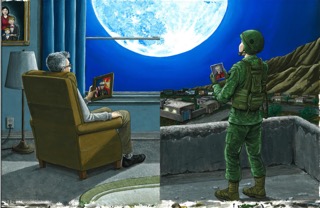
In Daddy Can You See the Moon? (Spork, 2019) a well-written and beautifully illustrated picture book, author, Gayle Krause, sensitively portrays one of war’s harsh realities: a soldier’s devastating injury. 

Krause's rhymes and Carlos de la Garza's illustrations, demonstrate three constants in the story: the moon, love, and courage. Before he leaves to serve, the father says: 


Though I'll be gone 
I have a way 
For us to share 
Part of each day.
At bedtime,  
Look up at the moon 
And I will too. 
I'll be home soon. 


While his father is away, the little boy counts the days and six full moons pass. Until the day his mother hears alarming news:


She sets down her coffee mug and wraps me in a giant hug.
I wipe her tears, and ask, "What's wrong?"
She answers "Son, you must be strong."
Daddy stepped on unsafe ground. His legs were hurt when he was found.


That night the boy looks out his window and fearfully wonders, 
“Daddy...can you see the moon 
Marching in a dream platoon?”
You're marking time at Soldier's Gate 
But I hope that you can wait. 
cause Baby, Ricky, Mom and me, 
We need you in our family.
His father comes home and the little boy helps his father rehabilitate. Courage—is shown, not told--through the text and illustrations. 


Reminiscent of one of my favorite picture books, I’ll Love you Forever, the book goes full circle ending with the boy having grown up and now a soldier looking at the moon. He holds his father’s picture while his father—back home—gazes at the moon too. 


See Kathleen Temean's blog for more information on Gayle's book journey. 

GIVEAWAY

To celebrate her book birthday tomorrow, April 9th, and in conjunction with the Month of the Military Child, Gayle is giving away an autographed copy of Daddy, Can You See the Moon? Leave me a comment by April 11 (with your email address if you are new to my blog) and I'll enter your name. If you have a family member in the military or plan to give this to a child whose parent is in the military, I'll enter your name twice. 


Monday, April 3, 2017

Wheels of Change: A Review, Autographed Giveaway, and Free Skype Visit!

If a picture is worth a thousand words, then a good title is worth at least as much.

WHEELS OF CHANGE (Creston Books, 2014), Darlene Beck Jacobson’s debut middle grade novel, is exactly what it purports to be: a novel about change. And of course, about wheels. 


The story, based loosely on Jacobson’s grandmother, shows 12-year-old Emily Soper in the middle of personal, family, and societal changes. Set in Washington, D.C. in 1908, WHEELS OF CHANGE is an ideal book for girls who loved the historical American Girl series and are now ready for meatier fare. 

Emily loves everything about her father’s carriage shop: the sounds, smells, and even the “pulsing waves of heat [which] make it feel like summer year round.” (p. 2). The following quote not only shows Emily’s affection, but foreshadows troubles to come:
I stare into the fire’s belly, watching it move and change colors as if it were a living thing. Some folks might think the forge is dark and dreary, with only one small window. But the fire is like a beacon that lights up the whole barn and makes it shimmer. Papa’s barn without the forge would be like Mama’s house without the kitchen. The heart would be gone. (p.2)


In truth, Emily wishes she could be a blacksmith—but of course, that’s not a fitting trade for a young woman in the beginning of the twentieth century.  As a result of her friendship with Henry, the Negro blacksmith who she enjoys watching, she learns first hand about racism and loyalty. 

Whereas impetuous and worry-wart Emily feels more at home in the forge than in her mother's kitchen, her mother has other plans for her. She wants Emily to learn domestic skills including how to host a tea for the neighborhood women. Emily surprises herself by enjoying baking, but the tea proves disastrous when Emily violently disagrees with one of the guests. Without spoiling the book, let's just say that Emily's courage saves the forge when a disgruntled employee, angry over Henry reclaiming his job, attempts to destroy it.   

After the tea, her teacher muses, 
".....Mr. Lincoln must be rolling over in his grave with grief to think that after all these years since the war, people still act this way. The war was supposed to change things." 
There's that word again. Change. Even after a horrible war, people still hold on to their old ideas about folks like Henry. The truth of it makes my insides churn and ache. 
Maybe folks can do without physical changes like cars and electricity. But old ideas about colored people and women should change. They must. (pp.153-4)
When her father's business starts failing because more people are buying motorcars, she suggests a new idea to her father:
"All this time, we liked everything to be just as it is. But some changes can bring really good things, Papa. Like colored folks living peacefully next to white folks and women getting to vote. What if you changed carriage making into something else?" 
"Like what?" 
"Maybe folks still need other things that horses pull. Wagons, carts, surreys, and coaches." My eyes open wider as more ideas pop into my head. "Baby buggies will never need motors. Sleighs and sleds for winter..." (p. 188-9)
And with that, Emily becomes an agent of change.


Honorable Mention, 2015

I am giving away my autographed hard cover copy of WHEELS OF CHANGE plus curriculum materials. Jacobson has volunteered to provide a SKYPE visit if the winner is an educator; if you prefer you can donate this visit to a school of your choice. If you are a media specialist, teacher, or home school parent, please let me know and I'll enter your name twice. If I don't have your email address make sure you leave it.  Giveaway ends on Saturday, April 8. 

Wednesday, May 18, 2011

The DeLaine Brothers

Although I am officially in the revision stage of Half-Truths, I am still gathering details from books, interviews, museums and other sources. Yesterday that mean attending a panel discussion at the Charlotte Tuesday Morning Breakfast Forum. Featured were Joseph and B.B. DeLaine, sons of Reverand Joseph DeLaine, who filed the historic lawsuit sixty years ago which led to the Supreme Court's landmark decision ending school desegregation in 1957.

B.B. DeLaine

Joseph A. DeLaine
As the brothers remembered their father and the 30's and 40's when they grew up in Clarendon, SC, several things stood out. I was impressed with their tremendous respect for their hard-working father.  Rev. DeLaine was a minister, farmer, school principal, and community leader. B.B. said, "Daddy was strong. He often told us that 'You are your brother's keeper. You have responsibility for those who are less fortunate.'"

In a county that was three-quarters black, and where the children often didn't go past the 6th grade because they were needed back home to work, schools were less than adequate:For more information, you can view a video of Joseph. B.B., and their sister Ophelia remembering their father's role in desegregation.  If you live near Charlotte, NC, visit The Levine Museum of the South to see the award winning exhibit COURAGE which tells this grassroots story through photographs, personal histories, and other artifacts.

As described in an editorial in yesterday's Charlotte Observer: "School was in old dilapidated buildings heated with pot-bellied stoves, with 75-80 students crammed into single classes with one teacher. Falling apart, hand-me-down school books bore the stamp 'colored only' so students knew their place in society. Getting to school required a walk of nine miles or more for many because the public school system refused to provide buses."

This was the system that Rev. DeLaine worked against in spite of the risks to his life and to his family's life. The brothers didn't realize it, but at the time armed black men guarded their home at night--extremely dangerous work.

B.B. said, "Our father was outspoken. He had nothing to lose." As a result of his courage and bravery many children eventually gained access to public transporation to the same schools which whites attended.

Joseph commented on how teenagers today don't know what it's like not to have to go into a restaurant through the back door. In a sense, this is a tribute to his father's legacy; segregation is now a part of our country's history.

But there are lessons about racial prejudice that we don't want to forget. This applies to many cultures and races. As B.B. said, "Like Jews, you have to know the past [in order] to know the future."


And I guess that is why I am writing Half-Truths. It is a part of Charlotte's not-so-long-ago past. A past that we all can stand to learn from.
****************


THE NIGHT WAR: A MG Historical Novel Review

  By now you should have received an email from my new website about my review of THE NIGHT WAR by Kimberly Brubaker Bradley. (It'll com...