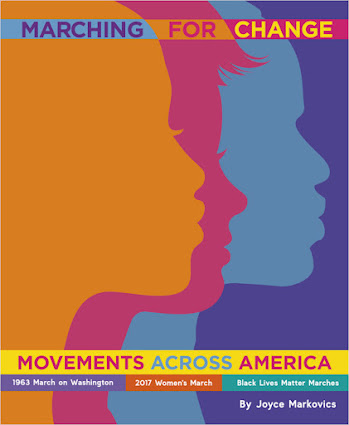
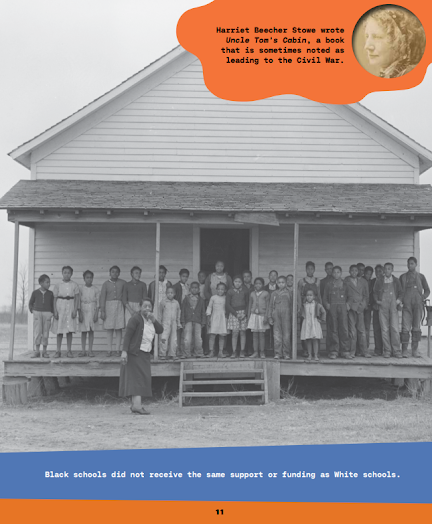
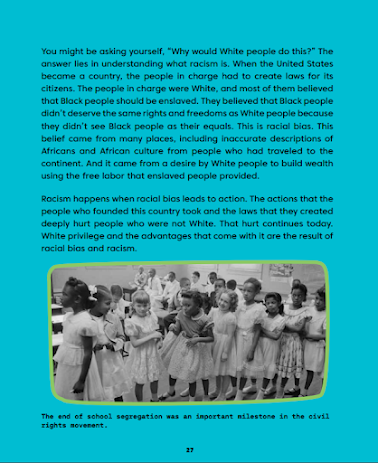
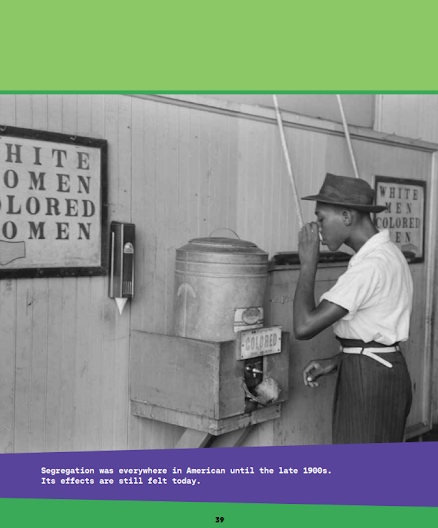
In honor of Black History Month, I'm introducing two books published by SPB Publishing. This publisher is a crossover of two Cherry Lake Publishing imprints: Sleeping Bear Press which specializes in fiction and nonfiction trade books, and the more academically-specialized Cherry Lake Press. Both books were published in 2021 but are still pertinent and will impact students for a long time. Since my personal interest leans towards history, I've selected a few pages from each book which highlight history. In both books, the text is complemented by thought-provoking questions and photographs which will promote discussion.
As the author, Joyce Markovics, states in the introduction, "This book describes three protest marches that shaped--and are still shaping the history of the United States. You'll read about the 1963 March on Washington, the 2017 Women's March, and finally the Black Lives matter marches that began in 2020....Keep Marching America!"
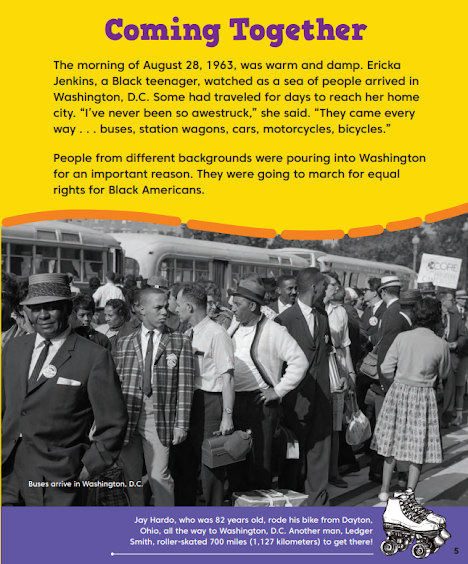
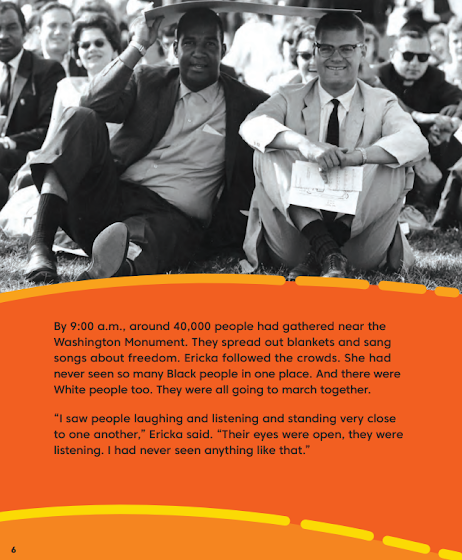
1963 March on Washington
What was this march all about?
It was about the biggest protest in US history--250,000 people--coming together to demand equal jobs and freedoms for Black people.
Rooted in enslaved Blacks being abused as slaves as well as the inequality of Jim Crow, the protest brought together people from all over the country with one purpose: to fight against racial injustice. The result of that protest and others was the passage of the Civil Rights Act of 1964 which helped thousands more Black Americans vote.
2017 Women's March
On January 21, 2017 women all over the country marched for women's rights in regard to immigration, healthcare, and racial equality.
But the women's movement started years before that.
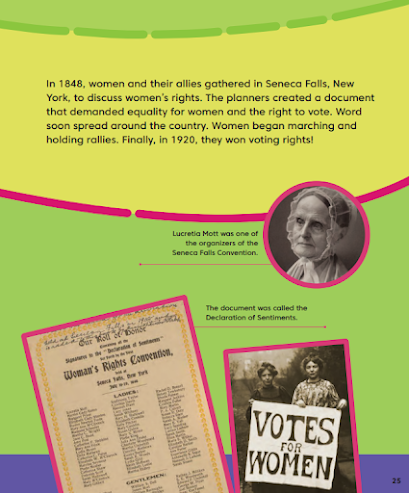
An early women's rights parade.
Women won the right to vote in 1920, but women continued to call for more active roles in society.
In 2017, 653 marches changed many women's attitudes and actions. The ramifications of those marches are still felt today.
2020 Black Lives Matter Marches
In 2020, the first BLM marches protested the death of an unarmed Black man, George Floyd. Marchers were looking for radical change after experiencing years of racism.
"Because of racism, Black men are viewed as more dangerous than other people. This can lead to false arrests and killings.
BLM was formed after Trayvan Martin's murder. It continues today to as a voice that says, "Black lives should be just as important as other lives."
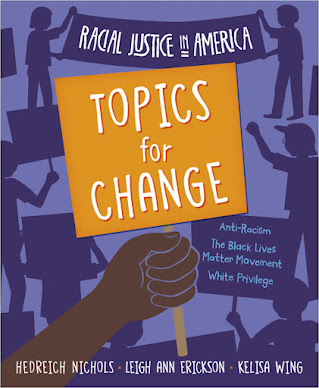
The introduction of this book, written by one of the authors, Kelisa Wing, states: "No one is born a racist. Racism is taught, and anything that is taught can be unlearned... We hope this book will create a safe entry point for you to start to have courageous conversations, give you a safe and brave space for learning, and allow you to see yourself as an agent of change." This theme is carried throughout the book through Ms. Wing's words and those of Hedreich Nichols and Leigh Ann Erickson.
What is Anti-Racism?
After the basics of racism are shown, the authors explore where the word "race" came from and how the concept of a "master race" was promoted in Nazi Germany. This exploration also includes how Native Americans were percieved and mistreated because of their skin color.
The authors point out racism in the past,
as well as in the present, and how students can fight against racism at home, in their schools, and in their community. This section ends with a quote from civil rights leader Fannie Lou Hamer, "Nobody's free until everybody's free."
What is White Privilege?
Using the image of a runner, the authors explain that the obstacles which are placed for a Black person's "race" are much different --and more difficult--than for a White runner. They go on to discuss how White boys are more likely to graduate from college and obtain a successful job than Black boys.
Where did White privilege come from? The authors look at the consequences of slavery, the KKK, and segregation.
The authors end this section with ideas about how students can take action. Going back to the running analogy, they point out, "...will you really feel good at the end of the race when you look back and see others fighting obstacles that you didn't even have? Instead of taking off down your path, what if you helped take away the obstacles in other runners' paths?"
What is the Black Lives Matter Movement?
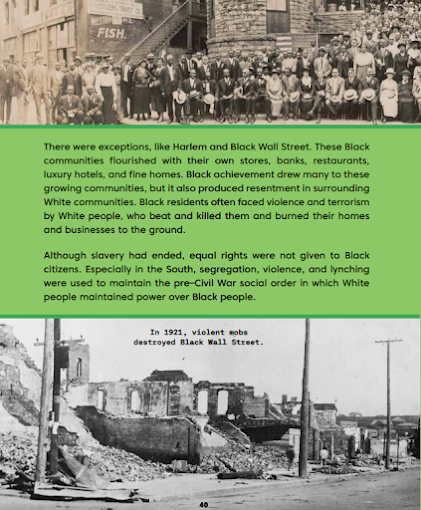
Many students are aware of BLM, but do they know the backstory behind it? The authors take readers back to enslavement and Jim Crow laws and segregation.
They show the results of mob violence,
discuss the formation of activist groups like the NAACP, and highlight important aspects of civil rights history.
This section ends with the impact of BLM today and how students can support the movement.
Both of these books will be useful in promoting classroom discussions.
I will be sharing this book on Greg Pattridge's wonderful middle grade book blog on Monday. You can find LOTS more books there!
GIVEAWAY
Leave me your name and email address (if you are new to my blog) in the comments along with your book preference. U.S. addresses only. Giveaway ends Tuesday, February 22 at 8 PM. Congratulations to Sue Heavenrich who won I Escaped North Korea.
True confession. I am not a football fan. I don't know one play from another and when dragged to a high school game by my husband, will patiently wait until half-time and then beg to leave. (Let's hear it for the marching band!) But after listening to BACKFIELD BOYS(August, 2017 Farrar, Straus, and Giroux) by sports journalist John Feinstein, next time I watch a game I'll pay a little more attention to what is actually happening on the field. Yep. This young adult book for boys (although female football fans will also enjoy it) is that good.
A short prologue sets the stage for the book when a member of a defeated touch football team says to Jason and Tom: "You two should make history. How many great quarterback receiver combinations have the black guy throwing to the white guy?" From that opening premise, John Feinstein spins out the adventure of best friends Jason Roddin and Tom Jefferson--two New York freshman who rock the world of an elite sports-focused boarding school--and the nation.
Written in an omniscient point of view, the reader is primarily privy to Tom and Jason's thoughts as they navigate the practice fields of the prep school. Tom, an African American, is the "Bullseye" quarterback. Jason is nicknamed "White Lightening" because he's a fast wide receiver. When they get to school and attend their first practice, they're surprised when their positions are switched. They protest, but to no avail. Soon, they and their two buddies--Billy Bob a white boy from Alabama; and Anthony, a huge black lineman who loves to eat--suspect that there's some heavy duty racism going on behind the scenes. Despite plenty of realistic obstacles, the boys figure out what's going on at the school, who is behind the racial discrimination, and how the coaches are covering up the story. In the course of the book the four boys make friends with the Hispanic student athletes (who fill them in on some of the political realities of the school) and four female athletes (conveniently, two are black, and two are white). The truth of how deeply racism runs in the fictional Virginia prep school is revealed at the school dance when the inter-racial couples are told to stop dancing with one another.
Although some readers may find the ending predictable, I couldn't stop listening to it. Published in 2017, this contemporary book might startle readers from ages 12-18: the roots of racism still dig deep into our American consciousness.
I appreciated narrator Mike Chamberlain's clear reading of Backfield Boys but I felt like his portrayal of Billy Bob--the tall southern boy with a deep drawl, was the most accurate. Although the hispanic secondary characters sounded authentic, I think Anthony, the southern black boy, was not as effectively portrayed. Click here for an audio snippet.
Even if you're not a football fan, you'll still enjoy this book and want to pass it along to the young male (or female!) reader in your life. Leave me a comment and I'll enter your name. Share on social media or follow my blog, and I'll enter your name twice. PLEASE make sure to leave your email address if you are new to my blog. Winner will be drawn on March 2.
Congratulations to Joan Edwards who won RESTART from last week's giveaway.
Thanks to almost five hundred people who read my second blog in this mini-series of posts about my WIP. That's a new record for a blog post about Half-Truths! In this post, Julian Daventry (the ring leader for these posts) challenged me and my fellow bloggers with ten more thought-provoking questions. Click here for Part I in this series, and Part II.
1. Name a unique aspect of your story world.
Both neighborhoods, Myers Park where Kate Dinsmore lives with her grandparents, and Cherry, an African American neighborhood where Lillian Harris lives three miles away, still exist. Several years ago I met a gentleman who grew up in Myers Park. Although his grandparents’ home is now subdivided into condominiums, we walked through parts of it. I have used it as a model for the Dinsmore home--including the gardens and the barn out back that once stabled horses.
George Snyder pointing out the "LS" (his grandfather's initials)
carved into the shutters on his grandparents' home.
One of my other experts was an elderly gentleman who grew up in Cherry. One day he drove me around the neighborhood and showed me his church and the home he grew up in.
Price Davis outside his childhood home in Cherry.
2.Talk about one of the important animals in the story (someone's pet or horse; or a fierce animal the MC must defeat).
When Kate leaves eastern, NC to live with her wealthy grandparents, she brings along her goat, Eileen. In a lot of ways Eileen represents Kate’s past that she doesn’t want to let go of. But, Eileen is stubborn and rambunctious and in some ways she represents Kate’s future too. (I’m not going to explain that. You’ll have to read the book to find out more!)
This is research.
3.A paragraph describing something in your storyworld (building, landmark, etc.).
Occasionally, Kate writes poems. In this scene Kate is walking back to her grandmother’s house after secretly meeting Lillian in Cherry. (Crossroads is the fictional town where Kate grew up.)
In Crossroads, nights were soft blankets
stars, my friends.
In the city, harsh street lamps glare,
Giant shadows loom behind every tree.
Footsteps echo.
Is someone following me?
Run across Kings Road.
Safe in Myers Park now.
Breathe.
Goosebumps prick my skin.
Monster mansions line the road.
Quiet. Solemn.
They don’t care about a country gal
rushing past.
I belong here,
right?
Not in Cherry.
Where Negros live.
4.Something dangerous in your story world.
This is part of a scene when Kate and Lillian go downtown together.
Over the lunch counter the WHITES ONLY sign accuses me. I stare at the chalkboard menu next to the large mirror. Will the waitress serve Lillian? She should! Lillian’s sand-colored skin is almost as white as mine! Now I understand why she’s wearing a suit. With less of her skin showing, she’ll blend in better.
The waitress takes our order without giving either of us a second glance. I spin my stool, trying to relax. The police officer who had shoved past us when we were standing outside Liggett’s swaggers past the colored kids. He stops, twirls his nightstick, and says something I can’t hear. Whatever he says, the kids nod their heads obediently. But when he turns his back, a boy sticks his tongue out. The kids hold their hands up to their mouths as if holding in laughter.
I twirl back and look at our reflection in the mirror. Lillian is sipping her Coca Cola like she’s savoring every ounce. “Don’t look now, but that fat policeman we saw outside just walked in,” I whisper. “Pretend like you’re minding your own business. Maybe he won’t see us.”
“I AM minding my own business,” Lillian hisses back.
“Hey there, Officer Duckworth,” the waitress calls. “Want your usual?”
“Yes, Susie. Two hot dogs all the way!” he looks up and down the counter. “You’re mighty crowded here today. There ain’t a place for a hard-working officer of the law to rest his aching feet.”
“It’s the special,” Susie jots down his order on her pad. “Brings everyone in off the street.” She jerks her finger towards the colored kids and wrinkles her nose. “‘Specially them.”
“They shouldn’t give you no trouble,” Officer Duckworth says. “If they do, you just let me and my partner here handle it.” He taps his nightstick that’s hanging from his hip.
Officer Duckworth strolls along the row of stools, greeting some of the customers, and patting a few on the back. He’s heading right for us! What are we going to do if he figures out Lillian is colored? We’ll be arrested and dragged off to jail! I can’t believe Lillian’s put us in such danger. When Grandmother finds out what we’ve done, I’ll never be allowed out of the house again.
Lillian’s eyes meet mine in the mirror. Outside of a vein pulsing in her neck, her face is as calm as the fish pond behind Pop’s house. She pats my hand. “My Daddy always says, ‘Nothing ventured, nothing gained!’”
I grit my teeth. More than anything I want to be mad at her, but I can’t.
Her passing was my idea.
5.Something delightful in your story world. Remember the marble in Post II? Kate's grandfather gives one to her one to and Lillian. Uncomfortable with receiving a gift from her white employer, Lillian tries to give it back:
“Nonsense! I have more than I can ever play with.” He laughs and shakes his head. “Besides, who’s going to tell me that an old man can’t give trinkets to two pretty young women?”
He slides the marble drawer closed. “It’ll be our secret,” he says. Then he sits down and picks up his paper. I toss my marble from one hand to another. Do I want to share a secret with Lillian?
Thunder rattles the window. Suddenly, the library door slams open. As if string ties our hands together, Lillian and I pocket our marbles at the same time.
6.A movie soundtrack that would complement the setting.
I have no idea. But here's a song Kate likes to dance to:
More Research
7.How does the geography impact the story?
The physical landscape doesn’t play much of a part, but this is a uniquely southern story. I recently explained the premise to an older friend in Grand Rapids, MI. Her response made me realize that the politics and history of the South—although studied in other parts of the country—may shock readers who have not lived in the South. 8.Is there a particular location or time period your story you had in mind when creating your story world? North Carolina, 1952. As a result, I've read about the Korean War, McCarthyism, tobacco farms, fashion, cars, architecture...you name it. See my Pinterest boards for pictures! 9.What is the climate like, and does it play a role in the story? It's hot and humid in the summers, but that doesn't play a huge role. I've realized that I probably have included too many storms though... 10.Are there any traditions, and do they have an effect upon the plot? I can't think of any!
********
I hope you'll check out my fellow bloggers answers and see how they answered these questions.
If a picture is worth a thousand words, then a good title is worth at least as much.
WHEELS OF CHANGE (Creston Books, 2014), Darlene Beck Jacobson’s debut middle grade novel, is exactly what it purports to be: a novel about change. And of course, about wheels.
The story, based loosely on Jacobson’s grandmother, shows 12-year-old Emily Soper in the middle of personal, family, and societal changes. Set in Washington, D.C. in 1908, WHEELS OF CHANGE is an ideal book for girls who loved the historical American Girl series and are now ready for meatier fare.
Emily loves everything about her father’s carriage shop: the sounds, smells, and even the “pulsing waves of heat [which] make it feel like summer year round.” (p. 2). The following quote not only shows Emily’s affection, but foreshadows troubles to come:
I stare into the fire’s belly, watching it move and change colors as if it were a living thing. Some folks might think the forge is dark and dreary, with only one small window. But the fire is like a beacon that lights up the whole barn and makes it shimmer. Papa’s barn without the forge would be like Mama’s house without the kitchen. The heart would be gone. (p.2)
In truth, Emily wishes she could be a blacksmith—but of course, that’s not a fitting trade for a young woman in the beginning of the twentieth century. As a result of her friendship with Henry, the Negro blacksmith who she enjoys watching, she learns first hand about racism and loyalty. Whereas impetuous and worry-wart Emily feels more at home in the forge than in her mother's kitchen, her mother has other plans for her. She wants Emily to learn domestic skills including how to host a tea for the neighborhood women. Emily surprises herself by enjoying baking, but the tea proves disastrous when Emily violently disagrees with one of the guests. Without spoiling the book, let's just say that Emily's courage saves the forge when a disgruntled employee, angry over Henry reclaiming his job, attempts to destroy it. After the tea, her teacher muses,
".....Mr. Lincoln must be rolling over in his grave with grief to think that after all these years since the war, people still act this way. The war was supposed to change things."
There's that word again. Change. Even after a horrible war, people still hold on to their old ideas about folks like Henry. The truth of it makes my insides churn and ache.
Maybe folks can do without physical changes like cars and electricity. But old ideas about colored people and women should change. They must. (pp.153-4).
When her father's business starts failing because more people are buying motorcars, she suggests a new idea to her father:
"All this time, we liked everything to be just as it is. But some changes can bring really good things, Papa. Like colored folks living peacefully next to white folks and women getting to vote. What if you changed carriage making into something else?"
"Like what?"
"Maybe folks still need other things that horses pull. Wagons, carts, surreys, and coaches." My eyes open wider as more ideas pop into my head. "Baby buggies will never need motors. Sleighs and sleds for winter..." (p. 188-9)
I am giving away my autographed hard cover copy of WHEELS OF CHANGE plus curriculum materials. Jacobson has volunteered to provide a SKYPE visit if the winner is an educator; if you prefer you can donate this visit to a school of your choice. If you are a media specialist, teacher, or home school parent, please let me know and I'll enter your name twice. If I don't have your email address make sure you leave it. Giveaway ends on Saturday, April 8.
As promised, today you're going to meet four women I have interviewed in the process of writing Half-Truths. I hope you'll enjoy a glimpse at their lives--"back in the day"-- and a few of their insights which have contributed to my book.
In 1962, Thereasea was one of the first black public health nurses to
integrate the white nursing community in Charlotte.
Thereasea as an Army Cadet
in WWII
At JCU's exhibit honoring the African Americans who integrated the medical profession in Charlotte. June, 2014
Thereasea has given me hours of her time answering innumerable questions about her community growing up, what it was like going into a KKK community as a black nurse, and the challenges which Lillie and Kate (my characters in Half-Truths) could conceivably face. One day when we were talking about race she said, "None of us were the same color. 'If you’re
black get back, if you're brown stick around, if you’re light and bright you’re
damn near white.' This wasn't said in our home, but it was said the streets. Even though everyone was brown and knew in general what that meant – that white
blood was there—the specifics wouldn’t have been shared."
Vermelle Diamond Ely
Vermelle Diamond as Miss Queen City Classic
1948
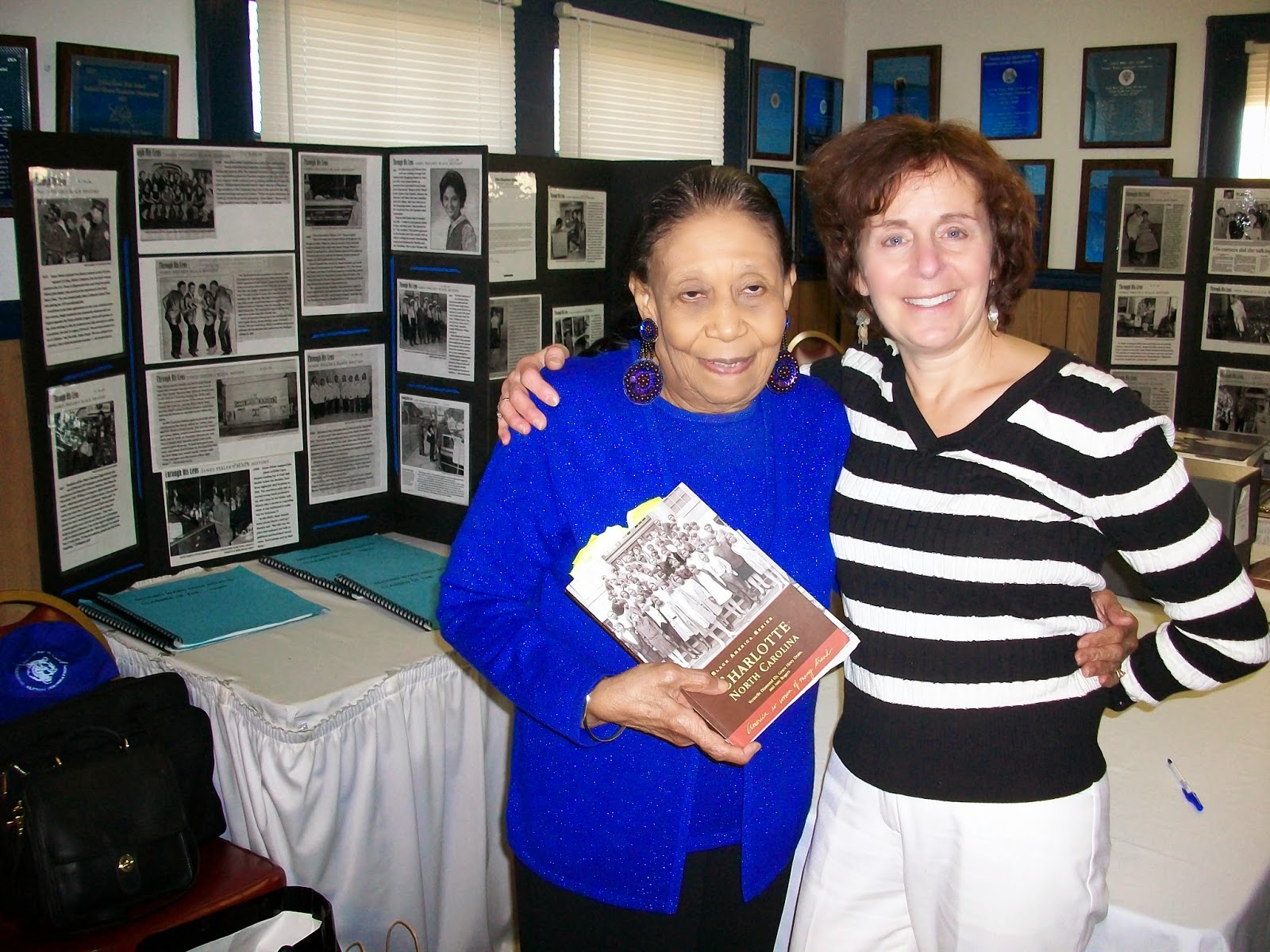
Vermelle and I at the Second Ward High School
Alumni House, 2010
Although she has been legally blind for all her life, Vermelle is co-author of the book, Charlotte, NC which is part of the Black America Series. When we talked about passing she told me, "Black girls who passed did it for their convenience. To get their hair done, go to the front of the line, get waited on, or go to eat in a certain restaurant. Their parents wouldn't have encouraged them." Speaking of my characters she said, "Lillie and Kate might have tried to see if Lillie could pass--just for fun and to see if she could get away from it." And for the record, "Lillie could have gone wherever she wanted with Kate because she was so light she could pass. Kate would have stuck out in the black community-but she would have been accepted there."
Daisy Stroud
Daisy and Gerson Stroud wedding
Circa 1948
Outside their home Circa late 1950's-mid 1960's
Daisy Stroud
December 2010
Daisy talked about the Cherry neighborhood (where Lillie lives): "There was a lot of pride there. They were the strivers who made sure their children had the opportunity to go to college." She remembered Bishop Daddy Grace: "He had beautiful light-skinned girls fanning him when he sat on his throne. It was an honor to be one of his girls; they were attractive and had good hair. They looked more like they were a different race." Similarly, "Young women who represented Second Ward High School were light-skinned….They were the privileged ones…We accepted in our race that some were like this. Then we would try to be like them because their beauty brought them privileges."
Dorothy Counts-Scoggins
In 1957, Dorothy Counts was one of the first black
students admitted to Harding High School in Charlotte.
She was met with jeers
and harassment. Her parents withdrew her after four days.
Photo taken at Johnson C. Smith University where Dorothy grew up. June 2014
"I wanted to make sure that what happened to me at age 15 growing up in this community wouldn't happen to someone else." Dorothy has spent her life advocating for better education for all children passing along her father's legacy. "We knew separation was wrong but my parents taught me acceptance and tolerance. My father, a professor at Johnson C. Smith and a minister, wasn't able to do anything about the separation. But when Kelly Alexander, Sr. asked him if he would be willing to test the new civil rights legislation, (Brown v. Board of Education in 1954 outlawing segregation in schools), our family agreed."
***********
I am indebted to these women--and the other experts who have shared their life stories with me. My work is a richer tapestry as a result of their honesty and forthrightness.