Showing posts with label book for middle grade girls and boys. Show all posts

Friday, April 26, 2024

SHE'S STILL HERE: A Book Review by Guest Blogger, Josie Murdock

REVIEW OF SHE'S STILL HERE by Caitlin Alexander


Twenty years ago, Ravendale Middle school caught fire and Jane Wright was lost forever. No one ever found out how the fire was started, leaving Jane’s ghost to wonder about the mystery of her death. Was it really an accident? Would she ever find the person who started it so she could finally be at peace and cease haunting the school grounds?


Middle-schooler, Kate Sablousky, moves to the town of Ravendale and discovers she has inherited her Jewish grandmother’s ability to see ghosts when she makes friends with a strange girl at school who no one else can see. Can Kate help her new ghostly friend find the answer to the mystery behind her death? 


I felt heartbroken, and I’d only just met Jane.

Well, would I even call it that? 

We couldn’t have met because she couldn’t be real. My stomach churned, picturing her poor mother and father with no real answers about what led to their daughter’s death. 

I’d never believed in the concept of closure. I probably didn’t have real “closure” from the fact my dad left Mom and me, but I’d learned to find peace with it. I doubted the Wrights had been able to find that peace. (p.46)


I enjoyed the fast-paced writing style and description of details. Even though the story carries with it some very heavy and sad themes, I liked that it had a satisfying conclusion that brings the plot all together. In horror stories, the main characters seem to always get themselves into terrible situations because of their own stupidity; but Kate was aware of danger which was refreshing to have a clever character who had a sense of self-preservation. 


As a Christian, I personally don’t enjoy stories where they fantasize the afterlife or use it as a concept for world building. Since the story was set in our world, that made the extra afterlife process feel strange to me. 


At one point in the story Jane tells Kate:


… “maybe you could help me. I’m stuck here. I can’t… pass on.”

… “And yes, I need your help,” Jane continued. A moment of silence made her plea all the more terrifying before she resumed. 

“I don’t know why I died.” (p.52) 


In the story Jane cannot rest in peace until she has solved the mystery behind her death, which  was also symbolic of the way grief can hold you hostage and unable to move forward. Even though I personally don’t like afterlife concept stories, it gave me a good opportunity to talk with my family about worldviews in stories, and how to view ghosts stories and hauntings.


Life’s not just the here and now. 

Tears welled in my eyes. I’d misunderstood Bubbe’s saying all this time. She was trying to prepare me. In case I was like her. In case I ever saw people like Jane. (p. 47)


RECOMMENDATION


I recommend this middle-grade book by Caitlin Alexander for anyone who loves a quick-read book series and enjoys scary mysteries. 


On the Monarch site, they have book ratings which is super helpful for knowing what exactly is in a book, I recommend checking it out as it would be informative and help you decide if the book is for you. 


Who knows? Maybe Jane will capture your interest and you can solve the mystery along with Kate and her ghostly friend. 


I returned Jane’s smile. She didn’t strike me as much of a rulebreaker, but she knew the school better than I did. I wanted to know more about her. (p.33)


Josie Murdock is 12 years old and lives with her family on a research farm in South Carolina.  She is homeschooled and loves reading, drawing, and foxes. Her last book review was here


Congratulations to Rebecca Wheeler who won THOMAS JEFFERSON'S BATTLE FOR SCIENCE.


Saturday, January 13, 2024

THE BLACKBIRD GIRLS by Anne Blankman: A MG Review and Giveaway

 We all have them. Books that stick in our heads after we've read the last page. Maybe it's the characters, the world-building, the settings, or the amazing way the author weaves together the plot. For me, it's all of those plus a story that touches my heart. This, my friends, is my latest favorite read:


Published in 2020 by Penguin Random House, it was off my radar. I've enjoyed Anne's books before so when I thought about connecting with other historical fiction novelists, I looked her up. In 2014 I wanted to give five stars to her debut novel, Prisoner of Night and Fog , and feel the same way about The Blackbird Girls (this link goes to a great interview with Anne). By the way, Conspiracy of Blood and Smoke (Harper Collins, 2015) was also excellent even though I didn't review it on my blog.

REVIEW

Like another historical fiction novel that I admire, REFUGEE by Alan Gratz, The Blackbird Girls has three viewpoints and several different timelines. Anne and Alan both deftly weave together story elements so that the reader is left with the sense of, "Wow--I didn't see that coming!"

The Blackbird Girls opens with the Chernobyl disaster in 1986 in Ukraine. Each of the two main protagonists, Valentina and Oksana,  have fathers who work at the nuclear power plant. Valentina is Jewish and is the victim of much anti-semitism, including taunting from her schoolmate, Oksana. Valentina's family is very afraid of expressing themselves as Jews due to government persecution and don't practice their religion. Oksana's head is full of anti-semitic propaganda she has heard from her father. As the story progresses the reader discovers that her father has poisoned her in other ways too. 

The two families live in the same apartment building but don't have much to do with each other. Although early on it is evident that the girls are enemies and the reader guesses that they will become friends (the beautiful cover shows that), it is not an easy path. Both girls are victims of prejudice and abuse and both have huge walls of distrust towards the other. 

Both of their fathers fall victim to radioactive poisoning after the meltdown in the plant, and their mothers have to quickly figure out how to help their daughters get away from the city. Valentina's mother has an escape route planned for Valentina and when Oksana's mother abandons her, she takes Oksana with them to Leningrad. She wires the only one who she thinks can offer them refuge--her mother who she hasn't seen for years.

Meanwhile, readers meet a third girl, Rifka, who lives in the Soviet Union in 1941. Her story unfolds at the same time as Valentina's and Oksana's. Rifka's mother makes her leave home to protect her from the invading Germans. She battles freezing temperatures and nearly dies before she finds shelter with a family who takes her in.

At this point in reading the book, I thought I understood the connection between the stories: two mothers who made difficult choices for their daughters' survival. 

But I was wrong. Anne Blankman indicates in the acknowledgments that the novel is based on a friend's true story about Chernobyl. She wrote to me about the true elements in the book:

When I was in ninth grade, I met a new classmate who has since become a lifelong friend. Victoria had recently emigrated from Ukraine to my small hometown in upstate New York, and as we became closer, she confided in me that she had survived Chernobyl, the massive nuclear disaster in the Soviet Union in 1986. To keep her safe, her parents made the heartbreaking decision to send their then-six-year-old daughter hundreds of miles away to live with distant relatives in Uzbekistan. 

The reason Victoria had family living so far away? Forty-five years earlier, her hosts had fled from the invading German army with scores of other Ukrainian Jews. They had ended up in Uzbekistan. These two journeys--one to run from enemy soldiers, the other to escape nuclear fallout--haunted me, and they became the inspiration for The Blackbird Girls. But I was afraid the multiple perspectives and separate timelines would prove too complicated and cumbersome for my readers, and I wrote the first draft from only Valentina's point of view. My editor encouraged me to explore Oksana and Rifka's perspectives and to flesh out the 1941 storyline. 

One of my favorite parts of the book is when the girls break through and become friends. They are attending their new school in Leningrad and on the first day, a boy teases Valentina for being Jewish and tells her to go back to Jerusalem and that no one wants her there.

In a surprise move, Oksana intervenes:

     Oksana stood up. "Nobody wants you here. Why don't you shut your mouth?"

     The boy's eyes narrowed. "What did you say to me?"

     A hush fell over the schoolyard. Children stopped playing to stare at Oksana.

     "You heard me." Oksana fisted her hands on her hips. "Leave Valentina alone."

      Valentina couldn't believe her ears. She stayed crouched on the ground, unable to move.

      "I know who you are," the boy said. "You're one of the Chernobylites. My father says you're all contaminated and you'll turn into rabid dogs."

      Oksana shoved her face into the boy's. "He's right. I think I'll take a bite out of you." She clicked her jaws, and the boy jumped back. She shouted, "You'd better run away! Next time I might bite your face!"

.....

      Oksana's face was red. She put her hands to her cheeks. "I can't believe I did that," she whispered.

       Valentina couldn't believe it, either. This couldn't be the same girl who had mocked her at their old school. 

.....

       Slowly, Valentina took the hand Oksana offered. She stood up. She knew she let go of Oksana's hand, but for some reason she didn't.... and while they played big bear's den they held hands the whole time, even though they weren't supposed to. (p. 144-5)
                           
                                             *****

This book is about events that happened forty and eighty years ago--but are as timely today with today's conflicts in Israel and Ukraine. I highly recommend it for use in middle-school classrooms and homeschool curriculums.

GIVEAWAY

Penguin Random House is offering to provide a copy of this book to one fortunate reader. Leave me a comment by January 17 and I'll enter your name. If you share this on social media or are a librarian or educator, I'll enter your name twice. Make sure you leave me your email address in the comment if you are new to my blog. U. S. addresses only. 

Join me and other bloggers on Greg Pattridge's MMGM site on Monday. 


Congratulations:

Kim Aker, a school librarian in Bland, Va won I'M TRYING TO LOVE GERMS.

Who said Middle-Grade books were only for kids?


Uncle Bob's new favorite middle-grade book.
He lived through this history.


Thursday, December 7, 2023

THE DOUBLE CROSSING by Sylvia Patience: A Middle Grade Historical Fiction Review, Author Interview, & Giveaway

 Sylvia Patience, the author of The Double Crossing (Paper Angel Press, 2023), reached out to me with a request to review her historical middle-grade book. She suspected that it was a book that would interest me and she was right.


REVIEW


I first learned about the ocean liner, the St. Louis in Barbara Krasner's picture book, Liesl's Ocean Rescue. One of Alan Gratz's characters in Refugee was a boy on board the luxury ocean liner. This novel is a unique in-depth story of the ocean crossing told from alternating points of view of thirteen-year-olds, Hannah Coen and David Jantzen. Like the other books, it takes place in 1939 and the 937 passengers are escaping Nazi Germany in hopes of finding a safe haven in Cuba. 

Quickly the reader learns that Hannah's father was arrested during Kristallnacht and sent to a concentration camp. Her mother promises to join her as soon as possible but Hannah is distraught over leaving her. She meets David who is traveling with his family. David's father is Jewish and his mother is Aryan.  Although their backgrounds and personalities are different, Hannah and David bond over bird watching.  

Early in the book, there are hints of problems to come. David's father hears a rumor that there might be problems landing in Cuba. Leo, a friend who is a steward for the pro-Jewish Captain Schroeder, tells them that the Nazi propagandists have been trying to get Cubans to change their minds about admitting the Jews. Hannah worries about why they would get sent back; if Hitler is starting a war, and if she'll ever see her parents again.

Hannah and David overhear conversations among the Nazis on board. Specifically, they learn of Gestapo official Otto Schiendick's plan to gather secret documents from Robert Hoffman. Although both kids are nervous about what to do with the information, Hannah is determined to stop Schiendick from carrying out his plan--no matter how dangerous that is. It is at this point in the story, that their different perspectives become very interesting. Hannah concludes that they must do something; David thinks they have no options. The following is from Hannah's POV.

As we descended the stairway from the bridge deck, David whispered, "See? If even Captain Schroeder can't do anything, what can we do?"

"If the captain can't do anything we have to. Whatever he says. Even if we get in trouble. Because we know about it. And it's wrong. It could mean war!"

And from David's POV: 

Since our talk with the captain and my argument with Hannah, I'd been going around and around in my head. If you know something is wrong, do you have to try to stop it? Even if you don't have much of a chance? Even if it's dangerous? And even if the grown-ups in charge tell you not to?

Together, they face the disappointment of not landing in Cuba and the hardships on the return voyage. Although separated once they return to Europe, the ending suggests that are reunited. It's a sweet conclusion that leaves the reader wanting to know more.

                                                ****                                 

I enjoyed the role that birds played in the book. In the beginning, Hannah and David rescue an injured petrel. They hide him in a lifeboat whey they push small bits of food down his throat. When Leo asks what it was like to be Jewish in Germany she answers, "Kind of like what's happening to Peter," she said. "He's trapped and can't get out. He probably feels scared and helpless."  After the ship is prohibited from landing in Cuba David observes, "Like the birds flying over the ocean, rumors flew on board." 

Even if you have read other accounts of the St. Louis, you will find this touching, suspenseful story a worthwhile read. 


MINI-INTERVIEW

Carol: What was the inspiration for this story?

Sylvia: I first saw an article in a news publication that talked about the St. Louis' 1939 voyage. It caught my interest. I'd never heard about it. This was probably around eight years ago. I immediately thought it would make an interesting story to write, started doing research, and read some other books about it and the time period in Germany. The story grew in my mind.  

Carol: What was your path to publication?

Sylvia: As far as publication, as you probably know it's very difficult to find an agent these days, let alone a publisher. I sent out a lot of queries. I was very lucky to hear of Paper Angel Press, as they had published works of another local author. They are an independent publisher and have done an excellent job with the book, and my other book, The Weaver's Daughter

BACK MATTER


I appreciate how Sylvia pulled together so many facts when she wrote The Double Crossing. As soon as I finished it, I read her Author's Note and Glossary. The Author's Note provided all the factual information about the important secondary characters who were real people. I hope you'll take the time to look at the links I provided in this review; you'll see how Sylvia's impeccable research was woven into this fictional story. It almost goes without saying that this would be a great curriculum resource when studying WWII. 

GIVEAWAY 


I'm giving away my copy to one fortunate reader. Please leave a comment by December 13 along with your email address if you are new to my blog. I'll do my best to get it into the mail ASAP so you can give it to your favorite middle-grade reader or add it to your library's shelves. Share this on social media or sign up for my blog and you'll get an extra chance. As usual, if you are a teacher, home-school educator, or librarian, you'll get an extra chance. If you prefer, email me to enter. U.S. addresses only. 

                                                    ***

Congratulations to one of my teen bloggers, Janelle Epko, who won the Ebook of A Study in Terminal. 

Saturday, October 28, 2023

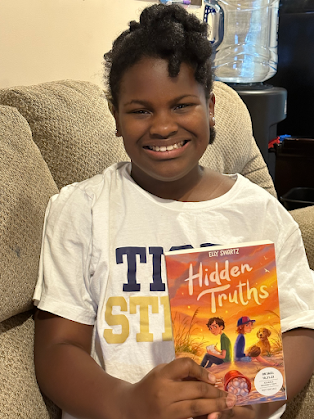
HIDDEN TRUTHS: A Middle Grade Book Review by Guest Blogger, Brooke White

I last featured Brooke White when I introduced her and her self-published book. Today she returns as one of my guest reviewers. Take it away, Brooke!


REVIEW


Have you ever felt guilty for something that you think is your fault? 


In the novel Hidden Truths by Elly Swartz (Delacorte Press, 2023), each chapter is told from Eric or Dani’s point of view. This book is mainly realistic fiction and a mix of adventure and tragedy. Relatable experiences that happen in most middle schools are shown in this book.


Best friends Eric and Dani go on a camping trip but then a fire starts and Eric does his best to save Dani. Eric partially succeeds, but medical professionals soon help Dani with her injuries. Once this event happens, Eric and Dani’s friendship becomes distant. The mayhem of the friendship breakup leads Eric to believe Dani’s injuries are his fault. Although he feels deep guilt, he keeps it to himself for a few months.

I believe this book is great for middle-grade readers because learning about how to cope with grief, friendship troubles, and how to make a large difference as shown in the novel are important lessons for middle-grade students to understand. After finishing this story, I realized how hard it can be in different situations, which allows me to view my peers in a more empathic way. I also believe that Dani is a great role model because she always perseveres and confesses when she does something wrong. Dani is also a leader because she did something no other girl had done for the sports team. Dani deals with harsh feelings but pulls through them. Dani is very responsible for her actions. 

Some people may think this book is too mature for younger readers, considering there are some injuries and the book shows some examples of Eric and Dani facing anxiety and pain.

This book is very well-rounded with a captivating beginning and satisfying ending. Hidden Truths is a story that will grasp readers' attention. Overall, I would recommend Hidden Truths by Elly Swartz for ages 8+ (or around that age so they can fully grasp the story and its meaning).  I love the characters’ reactions and traits shown in the bittersweet parts of the book.


Brooke White is a 10-year-old 5th grader and lives in Charlotte, North Carolina. She has written two books, “ Cupcake the Lying unicorn” and “Cookie Cat and the Tagalongs”. When Brooke isn’t reading or writing you’ll probably spot her sewing, scootering, swimming, or studying. This is Brooke’s first-ever book review! She has been dreaming about becoming a book reviewer ever since she could read!


GIVEAWAY

This book is creating a lot of buzz! If you'd like to win a copy, please leave a comment by October 31. If you're new to my blog, please leave your email address or email me here. Remember, I have to approve your post before you'll see it online. U.S. addresses only.


Friday, June 30, 2023

THE WALL: Growing Up Behind The Iron Curtain: A Graphic Novel Review


I found THE WALL (Farrar, Straus, and Giroux, 2007) by Peter Sís in my library under graphic novels and since it was historical, I thought I'd check it out. It's the size of a picture book (9 x 12) with about the same number of pages you'd find in a picture book. But, don't be mistaken. This book is NOT for little kids. It should be compulsory reading for middle- and high-school students; adults can learn from it too. 

Sís used maps, cartoon caricatures of Russian leaders, timelines, photographs of himself and his drawings, black and white panels with sprinkles of red, journal entries from his diary growing up, and a cartoon style to tell the story of his life behind the Iron Curtain. 


Each page tells a different part of his story in a different way. Sís saved full color for the joyous, exciting part of his life in 1968:

https://i0.wp.com/thispicturebooklife.com/wp-content/uploads/2014/02/Screen-Shot-2014-02-26-at-11.00.36-AM.png


But besides all of the amazing ways that Sís found to tell and illustrate this story, there's the story itself. Written in the third person, Sís shows what it was like growing up an artist (and teenage free thinker and music lover) in Prague under communist control. 

He writes of himself as a teenager, "He was painting dreams...and then nightmares. The dreams could be kept to himself, but the drawings could be used against him. He stopped drawing and was left with only his dreams. But he had to draw. Sharing the dreams gave him hope."

Not only is this thin book an amazing pictorial tutorial about life during the Cold War and how the fall of the Berlin Wall in 1989 led to the collapse of the Communist system, but it shows the pernicious effects of brainwashing--something I plan to tackle in NIGHTMARE IN NUREMBERG.

By the way, the wall came down only a little over thirty years ago. Hard to believe, isn't it?

For more great middle-grade book reviews, make sure you stop by Greg Pattridge's ALWAYS IN THE MIDDLE blog.


Saturday, December 31, 2022

TAKE BACK THE BLOCK: A MIDDLE GRADE REVIEW AND GIVEAWAY

 I always enjoy supporting my fellow SCBWI-Carolinas writers, particularly those who live in Charlotte. Today I'm bringing you Chrystal D. Giles' debut novel, TAKE BACK THE BLOCK (2021: Random House Books for Young Readers).

REVIEW

I spent the morning of my eleventh birthday carrying a sign that read WE WERE HERE FIRST.

How do you like that for a dynamic opening line? How could any middle-grade reader not want to know more about this protagonist?

In the first chapter, readers find out what Wes wants: not to be a part of his mother's protest against the destruction of apartment complexes which are scheduled to be replaced by new condos.  

But they will also see his love for his neighborhood. After the protest, he and his mother return home. Entering Kensington Oaks is like being hugged by a grove of lake trees and sunshine. (p. 6) Bravo to the author for immediately setting up Wes's conflicts. 

The young protagonist's voice is also clearly heard. Here's a description of his former friend, Kari, whose family had to move out of the neighborhood after his parents split up.

Just last year, he rocked four different hairstyles. Bald fade, low fade, baby Afro, then twists. This year he started growing locs. They were short, frizzy, and uneven--kinda like him...

I peeked at the strings hanging from his shorts. I wouldn't be caught dead in that outfit. (p.23)

Giles uses this simple physical description of Kari to show more than what he looks like--we also have a glimpse of his character and Wes's too.

After meeting Wes's friends and his new middle school,  the plot begins to unfold. Wes's mother gets a notice that a development company wants to buy Kensington Oaks and redevelop it. Suddenly, his mother's concerns are now his. 

Flashes of all my favorite memories popped into my mind--a highlight reel of my life. How could I leave all that? (p.51)

As Wes tries to figure out how the redevelopment will affect him and his friends (wouldn't it be cool to be able to walk to a place that sells organic smoothies?), he reads an article in the local paper that his Social Studies teacher wrote entitled, 'Is Gentrification the New Segregation?' With his teacher's help, he organizes a team of kids to join the fight and save his neighborhood. But there's a problem: not all of his friends' families want to resist the development. They'd rather take the money that is being offered so they can move into a bigger house.

Wes also needs to find a topic that matters to him for his social studies project. After ditching researching climate change, he finally realizes that the topic that matters to him the most is gentrification. He tackles it with gusto and ends up being a community organizer--just like his mom but--a much flyer version. 

I don't want to give away the ending, but it's enough to say that Wes's determination pays off in a way that even he wouldn't have imagined. 

I hope that readers will come away from reading this contemporary middle-grade book for boys and girls with the hope that their voices and efforts can matter. 

Chrystal Giles writes in her Author's Note that although this book is loosely based on her hometown of Charlotte, North Carolina, her first up-close view of gentrification was during a walking tour of Harlem. She realized that change was sweeping away a great amount of Black culture and history. Although she thought that was only a big-city problem, when she came home she saw it was happening in Charlotte too. "Historic neighborhoods, parks, and restaurants would be there one month and gone the next. Beyond the places, what happened to the children and families? I wondered. That question plagued me for years and eventually became the motivation for Take Back the Block."

Chrystal's next book is coming out soon! I look forward to reading and reviewing Not an Easy Win.

GIVEAWAY

I have an autographed copy that I am giving away. Please leave me a comment by January 4 along with your name and email address if you are new to my blog. If you are a teacher or librarian, please tell me and I'll put your name in twice.


Saturday, October 8, 2022

MOONWALKING: A Middle-Grade Review

There is a lot to like about Moonwalking (MacMillan, 2022) co-authored by Zetta Elliott and Lyn Miller-Lachmann. This middle-grade verse novel set in New York City in 1980, alternates between the POV of the two protagonists. Pie Velez is a math whiz and graffiti artist, and his most unlikely friend, JJ Pankowski, is a punk rock fan and one of the few white kids at their school. 


When I read books that I plan to review I record some of my favorite passages. Here are a few that I noted.

From Pie's second poem, "Bomb."

.... I never knew mist

wrapped in metal could be

light as air and dark as night

or brighter than a neon sign

I shake the can and

the seed of a rainbow clatters

inside before blooming in my palm

and climbing across the wall

                             ...... 

tags spread like wildfire

we write in code on concrete

words most folks can't read

signs that wow

warn

and won't be ignored

WE ARE HERE  (p.8)

From one of JJ's poems entitled, "Three Chords." In this scene when the reader is just getting to know JJ, he's learning how to play his uncle's guitar.

Joe Strummer said  

you don't need talent 

you don't need skill 

       all you need is a loud voice

        an electric guitar

        three chords

        and a story. (p. 15)

Clearly, both boys yearn to express themselves. 

JJ finds refuge in a school that is so crowded no one notices him. This is an excerpt from the poem, "Invisible Me."

They're a team

I won't go out for.

A party for which I don't beg

an invitation.

A universe

I dare not disturb. (p. 25)

Pie struggles with his mother's mental illness, being bullied by neighborhood kids who call her loco, and his dreams of being an artist. JJ's father lost his job and they have to cram into his grandmother's apartment; he doesn't fit in at school and he misses his sister who moved out. 

Slowly, the boys get to know one another and learn to appreciate each other's art. JJ gapes at "Pie murals on subway cars and buildings." Pie invites him to eat lunch in the quiet art room. JJ makes him a mixtape and the boys bond. But when JJ joins him to tag some buildings, the police show up and their encounter becomes a test of their friendship.  

This poem excerpt is from"Tag--I'm It" From JJ's POV:

all I could think about was how    through it all JJ   said nothing

did nothing    just kept his head down      to keep himself safe

Andres was right    no mixtape's gonna change    the system

'cause when it comes to      playing tag with cops

they only ever    try to catch

                    someone like me. (p. 146)

The ending is not your typical "two-different-kids-become-friends" and live happily ever after. But, it satisfactorily concludes the book. I loved the imagery in the poems and the way each character was deeply shown and how the boys helped each other through difficult times.

The main thing that I didn't like was how JJ discovers that his sister is a lesbian and that is why she left home. I thought that was a peripheral subplot that didn't add to the boys' friendship story.  Christian parents, grandparents, and teachers should be aware that this subject material is included in the novel. 

I wrote an email to Lyn Miller-Lachman stating my concerns and she responded: "Thank you for your note and your thoughts. I’m glad you appreciated the poetry and the story of MOONWALKING....The reason for including that thread is to show JJ’s growing realization that the world is more complex than he had believed—one more for his list of 'things that make no sense.' However, this crisis also shows him that he has choices, and he chooses to maintain his relationship with his sister, just as later on he will do what he can to maintain his friendship with Pie in the face of Pie’s anger. If you do include a note to potential readers who are Christians, I could see this as a discussion prompt: What would you do if you found out someone close to you—a family member—was having a same-sex relationship? Would you cut all ties to that person, or would you maintain the connection?”

                                                ****

What do you think, readers? Are you interested in reading this book? Why, or why not?


Congratulations to Gwen McCluney who won EVICTED! and to Hewi Mason who won A Planet Like Ours.

Saturday, September 10, 2022

DAUGHTER OF THE DEEP and 20,000 LEAGUES UNDER THE SEA: Book Comparisons by Guest Blogger, Elliott Kurta

        REVIEW 

        Rick Riordan’s latest middle-school adaptation of mythology, Daughter of the Deep is a fast-paced, ocean-spanning tale, featuring protagonist Ana Dakkar. Taking inspiration from Jules Verne’s 20,000 Leagues Under the Sea, the novel features many of Captain Nemo’s inventions while still remaining engaging to a modern audience.


            Daughter of the Deep’s strong point—the witty dialogue accentuated by a diverse and vivid cast—addresses 20,000 Leagues’ weaknesses. Although 20,000 Leagues Under the Sea is a perfect adventure novel, backed with such thorough explanations that it seems believable, the story remains superficially interesting. Pierre Aronnax’s descriptions of his adventures are certainly thrilling, but the book ultimately fails to invest the readers personally in the ongoing story. A small cast of characters adds to these detriments. The only characters in the story are Aronnax, a scientist of marine biology; Conseil, Aronnax’s companion; Ned Land, a short-tempered harpoonist; and Captain Nemo, the withdrawn and sullen commander of the Nautilus.

            But what 20,000 Leagues Under the Sea lacks in characterization, it makes up for with a series of wild explorations. From ancient volcanoes and submerged cities to underwater hunting expeditions and glacial exploration, the novel doesn’t hesitate to describe adventures that remain fantastical even over a hundred and fifty years later. Daughter of the Deep, however, stays true to Rick Riordan’s conflict-centric writing style, moving quickly between each of the challenges Ana faces. There’s no shortage to the trouble she finds herself in, ranging from breaking a code of whale song to outwitting a hostile submarine in a marine battle.

            If anything, Daughter of the Deep only showcases the versatility of Rick Riordan’s writing. The story manages to feature several elements from The Mysterious Island, which explores in-depth Captain Nemo’s past. Even so, the story is in no way reliant on Verne’s earlier storytelling, even going so far as to adapt Nemo’s technology to modern-day equivalents. But even so, comprehensive explanations accompany every mention of futuristic technology, as seen in this excerpt from page 189:

            “Super-cavitation…?” … I start to hum “Supercalifragilisticexpialidocious” in my head, but I’m pretty sure that’s a different concept.

            …

            “Cav-drive is next level propulsion,” Nelinha explains. “The world’s best navies are researching it now, but no one has gotten it to work yet. You create a sheath of air around the nose of the sub, so you have zero water resistance. Then BANG. You hit the engine and… well, in theory you could shoot across the ocean at any depth at extreme velocity, more like a bullet than a boat.”

            Even though the book does an excellent job of keeping readers engaged and entertained throughout each of the short chapters, the occasional bout of odd phrasing often throws off the rhythm of the book. Missed contractions are present every few chapters, just often enough that most readers will notice the issue as it continues to recur.

            Overall, both books have their flaws and areas where they set themselves apart. 20,000 Leagues may be hard to follow due to overly complicated phrasing, but it makes up for it with unique, if impersonal descriptions of exotic locations. Daughter of the Deep is better suited for middle-schoolers, with a wry main character and non-stop action. And while neither book is superior, both are most definitely worth reading.

Elliott is a prolific reader of various genres 
who is more than happy to share his opinions on books.
 In his free time, he enjoys writing, reading, and running. 
He is a 9th-grade student in Charlotte, NC. 

 A NOTE FROM ELLIOTT

The title, 20,000 Leagues Under the Seas, was originally mistranslated. Since then, it’s been discovered that 20,000 Leagues Under the Seas refers to the fact that Captain Nemo travels a total of 20,000 leagues, or 60,000 miles, through the world’s oceans over the course of the eponymous book. If Captain Nemo had indeed dived to a depth of 60,000 miles, as the book seems to suggest, he would have broken through the other side of the earth after the first 8,000 miles, passed the Karman line after another 62, and then found himself in deep space, roughly 52,000 miles above the earth.


CONGRATULATIONS

Congratulations to Virginia Dennison who won The Black Hole Debacle and to Marci Whitehurst who won There Was A Hole from last week's blog post. Thanks to everyone who entered. More giveaways coming up soon!

Don't forget to check out Greg Pattridge's great Always in the Middle blog for more Middle Grade reviews.


Wednesday, June 29, 2022

GIRL ON FIRE: A Graphic Novel Review by Guest Blogger, Elliott Kurta


Written by a Grammy-winning musician, Girl on Fire is Alicia Keys’ latest project. Aimed at mature middle-schoolers, this graphic novel is a good book for easing students into heavier reading with more complex themes. The book is illustrated by Brittney Williams

            Girl on Fire stars Lolo Wright, a Black girl who lives in the Monroe Housing Projects. Lolo thinks she’s normal, albeit smarter than all her classmates, until a police officer assaults her brother. Before even Lolo knows what she’s doing, the police officer is floating above the ground. Lolo discovers she has the ability to lift and manipulate objects, including people. Soon, she’s bombarded with visions of a classmate and former friend, Michael Warner. As Lolo and her family come to terms with her new powers, a powerful drug dealer, Skin, tries to enlist Lolo so that he can use her abilities. Michael has already started working for Skin, and he’s put in charge of bullying Lolo’s family so that Lolo will fall in line with Skin’s orders. With so many variables, Lolo knows that it’s up to her to make sure that her family and friends are protected. Will she succeed in keeping her family safe, or will the pressure be too much for her?

            Although there are some redeeming qualities to this book, for the most part, it reads like a bad publicity stunt. Each chapter, and even the title of the book, all share names with an Alicia Keys song. The book even ends with a verse from the song Girl on Fire. Aside from the branding involved in her book, Alicia Keys also creates a plot that both overwhelms and leaves something to be desired. Lolo Wright is a normal girl who’s trying to make a better life for herself. While battling drug dealers. And handling her new superpowers. And dealing with the sudden reappearance of her mother. In between standing up for herself to the school bullies and realizing it’s okay to be smart and confident in yourself. Plus, she has a love interest, as does her brother. Even with all of these concurrent plot lines, the ending is a bit of a Deus Ex Machina, and Lolo doesn’t progress much as a character. Various themes are introduced, then dropped, leaving many questions to be answered. For example, Lolo’s connection with Michael is never fully explained. There are also various disposable characters that serve no real purpose other than to add “depth” to the story.

            Even though this novel is written for middle schoolers, this graphic novel is an awfully graphic novel. There are drug dealers, murders, various explosions, and four near-death experiences. Lolo Wright and her family, especially her brother and father, go through a lot of bad experiences over the course of the book. High schoolers might be better suited to this book, or at least rising high schoolers.

            Plot holes aside, Girl on Fire ultimately tells a story of perseverance. Lolo Wright stands her ground and sticks to her morals and earns the ending she deserves. The theme of this book is to push through and do things the right way, even if that takes more time and effort. Even with the darker and less appropriate elements found in this story, the message behind it all is moving and empowering. And although readers may be consistently left a bit confused, they’ll certainly be able to relate to the characters in the story. Lolo and her friends and family all have realistic dialogue that stays appropriate for the ages of their characters. Lolo’s self-consciousness, her father’s values, and her friend Nia’s peppy attitude all shine through their words and actions.

            In conclusion, Girl on Fire has its share of flaws, but behind it all is a moving story. The novel is ridden with drug dealers and violence, but part of what makes this novel so graphic is the realistic characters and what befalls them. For mature Alicia Keys fans, Girl on Fire is a good introduction to darker themes for rising high schoolers. The illustrations in this book will draw readers in, but the realistic topics and characters will be what hook them.


Elliott is a prolific reader of various genres 

who is more than happy to share his opinions on books.
 In his free time, he enjoys writing, reading, and running. 
He is a 9th-grade student in Charlotte, NC. 


Don't forget to check out Greg Partridge's Always in the Middle blog on Monday with lots more MG books!


Congratulations to Connie Saunders who won MY HANDS TELL A STORY. 


THE NIGHT WAR: A MG Historical Novel Review

  By now you should have received an email from my new website about my review of THE NIGHT WAR by Kimberly Brubaker Bradley. (It'll com...