Showing posts with label New York city. Show all posts

Monday, December 19, 2022

TWO HISTORICAL PICTURE BOOK by MEGAN HOYT

 Today I'm proud to share two informational picture books by my SCBWI-Carolinas colleague, Megan Hoyt. No giveaways this week--my grandchildren will be the proud recipients of these fine books. But in case you need one (or two!) more gifts for the young reader in your life, check out these marvelous books.

Megan Hoyt discovers small pieces of history that are stories begging to be told and then writes them in a way that engages both children and adults. These picture books are for slightly older readers and can be used as classroom resources in grades 1-3. Both books have extensive back matter which include Megan's interest in the topic, additional information about the subject, timelines, and sources. BARTALI'S BICYCLE also includes a letter to the reader from Gino's granddaughter, Lisa. THE GREATEST SONG OF ALL includes the petition which Isaac Stern wrote to save Carnegie Hall. 

REVIEWS

BARTALI'S BICYCLE is stunningly illustrated by Italian illustrator, Iacopo Bruno.

Gino Bartali thought of himself as an ordinary bicyclist in Italy in the 1930s. But he was far from ordinary.

For eight years he trained along Italy's mountains and rugged paths. He won race after race, including the prestigious Tour de France in 1938. 

When World War II broke out, Gino refused to believe the lies that leaders were spreading about the Jews. 

He watched as Jews were rounded up and taken away on trucks. He wanted to help--but how?

A priest contacted him and asked him to deliver secret identity papers to Jews who were trying to escape. Although he was afraid of getting caught, he decided to help. "Some medals are pinned to your soul, not your jacket," he said. 

He stuffed the fake identity papers into his hollow bicycle bars and delivered them to hundreds of families, he hid his friend's family in his cellar, and rescued prisoners. 

Gino was a humble man who didn't want to be recognized.

"Good is something you do, not something you talk about," he said. 

But stories trickled out. Children came forward. 

Grateful families remembered the remarkable Gino Bartali, the Tour de France winner, Italian sports hero, and...secret champion.


THE GREATEST SONG OF ALL is brought alive by talented illustrator, Katie Hickey.
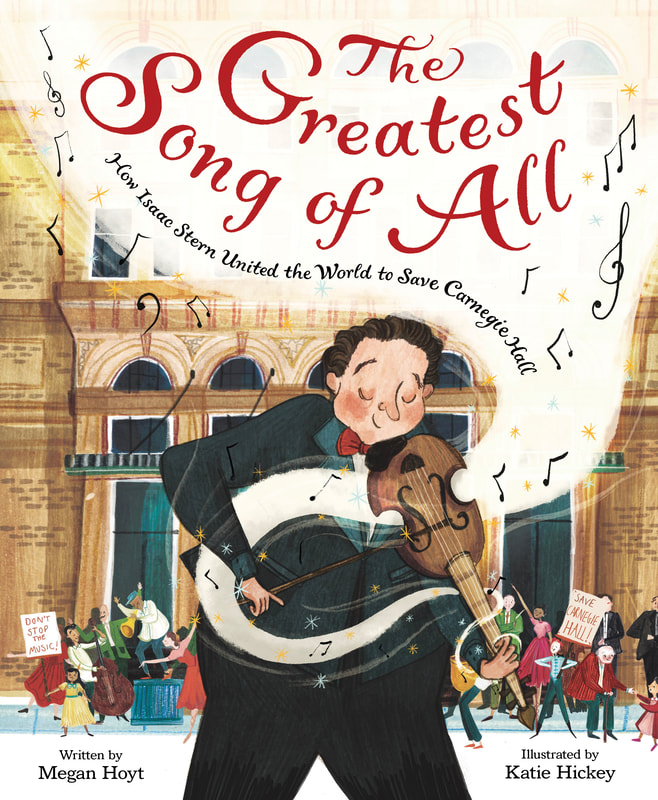

When Carnegie Hall opened in 1891 in New York City, Issac Stern wasn't even born yet. He was a young promising violinist in 1934 when Albert Einstein educated the audience with theories of splitting atoms and bending time.

But someone new would soon step onto the legendary stage. Without him, Carnegie Hall's story might have ended right there.


Issac was talented, but his parents were poor Jewish immigrants from Ukraine. They scrimped and said until pennies became dollars. Then they sent their son to the best violin teacher in town."

Issac practiced for years and at 23, made his Carnegie Hall debut. He ended up playing there more than fifty times. This cavernous ruby-colored room felt like a second home to Issac.  Little did Issac know that a powerful city planner, Robert Moses, had other plans for Carnegie Hall. 

His mind swirled with grids and sketches and pans. It may have looked like he was making the city more beautiful, but when Mr. Moses decide Manhattan needed a new, bigger, music hall, he didn't mind knocking down eighteen city blocks to make room for it.

The wrecking ball was scheduled for March 31, 1960. But Mr. Moses hadn't met Issac Stern's opposition.


Music lovers, musicians, and dancers protested against the demolition. But to no avail... Issac couldn't persuade the mayor to preserve the Hall--and he didn't have the five million dollars that was needed to purchase it. 

But Jacob Kaplan, a wealthy business man did! In the nick of time, Issac and his supporters were able to save the magnificent hall and...

Carnegie Hall opened its doors to talented performers from all over the world--rich and poor, young and old, American-born or immigrants seeking a better life, like Issac Stern's family did many years ago.


                                                    ***

Megan told me that she is attracted to stories that hold a personal connection.  For Megan's connection to each topic (and a hint at what she is working on next), please visit the Talking Story Facebook page. (Interviews will be posted on December 20 and 21. If you aren't a member yet, just request to join and I'll approve you.)

                                                    ***

Congratulations to Danielle Hammelef who won The Snowman's Waltz and to Marci Whitehurst who won Baa, Baa, Tap, Sheep 

Saturday, October 8, 2022

MOONWALKING: A Middle-Grade Review

There is a lot to like about Moonwalking (MacMillan, 2022) co-authored by Zetta Elliott and Lyn Miller-Lachmann. This middle-grade verse novel set in New York City in 1980, alternates between the POV of the two protagonists. Pie Velez is a math whiz and graffiti artist, and his most unlikely friend, JJ Pankowski, is a punk rock fan and one of the few white kids at their school. 


When I read books that I plan to review I record some of my favorite passages. Here are a few that I noted.

From Pie's second poem, "Bomb."

.... I never knew mist

wrapped in metal could be

light as air and dark as night

or brighter than a neon sign

I shake the can and

the seed of a rainbow clatters

inside before blooming in my palm

and climbing across the wall

                             ...... 

tags spread like wildfire

we write in code on concrete

words most folks can't read

signs that wow

warn

and won't be ignored

WE ARE HERE  (p.8)

From one of JJ's poems entitled, "Three Chords." In this scene when the reader is just getting to know JJ, he's learning how to play his uncle's guitar.

Joe Strummer said  

you don't need talent 

you don't need skill 

       all you need is a loud voice

        an electric guitar

        three chords

        and a story. (p. 15)

Clearly, both boys yearn to express themselves. 

JJ finds refuge in a school that is so crowded no one notices him. This is an excerpt from the poem, "Invisible Me."

They're a team

I won't go out for.

A party for which I don't beg

an invitation.

A universe

I dare not disturb. (p. 25)

Pie struggles with his mother's mental illness, being bullied by neighborhood kids who call her loco, and his dreams of being an artist. JJ's father lost his job and they have to cram into his grandmother's apartment; he doesn't fit in at school and he misses his sister who moved out. 

Slowly, the boys get to know one another and learn to appreciate each other's art. JJ gapes at "Pie murals on subway cars and buildings." Pie invites him to eat lunch in the quiet art room. JJ makes him a mixtape and the boys bond. But when JJ joins him to tag some buildings, the police show up and their encounter becomes a test of their friendship.  

This poem excerpt is from"Tag--I'm It" From JJ's POV:

all I could think about was how    through it all JJ   said nothing

did nothing    just kept his head down      to keep himself safe

Andres was right    no mixtape's gonna change    the system

'cause when it comes to      playing tag with cops

they only ever    try to catch

                    someone like me. (p. 146)

The ending is not your typical "two-different-kids-become-friends" and live happily ever after. But, it satisfactorily concludes the book. I loved the imagery in the poems and the way each character was deeply shown and how the boys helped each other through difficult times.

The main thing that I didn't like was how JJ discovers that his sister is a lesbian and that is why she left home. I thought that was a peripheral subplot that didn't add to the boys' friendship story.  Christian parents, grandparents, and teachers should be aware that this subject material is included in the novel. 

I wrote an email to Lyn Miller-Lachman stating my concerns and she responded: "Thank you for your note and your thoughts. I’m glad you appreciated the poetry and the story of MOONWALKING....The reason for including that thread is to show JJ’s growing realization that the world is more complex than he had believed—one more for his list of 'things that make no sense.' However, this crisis also shows him that he has choices, and he chooses to maintain his relationship with his sister, just as later on he will do what he can to maintain his friendship with Pie in the face of Pie’s anger. If you do include a note to potential readers who are Christians, I could see this as a discussion prompt: What would you do if you found out someone close to you—a family member—was having a same-sex relationship? Would you cut all ties to that person, or would you maintain the connection?”

                                                ****

What do you think, readers? Are you interested in reading this book? Why, or why not?


Congratulations to Gwen McCluney who won EVICTED! and to Hewi Mason who won A Planet Like Ours.

Monday, May 28, 2018

A Pup Called Trouble: A Review

Congratulations to Rosi Hollenbeck who won OOTHAR THE BLUE and Cathy Ogren who won MAY I COME IN?


A Pup Called Trouble (Kathy Tegan Books, 2018) by Bobbie Pyron is an engaging story that 3-5th grade students or older reluctant readers will enjoy. Based on true stories of coyotes who live in New York's Central Park, the book is told mostly through the point of view of the aptly named coyote, Trouble. Pyron, who makes her home  in the Utah mountains, spent four days roaming around Manhattan imaging how the city would smell, sound, and look to a lost coyote pup. Those four days became the backbone for this story. 


Although the child reader may not recognize herself in the story, Trouble’s desire to experience what his parents have forbidden is very child-like. Pyron sets up this identification at the beginning of the book when Trouble’s parents take him to see a tractor for the first time. Whereas his siblings fear the loud noise it makes, Trouble responds:

“It sounds huge,” Trouble exclaimed. “It sounds exciting! Can we go see?” (p. 16) 

After he sees Makers (humans) for the first time, he bombards his mother,
[Trouble] raced in circles of excitement. "Can we see more tomorrow?" (p. 21-22)
"No, she snapped. "Nothing good comes from Makers."
Swift shivered with fright. Pounced moved closer to his father, and Star trembled. 
Trouble's eyes glowed with dreamy curiosity. (p. 21-22)

Inevitably, the pup’s curiosity gets him into trouble. The reader sees and feels what happens when Trouble hides inside a truck. "...a loud, low growl rumbled to life beneath Trouble's feet. It grew louder and louder, shaking the floor and the walls and the ceiling of the shelter. Then, to Trouble's horror, the Beast lurched to life."(p.30). 

He finds himself in a "stone forest [which] rose so high it cut the wide blue expanse to wedges and slivers of white (p. 33). His senses are accosted by strange scents, sounds, and sights--not the least of which is the Makers "looking intently at a small something [they] held in their hands." At one point he is surrounded by Makers of all sizes. "Trouble leaped to his feet, spun in circles looking for the cover of forest, trees, bushes, anything where he could hide. Nothing. Everything was hard. Solid. Unforgiving." (p. 33)

Although Trouble admits that he's lost in this strange world, his curiosity drives him further and further from the truck that brought him to the city. When a crow named Mischief spies Trouble and takes an interest in him, there are great opportunities for fun and games as the two ride a subway, scare New Yorkers, and cause general mayhem. 

Mischief introduces him to other animals living in Central Park and Trouble falls in love with a poodle named Minette. As a result of these friendships, Trouble begins to lose his homesickness and begins to start liking his new life. His friends are alarmed and arrange for him to visit the "Place of the Once Wild." At the city zoo Trouble's eyes are opened to see what he risks losing. 

Ultimately, it is the fact that his friends band together to save him from the consequences of his poor decision that helps Trouble return home. The "good friends help friends stay out of trouble" moral-of-the-story is subtly and sweetly woven into a book that boys and girls will both enjoy. 

Once again, I can't part with this book! My animal loving granddaughters will love it! 


Bobbie Pyron is the author of five award-winning, critically-acclaimed middle grade and young adult novels including A DOG'S WAY HOME, THE DOGS OF WINTER, and LUCKY STRIKE. She lives in Park City, Utah with her husband, dogs, and occasional moose.


Monday, February 22, 2016

Juba! A Novel- A Review and ARC Giveaway

Congratulations to Linda Andersen and Monica M., a new Twitter follower, who each won a copy of OF BETTER BLOOD on last week's blog.

********

Writing historical fiction is hard. You read shelves full of books, study documents, interview experts, ponder maps, photographs, and data. You work really hard to insert authentic details (what color dress would she have worn to the dance? What did he eat for lunch? What bus would she have taken to work?) and then plunge forward to create as authentic a character as possible.

But when you're writing a story about a young man who lived over a hundred and fifty years ago to whom you want to pay tribute, but yet there is little "real" data, your task becomes even more difficult. You have a few bones to build your story around-- perhaps a death certificate and a few photographs. If you're lucky, maybe you'll find a few newspaper articles you can dig up to authenticate your story.

Such was Walter Dean Myers challenge when he wrote Juba! (Harper Collins, 2015)


This book for middle grade or young adult readers, is based on the true story of a talented young black dancer considered to be the inventor of tap dancing. While performing in New York City, he was noticed by Charles Dickens who wrote about him in American Notes:


"Single shuffle, double shuffle, cut and cross-cut; snapping his fingers, rolling his eyes, turning in his knees, presenting the backs of his legs in front, spinning about on his toes and heels like nothing but the man's fingers on the tambourine; dancing with two left legs, two right legs, two wooden legs, two wire legs, two spring legs - all sorts of legs and no legs - what is this to him?" 
"And in what walk of life, or dance of life, does man ever get such stimulating applause as thunders about him, when, having danced his partner off her feet, and himself too, he finishes by leaping gloriously on the bar-counter, and calling for something to drink, with the chuckle of a million of counterfeit Jim Crows, in one inimitable sound!"
Engraving from American Notes by Charles Dickens (1842) showing 
Master Juba being observed by Dickens and an associate.
www.masterjuba.com


Walter Dean Myers, in his last book before his death, told the story of William Henry Lane (Juba's real name) using just a few resources: Dickens' writings, a smattering of newspaper articles and images, and Juba's death certificate. Here are a few of my favorite quotes.

Initially Juba seeks dance instruction from an Irish teacher named Margaret. (This particular passage reminded me of a comment my current dance partner--my husband's 85-year-old uncle--made. "When you see old people dancing, they're imagining themselves as teenagers.")
"If you weren't so thickheaded, you'd know they [the audience] were watching you because they want to enjoy themselves, not marvel at you. You ever go to an Irish dance and see the young people swinging themselves around and kicking up their heels and the old people watching them? The old people are thinking back on a time when they were young and they could do the same thing the young people are doing. But you have to give them something they can do, if only on the floor between their ears, if you get my drift." (p. 44)
The reader hears Juba's despondency and realism in the following line. He has just auditioned as a dancer and thinks he won't get the job. 
"My dancing didn't mean a thing. The only thing they see in a black man is a clown or a slave. "(p. 55)
www.masterjuba.com

Juba finally gets a few gigs as a dancer but when Mr. Charles Dickens comes to New York and watches him, he dances as he never has before. This quote begins with Mr. Dickens speaking.


"...There's a freedom about the way you move that makes me wish I could dance. Have you ever had a difficult time in your life?" 

"At times, everything seems hard," I said. "I'm not sure what tomorrow is going to be like. I'm just hoping it's something good." 

"I imagined--and I know I'm talking too much--that you must have had some difficult times along the way. I think that's the mystery of greatness and of people who achieve wonderful things," Mr. Dickens said. "That somewhere in their lives they have felt the cold winds of despair, but have kept their hearts warm themselves." (p. 104)


In order to make a small living Juba is forced to make compromises.

Jack [his "fair minded" white landlord] knew how black people were treated in New York. We were second-class people every day and third-class performers when we tried to exercise our talents outside of the black community. What he did was to needle me so I wouldn't give up all together, and in a way, I appreciated it. In a way, I didn't, though, because sometimes he made me feel that when I accepted a job with a minstrel band or put on blackface I was betraying my people. To me, putting on blackface was the strangest thing in the world. I was born black, and yet the promoters wanted me to dress up like some kind of strange image of a black person that really wasn't a true Negro. It was as if a lot of white people had a place in their heads for black people and you had to fit in that place in a certain manner or they didn't want you. They wanted black performers to talk bad, say stupid things, and be like pets. Jack said a lot of white people were afraid of real black people. (pp. 123-4)
Even after Juba was well received by Londoners who had read accounts of him by Charles Dickens, he still encounters this same prejudice from fellow performers.  
Huff [another performer] walked across the room and put his nose an inch from Gil's. "What I see with my own two eyes is that I'm not going to make no kind of steady living working for a nigger. And that's what I'm doing over here, working behind Boz's Juba or whatever it is he's calling himself. In America you make a living working with white men, and for white men. And I aim to go back to America, back to Mableton, Georgia and make a living. And if I want any coloreds around me, I'll buy a few!" (p. 157)

Possibly depicting Juba performing in England
www.masterjuba.com


 Walter Dean Myers did an excellent job of bringing this forgotten, yet important, performer to life. Juba's life was full of sorrow, yet it also held love and accomplishment. I hope whoever wins my gently read ARC, will pass it along to a young person who can be encouraged by an inspirational story of a man who, despite many obstacles, followed his dreams.

To enter this giveaway, please leave me a comment by noon on Thursday, February 25. If you are new to my blog, please leave your contact information also. For extra chances to win this ARC, post on Facebook or Twitter and let me know what you have done.  


THE NIGHT WAR: A MG Historical Novel Review

  By now you should have received an email from my new website about my review of THE NIGHT WAR by Kimberly Brubaker Bradley. (It'll com...