Showing posts with label historical. Show all posts

Monday, December 19, 2022

TWO HISTORICAL PICTURE BOOK by MEGAN HOYT

 Today I'm proud to share two informational picture books by my SCBWI-Carolinas colleague, Megan Hoyt. No giveaways this week--my grandchildren will be the proud recipients of these fine books. But in case you need one (or two!) more gifts for the young reader in your life, check out these marvelous books.

Megan Hoyt discovers small pieces of history that are stories begging to be told and then writes them in a way that engages both children and adults. These picture books are for slightly older readers and can be used as classroom resources in grades 1-3. Both books have extensive back matter which include Megan's interest in the topic, additional information about the subject, timelines, and sources. BARTALI'S BICYCLE also includes a letter to the reader from Gino's granddaughter, Lisa. THE GREATEST SONG OF ALL includes the petition which Isaac Stern wrote to save Carnegie Hall. 

REVIEWS

BARTALI'S BICYCLE is stunningly illustrated by Italian illustrator, Iacopo Bruno.

Gino Bartali thought of himself as an ordinary bicyclist in Italy in the 1930s. But he was far from ordinary.

For eight years he trained along Italy's mountains and rugged paths. He won race after race, including the prestigious Tour de France in 1938. 

When World War II broke out, Gino refused to believe the lies that leaders were spreading about the Jews. 

He watched as Jews were rounded up and taken away on trucks. He wanted to help--but how?

A priest contacted him and asked him to deliver secret identity papers to Jews who were trying to escape. Although he was afraid of getting caught, he decided to help. "Some medals are pinned to your soul, not your jacket," he said. 

He stuffed the fake identity papers into his hollow bicycle bars and delivered them to hundreds of families, he hid his friend's family in his cellar, and rescued prisoners. 

Gino was a humble man who didn't want to be recognized.

"Good is something you do, not something you talk about," he said. 

But stories trickled out. Children came forward. 

Grateful families remembered the remarkable Gino Bartali, the Tour de France winner, Italian sports hero, and...secret champion.


THE GREATEST SONG OF ALL is brought alive by talented illustrator, Katie Hickey.
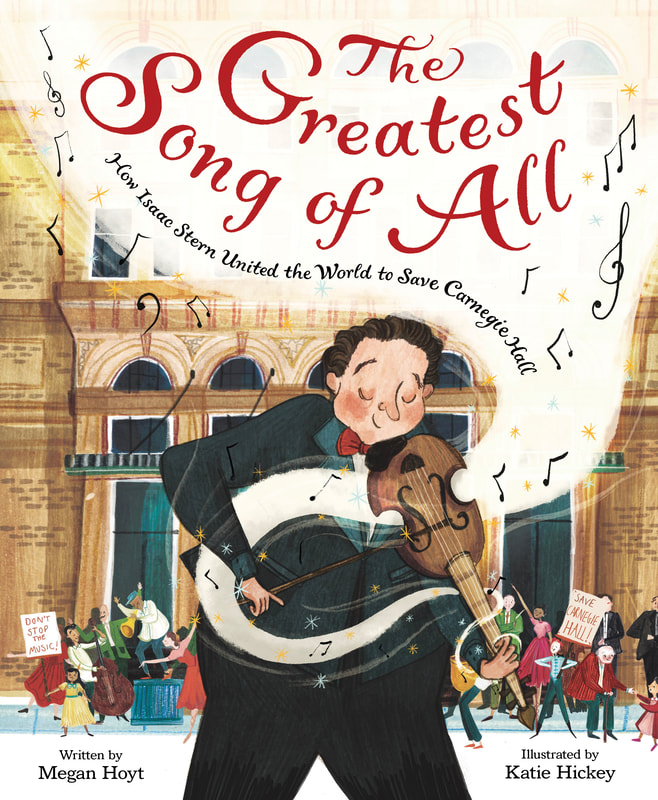

When Carnegie Hall opened in 1891 in New York City, Issac Stern wasn't even born yet. He was a young promising violinist in 1934 when Albert Einstein educated the audience with theories of splitting atoms and bending time.

But someone new would soon step onto the legendary stage. Without him, Carnegie Hall's story might have ended right there.


Issac was talented, but his parents were poor Jewish immigrants from Ukraine. They scrimped and said until pennies became dollars. Then they sent their son to the best violin teacher in town."

Issac practiced for years and at 23, made his Carnegie Hall debut. He ended up playing there more than fifty times. This cavernous ruby-colored room felt like a second home to Issac.  Little did Issac know that a powerful city planner, Robert Moses, had other plans for Carnegie Hall. 

His mind swirled with grids and sketches and pans. It may have looked like he was making the city more beautiful, but when Mr. Moses decide Manhattan needed a new, bigger, music hall, he didn't mind knocking down eighteen city blocks to make room for it.

The wrecking ball was scheduled for March 31, 1960. But Mr. Moses hadn't met Issac Stern's opposition.


Music lovers, musicians, and dancers protested against the demolition. But to no avail... Issac couldn't persuade the mayor to preserve the Hall--and he didn't have the five million dollars that was needed to purchase it. 

But Jacob Kaplan, a wealthy business man did! In the nick of time, Issac and his supporters were able to save the magnificent hall and...

Carnegie Hall opened its doors to talented performers from all over the world--rich and poor, young and old, American-born or immigrants seeking a better life, like Issac Stern's family did many years ago.


                                                    ***

Megan told me that she is attracted to stories that hold a personal connection.  For Megan's connection to each topic (and a hint at what she is working on next), please visit the Talking Story Facebook page. (Interviews will be posted on December 20 and 21. If you aren't a member yet, just request to join and I'll approve you.)

                                                    ***

Congratulations to Danielle Hammelef who won The Snowman's Waltz and to Marci Whitehurst who won Baa, Baa, Tap, Sheep 

Monday, November 1, 2021

THE LAST CHERRY BLOSSOM--Big News from Kathleen Burkinshaw and an Audiobook Giveaway!

Kathleen Burkinshaw is not only a dear friend of mine, but no stranger to this blog. I've shared her story of writing and publishing her debut middle grade historical novel in three different blogs: I interviewed her about how the book was built on her mother's experience in Hiroshima, reviewed the book, and then checked in with her post-publication. It's only fitting that she asked me to share her news about the audiobook that was just released! 

In this post you'll to hear from Kathleen and Yuuki Luna, the narrator. PLUS, if you click here, and then click on Sample, you can hear Yukki read the book.


 United Nations Office of Disarmament Education Resource for Teachers and Students
October 2018 BOOK RIOT list of "30 Fascinating Historical Fiction Books for Middle School Readers" 
Nominated 2019 NC School Library Media Assoc. YA Book Award
Finalist 2018 Sakura Medal, Japan
SCBWI Crystal Kite Award Finalist(southeast region)
Scholastic WNDB Reading Club Selection, 2018 & 2016

An Interview with Kathleen Burkinshaw


Carol: For my new followers who might not be familiar with your book, please summarize it for them.

Kathleen: THE LAST CHERRY BLOSSOM is about a young girl's life in Hiroshima during WWII. She discovers a shocking family secret right before her world is about to become a shadow of what it had been. THE LAST CHERRY BLOSSOM (TLCB) is based on my mother's experience surviving the atomic bomb. It is through her 12-year-old eyes that readers witness that horrific day. 

The novel is written with information on the culture, mindset, and daily life during WWII before the bomb was dropped-something that hasn’t been done before.  My hope is not only to convey the message that nuclear weapons should never be used again; but to also reveal that the children in Japan had the same love for family, fear of what could happen to them, and hopes for peace as the Allied children had. The ones that we may think don't belong or are our "enemy" are not so different from ourselves.


Carol: What was involved in making TLCB into an audiobook?

KathleenThe audiobook process for TLCB happened later than most books, since the hardcover of TLCB first published 5 years ago. In my contract with TLCB's publisher, Sky Pony Press, the unexercised audiobook rights reverted back to me after a few years. So, once they were mine, my  agent Anna Olswanger, Olswanger Literary, began submitting to audiobook publishers in January 2021. I received an offer from Dreamscape in April! Naturally I was ecstatic!! 😁


I hoped that they would choose a Japanese or Japanese American voiceover artist and was overjoyed when Yuuki Luna reached out to me on Instagram after recording TLCB. Once she told me of her connection with Hiroshima, that her grandfather was a Hibakusha (atomic bomb survivor) from Hiroshima, I knew that it was meant to be.


We did not have an opportunity to be in touch while she was recording TLCB with Dreamscape. However, after that was finished we had an opportunity to meet each other on Zoom (she lives in California). Not only that, but that day I had the honor to meet her mother, a second generation Hibakusha like myself, and I introduced them to my daughter, Sara, a 3rd generation HIbakusha like Yuuki. I could feel my mom with us.


Yuuki's lovely voice and grace added so much to my written words about my mother's story. When I first heard her narration, I cried. It touched me so much to hear a young voice for my mother's character in Yuriko. I also cried  because I thought an audiobook would not happen. Although, I must confess that I haven't listened to the chapters about the day of the bombing or after that. I know it will be extremely emotional for me because I already hear my mother's voice and her cries when I read the words. And I know it was emotional for Yuuki to read as well because of her compassion and connection to the story. 
I'm so grateful that The Last Cherry Blossom is now accessible to more readers and I'm thrilled to say that in addition to being available through Audible, Libro.FM, and anywhere audiobooks are sold, it is also on Hoopla Digital. 


Interview with Yuuki Luna

CarolPlease tell me a little bit about yourself, how you got into creating audio books, etc. What is your background? 

Yuuki: I started out as a stage combat performer during my childhood, performing in local community shows and festivals. I then started performing with the Walt Disney Parks and Resorts, and then started voiceover work, which led me into the audiobook world. 

Carol: What goes into preparation of recording a book like TLCB? How long did it take to record—was it over many sessions? 

Yuuki: In terms of preparation for audiobook reads, I've found it best to read the work at least once, maybe twice before I start recording, taking notes along the way. Recording The Last Cherry Blossom did take around a week, as I tried to fit in a few hours of recording each day. 

Carol: Were parts of the book difficult to narrate? What was that experience like for you?


YuukiThe book became difficult to narrate the more I got closer to the end; the emotions became so real that I needed to take a few breaks in between. Kathleen's story and words are also powerful and hit home in many ways, as I also have family from Hiroshima as well. Her novel is such a rare gem that paints the most genuine picture of how families in Hiroshima (including my own) lived during the war, and I feel honored to have been a part. 

GIVEAWAY

Leave your name and email address (if you are new to my blog) in the comment to enter the giveaway. If you decide to follow my blog or share this on social media, I'll enter your name twice. Kathleen will arrange for the winner to receive a download code for the book.

REMEMBER: I cannot enter you unless I have your name and email address. If you're not sure, leave your email address in the comment. Giveaway ends at 6PM on Wednesday, November 3. 

Congratulations to Barbara Younger who won Headstrong Hallie from last week's blog. 


Wednesday, April 28, 2021

Lincoln Clears A Path: A Picture Book Biography

Congratulations to Kathleen Burkinshaw and Carolyn Frazier who won autographed copies of Halli Gomez's book, LIST OF TEN from last week's blog.


                                                                    *******

In Lincoln Clears A Path (Calkins Creek, 2021) a new picture book by talented picture book author Peggy Thomas, our 16th president's accomplishments are presented from a different perspective. Although he is known for his stance against slavery, how many students know about his agricultural legacy?  In a book well-suited for home and classroom libraries, readers from 7-10 years of age are introduced to the many other paths which Lincoln cleared.


The book opens with seven-year old Abe arriving in the middle of the Indiana wilderness. This was not a farm. Not yet.

His family got to work.


Along with his father, Abe felled trees, cleared brush, pulled stumps and plowed fields. At night he studied stars, math and poetry...Abe marveled at how the founding fathers--Thwack! Swish! Thwump Yah!--cleared a path for folks like him.

In New Orleans Abe saw how slaves were auctioned off and he wondered, Could anyone clear a path for them?

Back home in Illinois, his friends urged their talented friend to run for office. He was poor and uneducated. But his friends provided books to read, tutoring in math, and even a suit to wear.

In the Illinois legislature he cleared paths for better schools and more roads. He stood against slavery. "There is no reason in this world why the negro is not entitled to all the natural rights enumerated in the Declaration of Independence, the right to life, liberty, and the pursuit of happiness."

But soon after he was elected president, South Carolina seceded and the Civil War began (see this timeline for more information.)

In the middle of the war, Lincoln did something that was seemingly unrelated to the North-South conflict. He created the United States Department of Agriculture to support the farmers who were supporting the troops.


But that was not all.


With a stroke of his pen, he signed the Homestead Act and cleared a path west. "New free States are the places for poor people to go to and better their condition," he wrote.


Then he signed the Pacific Railway Act and cleared a path across the nation.


In addition, Lincoln created land-grant colleges which cleared a path for students to learn more about agriculture.

He cleared a final path when he signed the Emancipation Proclamation and created a path to freedom for slaves. 


By Lincoln, Abraham, 1809-1865 - http://www.wdl.org/media/2714/service/thumbnail/6000x6000/1/1.jpgGallery: http://www.wdl.org/en/item/2714/, Public Domain, https://commons.wikimedia.org/w/index.php?curid=31578413 

"'Liberty to all'....clears the path for all--gives hope to all." 

The onomatopoeia of the four words--Thwack! Swish! Thwump! and Yah! which repeat throughout the story will keep even younger readers engaged. The simple, yet profound message of what Abraham Lincoln accomplished is communicated through the text, his quotes, and interesting facts distributed throughout the book. 

Nine pages of back matter include highlights from Abraham's childhood and adult years; how the Civil War affected U.S. agriculture; and a bibliography. There is additional information about the four acts; the author made sure to show how Native Americans were unfairly impacted by these acts. 

I was particularly impressed with how Thomas discovered the theme by noticing Lincoln's phrase "clearing the path" in his writing. She writes, "Sometimes he was referring to the removal of rocks and stumps so a wagon could pass, but other times he was thinking about ways to remove much bigger obstacles like poverty, racism, and ignorance so that all Americans could lead a better life." She challenges readers by asking, "How could you clear a path?" 

Illustrator Stacy Innerst's sepia watercolors evoke an "old-timey" feel which lends a distinct flavor to this historical picture book biography. 

No giveaway this week! I'm saving this book for my grandchildren. 

Here is a short video by Carolyn Yoder, Peggy Thomas's editor at Calkins Creek.


THE NIGHT WAR: A MG Historical Novel Review

  By now you should have received an email from my new website about my review of THE NIGHT WAR by Kimberly Brubaker Bradley. (It'll com...