Showing posts with label Abraham Lincoln. Show all posts

Thursday, April 28, 2022

TAD LINCOLN'S RESTLESS WRIGGLE: A Informational Picture Book Review, Giveaway, and Author Interview

 "I don't know but I may succeed in governing the nation, but I do believe I shall fail in ruling my own household." Abraham Lincoln

Author Beth Anderson uses that quote to draw readers into the life of Abraham Lincoln's boisterous son, Tad. You'll see why that quote is a fitting preface to another great picture book published by Calkins Creek.


REVIEW

Thomas Lincoln wriggled from the moment he was born. 
Like a tadpole, thought Abraham, and he called his son "Tad." 
The name stuck. 
So did the wriggle.

In that simple manner we meet Tad. 

Since he was born with an opening in the roof of his mouth, Tad's words were hard to understand. Although he had difficulty communicating clearly, his energy was quite obvious. 

Tad careened through the East Room in his chariot, scattering shrieking ladies not corners. "Get out of my way!" 

The staff huffed. Children should not be seen--and certainly not heard!

I LOVE the horrified looks on the ladies, don't you?

 The same was true in the classroom:

Illustrator S.D. Schinder captured Tad's movement!

Tad ran through the house, yard, and stables, tore through his father's important meetings, and even went to a soldier's camp. 

Unlike today when presidents are closely guarded, Abraham Lincoln walked Washington's streets accompanied by his son. Tad learned how to comfort wounded soldiers and listened as his father chatted with storekeepers and war volunteers. 

Visitors poured into the White House requesting time with the President. Lincoln didn't turn anyone away. 

Women requested passes across enemy lines. 

Families begged for money. 

Politicians wanted favors.

President Lincoln watched his young son's compassion for soldiers, homeless men, stray dogs and kids, and even for the Christmas turkey (who had become one of his pets). Despite his difficulty with language, Tad managed to convince his papa to rescue the turkey from being served as dinner. 

When Tad received more books as Christmas presents than his father would have time to read to him, he decided to share them with injured soldiers. He filled a big box with books and goodies and delivered them to the hospital. 

Although he couldn't write, "his message was clear as he filled the very big box... 


S.D. Schindler's illustrations are magnificent and highlight the story in a superb manner. 

BACKMATTER

Beth Anderson shares an interesting assortment of information in her Author's Note. She began researching the first presidential turkey pardon and became entranced with the close father-son relationship between President Lincoln and his fourth son, Tad. Readers will learn about how Tad's partial cleft palate would be surgically repaired today. Personally, I was intrigued by Beth's bibliography. Her primary sources include several books written in the 19th century as well as those published in the first part of the 20th century. 

AUTHOR INTERVIEW

CAROL: You started to write a book about pardoning the Thanksgiving turkey and that concept changed as you got to know Tad better. Can you explain how that happened?


BETH: The turkey pardon story was a tender bit of father and son with some humor that resulted in the national tradition, but…I wasn’t finding a special heart angle to make the story resonate and matter in a special way. As I learned more about the antics of Tad Lincoln, how his mother referred to him as her “troublesome sunshine," his executive mansion adventures, his disabilities, rejection by others, and his joyful heart, I knew there was so much more to this little human than met the eye. As a teacher who has experienced the discovery of unexpected talents, depth, and humor beneath challenging behavior, I wanted to know more about this complicated child and showcase the contradictions he seemed to embody. Because we’re all complicated, right?


CAROL: Your bibliography is fascinating. Can you speak about your research process and how you found those primary sources?


BETH: Once I start digging in, I follow the trail of breadcrumbs from sources in bibliographies and search out the various names I encounter. It’s fortunate there are so many resources about Lincoln and so many accounts left by those who spent time with the Lincoln family. Most of those sources are people who were on the staff or frequently there covering the President. Tad never failed to make an impression of some sort, so he is often mentioned. A few of the officials loved him and doted on him, like Stanton who gave him a Union uniform. Tad often accompanied his father on outings, so journalists often noted incidents with Tad. There are Tad anecdotes sprinkled through writings from Lincoln’s secretaries, the boys’ baby sitter, Mary’s dressmaker, and more. Once you find who was with the family in the President’s House, you can search out those, and most are referenced in other books about Lincoln. 


CAROL: Why did you pick 1863? 


BETH: Scope is always an issue with an historical picture book. I like to take a short piece of time if possible so I can really delve into character. As I gathered the stories about Tad, and looked at how they fell on a timeline, I could see that during the year 1863 he transformed under the loving guidance of his father. Once I saw that, I dug for more from 1863, looking for the pieces of the puzzle, choosing the most meaningful, to make my heart thread sing. That was the year after Willie’s death (Tad’s brother), so both were grieving and they needed each other more than ever. Their relationship was intense and vital, humorous and joyful, tender and nurturing. 1863 also allowed me to focus on the relationship and all they brought to each other without having to bring in Willie’s death or the assassination. And at the end of 1863, Christmas, I had the climax moment with the turkey, and I found the perfect incident to use as the ending to tie that heart thread tightly and let it resonate. 


CAROL: How have kids reacted to the book?


BETH: Kids have really loved the book! They totally understand the WRIGGLE! And some of the historical details are great surprises for them. I haven’t been able to experience their reactions in person due to the release during the pandemic, but the feedback I’ve gotten virtually has been wonderful!


GIVEAWAY

Leave a comment (along with your name and email address if you are new to my blog) to enter the giveaway. If you follow my blog, I'll enter your name twice. Become a NEW follower and you'll also get a second chance. Giveaway ends May 2. Continental U.S. addresses only. If you're uncomfortable leaving your email address, please email me. 

Wednesday, January 5, 2022

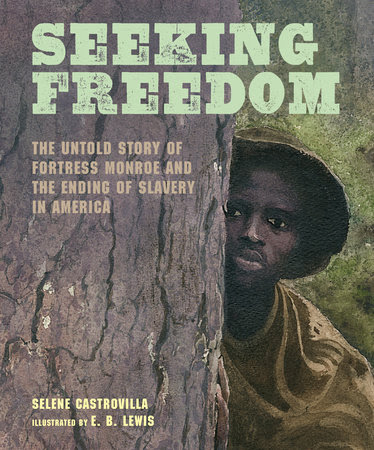
SEEKING FREEDOM: The Untold Story of Fortress Monroe and the Ending of Slavery in America- A Nonfiction Picture Book Review and Giveaway

I'm starting off the new year by joining a blog tour for a new book by award-winning Selene Castrovilla, SEEKING FREEDOM (Calkins Creek, 2022). The expressive watercolor illustrations are by award-winning artistrator, E.B. Lewis.


REVIEW

Although most of this informational picture book for 7-10 year-olds is presented in a journal format, the book opens with a quote from President Abraham Lincoln's First Inaugural Address on March 6, 1981:

I have no purpose, directly or indirectly, to interfere with the institution of slavery in the States where it exists. I believe I have no lawful right to do so, and I have no inclination to do so.

The next page explains how Lincoln was unable to convince the remaining Southern states (seven had already left the United States) to stay. War broke out on April 2, 1861. Five days later, Virginia abandoned the country. Fearful of being separated from their families and forced into hard labor, "The enslaved people...would do anything to be free."

Thus, this true story opens.


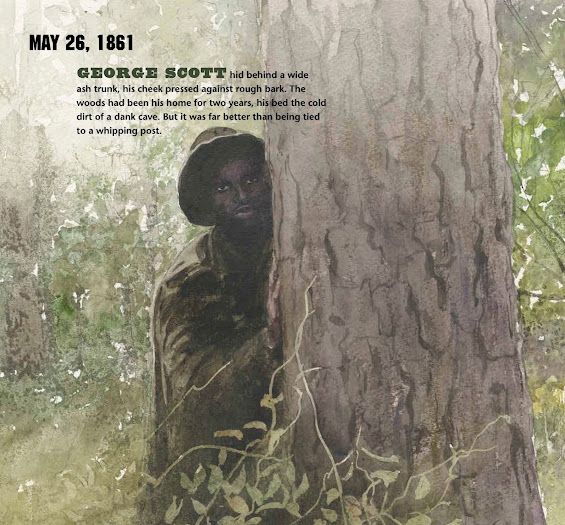
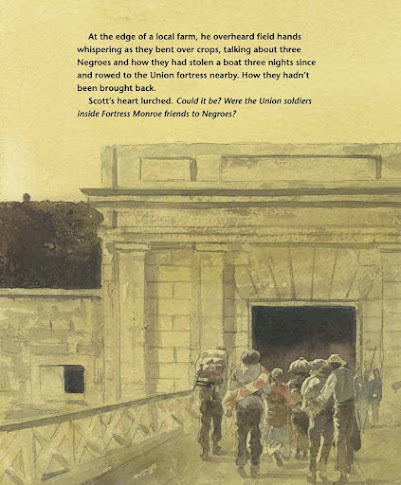
Scott knew the forest and swamps--but he didn't know what was going on the town of Hampton. He overheard field hands talking about how three Negroes had escaped to a Union fortress nearby--and hadn't been returned. Could it be? Were the Union soldiers inside Fortress Monroe friends to Negroes?


Scott watched as eight Negroes headed inside. He waited. But they didn't come out. Was it true? Were these people now among friends?

Despite his fears, he snuck in with another group of Negroes and waited for an interview with the commander of Fortress Monroe--Major General Benjamin Franklin Butler. 

https://www.nps.gov/fomr/learn/historyculture/index.htm

By the time Scott spoke with Butler, the major was frustrated. He had interviewed many Negros but hadn't obtained the information he needed: Where were the Confederates stationed?  The major was also in a difficult position. He was holding every Negro who came to him as contraband of war--"property used for warlike purposes against the government of the United States." 


Library of Congress Prints and Photographs Division Washington, D.C. 20540 USA http://hdl.loc.gov/loc.pnp/pp.print
"A Group of Contrabands"
James Gibson, photographer
When Major Butler spoke with George Scott he realized he'd found the man he was looking for--someone who could track down the Confederates. Even after finding out that his plan to use Negros as spies was approved, Butler was still worried. Could the fortress remain secure against enemy attack? He prayed for Scott's safety.

George Scott wandered for eight days looking for the Confederates. He prayed that the Lord would lead him. Just then, he saw thousands of Confederate soldiers outside a church. His prayers had been answered. 

Scott raced back to the fort with the news he had gleaned--the rebels were preparing to cut off all supplies.


Butler's men had not died in vain. The confederates had fled; the threat to the fortress was over. But how could Butler reward Scott? When Scott asked for freedom, Butler put his legal skills to work.

 Butler implored the President and Congress: 

These human beings must be given the free enjoyment of life, liberty, and the pursuit of happiness.


BACK MATTER

Seeking Freedom includes eight pages of back matter; that's an exceptional amount of pages! But the sections on the Aftermath (including references to the Confiscation Act of 1862 and the Emancipation Proclamation), the Contrabands, Benjamin Butler's Legacy, George Scott, and Fort Monroe in Hampton, Virginia, add a depth of information to this informational picture book that will be appreciated by older students as well as adults. By the way, the last spread is a picture of President Obama signing a proclamation establishing the Fort Monroe National Monument. 

Interestingly, there are no known images of George Scott. William Headly shared Scott's story. He escaped enslavement and became a contraband in North Carolina. His cloak is an old cotton bag. 

https://www.loc.gov/item/2010647919/

For a view behind the scenes of how Selene came to write this story, see her post on Nerdy Book Club.  

Here's a YouTube video of Selene talking to her editor, Carolyn Yoder, about writing picture books which bring alive history.


GIVEAWAY

To enter this giveaway, please leave me a comment by 6PM on January 8th. U.S. postal addresses only. If you decide to follow my blog I'll put your name in for a second chance.Please include your name and email address if you are new to my blog. If you are hesitant to leave your email address, you can reach me directly by clicking here. 

Congratulations to Gail Cartee who won The Dirt Book from last week's blog.

Wednesday, April 28, 2021

Lincoln Clears A Path: A Picture Book Biography

Congratulations to Kathleen Burkinshaw and Carolyn Frazier who won autographed copies of Halli Gomez's book, LIST OF TEN from last week's blog.


                                                                    *******

In Lincoln Clears A Path (Calkins Creek, 2021) a new picture book by talented picture book author Peggy Thomas, our 16th president's accomplishments are presented from a different perspective. Although he is known for his stance against slavery, how many students know about his agricultural legacy?  In a book well-suited for home and classroom libraries, readers from 7-10 years of age are introduced to the many other paths which Lincoln cleared.


The book opens with seven-year old Abe arriving in the middle of the Indiana wilderness. This was not a farm. Not yet.

His family got to work.


Along with his father, Abe felled trees, cleared brush, pulled stumps and plowed fields. At night he studied stars, math and poetry...Abe marveled at how the founding fathers--Thwack! Swish! Thwump Yah!--cleared a path for folks like him.

In New Orleans Abe saw how slaves were auctioned off and he wondered, Could anyone clear a path for them?

Back home in Illinois, his friends urged their talented friend to run for office. He was poor and uneducated. But his friends provided books to read, tutoring in math, and even a suit to wear.

In the Illinois legislature he cleared paths for better schools and more roads. He stood against slavery. "There is no reason in this world why the negro is not entitled to all the natural rights enumerated in the Declaration of Independence, the right to life, liberty, and the pursuit of happiness."

But soon after he was elected president, South Carolina seceded and the Civil War began (see this timeline for more information.)

In the middle of the war, Lincoln did something that was seemingly unrelated to the North-South conflict. He created the United States Department of Agriculture to support the farmers who were supporting the troops.


But that was not all.


With a stroke of his pen, he signed the Homestead Act and cleared a path west. "New free States are the places for poor people to go to and better their condition," he wrote.


Then he signed the Pacific Railway Act and cleared a path across the nation.


In addition, Lincoln created land-grant colleges which cleared a path for students to learn more about agriculture.

He cleared a final path when he signed the Emancipation Proclamation and created a path to freedom for slaves. 


By Lincoln, Abraham, 1809-1865 - http://www.wdl.org/media/2714/service/thumbnail/6000x6000/1/1.jpgGallery: http://www.wdl.org/en/item/2714/, Public Domain, https://commons.wikimedia.org/w/index.php?curid=31578413 

"'Liberty to all'....clears the path for all--gives hope to all." 

The onomatopoeia of the four words--Thwack! Swish! Thwump! and Yah! which repeat throughout the story will keep even younger readers engaged. The simple, yet profound message of what Abraham Lincoln accomplished is communicated through the text, his quotes, and interesting facts distributed throughout the book. 

Nine pages of back matter include highlights from Abraham's childhood and adult years; how the Civil War affected U.S. agriculture; and a bibliography. There is additional information about the four acts; the author made sure to show how Native Americans were unfairly impacted by these acts. 

I was particularly impressed with how Thomas discovered the theme by noticing Lincoln's phrase "clearing the path" in his writing. She writes, "Sometimes he was referring to the removal of rocks and stumps so a wagon could pass, but other times he was thinking about ways to remove much bigger obstacles like poverty, racism, and ignorance so that all Americans could lead a better life." She challenges readers by asking, "How could you clear a path?" 

Illustrator Stacy Innerst's sepia watercolors evoke an "old-timey" feel which lends a distinct flavor to this historical picture book biography. 

No giveaway this week! I'm saving this book for my grandchildren. 

Here is a short video by Carolyn Yoder, Peggy Thomas's editor at Calkins Creek.


Tuesday, May 8, 2018

Be Free or Die: The Amazing Story of Robert Smalls' Escape from Slavery to Union Hero -- An Audio Book Review

Congratulations to Linda Anderson Gutheil who won W Is For Welcome and to Michelle Wall who won Ebenezer Creek. 

REVIEW

BE FREE OR DIE (St. Martin's Press, 2017) by Cate Lineberry is actually more than what the subtitle conveys. It is simultaneously a detailed account of how a young slave impacted the cause of the Union, as well as a panoramic view of South Carolina before, during, and after the Civil War. 


The biography of this unsung hero begins in 1862 with an extensive description of Smalls, a 23-year-old slave governed by his desire for freedom for himself and his family. Smalls grew up working a variety of jobs, eventually becoming a pilot on the steamer, the CSS Planter. In that position, Smalls conceived the dangerous plan to comandeer the boat and turn it over to the Union Navy. He knew that Southerners and even many Northerners didn’t expect a black man to have the intelligence to execute such a daring plan. Swearing the crew members to secrecy, Smalls planned his dangerous escape. 


The Planter carrying 1000 bales of cotton.
https://en.wikipedia.org/wiki/USS_Planter_(1862)

The promise of freedom was so strong that despite the high risk of being captured and killed and his wife and children tortured--Smalls carried out his plan. With his lighter skin and under the cover of darkness, he piloted the ship out of the heavily guarded Charleston Harbor. Other enslaved people had tried to get to the Union side in rowboats or canoes--but no one had turned over a ship like the Planter; a vessel that carried several canons and thousands of pounds of ammunition which the union desperately needed. 

Pursuant to the Fugitive Slave Act of 1850,
Smalls risked being caught and returned to his master.
https://en.wikipedia.org/wiki/Fugitive_Slave_Act_of_1850


Childhood Years

In Chapter 2, Cate Lineberry delves into Smalls' childhood. His mother Lydia, was part of the Gullah community in the sea islands and as a result, Smalls learned the Gullah language. He lived between the Gullah and white community, but since he was a house slave from the age of nine, he was at the mercy of whites. 

It is unclear who Smalls' father was and some people have thought that it was Lydia’s master. But the author says that is unlikely because Lydia was the one who raised her master and was significantly older than him. But the ambiguity made me realize how these types of relationships were never quite accounted for. I found this interesting since the backstory of my WIP, Half-Truthsincludes a similar master/slave relationship.

Robert’s early childhood was controlled by the realities of slavery: the deprivation of equality, the lack of privileges and rights; the metal badges slaves wore which separated them from free blacks. The latter reminded me of the yellow arm bands which Hitler forced Jews to wear.

These small metal badges, most often made of copper, were produced in Charleston, South Carolina between 1800 and the Civil War. They were worn by slaves working in the city.
http://americanhistory.si.edu/collections/search/object/nmah_671073


Accomplishments

Against the background of the Civil War and Reconstruction, the book details Smalls' adventures and accolades after he captured the Planter.  He became known as a hero to Northern whites and he inspired thousands of enslaved and free blacks. He worked for both the Navy and the Army; became a spokesman for freedom; helped convince President Lincoln to establish a black Union military force; was present at 17 major battles and engagements in the Civil War, supported the Port Royal Experiment for the education of blacks, ran several successful businesses, was a South Carolina Representative (1868-1870 and served five terms as the first black elected to the U.S. House of Representatives.

https://en.wikipedia.org/wiki/Robert_Smalls


Historical Context

Lineberry includes a tremendous amount of historical context for all of these public and personal triumphs. Two particular events stand out in my mind. The first is his purchase of the house in which he had served as a slave. Here's a video that shows the exterior of the home and details this history. He spent many years entertaining in the home along with his beloved wife, Hannah. 

The second was Lineberry's mention of Sherman's March to the Sea. The author discussed so many events that occurred in the South during the Civil War--I wondered if she would mention what happened at Ebenezer Creek. Sure enough, she included that devastating event which Tonya Bolden so skillfully dramatized in Crossing Ebenezer Creek.

***********

At the end of a book that is skillfully woven together, educational, and inspiring, Cate Lineberry wrote, "Robert Smalls deserves to be celebrated not only as a union hero, but an American hero." I am grateful that she brought this story to life.


For more information, see Lineberry's website or her interview on C-SPAN.

Narrated by the talented JD Jackson, the audio CD produced by Tantor Audio, is a treat to listen to. You can here a sample of the book here.

THE NIGHT WAR: A MG Historical Novel Review

  By now you should have received an email from my new website about my review of THE NIGHT WAR by Kimberly Brubaker Bradley. (It'll com...