Showing posts with label civil war. Show all posts

Thursday, February 1, 2024

Celebrate Valentine's Day with a Giveaway of VALENTINES FOR ALL by Nancy Churnin

 It seems as if we just celebrated New Year's and now it's time for Valentine's Day! To help celebrate, I have the perfect book for your child, grandchild, classroom or library-- VALENTINES FOR ALL: Esther Howland Captures America's Heart by Nancy Churnin and illustrated by Monika Rosa Wisniewska


REVIEW

From the opening of the story where Esther Howland gets the idea of creating valentines, to the end where she is a woman in a wheel chair watching a young couple read one of her valentines, each page is decorated with a fictional "Rose are Red, Violets are Blue" rhyme. How can you not love a book that is historical, sweet, and poetic all at the same time?

                          Roses are red. Violets are blue.  
I've got an idea for something new.

Despite Esther's brothers' skepticism that her business wouldn't take off--it did! She believed that people couldn't always express big feelings in words and that cards would help them communicate how they loved another person.

When her first order was for five thousand cards she enlisted her friends to help make them.


Roses are red. Dahlias are lime. How can I make so many in time?

When the Civil War began in 1861she was surprised how many wives asked for cards for their soldier husbands.


Roses are red. Pussy willows are gray.
When people are hurting I know what to say.


Eventually, Esther realized that she could create birthday and holiday cards that would help people convey their feelings throughout the year.

Roses are red. Night tulips are black. Looking for words? They're in my card rack.

Esther had to use a wheelchair after she slipped, fell, and injured her knee.  That didn't stop her card-making business though. She printed a poetry book so that her customers could cut and paste words and create their own cards. 

Esther is a great model of perseverance to make your dream come true. As Nancy Churnin's last poem states:

Roses are red. Forget-me-nots, blue. Why don't you make your dreams come true?

BACK MATTER

The Author's Note includes wonderful information about how Esther was a successful woman entrepreneur many years before women earned the right to vote. At the height of her business, she earned more than $100,000 per year--which is the equivalent of two million dollars today.

There is a page dedicated to creating your own valentines and how to send them to Nancy's website or to the Worcester Historical Museum in Worcester, MA where Esther lived.

CURRICULUM RESOURCE

This book can be used as a resource when teaching American history, women's changing roles, writing, and art. Since the author frequently mentions Esther Howland's desire to strengthen relationships, VALENTINES FOR ALL can also be a SEL resource. The illustrations inspire readers to create their own valentines.

GIVEAWAY

Albert Whitman is giving away a copy of VALENTINES FOR ALL to one fortunate reader. To get this in the mail ASAP, this giveaway ends February 3. As usual, if you share on social media, sign up for my blog, or are an educator or librarian, you will get an extra chance. Let me know in the comments and make sure to leave your email address if you are new to my blog. U.S. addresses only.


Thursday, April 28, 2022

TAD LINCOLN'S RESTLESS WRIGGLE: A Informational Picture Book Review, Giveaway, and Author Interview

 "I don't know but I may succeed in governing the nation, but I do believe I shall fail in ruling my own household." Abraham Lincoln

Author Beth Anderson uses that quote to draw readers into the life of Abraham Lincoln's boisterous son, Tad. You'll see why that quote is a fitting preface to another great picture book published by Calkins Creek.


REVIEW

Thomas Lincoln wriggled from the moment he was born. 
Like a tadpole, thought Abraham, and he called his son "Tad." 
The name stuck. 
So did the wriggle.

In that simple manner we meet Tad. 

Since he was born with an opening in the roof of his mouth, Tad's words were hard to understand. Although he had difficulty communicating clearly, his energy was quite obvious. 

Tad careened through the East Room in his chariot, scattering shrieking ladies not corners. "Get out of my way!" 

The staff huffed. Children should not be seen--and certainly not heard!
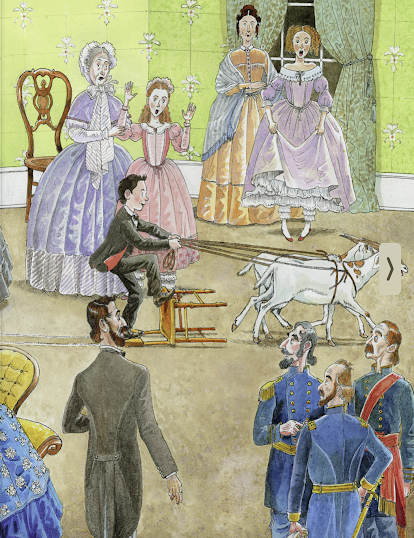
I LOVE the horrified looks on the ladies, don't you?

 The same was true in the classroom:

Illustrator S.D. Schinder captured Tad's movement!

Tad ran through the house, yard, and stables, tore through his father's important meetings, and even went to a soldier's camp. 

Unlike today when presidents are closely guarded, Abraham Lincoln walked Washington's streets accompanied by his son. Tad learned how to comfort wounded soldiers and listened as his father chatted with storekeepers and war volunteers. 

Visitors poured into the White House requesting time with the President. Lincoln didn't turn anyone away. 

Women requested passes across enemy lines. 

Families begged for money. 

Politicians wanted favors.

President Lincoln watched his young son's compassion for soldiers, homeless men, stray dogs and kids, and even for the Christmas turkey (who had become one of his pets). Despite his difficulty with language, Tad managed to convince his papa to rescue the turkey from being served as dinner. 

When Tad received more books as Christmas presents than his father would have time to read to him, he decided to share them with injured soldiers. He filled a big box with books and goodies and delivered them to the hospital. 

Although he couldn't write, "his message was clear as he filled the very big box... 


S.D. Schindler's illustrations are magnificent and highlight the story in a superb manner. 

BACKMATTER

Beth Anderson shares an interesting assortment of information in her Author's Note. She began researching the first presidential turkey pardon and became entranced with the close father-son relationship between President Lincoln and his fourth son, Tad. Readers will learn about how Tad's partial cleft palate would be surgically repaired today. Personally, I was intrigued by Beth's bibliography. Her primary sources include several books written in the 19th century as well as those published in the first part of the 20th century. 

AUTHOR INTERVIEW

CAROL: You started to write a book about pardoning the Thanksgiving turkey and that concept changed as you got to know Tad better. Can you explain how that happened?


BETH: The turkey pardon story was a tender bit of father and son with some humor that resulted in the national tradition, but…I wasn’t finding a special heart angle to make the story resonate and matter in a special way. As I learned more about the antics of Tad Lincoln, how his mother referred to him as her “troublesome sunshine," his executive mansion adventures, his disabilities, rejection by others, and his joyful heart, I knew there was so much more to this little human than met the eye. As a teacher who has experienced the discovery of unexpected talents, depth, and humor beneath challenging behavior, I wanted to know more about this complicated child and showcase the contradictions he seemed to embody. Because we’re all complicated, right?


CAROL: Your bibliography is fascinating. Can you speak about your research process and how you found those primary sources?


BETH: Once I start digging in, I follow the trail of breadcrumbs from sources in bibliographies and search out the various names I encounter. It’s fortunate there are so many resources about Lincoln and so many accounts left by those who spent time with the Lincoln family. Most of those sources are people who were on the staff or frequently there covering the President. Tad never failed to make an impression of some sort, so he is often mentioned. A few of the officials loved him and doted on him, like Stanton who gave him a Union uniform. Tad often accompanied his father on outings, so journalists often noted incidents with Tad. There are Tad anecdotes sprinkled through writings from Lincoln’s secretaries, the boys’ baby sitter, Mary’s dressmaker, and more. Once you find who was with the family in the President’s House, you can search out those, and most are referenced in other books about Lincoln. 


CAROL: Why did you pick 1863? 


BETH: Scope is always an issue with an historical picture book. I like to take a short piece of time if possible so I can really delve into character. As I gathered the stories about Tad, and looked at how they fell on a timeline, I could see that during the year 1863 he transformed under the loving guidance of his father. Once I saw that, I dug for more from 1863, looking for the pieces of the puzzle, choosing the most meaningful, to make my heart thread sing. That was the year after Willie’s death (Tad’s brother), so both were grieving and they needed each other more than ever. Their relationship was intense and vital, humorous and joyful, tender and nurturing. 1863 also allowed me to focus on the relationship and all they brought to each other without having to bring in Willie’s death or the assassination. And at the end of 1863, Christmas, I had the climax moment with the turkey, and I found the perfect incident to use as the ending to tie that heart thread tightly and let it resonate. 


CAROL: How have kids reacted to the book?


BETH: Kids have really loved the book! They totally understand the WRIGGLE! And some of the historical details are great surprises for them. I haven’t been able to experience their reactions in person due to the release during the pandemic, but the feedback I’ve gotten virtually has been wonderful!


GIVEAWAY

Leave a comment (along with your name and email address if you are new to my blog) to enter the giveaway. If you follow my blog, I'll enter your name twice. Become a NEW follower and you'll also get a second chance. Giveaway ends May 2. Continental U.S. addresses only. If you're uncomfortable leaving your email address, please email me. 

Wednesday, January 5, 2022

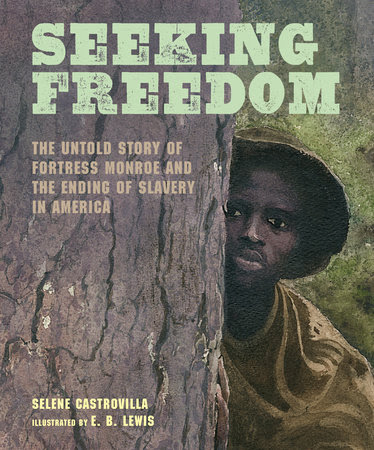
SEEKING FREEDOM: The Untold Story of Fortress Monroe and the Ending of Slavery in America- A Nonfiction Picture Book Review and Giveaway

I'm starting off the new year by joining a blog tour for a new book by award-winning Selene Castrovilla, SEEKING FREEDOM (Calkins Creek, 2022). The expressive watercolor illustrations are by award-winning artistrator, E.B. Lewis.


REVIEW

Although most of this informational picture book for 7-10 year-olds is presented in a journal format, the book opens with a quote from President Abraham Lincoln's First Inaugural Address on March 6, 1981:

I have no purpose, directly or indirectly, to interfere with the institution of slavery in the States where it exists. I believe I have no lawful right to do so, and I have no inclination to do so.

The next page explains how Lincoln was unable to convince the remaining Southern states (seven had already left the United States) to stay. War broke out on April 2, 1861. Five days later, Virginia abandoned the country. Fearful of being separated from their families and forced into hard labor, "The enslaved people...would do anything to be free."

Thus, this true story opens.


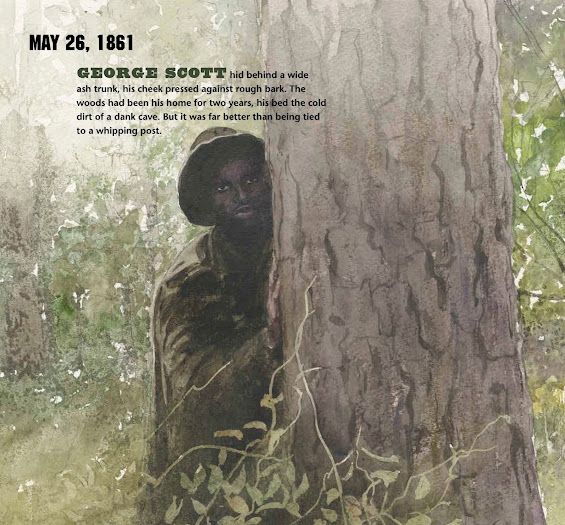
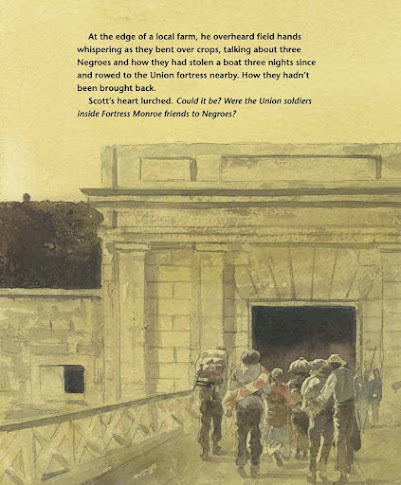
Scott knew the forest and swamps--but he didn't know what was going on the town of Hampton. He overheard field hands talking about how three Negroes had escaped to a Union fortress nearby--and hadn't been returned. Could it be? Were the Union soldiers inside Fortress Monroe friends to Negroes?


Scott watched as eight Negroes headed inside. He waited. But they didn't come out. Was it true? Were these people now among friends?

Despite his fears, he snuck in with another group of Negroes and waited for an interview with the commander of Fortress Monroe--Major General Benjamin Franklin Butler. 

https://www.nps.gov/fomr/learn/historyculture/index.htm

By the time Scott spoke with Butler, the major was frustrated. He had interviewed many Negros but hadn't obtained the information he needed: Where were the Confederates stationed?  The major was also in a difficult position. He was holding every Negro who came to him as contraband of war--"property used for warlike purposes against the government of the United States." 


Library of Congress Prints and Photographs Division Washington, D.C. 20540 USA http://hdl.loc.gov/loc.pnp/pp.print
"A Group of Contrabands"
James Gibson, photographer
When Major Butler spoke with George Scott he realized he'd found the man he was looking for--someone who could track down the Confederates. Even after finding out that his plan to use Negros as spies was approved, Butler was still worried. Could the fortress remain secure against enemy attack? He prayed for Scott's safety.

George Scott wandered for eight days looking for the Confederates. He prayed that the Lord would lead him. Just then, he saw thousands of Confederate soldiers outside a church. His prayers had been answered. 

Scott raced back to the fort with the news he had gleaned--the rebels were preparing to cut off all supplies.


Butler's men had not died in vain. The confederates had fled; the threat to the fortress was over. But how could Butler reward Scott? When Scott asked for freedom, Butler put his legal skills to work.

 Butler implored the President and Congress: 

These human beings must be given the free enjoyment of life, liberty, and the pursuit of happiness.


BACK MATTER

Seeking Freedom includes eight pages of back matter; that's an exceptional amount of pages! But the sections on the Aftermath (including references to the Confiscation Act of 1862 and the Emancipation Proclamation), the Contrabands, Benjamin Butler's Legacy, George Scott, and Fort Monroe in Hampton, Virginia, add a depth of information to this informational picture book that will be appreciated by older students as well as adults. By the way, the last spread is a picture of President Obama signing a proclamation establishing the Fort Monroe National Monument. 

Interestingly, there are no known images of George Scott. William Headly shared Scott's story. He escaped enslavement and became a contraband in North Carolina. His cloak is an old cotton bag. 

https://www.loc.gov/item/2010647919/

For a view behind the scenes of how Selene came to write this story, see her post on Nerdy Book Club.  

Here's a YouTube video of Selene talking to her editor, Carolyn Yoder, about writing picture books which bring alive history.


GIVEAWAY

To enter this giveaway, please leave me a comment by 6PM on January 8th. U.S. postal addresses only. If you decide to follow my blog I'll put your name in for a second chance.Please include your name and email address if you are new to my blog. If you are hesitant to leave your email address, you can reach me directly by clicking here. 

Congratulations to Gail Cartee who won The Dirt Book from last week's blog.

Monday, February 25, 2019

The Smallest Tadpole's War in the Land of Mysterious Waters: An Audio Book Review and Giveaway

Florida became a state in 1845 and was quickly thrust into the Civil War. The Smallest Tadpole’s War in the Land of Mysterious Waters bridges the years from 1843  to 1900. The main character, Thomas Franklin Swearingen, was author Diane Swearingen’s husband’s great-great-grandfather. 

Thomas Swearingen, an uneducated farmer who settled northern Florida when it was home to untamed forests, black bear, Seminole ponies, and biting insects, went on to become a legislator, a drafter of the Florida constitution, and president pro-temp of the Florida senate. This is his story—and the story of Florida’s early years as a state. 


The Smallest Tadpole is told from the perspective of Henry, Thomas’s adopted son. Henry recounts that his favorite book as a child was Thomas’s diary.  Although Diane Swearingen fabricated Thomas’s diary and letters, she used county and military records as well as Thomas’s papers that now reside in the Florida State archives.  Historical accuracy permeates each diary entry and the entire book. 

Thomas left Georgia and settled in Wakulla County, Florida in the late 1840's. In 1855 when his best friend died, Thomas married his widow, Louise, and adopted Henry. In 1860, at the age of eleven, Henry became a man when Thomas left for the war. His boyhood days of fishing with Thomas in the Gulf of Mexico and camping out staring at the stars, were over. 


Henry remembers how Thomas, a prosperous businessman, had been invited to political rallies before the war. The local cotton farmers agreed that they shouldn't be taxed by the north. Although Thomas had been warned that slavery would remain in the South as long as it was a colony to the North, it was the unspoken issue at these rallies where secession was a huge topic. Although most of the farmers did not own slaves, (Florida's population was 140,000 in 1861; 63,000 were African Americans), wealthy cotton plantation owners held the purse strings and great political influence over the farmers. To speak against them was financial suicide. The political rallies became enlistment opportunities for the Confederate Army; the farmers were loyal to a way of life and to local economics rather than defenders of slavery.


Thomas was made a lieutenant in the Wakulla Guard because of his leadership and popularity in the county--not because of any prior military experience. (This verified the experience of Kate Dinsmore's great-grandfather. As the protagonist in Half Truths, I researched how her great-grandfather would have been made captain in Charlotte, NC under similar circumstances.)  With great pomp and ceremony, the Florida men left for war with families excited about the $100.00/month the soldiers would receive. 

But the reality of war set in quickly with women left alone to care for their farms and children, while news of injuries and deaths trickled in from the front. Thomas's letters reported the realities of war and Swearingen's portrayal does not hold back from describing the smell of death, ears that ran from cannon fire, and the screams of dying men. It put faces on the 16,000 Florida soldiers who never returned home. 

Henry's narrative of the war is sprinkled throughout with local stories of Wakulla County and his own enlistment prior to the war ending. There was not enough black cloth for all the widows to sew funeral attire. Carpetbaggers grabbed land because of taxes owed. The homeless and helpless were throughout the countryside. 

Although Thomas returned home injured, he was encouraged to run as the Florida representative of Wakulla County and from there held several political offices. Throughout his career Thomas was anti-slavery.

This audio version available through Audible, is expertly narrated by Jim Seybert.

WAKULLA’S BEAUTIFUL WAKULLA RIVER IS A SPRING FED CLEAR WATER RIVER THAT RUNS EVENTUALLY INTO THE GULF OF MEXICO.  TODAY, MANATEES SWIM UP TO WINTER IN ITS SPRING. FROM THE FLORIDA MEMORY COLLECTION.


GIVEAWAY


Thanks to Jim Seybert's generosity, I will provide a code for the winner to download this book from Audible's website. To enter, please leave me a comment by February 28 along with your email address if you are new to my blog. 


Tuesday, May 8, 2018

Be Free or Die: The Amazing Story of Robert Smalls' Escape from Slavery to Union Hero -- An Audio Book Review

Congratulations to Linda Anderson Gutheil who won W Is For Welcome and to Michelle Wall who won Ebenezer Creek. 

REVIEW

BE FREE OR DIE (St. Martin's Press, 2017) by Cate Lineberry is actually more than what the subtitle conveys. It is simultaneously a detailed account of how a young slave impacted the cause of the Union, as well as a panoramic view of South Carolina before, during, and after the Civil War. 


The biography of this unsung hero begins in 1862 with an extensive description of Smalls, a 23-year-old slave governed by his desire for freedom for himself and his family. Smalls grew up working a variety of jobs, eventually becoming a pilot on the steamer, the CSS Planter. In that position, Smalls conceived the dangerous plan to comandeer the boat and turn it over to the Union Navy. He knew that Southerners and even many Northerners didn’t expect a black man to have the intelligence to execute such a daring plan. Swearing the crew members to secrecy, Smalls planned his dangerous escape. 


The Planter carrying 1000 bales of cotton.
https://en.wikipedia.org/wiki/USS_Planter_(1862)

The promise of freedom was so strong that despite the high risk of being captured and killed and his wife and children tortured--Smalls carried out his plan. With his lighter skin and under the cover of darkness, he piloted the ship out of the heavily guarded Charleston Harbor. Other enslaved people had tried to get to the Union side in rowboats or canoes--but no one had turned over a ship like the Planter; a vessel that carried several canons and thousands of pounds of ammunition which the union desperately needed. 

Pursuant to the Fugitive Slave Act of 1850,
Smalls risked being caught and returned to his master.
https://en.wikipedia.org/wiki/Fugitive_Slave_Act_of_1850


Childhood Years

In Chapter 2, Cate Lineberry delves into Smalls' childhood. His mother Lydia, was part of the Gullah community in the sea islands and as a result, Smalls learned the Gullah language. He lived between the Gullah and white community, but since he was a house slave from the age of nine, he was at the mercy of whites. 

It is unclear who Smalls' father was and some people have thought that it was Lydia’s master. But the author says that is unlikely because Lydia was the one who raised her master and was significantly older than him. But the ambiguity made me realize how these types of relationships were never quite accounted for. I found this interesting since the backstory of my WIP, Half-Truthsincludes a similar master/slave relationship.

Robert’s early childhood was controlled by the realities of slavery: the deprivation of equality, the lack of privileges and rights; the metal badges slaves wore which separated them from free blacks. The latter reminded me of the yellow arm bands which Hitler forced Jews to wear.

These small metal badges, most often made of copper, were produced in Charleston, South Carolina between 1800 and the Civil War. They were worn by slaves working in the city.
http://americanhistory.si.edu/collections/search/object/nmah_671073


Accomplishments

Against the background of the Civil War and Reconstruction, the book details Smalls' adventures and accolades after he captured the Planter.  He became known as a hero to Northern whites and he inspired thousands of enslaved and free blacks. He worked for both the Navy and the Army; became a spokesman for freedom; helped convince President Lincoln to establish a black Union military force; was present at 17 major battles and engagements in the Civil War, supported the Port Royal Experiment for the education of blacks, ran several successful businesses, was a South Carolina Representative (1868-1870 and served five terms as the first black elected to the U.S. House of Representatives.

https://en.wikipedia.org/wiki/Robert_Smalls


Historical Context

Lineberry includes a tremendous amount of historical context for all of these public and personal triumphs. Two particular events stand out in my mind. The first is his purchase of the house in which he had served as a slave. Here's a video that shows the exterior of the home and details this history. He spent many years entertaining in the home along with his beloved wife, Hannah. 

The second was Lineberry's mention of Sherman's March to the Sea. The author discussed so many events that occurred in the South during the Civil War--I wondered if she would mention what happened at Ebenezer Creek. Sure enough, she included that devastating event which Tonya Bolden so skillfully dramatized in Crossing Ebenezer Creek.

***********

At the end of a book that is skillfully woven together, educational, and inspiring, Cate Lineberry wrote, "Robert Smalls deserves to be celebrated not only as a union hero, but an American hero." I am grateful that she brought this story to life.


For more information, see Lineberry's website or her interview on C-SPAN.

Narrated by the talented JD Jackson, the audio CD produced by Tantor Audio, is a treat to listen to. You can here a sample of the book here.

Monday, April 23, 2018

Crossing Ebenezer Creek- A Review and ARC Giveaway

Congratulations to Clara Gillow Clark who won I AM FAMOUS and Sheri Levy who won SHARK NATE-O.
**********
Two scruffy, scraggly bearded soldiers in sky-blue trousers and dark-blue sack coats flanked the root cellar doors. Musket rifles at the ready.
From astride a bay steed, a third white man--crisp, clean shaven, long, lean--looked down on her and the boy. (pp. 8-9)
What a way to set the scene! Although this isn't the opening of Crossing Ebenezer Creek, through the use of precise details the author, Tonya Bolden, quickly establishes the time, place, and some of the characters the reader will meet.  


School Library Journal Best Book of 2017, Young Adult
Mariah, a young Georgia slave, has lived all her life waiting for this day. So when Yankee soldiers arrive and pronounce "Freedom!" she hardly knows what to do first. She grabs her younger brother, Zeke, and starts desperately to look for the other slaves to make sure they all leave the Chaney plantation as soon as possible.

One of the men who liberates the plantation is a black soldier, Caleb. He is immediately drawn to her.


Mariah. Strong, proud-sounding name. But then he remembered that passage in Exodus about a place named Mariah. "A place of bitter water," Caleb said to himself.
How bitter her days? Caleb speculated on how much hell Mariah had endured, especially with her being such a pretty one. Mahogany. Her dark eyes had a shine like diamonds. Lips a bit pouty. Button nose. (p. 25) 
I love how this paragraph with it's small snippet of dialogue reveals so much:
When the signal to fall in came, Caleb looked back, saw Mariah heading for his wagon. His heart sank when she climbed into the back, but then his spirit soared when she pulled a quilt out of one of her sacks and placed it over Zeke and Dulcina.
"Captain Galloway gave you some good news?" Mariah asked as she rejoined Caleb in the buckboard.
"Not really. Why?"
"You look like you won a prize or something." (p. 37)
As more people join the march, or as Mariah calls, "one moving wound," the two very slowly get to know one another. And like the slow moving march itself, their friendship and love develop slowly. Each one has deep wounds in their past that make trusting each other almost impossible. 


Ms. Bolden reveals Mariah's and Caleb's backstories through flashbacks. In this one, Mariah remembers Nero, the slave driver who constantly harassed her. She would always be on the look out for, 
Him peeping at her through the cookhouse door, making nasty gestures.
Him trying to sneak up on her when she headed to the chicken coop.
Him once just staring at her, mumbling about extra dresses, more food, and how she was to respect the white in him. (p.105) 
Caleb's backstory comes out when he tells Mariah about the white man he almost killed because he had killed his sister, Lily. 


"You killed the man?" Mariah interrupted when Caleb told of picking up a brick.
"Was about to when something came over me. It wasn't like I heard some still, small voice. More like I saw myself becoming a worse evil, knew if I murdered the man, his blood...never enough. Me, I'd never be right. I'd only soil my soul." (p. 189) 
I appreciated the Christian sub-theme that ran throughout the book. At one point Captain Galloway is training new soldiers to help the ex-slaves. Caleb sits in on one of the captain's talks "where he [the captain] handed out tracks about slavery. And now he watched him put another plan into action, starting with Privates Sykes and Dolan. "They say they are Christians. I want to help them prove it."

The privates are given the job of distributing food. Later in that scene one of the privates says, "I was just--it sounds like we'll be serving them...them."... "You will be serving your Lord and Savior," said Captain Galloway. (p. 53-4)

I don't want to give away the ending, but it crept up on me and although in retrospect I saw it was predictable--yet it still surprised me. Based on the true account of Ebenezer Creek, this beautifully written story will be useful in the classroom and appeal to both girls and boys, as well as adults. I highly recommend it. 


GIVEAWAY

I am giving away this middle grade novel for boys and girls in conjunction with the spring issue of Talking Story on Prejudice. Leave a comment here for one chance; leave a comment through the newsletter and I'll enter your name twice. Giveaway ends April 30th. 


Monday, December 7, 2015

You Heard it Here First: Kathy Wiechman's Path to the Grateful American Book Prize- Part II

Congratulations to Monica O' Quinn who won A Handful of Stars by Cynthia Lord. Thanks to so many of you for entering; this was a popular giveaway. And here's another!

Last week you heard how Ohio author Kathy Wiechman, the self-proclaimed "poster child for perseverance" attended workshops and critique groups for years before stepping into the "I'm a published author!" box. Today you'll hear more details about the workshops she's attended, the people who have helped her along the way, and the Grateful American Book Prize.
**********
CAROL: Can you tell us more about the Highlights workshops that helped further your career?

KATHY: Shortly after I attended Chautauqua in 1999, the Highlights Foundation began offering smaller, less expensive, workshops at their Boyds Mills location. I told my family not to give me birthday or Christmas gifts anymore, just donate money toward a workshop. My first one was Joy Cowley’s Writing from the Heart in 2001. I was hooked. I went from going every other year to every year to twice a year. I learned about Voice from Patti Gauch, promoting a book from Peter Jacobi, and about the publishing business from numerous experts. I even learned how to load and fire a muzzleloader, when I was researching LIKE A RIVER.

CAROL: Who helped you the most?

KATHY: I took more than half a dozen workshops with Rich Wallace. Not only was he encouraging, but he always seemed to spot what my writing was missing, and I came away with what I needed to move forward. Carolyn Yoder (Calkins Creek Press) saw the early chapters of LIKE A RIVER at a retreat in 2012. She encouraged me to keep going, told me things I could improve, and requested I send it to her when it was finished. I did, and she has been my editor ever since.

CAROL: What were some of Carolyn's suggestions?

KATHY: Make Leander more likable, flesh out the characters of Crawford and Morgan a bit, and give the two halves of the book more balance.

CAROL: Why have you chosen not to be agented?

KATHY: When I first began, very few children’s writers had agents. But times have changed, and it can be extremely difficult to get a manuscript in an editor’s hands without an agent. I was researching possible agents at the time I was offered my first contract with Boyds Mills Press. I had an agent friend look over the contract before I signed it, but have never sought one to represent me. I am very fortunate to have been published by Boyds Mills Press, who still accepts unagented manuscripts. If I were a younger writer, I might seek an agent, but for the time being, I don’t feel it necessary.

CAROL: What advice do you wish someone had given you when you first started writing?

KATHY: I wish someone had warned me how long the road to publication can be. I would have traveled it anyway, but it would have been good to know. I wish someone had said, "Don't take rejection personally. Think of it as not being chosen yet." (I heard that after I was already published, but it would have been good to hear during all those struggle years.) I wish someone had said, "Don't be afraid to break the rules of grammar and sentence structure. Have a good reason for breaking them, but don't let them hold you back."

CAROL: Tell us about your experience winning the Grateful American Book Prize. How many books did you compete against? How did you find out about the contest?

KATHY: I was told there were "more than 140" books competing for the Prize. Last spring, one of the marketing people at Boyds Mills Press told me they were planning to submit LIKE A RIVER for the prize and asked me to write about my research methodology for the submission form. I am incredibly grateful for the support I have gotten from the folks at Boyds Mills Press.

I never dreamed of winning an award. The Grateful American Book Prize is a new award, the brainchild of David Bruce Smith and Dr. Bruce Cole. This inaugural award was for writing about the past in a way that engages young readers in American history, something I have always tried to do with my historical fiction. The judges for the award are people who honored me just by reading LIKE A RIVER; deciding to award me the prize was beyond words. I received the award (an exquisite medal, a fantastic cash prize, and a lifetime membership to the New York Historical Society) at a cocktail party and dinner at Lincoln’s Cottage in Washington, DC.
Kathy receiving the Grateful American Book Medal from David Bruce Smith
I have always been a devotee of the sixteenth president, and LIKE A RIVER is a Civil War story, so the setting was perfect. Tours of the Cottage are available, and I tried to take one the afternoon of the award ceremony, but I was told the afternoon tours had been cancelled to allow for setting up for “a big event” that evening. My big event! After dinner, I was taken on a personal tour, which ended in the room where Lincoln wrote the Emancipation Proclamation. Heaven indeed for a Lincoln fan and history buff like me! 

CAROL: What’s next?

KATHY: My second novel, EMPTYPLACES, is due out in April, 2016. It takes place during the Great Depression in Harlan County, Kentucky, and has a few elements inspired by my husband's family. I am also working on new novels, writing and researching. I waited a long time to reach this stage of my career, and now I am busier than ever, but I enjoy it all, especially meeting with and hearing from the readers who like my book.


As I promised a week ago, Boyds Mills Press is providing a copy of LIKE A RIVER to one fortunate blog readers. Leave me a comment (make sure you leave your email address if you're new to my blog) and I'll add your name to the list of entries from last week. (If you left me a comment last week, you can enter twice.) Winner will be drawn on Thursday, December 10 so that you will receive your book in time for the holidays.
*******

Thanks, Kathy, for sharing your journey and wonderful news with us. 

Monday, July 27, 2015

Wonder at the Edge of the World- and a Giveaway!

To be honest, at first I didn't think about historical fantasy being a genre until I read Wonder at the Edge of the World by Nicole Helget and was contemplating how I wanted to review it. But then I realized I've read many books with both historical and magical elements--although typically they take place prior to the 20th century. 

Set in Kansas right before the Civil War, this is the story of how a young girl, Hallelujah Wonder; and her best friend, Eustace, who is a slave, deliver a dangerous Medicine Head to the cold depths of Antarctica to prevent a Captain Greeney, a wicked Navy captain from using it to work evil. 

In a nutshell, these are the historical and magical elements of this middle grade book that is a story of adventure, friendship, and sacrifice. 

The reader gets a great glimpse into Hallelujah's (who prefers to be called Lu) character when she tells the reader that she intends to be "the first lady scientist in Kansas--maybe the only scientist at all in this sunbaked, throny-plant, tree-lonely, dirty-water, skinny-animal, dusty-air, grasshopper-happy, God-forsaken place." (p. 8,9) We also find out that her role model is her father who Captain Greeney murdered. He was not only a great explorer who discovered Antarctica, but he brought home a number of valuable artifacts. So valuable that they are hidden in a cave which only Lu and Eustace know about. 

One of the artifacts, the Medicine Head that talks, can only be heard by certain individuals--including Lu. Bundled in a crate with the instructions, "KEEP COOL. DO NOT DESTROY!" Lu feels the head calling to her. When she can't resist touching it, she sees visions from the past; including images of Captain Greeney pursuing her father in order to possess the Medicine Head's power. 

With Captain Greeney on her trail, but now knowing all of the Head's powers, Lu decides it's her job to get the Head to Antarctica--where it is cold and will never be destroyed.  

At the same time, pre-Civil War unrest infiltrates Tolerone, her midwest town. A fight between the Abolitionists and slave owners leads to a devastating fire leaving Eustace temporarily without a master. Recognizing that this is a once in a lifetime opportunity to be free, Eustace leaves Kansas with Lu on her quest to take the Medicine Head to Antarctica. 

Like I said, the story mixes fantasy with history and I enjoyed the historical parts the best--which shows you what kind of reader I am! I particularly appreciated how Lu describes the changes she sees in Eustace after leaving Kansas and arriving in New Bedford, Massachusetts where they hope to find passage to Antarctica: 
"Eustace is walking funny. He moves through the lanes of New Bedford with a confidence I never saw in him at home." (p. 206)

Seeing Eustace's freedom through Lu's eyes tells the reader a lot about both characters:
I try to feel what Eustace is feeling right now. I'm sure he misses his ma. I know he does. But if he had stayed in Tolerone, he'd probably have been separated form her away. He'd probably have been shipped off to work all day, every day, for mean old slave owners who would never appreciate a single thing he did or knew. They'd probably never realize how smart Eustace is. They'd probably never appreciate how loyal he is. They'd probably never see how strong and courageous he is. Or how forgiving he is. Even if he is a mama's boy and hits girls.
I wonder if he's looking around and thinking about all the possibilities he has. All those things had had hoped for his life, about being a cowboy or a scientist, are suddenly possible. I feel happy for him. But I feel a bit of unhappiness, too. I know that at some point, our journey, successful or not, will be over, and Eustace and I will have to separate. (p. 218)
When Lu finally rids herself of the Medicine Head, she's no longer a prisoner to its whims. She has found her freedom; in the same way that Eustace has found his.
*******
To win a copy of this novel for yourself or for a middle grade reader, leave me a comment by 6 PM on Wednesday, July 29. If you want to increase your chance of winning, please share on Facebook or Twitter and let me know in your comment which you did.  

This review was first posted on LitChat on July 2, 2015.


THE NIGHT WAR: A MG Historical Novel Review

  By now you should have received an email from my new website about my review of THE NIGHT WAR by Kimberly Brubaker Bradley. (It'll com...