Showing posts with label classroom resource. Show all posts

Wednesday, April 10, 2024

Building Picture Books

 Did I hook you with that title? Did you think this blog post was going to be about how to create a picture book? Homonyms can be clever--and difficult for English language learners! 

In this case, I'm using "building" as an adjective. The spring issue of Talking Story is coming out next week and Rebecca Wheeler and I are featuring books that are about building. We have four great giveaways and I'm introducing two of them here.


LET'S BUILD A LITTLE TRAIN (Sleeping Bear Press: 2022)

This informative yet entertaining picture book written by Julia Richardson and with colorful illustrations by Ryan O'Rourke is for the youngest reader in your home or school. Children will enjoy the simple rhyme, rhythm, and "Chugga Chugga Choo Chooo" which they can chime in with. 

Although the characters and some of the tools are contemporary-looking, the book shows the steps for building a 19th-century steam engine. It begins with this page:


The book shows the men and women who helped build it, some of their tasks, and the different parts of the steam engine. 


The engine pulls a beautiful train as it moves through the countryside.


Two pages of back matter show the history of steam trains, how they work, and photographs that define some of the words used in the book.

Young builders and their teachers and parents will enjoy reading this STEM book together. Writers, you will want to study this book for word choice, structure, and the framework of the story!


PRAIRIE BOY (Astra Publishing: 2019), written by Barb Rosenstock and perfectly illustrated by Christopher Silas Neal is about architecture, history, and dreams. It will educate and inspire an older audience than Let's Build a Little Train; I would recommend it for ages 5-9. 

Frank Lloyd Wright is a name familiar to many of us. Although adults might know him as a famous architect, this childhood-adulthood picture book shows readers (and the adults who read it to them!) what events inspired Wright's famous career. 

As you read this opening, consider Rosentock's use of verbs, alliteration, and shapes, AND how she shows the growth and personality of a young boy in one very tight paragraph:

FRANK WRIGHT TOOK HIS FIRST BREATH ON THE WISCONSIN PRAIRIE. He crawled in the paths of brush-footed butterflies and toddled through waves of tall grass. He skipped past oval milkweed sees, six-sided honeycombs, and trying-face badgers, growing into the kind of boy who wondered...
     
HOW DO BROWN FIELD ANTS
   HIDE IN WHITE QUEEN ANNE'S LACE?

WHEN DOES THE HARVEST MOON
   CHANGE SHAPE?

WHAT MAKES THE PRAIRIE
   FEEL LIKE HOME?


Frank moved five times in seven years and yearned for the "shapes of the heartland." His mother bought him a set of Froebel blocks which fascinated him as he discovered how shapes were connected to one another.

His mother bought him more blocks.

 
As a teenager, Frank began to dream.


He moved to Chicago, studied architecture, and watched as fancy houses went up on flat prairie lots. They reflected Greek Revival, Victorian, and Italian architecture.  Everyone liked them, except Frank.


He wanted to design new kinds of homes that fit new American families. So, that's what he did.


"Like magic, he shook dozens of shapes from his shirtsleeves- ovals, hexagons, triangles, cubes, spheres, and cylinders... He called the Prairie Houses...and spun the shapes he loved into America's homes."

The back matter includes photographs of several famous Frank Lloyd Wright buildings and the plans for Fallingwater; a famous home in Mill Run Pa. 


If I were using this book in the classroom, I would not only ask students to look for figurative language, but I would ask them to cite instances where the text emphasizes shapes. What a wonderful way to pay tribute to an architect who loved shapes. 

GIVEAWAYS!


I am giving away both of these books next week through Talking Story. I'd love it if you subscribed to this quarterly newsletter. You can use the QRC code below or click here to subscribe. If you leave me a comment below, please let me know which book you prefer. If you leave a comment through the newsletter, I'll enter your name twice. As always, if you are an educator, librarian, or a new subscriber to my blog, you will earn an additional chance. U.S. addresses only. The giveaway ends April 20. Make sure you leave your email address if you are new to my blog.


Saturday, November 12, 2022

SUPERPOWER? A MIDDLE-GRADE STEM BOOK REVIEW by ELLIOTT KURTA, AUTHOR INTERVIEW, and GIVEAWAY!

Here is Elliott Kurta's first foray into reviewing nonfiction. He wants more opportunities--so I'm on the lookout for books to recommend to him. If you have a favorite nonfiction middle-grade, please leave the title in the comments.

REVIEW

If you could have any superpower, what would it be? In Elaine Kachala’s debut book, Superpower?,  (Orca Books: 2022) kids learn about wearable technology, or wearables, that make it possible to have super strength, flight, telepathy, and more! Distilling a complicated topic into an enlightening and profound book, Superpower? explains not only what wearables are but how they’re affecting our society.

Overall, Superpower? is the quintessential nonfiction book. Not only does it cover a cool topic—real-life superpowers—it does so with easy-to-understand explanations and eye-catching illustrations. Each of the chapters is rife with intriguing examples of wearables in use today, and will capture the imaginations of readers. This book is ideal for 9-12 year-olds kids, although it could be read to much younger kids. However, as new and challenging words and terms are occasionally introduced without contextual definitions, parental help may be needed either way.

Illuminating the world of wearables, Superpower? addresses the technologies that are turning science fiction into reality. Covering VR, prosthetics, fitness trackers, smart clothing, and more, the book addresses some of the obvious—and not-so-obvious—examples of wearables already in use today. The book also addresses not only the history of wearables and early examples of technologies but also a glimpse of what we can hope to develop in the future. Additionally, the book features interviews with young scientists and inventors working towards a brighter future. Below, you can see an example found on pages 22 and 23, in which Christina Mann demonstrates her invention, a sonar collar that encourages social distancing.


 A bubble ball? A spiked collar? Finally, a 3-D printed prototype. Christina Mann constructed and tested different designs to spark discussion about COVID-19 and social issues and create practical technologies to keep people safe while protecting their privacy and sensory rights.
Photo credit: Steve Mann and Christina Mann

However, the wearables in development are only half of the story. Superpower? also delves into how wearables have affected our lives, our interactions, and most importantly, our privacy. Despite being a children’s book, Superpower? isn’t afraid to talk about the ethical concerns regarding these new technologies. In between describing what fitness trackers and brain-computer interfaces are, Kachala takes a moment to remind readers what might happen if corporations have unlimited access to our data or if an AI “goes rogue” and takes over. In order to spur further thought, at least once or twice per chapter the book also includes sidebars reminding the readers to “slow down and think human.”

Overall, Superpower? sets itself apart in how it addresses the dilemmas surrounding controversial new technology. While the material is adjusted to a younger audience, quality is not compromised. The photos and illustrations throughout the book expedite the process, renewing engagement throughout each of the chapters. All in all, Superpower? is a great way to introduce middle-schoolers to non-fiction, encouraging the use of critical thinking while remaining an enlightening, exploratory book.


Elliott is a prolific reader of various genres who is more than happy 
to share his opinions on books.
In his free time, he enjoys writing, reading, and running. 
       He is a 9th-grade student in Charlotte, NC.  


AUTHOR INTERVIEW 


CAROL: How did your science background feed your interest in writing this book? 


ELAINE: I have a science and social sciences background. Back at the University of Toronto,, I took a Sociology of Health and Illness course, which hooked me and led me to a new career path. I'd worked as a medical technologist, made my way into hospital management, and considered doing a master's in health care administration. This sociology course started me thinking about the social, economic, and environmental issues that affect our health, well-being, and quality of life. 


CAROL: Did you write the book first or contact a publisher with a proposal?


Outside of picture books, writers usually develop a proposal for nonfiction. But crafting a nonfiction proposal is pretty intense! I had to do a lot of research to write the proposal. It included several elements:


  • An overview with a captivating hook and summary, noting the genre, key concepts, target age group, who would buy the book, and word count.
  • How the book compares to, and is different from, other books in the market.
  • Table of Contents, followed by a detailed outline of each chapter.
  • Three sample chapters (I had to do three because this was my first book so the publisher would see my writing style and voice).
  • Bibliography.
  • Marketing and promotion plan.
  • My bio.


Ted Staunton critiqued it. We made some tweaks, but overall, he thought it was great and recommended that I reach out to Kirstie Hudson at Orca Book Publishers. As luck would have it, Superpower? was a perfect fit for Orca Think, a new nonfiction series that looks at issues making headlines to give kids the tools to think critically. I am beyond grateful for Ted's support and Kirstie's interest in the book! Then, the research and revising continued!  


CAROL: Superpower? is remarkably up to date—including Covid in 2020. Was this a challenge?


Yes! It was my biggest challenge. As time went on while writing the book, I learned of new devices and made some replacements. Covid wearables are a perfect example. I did not have this in my nonfiction proposal, but since I wrote the book throughout Covid, I ran into fascinating information which demanded to be included.   


CAROL: Out of curiosity, did you meet the Manns?


ELAINE: No, not yet, but I'm looking forward to it. Because I wrote the book during Covid, this wasn't possible. But we corresponded regularly, and Dr. Mann graciously took an incredible amount of time to answer all my questions and send many fabulous photos. Also, he was one of the experts to fact-check the manuscript. I hope we'll meet up soon.   


Want to know how Elaine got interested in wearables? On Monday, I'll 

post her answer to that question on the Talking Story Facebook 

group. Not a member? Let me know in the comments and I'll send you

an invitation. 

GIVEAWAY

To enter this giveaway leave a comment by November 16. If you are new to my blog, please include your name and email address. For each time you share this post on social media I'll give you another chance; just let me know what you do. U.S. addresses only. If you prefer, you can email me with your contact information.

Congratulations to Hewi Mason who won MEOW! from last week's blog. 

For more great middle grade books, check out Greg Pattridge's blog on Monday. He features lots of fine books!


Thursday, April 28, 2022

TAD LINCOLN'S RESTLESS WRIGGLE: A Informational Picture Book Review, Giveaway, and Author Interview

 "I don't know but I may succeed in governing the nation, but I do believe I shall fail in ruling my own household." Abraham Lincoln

Author Beth Anderson uses that quote to draw readers into the life of Abraham Lincoln's boisterous son, Tad. You'll see why that quote is a fitting preface to another great picture book published by Calkins Creek.


REVIEW

Thomas Lincoln wriggled from the moment he was born. 
Like a tadpole, thought Abraham, and he called his son "Tad." 
The name stuck. 
So did the wriggle.

In that simple manner we meet Tad. 

Since he was born with an opening in the roof of his mouth, Tad's words were hard to understand. Although he had difficulty communicating clearly, his energy was quite obvious. 

Tad careened through the East Room in his chariot, scattering shrieking ladies not corners. "Get out of my way!" 

The staff huffed. Children should not be seen--and certainly not heard!

I LOVE the horrified looks on the ladies, don't you?

 The same was true in the classroom:

Illustrator S.D. Schinder captured Tad's movement!

Tad ran through the house, yard, and stables, tore through his father's important meetings, and even went to a soldier's camp. 

Unlike today when presidents are closely guarded, Abraham Lincoln walked Washington's streets accompanied by his son. Tad learned how to comfort wounded soldiers and listened as his father chatted with storekeepers and war volunteers. 

Visitors poured into the White House requesting time with the President. Lincoln didn't turn anyone away. 

Women requested passes across enemy lines. 

Families begged for money. 

Politicians wanted favors.

President Lincoln watched his young son's compassion for soldiers, homeless men, stray dogs and kids, and even for the Christmas turkey (who had become one of his pets). Despite his difficulty with language, Tad managed to convince his papa to rescue the turkey from being served as dinner. 

When Tad received more books as Christmas presents than his father would have time to read to him, he decided to share them with injured soldiers. He filled a big box with books and goodies and delivered them to the hospital. 

Although he couldn't write, "his message was clear as he filled the very big box... 


S.D. Schindler's illustrations are magnificent and highlight the story in a superb manner. 

BACKMATTER

Beth Anderson shares an interesting assortment of information in her Author's Note. She began researching the first presidential turkey pardon and became entranced with the close father-son relationship between President Lincoln and his fourth son, Tad. Readers will learn about how Tad's partial cleft palate would be surgically repaired today. Personally, I was intrigued by Beth's bibliography. Her primary sources include several books written in the 19th century as well as those published in the first part of the 20th century. 

AUTHOR INTERVIEW

CAROL: You started to write a book about pardoning the Thanksgiving turkey and that concept changed as you got to know Tad better. Can you explain how that happened?


BETH: The turkey pardon story was a tender bit of father and son with some humor that resulted in the national tradition, but…I wasn’t finding a special heart angle to make the story resonate and matter in a special way. As I learned more about the antics of Tad Lincoln, how his mother referred to him as her “troublesome sunshine," his executive mansion adventures, his disabilities, rejection by others, and his joyful heart, I knew there was so much more to this little human than met the eye. As a teacher who has experienced the discovery of unexpected talents, depth, and humor beneath challenging behavior, I wanted to know more about this complicated child and showcase the contradictions he seemed to embody. Because we’re all complicated, right?


CAROL: Your bibliography is fascinating. Can you speak about your research process and how you found those primary sources?


BETH: Once I start digging in, I follow the trail of breadcrumbs from sources in bibliographies and search out the various names I encounter. It’s fortunate there are so many resources about Lincoln and so many accounts left by those who spent time with the Lincoln family. Most of those sources are people who were on the staff or frequently there covering the President. Tad never failed to make an impression of some sort, so he is often mentioned. A few of the officials loved him and doted on him, like Stanton who gave him a Union uniform. Tad often accompanied his father on outings, so journalists often noted incidents with Tad. There are Tad anecdotes sprinkled through writings from Lincoln’s secretaries, the boys’ baby sitter, Mary’s dressmaker, and more. Once you find who was with the family in the President’s House, you can search out those, and most are referenced in other books about Lincoln. 


CAROL: Why did you pick 1863? 


BETH: Scope is always an issue with an historical picture book. I like to take a short piece of time if possible so I can really delve into character. As I gathered the stories about Tad, and looked at how they fell on a timeline, I could see that during the year 1863 he transformed under the loving guidance of his father. Once I saw that, I dug for more from 1863, looking for the pieces of the puzzle, choosing the most meaningful, to make my heart thread sing. That was the year after Willie’s death (Tad’s brother), so both were grieving and they needed each other more than ever. Their relationship was intense and vital, humorous and joyful, tender and nurturing. 1863 also allowed me to focus on the relationship and all they brought to each other without having to bring in Willie’s death or the assassination. And at the end of 1863, Christmas, I had the climax moment with the turkey, and I found the perfect incident to use as the ending to tie that heart thread tightly and let it resonate. 


CAROL: How have kids reacted to the book?


BETH: Kids have really loved the book! They totally understand the WRIGGLE! And some of the historical details are great surprises for them. I haven’t been able to experience their reactions in person due to the release during the pandemic, but the feedback I’ve gotten virtually has been wonderful!


GIVEAWAY

Leave a comment (along with your name and email address if you are new to my blog) to enter the giveaway. If you follow my blog, I'll enter your name twice. Become a NEW follower and you'll also get a second chance. Giveaway ends May 2. Continental U.S. addresses only. If you're uncomfortable leaving your email address, please email me. 

Thursday, March 3, 2022

BATTLE OF THE BUTTS: The Science Behind Animal Behinds-- A Nonfiction Picture Book Review and Author Interview

BATTLE OF THE BUTTS (Running Press, 2021) by Jocelyn Rish with illustrations by David Creighton-Pester, is really about a battle to determine which animal has the best buttocks of all. As Jocelyn tells her young readers in the introduction:

You're the judge in the Battle of the Butts. As you meet each challenger in this battle and learn about their posterior power, it's up to you to rate them:

        • Terrific Tushie
        • Remarkable Rump
        • Cool Caboose
        • Passable Posterior
        • Boring Backside
What kid can resist being a judge--particularly a judge of animals' backsides?!

With that intriguing set-up, Jocelyn begins this fact-filled and incredibly kid-friendly book. 


REVIEW

Two spreads are dedicated to each of the ten challengers" posteriors: the "Pudgy Posterior" A.K.A. the Manatee; the "Tough Toushie A.K.A. the Wombat; the "Bum Breather" A.K.A. the Fitzroy River Turtle; the "Toot Talker" A.K.A. the Herring; the "Cannon Caboose" A.K.A. the Bombardier Beetle, the "Projectile Pooper" A.K.A. the Silver-Spotted Skipper Caterpillar; the "Fatal Farter" A.K.A The Beaded Lacewing; the "Beach Bum" A.K.A. the Parrotfish; the "Two-headed Tooter" A.K.A. the Sonoran Coral Snake; and the "The Hotel Hiney" A.K.A. The Sea Cucumber. 

(Clearly, Jocelyn has too much time on her hands if all she is doing is sitting around thinking up amazing alliterations!)

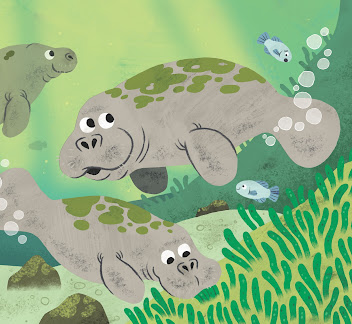
The Manatee's Posterior Power

The book begins with the manatee (which by the way, I had the pleasure of swimming with a few years ago. Unfortunately, the water was a little murky so I didn't get to observe their "posterior power" -- they swim using farts!).


Besides that important piece of information, In the "Extra Booty" section I also learned that manatees' intestines are as long as a bowling alley (65 feet) and as wide as a dollar bill (6 inches in diameter). But wait--there's more! 
Butt Bonus: When manatees are unable to poop because they're constipated, they lose buoyancy control and float with their tails higher than the rest of their bodies. Once they are finally able to poop again, they will let out a massive fart and are then able to swim normally.

I know... you've been waiting all your life to know that about manatees, right?

The Wombat's Posterior Power

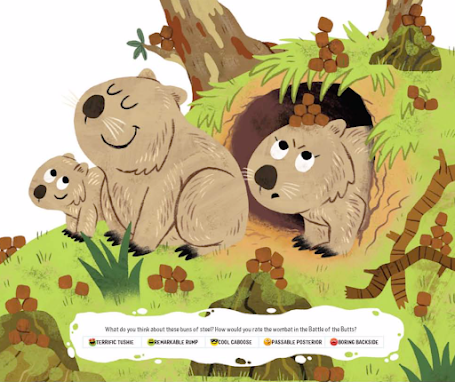
Jocelyn's research took her far and wide. In the process she found the Australian wombat. You'll never guess what their posterior power is so I'll let you in on a secret---their butts are shields that protect themselves and destroy their enemies! 

If a predator manages to push its head into the entrance, the wombat uses its strong legs to slam its butt against the predator's head. Wham! It crushes the predator's skull against the roof the burrow, killing it. That's one deadly derrière!


Not only that, but according to the "Butt Bonus," wombat poop is shaped like cubes. They mark their territory on rocks and logs and the square shape stops the pellets from rolling onto the ground. Pretty amazing, huh?

Whether you want to read more about a turtle who breathes through his butt; herring who communicate through farts ("Bluurp! Hey dude, you're too close to my left, move over a few inches); or the beetle that deploys a chemical poison from his "super soaker butt"--than this is the book for you! Parents, caretakers, teachers--you all will love introducing your pre-school through second grader to these crazily cool creatures. (Uh oh, Jocelyn! Your alliteration is contagious!)

The book ends with a challenge to the kid judges and a glossary highlighting unfamiliar words. Kudos also to artist David Creighton Pester for his clever and colorful illustrations. 

AUTHOR INTERVIEW

In this interview Jocelyn not only shares what's coming up next, but her (very early!) inspiration for writing BUTTS.

CAROL: “Why butts?” Why did you think of this idea in the first place?

JOCELYN: I'm not sure if I should admit this, but I have a pretty terrible Twitter habit. Late one night when I should have been doing something productive (like sleeping!), I was mindlessly scrolling Twitter when I saw an adorable graphic of a manatee that said, “Manatees can control their buoyancy through an endless cycle of farting. There. That’s a thing you know now.” I didn't think that could possibly be true, so I googled, and it was! The best part is the google search also brought up articles about other animals that do weird things with their tushies. From that night of learning funny fanny facts, BATTLE OF THE BUTTS was born!
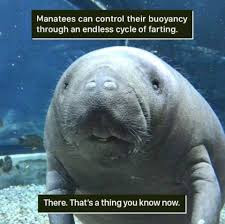

The picture that started it all.
FUN FACT: Jocelyn has been enamored with manatees since she was a kid.

CAROL: How did you pick these ten animals? 

JOCELYN: As I discovered there were other animals out there with remarkable rumps, I started googling things like: "animals with weird butts" and "funny butt abilities" and other silly terms like that. As new animals came up in searches, I added them to my notes. Then I researched each animal further in scientific journals to separate fact from internet legend. When it came time to decide on the final ten animals, I tried to pick a variety of scientific classifications, with different types of booty abilities, and a mix of water and land (there are five of each). But I still have plenty of animals with funky fannies available to make BATTLE OF THE BUTTS NUMBER 2. 😆

CAROL: I love the judging format. How did you come up with that?


JOCELYN: Thank you! As I read about the various fanny facts, I envisioned the animals on stage showing off their tushie talents reality show style, like America’s Got Talent or American Idol. I started playing around with titles like Butts Got Talent or Butt Idol, but those didn’t feel right. When I hit on the alliteration of BATTLE OF THE BUTTS, I immediately knew that was the title. So then I started thinking, if it’s a battle, then there has to be a winner, and if there’s a winner, there should be judges – and of course the kids will be the judges! From there, it was just a matter of hitting up the thesaurus to come up with fun names for each judging category. 


CAROL: The language is very kid-friendly.  Did it take many drafts to get in all the lovely alliteration?  Did you have any kid beta-readers? 


JOCELYN: I’m so glad you think so! It was important to me that along with the funny butt facts that the book also be fun to read out loud. I’m actually an alliteration aficionado (probably too much so!), so it kind of comes naturally as I write. I found lists online of synonyms for butts, farts, and poop (there are a shocking number of alternate potty words!) and kept those beside my thesaurus as I wrote my first draft. Then I sent it to my critique partners, and from their feedback, I did some tightening and tweaking. At that point, I felt ready to query, so it was really only two drafts. 


My cousin’s son loves animals and nature, so he read it for me and found an issue where I said poisonous rather than venomous when talking about the snake, so that was a great catch (Thanks, Colton!). I also read it with my Reading Partners student, having him mark places that made him laugh and places he didn’t understand. That was very helpful for adding words to the glossary. 


CAROL: How has the book been received? Are schools using it? Do you have plans for online curriculum guides? 


JOCELYN: Friends and even strangers on social media have been so sweet about sending me videos of their kids reading BUTTS and giggling. One little girl was laughing so hard she fell over sideways on the couch, which totally made my day. So I think kids are enjoying it like I hoped. 


I participated in World Read Aloud Day with ten schools last month and had such a blast reading with the kids. They asked such insightful questions. And I’m reading with eight more schools next week for Read Across America Day – I can’t wait! I’d love to have a curriculum guide, but I’ll definitely have to outsource that. It’s on my To Do list! 


CAROL: What awards have you won?


For BATTLE OF THE BUTTS, I was thrilled that the Missouri Association of School Librarians included BUTTS on their 2022 Dogwood Book List for Nonfiction.


As for non-BUTTS awards, I’ve been fortunate to win several like the 2020 Book Pipeline YA Unpublished Contest, the 2013 SCBWI WIP Grant for Contemporary Novel for Young People, and the 2009 Highlights Fiction contest. 


It’s because of that last one that I first met you because my prize was tuition to the Highlights Chautauqua summer session! 
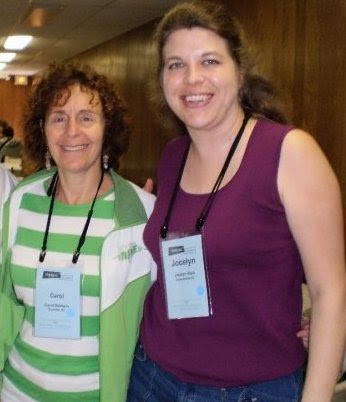

This picture popped up in Jocelyn's FB feed.
I'd forgotten we were there together!


CAROL: What’s next?


The illustrator David Creighton-Pester is currently working his magic again on BATTLE OF THE BRAINS, which is scheduled for release on Nov 8, 2022. It’s about ten animals with mind-blowing brain abilities.


And I’ve pitch my agent and editor several ideas for a third BATTLE book, so fingers crossed. Also, I was inspired by Tara Lazar’s Storystorm with several fiction ideas, one of which I’m currently scribbling about in my notebook. I hope it shapes into something creepy and fun!


GIVEAWAY INFORMATION

No giveaway this time.  I hope my grandkids laugh themselves off the sofa when I read them this book! Congratulations to Joan Edwards who won The View from the Very Best House in Town and to Donna Johnson for winning I Want My Book Back. 

Tuesday, December 28, 2021

The Dirt Book: Poems About Animals That Live Under Our Feet

From the moment you hold The Dirt Book: Poems About Animals that Live Beneath Our Feet (Holiday House, 2021) in your hands, you realize that this is a unique picture book.  After all, how many books do you turn 90 degrees in order to read it? I can only think of one other, Tops and Bottoms by Janet Stevens, which my (now) adult children enjoyed as kids! 

In fact, the award-winning author of The Dirt Book, David L. Harrison, admitted that the brilliant design concept was worked out between his editor and the artist, Kate Cosgrove (scroll down to her October 13th post). "It was a delightful surprise to see the finished book," David said. 

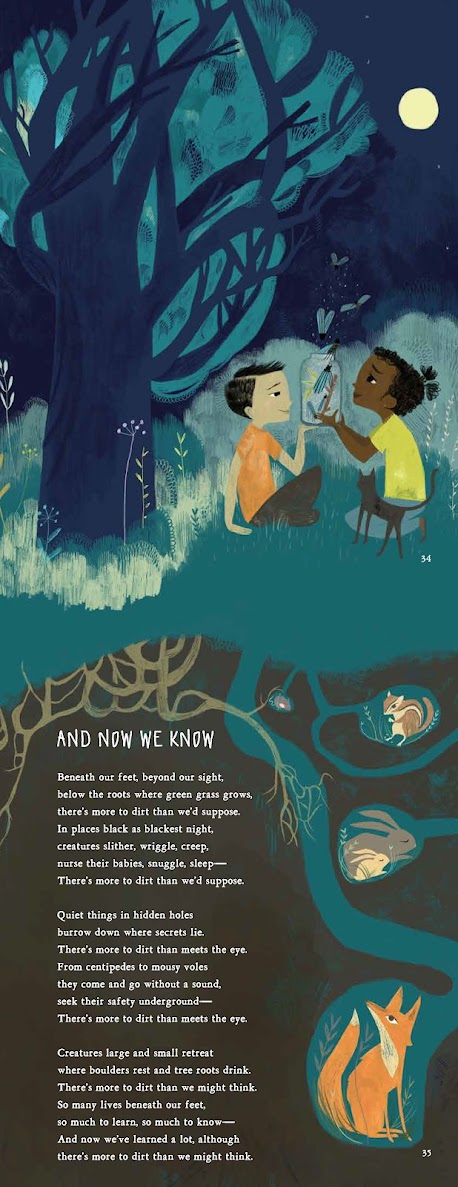
If you haven't yet seen this STEM poetry book, you might wonder what I'm so excited about. The reader's experience is enhanced by poems and images that begin at the top of the page and are carried through to the bottom--which shows what is going on in the dirt. And of course, since David is a poet, he uses different types of poetry to highlight these critters.

REVIEW

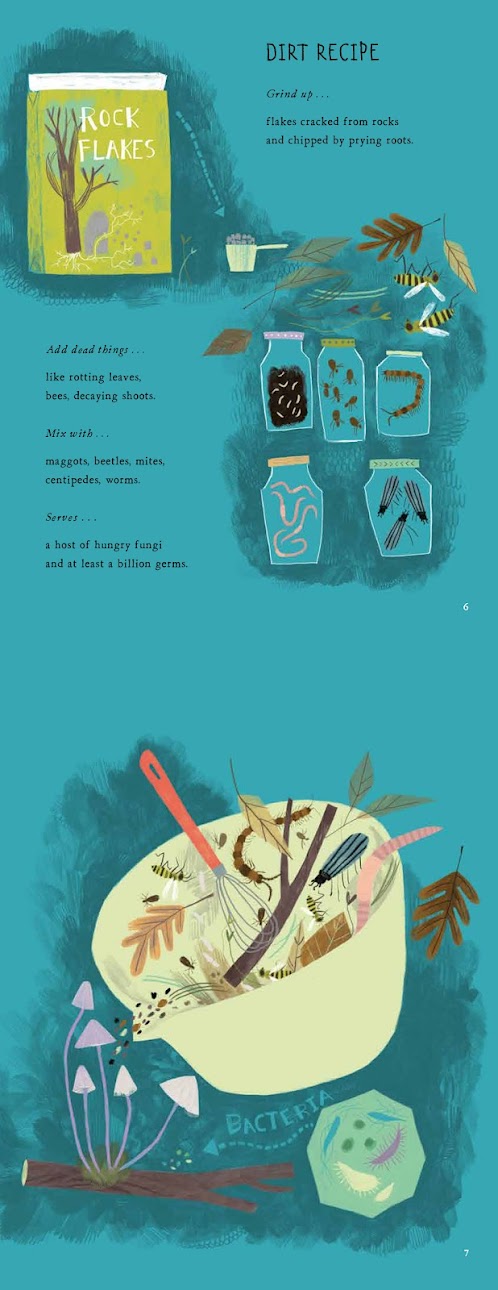
The book begins with a dirt recipe:


(Parents beware: your children may want to try and duplicate this recipe in your backyard!)

What creatures are found in the dirt?

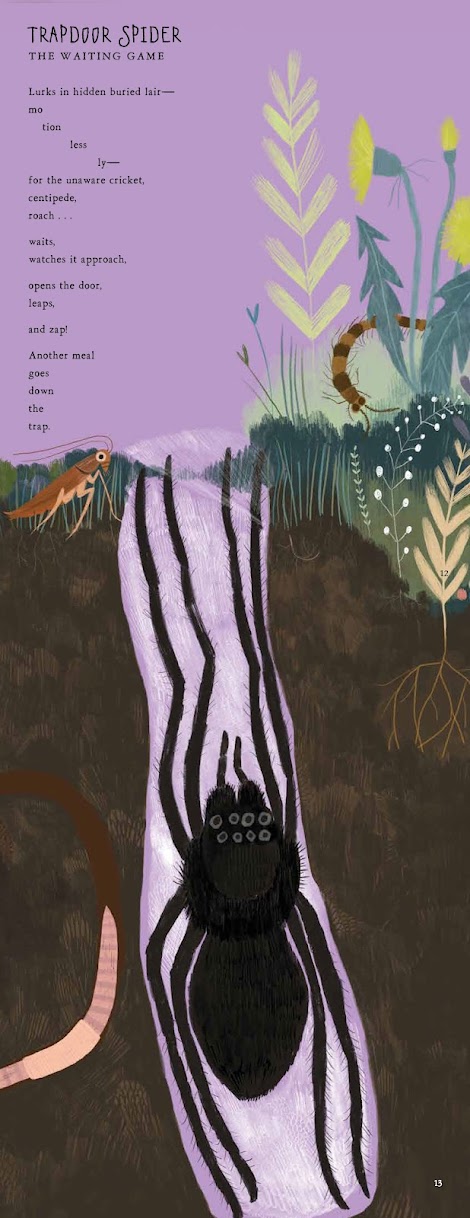
Readers will meet a doodlebug who creates dirt funnels so that ants slide in and become their lunch; a trap door spider, 


and an earthworm who performs dirty work:


Earthworm squiggles,

earthworm squirms,

earthworm dines on 

dirt and germs.


Earthworm dodges,

earthworm weaves,

earthworm nibbles

dear wet leaves.

Earthworm crawls,

earthworm creeps,

earthworm tunnels,

rarely sleeps.

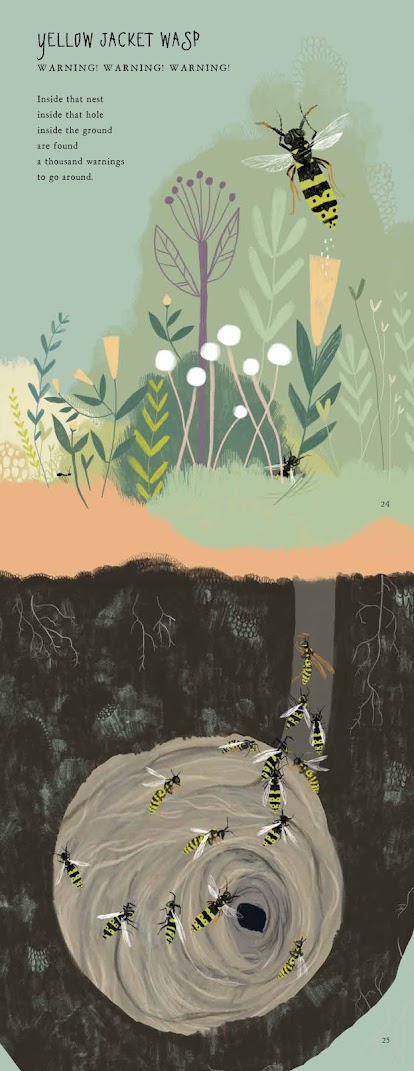
Under our feet are ants that build cities, grubs which kill grass (the immaculate-lawn owner's nemesis!), mice, moles, bees, toads, and... Warning! Warning! Yellow Jacket Wasps.


I love this ending spread with a form of a Tristitia poem:


If you are interested in reading David's inspiration for this book and what he hopes readers will take away from it, please see this interview on Deborah Kalb's blog.


CURRICULUM RESOURCE


Readers from pre-kindergarten through third grade will enjoy the illustrations and poetry. The book will be a great asset to classrooms and homeschool educators. Christian parents and teachers, please be aware that the introduction includes the belief that dirt was formed two million to four billion years ago.

GIVEAWAY

If you would like to enter this giveaway, please leave your name AND EMAIL ADDRESS (if you are new to my blog). Educators and media specialists, include where you work and I'll enter your name twice. If you decide to follow my blog, I'll also throw in an additional chance. U.S. postal addresses only. The giveaway ends on New Year's Day at 12 PM. 


Wednesday, December 30, 2020

Letters From Space: A Picture Book Review and Giveaway

 Former astronaut Clayton Anderson is not a stranger to my blog. I reviewed his previous book A is for Astronaut (also from Sleeping Bear Press).  Letters from Space is just as informative and engaging. As you'll see in the samples below, the illustrations by Susan Batori are full of humor. Kids will laugh out loud as they learn about disposable underwear; food, spiders, and plants in space; and how astronauts fly EVERYWHERE within the space shuttle. 

All of this is communicated through fictional letters "home" to friends, young fans, and family. Because of course, no one has perfected receiving mail from space... yet!


REVIEW


Flight Day 3


In a letter to his mother, Clayton describes his excitement at liftoff. 

It was loud, it was scary, and the entire space shuttle shook like crazy...We went faster and faster, and then--everything went quiet. I started to rise out of my seat. I was weightless!


Flight Day 22

In response to a young fan who just got a puppy, Clayton writes,

We can't have pets in space. It would be neat to have a dog or a cat, but what a mess with no gravity! Where would it go to the bathroom?!


Flight Day 45

Clayton takes a space walk and tells his brother, We were out there for over seven hours and I rode on the robotic arm. I was like one of those guys who fix wires on utility poles. But in SPACE! Man, did I have some great views of the Milky Way and the space station!


Flight Day 125

Clayton shares his favorite foods in space. I love to start my meal with a can of stuff they call "appetizing appetizer." It looks kind of like baby food. Yum. After that I always love a nice can of lamb with vegetables or pork and potatoes. It looks a lot like cat food. Maybe it even smells like cat food But I swear it doesn't taste like cat food.


Flight Day 134

It turns out that when Clayton was little he used to read Superman comic books.  Now that he's in space...he is Superman every day!


Flight Day 148

Clayton is coming home and he's so excited that he's doing flips in space! He writes to his mother, The time has flown by up here (ha ha) and life in weightlessness has been really fun.


End Notes


The book ends with two pages of facts about growing food in space, training to be an astronaut (in a pool!), gravity, teamwork, and lots of other things you didn't know. 

A STEAM book, this will be a great addition to the K-3rd grade curriculum. Not only will children learn science facts, but as Astronaut Anderson says, "Kids LOVE THE LETTER FORMAT. It encourages reading AND writing." 

By the way, most of the names used in the letters are real people in Clayton's life. It was his way of paying tribute to his teachers, college professors, childhood friends, mission control, and his family.


GIVEAWAY


Do you want this book for the child or student in your life? Leave me a comment by January 1 at 6 PM and I'll enter your name. Make sure you leave your email address if you are new to my blog. If you share this on social media (and tell me what you did) I'll enter your name twice. 

THE NIGHT WAR: A MG Historical Novel Review

  By now you should have received an email from my new website about my review of THE NIGHT WAR by Kimberly Brubaker Bradley. (It'll com...