Showing posts with label Talking Story. Show all posts

Wednesday, April 17, 2024

"BUILDING" BOOKS + 4 Giveaways


Talking Story is live! Here is your chance to not only win LET'S BUILD A TRAIN or PRAIRIE BOY but also A GRAND IDEA by Megan Hoyt and NICK AND TESLA by Bob Pflugfelder.


You can access the newsletter here. Read Megan Hoyt's backstory for her picture book about Grand Central Station, find other book recommendations, and discover how to build a roller coaster!

If you're a home school educator or librarian tell me in the comments and I'll enter your name twice! U.S. addresses only. Giveaway ends April 20. 

Wednesday, April 10, 2024

Building Picture Books

 Did I hook you with that title? Did you think this blog post was going to be about how to create a picture book? Homonyms can be clever--and difficult for English language learners! 

In this case, I'm using "building" as an adjective. The spring issue of Talking Story is coming out next week and Rebecca Wheeler and I are featuring books that are about building. We have four great giveaways and I'm introducing two of them here.


LET'S BUILD A LITTLE TRAIN (Sleeping Bear Press: 2022)

This informative yet entertaining picture book written by Julia Richardson and with colorful illustrations by Ryan O'Rourke is for the youngest reader in your home or school. Children will enjoy the simple rhyme, rhythm, and "Chugga Chugga Choo Chooo" which they can chime in with. 

Although the characters and some of the tools are contemporary-looking, the book shows the steps for building a 19th-century steam engine. It begins with this page:


The book shows the men and women who helped build it, some of their tasks, and the different parts of the steam engine. 


The engine pulls a beautiful train as it moves through the countryside.


Two pages of back matter show the history of steam trains, how they work, and photographs that define some of the words used in the book.

Young builders and their teachers and parents will enjoy reading this STEM book together. Writers, you will want to study this book for word choice, structure, and the framework of the story!


PRAIRIE BOY (Astra Publishing: 2019), written by Barb Rosenstock and perfectly illustrated by Christopher Silas Neal is about architecture, history, and dreams. It will educate and inspire an older audience than Let's Build a Little Train; I would recommend it for ages 5-9. 

Frank Lloyd Wright is a name familiar to many of us. Although adults might know him as a famous architect, this childhood-adulthood picture book shows readers (and the adults who read it to them!) what events inspired Wright's famous career. 

As you read this opening, consider Rosentock's use of verbs, alliteration, and shapes, AND how she shows the growth and personality of a young boy in one very tight paragraph:

FRANK WRIGHT TOOK HIS FIRST BREATH ON THE WISCONSIN PRAIRIE. He crawled in the paths of brush-footed butterflies and toddled through waves of tall grass. He skipped past oval milkweed sees, six-sided honeycombs, and trying-face badgers, growing into the kind of boy who wondered...
     
HOW DO BROWN FIELD ANTS
   HIDE IN WHITE QUEEN ANNE'S LACE?

WHEN DOES THE HARVEST MOON
   CHANGE SHAPE?

WHAT MAKES THE PRAIRIE
   FEEL LIKE HOME?


Frank moved five times in seven years and yearned for the "shapes of the heartland." His mother bought him a set of Froebel blocks which fascinated him as he discovered how shapes were connected to one another.

His mother bought him more blocks.

 
As a teenager, Frank began to dream.


He moved to Chicago, studied architecture, and watched as fancy houses went up on flat prairie lots. They reflected Greek Revival, Victorian, and Italian architecture.  Everyone liked them, except Frank.


He wanted to design new kinds of homes that fit new American families. So, that's what he did.


"Like magic, he shook dozens of shapes from his shirtsleeves- ovals, hexagons, triangles, cubes, spheres, and cylinders... He called the Prairie Houses...and spun the shapes he loved into America's homes."

The back matter includes photographs of several famous Frank Lloyd Wright buildings and the plans for Fallingwater; a famous home in Mill Run Pa. 


If I were using this book in the classroom, I would not only ask students to look for figurative language, but I would ask them to cite instances where the text emphasizes shapes. What a wonderful way to pay tribute to an architect who loved shapes. 

GIVEAWAYS!


I am giving away both of these books next week through Talking Story. I'd love it if you subscribed to this quarterly newsletter. You can use the QRC code below or click here to subscribe. If you leave me a comment below, please let me know which book you prefer. If you leave a comment through the newsletter, I'll enter your name twice. As always, if you are an educator, librarian, or a new subscriber to my blog, you will earn an additional chance. U.S. addresses only. The giveaway ends April 20. Make sure you leave your email address if you are new to my blog.


Wednesday, July 12, 2023

THE FATHER GOOSE TREASURY OF POETRY: A Review and Giveaway Through Talking Story

 As promised last week, I'm back again with another marvelous poetry book by Charles Ghigna. But this time, it's not just one poem It is one hundred and one! THE FATHER GOOSE TREASURY OF POETRY (Schiffer Books: 2023) is divided into seven sections. There is one section for each season, plus "Home," "Animals," and "Poetry." In this blog, Charles talks about the process of how he decided which poems to include in the anthology-- as well as his favorite sweet treats.


REVIEW

Charles uses nature themes and a vivid imagination to write poetry that brings smiles to readers of all ages. The way he incorporates sensory imagery makes readers take notice of word choice and world details. 

Take this poem for example:


            White Butterflies

I like to watch the falling snow.

It puts on such a lovely show.

It looks like little veils of lace,

White butterflies upon my face. (p. 37)

I found three types of figurative language in this word picture--how many do you find? Highlight the following phrase for the answer. personification, simile, metaphor).

Or, how about this sing-song poem with its unique way of rhyming? This one reminds me of how Charles listened to music as a child--you can almost hear the music behind his words.

The title itself makes me laugh and the illustrations of trees dancing in the wind compliment the poem perfectly. Look closely at the cloud and goose and you'll see collage elements that illustrator Sara Brezzi incorporated.

"Morning Rain" reminds me of one of my childhood favorites, Robert Louis Stevenson's A Child's Garden of Verses. (Does anyone else remember the "Land of Counterpane"? I was pleased to find out that Charles and I both read this book as children!)


           Morning Rain

Like a shadow

Passing by,

Storm clouds

Fill the morning sky,

From my window

I see wonder,

A lightning strike,

A clap of thunder.

I sit beside

The window pane

And watch the world

Fill up with rain.  (p.21)


Many of Charles' poems are playful,


            Thunder Bugs

On stormy nights

I often wonder,

Do lightning bugs

Make the thunder? (p.59)


Some are thought-provoking:


      Orion's Way


Each evening

he enters

the black forest

of night

and spreads

his star crumbs

across the sky

to find his way

back home.  (p. 29)

And, 


In honor of the Talking Story issue on wordplay, I had to share this one:


       Wild Romance

I love EWE

I'm not LION

I really GOPHER you.

I never GNU this would happen.

You are so DEER to me.

It's more than I can BEAR.

Let us SEAL our love with a kiss.

I will always BEE yours.

I will never have any EGRETS.

You are my one and only GULL.

OWL always love you. (p. 101)


CURRICULUM RESOURCE and GIVEAWAY

Parents, grandparents, teachers, and librarians--don't miss the opportunity to add this book to your collection! It's a wonderful read-aloud as well as an opportunity to teach figurative language.

Leave one comment here for one chance to win this book. Leave another through Talking Story for a second chance. On the far right column, you'll see an email address to enter four giveaways. Click on the link and let me know which book you are most interested in winning. (I try to honor requests-but I can't guarantee what Random.org picks!). U.S. addresses only. The giveaway ends on July 15th.

Congratulations to Gail Cartee who won A Poem is a Firefly from last week's blog.


Monday, June 26, 2023

BRAINSTORM! A Word Play Picture Book + A Giveaway

 Every once in awhile in my "career" as a picture book reviewer, I come across a book and I ask myself, "Why didn't I think of this?" BRAINSTORM! written by Rebecca Gardyn Levington and illustrated by Kate Kronreif is one of those books. From the title, to the puns, poetry, and figurative language on every page--there is A LOT of wordplay going on.  


REVIEW

In the first spread, we find our character feeling stuck.


Like raindrops, words and pictures start dropping into the girl's mind as a storm lets loose.


  An easy breeze... becomes a blast of funny phrases flying past.


Suddenly, there's a word whirlwind!


After stomping around in the mud of ideas and words, (and what writer can't identify with that metaphor!)

 I pounce and play, embrace the storm, as sentences begin to form.


Finally,


It stops. It's over. Done. The clouds float off and out comes...sun.

That's the climax, but there's a wonderful denouement that brings this story full circle.

CURRICULUM RESOURCE

This is a text that kindergarten to second-grade teachers will be able to use in the classroom to encourage young writers. If I were in a classroom, I would first read it out loud and let the class enjoy the rhythm and images. The second time, I would ask students to pick out the figurative language: similes, alliteration, onomatopoeia; as well as great adverbs and adjectives.  It would be fun to discover how many ways the author, illustrator, and the little girl all play with words. 

A fun extension activity would be to ask the students to draw words playing in the same manner in which Kate Kronreif dances them on the page!

LINKS

For a behind-the-scenes look at the book’s backstory, how Rebecca worked with the illustrator and her publishing journey, please see this interview: https://susannahill.com/2022/08/02/tuesday-debut-presenting-rebecca-gardyn-levington/ 


GIVEAWAY

The July issue of Talking Story is on wordplay and I will be giving away this book then. Leave me a comment now and I'll add your name to the giveaway list. Leave a comment through the newsletter (not a subscriber? Click here to subscribe) and I'll enter your name twice. If you’re a teacher or librarian, I’ll enter your name twice. Trust me. This is a book that every writer, caregiver, and teacher should have on her shelf to share with the young readers in her life! U.S. addresses only. I have to approve comments, so be patient if your comment doesn’t appear immediately! 


Thursday, March 16, 2023

MOON TREE: The Story of One Extraordinary Tree-- A Review, Book Journey, and Giveaway

Sometimes authors stumble upon their stories. And even though that story takes time to write, that initial connection remains strong when the book is brought into the world. 

As you'll read in the book journey below, that was the case for Carolyn Fraiser's debut STEM picture book, MOON TREE: The Story of One Extraordinary Tree (Reycraft Books, 2022) illustrated by Simona Mulazzani


REVIEW

Carolyn Fraiser, my SCBWI-Carolinas friend, makes writing a picture book look easy. The text is sparse yet lyrical.  But actually, the process of uncovering the "of course!" structure came only after many revisions. 

The story seems to begin with an ordinary sycamore in an ordinary forest. But actually, here is the true beginning many years before that tree was alive:

One ordinary boy

who dashes among the trees

At home, he watches

war planes soar

in the Oklahoma sky

and dreams that one day 

he will fly. 


He grew up to be...


He became a pilot who races through the skies. He watches others touch space.  Maybe one day, he'll fly even higher.

He does! And becomes,


the one NASA astronaut who packs his bag with seeds to honor the men who rescue trees.

But, back on earth, the container holding the seeds breaks and the seeds scatter. 

Along comes one forest researcher who watches them sprout and,

decides to send the "Moon Trees" to camps, schools, and state forests to celebrate the bicentennial. 


Everyone forgets about the trees until one third-grade girl finds a sycamore at her camp that is "named after the moon." She is curious and encourages her class to find out why it is called a moon tree.


In the end, the girl and the class discover the story of the Moon Tree--the book that your students, kids, or grandkids, will enjoy reading over and over again.  As you can see from the images I've included in this review, Simona Mulazzani's illustrations are out-of-this-world imaginative, and beautiful!

CAROLYN'S BOOK JOURNEY

I spent 20 years writing for adults before I decided to pursue writing for children, and it still took me 10 years to get a book published! Since I had written a lot for adult magazines, I started with children's magazines and had several pieces published. But book publishing was harder. I wrote and submitted many stories before I even started working on Moon Tree. 


I wanted to write Moon Tree from the day I stumbled across our local moon tree at the Cradle of Forestry in Pisgah Forest. I had never heard of the moon trees and the story fascinated me. I spent 6 months diving deep into research. I wasn't sure how to approach the story so I looked at it from every angle I could -- from Stuart Roosa's biography to the history of the Apollo program. I interviewed people with NASA and the US Forest Service, listened to interviews, read tons of newspaper articles, and watched every documentary I could find on the Apollo program. When I came across the story of the 3rd-grade class project, I had the opportunity to interview the teacher, and I knew I wanted to include that angle in my story. But my initial drafts were far from what ended up being published. 

My first draft was close to 1500 words with lengthy sidebars on every page. Then I wrote a fictionalized version from the perspective of the tree. I tried some other angles, but none of them really stuck. Then an agent challenged me to try a lyrical approach, which was more in my wheelhouse than anything else I had been trying. I let the idea simmer for several months before trying again. 

 began to think about each element and person of the story and how if any of those pieces were missing, the story might not have happened or may have been lost to history. That's what gave me the idea of starting with the concept of "one" because each one made a difference -- right down to the third-grade girl. I didn't know if it would work, but it did!   
I literally put all my research away and focused on the essence of the story. What came out was the final version that ended up in print

Rejections? Oh, there were A LOT! I think I had about 50 rejections from this manuscript alone, but most were from early versions of the story. Once I had the final version, I saw interest pick up almost immediately. 

I had been familiar with Reycraft from my research with various publishers and friends who had published through them. I had been selected for a mentorship with Vivian Kirkfield who convinced me that the version I had was ready to go out. I think I put the pitch out there for a few Twitter pitch contests. A friend saw it and thought it would be a good fit for Reycraft. She suggested that I submit it to them, so once I got the green light from Vivian, I did. 

A BOOK WITH KID APPEAL


As you know, I love giving books to my grandkids. MOON TREE is one that I'm sure will be read over and over again. The boys loved counting all the trees! And of course, my granddaughter insisted on reading it herself. 


GIVEAWAY

Reycraft is donating a copy of MOON TREE. I'm giving it away through the spring issue of the Talking Story newsletter. Leave a comment with your email address if you are new to my blog and I'll add your name to the giveaway list. A winner will be chosen on April 17th. U.S. addresses only. If you are an educator, decide to follow my blog, or also leave a comment through the newsletter, I'll enter your name twice.

Monday, February 27, 2023

A HISTORY OF TOILET PAPER (AND OTHER POTTY TOOLS): A Review and Giveaway

 If this is not a title and cover that will grab your attention--I'm not sure what will!


Sophia Gholz is no stranger to my blog. I have reviewed BUG ON THE RUGJACK HORNER, DINOSAUR HUNTER; and THE BOY WHO GREW A FOREST. But I must say, A HISTORY OF TOILET PAPER (Running Press Kids, 2022) is different from all of her other books. The book includes facts that curious kids will love, humorous illustrations by Xiana Teimoy, and witty word play.

In the beginning, potty time meant the great outdoors, with stones and seashells, grass, moss, leaves, and water or snow. 

Technology advanced from there to,


Potty tools changed over time.

Sophia gathered all sorts of facts which will grab the interest of everyone from potty-training toddlers to their older brothers and sisters:

  • The Romans pottied in public and didn't mind sharing tesorium (bum brushes). 
  • A Chinese inventor, Cai Lun, created paper in the first century. But it took a thousand years before the imperial family figured it was not only good for writing documents, but also suitable for wiping one's rear end. 
  • The first flushing toilet was invented by Sir John Harrington. But,

(Did you catch the word play?)

  • Across the pond, colonists found that corn as well as the Farmer's Almanac were useful outhouse accessories.
  • Less than two hundred years ago, Joseph Gayetty's invention of medicated wipes were not well received. You could say they went down the drain
  • It wasn't until the close of the 19th century that perforated toilet paper became a common household item--courtesy Clarence and E. Irvin Scott brothers


In the end, Sophia Gholz concludes,

...whether you prefer your potty to be fancy, simple, shared, private, or in the great outdoors--or whether you have paper, grass, sticks, or water--when it's time to go, it's time to go.

                                                    ****

I bet if you watch this trailer with a child, she'll beg for the book. 


For the backstory about this clever and informative book (that includes Covid and toilet paper shortages), see Kathy Temean's interview with Sophia.

GIVEAWAY

I'm giving away a copy of this book through the April issue of Talking Story which is on Change. As you can see from the trailer and my review, there is a lot of historical change shown in this nonfiction picture book! Leave me a comment and I'll add your name to the giveaway list; the winner will be drawn in mid-April. If you're an educator you will have two chances, if you enter through Talking Story you'll also have two chances. U.S. postal addresses only.  If you are new to my blog, please make sure to include your email address!

Sunday, January 22, 2023

A CONVERSATION WITH MARGRIET RUURS and a GIVEAWAY

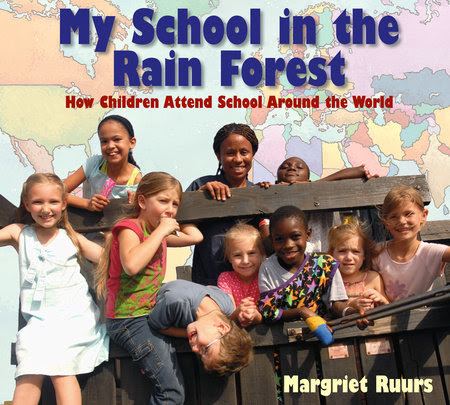
 Margriet Ruurs was the author expert in the recent issue of Talking Story on "Libraries Without Walls." She has published a plethora of nonfiction picture books so I decided to ask her a few more questions. Here are her answers as well as a chance to win one of her award-winning books, My School in the Rain Forest.


INTERVIEW

CAROL: How did publishing My Librarian is a Camel impact your writing career?


MARGRIET: It’s funny. I loved having Boyds Mills Press as a publisher. They did several of my other books since then. But I had this particular manuscript rejected several times. In the end, it has become one of my most successful books so I learned to never give up, to keep submitting, and to believe in your writing. This book also led to many speaking opportunities because of its topic. And I’m passionate about books and libraries so I loved the ride.

CAROL: Can you speak about the global nature of your books? What inspires you? 

MARGRIET: Travel has enriched my life. I travel the world, mostly to speak at International Schools where students speak or learn English but come from a wide variety of backgrounds, different cultures, and countries. I learn much from these kids when I meet them and often they will inspire stories. Meeting kids in Pakistan, Mongolia, in Israel made me realize how similar we are, and how we share the same values and needs despite our different religions or customs. This made me write books like Families Around The World and Where We Live. I hope that these books help to bring awareness and respect for people who are different from what we know.


Margriet sharing books in Mongoloia.

CAROL: Can you talk about how your books are used in classrooms? Was that always your vision as an author?

MARGRIET: Because I spend a fair amount of time in schools as visiting author, and conduct writing workshops in classes, I know that books can be much more than ‘just a story’. I also hope that my books are not just entertainment for a short while, but that they help kids to grow and expand their knowledge. Books truly can be ‘windows on the world’. So adding teaching materials, supplementing with activities and ideas for busy teachers, can really help to increase the value of a book. 

I have often put classes in touch with each other around the world so that they can become pen pals and exchange information about their countries and their daily lives.

But also following an author visit, students will better appreciate the process that goes into the making of a book. How long do you do research? Which sources are reliable? I love telling students about the many years it took me to collect information and images for My Librarian is a Camel, and how I did not give up when it took years to get the actual information from a remote country where the librarian did not speak English. Students need to learn about online research and how to differentiate between reliable and unreliable resources.

My book Stepping Stones is about refugees and was illustrated in stones by an artist in Syria. Many schools have used it to make art from rocks and other natural objects. But also to write biographical stories. It has been used widely as a fundraiser and raised more than $100,000 for refugees.

I also have quite a few books about animals and wildlife (Wild Babies, Amazing Animals, and more). I love showing students how to make sure their information is correct and how to put information in a format to which the reader can relate. For instance, in Amazing Animals, I tell the reader how much the heart of a Blue Whale weighs. But how do you imagine what 400 pounds look like? When you tell the reader that the heart of a Blue Whale is the same size as a mini-van, or that a newborn black bear is the same size as a stick of butter… that is something a kid can picture, and thus it makes more of an impact.

Stories can also focus on real-life experiences. One of my books is called The Elephant Keeper. The publisher used an interesting format for this nonfiction picture book. They turned the picture book into chapters. The main story is about a young Kenyan boy who feared elephants but grew up becoming a much-respected elephant caretaker in an elephant orphanage I visited. The main story is illustrated with beautiful art. This is interspersed with facts about elephants where photos are used. So this book become a format that works on many different levels, in the classroom and beyond.

CAROL: What’s next?

MARGRIET: I’m working on all sorts of exciting projects, including picture books about each continent. I always have writing on the go. I love being able to follow my own interests and getting kids excited about research and writing. Besides working on manuscripts, I interview a Canadian writer or illustrator for a regular column in a magazine that goes to all schools in Canada. I also review books with global appeal for The International Educator, a print and online publication for educators at International Schools. 


Margriet with Dashdondog Jambyn who ran Mongolia’s mobile library
 and wrote many beloved books in Mongolian.

GIVEAWAY

Astra Publishing is donating a copy of My School in the Rain Forest to one fortunate winner. To enter, leave me a comment by January 26. Make sure you leave your email address and name if you are new to my blog. BONUS: Educators and librarians get an extra chance! U.S. address only.

Don't panic if you don't see your comment published immediately. It will publish after I approve it. 

Saturday, September 24, 2022

EVICTED! The Struggle for the Right to Vote: A Middle Grade Picture Book Review, A Giveaway, PLUS MORE!

Every once in a while you read a book and feel the passion that the author brings to the topic. That is the way EVICTED! (Calkins Creek, 2022) struck me. This upper-level narrative nonfiction will be a welcome addition to classrooms when studying African American history and civil rights.  I have featured both the author, Alice Faye Duncan, and the illustrator, Charly Palmer, in previous posts. Click here for a review of Alice Faye's book, A Song for Gwendolyn Brooks, and click here for Charly's illustrations in The Teachers March!


REVIEW

EVICTED! opens with a not-to-be-missed page of Acknowledgments. Ms. Duncan writes, "In 2006, Ernest Withers gifted me a photography book about the Tent City Movement. His images demanded that I write about this history for young people."

Here is one of the pictures from that album:


Now you know exactly why Ms. Duncan interviewed farmers and activists in order to bring this story to life. 

EVICTED! is bookended by the life of James Junior Jamerson.  The narrative begins with Prologue to Freedom. "This is the story of a battle, a boy, and his broken-hearted blues." Following this introduction, the reader meets the people who were important in the story of Tent City. Charly Palmer's illustrations begin the story. 


Each page is a different vignette telling what led up to the creation of Tent City and what happened afterward. Here are some highlights from those events.
  • In 1959 there were no black jurors to serve in the trial of a Black man wrongfully accused of murder. Farmer John McFerren realized that justice was in the ballot box--and Blacks needed to register to vote. 
  • After Harpman Jameson came home from serving in WWII and wasn't allowed to vote he said, "'A man and woman don't have no country if they don't have no vote.""
  • In 1959 "Entire families were forced out their homes when Black parents registered to vote in Fayette County."
  • In 1960 Mary and Earlie B. Williams were the first family to move into a tent on Papa Towles' land. As more Blacks registered to vote, more were evicted from their homes. "Tent City" was named by TV broadcasters and national newspapers.

"Their hiding place was a cross of unmerited suffering."

https://www.memphis.edu/tentcity/moving-shacks-tents.php

  • In 1962 after John Doar of the Justice Department's Civil Rights Division filed a lawsuit to block white landowners from evicting Black sharecroppers, the landowners finally agreed to stop evictions. 
  • In 1964 Black voters cast their ballots while white locals stuffed the ballot boxes with illegal votes. In spite of that, the work for equality pushed forward. 
  • In 1965 President Lyndon Johnson signed the Voting Rights Act. "Black Americans voted in record numbers and won political seats."
James Junior is a grandfather now. "He says the past is the present, and it is urgent they [his grandchildren] understand, 'Every life is a battlefield and freedom is a golden prize.'"

The Epilogue concludes with, 
Despite his young age, James Junior served the freedom struggle with conquering faith and courage. He accepted the charge to rise and change history for good.  

Today--it is your turn.

                    Now is your time. 

Back matter includes photographs, a detailed timeline, resource guide, and bibliography. 

Viola McFerren talks about sharecropping and living in Tent City. 


ON A PERSONAL NOTE

I am drawn to this book for many reasons. When I set out to write Half-Truths I wanted to write a book that explored what led up to the civil rights period in my "own backyard"--Charlotte, NC. (Early on Harold Underdown pointed out that this was only the historical setting of my novel--not the book itself. That is another story.) In a graphic manner, EVICTED! uncovers an important part of what led up to the civil rights movement in Alice Faye's own "backyard." As a writer, I'm drawn to narrative nonfiction and enjoy learning how other authors master this genre. 

MINI-AUTHOR INTERVIEW

CAROL: Since you grew up in Memphis not far from Fayette County, were you aware of Tent City as a child or teenager?    


ALICE FAYE: Nope.  Not at all. Ironically, I visited Fayette County often as a child because my Great Uncle Buck and Great Aunt Boots lived in the community. They were former sharecroppers and both were dead by 1979 when I was in middle school. So, Tent City was not a discussion that I ever had with them. I was not astute enough at that time to broach such a conversation. I regret that today. Wisdom comes slowly. 


CAROL: How did you decide on the written format of narrative plus free verse poetry? 


ALICE FAYE: For children, I think that tragic and painful histories are shared best in the form of poetry and music. Poetry like blues music is optimism in the face of adversity. 


CAROL: Was that combination your vision from the beginning? 


ALICE FAYE: The combination of poetry with prose was my vision. It is a form that I originated for myself in 2018 when I wrote MEMPHIS, MARTIN AND THE MOUNTAINTOP.  I will use this form again in my new book, CORETTA'S JOURNEY--THE LIFE AND TIMES OF CORETTA SCOTT KING (Calkins Creek/ September 2023). 


GIVEAWAY

Alice Faye is the author expert in the fall issue of Talking Story on Voting Rights. She also provided a classroom activity. Leave one comment here and you'll be entered once to win EVICTED! Leave a second comment through the newsletter and you'll be entered a second time. To subscribe to the newsletter, click here. Educators and librarians automatically have their name entered twice. PLEASE LEAVE YOUR NAME AND EMAIL ADDRESS IF YOU ARE NEW TO MY BLOG. If you prefer, you can email me. Giveaway ends October 8. U.S. addresses only. 

Congratulations to Terri Michels who won the four-book set of Jalen's Big City Life.

                                                *******

Click on over to Greg Pattridge's awesome Always in the Middle blog post on Monday for a new list of great MG books.


THE NIGHT WAR: A MG Historical Novel Review

  By now you should have received an email from my new website about my review of THE NIGHT WAR by Kimberly Brubaker Bradley. (It'll com...