
Margriet Ruurs was the author expert in the recent issue of Talking Story on "Libraries Without Walls." She has published a plethora of nonfiction picture books so I decided to ask her a few more questions. Here are her answers as well as a chance to win one of her award-winning books, My School in the Rain Forest.
INTERVIEW
CAROL: How did publishing My Librarian is a Camel impact your writing career?
MARGRIET: It’s funny. I loved having Boyds Mills Press as a publisher. They did several of my other books since then. But I had this particular manuscript rejected several times. In the end, it has become one of my most successful books so I learned to never give up, to keep submitting, and to believe in your writing. This book also led to many speaking opportunities because of its topic. And I’m passionate about books and libraries so I loved the ride.
CAROL: Can you speak about the global nature of your books? What inspires you?
MARGRIET: Travel has enriched my life. I travel the world, mostly to speak at International Schools where students speak or learn English but come from a wide variety of backgrounds, different cultures, and countries. I learn much from these kids when I meet them and often they will inspire stories. Meeting kids in Pakistan, Mongolia, in Israel made me realize how similar we are, and how we share the same values and needs despite our different religions or customs. This made me write books like Families Around The World and Where We Live. I hope that these books help to bring awareness and respect for people who are different from what we know.
 |
Margriet sharing books in Mongoloia. |
CAROL: Can you talk about how your books are used in classrooms? Was that always your vision as an author?
MARGRIET: Because I spend a fair amount of time in schools as visiting author, and conduct writing workshops in classes, I know that books can be much more than ‘just a story’. I also hope that my books are not just entertainment for a short while, but that they help kids to grow and expand their knowledge. Books truly can be ‘windows on the world’. So adding teaching materials, supplementing with activities and ideas for busy teachers, can really help to increase the value of a book.
I have often put classes in touch with each other around the world so that they can become pen pals and exchange information about their countries and their daily lives.
But also following an author visit, students will better appreciate the process that goes into the making of a book. How long do you do research? Which sources are reliable? I love telling students about the many years it took me to collect information and images for My Librarian is a Camel, and how I did not give up when it took years to get the actual information from a remote country where the librarian did not speak English. Students need to learn about online research and how to differentiate between reliable and unreliable resources.
My book Stepping Stones is about refugees and was illustrated in stones by an artist in Syria. Many schools have used it to make art from rocks and other natural objects. But also to write biographical stories. It has been used widely as a fundraiser and raised more than $100,000 for refugees.
I also have quite a few books about animals and wildlife (Wild Babies, Amazing Animals, and more). I love showing students how to make sure their information is correct and how to put information in a format to which the reader can relate. For instance, in Amazing Animals, I tell the reader how much the heart of a Blue Whale weighs. But how do you imagine what 400 pounds look like? When you tell the reader that the heart of a Blue Whale is the same size as a mini-van, or that a newborn black bear is the same size as a stick of butter… that is something a kid can picture, and thus it makes more of an impact.
Stories can also focus on real-life experiences. One of my books is called The Elephant Keeper. The publisher used an interesting format for this nonfiction picture book. They turned the picture book into chapters. The main story is about a young Kenyan boy who feared elephants but grew up becoming a much-respected elephant caretaker in an elephant orphanage I visited. The main story is illustrated with beautiful art. This is interspersed with facts about elephants where photos are used. So this book become a format that works on many different levels, in the classroom and beyond.
CAROL: What’s next?
 |
Margriet with Dashdondog Jambyn who ran Mongolia’s mobile library and wrote many beloved books in Mongolian. |
GIVEAWAY
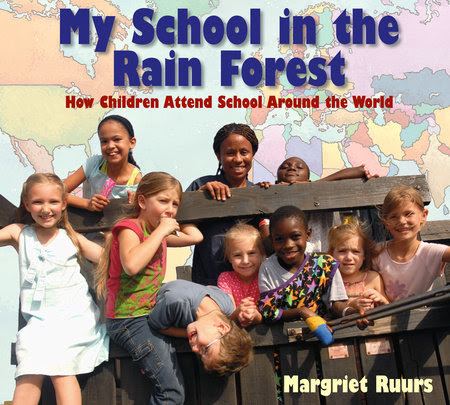
Astra Publishing is donating a copy of My School in the Rain Forest to one fortunate winner. To enter, leave me a comment by January 26. Make sure you leave your email address and name if you are new to my blog. BONUS: Educators and librarians get an extra chance! U.S. address only.
Don't panic if you don't see your comment published immediately. It will publish after I approve it.


