Showing posts with label perseverance. Show all posts

Friday, January 27, 2023

On Submission


This post has been a long time coming. About 16 years long. There have been times when I thought I was ready to submit my middle-grade novel, HALF-TRUTHS. But now I KNOW it. 

IN THE BEGINNING

From the beginning, I imagined a story about a white girl and a light-skinned Black girl discovering that they were second cousins. That premise, which consistently elicits a "WOW!" response, has remained the same throughout my book journey.  

Having written dozens of articles and two nonfiction books, (Friendship Counseling, Teaching the Story: Fiction Writing in Grades 4-8)  I had confidence in my writing skills. But I knew nothing about writing fiction. It felt like jumping into deep water without knowing where I'd find the bottom. 


I wanted it to be a pre-civil rights story but Harold Underdown, my mentor at a Highlights Foundation workshop in 2009, informed me that was only the setting. For years I wrestled to answer the question he posed: What does your character want

EVERYONE HAS A STORY 

In the summer of 2007, I started thinking about my story and began interviewing "experts." My friend and mentor, Joyce Hostetter, encouraged me to research far and wide. What was happening in the world? In North Carolina? In Charlotte? She suggested that I find people who lived in the area and listen to their histories. Since I was just discovering my story, those initial interviews were broad. It's funny to reread them and see some of the questions I asked. 

Even though I often got off track and wanted to include every story I heard--I absorbed a time and place that was new to me. (In a future post I'll share some of the stories that I wanted to include but didn't.) 

I'm working on my 20+ page bibliography which includes 100 expert interviews. Some interview notes are less than a page. One of my experts is a man who graduated high school the same year my protagonist was in middle school. His notes are over 90 pages. Skimming through these interviews, I found details that made it into my story. I'd forgotten where and how I learned things such as what was served for lunch in the school cafeteria, the Black help's relationship with their employers, what it felt like to sit at the back of the bus, the used books and sports uniforms passed to the Black schools, the discussions about school integration, the peasant dresses worn to dances. You name it. It's one thing to read about these things in history books. It's another thing to have someone tell you how they felt as they experienced Jim Crow and/or chose not to become a debutante. 


Dorothy Counts, one of my experts, walking to Harding High School in 1957.
She was the first Black to attend the school.  
The photo originally appeared in The Charlotte Observer. 

People often wonder how I found these experts. I learned to ask everyone, "Who else should I talk to?". Tom Hanchett, Charlotte's local historian recommended several individuals. Others were patients of my dentist husband who were long-time Charlotteans. Others were parents of friends. These became my experts whose stories were woven together to create Half-Truths.

WHERE DID I FIND THIS STORY?

As the (working) title indicates, this book is about secrets and "white lies." Ben Franklin wrote in the Farmer's Almanac in 1758, "Half a truth is often a great lie." Over the years, I've thought about the secrets that people choose to conceal or at least, not talk about. I've often wondered what effect that has on the following generations.  As a Christian, I'm committed to telling the truth as commanded in the ninth commandment: "Thou shalt not bear false witness." As I wrote this novel, I had to think about my own "little" half-truths that I tell, and the reasons for them.

One elderly woman, a former debutante, suggested that I not pry into Charlotte in the 1950s and instead, write about my own life. (Who would want to read about growing up in South Jersey? Boring!) I was fascinated by my adopted new hometown and walked and biked around South Park and Myers Park thinking, "What is the story that could have happened here?" When I visited the former Rosenwald School in Grier Heights and saw the picture of a light-skinned Black principal, I found a key part of my story.

Billingsville School in Grier Heights. 
Now a community center. 

JOURNEY HIGHLIGHTS 

 INovember 2008, following Joyce's advice, I joined NaNoWriMo for the first time. I didn't feel ready, but it helped me create a first draft.

Pretty soon I realized that I didn't know what I didn't know. I attended workshops and webinars, conferences, and classes. I read books and blogs on plotting, conflict, and character; participated in several critique groups, and received critiques from industry professionals. Throughout this time, my best writing buddy, Linda Phillips, and Joyce encouraged me, asked me pointed questions, and provided feedback.


From the left: Joyce Hostetter, myself, and Linda Phillips
 at a writer's retreat in 2011.


But why did it take 16 years? First, I spent a long time trying to figure out where the story began. HALF-TRUTHS takes place in 1950, but at one point I started it with the protagonist's father in WWII. Not even close to the inciting event--which I didn't know a novel needed! 

Despite the fact that I wrote several outlines, I kept getting off track. Whenever I heard a feasible suggestion, "Someone should die," or, "Write it from the points of view of both girls," or, "Include romance," I spent time incorporating these ideas and going down rabbit holes of research. Combine that with going back and forth on whether or not this was a young adult or middle-grade book, I often strayed from my original vision: two girls--one white, one Black, discovering they are related. 

Enter Rebecca Petruck.  Rebecca critiqued several drafts and offered great insight into character arcs, plot points, and internalization. After I had spent a lot of time writing boyfriends for each main character (when I was thinking HALF-TRUTHS was a young adult book), Rebecca told it to me straight. I had lost the essence of the story--the girls' relationship.  


Rebecca helped me construct a plot chart in October 2013. 
I learned about Save the Cat! for the first time.

Since all of my readers were saying the book sounded more middle-grade, I ditched the boyfriends and the young adult genre. Along the way, I continued to interview folks and read and review middle-grade books. I particularly enjoyed Kathy Weichman's historical novels. Winner of the first Grateful American Book Prize, Kathy used to joke that she is the poster child for perseverance. I think I might be tying her for that distinction. 

Joyce Hostetter and I have swapped manuscripts over the years. Last February she suggested that I hire an editor to bring the book to the next level. I asked several trusted professionals in the Kidlit community for recommendations and found Deborah Halverson. She is a treasure.

In June 2022, I shared one page from Deborah's comprehensive editorial letter. For the next six months, I worked on incorporating her suggestions. I took out Kate's free verse poetry and changed it to journal-type entries in her steno pad. This fits Kate's goal of becoming a journalist. I worked on more youthful language, made Kate the instigator for the major change in her life, tightened the ending, and strengthened the City Girl vs. Country Girl motif as Rebecca had suggested years ago--but I'd forgotten!

In other words, I revised. A few weeks ago I was rewarded with these words from Deborah: 

In this revision, I feel you have accomplished your goals with this project, creating an entertaining, enlightening, compelling, and satisfying story for middle graders. I believe young readers will connect with Katie immediately and root for her throughout. Her growth is inspirational, showing the triumph of a flawed but earnest young person. 


Deborah's words gave me a boost of confidence that finally brought me to the...


of this stage. But it is also the beginning of an exciting time--being on submission!

WHAT'S NEXT?

For my friends and family who are reading this and aren't writers, you may be wondering what happens next. Remember those conferences and webinars I mentioned? At each one, I collected the names of agents and editors who expressed interest in the manuscript. Many said they didn't care how long it took. They just wanted to see it when it was the best I could make it. 

Now I take out that list, organize it through Query Tracker, and start sending out the manuscript.

If you are a writer, how did you feel when you began submitting your work? Please share your experiences in the comments. 

GIVEAWAY

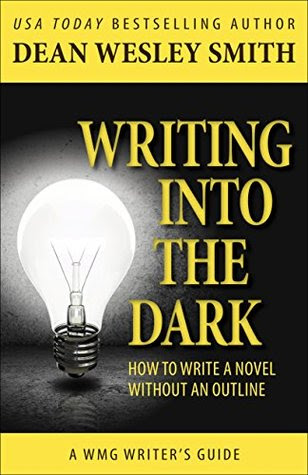
Obviously, I don't have a copy of Half-Truths to give away, but I'm cleaning off my bookshelves to make room for the books I'll need for my next project. Over the last 16 years, I learned that I'm definitely a plotter, rather than a panster. For those of you who abhor outlines, I'm giving away my (slightly marked-up) copy of WRITING INTO THE DARK. Leave me a comment with your email address by February 1 and it could be yours.


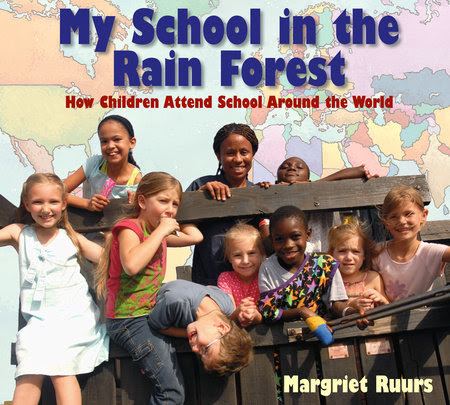
Congratulations to Emily Weitz who won MY SCHOOL IN THE RAIN FOREST.

Please take a minute to see views about other middle-grade books on Greg Pattridge's Always in the Middle blog.


Sunday, January 22, 2023

A CONVERSATION WITH MARGRIET RUURS and a GIVEAWAY

 Margriet Ruurs was the author expert in the recent issue of Talking Story on "Libraries Without Walls." She has published a plethora of nonfiction picture books so I decided to ask her a few more questions. Here are her answers as well as a chance to win one of her award-winning books, My School in the Rain Forest.


INTERVIEW

CAROL: How did publishing My Librarian is a Camel impact your writing career?


MARGRIET: It’s funny. I loved having Boyds Mills Press as a publisher. They did several of my other books since then. But I had this particular manuscript rejected several times. In the end, it has become one of my most successful books so I learned to never give up, to keep submitting, and to believe in your writing. This book also led to many speaking opportunities because of its topic. And I’m passionate about books and libraries so I loved the ride.

CAROL: Can you speak about the global nature of your books? What inspires you? 

MARGRIET: Travel has enriched my life. I travel the world, mostly to speak at International Schools where students speak or learn English but come from a wide variety of backgrounds, different cultures, and countries. I learn much from these kids when I meet them and often they will inspire stories. Meeting kids in Pakistan, Mongolia, in Israel made me realize how similar we are, and how we share the same values and needs despite our different religions or customs. This made me write books like Families Around The World and Where We Live. I hope that these books help to bring awareness and respect for people who are different from what we know.


Margriet sharing books in Mongoloia.

CAROL: Can you talk about how your books are used in classrooms? Was that always your vision as an author?

MARGRIET: Because I spend a fair amount of time in schools as visiting author, and conduct writing workshops in classes, I know that books can be much more than ‘just a story’. I also hope that my books are not just entertainment for a short while, but that they help kids to grow and expand their knowledge. Books truly can be ‘windows on the world’. So adding teaching materials, supplementing with activities and ideas for busy teachers, can really help to increase the value of a book. 

I have often put classes in touch with each other around the world so that they can become pen pals and exchange information about their countries and their daily lives.

But also following an author visit, students will better appreciate the process that goes into the making of a book. How long do you do research? Which sources are reliable? I love telling students about the many years it took me to collect information and images for My Librarian is a Camel, and how I did not give up when it took years to get the actual information from a remote country where the librarian did not speak English. Students need to learn about online research and how to differentiate between reliable and unreliable resources.

My book Stepping Stones is about refugees and was illustrated in stones by an artist in Syria. Many schools have used it to make art from rocks and other natural objects. But also to write biographical stories. It has been used widely as a fundraiser and raised more than $100,000 for refugees.

I also have quite a few books about animals and wildlife (Wild Babies, Amazing Animals, and more). I love showing students how to make sure their information is correct and how to put information in a format to which the reader can relate. For instance, in Amazing Animals, I tell the reader how much the heart of a Blue Whale weighs. But how do you imagine what 400 pounds look like? When you tell the reader that the heart of a Blue Whale is the same size as a mini-van, or that a newborn black bear is the same size as a stick of butter… that is something a kid can picture, and thus it makes more of an impact.

Stories can also focus on real-life experiences. One of my books is called The Elephant Keeper. The publisher used an interesting format for this nonfiction picture book. They turned the picture book into chapters. The main story is about a young Kenyan boy who feared elephants but grew up becoming a much-respected elephant caretaker in an elephant orphanage I visited. The main story is illustrated with beautiful art. This is interspersed with facts about elephants where photos are used. So this book become a format that works on many different levels, in the classroom and beyond.

CAROL: What’s next?

MARGRIET: I’m working on all sorts of exciting projects, including picture books about each continent. I always have writing on the go. I love being able to follow my own interests and getting kids excited about research and writing. Besides working on manuscripts, I interview a Canadian writer or illustrator for a regular column in a magazine that goes to all schools in Canada. I also review books with global appeal for The International Educator, a print and online publication for educators at International Schools. 


Margriet with Dashdondog Jambyn who ran Mongolia’s mobile library
 and wrote many beloved books in Mongolian.

GIVEAWAY

Astra Publishing is donating a copy of My School in the Rain Forest to one fortunate winner. To enter, leave me a comment by January 26. Make sure you leave your email address and name if you are new to my blog. BONUS: Educators and librarians get an extra chance! U.S. address only.

Don't panic if you don't see your comment published immediately. It will publish after I approve it. 

Tuesday, February 8, 2022

TWO FUN PICTURE BOOKS with IMPORTANT MESSAGES: ROCK AND VOLE and WHERE'S MY COW?

 I recently attended a webinar "Feel the Feelings: Crafting Picture Books" with Bethany Hegedus, author and founder of The Writing Barn. As a result, Social and Emotional Learning (SEL) is front and center in my brain.  Bethany emphasized that readers should be able to take away kindness, empathy, understanding, bravery, and inclusion after reading picture books. 

Here are five SEL components: 

            • Self-Management
            • Social Awareness
            • Relationship Skills
            • Responsible Decision-Making
            • Self-Awareness

Pay attention to these--because there will be a test!

Without further ado, here are two picture books from Sleeping Bear Press.

ROCK and VOLE 


Author-illustrator Jennifer Sattler is no stranger to my blog. Her illustrations are dynamic and there's always a cleverly disguised "message" within a playful story that children will understand--without being preached to.

Here's the first page:


Vole, (like many of us) followed her comfortable, predictable routine. 

But, one day when she woke up, she wanted something different--she
wanted an adventure!

In her organized fashion, 


She set off, backpack ready with all of her essentials, and everything went according to plan. Until she met,


Rock. 

Vole tried everything to get the rock to move out of her way so she could complete her adventure. She talked to it. She showed it her map. She tried to cajole it.


Nothing worked.

Until the sun started setting and Vole realized that the rock was lovely.
 

After Vole redid her map, she rested against the rock.


Which SEL skills does Jennifer Sattler subtly communicate to the reader in ROCK AND VOLE? Leave me your thoughts in the comments.

WHERE'S MY COW?


This fun picture book was inspired by author, Susan Blackaby's observations of the symbiotic relationship between egrets and cows. The dynamic illustrator, Scott Brundage was featured on my blog here

Here is the opening spread:


When the flock of egrets whirled off to explore the sea, one little egret preferred sticking close to his cow.

While the egrets were gone, the cow told him stories about the places she'd seen and the food she'd eaten. All the talk about kites and kayaks and toasted marshmallows gave the little egret ideas. With his cow encouraging his explorations, the egret flew off and found a view of the ocean that took his breath away!

But, he looked down, saw the herd far below and thought, 

"Where's my cow?"
Queasy, the egret gulped.
Sputtered. Plunged.
Ker-thump.

Fearing he'd never find his cow, he wouldn't fly far from home.

His cow encouraged him to try again and look for the cow with twitching ears.

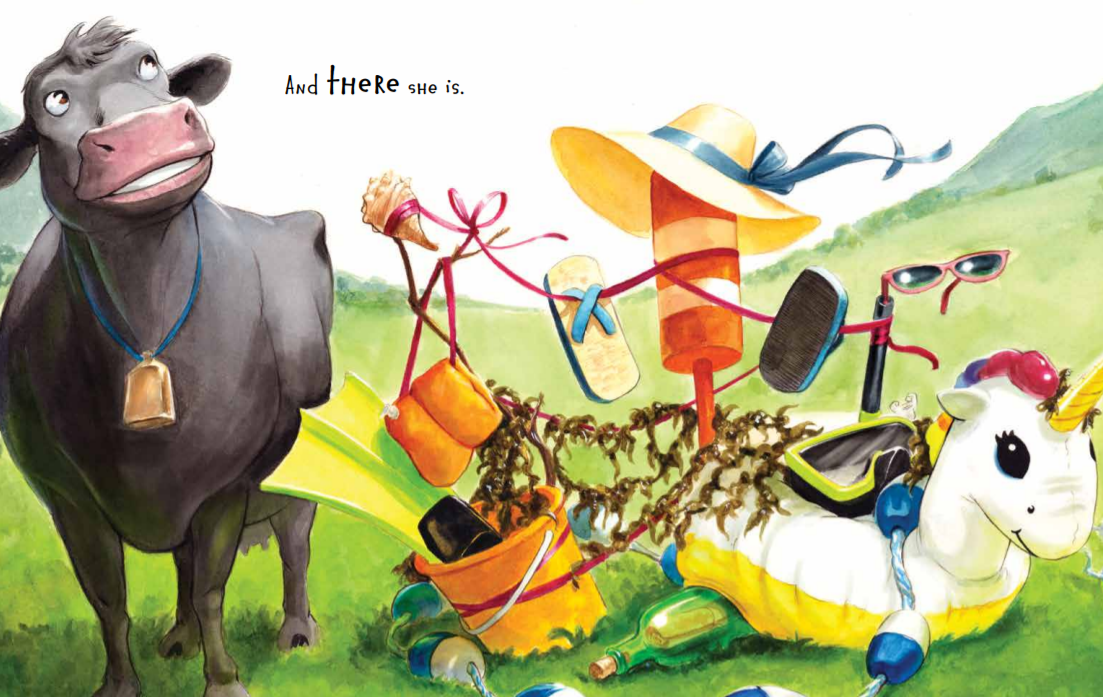
As the following illustration shows, that didn't work!


While cow suggested other unworkable plans about how his egret could find her,


the egret gains confidence in flying further and further away. Each time the egret returned with a gift for his cow: a shell, a string, and a twisty stick. 

Finally, egret came up with a solution that would help him find his cow. When he looked from high in the sky and wondered where she was, he spotted...


Test time! Which SEL components are expressed in WHERE'S MY COW? Leave your answers in the comments below.

GIVEAWAY

For a chance to win, leave a comment with your email address, or send me an email if you prefer. If you share this on social media, you will get one extra chance; if you follow my blog you will get another chance. Tell me what you have done and I will enter your name accordingly. Winner must live in the continental U.S and please let me know which picture book you are interested in winning. Giveaway ends Friday, February 11 at 6 PM. 


Wednesday, July 15, 2020

WOOD, WIRE, WINGS: A Review and a Giveaway

Congratulations to Jo Lynn Worden who won Will You Be My Friend? from last week's blog.

I have received a number of picture books from publishers recently, so if you love picture books...stay tuned!

WOOD, WIRE, WINGS: Emma Lilian Todd Invents an Airplane by Kirsten W. Larson (Calkins Creek, 2020) is a picture book biography that will entertain and educate elementary school readers. Because of its historicity and accessible language, I think it could also be useful for reluctant readers in middle school classrooms. You will find a teacher's guide here and a hands-on engineering activity here.


REVIEW

"To Emma Lilian Todd, problems were like gusts of wind: they set her mind soaring. 

Sometimes the problems seemed small, like where to find metal cans to craft her inventions. (Solution: she saved tin cans from her supper.)

But soon Lilian's challenges ballooned." 

In this way, the author immediately invites the reader to see Emma's character and conflicts. The time period is invoked on the cover illustration, promising readers the type of story they will find within the covers. 

Early in the book, the reader discovers that Lilian's role model was her grandfather, who invented his own carriage wheel. Like him, she also whittled and fiddled and dreamed of inventing something useful. (Hooray for great family role models!)


Her first invention was a weather vane that she made out of a broken toy and Christmas ball from their tree.

It worked!

One day she took apart a clock and enjoyed the challenge of putting it back together again. (sounds like Benjamin Banneker, doesn't it?).  Her mother encouraged her by making sure she had the tools she needed. (Hooray for great mothers!)


Since inventing things wasn't women's work at the end of the nineteenth century, Lilian worked at the U.S. Patent Office, typing up plans for new machines. "While Lilian's fingers raced across the keys, she constructed each contraption in her mind."


Pretty soon, she was working on creating blueprints for her own fantastic flying machines. After long days of typing, she built small airships in her Manhatten apartment. 

In 1908 she read about the Wright brothers flying machine in which the operator had to lie flat. She wanted to build a machine that was operated by a woman who would swing in a basket from a balloon below the machine. Lilian studied birds and pretty soon airplanes took over her apartment and her life. 


Lilian experienced many failures but she learned from each one. She was mocked by men but in 1908 she wrote, "they admit that my ideas are all right and that a full sized aeroplane built in accordance with these same despised models will fly---which is the principal thing after all, isn't it?"

One of the richest women in the world at the time, Olivia Sage, provided much needed financial support. Lilian found a space to assemble her design, she hired men to build it and bought supplies. 
Although she experienced many set-backs, in November 1910, she watched from the ground as the pilot took off in the air. 


I doubt Emma Lilian Todd envisioned the future of flying which included her own contribution, but she looked forward to "driving" an aeroplane at some point. That same year her plane successfully got up in the air, she wrote, "There is no work so exasperating, so delightful, so mean, so difficult, so exhilarating, as building aeroplanes..." 

Although I found this picture on Wikipedia, it is unclear if Lilian ever flew the plane herself. What is clear, is that she was the first woman to design a successful airplane on her own. 

http://f8.ifotki.info/org/458d57edd9d32c491cc269fd8ceb012c558d8f92112654.jpg


I believe this is a much-needed story of determination and perseverance. The next generation--girls and boys--needs role models of adults who do not easily give up and diligently work to fulfill their dreams. The detailed illustrations by Tracy Subisak complement the text beautifully. Teachers and home school educators will appreciate the endnotes showing the early days of airplanes, as well as the extensive bibliography. 


GIVEAWAY

Leave a comment (with your email address if you are new to my blog) by Friday, July 17 at 5 PM if you would like to enter this drawing. As usual, if you become a new subscriber or share on social media, I'll add your name twice--but make sure you tell me what you do! U.S. addresses only. 


Saturday, March 21, 2020

You Heard it Here First: Dorothy Price signs with Agent, Miranda Paul

It's always fun to share publishing news with my blog readers--particularly if it's news from one of my own writing friends. I first met Dorothy Price 10 years ago when she joined my SCBWI-Carolinas critique group. I've read her manuscripts and she's read mine. Today I'm thrilled to share her story of how she recently signed with an agent. 

Take it away, Dorothy!

*****

I am so excited to share my agent success story, after 11 years of writing kidlit!

This story began in October 2018, when I got a nudge from my writing friend, Tara Luebbe. She suggested I apply to the 2019 We Need Diverse Books Mentorship Program, to which I had zero interest. I was at a place in my writing career where I had gotten discouraged by rejection, and simply planned to stop submitting, to everyone and everything. But something about Tara’s nudge forced me to apply anyway, on October 31st—the very last day to submit. 

Two months later, I received an email from WNDB that I had been selected as a picture book winner, out of more than 100 entries! The amazing Samantha Berger became my mentor, and beginning in January 2019, we edited and revised three of my PB manuscripts.  

In November 2019, I decided to participate in NaNoWriMo, even though I had failed to finish three times before. On November 30th, I finally completed my first middle-grade novel. 

Armed with three completed PBs and a finished MG, I was confident this would attract an agent. In January 2020, I began agent submissions. I had a list of six agents, but one, in particular, was by referral only. This agent was also on the WNDB team, so she had seen my PB submission that won the contest; however, her agency only accepted referral submissions. Enter Samantha Berger, who graciously referred me, which opened the door for me to submit to Miranda Paul with Erin Murphy Literary Agency. 

Although I had two other agents to consider, when Miranda emailed me back a couple hours later and said she was happy to receive my query and asked to speak two days later, I knew she was the agent for me. Her intensity, energy, and passion were something I truly wanted in an agent.

Before we ended the call, Miranda offered representation, and after praying on it, a few days later, I accepted. If it hadn’t been for Tara’s nudge to enter that contest, I’m not sure I would have an agent today. The plug for that is, contests DO help, and I strongly encourage writers to submit! 

Things have been going well so far and I am enjoying every minute of the process. I can honestly say, if you put in the work, believe in yourself, and never quit, dreams will come true. 

*****


Dorothy H. Price is a long-time member of SCBWI Carolinas. Two of her nonfiction stories were published in Teaching Tolerance’s 2019 Teaching Hard History: American Slavery series. Her first picture book, Nana’s Favorite Things was published in 2016. You can connect with Dorothy on Twitter


Wednesday, March 4, 2020

Ticktock, Banneker's Clock: A Picture Book Review and Author Interview

Congratulations to the following winners from last week's blog:

Deborah Allmand, Jana Leah, and Carol Nelson won BEHIND THESE HANDS.

Joyce Hostetter and Sandra Warren won RUN TO THE LIGHT.

Danielle Hammelef and Connie Saunders won THE LAST CHERRY BLOSSOM


It's amazing what you can learn through picture books. 

Ticktock Banneker's Clock is another engaging and informative picture book biography by Shana Keller. I recently featured Shana for her new book, Bread for Words about Frederick Douglass. Ticktock's text, along with illustrations by David C. Gardner, depict an important episode in Benjamin Banneker's remarkable life.

Born in 1731, Benjamin, was a self-taught free African American farmer, naturalist, author, and surveyor.  He corresponded with Thomas Jefferson on the topics of racial equality and slavery and authored several almanacs. One of Benjamin's accomplishments was carving a striking clock. The book was voted as one of the best STEM books in 2017.


REVIEW


The story opens with a beautiful drawing showing Ben working on his farm in the Chesapeake Bay.


After his harvesting work was done, he had "time to dream." Sometimes he played the flute or violin, but this day he was fascinated with the inner workings of a pocket watch.


He decided to make a time piece, one that could sit on a mantel or hang for a wall. He took the watch apart, studied the tiny gears, and made diagrams. He carved the clock pieces out of wood, but found that the pieces snapped and broke. 

So, he dried the wood--a time consuming process--and then re-carved the pieces. 


This time, the wheels, pins, and gears didn't break! He had a bell made and timed the clock with the sun. 


Neighbors from far and near came to see his invention; the clock chimed every hour on the dot for the next forty years.

Ticktock Banneker's Clock will make an excellent curriculum resource for grades K-3. Sorry, no giveaway this time, I'm adding it to my library. Instead, I asked Shana what led her to writing this book. Here's her answer. 


AUTHOR INTERVIEW


When my oldest daughter was in the first grade, she came home with a small paragraph about a man named Benjamin Banneker. Even though I had majored in African American history in college, I didn’t recall seeing his name before and suddenly, I was on this path of research that led from one surprise to another. 

After reading everything I could find online and at the library, I visited the Benjamin Banneker Historic Park and Museum in Catonsville, Maryland. I met with Justine Schaeffer the director at the time and explained my interest. We discussed all things Banneker. I toured his lands which is where the park and museum are located. I saw his recreated cabin (Banneker’s burnt down days after his death). And, I met with some of Benjamin’s collateral descendants - children of his nieces and nephews. I also met with a griot, a storyteller, who was familiar with Banneker’s history. 

I discovered many intriguing things about Benjamin Banneker. He was a landowner. He was never enslaved and mostly self-taught. He was well respected in his community and often relied upon to calculate math problems. He wrote almanacs. He corresponded with Thomas Jefferson about civil rights. He was an astronomer. He helped survey the land where the nation’s capital would stand. And of course, he built a striking clock using a pocket watch as his guide. Given all of his accomplishments, I realized there was a lot to choose from and focus on. The achievement that struck me the most was how he built his clock. Benjamin’s goal was to never stop learning, and so is mine!

Tuesday, January 29, 2019

BOUND: A Review and an Autographed Giveaway

Within the first pages of Bound by Vijaya Bodach, the reader realizes that this is going to be a book that deals with serious issues. The main character, Rebecca Joshi who was adopted from India at birth, was burned six years earlier over 50% of her body; her older sister, Joy, is intellectually impaired; their mother died a year ago and their father has emotionally withdrawn from his daughters. To be honest I thought, is all that drama necessary in one novel? 

Guess what?

It is.


REVIEW


Rebecca struggles for freedom. She wants to get rid of her burned skin--a constant reminder of how freakish she looks. She remembers her first "so-called cosmetic surgery... At age eleven-and-half. Yes, sir. Cosmetic. Because nobody ever died from looking hideous." (p. 13)

And she wants to get rid of her time-consuming and emotionally-draining responsibility for Joy. Rebecca, not their father, is the one who makes sure Joy gets to work. Rebecca is the younger sister who sticks up for her big sister when Joy is called a "retard." Their father, Rebecca concludes, is his own god. 

One evening Joy urges Rebecca to come folk-dancing with her. 
"I'll hold your hand," Joy says. "I'll never leave you." 
That's what I'm afraid of sometimes. I don't want us to be like a binary star system--circling each other forever. (p. 6)
Rebecca wants desperately to go to medical school so she can return to India and help impoverished children. Hand in hand with this desire is her yearning to fling off the burden of always watching over Joy.

Rebecca helps Joy become more independent which relieves her of some of the responsibility she inherited after their mother's death. But as a result, Joy spends more and more time with a man from work and gets pregnant. Although Joy feels letdown by her boyfriend who wants no part of being a father, she quickly becomes attached to her unborn child. Rebecca sees the baby as one more obstacle to her leaving home for medical school and takes Joy to an abortion clinic. 

At the abortion clinic Rebecca removes the ultrasound gel from Joy's belly and remembers her burn treatment.
They soaked me in a warm tub and my dead skin would peel off. What didn't come off had to be scrubbed off. They'd hold me down and rub away the stinking flesh. The nurses always said they knew I didn't have inhalation injuries because of my strong lungs. I wonder how I survived as I scrape the paper towel over Joy's beautiful belly one last time. She doesn't realize how lucky she is the pregnancy is not permanent. She can return to her normal life after this crisis is over. I have not been so fortunate. The massive burns have changed me and my life forever. I'm not even the same person I used to be. (p. 94)

Joy rejects abortion--much to Rebecca's and their father's disapproval. But gradually, Rebecca changes her mind as the unborn child becomes more real to the family. The three return to India to visit a beloved grandmother. In the familiar country of her birth, Rebecca thinks about why her mother put her up for adoption. After she considers the possible scenarios she concludes, "Whatever the cause she didn't want me. But at least she didn't deny me my life." (p. 165) 

The dichotomy between Rebecca's high intelligence but deformed body, and Joy's simplistic thinking yet voluptuous body runs throughout the book.  An additional thread is the mystery of the events surrounding Rebecca's accident. The reader discovers bits and pieces of what happened when Rebecca was 11--but the true story is not revealed until close to the end.

This beautifully written story shows a realistic portrayal of a young adult facing many personal, family, cultural, and moral dilemmas. The satisfactory ending--including the father's change of heart and accepting responsibility for Joy's future--will leave the reader feeling hopeful for Rebecca, Joy and her baby, and their family. 

In our present socio-political climate, I applaud Vijaya Bodach for her brave pro-life position. I hope Bound will be a meaningful tool that counselors will use with young women experiencing an unwanted pregnancy.  


AUTOGRAPHED GIVEAWAY

Next week I'm interviewing Vijaya about the backstory to Bound. Leave a comment this week and I'll enter your name once. Leave me another one next week and you'll be in twice. Winner will be chosen on February 8th. Please leave me your email address if you are new to my blog.

THE NIGHT WAR: A MG Historical Novel Review

  By now you should have received an email from my new website about my review of THE NIGHT WAR by Kimberly Brubaker Bradley. (It'll com...