If you're like me, you give books as presents. On today's blog, I have two fun books published by Sleeping Bear Press that will make great presents for a young pirate or sailor in your life. Both books use great wordplay which will tickle the ears of both kids and adults.
What happens when a young man (who loves to dance) signs up to be a pirate? Author-illustrator Shawna J.C. Tenney answers that question in this action-packed picture book.
More than anything, Jack wanted to be a pirate.
......
When Jack heard the
slosh slosh slap of the waves,
the flip flip flap of the sails,
the creak creak crack of the ship,
he felt the rhythm in his soul
But, he quickly found out that,
Jack danced without knowing it. At sword-fighting practice, he saw the pirates-in-training stumble and fumble. Jack couldn't help himself.
He showed his fellow trainees how to grand jete' over gullies during a treasure hunt. But that got everybody in trouble.
Finally, a feared pirate came on board. Jack and his friends hid and watched.
Jack couldn't just stand by and do nothing--he had to dance!
It was a fierce battle. In the end, the Captain conceded. "Blimey! Keep dancing, Jack! KEEP DANCING!"
Jack's amazing dancing steps won the battle, the Captain's heart, and the reward of becoming an official pirate. From then on, everyone put their best foot forward.
Parents, grandparents, and teachers will enjoy the pleasure of reading this story out loud and children will enjoy the onomatopoeia and how an unlikely hero wins the day.
To read about Shawna's backstory for writing and illustrating this book, please see this post on Kathy Temean's blog.
Back matter includes an author's note, explanations of dance movements, and pirate speak definitions.
Lynn Becker's rhyming debut picturebook is about mythical sea creatures and the mayhem they cause when they meet up with a boat full of hardy, young sailors. Scott Brundage performs his magic with marvelous illustrations that are as funny and rollicking as the text.
The first monster who appears even before the first page is a Kraken.
You would
Share some jokes and your best riddle,
Feed her cakes from Cookie's griddle,
Teach her how to bow the fiddle,
Kraken in the briny.
Just when the sailors successfully tame a surly, scruffly, sea goat, the ship gets a visit from a
The sailors
Keep a bucket at the ready,
Mop his forehead if he's sweaty,
Tuck him into serpent beddy,
Serpent in the briny.
Next, the brave sailors meet a tearful turtle. They find innovative ways to cheer him up.
Readers will be anxious to find out what sea monster is next.
How about a hungry hydra?
"Yo! Ho! And up he's rising, Yo! Ho! He's quite surprising,
But wait.
One of the sailors is sick of shipwrecking monsters.
So,
Yo! Ho! And up we're rising,
Yo! Ho! We're all surprising,
Yo! Ho! We're harmonizing,
Monsters in the briny.
The back matter includes two pages about sea monsters and the music to "Monsters in the Briny" which is based on an old sea shanty about a drunken sailor.
If you're interested in reading about Lynn's book journey, you can find it on Kathy Temean's blog.
I recently took a webinar with children's book author Pat Miller. She encouraged picture book writers to look at different frameworks for their story idea. Using a song was one of her suggestions. Now I see how that can work so well--particularly with the imaginative team of Lynn Becker and Scott Brundage. This week Lynn and Scott will share some of the inside scoops behind this sea-faring creation in the Talking Story Facebook group. Don't miss the childhood game that inspired Lynn and some of Scott's drafts! (P.S. If you're not a member yet, just click on the link and request to join it.)
GIVEAWAYS
Please leave a comment by November 23 and let me know which book you're interested in winning. MAKE SURE YOU LEAVE YOUR NAME AND EMAIL ADDRESS IF YOU ARE NEW TO MY BLOG. If you follow my blog or sign up to follow it, I'll give you two chances.
Congratulations to Theresa Milstein who won SUPERPOWER? from last week's blog.
I recently attended a webinar "Feel the Feelings: Crafting Picture Books" with Bethany Hegedus, author and founder of The Writing Barn. As a result, Social and Emotional Learning (SEL) is front and center in my brain. Bethany emphasized that readers should be able to take away kindness, empathy, understanding, bravery, and inclusion after reading picture books.
Here are five SEL components:
Self-Management
Social Awareness
Relationship Skills
Responsible Decision-Making
Self-Awareness
Pay attention to these--because there will be a test!
Author-illustrator Jennifer Sattler is no stranger to my blog. Her illustrations are dynamic and there's always a cleverly disguised "message" within a playful story that children will understand--without being preached to.
Here's the first page:
Vole, (like many of us) followed her comfortable, predictable routine.
But, one day when she woke up, she wanted something different--she
wanted an adventure!
In her organized fashion,
She set off, backpack ready with all of her essentials, and everything went according to plan. Until she met,
Rock.
Vole tried everything to get the rock to move out of her way so she could complete her adventure. She talked to it. She showed it her map. She tried to cajole it.
Nothing worked.
Until the sun started setting and Vole realized that the rock was lovely.
After Vole redid her map, she rested against the rock.
Which SEL skills does Jennifer Sattler subtly communicate to the reader in ROCK AND VOLE? Leave me your thoughts in the comments.
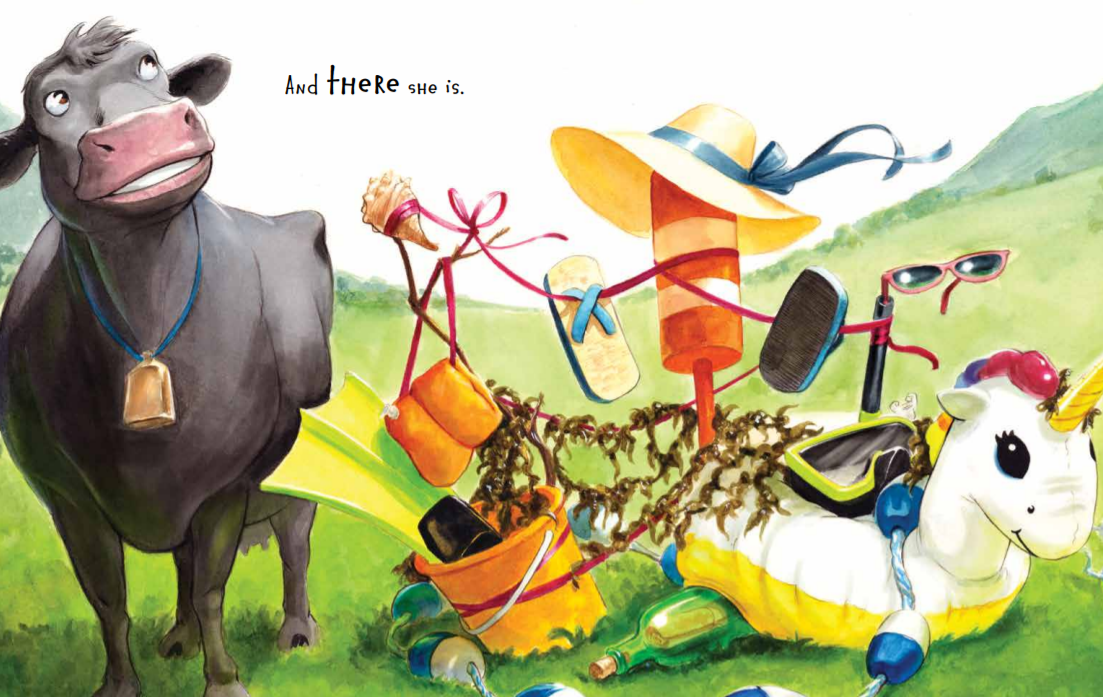
This fun picture book was inspired by author, Susan Blackaby's observations of the symbiotic relationship between egrets and cows. The dynamic illustrator, Scott Brundage was featured on my blog here.
Here is the opening spread:
When the flock of egrets whirled off to explore the sea, one little egret preferred sticking close to his cow.
While the egrets were gone, the cow told him stories about the places she'd seen and the food she'd eaten. All the talk about kites and kayaks and toasted marshmallows gave the little egret ideas. With his cow encouraging his explorations, the egret flew off and found a view of the ocean that took his breath away!
But, he looked down, saw the herd far below and thought,
"Where's my cow?"
Queasy, the egret gulped.
Sputtered. Plunged.
Ker-thump.
Fearing he'd never find his cow, he wouldn't fly far from home.
His cow encouraged him to try again and look for the cow with twitching ears.
As the following illustration shows, that didn't work!
While cow suggested other unworkable plans about how his egret could find her,
the egret gains confidence in flying further and further away. Each time the egret returned with a gift for his cow: a shell, a string, and a twisty stick.
Finally, egret came up with a solution that would help him find his cow. When he looked from high in the sky and wondered where she was, he spotted...
Test time! Which SEL components are expressed in WHERE'S MY COW? Leave your answers in the comments below.
GIVEAWAY
For a chance to win, leave a comment with your email address, or send me anemailif you prefer. If you share this on social media, you will get one extra chance; if you follow my blog you will get another chance. Tell me what you have done and I will enter your name accordingly. Winner must live in the continental U.S and please let me know which picture book you are interested in winning. Giveaway ends Friday, February 11 at 6 PM.
This rhyming picture book by Jill Esbaum and illustrated by Scott Brundage is based on a true story that Esbaum read in a newspaper. Jill fictionalized the story and it's shown from both Al and Jo's point of view--something I've never seen in a picture book!
Big Al is Jo's furry friend who loves traveling with her on the open road. When Jo takes a break, Al is busy meeting children, finding a snack, and rolling in someone's flower bed. But when he returns to the truck stop, Al can't find Jo!
As difficult as it is, Al waits for Jo, watching as trucks come and go along the highway.
At the same time, Jo realizes that Al is not in the truck with her!
While Big Al waits, he's sad and scared. He's tempted to go with Zack, a friendly boy who plays with him, but from out of the dark night, Al spots Jo's truck.
"I have to look,
Could it be true?
Oh, Jo. Please, Jo,
could that be--
onk-onk!
onnnnnnnnk!
Yip-yip!
Bye, Zack! I have to go!
I knew she'd come!
It's her!
My Jo!
Where'd My Jo Go? uses simple vocabulary and new readers will enjoy mastering the words. Both books are illustrated in a manner that reflects the story's content; Petra Brown and Scott Brundage show a realm of emotions in their characters! Both books will be enjoyed by children and the adults who read them out loud. Sorry--no giveaway this week. I'm celebrating the birth of a new grandson and these books will be a great contribution to their family library!
Big sister Eleanor enjoys reading to Luke and baby Caleb.
A is for Astronaut: Blasting Through the Alphabet, will appeal to readers of many ages. Like other books in Sleeping Bear's ABC list, each letter of the alphabet is anchored by a short poem for readers ages 5-8 and a longer exposition for 9-11 year-olds.
Illustrated by the talented Scott Brundage, each picture amplifies the text as in, Bis for Blastoff.
Amazing illustration!
Here is the poem for N which stands for...NASA. What else?
The world loves outer space; it's a grand destination,
And NASA's the group representing our nation.
The N stands for National, and it gives us such pride
when a rocket is launched with our flag on its side!
Don't you love the young astronomer's t-shirt?
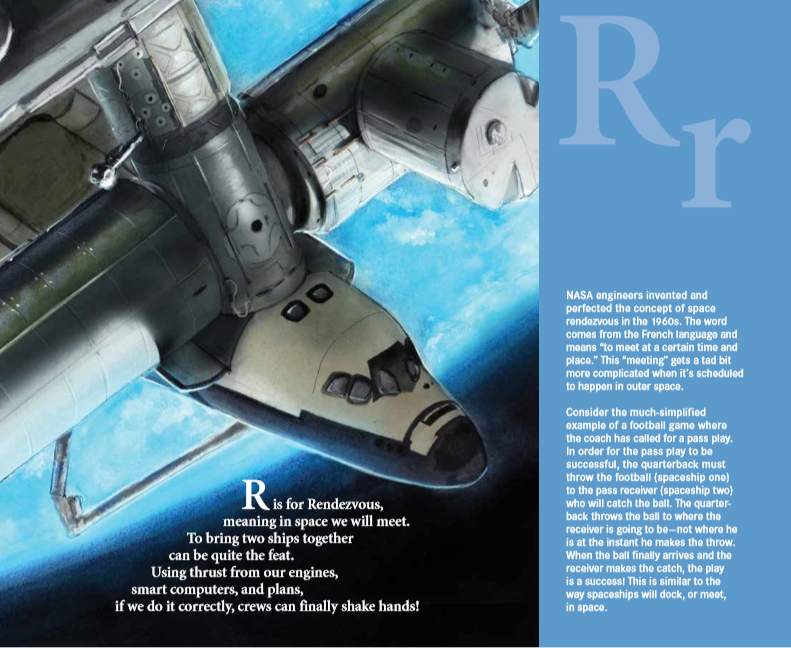
I liked the R page because of the accessible description of Rendezvous. Here's the second paragraph: Consider the much-simplifed example of a football game where the coach has called for a pass play. In order for the pass play to be successful, the quarterback must throw the football (spaceship one) to the pass receiver (spaceship two) who will catch the ball. The quarterback throws the ball to where the receiver is going to be--not where he is at the instant he makes the throw. When the ball finally arrives and the receiver makes the catch, the play is a success! This is similar to the way spaceships will dock, or meet, in space.
That's an explanation I will remember!
BEHIND THE SCENES
“Astro Clay”–Astronaut Clayton Anderson's story is one of perseverance. He applied 15 times before NASA selected him as an astronaut in 1998; and he spent 30 years working for NASA, 15 as an engineer and 15 as an astronaut. He is the first and ONLY Astronaut selected from the State of Nebraska.
This STEAM book will be a great addition to any school or home library. Here's a brief interview about how this book came to life.
CLAY: I was in Omaha, NE at the West Town Barnes and Noble, preparing for a book signing with my first book, The Ordinary Spaceman. The store manager kept pulling me over to the nearby children’s section. “You should write a children’s book,” she said. Hesitant, I shrugged my shoulders and replied, “Yeah… maybe one day.” She pointed out specific publishers, continually mentioning Sleeping Bear Press (SBP). “They don’t have ‘A is for Astronaut’,” was her firm “suggestion.” Shrugging my shoulders once again, and feigning only brief interest, I was overjoyed when the actual book signing began and turned my focus onto something I actually understood! A few months later, during some idle time at home, I did a Google search on SBP. It was then that I finally woke up and saw their tremendous success with their alphabet book series. Electronically investigating “A is for Airplane,” and a couple other titles on their highly populated series list, I thought to myself, "I can do this!”
Immediately I began to formulate the words I would use for each letter of the alphabet. A was easy… astronaut. B followed suit with Blastoff. I was cruising until I got to letters like F and K and I. Some more research via the internet gave me all 26 letters and a corresponding space term. Then came the poems. I actually finished the entire book in about 1.5 weeks!
CAROL: What was the most difficult part to write—the poems or the expository text? Why?
CLAY: The expository text was the most difficult for me, although difficult is a relative term. The poems simply “flew” from my brain (do you like that space reference?!) Writing them was a tremendously fun process. With the text however, a different challenge was presented. I was seeking to entertain, educate, and inform, while at the same time creating interesting reading material that was technically correct and had the ability to “stretch” the young reader’s vocabulary. Certain space concepts (e.g., rendezvous) forced me to dig a bit deeper as a writer. Often speaking to young children in schools, I use visual demonstrations to communicate some of the more technical aspects of flying in space. It became a simple matter of putting those demonstrations down on paper. A second part of the challenge was technical accuracy. I don’t claim to be an expert on “all things space.” Heck, I’m just an astronaut. Finding adequate reference material to ensure that what I wrote was valid and correct, required a bit more digging than I thought would be necessary. In the end I think we succeeded masterfully, but I’m partial!
When speaking to kids and young adults around the nation, I constantly implore them to remember that “…they are just like me.”They can be anything they chose to be.It will take hard work, a lot of help, and a little bit of luck, but the future is theirs.They must dare to make it extraordinary.
VIDEO
Check out this fun video starring Clayton Anderson--as himself!