Showing posts with label STEAM. Show all posts

Saturday, December 3, 2022

2 Picture Books by Shannon Hitchcock, 1 Giveaway

 If you've been following my blog for a while, you may remember my post on Shannon Hitchcock's book, Saving Grandaddy's Stories. I'm happy to share two more books that Shannon has written about unsung Appalachian artists. I love these books so much that I'm saving one for my granddaughter who I'm teaching to sew. 

The illustrator is mixed-media artist Sophie Page. Sophie used clay, fabric, paper, and wire to bring these stories to life. Both books are published by Reycraft Books.

As you read my reviews, notice Shannon's poetic text that emphasizes the importance of each word and Sophie's illustrations that show depth, color, and texture. Her images are like mini-stories.

REVIEWS


SHE SANG FOR THE MOUNTAINS: The Story of Singer, Songwriter, Activist Jean Ritchie.


The book opens with a simple line that says so much about Jean Ritchie.


Jean came from a large family who loved to sing while they worked. In the evenings, they rested on the porch swing and sang accompanied by their father's dulcimer.


Jean wished she could turn back time.

Her brothers and sisters left home one by one.
Finally, it was Jean's turn to go.


Jean taught the songs of the hills
to the children of the city--
songs that had echoed 
through the mountains for generations.
In the process, Jean was noticed by a song collector. 


Jean was far from the home she loved in Kentucky, but when she heard about companies that mined coal and then moved on--leaving men sick or unemployed--she realized that she wanted to protest too.


She sang about the unemployed coal miners and the strip mining that poisoned the water. 


Jean never stopped singing important songs which inspired others. Even when she was old and moved back to Kentucky, she kept 

singing for the mountains
and heard music everywhere.
                    ......

To this day, Jean's music lives on,
in the hearts of folksingers,
dulcimer players
and activists
who raise their voices and sing for the mountains.
The author's note includes more information about Jean. To hear her sing and play, click on this youtube video.


STORY QUILTS: Appalachian Women Speak


Here's the opening page that says so much:


The women had large families and worked hard. Their days were filled with cooking, cleaning, gardening, and canning.

Then, at day's end, they threaded their needles,
reached for their rag bags,
pieced colorful squares
and turned scraps into quilts that told stories.
Daughters watched their mothers until they were old enough to create a quilt of their own.

Sometimes, the daughter watched her mother pull out scraps from an apron that once looked like this:


Blue was special because,


Scraps of pillowcases became clouds or snow; other scraps became wildflowers.


She would move her quilt squares like puzzle pieces,
until they told a story.


The author's note includes Shannon's inspiration for this beautiful story of forgotten women. Sophie lists some of the quilters who inspired her illustrations.

Shannon is giving an extensive interview--plus information on her next book in this series--on the Talking Story Facebook page on Monday. (Not a member? Click on the link and ask to be admitted and you'll be in!). But she told me that she is drawn to writing about the past because she grew up on a farm in the foothills of the Blue Ridge Mountains. "We lived primitively compared to lots of families. My grandparents were farmers. They raised cows, pigs, and chickens. My grandma churned butter, had a large vegetable garden, canned, and quilted. Writing these books reminds me of home and a way of life that I want to preserve in my stories."


GIVEAWAY


If you have never won a book from my blog or are a new subscriber, I'll put your name in twice for SHE SANG FOR THE MOUNTAINS. Make sure you leave me a comment by December 7 with your name and email address if you are new to my blog.

Eileen Heyes entered last week's giveaway and told me that since she didn't have any "littles" in her life to give it to a library. Per her request, I gave Christmas with Auntie to Matthews Elementary School. Congratulations to Barbara Younger who won Miss Mary's Mittens


Wednesday, December 30, 2020

Letters From Space: A Picture Book Review and Giveaway

 Former astronaut Clayton Anderson is not a stranger to my blog. I reviewed his previous book A is for Astronaut (also from Sleeping Bear Press).  Letters from Space is just as informative and engaging. As you'll see in the samples below, the illustrations by Susan Batori are full of humor. Kids will laugh out loud as they learn about disposable underwear; food, spiders, and plants in space; and how astronauts fly EVERYWHERE within the space shuttle. 

All of this is communicated through fictional letters "home" to friends, young fans, and family. Because of course, no one has perfected receiving mail from space... yet!


REVIEW


Flight Day 3


In a letter to his mother, Clayton describes his excitement at liftoff. 

It was loud, it was scary, and the entire space shuttle shook like crazy...We went faster and faster, and then--everything went quiet. I started to rise out of my seat. I was weightless!


Flight Day 22

In response to a young fan who just got a puppy, Clayton writes,

We can't have pets in space. It would be neat to have a dog or a cat, but what a mess with no gravity! Where would it go to the bathroom?!


Flight Day 45

Clayton takes a space walk and tells his brother, We were out there for over seven hours and I rode on the robotic arm. I was like one of those guys who fix wires on utility poles. But in SPACE! Man, did I have some great views of the Milky Way and the space station!


Flight Day 125

Clayton shares his favorite foods in space. I love to start my meal with a can of stuff they call "appetizing appetizer." It looks kind of like baby food. Yum. After that I always love a nice can of lamb with vegetables or pork and potatoes. It looks a lot like cat food. Maybe it even smells like cat food But I swear it doesn't taste like cat food.


Flight Day 134

It turns out that when Clayton was little he used to read Superman comic books.  Now that he's in space...he is Superman every day!


Flight Day 148

Clayton is coming home and he's so excited that he's doing flips in space! He writes to his mother, The time has flown by up here (ha ha) and life in weightlessness has been really fun.


End Notes


The book ends with two pages of facts about growing food in space, training to be an astronaut (in a pool!), gravity, teamwork, and lots of other things you didn't know. 

A STEAM book, this will be a great addition to the K-3rd grade curriculum. Not only will children learn science facts, but as Astronaut Anderson says, "Kids LOVE THE LETTER FORMAT. It encourages reading AND writing." 

By the way, most of the names used in the letters are real people in Clayton's life. It was his way of paying tribute to his teachers, college professors, childhood friends, mission control, and his family.


GIVEAWAY


Do you want this book for the child or student in your life? Leave me a comment by January 1 at 6 PM and I'll enter your name. Make sure you leave your email address if you are new to my blog. If you share this on social media (and tell me what you did) I'll enter your name twice. 

Wednesday, October 7, 2020

Bionic Beasts by Jolene Gutiérrez: A Giveaway and A Mini-Author Interview

 Congratulations to Barbara Younger who won Acoustic Rooster's Barnyard Boogie from last week's blog.

**** 

In the last few weeks, I've featured picture books for young readers. Today, I'm happy to help launch Jolene Gutierrez's debut middle-grade nonfiction book, Bionic Beasts (Lerner Books, 2020) Since it's full of photographs, it's technically a picture book too--but this isn't a book for young readers. The challenging and informative text will be appreciated by students in grades 5-8; particularly by those who love animals and are possibly considering a career working with animals.  

REVIEW


In the pages of this unique book, readers will meet remarkable animals and the doctors and students who used modern technology to enable them to live normal lives. Here are the five main characters: Lola, a Kemp ridley sea turtle with a missing flipper;  Mosha, an Asian elephant who stepped on a land mine; Cassidy, a three-legged German Shepherd; Vitória, a greylag goose who had lost most of her beak; and Pirate, a Berkshire-Tamworth pig who was born with a fused tarsal joint in his hock. All of the animals needed extraordinary veterinary intervention which they received.

Each section of the book includes facts about the animals, the patient's history, environmental dangers the animal faced, how their injury affected their body, and how prosthetists, orthotistsveterinarians, and engineering students developed materials, prostheses, and even a fake beak! Every section concludes with an activity that enhances the reader's comprehension.

Lola, an endangered turtle who lives in the Gulf of Mexico weighed less than an ounce when she was found on Mustang Island, Texas. She was fitted with a tracking device that was the size of a grain of rice.  Her right flipper had to be amputated leaving her unable to swim in a straight line. Students at Worcester Polytech Institute wanted to create a replacement flipper--and that's exactly what they did! Although Lola will always live in an aquarium, as a result of several determined college students, she can now gracefully swim and dive.


Mosha, as pictured on the front of the book, was fitted with a prosthesis--but she outgrew them thirteen times! As she grows, she needs to be fitted with a new prosthesis every six months. She lives in the Friends of the Asian Elephant hospital where she socializes with other elephants and her human caregiver. 


No one knew how the rescue dog, Cassidy, lost his leg. All that his prospective owner knew was that he wanted to save him from being euthanized. Although he gained weight and grew back his hair after moving in with his family, Cassidy struggled to walk. At first, Cassidy was fitted with a removable prosthetic leg but he kept kicking them off. Finally, he was fitted with a metal prosthesis that was implanted into his leg bone.  Osseointegration was not without risks. But the surgery, performed at North Carolina's State University College of Veterinary Medicine, was successful. The process of creating an endoprosthesis was complicated, but here was the final result:


Vitória, a greylag goose was found off the coast of Brazil in 2015. It was missing part of its beak and was brought to the Friends of the Sea where she was cared for by a biologist and environmental technologist. Although she learned to trust him, she couldn't feed properly and he sought the help of a veterinary team called Animal Avengers. They had to engineer a top and bottom beak so that Vitória could eat and preen. Using sophisticated software, the team created her new beak and attached it during a two-hour surgery.  That first beak was too heavy and using photogrammetry, the team created a prosthesis that was one third the original size.  


Here she is with her mate and goslings!

Pirate, a Berkshire-Tamworth pig, was born with a right-hand leg that was permanently bent at a 90 angle.  A veterinarian suggested that the piglet would need a hybrid orthosis-prosthesis to support his leg. As of a year ago, Pirate was 500 pounds and wearing his fourth device, designed by a man who had made orthosis for dogs and humans--but never for a pig! 


AUTHOR INTERVIEW

CAROL: How did you end up writing a book about bionic animals?

JOLENE: Carol Hinz, my editor at Lerner, put out a call for STEM picture books in the spring of 2018 (I heard it through my SCBWI chapter-Rocky Mountain). I submitted a < 1,000-word picture book titled BIONIC BEASTS to her, and she told me she loved it but wondered if I'd be willing to make it a middle grade with 5 chapters (plus an intro and conclusion) about 5 different animals. The book is now ~10,000 words and researching each chapter was like writing a separate book because I had to track down the people involved with the stories, they had to be willing to share their stories (some weren't), there had to be photos available for Lerner to use, etc.

I chose to write about animals being helped through technology because I grew up on a farm and in a community where injured animals, runts, etc. were routinely put down. I spent years of my childhood arguing, crying, and protesting that. This book is my way of honoring the kind-hearted, skilled people who have stepped up around the world to help animals who need their support.


                           Jolene worked through piles of files papers as she sorted out her research. 

CURRICULUM RESOURCE 

Bionic Beasts will make a great curriculum resource for the 5-8th grade classroom or homeschool family. Please click here for a link to the teaching guide. The author provides information on technology, science, veterinary medicine, and environmental issues in a very accessible manner. The activities at the end of each chapter reinforce students' learning.

Here is a short video of one of my granddaughters building a robotic hand, the activity associated with Mosha.


GIVEAWAY

Please leave a comment (and your email address if you are new to my blog) I will enter your name. Winner will be drawn on Ocober 9.

Wednesday, August 19, 2020

Lights Out: A Review and Picture Book Giveaway

Congratulations to Kathy Wiechman who won the ARC (Advanced Readers Copy) of EQUAL from last week's blog. For those of you who didn't win, I'll be posting a review at a later date and you'll have an additional chance to win the book.

*******

Marsha Diane Arnold is another author who is no stranger to my blog. This week I'm delighted to be a part of the launch of her newest book, Lights Out with magnificent illustrations by Susan Reagan. As I think you'll see in the review below, Susan does a great job of amplifying Marsha's text. 


For centuries, people on Earth looked to the night sky for navigation, for inspiration, for wonder. But today, we can barely see that sky through all the artificial light. In fact, we see less than 1 percent of the night sky compared with people of the 1600’s. Author's Note

Today's children learn about air and water pollution, but what about light pollution? As a child, Marsha was surrounded by Kansas farmland. She remembers climbing out on the roof at night and being enthralled by the constellations. In 2008 on a Sequoia National Park Foundation's Authors in the Back Country adventure, she spent a week camped at 10,000 feet. She looked out of her tent at the darkness and dreamed of writing a picture book about the dangers of light pollution. Lights Out is the result of that dream.

REVIEW


Look at this beautiful opening:

Little fox peeks out from her den. Beetle flies above her. "Lights out!" she barks. But the lights stay on.


Fox and Beetle begin a journey to find a place where lights do not
disturb nighttime darkness. Unfortunately, that place is hard to find.
Instead, they discover all sorts of lights: Traffic lights, floodlights, blinking lights, and flashing lights. 

Where is Darkness? Where is Night, where coyotes sing, owls hunt, and birds fly across continents, where foxes move through the dark and beetles are more than beetles? 

The two begin their search around the world for Darkness.

They find a songbird who is confused by all the light because there are no stars to guide her. 


The songbird joins their search through the whole world--but everywhere is the same. Lights. No Darkness.


In the wetlands, Frog quietly waits for a nighttime chorus. Without Dark, only silence.


Frog joins the trio and so does a bear who can't hibernate because of the light. 

Through the forests and the meadows, across highlands, deserts, dunes, on tundras, prairies, and high mountains, they search.

When they come upon baby turtles on the seashore who can't make it back into the ocean, the friends take action and shepherd the hatchlings back to the sea.


The baby turtles follow Firefly and moon's glow, patterns of the Night emerge. Hatchlings paddle safely away.


The book closes with the right "lights" on and well,....you'll just have to purchase the book to see the perfect ending!

Children will get the message: light pollution is harmful to animals. Teachers, parents, and grandparents can add that human biorhythms can also be affected by too much light. This will be a great classroom resource for pre-school through third-grade students. 

Here is a link to several downloadable STEAM activities to go along with Lights Out

GIVEAWAY


One fortunate reader will win this book! Leave me your email address (if you are new to my blog) and I'll enter your name. Giveaway ends August 22; U.S. addresses only. For additional chances, share this on social media or start following my blog--just let me know what you do in the comments. 

Thursday, April 12, 2018

A is for Astronaut: A Picture Book Review and Author Interview


To celebrate the International Day of Human Space Flight, I am pleased to give you a peak into a new book by retired astronaut, Clayton Anderson (Sleeping Bear Press, May 2018). 


A is for Astronaut: Blasting Through the Alphabet, will appeal to readers of many ages. Like other books in Sleeping Bear's ABC list, each letter of the alphabet is anchored by a short poem for readers ages 5-8 and a longer exposition for 9-11 year-olds. 

Illustrated by the talented Scott Brundage, each picture amplifies the text as in, B is for Blastoff.

Amazing illustration!

Here is the poem for N which stands for...NASAWhat else?
The world loves outer space; it's a grand destination,  
And NASA's the group representing our nation.  
The N stands for National, and it gives us such pride  
when a rocket is launched with our flag on its side! 


Don't you love the young astronomer's t-shirt?


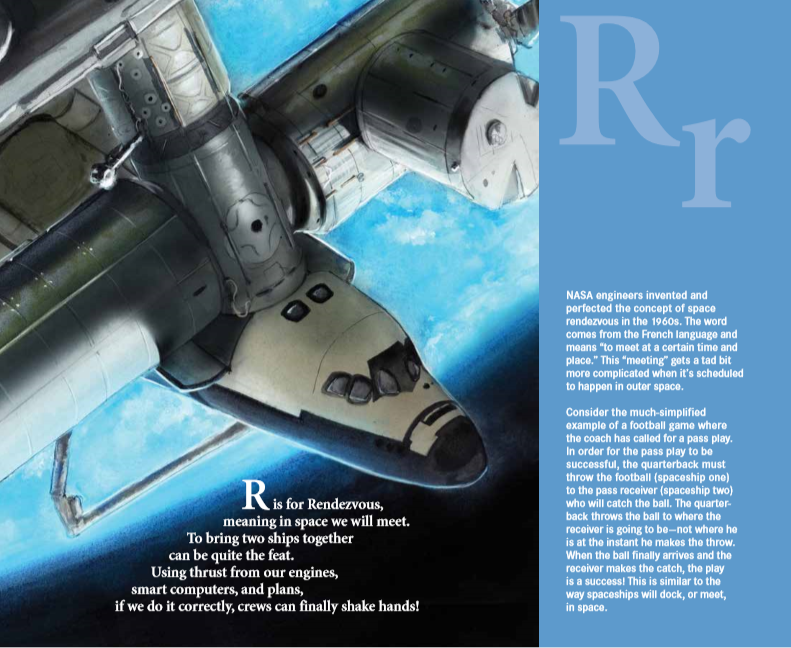
I liked the R page because of the accessible description of Rendezvous. Here's the second paragraph:

Consider the much-simplifed example of a football game where the coach has called for a pass play. In order for the pass play to be successful, the quarterback must throw the football (spaceship one) to the pass receiver (spaceship two) who will catch the ball. The quarterback throws the ball to where the receiver is going to be--not where he is at the instant he makes the throw. When the ball finally arrives and the receiver makes the catch, the play is a success! This is similar to the way spaceships will dock, or meet, in space.


That's an explanation I will remember!


BEHIND THE SCENES


“Astro Clay”–Astronaut Clayton Anderson's story is one of perseverance. He applied 15 times before NASA selected him as an astronaut in 1998; and he spent 30 years working for NASA, 15 as an engineer and 15 as an astronaut. He is the first and ONLY Astronaut selected from the State of Nebraska. 

This STEAM book will be a great addition to any school or home library. Here's a brief interview about how this book came to life.

CAROL: What prompted you to write A Is For Astronaut?

CLAY: I was in Omaha, NE at the West Town Barnes and Noble, preparing for a book signing with my first book, The Ordinary Spaceman.  The store manager kept pulling me over to the nearby children’s section.  “You should write a children’s book,” she said.  

Hesitant, I shrugged my shoulders and replied, “Yeah… maybe one day.” 

She pointed out specific publishers, continually mentioning Sleeping Bear Press (SBP).  “They don’t have ‘A is for Astronaut’,” was her firm “suggestion.”  Shrugging my shoulders once again, and feigning only brief interest, I was overjoyed when the actual book signing began and turned my focus onto something I actually understood!  

A few months later, during some idle time at home, I did a Google search on SBP.  It was then that I finally woke up and saw their tremendous success with their alphabet book series.  Electronically investigating “A is for Airplane,” and a couple other titles on their highly populated series list, I thought to myself, "I can do this!”

Immediately I began to formulate the words I would use for each letter of the alphabet.  A was easy… astronaut.  B followed suit with Blastoff.  I was cruising until I got to letters like F and K and I.  Some more research via the internet gave me all 26 letters and a corresponding space term.  Then came the poems. I actually finished the entire book in about 1.5 weeks! 

CAROL: What was the most difficult part to write—the poems or the expository text? Why? 

CLAY: The expository text was the most difficult for me, although difficult is a relative term.  The poems simply “flew” from my brain (do you like that space reference?!)  Writing them was a tremendously fun process. With the text however, a different challenge was presented.  I was seeking to entertain, educate, and inform, while at the same time creating interesting reading material that was technically correct and had the ability to “stretch” the young reader’s vocabulary. 

Certain space concepts (e.g., rendezvous) forced me to dig a bit deeper as a writer.  Often speaking to young children in schools, I use visual demonstrations to communicate some of the more technical aspects of flying in space.  It became a simple matter of putting those demonstrations down on paper.  A second part of the challenge was technical accuracy.  I don’t claim to be an expert on “all things space.”  Heck, I’m just an astronaut.  Finding adequate reference material to ensure that what I wrote was valid and correct, required a bit more digging than I thought would be necessary.  In the end I think we succeeded masterfully, but I’m partial!


When speaking to kids and young adults around the nation, I constantly implore them to remember that “…they are just like me.”  They can be anything they chose to be.  It will take hard work, a lot of help, and a little bit of luck, but the future is theirs.  They must dare to make it extraordinary. 

VIDEO

Check out this fun video starring Clayton Anderson--as himself! 

THE NIGHT WAR: A MG Historical Novel Review

  By now you should have received an email from my new website about my review of THE NIGHT WAR by Kimberly Brubaker Bradley. (It'll com...