Showing posts with label environment. Show all posts

Wednesday, January 19, 2022

PHOTO ARK ABC: NONFICTION PICTURE BOOK REVIEW, GIVEAWAY, and MINI-AUTHOR INTERVIEW

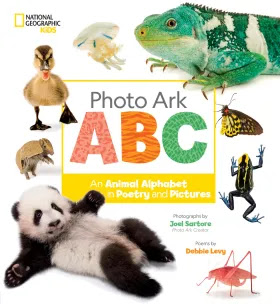
 I first "met" Debbie Levy through the pages of her novel-in-verse, This Promise of Change. In her newest book, Photo Ark ABC, Debbie  uses more than five different types of poems to playfully describe animals from Aardvarks to Zebra Finches. The accompanying photographs by National Geographic's Joel Sartore are outstanding, cute, and engaging. Children from ages 5-8 will "get" Photo Ark's message of protecting animals and their environment in a beautiful and fun manner. 


REVIEW

The book opens with an overview of all the animals featured in the book. Here is the first stanza:

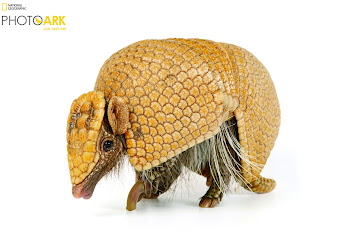
Hi, Armadillo, 
Greetings! Grizzly Bear!
In a poem you are neighbors
In the wild, you're not a pair.
From there, Debbie takes a unique look at A, for Armadillo. 

This is the last portion of the poem; unfortunately I can't show you how the words are positioned to highlight the physical features of the animal. But the words dance on the page!

The only mammal with a shell
Can barely see but sure can smell
A sniff will tell if danger's near
And if its time to disappear...

To once again
become a pillow
Stoney, scone-y
Armadillo.
The next two spreads compare bears with butterflies- through the photos and words. I wouldn't have have thought of pairing them together, but think about it... They both feast, sleep, and creep!

D is for Duck

Hey, little duckling
What did you do?
What's that drop 
I see behind you?

Aw, little mallard
That's part of life too-
It's not just a Duck thing
It's what we all do!

I is for Iguana


The second stanza of this poem reads,

Neither emerald nor moonstone,
not mineral, but fauna,
This gem has a backbone
This gem is Iguana.
J is for Jellyfish


No lungs, no nose, no ears, no eyes
No brain to make a jelly wise.
No tongues, no toes, not even hearts
Nope. Jellyfish don't need those parts.

Y is for Yabby


There once was a Yabby down under
Who thought he could vanquish the thunder
With claws he went THWACK
At each BOOM and each CRACK
But could not tear thunder asunder.


This great STEM book will make a wonderful addition to a little one's library, or to the pre-school through second grade curriculum.


AUTHOR INTERVIEW

CAROL: How did you come up with the idea for this book?


DEBBIE: I didn’t come up with the idea, the people at National Geographic did! A few years ago they’d published Animal Ark, which paired the amazing photos of Joel Sartore with poetic text by Kwame Alexander. Now the idea was to feature another batch of Joel’s photos (of which there are thousands) in an ABC book—from A for armadillo to Z for zebra (and zebra finch!), with a separate poem for each animal. They wanted the poems to be fun and to encourage young people to care about the animals. I was thrilled to have the opportunity.


CAROL: Were the poems difficult to write?


DEBBIE: The poems really were a joy to write. I wanted to include different types of poetry, as an homage to the diversity of species but also to add texture to the book. So there are rhyming forms and free verse and more formal structures, too. (These are all identified in my author’s note in the back matter.) You ask how difficult the poems were to write; if writing’s not at least a little difficult, I’m not sure it’s any fun! Some were more of a challenge than others, but by learning about the different species and subspecies pictured in the book, playing around with forms and words, thinking about what might bring a smile or spark curiosity in the reader’s mind, and meditating on Joel’s images, I composed the poems from A to Z! 


GIVEAWAY

To enter this giveaway, please leave your name and email address in the comments. If you are reluctant to leave your email address, you can email me at cbaldwin6@me.com. If you are educator or librarian (including home educators!) tell me where you work and I'll put your name in twice. Giveaway ends Saturday, January 22 at 6 PM. 

Congratulations to Lauris Burns who won the much-in-demand book, AIR by Monica Roe. 

Wednesday, August 19, 2020

Lights Out: A Review and Picture Book Giveaway

Congratulations to Kathy Wiechman who won the ARC (Advanced Readers Copy) of EQUAL from last week's blog. For those of you who didn't win, I'll be posting a review at a later date and you'll have an additional chance to win the book.

*******

Marsha Diane Arnold is another author who is no stranger to my blog. This week I'm delighted to be a part of the launch of her newest book, Lights Out with magnificent illustrations by Susan Reagan. As I think you'll see in the review below, Susan does a great job of amplifying Marsha's text. 


For centuries, people on Earth looked to the night sky for navigation, for inspiration, for wonder. But today, we can barely see that sky through all the artificial light. In fact, we see less than 1 percent of the night sky compared with people of the 1600’s. Author's Note

Today's children learn about air and water pollution, but what about light pollution? As a child, Marsha was surrounded by Kansas farmland. She remembers climbing out on the roof at night and being enthralled by the constellations. In 2008 on a Sequoia National Park Foundation's Authors in the Back Country adventure, she spent a week camped at 10,000 feet. She looked out of her tent at the darkness and dreamed of writing a picture book about the dangers of light pollution. Lights Out is the result of that dream.

REVIEW


Look at this beautiful opening:

Little fox peeks out from her den. Beetle flies above her. "Lights out!" she barks. But the lights stay on.


Fox and Beetle begin a journey to find a place where lights do not
disturb nighttime darkness. Unfortunately, that place is hard to find.
Instead, they discover all sorts of lights: Traffic lights, floodlights, blinking lights, and flashing lights. 

Where is Darkness? Where is Night, where coyotes sing, owls hunt, and birds fly across continents, where foxes move through the dark and beetles are more than beetles? 

The two begin their search around the world for Darkness.

They find a songbird who is confused by all the light because there are no stars to guide her. 


The songbird joins their search through the whole world--but everywhere is the same. Lights. No Darkness.


In the wetlands, Frog quietly waits for a nighttime chorus. Without Dark, only silence.


Frog joins the trio and so does a bear who can't hibernate because of the light. 

Through the forests and the meadows, across highlands, deserts, dunes, on tundras, prairies, and high mountains, they search.

When they come upon baby turtles on the seashore who can't make it back into the ocean, the friends take action and shepherd the hatchlings back to the sea.


The baby turtles follow Firefly and moon's glow, patterns of the Night emerge. Hatchlings paddle safely away.


The book closes with the right "lights" on and well,....you'll just have to purchase the book to see the perfect ending!

Children will get the message: light pollution is harmful to animals. Teachers, parents, and grandparents can add that human biorhythms can also be affected by too much light. This will be a great classroom resource for pre-school through third-grade students. 

Here is a link to several downloadable STEAM activities to go along with Lights Out

GIVEAWAY


One fortunate reader will win this book! Leave me your email address (if you are new to my blog) and I'll enter your name. Giveaway ends August 22; U.S. addresses only. For additional chances, share this on social media or start following my blog--just let me know what you do in the comments. 

Monday, November 20, 2017

Raccoon Rescue: A Review

Congratulations to Carol-Ann Ruddy who won Two Thousand Years from last week's blog.

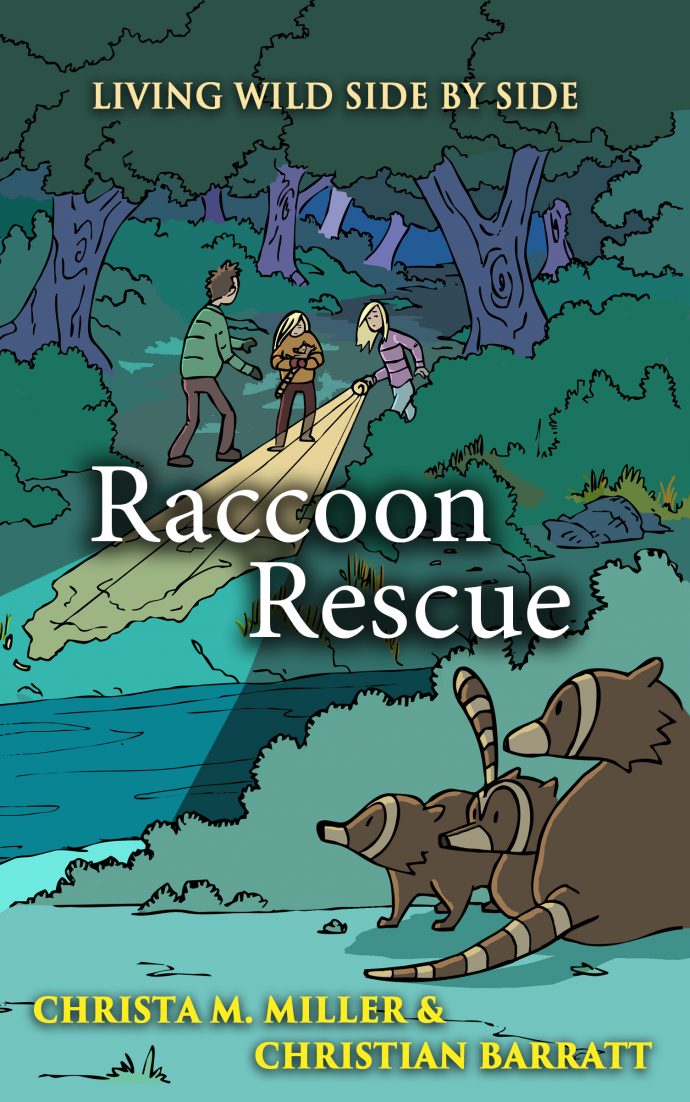
Author Christa M. Miller could have subtitled Raccoon Rescue, The Kits and the Kids. Those four words pretty much summarizes this illustrated book that children in grades 2-3 will enjoy.


Review


Roxy, Rufus, and Renae are three young raccoons who are learning about life outside their comfortable den. As they venture out to gather food they encounter humans--as well as the trash they leave behind. Children will enjoy the interaction between the kits that sounds very much like normal give and take in a family.

Here is an interchange when Roxy gets mad at her brother:


"Don't call me fox-bait!" She leaped at him. 
"Mama!" Rufus screeched and got away barely in time. "Roxy bared her teeth at me!"
"Roxy, don't pick fights with your brother," Mama said. "He was only trying to help you. And Rufus, don't call your sister names. That isn't necessary." (p.13)


Illustrated by Christian Barratt


When the kits see a child who seems scared their mother says, 
"When you see a human acting normal, the best thing to do is leave it alone." 

The youngest raccoon responds, "Can we adopt it?" asked Renae. "Raise it like a raccoon?" (p. 18)

As the raccoons cross paths with Helena, Hope, and their parents, there is misunderstanding conflict, and then ultimately, a new respect on both sides. The final chapter includes clever dialogue which shows the reader how both the animals and the children feel and think.


Author Statement 

Here is Christa's reason for writing Raccoon Rescue.
Raccoon Rescue was the result of spending hours at Izzie's Pond, a local wildlife rescue and sanctuary, volunteering to help care for recovering and orphaned animals -- including raccoons. As I watched young raccoons grow from small kits to juveniles and at last to releasable adults, I grew from simply thinking they were cute, to deeply respecting their intelligence, sociability, and instincts. 
Raccoons are among the most adaptable species, but also among the least understood. In the Guardians of the Galaxy movies, Rocket Raccoon is deeply offended by people calling him "vermin" or other epithets that reduce the true measure of his loyalty and quick wits. Seeing people disgusted by "disease-carrying" animals -- at the same time that professional rehabilitators treat them for distemper, worms, and even (via vaccination) rabies -- drove me to write Raccoon Rescue from the point of view of animals who are as uncertain about humans as we can be about them, and hopefully to make us think about how we see them. 
Raccoon Rescue is about the heart of those misunderstandings, and the small steps we can all take to correct them towards humane, peaceful coexistence with our wild neighbors.

Curriculum Connections

The illustrations sprinkled through Raccoon Rescue make this book very accessible to young readers. Read more about the illustrator, Christian Barratt, on Christa's blog. In addition, the book uses Dyslexic font to make it more accessible to readers with learning disabilities. 

One of the neat extras of this well-written book are the 29 pages of Curriculum Connections at the end. I'm giving my copy to one of my granddaughters to read and give to her teacher. If you have a child or grandchild in second or third grade, consider how this might be a better teacher gift this year than another coffee mug!

Caitlin with her Thanksgiving turkey
and Raccoon Rescue!


THE NIGHT WAR: A MG Historical Novel Review

  By now you should have received an email from my new website about my review of THE NIGHT WAR by Kimberly Brubaker Bradley. (It'll com...