Showing posts with label science. Show all posts

Monday, September 5, 2022

I Read Two "Hole" Books: 2 Picture Book Reviews, 2 Giveaways, and 1 Mini-Author Interview

I have received so many picture books from Sleeping Bear Press that I decided to double up on some of my reviews. I went through my pile and found these two with the word "Hole" in the title. They're as different as a fantasy/science book can be from a friendship/grief title. But as you'll see, either one would be an excellent addition to your home or school library.

THE BLACK HOLE DEBACLE


This book, written by Keri Claiborne Boyle and illustrated by Deborah Melmon is a fun combination of fantasy (the main character finds a black hole in her backpack) and science (two pages of back matter provide "real" information about black holes).

(By the way, both Keri and Deborah are not new to my blog. I reviewed Keri's fun book, Otis P. Oliver Protests, and showcased Deborah's art in Letters from My Tooth Fairy.)

The opening page spread shows what type of girl Jordie is,


as well as her main conflict.

That is only the beginning to Jordie's problems. On the bus the black hole snarfed down her water bottle, library books, and her friend's softball glove. At home, the black hole "gorged on her soccer ball, sheet shirt, unicorn underwear, and favorite pom-pom hat. It did, however, spit back the unicorn underwear."

The next thing she knew, her dog Neptune was gone!


She had no choice. She had to get her dog back. She opened her door, stepped to the black hole's edge, and leaped--finding herself in a world without sound so she couldn't even call her dog!

When her softball glove, homework, and dog floated by, she snatched them all up. And smart girl that she was, she also guessed that the black hole would spit out her underwear and..


she ended back at home. Unfortunately, her cosmic friend followed her home. Jodie knew "that black holes needed space. They were meant to graze galaxies and slurp stars, not dine on dogs." (Catch the pun and the alliteration?)

The next day at school Jordie found everything that had gone missing. Everything except her library books and magazines.

Jordie knew something that no other astronomer knew...
It turns out, black holes are ravenous readers. 
Awesome space/STEM book!

THERE WAS A HOLE

Now, get ready for a serious--yet beautiful--book about friendship, grief, and loss. Although the words are sparse, the marriage of Adam Lehrhaput's works and Carrie O'Neill's art, couldn't be better.


Here is the opening, poignant page.
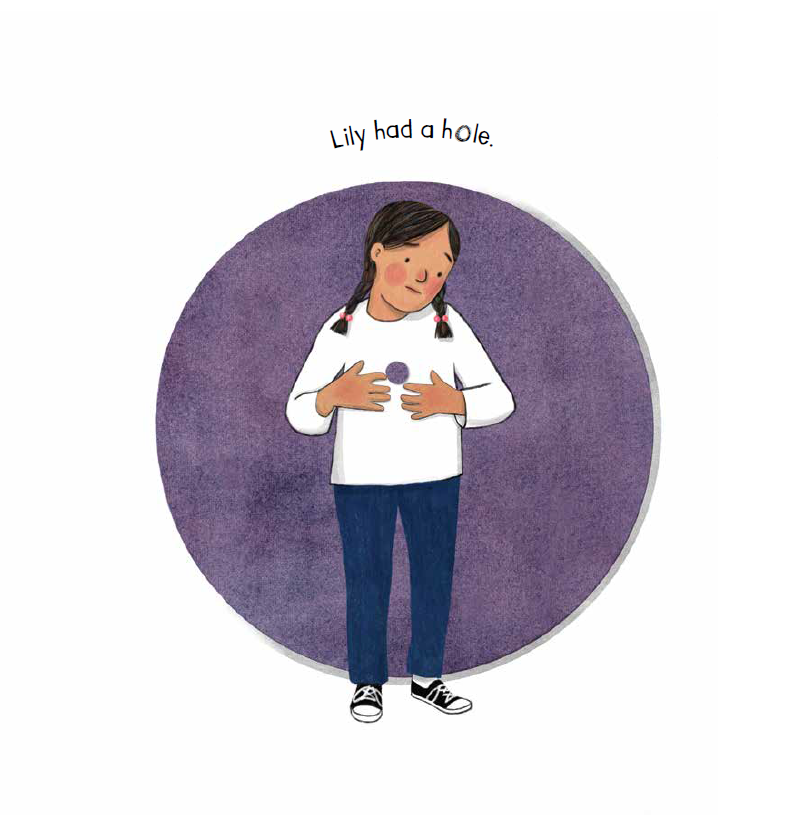


Her daddy noticed that she was angry and tried to make her happy by giving her toys or taking her to fun places. But nothing fixed the hole. 


She ate lunch by herself and didn't join the kids in playing her favorite game. 


When Thomas asked what was wrong, Lily admitted that she had a hole. He shared his secret, "I have a hole, too."


Thomas shows her how to repair the hole by making patches representing the things Lily enjoyed and was grateful for. She made patches that represented her father, their home, and flowers. Gradually, 
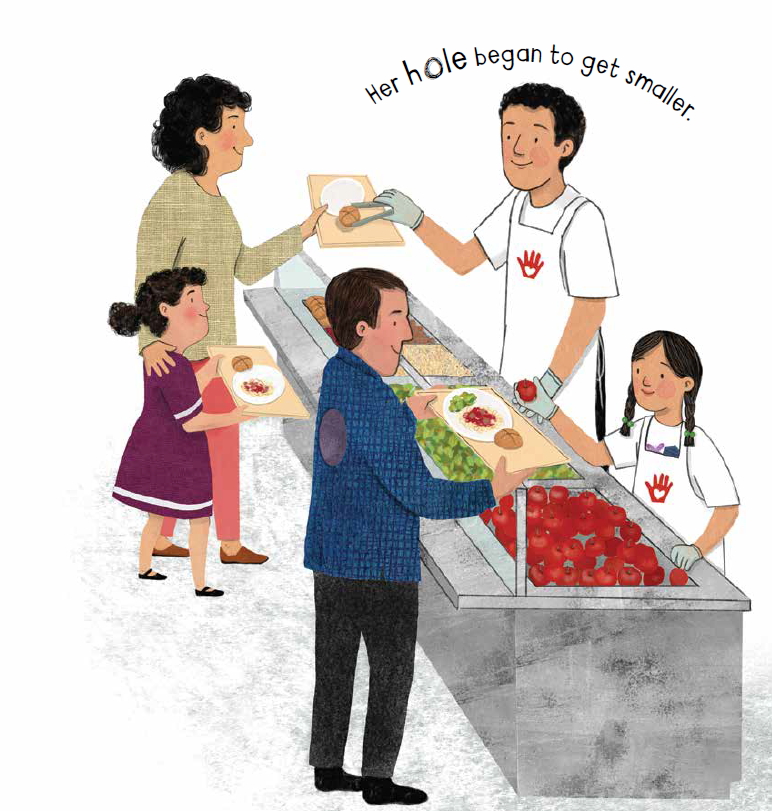


"The patches didn't fix everything.
But they were a start."


The back matter addresses the idea of loss in kid-friendly language and gives directions on how to make a patch. As the author states, "I know, you don't have an actual hole. But that's okay. It's the process of making patches where the real magic happens."


AUTHOR INTERVIEW with Adam Lehrhaupt


CarolTo be honest, it took two readings for me to get the message. I kept thinking, why is there only a father in the illustrations? Then, I realized that the hole was the person who was missing in Lily's life. The "magic" of this book is how you and the illustrator show, but don't tell, the effects of loss in a person's life.

AdamIt was very important to me that I didn’t force a particular reason for the hole into the story. I wanted readers to be able to place themselves in Lily’s position no matter what caused their hole. Savvy readers needed a concrete reason for Lily and her father’s holes.  

Carol: I know authors and illustrators don’t usually communicate much during book creation. But the idea of your book depends on the illustrations showing your text. Did you include illustrator notes?

Adam: I had a few art notes in my original manuscript. The most important was at the end of the first line of text:

"Lily had a hole. (In her chest where her heart would be.)"

Carol: That was all?

Adam: Other than that, the other notes were more about explaining the patches and activities going on around Lily. I really try to give my illustrators as much freedom to express their talents as possible. So far, I’ve never been let down by the results. In fact, I am most often in love with the results.  

The treatment of the hole, the wonderful emotional subtext expressed by the dog, and the look and feel of the patches all came from my amazing illustrator. She really hit this out of the park. I couldn’t be more thrilled. 


GIVEAWAY INFORMATION


If you are interested in winning either of these two books, please leave me a comment with the title preference, your name, and your email address. If you are a teacher/librarian/home educator or decide to follow my blog, I'll put your name in twice. If you prefer to contact me through email, click here. U.S. addresses only. The giveaway ends on Thursday September 8. 

Congratulations to Marci Whitehurst who won HURRICAMP from the last blog.


Thursday, December 10, 2020

WINGED WONDERS: A Picture Book Review and Giveaway

 Congratulations to Tricia Clark who won Fly, Firefly! from Monday's blog. She's an "old" friend, but a new follower to my blog. 


Author Meeg Pincus is a gifted author who I featured on my blog a year ago. I am new to Yas Imamura's work but as you'll see in the color palette she used in the illustrations, she is also very talented. This is another fine picture book published by Sleeping Bear Press.


REVIEW


In this way, Meg Pincus begins the story of how two Canadian scientists, many volunteers, a young married couple, and a village in Mexico worked together to solve the monarch migration mystery.


In 1976, the world finally learned the answer...with a groundbreaking discovery.


It began with Fred and Norah Urquhart, two scientists who spent 30 years studying the monarch mystery. In his lab, Fred tagged the butterfly's wings with--of all things--small price tags. Norah placed ads in newspapers throughout North and Central America asking for volunteers to tag butterfly wings. She kept track of every "tidbit of information" that was returned to her.

Thousands of science teachers, backyard gardeners, and other curious souls answered Norah's ads and became citizen scientists. 


Ken Brugger and his Mexican wife, Catalina, rode through Mexico for two years trying to track the butterflies' "twisting trail." 

Villagers in central Mexico directed the couple to look for the monarchs in their oyamel tree groves. 


Catalina kept 40 notebooks of monarch data and "crunched through early morning snow, high in the Sierra Madre mountains" and was rewarded by being the first to spot them.


But who provided the proof that Fred Urquhart needed to announce the discovery of The Great Monarch Migration?


CURRICULUM RESOURCE 

Winged Wonders ends with a plea to help save the diminishing monarch population. The last spread encourages readers to be a part of preserving landing spots and airstreams on which the monarchs depend. The back matter includes more about the migration discovery as well as ways in which everyone can help monarchs. I'm going to see about planting milkweed in my garden! Here are some links to educational activities


PUBLICATION JOURNEY

Since I'm always interested in an author's journey, I found Meeg's interview on Kathy Temean's blog to be inspiring. If you've ever been discouraged by what appears to be a dead-end in writing a picture book biography (as I have!) here's another way to look at a topic. 


GIVEAWAY

Leave me a comment (with your email address, if you are new to my blog) by December 12 at 6 PM. Share this post on social media for an additional chance to win the book!

Monday, December 7, 2020

FLY, FIREFLY! A Review and Picture Book Giveaway

 Congratulations to Connie Saunders who won the autographed copy of JUST BETWEEN SAM AND ME from last week's blog.


With the holidays coming up, I'm going to review and give away a few more books than usual. I know that many of you give these books to your children, grandchildren, nieces, and nephews. I enjoy passing them along and would love if you share pictures with their books on Facebook (please tag me and Sleeping Bear Press too) --as long as their parents don't mind!

Today I have another outstanding book written by Shana Keller and illustrated by Ramona Kaulitzki. Shana is no stranger to my blog but this is the first time I saw Ramona's evocative illustrations. 


With a few pictures and quotes from this rhyming picture book, I hope you will glimpse the beauty and hear the music in this story.

REVIEW


                                   to see the sea.


Attracted by bright lights in the ocean, the firefly ends up being whooshed out to sea. 


A young woman and her niece see him sink.

The woman wades in and scoops him out from the wet sand. Her niece explains to the firefly he is seeing bioluminescence swirling and twirling in the great sea. 


Cradling him in her hand, she brings him back to the tree line. 

"Trust us, you'll see. That glittering there is from the sea.
The glowing HERE is your own family.


CURRICULUM RESOURCE

This lovely picture book not only includes a message about the importance of "staying close" to one's family, but the back matter includes how Rachel Carson inspired this story and information about bioluminescence. Pre-kindergarten through second-grade teachers could use this book in their classrooms. See Shana's website for LOTS of ways to use this book as a resource. 


GIVEAWAY

Leave me a comment if you wish to be entered in this giveaway. PLEASE leave your email if you are new to my blog. If you are a new follower, I'll enter your name twice--just let me know! The giveaway ends on Wednesday, December 9 at 6 PM. 


Monday, September 23, 2019

Three Just-for-Fun Picture Books: Reviews and Giveaways

Congratulations to  Keturah Lamb who won my ARC of Maybe He Just Likes You from last week's blog.

We're back to picture books today and I have some fun ones for you to try to win for a child, grandchild, or student in your class. Thanks to Sleeping Bear Press, I seem to have an endless supply to review and pass along!


REVIEWS


Experiment #256  by Marty Kelley, is a cleverly written and illustrated STEAM-focused book for the youngest reader. The funny story of how Ian builds a jet pack for his dog, Wilbur, and all the things that go wrong is told through the illustrations, making this a book that pre-readers can figure out from the pictures. Minimal text is written in the form of Ian's notes about the experiment.

On the first few pages Ian builds the jet pack but wonders why he has leftover parts. 

NOTES:
Leftover parts were definitely the brakes.
Adding the turbo blaster was probably a mistake.
Lisa is not happy. 

Outside, Ian and Wilbur run into more trouble.

NOTES:
Garden fence need some repairs.
Wilbur got tangled up in the undies that Mrs. Marino was hanging on the line.
Mrs. Marino is not happy. 
In the end Ian designs Experiment #257, a Snack Blaster that blasts out dog treats. Wilbur is hugely happy...but their neighbor, Mrs. Marino is not. You'll have to get the book to see why!

By the way, the Front Matter is very clever. Kelley has small vignettes showing twelve of Ian's previous experiments...and disasters. 


******

Back Roads, Country Toads is not the first book by author Devin Scillian and illustrator Tim Bowers. I was drawn into this book by the first lines, "On a warm spring morning, Hank and Buckaroo were sitting in their favorite drainpipe near Cooper's General Store. They were licking up the last few sips of a bottle of strawberry soda and they were as happy as two country toads could be."  

The adventure starts when Hank and Buckaroo overhear two men talking about fly fishing. They assume that the men are going fishing for flies...what else could it mean?

When they get to the fishing spot, Emmitt, a friendly raccoon, overhears their delight:

"It's going to be a fly cafeteria!" yelped Buckaroo.
"Oh yeah, said Hank. "A down-home,
big-time fly barbecue!
After Bukaroo almost gets hooked by a fake fly, the toads are disappointed to discover that fishermen use fake flies for lures. But Hank turns the tables by using Emmitt's stolen fish as a lure for a fly dinner. 

"Yahoo!" yelled Buckaroo. Their tongues
darted through the air, snapping up fly after fly,
and the two toads reeled them in by the dozens.

In the end, "... two very plump, very happy country toads waddled back to town for a strawberry soda and an afternoon nap." 

"Toadally" sounds good, doesn't it?


********


Invisible Lizard in Love follows chameleon Napoleon's first book, Invisible Lizard  in which he sorrows over not having any friends (after all--he's a chameleon, so who sees him?). In this second book, written by Kurt Cyrus and illustrated by Andy Atkins, Napoleon's new-found friends desert him when they find love. He's alone again!

Napoleon sulks and then scratches his initial inside a heart on a tree. When the branch snaps, 

Moss and bark rained from the sky.
Fern grounds fluttered by.
A warty lumpstool fell onto
the far end of the branch.
Napoleon held on.

Napoleon realizes that the only thing which is keeping the limb balanced is the "big warty lumpstool" who turns out to be a girl chameleon aptly named (who else?) -- Josephine.  

The two chameleons slowly move towards one another, afraid to disturb the balance of the precarious limb.

They kept on creeping. 

Until they meet in the middle of the branch. 

Like a chameleon itself, science and friendship lessons are hidden within the story and illustrations. 


******
One of the challenges of writing a good picture book is that the adult reader and the child are both entertained. These three picture books soundly meet that challenge. 


GIVEAWAY

Leave me a comment if you would like to win Back Roads, Country Toads or Invisible Lizard in Love. (I'm saving Experiment #256 for my grandkids). Make sure you leave me your email address if you are new to my blog and which book you are interested in. Giveaway ends September 26 and is limited to the continental United States. 

Monday, July 2, 2018

Strange, Unusual, Gross and Cool Animals by Charles Ghigna: A Review and Giveaway

Congratulations to Joan Edwards who won the audio CD of "The Road to Bittersweet." Thanks to all who left comments. Keep persevering and entering. More giveaways coming up--starting today!

**********
Charles Ghigna, the Father Goose of children's books and no stranger to this blog, has done it again. But this time, it's not a clever book in rhyme for the youngest readers. Strange, Unusual, Gross, and Cool Animals  (Animal Planet, 2016) will appeal to kids of all ages who want to get up close and personal to some very weird animals. 


The animals are divided the way the title predicts: Strange, unusual, gross, and cool. Within each section there are four types of pages: a gallery spread which shows animals that live in different parts of the world but have adapted to their environment in similar ways; a featured creature that highlights one phenomenal animal through details about its life, stats, and maps; a creature collection which compares and contrasts a large group of animals; and macroview pages which show tiny details of very small animals.

Charles Ghigna gave me a "behind-the-scenes" look at the book's creation. After he agreed to write this book in nine months, he realized it would be a book that was, "Full of facts. No fanciful word play. No imaginative nonsense rhymes for toddlers. My tranquil treehouse would become the center of the universal pursuit of the biggest, baddest, best creatures on the planet. No more loose and loony alliteration. This was serious business."

Enter Strange, Unusual, Gross and Cool Animals--an accessible, factual, humorous book that will make every young reader want to learn more about the animal kingdom--even if she's scared of snakes and spiders like me. And guess what? Ghigna couldn't resist including a rhyme or two.

STRANGE

Strange how we as humans
view creatures great and small--
for we who see their strangeness
are the strangest of them all!


How strange is the star-nosed mole? Pretty strange. "It's nose is covered in 22 sensitive appendages that are so good at detecting vibrations they can tell when earthquakes are coming...It can even smell underwater by blowing bubbles it then breathes in through its nose." (p. 10)


UNSUSUAL

Unusual is what we call
The weird, the fast, the rare.

We classify each creature--

But do they really care?


The thorny dragon looks like it comes from prehistoric times. Besides having a camouflaged body covered in hard, sharp spikes and two horns--it also has a false head growing on its shoulders! The sharp spines make it difficult for a predator to swallow. Besides, as Ghigna points out, "Who would want to eat a thorny, two-headed , puffed-up dragon?"

GROSS

Gross is used instead of yuck
for words like poop and pus,
but all these animals agree--
it's only gross to us!


From my experience with kids, many are delightfully intrigued by gross stuff. From finding out that honey is really regurgitated nectar and millipedes can secrete yucky liquid that burns other bugs, discovering parrotfish who poop out sand, reading about a Goliath bird-eating spider that can be up to five inches long and when threatened, has a hiss that can be heard 15 feet away--readers looking for gross animals will find it in these pages.

COOL


Cool is how we think we look
when we try to impress,
but animals are born that way-
with lots of cool finesse!


Because of its translucent skin on its belly, "you can see through the glass frog and see its liver, heart, and intestines without an X-ray machine, just like Superman can!" (p. 108) Some see-through creatures include glasswing butterflies, the pelagic octopus, and the big skate that looks like a slimy ghost! Other cool animals glow in the dark, sport blue feet (blue-footed booby) or climb walls like Spider Man (mwanza flat-headed rock agama). 

A book to leaf through or read from cover to cover, young readers will enjoy discovering new animals just as much as Ghigna did: "The Blobfish first caught my eye. Icky pink and bulbous looking. Voted the “World’s Ugliest Animal,” I knew that one would become a hit with the 8-12 year old crowd. Who could resist the Rosy Wolfsnail, the fastest snail on earth? Who just happens to be a cannibal from Hawaii. And who just happens to inhabit my home state of Alabama and throughout the Southeast. Or the Fangtooth Fish whose teeth are so large it can never close its mouth?"


Ghigna told me, "I am glad I could be a part of this irresistible collection of amazing creatures whose lives will be explored by an endless parade of curious kids who might even put down their iPhones to ponder these scary, stunning pictures of exotic animals from around the world taken by some of the world’s top photographers."

GIVEAWAY

In mid-July Joyce Hostetter and I will publish our summer issue of Talking Story on "The Great Outdoors." Since all of these animals can be classified as existing somewhere in that category, I'm going to give away this tremendous classroom resource through Talking Story. Leave me a comment here (with your email address if you are new to my blog) and I'll enter your name once. Follow the directions to enter the Talking Story giveaway (and if you don't know about this quarterly newsletter for teachers and librarians here is a link to the spring issue. You can subscribe through the link) and your name goes in twice. Winner will be drawn on July 21. 

Monday, November 20, 2017

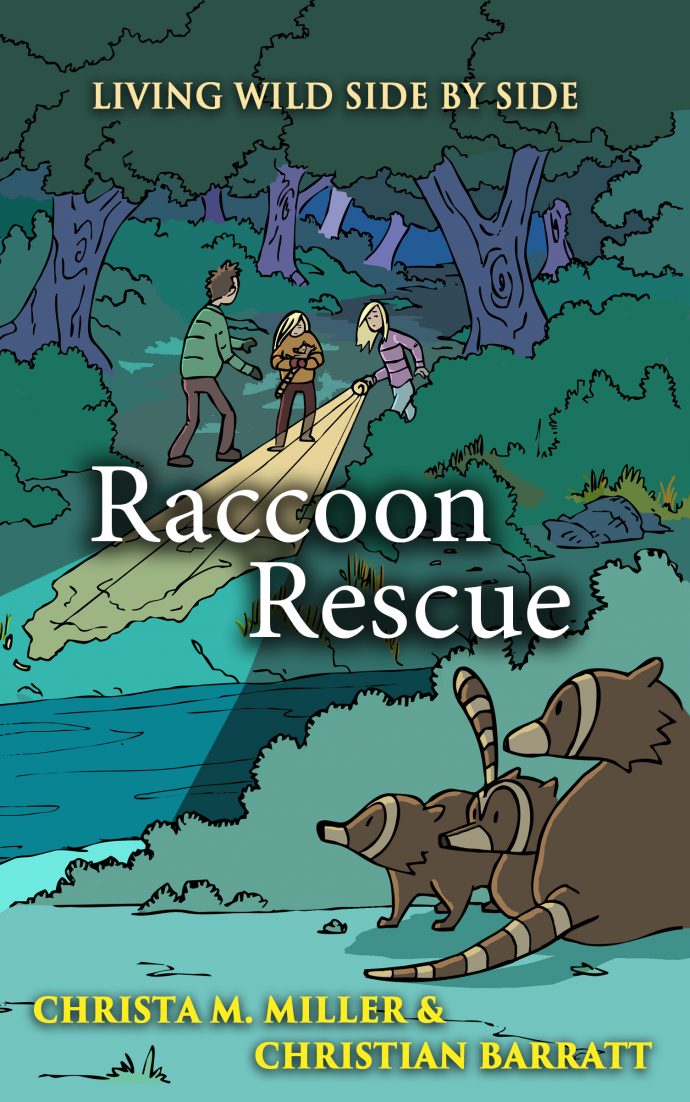
Raccoon Rescue: A Review

Congratulations to Carol-Ann Ruddy who won Two Thousand Years from last week's blog.

Author Christa M. Miller could have subtitled Raccoon Rescue, The Kits and the Kids. Those four words pretty much summarizes this illustrated book that children in grades 2-3 will enjoy.


Review


Roxy, Rufus, and Renae are three young raccoons who are learning about life outside their comfortable den. As they venture out to gather food they encounter humans--as well as the trash they leave behind. Children will enjoy the interaction between the kits that sounds very much like normal give and take in a family.

Here is an interchange when Roxy gets mad at her brother:


"Don't call me fox-bait!" She leaped at him. 
"Mama!" Rufus screeched and got away barely in time. "Roxy bared her teeth at me!"
"Roxy, don't pick fights with your brother," Mama said. "He was only trying to help you. And Rufus, don't call your sister names. That isn't necessary." (p.13)


Illustrated by Christian Barratt


When the kits see a child who seems scared their mother says, 
"When you see a human acting normal, the best thing to do is leave it alone." 

The youngest raccoon responds, "Can we adopt it?" asked Renae. "Raise it like a raccoon?" (p. 18)

As the raccoons cross paths with Helena, Hope, and their parents, there is misunderstanding conflict, and then ultimately, a new respect on both sides. The final chapter includes clever dialogue which shows the reader how both the animals and the children feel and think.


Author Statement 

Here is Christa's reason for writing Raccoon Rescue.
Raccoon Rescue was the result of spending hours at Izzie's Pond, a local wildlife rescue and sanctuary, volunteering to help care for recovering and orphaned animals -- including raccoons. As I watched young raccoons grow from small kits to juveniles and at last to releasable adults, I grew from simply thinking they were cute, to deeply respecting their intelligence, sociability, and instincts. 
Raccoons are among the most adaptable species, but also among the least understood. In the Guardians of the Galaxy movies, Rocket Raccoon is deeply offended by people calling him "vermin" or other epithets that reduce the true measure of his loyalty and quick wits. Seeing people disgusted by "disease-carrying" animals -- at the same time that professional rehabilitators treat them for distemper, worms, and even (via vaccination) rabies -- drove me to write Raccoon Rescue from the point of view of animals who are as uncertain about humans as we can be about them, and hopefully to make us think about how we see them. 
Raccoon Rescue is about the heart of those misunderstandings, and the small steps we can all take to correct them towards humane, peaceful coexistence with our wild neighbors.

Curriculum Connections

The illustrations sprinkled through Raccoon Rescue make this book very accessible to young readers. Read more about the illustrator, Christian Barratt, on Christa's blog. In addition, the book uses Dyslexic font to make it more accessible to readers with learning disabilities. 

One of the neat extras of this well-written book are the 29 pages of Curriculum Connections at the end. I'm giving my copy to one of my granddaughters to read and give to her teacher. If you have a child or grandchild in second or third grade, consider how this might be a better teacher gift this year than another coffee mug!

Caitlin with her Thanksgiving turkey
and Raccoon Rescue!


Monday, April 13, 2015

Red Madness: How a Medical Mystery Changed What We Eat

Congratulations to Kathleen Burkinshaw who won Miriam Franklin's ARC, Extraordinary. Random.org didn't know they are both Sky Pony debut authors--but I did! Look for a review and giveaway of Kathleen's book, The Last Cherry Blossom  next fall.
*******
How many of you have heard of pellagra? Before reading Red Madness, I was unfamiliar with the disease. But reading it resolved a personal mystery for my husband's 85-year-old uncle. He finished the book and said, "Now I know what I had as a child."

This disease which produces a horrible skin rash, leads to severe intestinal problems, causes neurological problems, and often leads to death, no longer afflicts wide portions of our population--the way it did during the first half of the twentieth century. Pellagra has been eradicated from most developed countries because of the tireless work of one physician: Joseph Goldberger. Red Madness by award winning author Gail Jarrow, describes how this medical mystery was solved.
Written with clear language accessible to readers from age ten through adult, Gail Jarrow chronicles the history, myths, and treatments associated with pellagra. Dr. Goldberger's tireless efforts to determine the primary cause of pellagra included hosting "filth parties." In gruesome detail, Gail describes how Goldberger tried infecting himself with pellagra in order to prove that it was not contagious or a result of infection. 


http://www.loc.gov/pictures/item/ncl2004004556/PP/
"This Oklahoma sharecropper and his family pick cotton in 1916.
The older two children--ages six and five--together picked twenty-five pounds of cotton a day.
Goldberger tried to communicate his message about diet to farmers and mill workers,
 two groups that suffered from pellagra." (p.100)
Since the disease appeared most often in poor households where diets were limited to 3-M's: meal (cornmeal baked into bread), meat (fatback, form the fatty layer on a pigs back) and molasses (syrup), Goldberger was convinced that pellagra was probably caused by a diet deficiency. But how could he prove that? Goldberger spent eleven years, traveling frequently in the South where the disease was most common, and performed experiment after experiment. 

In 1923 his efforts finally paid off. Experimenting with dogs who were experiencing pellagra symptoms, Goldberger fed them brewer's yeast (something missing from most pellagrins' diets). Quickly, the dogs recovered. In 1926 the Mississippi River flooded. 700,000 people lost their homes and 45-50,000 developed pellagra. The Red Cross took Goldberger's recommendation to add yeast to the impoverished people's diet. Within two months people were cured. 

After Goldberger died in 1928, other scientists continued searching for the vitamin that would prevent pellagra. Eventually, Conrad Elvehjem discovered that nicotinic acid (now known as niacin) was indeed, the pellagra-preventing vitamin. Ten years later bakers began adding niacin, along with other Vitamin B complex vitamins to bread. That was the beginning of the enriched bread we enjoy today. 

According to a recent Writer's Digest article, "Straight Up Nonfiction with a Twist," one way authors enhance text is by using sidebars for supplemental material. Gail and her team at Calkins Creek did an excellent job of interweaving newspaper headlines, facts, and photos such as this one into the body of the text.
"Some doctors referred to the butterfly-shaped rash on the
girls neck as the Collar of Casal, named after
the first doctor to write about pellagra." (p. 83)
In addition, dozens of case histories of individuals whose lives were torn apart by the disease, are sprinkled throughout the book. 

In a recent SCBWI, Bulletin article, "What Teachers Want from Nonfiction Authors," Alexis O'Neill said that teachers wanted authors to share about their research and writing process. Accordingly, I asked Gail a few questions about her process.


CarolWhat was it like for you to see the images of people afflicted with pellagra and pulling them together for this book?

Gail: Part of me approached this topic in a clinical manner. I have a background in biology, and I was fascinated to learn how a vitamin deficiency could lead to such dramatic physical symptoms. But when I read the accounts of patients’ suffering written by their doctors, I felt upset knowing this disease was so easy to prevent. Even after  pellagra’s cause and cure were discovered—and publicized—people continued to fall ill and die. Many victims lacked the resources to eat properly or didn’t realize how diet affected their bodies. Tragically, other deaths occurred because some physicians refused to accept that pellagra was a diet deficiency disease.

Carol: Was any part of this writing/publishing journey more difficult than another? 

Gail: The hardest part—and this is always the case when I write a non-fiction book—is locating and obtaining the primary documents.  Those were key because  secondary sources were contradictory about the early-20th-century understanding of pellagra, Joseph Goldberger and his research, and other details included in my book. Whenever possible, I go back to the original sources and do not necessarily trust what I read elsewhere. Too many times, I’ve found errors in the secondary sources.

For more information on the nitty gritty behind writing this book, see the informative Author's Note at the end of the book and Gail's interview in the School Library Journal. Teachers, make sure you utilize the educational activities which Gail has assembled. With such a detailed analysis of the disease, what caused it, and the stigmas associated with the disease, Red Madness will be an excellent supplement to history, sociology, and science lesson plans. 
*******
I usually give away the books which I receive to review. This time I donated Red Madness to The Christian Academy, where my daughter teaches. In an upcoming blog I plan to review another new book by Gail, Fatal Fever: Tracking Down Typhoid Mary.  You'll have a chance to win that one; both books are outstanding additions to any home or school library. 

Read this book and maybe you'll discover answers to the mystery disease which left its mark on someone you know. 

THE NIGHT WAR: A MG Historical Novel Review

  By now you should have received an email from my new website about my review of THE NIGHT WAR by Kimberly Brubaker Bradley. (It'll com...