Showing posts with label Calkins Creek. Show all posts

Monday, April 22, 2024

THOMAS JEFFERSON'S BATTLE FOR SCIENCE: A Picture Book Review and Giveaway

Beth Anderson is no stranger to my blog. Her outstanding nonfiction biographies find little-known stories within a historical character's well-known life. Thomas Jefferson's Battle for Science: Bias, Truth, and a Mighty Moose! (Calkins Creek, 2024) is her latest contribution to her other great curriculum resources for grades 2-5. The engaging illustrations by Jeremy Holmes amplify the text and pull readers of all ages into the book.


REVIEW

The book opens with illustrations of the animals, plants, and geographical formations that Jefferson studied. The text reads, "Young Thomas Jefferson measured his world." He collected fossils and bones. "The power and majesty of nature called him to question, experiment, and explore." He was quite certain it was all peaceful and measurable until he read Count Georges-Luis Lecleric De Buffon's encyclopedia of the natural world.


The battle began.

Buffon declared that the new world was swampy, cold, and lacked magnificent animals like lions and elephants. He wrote that bears were smaller and wolves were puny. Jefferson read,


"Suddenly science wasn't certain or peaceful."

The War of Independence erupted and Jefferson focused on his role as the Virginia representative to Congress. But inside of him, his own battle raged. He asked questions about Buffon's "facts." Most of all, he wanted to know how the French naturalist could write about America without ever traveling here! He compiled evidence to disprove Buffon's conclusions and wrote his own book--Notes on the State of Virginia! (His only full-length book published in his lifetime.)

He packed his bags and went to France to present his arguments and evidence to Buffon. After months of waiting to hear from Buffon, they agreed to meet in person. Now, the battle began in earnest!


Without including spoilers, I'll just say that Thomas Jefferson's Battle for Science lets the reader see how despite setbacks, Jefferson fought his battle for truth and facts. 

In the end,


IN TIME, new truths overshadowed Buffon's biased ideas. The land that Thomas loved wasn't a terrible, unhealthy place. It wasn't better or worse than the Old World. JUST MEASURABLY DIFFERENT.
 

BACK MATTER

The Author's Notes, Timeline, and Bibliography are all worth reading. I loved the endpapers that Jeremy Holmes created from footprints of animals that Jefferson observed. 

The discussion guide can be found here.

YOUTUBE VIDEO


]


GIVEAWAY

If you are interested in winning this book, please leave me a comment by April 25. U.S. addresses only. Teachers, home school educators, and librarians get two chances. Beth is happy to provide a virtual Q&A if an educator wins. If you share this on social media or sign-up to follow my blog you'll get an extra chance too. MAKE SURE YOU LEAVE YOUR EMAIL ADDRESS IF YOU ARE NEW TO MY BLOG!


Saturday, October 21, 2023

HOW BENJAMIN FRANKLIN BECAME a REVOLUTIONARY in SEVEN (Not-So-Easy) STEPS : Review & Interview by Guest Blogger Janelle Ekpo

Today it is my pleasure to introduce a new teen blogger, Janelle Ekpo. The last time I saw Janelle she was about eight--but now she's in high school and a fantastic writer. I trust you'll enjoy her debut book review and her interview with the author, Gretchen Woelfle -- no stranger to my blog

REVIEW


If there were more books like How Benjamin Franklin Became a Revolutionary in Seven Steps by Gretchen Woelfle we would all be historians. This book is accessible for all ages and would work especially well for any middle school students studying American history and finding it a little dull. It’s a fun way to bring life to a history book.


Fun illustrations are by the talented illustrator, John O' Brien.

The first step Franklin learns is to not give too much for a whistle. As a child, Franklin met a boy with a whistle. He wanted it, and he used all the coins in his pocket to buy it. When Franklin’s family found out how he got the whistle, they laughed at him and told him the whistle was worth much less than he paid. Though this is a simple lesson, it is one of the cornerstones of what caused Franklin’s shift from Loyalist to Revolutionary. He waited for the British Empire to redeem itself, but it didn’t. He refused to pay for what he thought the Empire wasn’t worth.


The second lesson he learned was to push back when he felt that his rights and liberties were violated. He learned this as a young adult when he worked for his older brother’s newspaper. Franklin started writing snappy articles under the name Mrs. Silence Dogwood. In the articles, he questioned the British government and the way of life in general in the colonies. This, of course, is one of the defining characteristics of Franklin: when others were unhappy with the violation of their rights, he acted.


Thirdly, he mastered the art of writing to entertain and inform the public. As his career moved forward, Franklin worked hard to be the best printer in the colonies. He worked as an apprentice and then he opened his own shop. He continued to write. He began Poor Richard’s Almanack, which was full of farming advice, recipes, and, of course, amusing articles featuring the life of a poor man named Richard. These stories entertained the public and made Benjamin Franklin a well-known name. Writing was as important a skill then as it is now. Writing in its plainest form is to persuade, inform or entertain. From this it is clear that Franklin was not a Revolutionary simply because he spoke out against Great Britain - rather, he knew how to frame his words, how to draw the public to him, and how to win an argument.


These are the first three steps that led Benjamin Franklin from obscurity to fame, from being a Loyalist to being a Revolutionary. But these are not the only steps. There are four more. They aren’t listed here simply to encourage you to read the book for yourself and learn about the other four steps Franklin took to be a Revolutionary success. After all, if he could do it, couldn’t you too?


                                                    ****

Janelle hiding behind
a favorite book.

I’m a sophomore from South Carolina who is passionate about Christian fantasy, realistic fiction, and writing. I often help students with their papers and write book reviews to encourage people to read quality books. I’m working on growing my personal library!


INTERVIEW


Janelle: If you were to write another book like this one, who would you write about, and why?


Gretchen: I intend to write another book like this one – an illustrated biography, but of someone who is unknown in children’s literature. All my past biographies have featured such people, usually women and/or people of color. Benjamin Franklin, a very famous white man, is an aberration for me. I’ve got two new subjects in mind. Both took action against what they believed was a serious flaw in our society. I’ve done some research on both people, and am tempted to do more, but I’m in the midst of writing a much longer book and must finish that one first. Finishing a book is much harder and less exciting than starting a new one, but I must persevere!


Janelle: You worked at The Franklin Papers Project, and thus have interacted with many of his works. Which is your favorite?


Gretchen: My favorite: Franklin’s Autobiography, is the only book he wrote. He wrote it in four stages and never finished it. It presents his life up to 1757 when he first traveled to England as a lobbyist for Pennsylvania. His account of his family background, childhood, and young adulthood is especially appealing. He doesn’t hesitate to poke fun at himself and his youthful follies. We get a sense of Franklin’s boundless energy, curiosity, and love of life. Franklin’s letters and satiric essays are brilliant reads as well, and can be found in books like Benjamin Franklin: Selected Writings (NY: Fall River Press, 2010) His letters to his friends and family give us a glimpse of the private Franklin.


Janelle: What do you think is America’s biggest misconception about Franklin?


Gretchen: Many people who have only read or heard about the Autobiography, consider Franklin a self-serving, rather priggish materialist whose main goal in life was to work hard and become rich and famous. Mark Twain humorously laments that the book "brought affliction to millions of boys since whose fathers had read Franklin's pernicious biography".  Biographies of Franklin which draw on his letters and essays give us a fuller understanding of him. His voluminous correspondence to his many friends and family shows his deep affection for them. His essays display his brilliant wit and humor, as well as his passionate commitment to social and political justice. Young Benjamin Franklin: The Birth of Ingenuity by Nick Bunker; The Private Franklin: The Man and His Family by Claude-Anne Lopez and Eugenia W. Herbert; and Book of Ages: The Life and Opinions of Jane Franklin by Jill Lepore, all describe the compassionate, generous side of Benjamin Franklin.


Janelle: Do you think that if people were to apply these seven steps to their lives, we would have modern-day revolutionaries, and heralds of change?


Gretchen: How Benjamin Franklin Became A Revolutionary in Seven (Not-So-Easy) Steps is my interpretation of his responses to what life offered him. Through the steps I’ve chosen, we see him seizing opportunities to grow and expand his spheres of influence. We see him join with others for the common good. We see him learning from his mistakes, and adapting to changing times. All these qualities are important for everyone, wherever their talents lead them. 


Gretchen shared her book with her friend, Benjamin Franklin.
This sculpture by George Wayne Lundeen is in Glendale, CA


GIVEAWAY

To enter the giveaway, please leave a comment by October 24 with your email address if you are new to my blog. Please be aware that I will approve your post before it goes live. If you are a teacher or home school educator, I'll enter your name twice. You can also email me to enter. U.S. addresses only. 

For the fun backstory behind this book, please visit Beth Anderson's blog and another chance to win this book. 

Wednesday, April 26, 2023

JOSEPHINE AND HER DISHWASHING MACHINE: A STEM Picture Book Giveaway

Have you ever wondered who invented the dishwasher? Read my review and you'll find out!

This STEM picture book by Kate Hannigan starts with an introduction that gives the reader an idea about this spunky woman and the historical context of the story. And I love how illustrator, Sarah Green, shows Josephine looking out of the page as if she's looking into the future.

Next, we see the inciting incident: chipped dishes!


Josephine puts on an apron and goes to work. But,

Stuck at the sink washing dirty plates, Josephine's fingers weren't free to tickle the ivories at the piano. Or pick her favorite flowers....or even scratch the furry ears of her beloved hounds! (Isn't that a clever way of showing Josephine's interests?)

So, she decided to find a way to get her dinnerware clean without dings and nicks.

She pondered.

She sketched

She tinkered.

                ....

She measured saucers and soup bowls, calculating how big her contraption would be.

She used pliers and wires, shaping metal baskets to hold plates, glasses, and spoons.

(Did you notice the alliteration and the internal rhyme?)


 Despite the grief and financial worries after her husband died, Josephine and George tested and tinkered and pushed and persevered until she was satisfied.

Josephine submitted a patent application and waited a year. In December 1885 she was awarded a patent for her dish-washing machine!


https://www.uspto.gov/learning-and-resources/journeys-innovation/historical-stories/ill-do-it-myself

Josephine's next obstacle was to find investors who would help build her business. She took her machine to the 1893 Columbian Exposition and she took home the highest prize!

She found financial backers and orders poured in from hotels, restaurants, schools, and hospitals. 

https://www.uspto.gov/learning-and-resources/journeys-innovation/historical-stories/ill-do-it-myself

Even into her seventies, Josephine was marketing her machine to hotels and modern department stores.


I love how this book comes full circle, mirroring Josephine's initial dreams--and how the illustrator gave Josephine a special place--on the front of a lovely teacup. 

This STEM book is a great curriculum resource for K-3rd grade as an aid in discussing inventions, women's history, and the industrial revolution. For more backstory on why Kate Hannigan picked Josephine's story, see Beth Anderson's blog. For more information about Josephine's patent process, go here.

How would you like to own this dish-washing machine? 

https://kidsdiscover.com/quick-reads/meet-the-woman-who-invented-the-automatic-dishwasher/

GIVEAWAY

To enter this giveaway, please leave your name and email address (if you are new to my blog) by April 29. U.S. addresses only. If you prefer not to leave your name, you can email me instead. Educators and librarians get a second chance, just identify yourself in the comments.

Congratulations to Hewi Mason who won Mr. Thatcher's House and to Danielle Hammelef who won Luna's Green Pet.

Saturday, September 24, 2022

EVICTED! The Struggle for the Right to Vote: A Middle Grade Picture Book Review, A Giveaway, PLUS MORE!

Every once in a while you read a book and feel the passion that the author brings to the topic. That is the way EVICTED! (Calkins Creek, 2022) struck me. This upper-level narrative nonfiction will be a welcome addition to classrooms when studying African American history and civil rights.  I have featured both the author, Alice Faye Duncan, and the illustrator, Charly Palmer, in previous posts. Click here for a review of Alice Faye's book, A Song for Gwendolyn Brooks, and click here for Charly's illustrations in The Teachers March!


REVIEW

EVICTED! opens with a not-to-be-missed page of Acknowledgments. Ms. Duncan writes, "In 2006, Ernest Withers gifted me a photography book about the Tent City Movement. His images demanded that I write about this history for young people."

Here is one of the pictures from that album:


Now you know exactly why Ms. Duncan interviewed farmers and activists in order to bring this story to life. 

EVICTED! is bookended by the life of James Junior Jamerson.  The narrative begins with Prologue to Freedom. "This is the story of a battle, a boy, and his broken-hearted blues." Following this introduction, the reader meets the people who were important in the story of Tent City. Charly Palmer's illustrations begin the story. 


Each page is a different vignette telling what led up to the creation of Tent City and what happened afterward. Here are some highlights from those events.
  • In 1959 there were no black jurors to serve in the trial of a Black man wrongfully accused of murder. Farmer John McFerren realized that justice was in the ballot box--and Blacks needed to register to vote. 
  • After Harpman Jameson came home from serving in WWII and wasn't allowed to vote he said, "'A man and woman don't have no country if they don't have no vote.""
  • In 1959 "Entire families were forced out their homes when Black parents registered to vote in Fayette County."
  • In 1960 Mary and Earlie B. Williams were the first family to move into a tent on Papa Towles' land. As more Blacks registered to vote, more were evicted from their homes. "Tent City" was named by TV broadcasters and national newspapers.

"Their hiding place was a cross of unmerited suffering."

https://www.memphis.edu/tentcity/moving-shacks-tents.php

  • In 1962 after John Doar of the Justice Department's Civil Rights Division filed a lawsuit to block white landowners from evicting Black sharecroppers, the landowners finally agreed to stop evictions. 
  • In 1964 Black voters cast their ballots while white locals stuffed the ballot boxes with illegal votes. In spite of that, the work for equality pushed forward. 
  • In 1965 President Lyndon Johnson signed the Voting Rights Act. "Black Americans voted in record numbers and won political seats."
James Junior is a grandfather now. "He says the past is the present, and it is urgent they [his grandchildren] understand, 'Every life is a battlefield and freedom is a golden prize.'"

The Epilogue concludes with, 
Despite his young age, James Junior served the freedom struggle with conquering faith and courage. He accepted the charge to rise and change history for good.  

Today--it is your turn.

                    Now is your time. 

Back matter includes photographs, a detailed timeline, resource guide, and bibliography. 

Viola McFerren talks about sharecropping and living in Tent City. 


ON A PERSONAL NOTE

I am drawn to this book for many reasons. When I set out to write Half-Truths I wanted to write a book that explored what led up to the civil rights period in my "own backyard"--Charlotte, NC. (Early on Harold Underdown pointed out that this was only the historical setting of my novel--not the book itself. That is another story.) In a graphic manner, EVICTED! uncovers an important part of what led up to the civil rights movement in Alice Faye's own "backyard." As a writer, I'm drawn to narrative nonfiction and enjoy learning how other authors master this genre. 

MINI-AUTHOR INTERVIEW

CAROL: Since you grew up in Memphis not far from Fayette County, were you aware of Tent City as a child or teenager?    


ALICE FAYE: Nope.  Not at all. Ironically, I visited Fayette County often as a child because my Great Uncle Buck and Great Aunt Boots lived in the community. They were former sharecroppers and both were dead by 1979 when I was in middle school. So, Tent City was not a discussion that I ever had with them. I was not astute enough at that time to broach such a conversation. I regret that today. Wisdom comes slowly. 


CAROL: How did you decide on the written format of narrative plus free verse poetry? 


ALICE FAYE: For children, I think that tragic and painful histories are shared best in the form of poetry and music. Poetry like blues music is optimism in the face of adversity. 


CAROL: Was that combination your vision from the beginning? 


ALICE FAYE: The combination of poetry with prose was my vision. It is a form that I originated for myself in 2018 when I wrote MEMPHIS, MARTIN AND THE MOUNTAINTOP.  I will use this form again in my new book, CORETTA'S JOURNEY--THE LIFE AND TIMES OF CORETTA SCOTT KING (Calkins Creek/ September 2023). 


GIVEAWAY

Alice Faye is the author expert in the fall issue of Talking Story on Voting Rights. She also provided a classroom activity. Leave one comment here and you'll be entered once to win EVICTED! Leave a second comment through the newsletter and you'll be entered a second time. To subscribe to the newsletter, click here. Educators and librarians automatically have their name entered twice. PLEASE LEAVE YOUR NAME AND EMAIL ADDRESS IF YOU ARE NEW TO MY BLOG. If you prefer, you can email me. Giveaway ends October 8. U.S. addresses only. 

Congratulations to Terri Michels who won the four-book set of Jalen's Big City Life.

                                                *******

Click on over to Greg Pattridge's awesome Always in the Middle blog post on Monday for a new list of great MG books.


Thursday, June 16, 2022

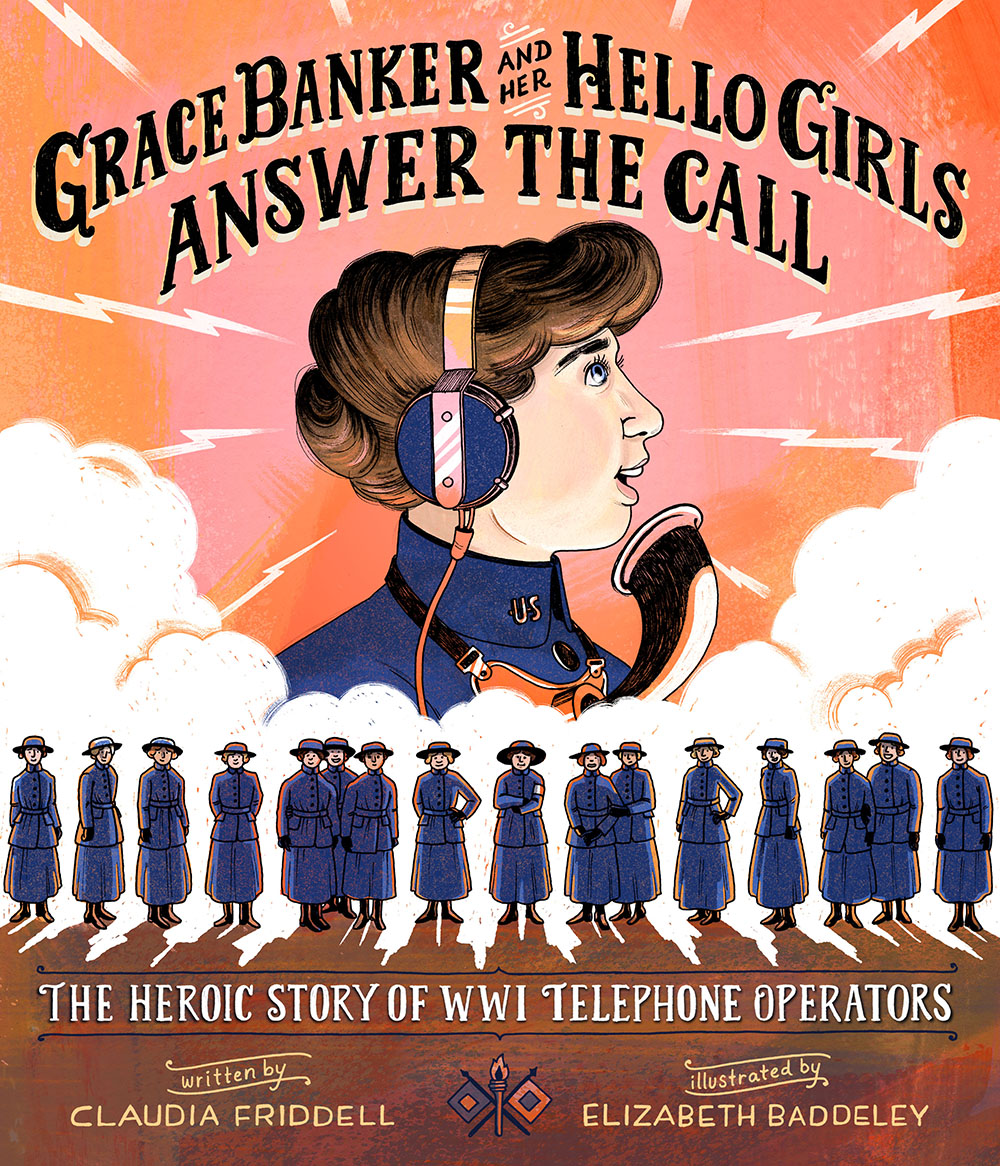
GRACE BANKER AND HER HELLO GIRLS ANSWER THE CALL- Part II. Author & Illustrator Interviews + Giveaway

 Last week I introduced you to Claudia Friddell's book, Grace Banker and Her Hello Girls. Today you're going behind the scenes on the story as well as learn interesting tidbits about the illustration process from the illustrator, Elizabeth Baddeley.  There is one thing that all of the nonfiction authors I have interviewed have in common: curiosity. Claudia's backstory is a great example of that!

AUTHOR INTERVIEW


CAROL: I understand that reading the book, The Hello Girlswas what prompted you to write this picture book. But what led you to that book? 

CLAUDIA: I found Elizabeth Cobb’s book when I was researching the story of Thomas Edison making up the word ‘hello’ to use as a telephone greeting. Elizabeth’s book The Hello Girls popped up and the blurb intrigued me so I preordered it. As soon as I got it, I read it in two sittings and was completely captivated by these remarkable women and their pioneering contributions to the military and our country which were unrecognized for 60 years. I thought Grace Banker was an inspiring leader and role model for kids today, so I decided to make her the subject of my kid-friendly version of the Hello Girls’ story. 


CAROL: Was it difficult tracking down Elizabeth Cobbs?

CLAUDIAI thought it might be tricky to connect with Elizabeth, but I very much wanted her to be my expert if she was willing. It was not difficult to find her academic email address so I wrote her. She was incredibly gracious and helpful. When I spoke to her on the phone she invited me to join her in Washington DC for the screening of Jim Theres’ award-winning documentary, also called The Hello Girls. (I recommend everyone see it.  It’s fabulous!) There, I did not only meet Elizabeth and Jim, but I connected with Grace Banker’s niece, Carolyn Timbie, who was an invaluable contributor for my book. She shared Grace’s treasure chest of WWI mementos as well as Grace’s personal diary which I incorporated into my text. 

Carolyn invited me to her family’s lake cabin that her grandmother Grace and her grandfather built before Carolyn was born. There, at the same table where Grace sat, I found so many treasures—one of which was the faded handwritten Soldier’s Poem that is included in the back matter. I think that’s proof enough that the male soldiers considered these female telephone operators who enabled battlefield communications to be US soldiers as well!


As an aside and shout out to the importance of research—a nonfiction author’s treasure hunt—while I was researching Edison’s ‘hello’ story, I not only found the Hello Girls’ story, but I also learned about the camping trips of Thomas Edison and Henry Ford that pioneered recreational camping. You never know what treasures you’ll find when you dig into history!

CAROL: That is so amazing and so true!

By the way, Claudia's next book from Calkins Creek (releasing in October) is Road Trip: Camping with the Four Vagabonds: Thomas Edison, Henry Ford, Harvey Firestone, and John Burroughs!


ILLUSTRATOR INTERVIEW


CAROL: What medium did you use?

ELIZABETHThe medium is a combination of acrylic paint and ink drawings that I composited in Photoshop and added more color to.

CAROL: It seemed like there is a patriotic color theme going on. Am I right?

ELIZABETH: The red-white-blue theme was not intentional. I did intentionally use blue because the uniforms were a dark navy. As for the red, I just like it and tend to use it a lot! 


Here are some notes about Elizabeth's research from the Artist's Note which is part of the Back Matter.

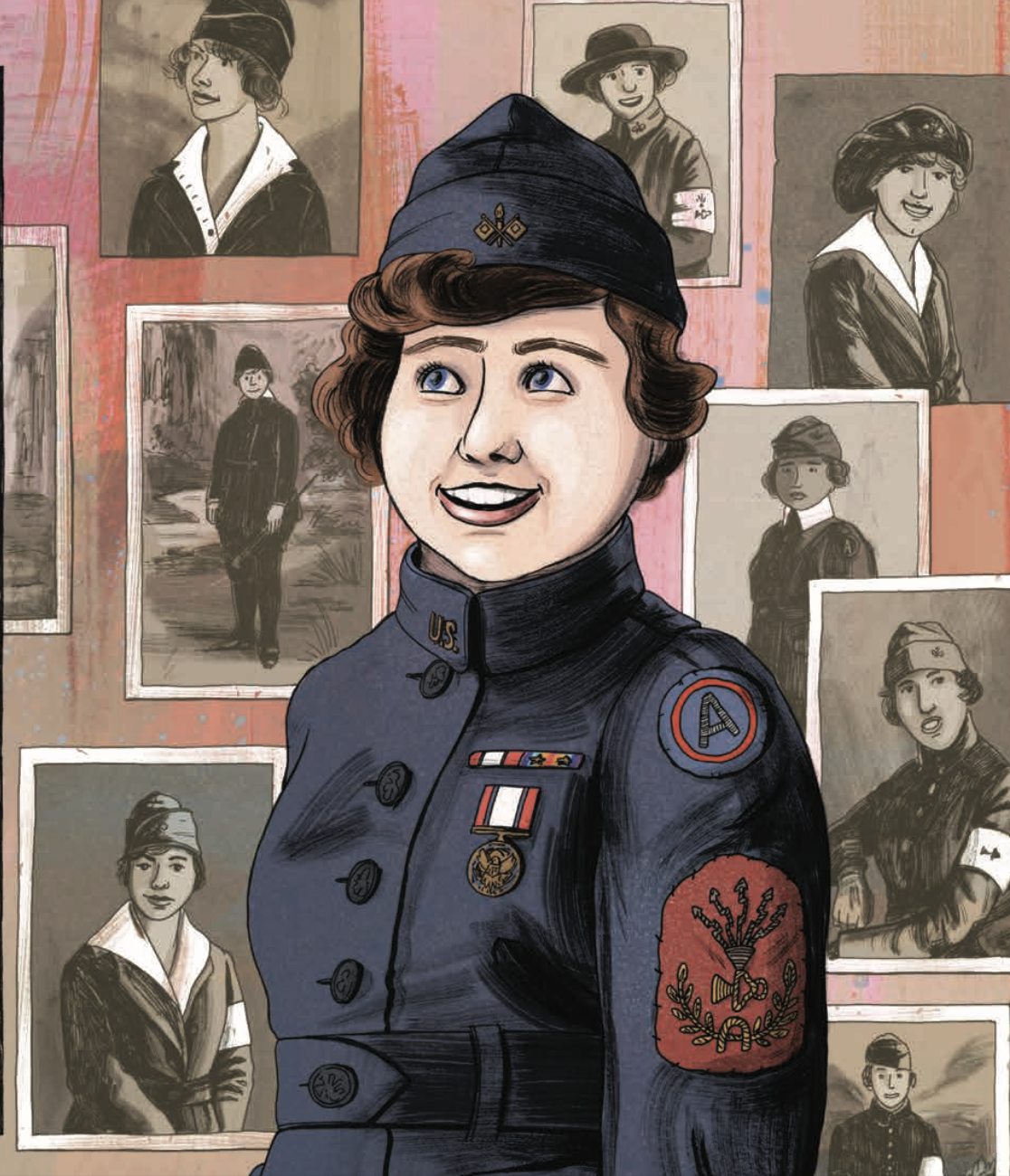
As it so happens, I live in Kansas City, Missouri--the home of the National World War I Museum and Memorial. When I first began working on this book, I paid a visit to the museum. They have everything you could possibly want to see related to WWI, but most importantly for me, Grace Banker's actual uniform and helmet! I was able to sit and draw her uniform standing right in front of me...I looked at photographs, postcards, and even diary entries before ever putting pencil to paper. I love to be creative and have fun getting messy with ink and paint, but the real work always starts with the research.

GIVEAWAY

Leave me a comment by June 20 to enter this giveaway. If you haven't already left a comment on the first blog, do so now and you'll have two chances! If you prefer, email me at cbaldwin6@me.com. U.S. addresses only. 

Saturday, June 11, 2022

GRACE BANKER AND HER HELLO GIRLS ANSWER THE CALL Part I- A Review and Informational Picture Book Giveaway

Claudia Friddell is no stranger to my blog. A year ago I featured her book, Saving Lady Liberty: Joseph Pulitzer Fight for the Statue of Liberty. Today I have another fantastic informational picture book, Grace Banker and Her Hello Girls (Calkins Creek, 2021). In Part II Claudia and illustrator Elizabeth Baddeley provide the back story to this glimpse into the women who served behind the scenes in World War I. 


REVIEW

Drawing upon Grace's diaries and interviews, the story opens in December 1917 with Grace reading how the commander of the U.S. troops in Europe was issuing a call for female telephone operators. 

That was not the only way that women were called to help with the war effort,

but it was the one Grace acted on.

As a telephone operator, she had the skills and she also knew French and English. But, women had never been allowed in the army.


Grace was thrilled not only to be accepted into the Signal Corps, but she was named the chief operator of the first group of thirty-seven women to go overseas. After two months of drills and classes, the Signal Corps Girls headed to France on board the troop ship Celtic.


By U.S. Navy photo NH 912, Public Domain,
https://commons.wikimedia.org/w/index.php?curid=8664455 

The minute the Signal Corps Girls started plugging in cords and connecting calls at General Pershing's headquarters in France, calls poured in from homesick doughboys missing the voices of their mothers, sisters, wives, and sweethearts.

Grace loved her busy twenty-four-hour days. She wrote in her journal, "Never spent more time at the office and never enjoyed anything more. My girls work like beavers."

When General Pershing moved his headquarters to the front, Grace and her girls followed--with gas masks and helmets hanging from their chairs. Grace was almost hit by shrapnel but nothing kept the women from making sure that every call was connected. "Any missed command could lose the battle."

At one point General Pershing moved the unit to a top-secret location. 

Like the conductor of an orchestra, Grace directed her girls from the top of a crate. With fingers flying over the fighting lines' switchboards, the operators barely noticed the bitter winds or leaky barracks.


When a fire broke out in the barracks, the girls wouldn't leave their posts. Only when they were threatened with court-martial did they leave their switchboards!

Finally, on November 11, 1918, a captain of the Signal Courts picked up Grace's phone and made an urgent call--


On May 22, 1919 Grace was the first woman soldier to receive the U.S. Army's Distinguished Service Medal. She wrote in her journal:

There are many who saw far more service than I, and many who earned medals even if they did not receive them. Mine I consider as a tribute to the girls who worked under me at the First Army and to the Signal Corps men operators scattered throughout the tiny tiny field offices. 

BACK MATTER

Seven pages of back matter include a timeline, the fight to obtain full veteran's benefits for the operators, relevant statistics, information on how a switchboard worked, an extended bibliography and interesting artist's notes. There's no question that this book is an excellent curriculum resource for 1st-3rd graders. 

Come back next week to read about how Claudia obtained this amazing story and more information on Elizabeth's process of researching and creating the illustrations.

GIVEAWAY

Leave me a comment along with your email address and I'll enter your name once. Leave a second comment on Part II and you'll be in twice. U.S. addresses only. If you prefer, send me an email to enter. 


THE NIGHT WAR: A MG Historical Novel Review

  By now you should have received an email from my new website about my review of THE NIGHT WAR by Kimberly Brubaker Bradley. (It'll com...