Showing posts with label Claudia Friddell. Show all posts

Thursday, June 16, 2022

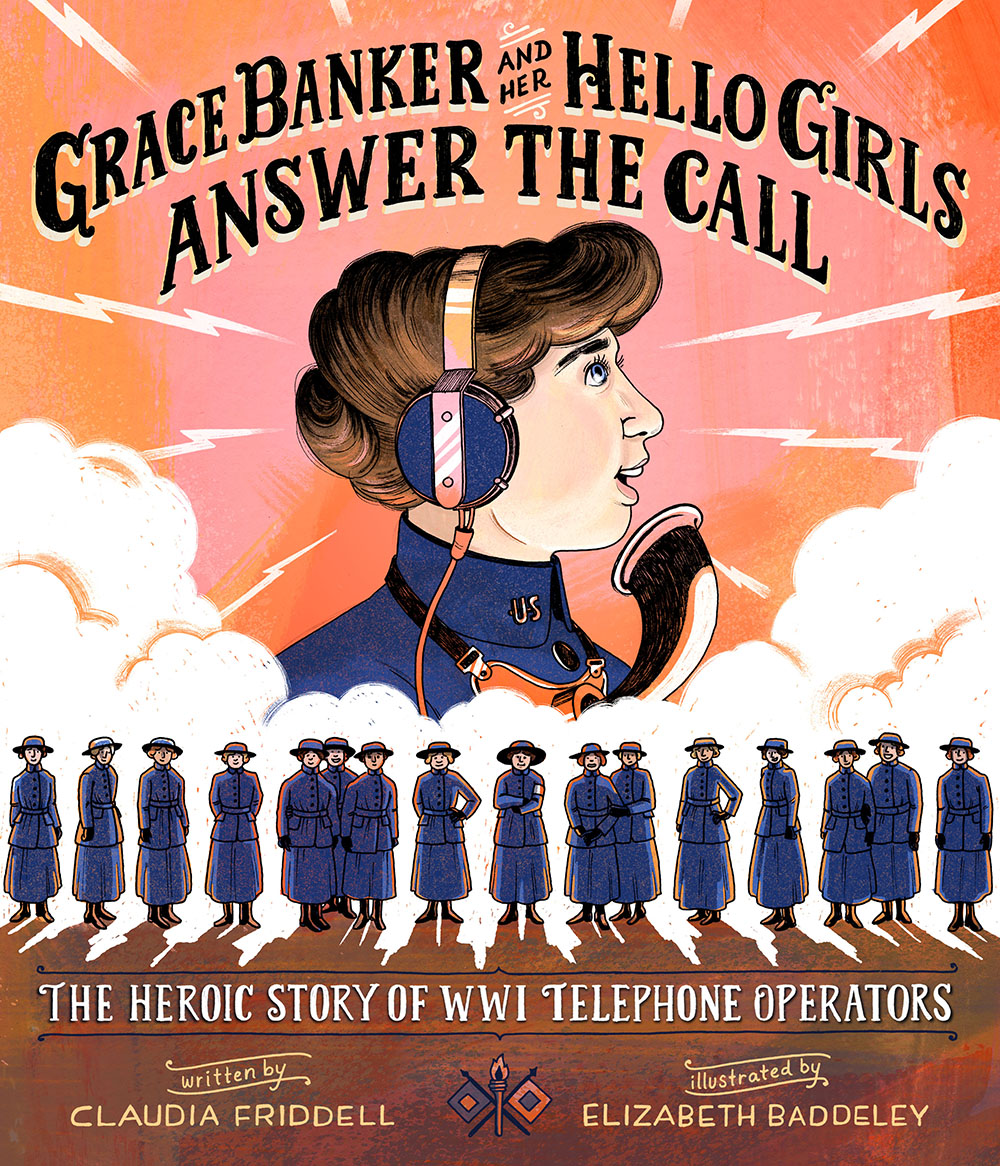
GRACE BANKER AND HER HELLO GIRLS ANSWER THE CALL- Part II. Author & Illustrator Interviews + Giveaway

 Last week I introduced you to Claudia Friddell's book, Grace Banker and Her Hello Girls. Today you're going behind the scenes on the story as well as learn interesting tidbits about the illustration process from the illustrator, Elizabeth Baddeley.  There is one thing that all of the nonfiction authors I have interviewed have in common: curiosity. Claudia's backstory is a great example of that!

AUTHOR INTERVIEW


CAROL: I understand that reading the book, The Hello Girls, was what prompted you to write this picture book. But what led you to that book? 

CLAUDIA: I found Elizabeth Cobb’s book when I was researching the story of Thomas Edison making up the word ‘hello’ to use as a telephone greeting. Elizabeth’s book The Hello Girls popped up and the blurb intrigued me so I preordered it. As soon as I got it, I read it in two sittings and was completely captivated by these remarkable women and their pioneering contributions to the military and our country which were unrecognized for 60 years. I thought Grace Banker was an inspiring leader and role model for kids today, so I decided to make her the subject of my kid-friendly version of the Hello Girls’ story. 


CAROL: Was it difficult tracking down Elizabeth Cobbs?

CLAUDIA: I thought it might be tricky to connect with Elizabeth, but I very much wanted her to be my expert if she was willing. It was not difficult to find her academic email address so I wrote her. She was incredibly gracious and helpful. When I spoke to her on the phone she invited me to join her in Washington DC for the screening of Jim Theres’ award-winning documentary, also called The Hello Girls. (I recommend everyone see it.  It’s fabulous!) There, I did not only meet Elizabeth and Jim, but I connected with Grace Banker’s niece, Carolyn Timbie, who was an invaluable contributor for my book. She shared Grace’s treasure chest of WWI mementos as well as Grace’s personal diary which I incorporated into my text. 

Carolyn invited me to her family’s lake cabin that her grandmother Grace and her grandfather built before Carolyn was born. There, at the same table where Grace sat, I found so many treasures—one of which was the faded handwritten Soldier’s Poem that is included in the back matter. I think that’s proof enough that the male soldiers considered these female telephone operators who enabled battlefield communications to be US soldiers as well!


As an aside and shout out to the importance of research—a nonfiction author’s treasure hunt—while I was researching Edison’s ‘hello’ story, I not only found the Hello Girls’ story, but I also learned about the camping trips of Thomas Edison and Henry Ford that pioneered recreational camping. You never know what treasures you’ll find when you dig into history!

CAROL: That is so amazing and so true!

By the way, Claudia's next book from Calkins Creek (releasing in October) is Road Trip: Camping with the Four Vagabonds: Thomas Edison, Henry Ford, Harvey Firestone, and John Burroughs!


ILLUSTRATOR INTERVIEW


CAROL: What medium did you use?

ELIZABETH: The medium is a combination of acrylic paint and ink drawings that I composited in Photoshop and added more color to.

CAROL: It seemed like there is a patriotic color theme going on. Am I right?

ELIZABETH: The red-white-blue theme was not intentional. I did intentionally use blue because the uniforms were a dark navy. As for the red, I just like it and tend to use it a lot! 


Here are some notes about Elizabeth's research from the Artist's Note which is part of the Back Matter.

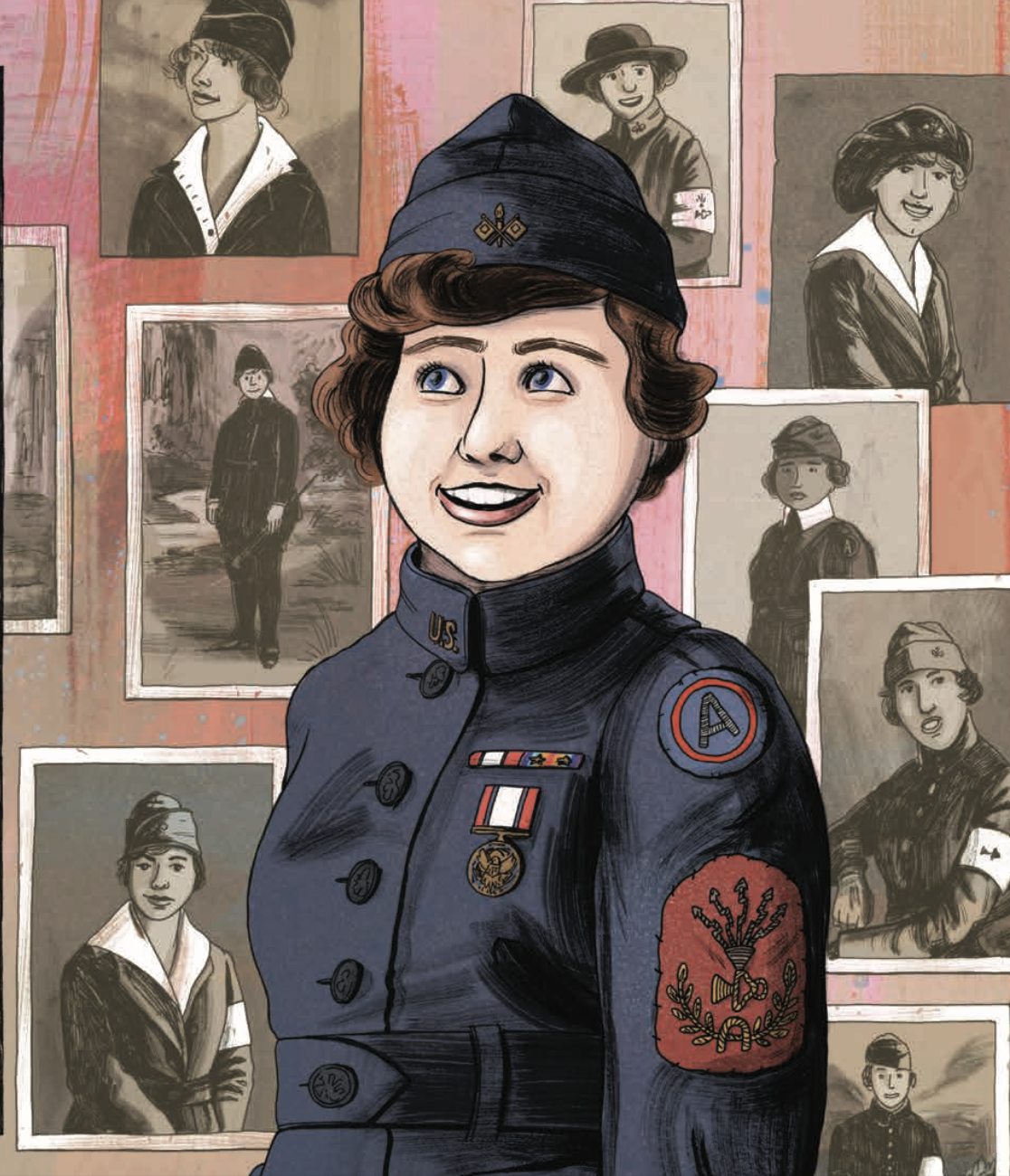
As it so happens, I live in Kansas City, Missouri--the home of the National World War I Museum and Memorial. When I first began working on this book, I paid a visit to the museum. They have everything you could possibly want to see related to WWI, but most importantly for me, Grace Banker's actual uniform and helmet! I was able to sit and draw her uniform standing right in front of me...I looked at photographs, postcards, and even diary entries before ever putting pencil to paper. I love to be creative and have fun getting messy with ink and paint, but the real work always starts with the research.

GIVEAWAY

Leave me a comment by June 20 to enter this giveaway. If you haven't already left a comment on the first blog, do so now and you'll have two chances! If you prefer, email me at cbaldwin6@me.com. U.S. addresses only. 

Saturday, June 11, 2022

GRACE BANKER AND HER HELLO GIRLS ANSWER THE CALL Part I- A Review and Informational Picture Book Giveaway

Claudia Friddell is no stranger to my blog. A year ago I featured her book, Saving Lady Liberty: Joseph Pulitzer Fight for the Statue of Liberty. Today I have another fantastic informational picture book, Grace Banker and Her Hello Girls (Calkins Creek, 2021). In Part II Claudia and illustrator Elizabeth Baddeley provide the back story to this glimpse into the women who served behind the scenes in World War I. 


REVIEW

Drawing upon Grace's diaries and interviews, the story opens in December 1917 with Grace reading how the commander of the U.S. troops in Europe was issuing a call for female telephone operators. 

That was not the only way that women were called to help with the war effort,

but it was the one Grace acted on.

As a telephone operator, she had the skills and she also knew French and English. But, women had never been allowed in the army.


Grace was thrilled not only to be accepted into the Signal Corps, but she was named the chief operator of the first group of thirty-seven women to go overseas. After two months of drills and classes, the Signal Corps Girls headed to France on board the troop ship Celtic.


By U.S. Navy photo NH 912, Public Domain,
https://commons.wikimedia.org/w/index.php?curid=8664455 

The minute the Signal Corps Girls started plugging in cords and connecting calls at General Pershing's headquarters in France, calls poured in from homesick doughboys missing the voices of their mothers, sisters, wives, and sweethearts.

Grace loved her busy twenty-four-hour days. She wrote in her journal, "Never spent more time at the office and never enjoyed anything more. My girls work like beavers."

When General Pershing moved his headquarters to the front, Grace and her girls followed--with gas masks and helmets hanging from their chairs. Grace was almost hit by shrapnel but nothing kept the women from making sure that every call was connected. "Any missed command could lose the battle."

At one point General Pershing moved the unit to a top-secret location. 

Like the conductor of an orchestra, Grace directed her girls from the top of a crate. With fingers flying over the fighting lines' switchboards, the operators barely noticed the bitter winds or leaky barracks.


When a fire broke out in the barracks, the girls wouldn't leave their posts. Only when they were threatened with court-martial did they leave their switchboards!

Finally, on November 11, 1918, a captain of the Signal Courts picked up Grace's phone and made an urgent call--


On May 22, 1919 Grace was the first woman soldier to receive the U.S. Army's Distinguished Service Medal. She wrote in her journal:

There are many who saw far more service than I, and many who earned medals even if they did not receive them. Mine I consider as a tribute to the girls who worked under me at the First Army and to the Signal Corps men operators scattered throughout the tiny tiny field offices. 

BACK MATTER

Seven pages of back matter include a timeline, the fight to obtain full veteran's benefits for the operators, relevant statistics, information on how a switchboard worked, an extended bibliography and interesting artist's notes. There's no question that this book is an excellent curriculum resource for 1st-3rd graders. 

Come back next week to read about how Claudia obtained this amazing story and more information on Elizabeth's process of researching and creating the illustrations.

GIVEAWAY

Leave me a comment along with your email address and I'll enter your name once. Leave a second comment on Part II and you'll be in twice. U.S. addresses only. If you prefer, send me an email to enter. 


Thursday, July 15, 2021

SAVING LADY LIBERTY: An Author Interview with Claudia Friddell--Part II

Two former posts in this mini-series include my review of Saving Lady Liberty: Joseph Pulitzer's Fight for the Statue of Liberty and Part I of this author interview. 

RESEARCH


CAROL: When you were researching Saving Lady Liberty, how did you know what information would fit into your story and what you should leave out? Similarly, how did you know what to save for the back matter? (I can’t believe Carolyn Yoder gave you 8 pages for all your information. Lucky you!!)


CLAUDIA: Well, that’s a great question! Usually, I figure that out along the way. I always start out by including too much information, and as I whittle my story down, I decide what goes to the back matter and what gets left behind. It’s like starting with a block of wood and chiseling away to find the shape of the story. I know I can only keep the facts and details that help move along my plot. Of course, I find all kinds of fascinating nuggets while treasure hunting that I can’t wait to share. I save those for the back of the book. As a former teacher, I want my back matter to be as interesting as my story. I want teachers, librarians, and students to find lots of extra fun facts and enriching material at their fingertips. Fortunately, Carolyn Yoder understands and values the importance of back matter!


Claudia at her writing desk in her river house.
(Does any other writer covet that space besides me?)

IMMIGRATION THEME


CAROL: As a child of 2 German Jewish immigrants, I was touched by the fact that this is an immigrant’s story. Have you received any feedback from teachers or children about immigration? 


The immigration theme to this story is what interested me the most. I was fascinated to find that Lady Liberty’s journey to America parallels that of Joseph Pulitzer and millions of other immigrants in many ways. I chose to completely personify the statue. I always refer to her as Lady Liberty because of her very human story—she was raised in another country, she had a long and dangerous journey, she arrived in America with an uncertain fate, and she found firm footing in a new land of opportunity through the generosity of everyday Americans. I also love knowing that immigrants built the pedestal. The immigration theme has been a great interest to the teachers and students I’ve talked to, and I will never grow tired of hearing their stories of how it’s important to them!


JOSEPH PULITZER


I assume you found lots of other information out about Pulitzer.  Have you thought of writing about other aspects of his life? (ie, The Pulitzer Prize?) 


CLAUDIA: I was fascinated to learn about Joseph Pulitzer’s life from reading James McGrath Morris’ excellent biography, Pulitzer. While there were many different facets to Pulitzer’s complicated and accomplished life, most of them, unfortunately, are not kid friendly! 


He left instructions for the Pulitzer Prizes in his will so I’m not sure if there’s a book there. I think it would be fascinating if someone wanted to write about the history of Pulitzer revolutionizing the newspaper. He was responsible for making the template for our modern-day newspapers to make them entertaining, informative, and readable for all Americans. And he lowered the price to a penny so everyone could afford to read them! 


RELEVANCE 


CAROL: How do you think your book is relevant to children today? 


CLAUDIA: This is the most important question I ask myself.  I think Saving Lady Liberty is relevant in so many ways for kids. Like countless other children, Joseph Pulitzer faced and overcame great adversity and loss as a child. As a Jewish boy in Hungary and a Jewish man in America he faced discrimination his entire life, but he never let any of these obstacles keep him from pursuing his dreams. Through hard work and perseverance Pulitzer not only survived—he succeeded in becoming one of America’s greatest success stories. 


Most children today are familiar with crowd funding, so I was excited to introduce them to the very first crowd funding venture. Pulitzer proved that the small contributions from ordinary folks united by a good cause can accomplish amazing things. He used his newspaper to remind his readers that in a democracy they had a voice in speaking up for liberty. Pulitzer’s passion for a free press inspired him to modernize newspapers to inform and entertain readers of all ages and backgrounds, and his passion for excellence inspired him to create the Pulitzer Prizes. It is timely and relevant for kids to learn that staying educated and informed of facts and events, not only inside one’s community but far beyond as well, can help them find their way in the world. 


Patriotism is the obvious term for Pulitzer’s motivation in Saving Lady Liberty, but for children, I like to describe it as gratitude. Pulitzer never forgot that only in America could he have reinvented himself and lived his rags to riches life. He wanted others to appreciate that it isn’t just a gift to live in a free country. There are responsibilities that go along with keeping those freedoms alive. He seemed to know that people not only need a welcome—we all need reminders, so we never forget and never take our freedoms for granted. I hope, after reading Saving Lady Liberty, kids and adults alike will be as inspired as I am by Pulitzer’s love of liberty and his devotion to democracy, a free press, and equal opportunities for all.


GIVEAWAY

Each time you leave a comment on one of the three posts about Saving Lady Liberty your name will be entered. Giveaway ends on July 16 at 4 PM. Continental U.S. addresses only. 


Monday, July 12, 2021

SAVING LADY LIBERTY: An Author Interview with Claudia Friddell - Part I

 Last week I reviewed Claudia Friddell's picture book biography, Saving Lady Liberty: Joseph Pulitzer's Fight for the Statue of Liberty.  I promised you an author interview and not only are you going to receive one post revealing Claudia's writing and researching process--but two! I hope you enjoy learning about Claudia's passion to share Pulitzer's fight and how she communicates that passion to her readers--both young and old. 


INSPIRATION


CAROL: What was your inspiration for Saving Lady Liberty? 


CLAUDIA: When I visited Liberty Island with friends six years ago, I was surprised to see Joseph Pulitzer’s statue in the sculpture garden that honors the five founders of the Statue of Liberty. When I went home and started to dig for treasure—that’s code for research! — I learned that if not for Joseph Pulitzer’s first crowd funding effort to raise money for the pedestal, Lady Liberty would not be standing in New York’s harbor. I felt like this was an important, patriotic American story that kids should know. Adults should know it, too!


Claudia (on the far right) at the Statue of Liberty in 2015
with a fellow teacher
and a former student's family.
. 

CAROL: Can you speak about your writing process? I would also love to hear about the different versions you created and how your editor, Carolyn Yoder, helped you pull them together. 


WRITING PROCESS


CLAUDIA: My writing process can vary depending on the subject, but I do have a few constants. 


The journey of writing a book can take years, so for me I need to answer yes to the following questions before heading out on that long and winding road: 

·      Can this real-life event read like a kid-friendly story? 

·      Is there something familiar and historically significant (the Statue of Liberty) combined with something virtually unknown, historically significant, and interesting to kids (Pulitzer’s crowd funding campaign to save the Statue of Liberty)?

·      Is the story timely and relevant for kids today?


Once I’m all in, I read everything I can about my subject from adult biographies, articles, diaries, and interviews to every children’s book I can find relating to the subject.


I take tons of handwritten notes. I often organize my content and sources in a notecard file box. This is especially helpful when writing nonfiction to keep track of sources and quotes. I am also big on writing outlines— I start broad and add layers of detail.


Finding the voice and my literary style is the hardest part for me. Once I have a plan, I get on the computer and start writing…thousands of drafts! I find it helpful to make dummies with sticky notes for my picture books.


Frequently I try writing my books a few different ways. I initially struggled to find the best way to weave together Pulitzer’s story with Lady Liberty’s journey. I wrote many different versions and finally showed my editor two of my favorite beginnings. She pointed out sections of each version that she liked, and I went back to work. Her invaluable input helped me find my voice and my story.


CAROL: Please expound on the “treasure chest” of documents you found while researching—and the people who helped you. How did you know when your research was done? 


CLAUDIA: I know it sounds corny, but I really do consider the research process to be a treasure hunt. Hidden in old documents, letters, newspapers, articles, journals, and diaries there are fascinating nuggets of information that help bring true stories from long ago to life.


While I was reading another book about the Statue of Liberty, I saw a wonderful quote from a child’s donation letter in response to Pulitzer’s plea for pedestal contributions. I headed to the New York Public Library where a few amazingly helpful librarians guided me to some very fuzzy, hard to read 135-year-old microfilm copies of The World newspapers. That’s where I found the wonderful children’s letters that I included in my book.


I have found that with nonfiction projects with extensive back matter information, I’m never really finished with the research until everyone has signed off on the last pass of the book. It’s important to continue to keep up with pertinent information throughout the entire writing and editing journey. For example, in the final copy-editing stages of Saving Lady Liberty, I learned that one of the smaller statues had been moved to another location, so I needed to update that information in the back matter. 


As I scrolled through days, weeks, and months of papers, I found the hidden gems I was searching for— children’s letters sprinkled among thousands of names and messages from a broad swath of patriotic Americans. Whenever possible, I like to feature the actual words of my subjects, so it was wonderful to not only find some of Pulitzer’s most passionate editorials about saving Lady Liberty in his newspaper, but it was a special treat to highlight the patriotic letters from American children!


PART II will be about Claudia's research process, the immigration theme, Joseph Pulitzer (with a hint at a book someone else should write!), and relevance to children.


GIVEAWAY


The giveaway list started last week. You can increase your chances to win this book by leaving a comment today and on the next post. Winner will be chosen on July 16. REMEMBER:  Please leave your email address if you are new to my blog so I can enter your name. Continental United States addresses only.


Wednesday, July 7, 2021

Saving Lady Liberty: Joseph Pulitzer's Fight for the Statue of Liberty- A Picture Book Review and A Giveaway- Part I

Like me, you might associate Joseph Pulitzer with the Pulitzer Prize. But, you might not know how he was instrumental in bringing the Statue of Liberty to the United States. Here is the inspirational story of Saving Lady Liberty  (Calkins Creek, 2020) which author Claudia Friddell packed into forty-eight informative pages. The illustrator, Stacy Innerst, is not new to my blog. Check out his illustrations from Lincoln Clears a Path.


REVIEW

Joseph Pulitzer loved words. And the word he loved best was liberty.

Maybe that's because Joseph, the son of a wealthy Jewish merchant, enjoyed freedoms that other Jewish boys outside of Pest, Hungary could not. But after his father died when Joseph was eleven, his world changed forever.
That is Claudia Friddell's opening which lures readers into turning the page. 

The book proceeds to show how Joseph was left penniless--unable to even get a job in the army because of his poor eyesight. But,

 
(Isn't it cool how Lincoln appears in this book too?)
Pulitzer went from guard duty in the Civil War (where he'd rather plan battles on the chess board than be in a battle) to a poor immigrant who couldn't speak English (although he was fluent in French, German, Hungarian, and Yiddish).

After weeks of sleeping on park benches, Joseph hopped a train and headed for St. Louis--a city filled with German-speaking immigrants. 

When he wasn't working or learning how to read and write English, Joseph played chess in the library. He caught the attention of an owner of a German newspaper and finally got a job he loved--he was a reporter! 

Grateful for the freedom to write what he chose, Joseph uncovered corruption and inequality. His brash manner and relentless drive didn't earn him many friends but no matter--Joseph kept moving up until he owned the newspaper alongside his chess-playing boss.

Joseph married and traveled to the 1878 Paris World's Fair where he was entranced by Graham Bell's talking machine and the "colossal copper leaf of Auguste Bartholdi's unfinished statue, Liberty Enlightening the World.."

https://www.nydailynews.com/new-york/statue-liberty-construction-gallery-1.1397435
Albert Fernique/New York Public Library


After being impressed with the statue, Joseph met Auguste.


But although the United States had agreed to build a pedestal for the statue, New Yorkers didn't want to pay for it. When he returned to the States, Joseph vowed to convince his fellow citizens to pay to have the pedestal built and installed on Bedloe's Island (renamed Liberty Island in 1956).


Pulitzer bought the New York World newspaper and put Lady Liberty in the middle of the masthead:


https://www.loc.gov/item/sn83030193/1900-01-30/ed-1/

He wrote editorials and scolded wealthy NewYorkers. 

What a burning disgrace it will be to the United States if the statue of the goddess is brought to our shores on a French government vessel and is met by the intelligence that our people, with all their wealth, have not enough public spirit, liberality, and pride to provide a fitting pedestal on which it can be placed!

No matter how hard he tried to raise the money for the pedestal, Pulitzer didn't have enough. Finally he came up with a new plan. "If a person donated even a penny, he would print their name and their story in the World."


His idea worked. Stories poured in and Pulitzer printed them all. Two of my favorite pages show letters from children with their contributions. One child sold squash and pumpkins and sent in ten cents, another raided his "frog-bank" and combined his earnings with his friends for another ten cents. One kindergarten class sent in $1.35.

Finally, Lady Liberty was loaded into 214 crates and sailed across the stormy Atlantic. 


Of course, when the pedestal was completed, that was a newsworthy story!

https://www.bbc.com/news/in-pictures-21947710


Eight years after Pulitzer first saw Lady Liberty, he "witnessed Bartholdi unveil his magnificent monument ready to welcome every traveler with a torch of hope and a promise of freedom." 

As the daughter of German Jewish immigrants, I imagine that the first time my parents saw Lady Liberty, they were filled with a mixture of fear, awe, and excitement. Here was the symbol of the country that would be their new home--a place of liberty.

                                                ****

Next week Claudia will answer questions about her research process and her path to publication. 

Claudia's newest fan,
"Uncle Bob" Toupal. 


CURRICULUM RESOURCE

This book is an excellent resource for any student studying immigration and American history. Eight pages of back matter include little-known facts about the statute and Joseph Pulitzer. Claudia Friddell has created an educator's guide with a variety of  activities for students in grades 2-6. 

For more details about how the statue evolved and how it was connected to the end of slavery and Reconstruction, see this post.

GIVEAWAY

Leave a comment to enter the giveaway along with your email address if you are new to my blog. If you also leave a comment next week on the interview, then I'll put your name in twice. Winner's name will be drawn at 4 PM on July 16.  Continental U.S. addresses only. 

Congratulations to Helena George and Kim Peterson who won copies of THE BUTTON GIRL.


THE NIGHT WAR: A MG Historical Novel Review

  By now you should have received an email from my new website about my review of THE NIGHT WAR by Kimberly Brubaker Bradley. (It'll com...