Showing posts with label cross-curriculum. Show all posts

Thursday, May 19, 2022

SO MUCH MORE TO HELEN! The Passion and Pursuits of Helen Keller: A Picture Book Biography and Giveaway

 What do you know about Helen Keller?

Many of us have grown up knowing the story of how Annie Sullivan taught Helen to sign her first word, "water" by the family's water pump. 


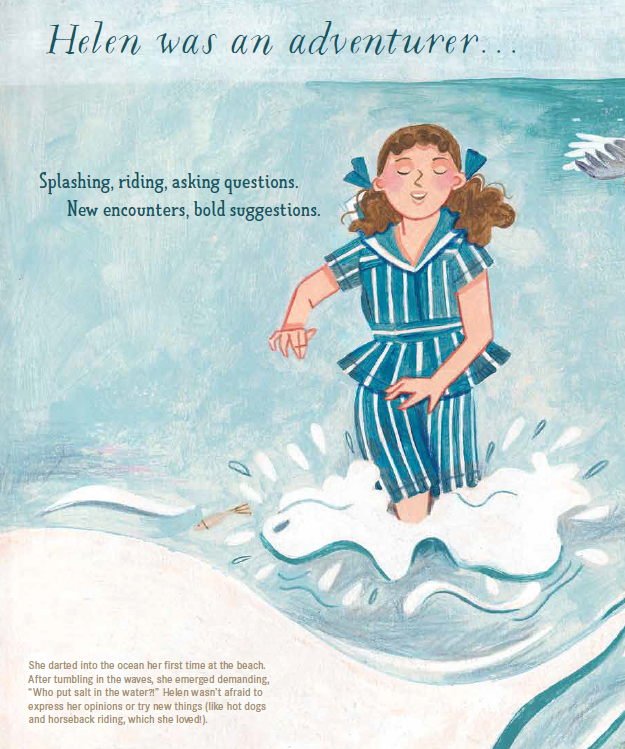
But as the title of this new picture book from Sleeping Bear Press indicates, there is much more to know. Written by Meeg Pincus (no stranger to my blog) with lush illustrations by Caroline Bonne-Müller,
this book will appeal to Kindergarten-third grade readers. As you'll see from the illustration samples below, each spread includes basic information written in a rhyming couplet with additional details provided in a text box for older children. 

REVIEW 

On the first page, readers discover that Helen was a friend to a young black girl as well as to First Lady Eleanor Roosevelt and Inventor Alexander Graham Bell.

Then we discover that, 


And she was,


                Braille and signing, first through college.


Helen was a dog lover and an author...

            Always writing, never slowing.
            Essays, books, and stories flowing.


Helen was an activist, a jokester, and also, 


Did you know that Helen was a romantic who fell in love with Peter Fagan, a journalist? Her parents wouldn't allow her to marry him since many people at the time didn't think DeafBlind people should marry or have children. 

Indeed, Helen was a survivor. 


            Discrimination, heartbreak, grieving.
            Never gave up, kept believing. 

She traveled to five of the seven continents as a humanitarian and peacemaker.  After the World Wars, she visited wounded soldiers and damaged cities to help foster goodwill and healing. She gave speeches in packed amphitheaters and met with world leaders as well as everyday struggling people.

Helen was a changemaker.


Fought for those with deafness, blindness.
Laws, employment, schools--and kindness.

The last spread shows thirteen individuals with either visible or invisible disabilities. 

BACK MATTER

The last two pages include more details and quotes about each "job" that Helen had. There is also a smaller version of the last spread identifying the thirteen "solutionaries" (someone who tries to solve problems for people, animals, and the planet) and what their disabilities and accomplishments are.

Meeg includes her interest in Helen Keller which stemmed from a high school project. She ends with, "I hope this book inspires you-- whatever disabilities or challenges you may face--to follow our passions and be a solutionary too."

This is an excellent curriculum resource, but I wish a bibliography was included for students and teachers who wanted to read more about this DeafBlind heroine. Click here for Meeg's Free Teaching Tools.

For more of the author's backstory, please see Kathy Temean's blog (and another giveaway!). 

And check out this book trailer:


GIVEAWAY

Leave me a comment (with your last name and email address if you are new to my blog) by May 23 to enter the giveaway. U.S. addresses only. 

Congratulations to Terri Michels who won Ribbit! The Truth About Frogs.

Monday, July 12, 2021

SAVING LADY LIBERTY: An Author Interview with Claudia Friddell - Part I

 Last week I reviewed Claudia Friddell's picture book biography, Saving Lady Liberty: Joseph Pulitzer's Fight for the Statue of Liberty.  I promised you an author interview and not only are you going to receive one post revealing Claudia's writing and researching process--but two! I hope you enjoy learning about Claudia's passion to share Pulitzer's fight and how she communicates that passion to her readers--both young and old. 


INSPIRATION


CAROL: What was your inspiration for Saving Lady Liberty


CLAUDIA: When I visited Liberty Island with friends six years ago, I was surprised to see Joseph Pulitzer’s statue in the sculpture garden that honors the five founders of the Statue of Liberty. When I went home and started to dig for treasure—that’s code for research! — I learned that if not for Joseph Pulitzer’s first crowd funding effort to raise money for the pedestal, Lady Liberty would not be standing in New York’s harbor. I felt like this was an important, patriotic American story that kids should know. Adults should know it, too!


Claudia (on the far right) at the Statue of Liberty in 2015
with a fellow teacher
and a former student's family.

CAROL: Can you speak about your writing process? I would also love to hear about the different versions you created and how your editor, Carolyn Yoder, helped you pull them together. 


WRITING PROCESS


CLAUDIA: My writing process can vary depending on the subject, but I do have a few constants. 


The journey of writing a book can take years, so for me I need to answer yes to the following questions before heading out on that long and winding road: 

·      Can this real-life event read like a kid-friendly story? 

·      Is there something familiar and historically significant (the Statue of Liberty) combined with something virtually unknown, historically significant, and interesting to kids (Pulitzer’s crowd funding campaign to save the Statue of Liberty)?

·      Is the story timely and relevant for kids today?


Once I’m all in, I read everything I can about my subject from adult biographies, articles, diaries, and interviews to every children’s book I can find relating to the subject.


I take tons of handwritten notes. I often organize my content and sources in a notecard file box. This is especially helpful when writing nonfiction to keep track of sources and quotes. I am also big on writing outlines— I start broad and add layers of detail.


Finding the voice and my literary style is the hardest part for me. Once I have a plan, I get on the computer and start writing…thousands of drafts! I find it helpful to make dummies with sticky notes for my picture books.


Frequently I try writing my books a few different ways. I initially struggled to find the best way to weave together Pulitzer’s story with Lady Liberty’s journey. I wrote many different versions and finally showed my editor two of my favorite beginnings. She pointed out sections of each version that she liked, and I went back to work. Her invaluable input helped me find my voice and my story.


CAROL: Please expound on the “treasure chest” of documents you found while researching—and the people who helped you. How did you know when your research was done? 


CLAUDIA: I know it sounds corny, but I really do consider the research process to be a treasure hunt. Hidden in old documents, letters, newspapers, articles, journals, and diaries there are fascinating nuggets of information that help bring true stories from long ago to life.


While I was reading another book about the Statue of Liberty, I saw a wonderful quote from a child’s donation letter in response to Pulitzer’s plea for pedestal contributions. I headed to the New York Public Library where a few amazingly helpful librarians guided me to some very fuzzy, hard to read 135-year-old microfilm copies of The World newspapers. That’s where I found the wonderful children’s letters that I included in my book.


I have found that with nonfiction projects with extensive back matter information, I’m never really finished with the research until everyone has signed off on the last pass of the book. It’s important to continue to keep up with pertinent information throughout the entire writing and editing journey. For example, in the final copy-editing stages of Saving Lady Liberty, I learned that one of the smaller statues had been moved to another location, so I needed to update that information in the back matter. 


As I scrolled through days, weeks, and months of papers, I found the hidden gems I was searching for— children’s letters sprinkled among thousands of names and messages from a broad swath of patriotic Americans. Whenever possible, I like to feature the actual words of my subjects, so it was wonderful to not only find some of Pulitzer’s most passionate editorials about saving Lady Liberty in his newspaper, but it was a special treat to highlight the patriotic letters from American children!


PART II will be about Claudia's research process, the immigration theme, Joseph Pulitzer (with a hint at a book someone else should write!), and relevance to children.


GIVEAWAY


The giveaway list started last week. You can increase your chances to win this book by leaving a comment today and on the next post. Winner will be chosen on July 16. REMEMBER:  Please leave your email address if you are new to my blog so I can enter your name. Continental United States addresses only.


Tuesday, December 1, 2020

Lions & Cheetahs & Rhinos OH MY! Animal Artwork by Children of Sub-Saharan Africa: Picture Book Review


Today I'm sharing another unique book published by Sleeping Bear Press, Lions, & Cheetahs & Rhinos OH MY!. Sorry, no giveaway this time--I'm keeping this one for my grandkids. 


HOW TO DRAW A LION


I love the concept behind this book. Each stellar drawing was made by a young African who participated in John Platt's non-profit program, How to Draw a Lion. 

Here is the program's mission statement from their website:

How to Draw a Lion is a program founded to provide art classes for children, raise money for their education with shows around the world, and to create awareness about child welfare and conservation.  The program has taken shape around art classes for under-resourced youth in sub-Saharan Africa, and now the US.  Each piece brings with it the spirit and personality of the artist who created it and the sale of the work raises funds for the organizations that support their education. All proceeds from the book are donated to the program to support these and future artists. 

REVIEW 

Do you like wild animals? Would you like to paint one? How about a LION?

Young readers are invited into this gorgeous book with information about this ferocious hunter.


Each page leads naturally to the next. Maybe the reader won't want to get too near to a lion to draw her, so he might want to draw a gentler animal, like a zebra.


The text provides interesting information about each animal. Did you know that you can tell zebras apart because the pattern of each zebra's stripes is different, like fingerprints?

Cheetahs with all their spots are FAST! You better draw a cheetah before it dashes away...It can race at 65 miles per hour.

[Giraffes] are covered in spots too. Like the zebra's stripes, the pattern of posts on the giraffe's fur is special to each animal. 

Like the giraffe, here's another animal that loves to eat vegetables.


An animal that spends its day in the water and feeds on the grass at night is pictured here.


An elephant can drink 50 gallons a day--that's 800 glasses of water!


Female lions raise the cubs and are the primary hunters for the pride.


An animal this majestic inspires everyone. Let's all draw a lion and then paint it!

Other facts I learned reading this book:
  1. Impalas are a type of antelope.
  2. Leopards are shy.
  3. Some gorillas live in tropical forests but others hang out in the mountains. 


CURRICULUM RESOURCE

How to Draw a Lion concludes with information about endangered animals and habitat loss. By learning about African animals and their endangered status, you can help protect them.

Of course, this book would not be complete without directions on how to draw a lion; and these are included. If you don't get a copy for your child, grandchild, or classroom, you can follow this tutorial instead.


A cross-curriculum book, students in grades K-4th grade will enjoy the artwork and information about African animals. I hope many readers will be inspired by the art of other young people and attempt to draw animals also. 

Now, if you'll excuse me, I think I'll go draw a lion.


THE NIGHT WAR: A MG Historical Novel Review

  By now you should have received an email from my new website about my review of THE NIGHT WAR by Kimberly Brubaker Bradley. (It'll com...