Showing posts with label K-3rd grade. Show all posts

Friday, August 11, 2023

ARMANDO'S ISLAND: A Picture Book Review, Author Interview, and Giveaway


From the publisher:

Armando's home is the rainforest—he knows its sights, smells, tastes, and sounds. He even knows its moods. From the bottom of the forest floor to the top of the emergent layer, the trees are also home to a multitude of creatures. When outsiders begin laying claim to and destroying the surrounding landscape, the displaced animals find refuge with Armando in the only remaining pocket of untouched forest, his "island." As people come in and animals are forced out, this poignant tale shows the cumulative and disastrous effects of Amazonian deforestation. (The Creative Company: 2023)

                                                                        ***

It is always a pleasure to review one of Marsha Diane Arnold's beautifully written picture books. For those of you who have been following my blog for a while, you may remember Badger's Perfect Garden, Mine. Yours., Lights Out, or Galapagos Girl. (if you're new to my blog, check those titles out!). 


Marsha's love for animals, nature, and conserving the environment is present in her newly released book, ARMANDO'S ISLAND. This time, as the book blurb indicated, it's a story about a young boy growing up surrounded by the animals of the Amazon rainforest.  

REVIEW

The book sets the stage with this word picture:

Beneath a canopy of trees, flowing like green ocean, 
in an ancient forest
lived Armando.

and this illustration: 


Marsha describes Armando's life in sensory language:

Walking barefoot, leaves crunching beneath him, 

playing among riverbanks, mud squishing between toes

skipping across fallen logs, grasshoppers jumping, 

climbing liana vines, lizards scrambling beside him

he felt connected to his leafy refuge.

Armando grows, as does his love for the rainforest.


Men and women come to Armando asking him to sell his land. They promise him great wealth in return. Repeatedly, Armando refuses.

"I am rich already," said Armando,

gazing at the emerald green surrounding him.

Each conversation is followed by a scene showing the machinery destroying the rainforest and the animals and birds fleeing to Armando's land.


In the morning, to the east, a great hammering and

sharp drilling 

wailed through the air.


Dolphins stopped swimming.

Otters stopped sliding.

Capybaras stopped bathing.

Hummingbirds left their dance beneath the waterfall

as they fled, to the west, to Armando's. 

The expressions on the animals' faces reflect their emotions as they face their homes destruction.


In the end, 

Now, Armando's home stands crowded and apart,

an island of emerald green, shimmering in the sunlight.


Sometimes the people to the north, south, east, and west

glance at Armando's island, fragile in the mist.

Armando hopes that some morning with the first song of the toucan,

a long-ago memory will come to them...


Anne Yvonne's lush illustrations compliment Marsha's lyrical language and immerse readers into the interconnections of the rainforest's ecosystem. I loved how she even showed the feelings of the animals who are displaced.

Several pages show Armando on one side of the text along with the machinery destroying the forest on the other. 
 
To read the backstory behind Armando's Island (and how long it took to get this book out into the world!), please see Beth Anderson's blog post.

CURRICULUM RESOURCE

I picture Armando's Island used in Pre-K through third-grade classrooms. The back matter includes three pages of information and illustrations of animals in the Amazon rainforest. An activity guide will be available on the publisher's website on September 1--just in time for back to school!

AUTHOR INTERVIEW

CAROL: What was your inspiration for this book? It is so rich with detail—did you go to the Amazon yourself or is this from research?

MARSHA: I wish I could say I traveled to the Amazon, but the book came from research and from my great love of nature and rainforests. 

As I note in my Activity Guide, "There is a difference in knowledge by acquaintance and knowledge by knowing information. We may never travel to the Amazon rainforest, so we will not know it by acquaintance. But we can immerse ourselves as much as possible with videos, audios, books, and activities and we may know and appreciate it a little in this way."


I started researching Armando’s Island thirty years ago! At that time, I was involved with a number of conservation organizations, some working to protect the rainforests. Later, I visited Costa Rica and fell in love with the rainforests there. My husband and I built a casita in the rainforest years after that first visit. Macaws, monkeys, and toucans were our neighbors. 

CAROL: How did you get Armando’s name? Is he from a particular tribe?

MARSHA: I have no remembrance of where the name Armando came from. The rhythm of phrases is always important to me and I do think this has a lovely rhythm - Armando’s Island. I suspect I researched names common in Latin America. Armando is a multicultural name. In Latin America, it is associated with strength, courage, and a fierce loyalty to friends. The Armando in my book is certainly all of those.

The name is not from a particular tribe. I wrote the story as a fable, an ode to the rainforest and its animals and those who stand with them. Anne Yvonne did scrupulous research. She deliberately made Armando’s face paint and headdress non-specific, but he is identifiable as an indigenous Brazilian tribesman.

I love that a man named Armando, the only person I know with that name, invited me to join the 2008 Artists in the Back Country group of seven artists, chosen to spend a week in the High Sierras, painting, photographing, and writing. Another natural island. Serendipity?

CAROL: Do you consider this free verse poetry?  (seems so to me!)

MARSHA: I have always thought of it simply as lyrical writing, but free verse poetry sounds very nice to me. Thank you!

CAROL: Were you involved in the choice of the artist? Anne Yvonne is perfect for this book.  What medium does she use?

MARSHA: In a roundabout way you might say I was involved. At the end of Armando’s Island’s thirty-year journey, there were two publishers who offered a contractI knew that The Creative Company published beautiful books and in 2020 they had found the perfect illustrator, Susan Reagan, for my book on light pollution, Lights Out. I trusted them to find another perfect illustrator. They did not let me down. I was thrilled and humbled that someone of Anne Yvonne Gilbert’s caliber would be illustrating my book. She used colored pencils over-layered with sepia drawing ink. So beautiful.

CAROL: Whose idea was it to frame some of the text between an illustration of the machinery and the animals? That is brilliant juxtaposition. 

CAROL: The layouts were Anne Yvonne's ideas, approved by the art director, Rita Marshall. It is indeed a brilliant juxtaposition.

Thank you, Carol, for having me on your blog and for your insightful questions.

GIVEAWAY

To enter the giveaway, please leave me a comment along with your email address if you are new to my blog. U.S. addresses only. If you prefer, you can shoot me an email instead. If you are a home school educator, teacher, or librarian please let me know. You'll get two chances. The giveaway ends August 15. 


Wednesday, July 12, 2023

THE FATHER GOOSE TREASURY OF POETRY: A Review and Giveaway Through Talking Story

 As promised last week, I'm back again with another marvelous poetry book by Charles Ghigna. But this time, it's not just one poem It is one hundred and one! THE FATHER GOOSE TREASURY OF POETRY (Schiffer Books: 2023) is divided into seven sections. There is one section for each season, plus "Home," "Animals," and "Poetry." In this blog, Charles talks about the process of how he decided which poems to include in the anthology-- as well as his favorite sweet treats.


REVIEW

Charles uses nature themes and a vivid imagination to write poetry that brings smiles to readers of all ages. The way he incorporates sensory imagery makes readers take notice of word choice and world details. 

Take this poem for example:


            White Butterflies

I like to watch the falling snow.

It puts on such a lovely show.

It looks like little veils of lace,

White butterflies upon my face. (p. 37)

I found three types of figurative language in this word picture--how many do you find? Highlight the following phrase for the answer. personification, simile, metaphor).

Or, how about this sing-song poem with its unique way of rhyming? This one reminds me of how Charles listened to music as a child--you can almost hear the music behind his words.

The title itself makes me laugh and the illustrations of trees dancing in the wind compliment the poem perfectly. Look closely at the cloud and goose and you'll see collage elements that illustrator Sara Brezzi incorporated.

"Morning Rain" reminds me of one of my childhood favorites, Robert Louis Stevenson's A Child's Garden of Verses. (Does anyone else remember the "Land of Counterpane"? I was pleased to find out that Charles and I both read this book as children!)


           Morning Rain

Like a shadow

Passing by,

Storm clouds

Fill the morning sky,

From my window

I see wonder,

A lightning strike,

A clap of thunder.

I sit beside

The window pane

And watch the world

Fill up with rain.  (p.21)


Many of Charles' poems are playful,


            Thunder Bugs

On stormy nights

I often wonder,

Do lightning bugs

Make the thunder? (p.59)


Some are thought-provoking:


      Orion's Way


Each evening

he enters

the black forest

of night

and spreads

his star crumbs

across the sky

to find his way

back home.  (p. 29)

And, 


In honor of the Talking Story issue on wordplay, I had to share this one:


       Wild Romance

I love EWE

I'm not LION

I really GOPHER you.

I never GNU this would happen.

You are so DEER to me.

It's more than I can BEAR.

Let us SEAL our love with a kiss.

I will always BEE yours.

I will never have any EGRETS.

You are my one and only GULL.

OWL always love you. (p. 101)


CURRICULUM RESOURCE and GIVEAWAY

Parents, grandparents, teachers, and librarians--don't miss the opportunity to add this book to your collection! It's a wonderful read-aloud as well as an opportunity to teach figurative language.

Leave one comment here for one chance to win this book. Leave another through Talking Story for a second chance. On the far right column, you'll see an email address to enter four giveaways. Click on the link and let me know which book you are most interested in winning. (I try to honor requests-but I can't guarantee what Random.org picks!). U.S. addresses only. The giveaway ends on July 15th.

Congratulations to Gail Cartee who won A Poem is a Firefly from last week's blog.


Thursday, July 14, 2022

THE PEACH PIT PARADE: A World War I Story. An Historical Fiction Picture Book Review and Giveaway

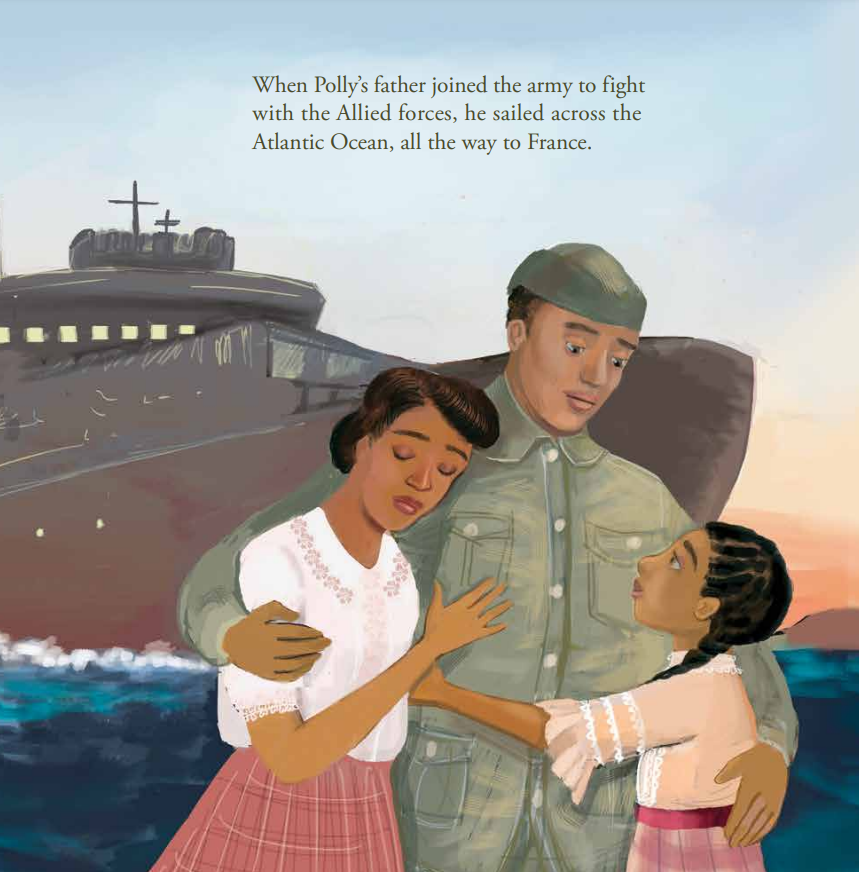
North Carolina picture book author, Shana Keller, is no newcomer to my blog. Some of you may remember Bread for Words, Tick Tock Banneker's Clock, or Fly, Firefly--her three other engaging books published by Sleeping Bear Press.  Her fourth book, Peach Pit Parade is illustrated by Margeaux Lucas. The soft tones Ms. Lucas used speak of Polly's love for her soldier father. The characters' faces portray their emotions beautifully. 


REVIEW

"Polly felt everything change when the whole world got into a fight. A big fight."

The first page of the book shows the front page headline, "U.S. AT WAR!" The reader is brought into Polly's world in this second illustration:


Even though Polly missed her father terribly, she and her mother stayed busy planting a victory garden and thinking of ways to help with the war effort.

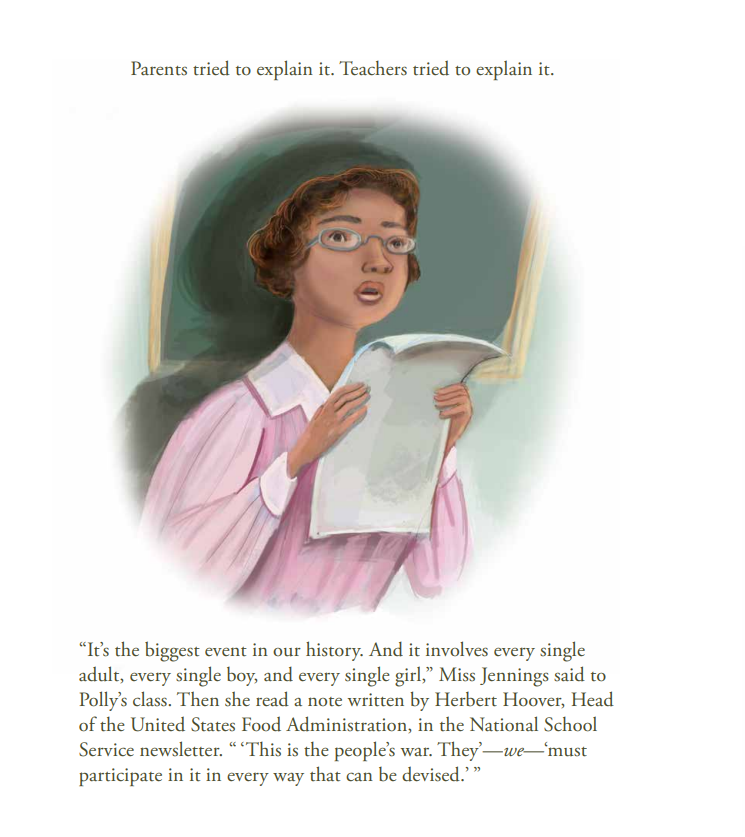
Polly's teacher encouraged her students to get involved.

Polly wondered what could she do?


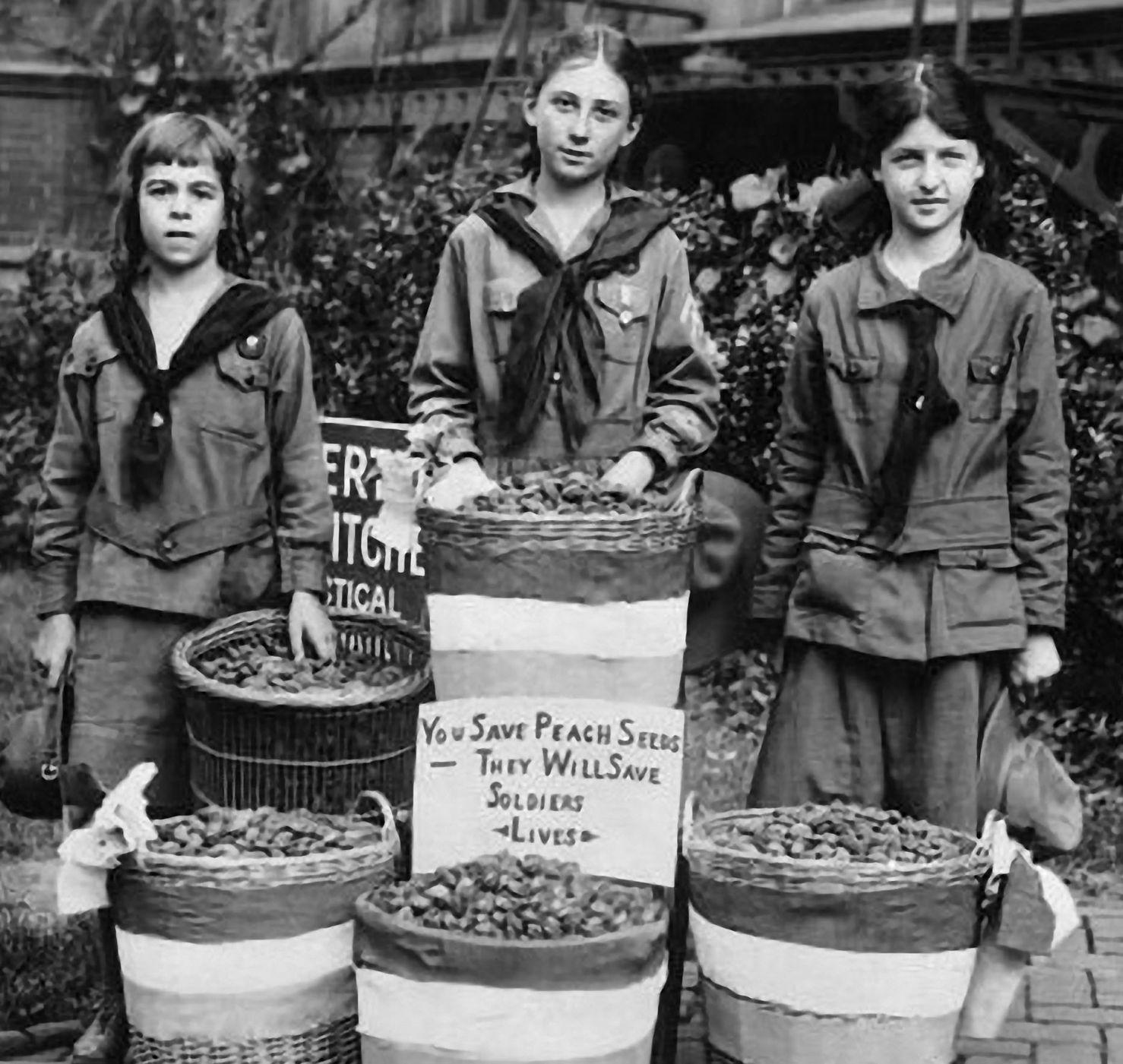
Miss Jennings had a strange request. "The government needs our help to collect all types of fruit pits, especially peach pits."

Her teacher explained that the pits were needed in the gas masks which the soldiers wore. The pits helped absolve harmful gasses. 

A newspaper ad to encourage Americans to save fruit pits.
https://www.etsy.com/listing/570286058/1917-original-wwi-american-red-cross

Polly's next problem was to figure out how to collect enough peach pits to make a difference. She had participated in "send-off" parades when people gave soldiers extra blankets and books when they were leaving. What about a peach pit parade?

Polly shared her idea with her class and her Girl Scout troop. Neighbors, family, friends, and even the local newspaper got excited about the parade.

With Polly in the lead and flutes and cymbals playing, the parade wound through town. 


"In the end of the day, every wagon, bucket, basket, and barrel was filled with pits."


Polly's smile shone brighter than the sun. In that moment, she felt as if the cloud of war had cleared away. Polly finally felt like she was doing all she could, and she couldn't wait to write to her father about the Peach Pit Parade.


CURRICULUM RESOURCE

Like Shana's previous books, The Peach Pit Parade is a great addition to the K-3rd grade classroom. You will find additional resources for each one of her books on her website; here is her page for The Peach Pit Parade. This inspiriting STEM book can prompt conversations about war, compassion, service, and how individuals can make a difference. 


https://texascooppower.com/patriotic-peach-pits/


BOOK JOURNEY

For an inside view of Shana's book journey and how she became interested in the role of peach pits and the Girl Scouts in WWI, see Kathy Temean's blog.

GIVEAWAY

Leave a comment with your name and email address (if you are new to my blog) by July 18. If you prefer, you can email me. Let me know if you are an educator or librarian and I'll put your name in twice. U.S. addresses only. NOTE: If you don't see your comment immediately, don't worry. I screen all comments and then publish them. 

Congratulations to Michelle Tracey who won Footprints Across the Planet last week.

Wednesday, June 1, 2022

SOUNDS ALL AROUND: A Nonfiction Picture Book and Giveaway


Sounds All Around: The Science of How Sound Works  (Kids Can Press, 2021) written by Susan Hughes and illustrated by Ellen Rooney, is exactly what the title says it is: an accessible STEM book for young readers about the science of sound. An unnamed protagonist and his dog guide the reader through the book.

Here is the opening page: 


 A honeybee!

                               Such a tiny insect, but its 

                    beating wings make a big

sound in the silence.


(I love the alliteration and thought behind that last sentence!)

Using thunder and lightning as an example, the author goes on to explain how light travels through air faster than sound. 

From there, it's a hop, skip, and a jump from "natural" sounds to


The author moves on to easy-to-understand text (with great accompanying illustrations) on how sound happens.


There are several "try this" pages including one on clapping that introduces vibrations, sound waves, and the concept of pitches. 


This illustration says so much:


Information and this illustration about hearing ranges will be a great asset in the K-3rd grade classroom.


In the same way, the author and illustrator explain and illustrate decibels.


Back matter includes instructions on how to make a bee buzzer and a glossary.


GIVEAWAY

Leave me a comment with your email address (or send me an email with that information) by June 4 to enter this giveaway. If you are a teacher, home school educator, or librarian let me know and I'll put your name in twice. U.S. addresses only. 

Congratulations to Hewi Mason who won Saguaro's Gifts.

Thursday, May 19, 2022

SO MUCH MORE TO HELEN! The Passion and Pursuits of Helen Keller: A Picture Book Biography and Giveaway

 What do you know about Helen Keller?

Many of us have grown up knowing the story of how Annie Sullivan taught Helen to sign her first word, "water" by the family's water pump. 


But as the title of this new picture book from Sleeping Bear Press indicates, there is much more to know. Written by Meeg Pincus (no stranger to my blog) with lush illustrations by Caroline Bonne-Müller,
this book will appeal to Kindergarten-third grade readers. As you'll see from the illustration samples below, each spread includes basic information written in a rhyming couplet with additional details provided in a text box for older children. 

REVIEW 

On the first page, readers discover that Helen was a friend to a young black girl as well as to First Lady Eleanor Roosevelt and Inventor Alexander Graham Bell.

Then we discover that, 


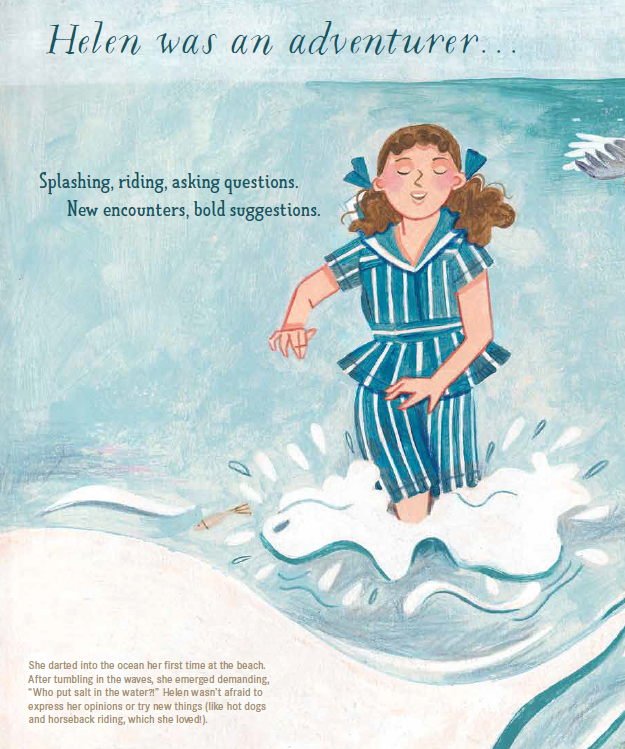
And she was,


                Braille and signing, first through college.


Helen was a dog lover and an author...

            Always writing, never slowing.
            Essays, books, and stories flowing.


Helen was an activist, a jokester, and also, 


Did you know that Helen was a romantic who fell in love with Peter Fagan, a journalist? Her parents wouldn't allow her to marry him since many people at the time didn't think DeafBlind people should marry or have children. 

Indeed, Helen was a survivor. 


            Discrimination, heartbreak, grieving.
            Never gave up, kept believing. 

She traveled to five of the seven continents as a humanitarian and peacemaker.  After the World Wars, she visited wounded soldiers and damaged cities to help foster goodwill and healing. She gave speeches in packed amphitheaters and met with world leaders as well as everyday struggling people.

Helen was a changemaker.


Fought for those with deafness, blindness.
Laws, employment, schools--and kindness.

The last spread shows thirteen individuals with either visible or invisible disabilities. 

BACK MATTER

The last two pages include more details and quotes about each "job" that Helen had. There is also a smaller version of the last spread identifying the thirteen "solutionaries" (someone who tries to solve problems for people, animals, and the planet) and what their disabilities and accomplishments are.

Meeg includes her interest in Helen Keller which stemmed from a high school project. She ends with, "I hope this book inspires you-- whatever disabilities or challenges you may face--to follow our passions and be a solutionary too."

This is an excellent curriculum resource, but I wish a bibliography was included for students and teachers who wanted to read more about this DeafBlind heroine. Click here for Meeg's Free Teaching Tools.

For more of the author's backstory, please see Kathy Temean's blog (and another giveaway!). 

And check out this book trailer:


GIVEAWAY

Leave me a comment (with your last name and email address if you are new to my blog) by May 23 to enter the giveaway. U.S. addresses only. 

Congratulations to Terri Michels who won Ribbit! The Truth About Frogs.

THE NIGHT WAR: A MG Historical Novel Review

  By now you should have received an email from my new website about my review of THE NIGHT WAR by Kimberly Brubaker Bradley. (It'll com...