
What do you know about Helen Keller?
Many of us have grown up knowing the story of how Annie Sullivan taught Helen to sign her first word, "water" by the family's water pump.

this book will appeal to Kindergarten-third grade readers. As you'll see from the illustration samples below, each spread includes basic information written in a rhyming couplet with additional details provided in a text box for older children.
REVIEW
On the first page, readers discover that Helen was a friend to a young black girl as well as to First Lady Eleanor Roosevelt and Inventor Alexander Graham Bell.
Then we discover that,
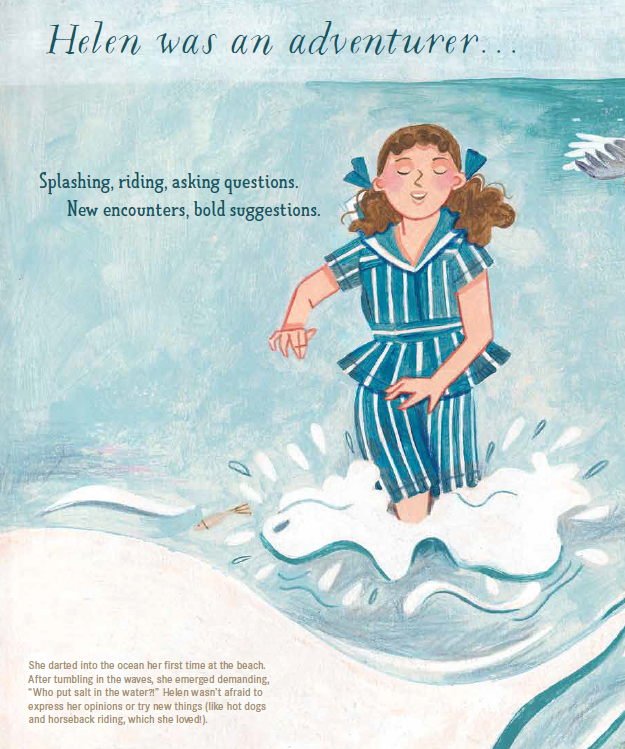
And she was,

Braille and signing, first through college.
Helen was a dog lover and an author...
Always writing, never slowing.Essays, books, and stories flowing.

Helen was an activist, a jokester, and also,

Indeed, Helen was a survivor.

Discrimination, heartbreak, grieving.Never gave up, kept believing.
She traveled to five of the seven continents as a humanitarian and peacemaker. After the World Wars, she visited wounded soldiers and damaged cities to help foster goodwill and healing. She gave speeches in packed amphitheaters and met with world leaders as well as everyday struggling people.
Helen was a changemaker.

Fought for those with deafness, blindness.Laws, employment, schools--and kindness.
The last spread shows thirteen individuals with either visible or invisible disabilities.
BACK MATTER
The last two pages include more details and quotes about each "job" that Helen had. There is also a smaller version of the last spread identifying the thirteen "solutionaries" (someone who tries to solve problems for people, animals, and the planet) and what their disabilities and accomplishments are.
Meeg includes her interest in Helen Keller which stemmed from a high school project. She ends with, "I hope this book inspires you-- whatever disabilities or challenges you may face--to follow our passions and be a solutionary too."
This is an excellent curriculum resource, but I wish a bibliography was included for students and teachers who wanted to read more about this DeafBlind heroine. Click here for Meeg's Free Teaching Tools.
For more of the author's backstory, please see Kathy Temean's blog (and another giveaway!).
And check out this book trailer:
GIVEAWAY
Leave me a comment (with your last name and email address if you are new to my blog) by May 23 to enter the giveaway. U.S. addresses only.


