Showing posts with label Black History Month. Show all posts

Thursday, February 17, 2022

TWO MIDDLE GRADE NONFICTION BOOKS from SBP Publishing: Reviews and Giveaways

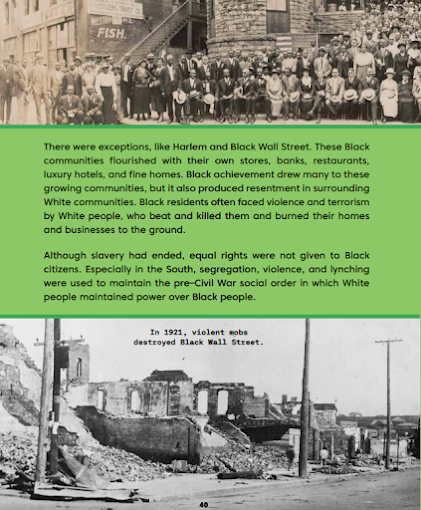
 In honor of Black History Month, I'm introducing two books published by SPB Publishing. This publisher is a crossover of two Cherry Lake Publishing imprints: Sleeping Bear Press which specializes in fiction and nonfiction trade books, and the more academically-specialized Cherry Lake Press. Both books were published in 2021 but are still pertinent and will impact students for a long time. Since my personal interest leans towards history, I've selected a few pages from each book which highlight history. In both books, the text is complemented by thought-provoking questions and photographs which will promote discussion.

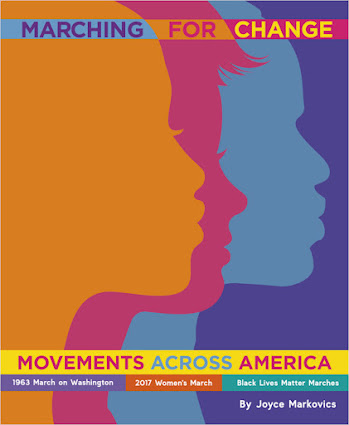
MARCHING FOR CHANGE: MOVEMENTS ACROSS AMERICA


As the author, Joyce Markovics, states in the introduction, "This book describes three protest marches that shaped--and are still shaping the history of the United States. You'll read about the 1963 March on Washington, the 2017 Women's March, and finally the Black Lives matter marches that began in 2020....Keep Marching America!"

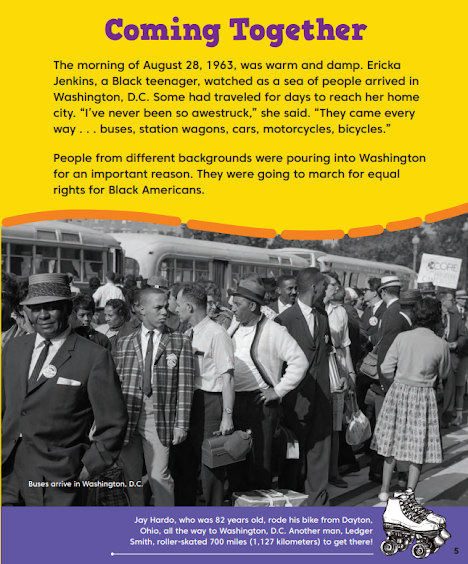
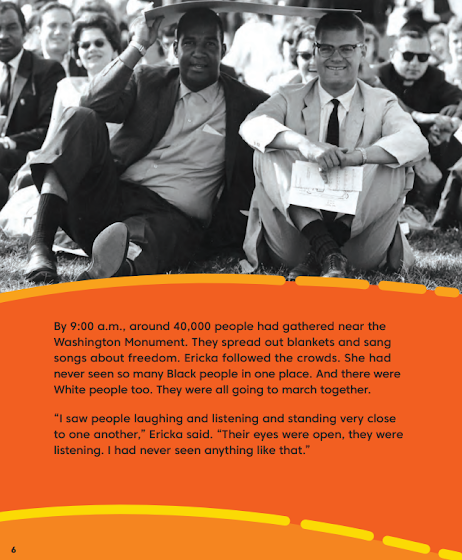
1963 March on Washington

What was this march all about?


It was about the biggest protest in US history--250,000 people--coming together to demand equal jobs and freedoms for Black people.


Rooted in enslaved Blacks being abused as slaves as well as the inequality of Jim Crow, the protest brought together people from all over the country with one purpose: to fight against racial injustice. The result of that protest and others was the passage of the Civil Rights Act of 1964 which helped thousands more Black Americans vote.

2017 Women's March

On January 21, 2017 women all over the country marched for women's rights in regard to immigration, healthcare, and racial equality. 

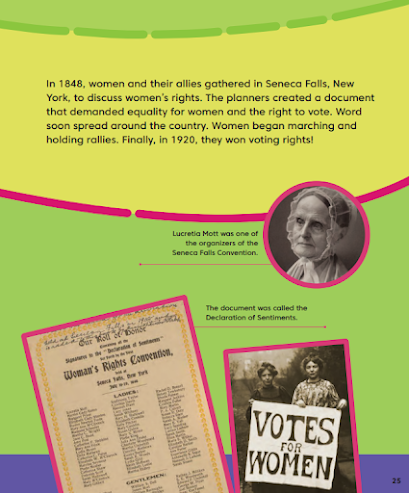
But the women's movement started years before that.

An early women's rights parade.


Women won the right to vote in 1920, but women continued to call for more active roles in society. 

In 2017, 653 marches changed many women's attitudes and actions. The ramifications of those marches are still felt today.

2020 Black Lives Matter Marches

In 2020, the first BLM marches protested the death of an unarmed Black man, George Floyd. Marchers were looking for radical change after experiencing years of racism.


"Because of racism, Black men are viewed as more dangerous than other people. This can lead to false arrests and killings.


BLM was formed after Trayvan Martin's murder. It continues today to as a voice that says, "Black lives should be just as important as other lives."

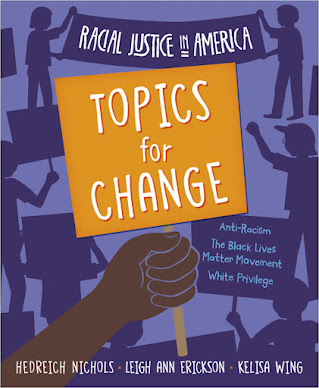
RACIAL JUSTICE IN AMERICA: TOPICS for CHANGE


The introduction of this book, written by one of the authors, Kelisa Wing, states: "No one is born a racist. Racism is taught, and anything that is taught can be unlearned... We hope this book will create a safe entry point for you to start to have courageous conversations, give you a safe and brave space for learning, and allow you to see yourself as an agent of change."  This theme is carried throughout the book through Ms. Wing's words and those of Hedreich Nichols and Leigh Ann Erickson.

What is Anti-Racism?

After the basics of racism are shown, the authors explore where the word "race" came from and how the concept of a "master race" was promoted in Nazi Germany. This exploration also includes how Native Americans were percieved and mistreated because of their skin color. 


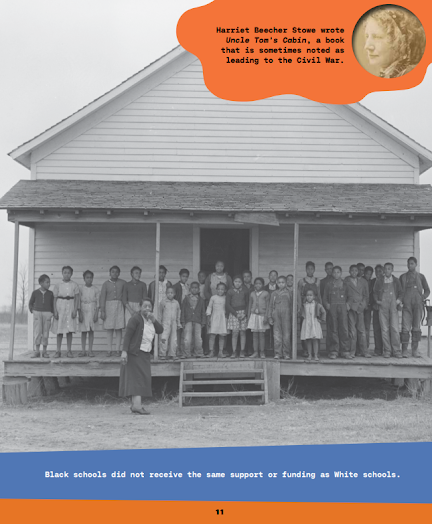
The authors point out racism in the past,


as well as in the present, and how students can fight against racism at home, in their schools, and in their community. This section ends with a quote from civil rights leader Fannie Lou Hamer, "Nobody's free until everybody's free."

What is White Privilege?

Using the image of a runner, the authors explain that the obstacles which are placed for a Black person's "race" are much different --and more difficult--than for a White runner. They go on to discuss how White boys are more likely to graduate from college and obtain a successful job than Black boys. 

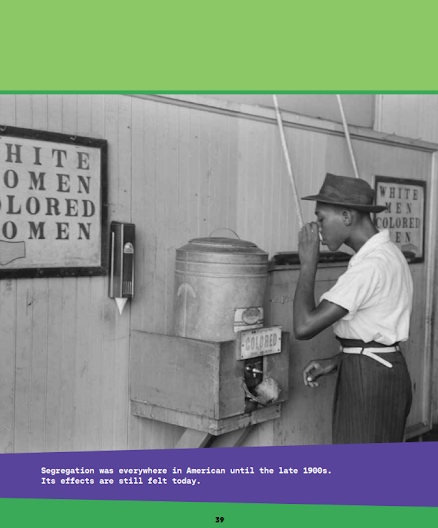
Where did White privilege come from? The authors look at the consequences of slavery, the KKK, and segregation. 


The authors end this section with ideas about how students can take action. Going back to the running analogy, they point out, "...will you really feel good at the end of the race when you look back and see others fighting obstacles that you didn't even have? Instead of taking off down your path, what if you helped take away the obstacles in other runners' paths?"

What is the Black Lives Matter Movement?

Many students are aware of BLM, but do they know the backstory behind it? The authors take readers back to enslavement and Jim Crow laws and segregation.


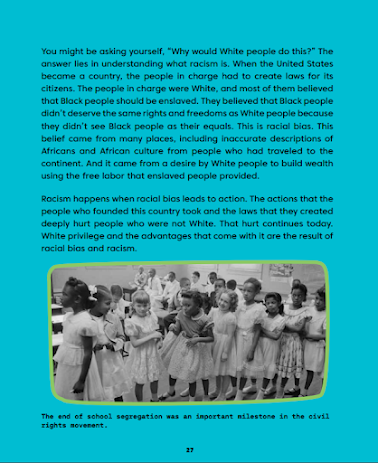
They show the results of mob violence,


discuss the formation of activist groups like the NAACP, and highlight important aspects of civil rights history.

This section ends with the impact of BLM today and how students can support the movement.

Both of these books will be useful in promoting classroom discussions.

I will be sharing this book on Greg Pattridge's wonderful middle grade book blog on Monday. You can find LOTS more books there!


GIVEAWAY

Leave me your name and email address (if you are new to my blog) in the comments along with your book preference. U.S. addresses only. Giveaway ends Tuesday, February 22 at 8 PM.  Congratulations to Sue Heavenrich who won I Escaped North Korea.

Wednesday, February 24, 2021

Stompin' at the Savoy: A Nonfiction Picture Book Review and Giveaway

 Congratulations to Joan Edwards who won Barbara Younger's painting from last week's blog.

The other day I received a stack of books from Sleeping Bear Press which included several nonfiction titles.


In honor of Black History month, I chose Stompin' at the Savoy: How Chick Webb Became the King of Drums by Moira Rose Donohue as the first one to read and giveaway. 


As I write two nonfiction picture books, I am participating in a superb online "crash course" in writing nonfiction, NF Fest. Each day a different author posts information and an activity related to writing nonfiction. Today, I was inspired by Candace Fleming's challenge, "Let's Make a Scene" to look at the scenes and summaries in a nonfiction text. She defines scenes as "a specific time, a specific place, and one change." Summaries,
tell the reader something necessary without creating a full scene. You can use summary to transition between scenes, set the tone or mood for the next scene, leap forward in time, or explain something (context) your readers will need to understand the next scene. We can identify it by its lack of time and place.

This blog will be my analysis of some of the scenes and summaries in Stompin' at the Savoy

REVIEW

The book opens with a scene of William Henry "Chick" Webb tapping rhythms on iron railings and marble steps. The author and illustrator foreshadow the changes that will occur in Chick's life.


The reader turns the page and on the left side finds a summary of William's early childhood illness that affected his spine. On the right is the dramatic illustration of this scene:


After the fall and an operation, the doctor wanted him to get a set of drums to strengthen his arms (summary). In the next two-page scene William is in the kitchen with his mother pounding on "pots and pats, floorboards and washboards" (notice the wonderful alliteration and internal rhyme!) because the family couldn't afford drums or drumsticks. William made his own drumsticks!

The following page is a summary illustrated here. There's no time or place, but rather an explanation of how William became known as Chick.


Next, the reader sees a scene in which Chick is making money by selling newspapers and twirling his real drumsticks in the air. The change is that he has saved up money to buy the drumsticks and is attracting attention, and spare change, with his tricks.

The next scene shows how although Chick stopped growing at four feet, one inch, he saved enough money to buy a drum set.


The reader then learns through the following scenes how jazz bands were "jamming all over the country" and Chick was hired to play with other bands.  Finally, Chick started his own swing band and hired Ella Fitzgerald as his lead singer.

The next scene shows the dancers at the Savoy ballroom where Chick's band was hired to play. 


At that time, band competitions were the rage. There's a scene where Chick loses to Duke Ellington. Disappointed but undeterred, Chick challenges Benny Goodman, the "King of Swing" to a battle of the bands.

Several pages depict both summary and scenes at the Savoy the big contest night.  

The climax of the competition is depicted in this scene in which Benny Goodman's drummer bows to the new "King of Drums."


How About You?

Have you considered scenes and summaries in the book you are writing or reading? This exercise was helpful to me as I go forward in writing picture books, but it is also helpful for all genres of writing. I previously blogged about scene elements here and here.

Other Thoughts

I loved Laura Freeman's artwork that swirls through the pages.  She captures the music's movement through art--which to me, seems like an incredible feat. 

Stompin' at the Savoy is a great classroom resource to teach K-2nd graders about African American history, music, and perseverance. The one page of back matter expands the reader's knowledge of the challenges which Chick faced as well as information about swing music. In the touching last paragraph, the author shares why she was drawn to Chick's story. 

Giveaway

Leave me a comment by 6 PM on February 26 to enter this giveaway. Increase your chances to win by sharing it on social media and/or following my blog. Make sure you tell me which you do. If you are new to my blog, make sure you leave your email address so I can notify you if you win. U.S. addresses only. 

Wednesday, January 29, 2020

Bread for Words-- A Frederick Douglass Story: A Picture Book Review and Giveaway

Congratulations to Danielle Hammelef who won Galapagos Girl from last week's blog.

As the new blog coordinator for the SCBWI-Carolinas blog, I was excited to "meet" Shana Keller through email and schedule her blog on writing picture book biographies. When she told me that her newest biography, Bread for Words was being published by Sleeping Bear Press this month, I immediately requested a book to review and give away. Beautifully illustrated by Kayla Stark, this is another wonderful picture book to add to your personal collection.  Kindergarten through 4th grade teachers should add it to their classroom libraries and use it during Black History Month.


REVIEW

Written in the first person point of view, the book opens with this remarkable statement: "I know where I was born, not when."


Frederick wasn't at all happy about giving up his freedom and although he met his brothers and sisters at the Great House Farm, he was so sad to leave his grandmother that he didn't even play with them. 

He met Daniel, the young boy who lived in the great house and they hunted and fished together. "Except for the color of our skin, it was hard to know why we were different."


Frederick wanted to learn how to read and write, but he learned early on that it was illegal, unlawful, and unsafe for him to become literate.

Perhaps it was because he showed the master's family that he was just like Daniel, he was sent away from the plantation to live with the family's kin. Conditions were better for him and the master's wife began to teach him.


But, his new master disapproved and forbade her teaching.

"From that moment, I understood the pathway from slavery to freedom. If I learned to read, I could loosen the changes of bondage."

Frederick's jobs including escorting young Thomas to school and running errands for the family. When we met some hungry boys on the streets, he remembered how it felt to be hungry and he came up with a plan. 


Frederick copied letters he saw at the shipyard and wrote them on fences, brick walls, and the pavement. He copied letters from Thomas's discarded copybooks. 

Finally, 


This inspirational book ends with a summary of Frederick Douglass' life and why Ms. Keller chose to write the book as she did. Notice in some of the illustrations above, the words in bold are Frederick's exact words taken from Narrative of the Life of Frederick Douglass, an American Slave. In keeping with Ms. Keller's example, I put words in bold that I copied from Bread for Words that were Mr. Douglass' exact words. 


STORY NUGGETS


As I consider writing a picture book biography, I plan to look for the nugget in each book around which the person's life (and thus the biography) revolves. For Galapagos Girl, it was Ms. Cruz's passion for her native island and animals. What do you guess the story nugget is for Bread for Words? Hint: I think there are several "right" answers.


GIVEAWAY

For a chance to win my copy of this book (which I hate to give away--but I will for some fortunate reader's sake!) please leave me a comment along with your email address if you are new to my blog. Giveaway ends on February 1. For extra chances, share this on social medial. Just let me know what you do. Continental United States Only

Monday, February 18, 2019

Celebrate Black History Month With These Books

Congratulations to Connie Saunders who won Vijaya Bodach's new novel, BOUND. Thanks to all of you for your comments the last three weeks; both Vijaya and I appreciated hearing from you.


*******

Many of you have been following my blog for years and some of you are new readers. My "old" followers are familiar with the books that have helped me write Half-Truths. To recognize Black History Month, I thought I'd provide links to these past reviews, particularly for my new readers. I hope you'll add some of them to your "to-be-read" list. 

The order in which the books are displayed reflects the order in which I read them; most recent book is on top.

Mothers of Massive Resistance: White Women and the Politics of White Supremacy  Written by North Carolina professor, Elizabeth Gillespie McRae, this book opened my eyes to the role that white women in the South played in maintaining segregation.

Memphis, Martin, and the Mountaintop Alice Faye Duncan's debut picture book told from the perspective of a young girl who "meets" Martin Luther King.

Eyes on the Prize This excellent book on the Civil Rights decade is written by Juan Williams. If you're looking for an in-depth overview of the Civil Rights movement, then you've come to the right book.

Be Free or DieThe Amazing Story of Robert Smalls' Escape from Slavery to Union Hero. This is a great panoramic view of South Carolina before, during, and after the Civil War and an eye-opening biography of an amazing man.

Crossing Ebenezer Creek This middle grade novel, based on true events, deepened my understanding of what ex-slaves experienced after "freedom."

Midnight Without a Moon. This book takes place in Mississippi in the mid-50's. Linda Williams Jackson's debut novel uses Emmitt Till's murder as a background for Rose Lee Carter's decision not to flee the South. 

Loving vs. Virginia. This is a great curriculum resource written in free verse which shows Mildred and Richard Loving's struggles to legalize their marriage in Virginia. 

The Lions of Little Rock This classic civil rights book is set in Little Rock, AK in 1958. I now use it as a comp title in my pitch for Half-Truths!

Carver: A Life in Poems. Lillian, my most important secondary character, wants to be a scientist. Reading about George Washington Carver helped me think more deeply about Lillian.

Primary Lessons: A Memoir by Sarah Bracey White Sarah grew up in the Jim Crow south and here I share excerpts describing her experiences. 

Dear Senator: A Memoir by the Daughter of Strom Thurmond. This book was a fascinating look into Strom Thurmond's bi-racial daughter and the many challenges she and her mother faced. I blogged about it extensively. 

The Color of Love. This is an autobiographical account of a boy whose mother falls in love with a black man in the Jim Crow South. 

Mixed: My life in Black and White  A candid autobiography written by Angela Nissel. She describes what it was like to grow up in Philadelphia as a bi-racial child during the second half of the 20th century.

Fly Girl A beautifully written YA novel about a young black woman who becomes a pilot during WWII.

A Lesson Before Dying. A book review of a powerful book portraying racism in Louisiana in the 1940's.

Here are a few of the books that didn't make it into this list!

Have you read any books about African American history that you would recommend? Please share in the comments below. 

(This post was originally published on the Write2Ignite blog.)

Wednesday, June 29, 2011

Zora and Me: Multi-Racial Read #5

I didn’t realize when I selected Zora and Me from the audio book shelf of my local library that I would be treated to a powerful, multiracial historical novel. But I was.  

Under 200 pages long, this book is the result of collaboration between Victoria Bond and T.R. Simon. Their fictionalized account of Harlem renaissance author Zora Neale Hurston’s childhood, brings the reader into gator country, Eatonville, Florida, during the Jim Crow period.

Zora’s outspoken manner and boldness is seen through her best friend Carrie’s eyes. The two young girls get caught up into the myth and mysteries of the local “Gator King” (half-man, half-alligator) which they imagine to be ghostly white. In a line foreshadowing later conflict, Carrie observes, “If coloreds can be different colors, why can’t gators?”

When Ivory, an itinerant turpentine worker is murdered, Zora decides to apply her alligator-sleuthing abilities to solving the murder. The story gets more complicated when the girls meet Gold – a woman who is beautiful, stylish, and colored but “not like us.” Gold is engaged to a white man and the black community is horrified that she has turned her back on her people.

In a powerful scene, the girls come across Gold sitting in the forest by a fire, her clothes dirty and in disarray. By the firelight Gold “looks colored but like she’d been wiped down by chalk dust.” Zora confronts Gold on why she has chosen to pass. Here are snippets from this dialogue revealing Gold’s conflicts and motivation:

Zora asks, “Why would you want to be like white folks?”
Gold replies, “I get tired of being colored. I get tired of seeing everything the world has to offer and settling for a big bowl of nothing."      

During the same scene, Gold relays a story from her own childhood. Her mother was much darker than she was. When the two would go shopping, Gold’s mother would pretend to be her nanny in order to purchase what she wanted. Gold remembers, “It’s like I was the skeleton key unlocking the other world just for my Mama.” In this conversation Gold tells the two friends, “You’re both lucky. You don’t have to make hard choices. You know exactly where you belong.”

This is a powerful story about hurt, fear, and prejudice and two young girls coming of age in a town that had previously sheltered them from the bigger scope of life’s conflicts. As Carrie realizes at the end, “The bad things in life don’t define misery—what you do with them does.”

This book would be an excellent supplement to a class in US history, or to be read during Black History month. Although the two main characters are both girls, Ivory’s plight and the overarching historical theme make this also an appealing book for middle school boys. Students and writers should both analyze the internal and external conflicts permeating Gold’s, Zora’s, and Carrie’s lives. There is much to learn from this well-written book. 


View this video for more information on Zora Hurston and the story behind the story: 


Wednesday, February 10, 2010

Black History Month Resources

Locally (Charlotte, NC):

Levine Museum of the New South presents, "Blood Done Sign My Name", performed by Mike Wiley. The play is based on Tim Tyson’s best book about a true story in eastern NC involving the murder of a black Vietnam veteran. Click here for ticket information.

Nationally:

The 2010 National African American Read-In is sponsored by the black caucus of NCTE.

"Schools, churches, libraries, bookstores, community and professional organizations, and interested citizens are urged to make literacy a significant part of Black History Month by hosting and coordinating Read-Ins in their communities. Hosting a Read-In can be as simple as bringing together friends to share a book, or as elaborate as arranging public readings and media presentations that feature professional African American writers.

To be counted as participants, simply select books authored by African Americans; and report your results by submitting the 2010 African American Read-In Report Card. The Read-In has been endorsed by the International Reading Association. Over a million readers of all ethnic groups from 49 states, the West Indies, and African countries have participated. The goal is to make the celebration of African American literacy a traditional part of Black History Month activities."

You can download a packet here.

Other resources:
"African American Read-In Day 2010": Watch this video about introducing students to first editions of classic works by African American authors and having "characters" from the books on hand to read and act out excerpts of the documents.

"Wallace School Honors Black Writers": See the photos from the event. Vineland Daily Journal, February 2, 2010

"Black History Month Used As Teaching Tool": View the photos of "57 Great Faces in Black History": Cherry Hills Courier-Post, February 1, 2010

New City School Class Features Black Literature. The Pittsburgh public schools are offering a black literature course as one choice for senior English; other choices are the standard 12th grade AP or English. Pittsburgh Post-Gazette, February 1, 2010
Technorati Tags:

Saturday, February 6, 2010

History Happened Here

In honor of Black History Month the Charlotte Mecklenburg Public Library is hosting a series of documentaries highlighting local African American history. The four films were produced by WBTV reporter Steve Crump; click here to see the schedule (scroll down to films).

Today I saw the first movie, Lessons from the Lunch Counter, which recounts the Greensboro lunch counter sit-in fifty years ago. The non-violent protests began with four African American students from A&T College and were followed by similar sit-ins at several lunch counters in Charlotte. From there, the movement spread to other southern cities.


This photograph was taken of several Johnson C. Smith students demanding service at a Woolworth's lunch counter. In Charlotte, store owners responded to the situation by closing the lunch counters all together. With falling sales, five months later the sore managers re-opened the counters and served the black community. Although it might have been a decision forced by economics, it proved to be instrumental in leading to the desegregation of other public facilities and the eventual end of Jim Crow laws.

The documentary interviewed protesters as well as area historians. A professor commented that one of the reasons the lunch counter desegregation was so significant was that it was taboo for people of different races to eat together. Sharing a meal implied equality and common respect. People I have interviewed for my novel have confirmed this truth. They have recounted how the black help ate with separate utensils, plates, and glassware; sometimes outside the house itself.

As Crump said when he introduced this film, if you live in Charlotte, N.C., this is part of the story in our own backyard.

Not too far down the interstate, this photograph was taken in Durham, NC in 1940. Notice the signs for "White" and "Colored."


Fifty years ago, dedicated college students impacted history in ways they could never have foreseen.

Technorati Tags:

Monday, December 1, 2008

The Voice that Challenged a Nation


Award winning author Russell Freedman published this biography of African American vocalist Marian Anderson in 2004. I selected it as background to the novel that I'm working on and was not disappointed.

Anderson was born in 1897 and grew up in the ethnic neighborhoods of south Philadelphia. Her mother was widowed when she and her two sisters were young; her father was injured in an accident at the Reading Terminal Market where he worked as a front loader. (On a personal note, my German grandmother would take me and my brother and sister to the market once a year to buy delicacies from home. I can still remember the crammed rows of stands that sold sausages, chocolates, breads, and cheeses.) Anderson's church recognized her talents as a contralto when she was only 8 years old and helped raise the money that she needed for lessons. Her instructors included Guiseppe Boghetti who was moved to tears after hearing her sing, "Deep River."

In the 1920's Anderson began touring the country singing at black churches and colleges. She received a boost in her career when she beat 300 rivals and won the prestigious the Lewisohn Stadium competition in 1925. But her performances in the United States were mostly to fellow African Americans; and she knew that her career would never advance unless she had a wider audience. She decided to go to Europe to study Italian and German so that she could be better equipped to sing operas. During the 1930's Anderson was enthusiastically received by heads of state and famous composers in Scandinavia, Germany, Austria, and Russia. Arturo Toscanini, a very well-known conductor, heard her sing and said, "Yours is a voice such as one hears once in a hundred years."

But when Anderson returned home racism and prejudice still haunted her. She frequently received third or fourth class hotel and travel accommodations and even into the mid 1950's was blocked from walking unto a "Whites only" train platform in the Deep South. The pinnacle of her fight against racism occurred in 1939 when her manager wanted to arrange for a concert at Constitution Hall in Washington, D.C. The hall was operated by the DAR (Daughters of the American Republic) who had initiated a "white artists only" policy in 1935. First lady Eleanor Roosevelt resigned her DAR membership and public outrage followed this act of outright racism. As a result, Anderson performed for 75,000 people in front of the Lincoln Memorial: establishing the Memorial as the "moral high ground" for protest rights. You can view a short video of this event at: http://www.youtube.com/watch?v=wQnzb0Jj074 . From that website you will find links to other historical videos, including her reminiscing about her hero, Roland Hayes .

Although Anderson did not begin her singing career in order to combat racial injustice, she tenaciously conquered many racial barriers. In recollecting the 1939 concert she said: "I said yes, but the yes did not come easily or quickly. I don't like a lot of show, and one could not tell in advance what direction the affair would take. I studied my conscience. …. As I thought further, I could see that my significance as an individual was small in this affair. I had become, whether I like it or not, a symbol, representing my people."

When I listened to this book on CD, I wished an audio clip of her singing had been included. Middle school and high school students will appreciate reading this book and teachers should consider using it as a resource for Black History Month. I. Go to http://www.lkwdpl.org/wihohio/ande-mar.htm or http://www.afrovoices.com/anderson.html for more details about Marian Anderson and her contribution to American history.

Technorati Tags:
, , , , , , ,

THE NIGHT WAR: A MG Historical Novel Review

  By now you should have received an email from my new website about my review of THE NIGHT WAR by Kimberly Brubaker Bradley. (It'll com...