Showing posts with label Boyds Mills & Kane. Show all posts

Sunday, January 22, 2023

A CONVERSATION WITH MARGRIET RUURS and a GIVEAWAY

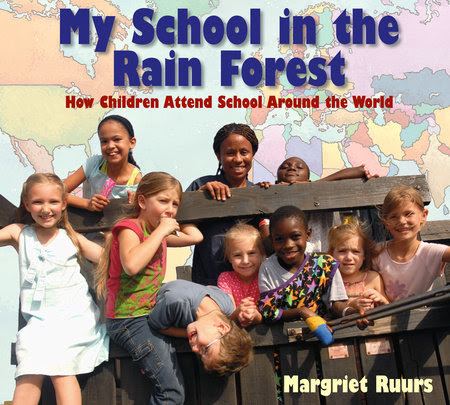
 Margriet Ruurs was the author expert in the recent issue of Talking Story on "Libraries Without Walls." She has published a plethora of nonfiction picture books so I decided to ask her a few more questions. Here are her answers as well as a chance to win one of her award-winning books, My School in the Rain Forest.


INTERVIEW

CAROL: How did publishing My Librarian is a Camel impact your writing career?


MARGRIET: It’s funny. I loved having Boyds Mills Press as a publisher. They did several of my other books since then. But I had this particular manuscript rejected several times. In the end, it has become one of my most successful books so I learned to never give up, to keep submitting, and to believe in your writing. This book also led to many speaking opportunities because of its topic. And I’m passionate about books and libraries so I loved the ride.

CAROL: Can you speak about the global nature of your books? What inspires you? 

MARGRIET: Travel has enriched my life. I travel the world, mostly to speak at International Schools where students speak or learn English but come from a wide variety of backgrounds, different cultures, and countries. I learn much from these kids when I meet them and often they will inspire stories. Meeting kids in Pakistan, Mongolia, in Israel made me realize how similar we are, and how we share the same values and needs despite our different religions or customs. This made me write books like Families Around The World and Where We Live. I hope that these books help to bring awareness and respect for people who are different from what we know.


Margriet sharing books in Mongoloia.

CAROL: Can you talk about how your books are used in classrooms? Was that always your vision as an author?

MARGRIET: Because I spend a fair amount of time in schools as visiting author, and conduct writing workshops in classes, I know that books can be much more than ‘just a story’. I also hope that my books are not just entertainment for a short while, but that they help kids to grow and expand their knowledge. Books truly can be ‘windows on the world’. So adding teaching materials, supplementing with activities and ideas for busy teachers, can really help to increase the value of a book. 

I have often put classes in touch with each other around the world so that they can become pen pals and exchange information about their countries and their daily lives.

But also following an author visit, students will better appreciate the process that goes into the making of a book. How long do you do research? Which sources are reliable? I love telling students about the many years it took me to collect information and images for My Librarian is a Camel, and how I did not give up when it took years to get the actual information from a remote country where the librarian did not speak English. Students need to learn about online research and how to differentiate between reliable and unreliable resources.

My book Stepping Stones is about refugees and was illustrated in stones by an artist in Syria. Many schools have used it to make art from rocks and other natural objects. But also to write biographical stories. It has been used widely as a fundraiser and raised more than $100,000 for refugees.

I also have quite a few books about animals and wildlife (Wild Babies, Amazing Animals, and more). I love showing students how to make sure their information is correct and how to put information in a format to which the reader can relate. For instance, in Amazing Animals, I tell the reader how much the heart of a Blue Whale weighs. But how do you imagine what 400 pounds look like? When you tell the reader that the heart of a Blue Whale is the same size as a mini-van, or that a newborn black bear is the same size as a stick of butter… that is something a kid can picture, and thus it makes more of an impact.

Stories can also focus on real-life experiences. One of my books is called The Elephant Keeper. The publisher used an interesting format for this nonfiction picture book. They turned the picture book into chapters. The main story is about a young Kenyan boy who feared elephants but grew up becoming a much-respected elephant caretaker in an elephant orphanage I visited. The main story is illustrated with beautiful art. This is interspersed with facts about elephants where photos are used. So this book become a format that works on many different levels, in the classroom and beyond.

CAROL: What’s next?

MARGRIET: I’m working on all sorts of exciting projects, including picture books about each continent. I always have writing on the go. I love being able to follow my own interests and getting kids excited about research and writing. Besides working on manuscripts, I interview a Canadian writer or illustrator for a regular column in a magazine that goes to all schools in Canada. I also review books with global appeal for The International Educator, a print and online publication for educators at International Schools. 


Margriet with Dashdondog Jambyn who ran Mongolia’s mobile library
 and wrote many beloved books in Mongolian.

GIVEAWAY

Astra Publishing is donating a copy of My School in the Rain Forest to one fortunate winner. To enter, leave me a comment by January 26. Make sure you leave your email address and name if you are new to my blog. BONUS: Educators and librarians get an extra chance! U.S. address only.

Don't panic if you don't see your comment published immediately. It will publish after I approve it. 

Wednesday, May 12, 2021

EQUAL by Joyce Moyer Hostetter: A Review, An Autographed Giveaway, and a Bonus Giveaway!

Congratulations to Danielle Hammelef who won THE SUMMER OF THE TREE ARMY from last week's blog.

                                                        ****

Some people read a book which they really like and rush through it to get to the end. Not me. When I find a book that I love, I stretch it out. I don't want the story to end.

That was doubly true for Joyce Moyer Hostetter's last book in the Bakers Mountain Stories series-- EQUAL (Calkins Creek: 2021). How is it possible that there won't be another story about the Honeycutt family? I'm sorry to say to all her fans--there won't be. 😞 I even knew how the book would turn out AND I still cried at the beautifully crafted ending. But, I'm getting ahead of myself...

REVIEW


                                PROLOGUE

When I went to the river that day in 1959,
I didn't expect to meet a colored boy
who loved birds like I love my cow.
I didn't know what all I'd learn from him
or that a mean old drunk would come along
and force me to see myself as I never had before.

I didn't realize I was face to face with a muddy wide river.

I didn't think when I went into eighth grade
that a teacher would name my strengths
and inspire me to be even stronger.
I didn't know that I'd learn 
to speak up while measuring my words,
to hold back when I wanted revenge,
or to imagine an enemy as my friend.

                                                                            ******
EQUAL is the story of two boys--one white and one Black--becoming friends despite their differences, hard feelings, and an act of senseless prejudice. But that only scratches the surface. 

EQUAL is also about what it was like to live in a small, rural town in North Carolina in 1960 on the eve of civil rights. Segregation was the norm. As 8th-grader Jackie Honeycutt finds out, the atmosphere of prejudice not only dictates what school and church Jackie attends, but it leaves his new Black acquaintance, Thomas Freeman, and his family in constant fear of potential harm to themselves or their property.  

Mrs. Cunningham, Jackie's teacher, begins the school year by writing Abraham Lincoln's quote on the chalkboard: "Do I not destroy my enemies when I make them into my friends?" This question haunts Jackie throughout the book and (as you can tell from the cover) is EQUAL's theme. Jackie wrestles with jealousy towards other kids at the 4-H competition; he struggles with anger towards a classmate who constantly mocks him; and he feels irritated towards the woman who leads the local Home Demonstration club and snubs his mother. But most of all, he has to come to resolve that dilemma with Thomas. It is not until he truly empathizes with Thomas and Thomas's family does he realize how he can answer Lincoln's rhetorical question. 

In the last third of the book Jackie is staring at Bakers Mountain from his front porch and thinks, "One thing I was figuring out was--as long as white people didn't know Negroes personally, we could never understand their viewpoint. Thomas had educated me on things I never even thought about before." (p.206) That is Jackie's moment of truth which leads to actions that surprise him, are character-revealing, and lead to the wonderful conclusion.

I have blogged before about the importance of making secondary characters a vital part of the story; there are many other characters in EQUAL who are strong and well-crafted. Readers will be happy to see Ann Fay get reunited with Imogene, her friend from the polio ward in BLUE and now she and Junior are happily married (finally)! But the other person in EQUAL who I want to mention is Jackie's mother. Her character arc is shown as she goes from being afraid of what her neighbors will think when a Black family spends the night during a snow storm to saying to Jackie, "Your father and I have been wrong. I was wrong for letting Blanche scare me away from doing the right thing. I believed her when she said poeple would think we're communists. And she was always saying integration could bring violence. I was scared, Jackie."

That conversation ends with her encouraging Jackie to invite Thomas over so she can really meet him. Jackie doesn't know it--but his learning to make friends with his enemies--changed not only him--but his parents too.

                                        EPILOGUE


When I went into the new year, 1960,
I didn't expect to be snowed in with a colored family
who deserved freedom as much as I did.
I didn't know what all I'd learn from them
or that a personal enemy would make me care enough
to join their fight.

I still didn't know how to cross that muddy wide river.

When I went to graduation that night
I knew I wasn't happy with my speech.
I didn't know that Maribelle would show up and 
I'd see Thomas in my mind's eye.
I didn't imagine that because of them,
and the two Jackies,
and all the brave people
who sat at lunch counters and marched in the streets,
I'd change my words midsentence
and wade right into that muddy wide river.

But I'm glad I did. 

                                ********

Equal takes place sixty years ago and is equally as relevant today. Read it with your kids, grandkids, and students.  Explore the Author's Note at the end. Talk about it. I want to hear the discussions that happen as a result of this book--and I'm sure Joyce does too.


ON A PERSONAL NOTE

I've had the privilege of being Joyce's beta reader and read several drafts. You will read the completed story of how Jackie recognizes his racism and deals with it. But I saw how Joyce built the book. She knew Jackie was someone who talked first and regretted his words later. She knew he was a 4-H kid who loved his cow, Lucy, and would learn big lessons when he showed her at the county fair. She knew that fears of bombs from Russia, Communism, and integration would be part of the setting. She had the characters of course--she's been creating stories about the Honeycutts ever since Ann Fay's father left for WWII in BLUE. 

But Joyce didn't know Jackie's backstory and why Thomas didn't trust him. I was on the sidelines and watched her figure out that BIG piece of the puzzle and then weave it into the book. 

I tell you all this because some of you reading this are writers, like myself, who realize the enormity of pulling together all of the many threads that go into a novel--and I want to encourage you that even a master writer like Joyce works HARD to accomplish this. Others of you are readers. I want you to know that a story as magnificent as Joyce's doesn't just happen. There are hours and hours of drafting, writing, reorganizing, deleting, revising, and tweaking that go on behind the scenes.

If you are new to my blog and haven't heard of the Bakers Mountain Stories, please check out my other posts: AIM, BLUE, COMFORT, and DRIVE. (In this blog and this one, Joyce explains the order in which the first three books were written.)


TWO GIVEAWAYS!!

Thanks to Calkins Creek's generosity, Joyce is giving away one copy of a personally autographed book to one fortunate winner. Please leave me a comment by 6 PM on May 14 to enter. MAKE SURE you include your name and email address if you are new to my blog. 


DRIVE - with a beautiful new cover-- just came out in paperback and I have a copy of of that to give away also. When you leave a comment, please let me know which book you are interested in winning. Only continental United States addresses please. Sorry, you can't win both!

ONE FINAL WORD

Joyce's virtual launch with SCBWI-Carolinas is on May 27 at 7 PM.  She will be giving away another copy of EQUAL at that time--so if you don't win now, you'll have another chance to win later. You don't need to be a member of SCBWI to sign up and attend. Come and find out why Joyce wrote EQUAL and what she hopes readers will take away from it. 

Wednesday, April 28, 2021

Lincoln Clears A Path: A Picture Book Biography

Congratulations to Kathleen Burkinshaw and Carolyn Frazier who won autographed copies of Halli Gomez's book, LIST OF TEN from last week's blog.


                                                                    *******

In Lincoln Clears A Path (Calkins Creek, 2021) a new picture book by talented picture book author Peggy Thomas, our 16th president's accomplishments are presented from a different perspective. Although he is known for his stance against slavery, how many students know about his agricultural legacy?  In a book well-suited for home and classroom libraries, readers from 7-10 years of age are introduced to the many other paths which Lincoln cleared.


The book opens with seven-year old Abe arriving in the middle of the Indiana wilderness. This was not a farm. Not yet.

His family got to work.


Along with his father, Abe felled trees, cleared brush, pulled stumps and plowed fields. At night he studied stars, math and poetry...Abe marveled at how the founding fathers--Thwack! Swish! Thwump Yah!--cleared a path for folks like him.

In New Orleans Abe saw how slaves were auctioned off and he wondered, Could anyone clear a path for them?

Back home in Illinois, his friends urged their talented friend to run for office. He was poor and uneducated. But his friends provided books to read, tutoring in math, and even a suit to wear.

In the Illinois legislature he cleared paths for better schools and more roads. He stood against slavery. "There is no reason in this world why the negro is not entitled to all the natural rights enumerated in the Declaration of Independence, the right to life, liberty, and the pursuit of happiness."

But soon after he was elected president, South Carolina seceded and the Civil War began (see this timeline for more information.)

In the middle of the war, Lincoln did something that was seemingly unrelated to the North-South conflict. He created the United States Department of Agriculture to support the farmers who were supporting the troops.


But that was not all.


With a stroke of his pen, he signed the Homestead Act and cleared a path west. "New free States are the places for poor people to go to and better their condition," he wrote.


Then he signed the Pacific Railway Act and cleared a path across the nation.


In addition, Lincoln created land-grant colleges which cleared a path for students to learn more about agriculture.

He cleared a final path when he signed the Emancipation Proclamation and created a path to freedom for slaves. 


By Lincoln, Abraham, 1809-1865 - http://www.wdl.org/media/2714/service/thumbnail/6000x6000/1/1.jpgGallery: http://www.wdl.org/en/item/2714/, Public Domain, https://commons.wikimedia.org/w/index.php?curid=31578413 

"'Liberty to all'....clears the path for all--gives hope to all." 

The onomatopoeia of the four words--Thwack! Swish! Thwump! and Yah! which repeat throughout the story will keep even younger readers engaged. The simple, yet profound message of what Abraham Lincoln accomplished is communicated through the text, his quotes, and interesting facts distributed throughout the book. 

Nine pages of back matter include highlights from Abraham's childhood and adult years; how the Civil War affected U.S. agriculture; and a bibliography. There is additional information about the four acts; the author made sure to show how Native Americans were unfairly impacted by these acts. 

I was particularly impressed with how Thomas discovered the theme by noticing Lincoln's phrase "clearing the path" in his writing. She writes, "Sometimes he was referring to the removal of rocks and stumps so a wagon could pass, but other times he was thinking about ways to remove much bigger obstacles like poverty, racism, and ignorance so that all Americans could lead a better life." She challenges readers by asking, "How could you clear a path?" 

Illustrator Stacy Innerst's sepia watercolors evoke an "old-timey" feel which lends a distinct flavor to this historical picture book biography. 

No giveaway this week! I'm saving this book for my grandchildren. 

Here is a short video by Carolyn Yoder, Peggy Thomas's editor at Calkins Creek.


Wednesday, March 10, 2021

Born to Swing: A Picture Book Review and Giveaway

As I mentioned a few weeks ago, I have a shelf full of picture books to review, use as mentor texts, and to give away. In honor of Women's History month, here's my next one, Born to Swing (Calkins Creek, 2018) by Mara Rockliff and illustrated by Michele Wood. (Images courtesy of Calkins Creek.)


"I was born to swing, that's all. Call it what you want, blues, swing, jazz, it caught hold of me way back in Memphis and it looks like it won't ever let go." Lil Hardin Armstrong

REVIEW

In this vivid picture book biography, Lillian Hardin Armstrong's life and love of music is depicted on every page.

From the time she was a child, Lillian loved to listen to the Father of the Blues, Mister W.C. Handy's band playing outside her Memphis boarding house window.

Although her mother called it "Devil's music," she couldn't keep Lillian away from the family organ. Her legs were too short, so her cousin played the pedals for her!


Lillian played hymns for Sunday School--albeit with a beat. She didn't know it at the time, but she was playing jazz! During a piano contest she lost her place, improvised, and won!

When the Great Migration north started, she and her mother headed to Chicago. There she strolled up and down the Stroll listening to music at all hours of the day and night. 

She got a job playing piano in a music store and earned the tile, "The Jazz Wonder Child."


She met Jelly Roll Morton (who said he invented jazz) and despite being a woman, started playing with the New Orleans Creole Jazz Band.

She was "swinging with the swingingest band in Chicago. I laid those rhythms down so hot, they called me Hot Miss Lil." That's when she met Louis Armstrong. 

"Louis was not a handsome man. His clothes were out of style. But when he blew his horn, oh, gee!"

Of course, they had a jazz wedding! No honeymoon for the two of them, they were too busy touring across the country with the band.


Lil and Louis wrote songs and put a band together they called the Hot Five. Their marriage lasted for 14 years; the author reporting their divorce as Louis moving on. 

Lil continued to write songs and play piano. She also started her own band, ran a restaurant, designed clothes, and traveled to Paris where the French had flipped for le jazz hot. 

When she returned home, the country was wild about rock and roll. She thought maybe everyone had forgotten her, but she was labeled a "living legend" and she was on television-- a new type of entertainment media back in the day!


Interestingly, the book ends with Lil saying,

You won't believe me, but I died at the piano, playing that "St. Louis Blues"--playing hard. Oh boy, I went out swinging.

Right up to the end, I had the widest smile and the biggest brightest eyes.

In 1971, shortly following Louis's death, Lillian collapsed at the piano and had a heart attack on the way to the hospital. Wikipedia notes that the autobiography she was working on, and her personal letters, disappeared shortly after her death.


END PAGES & CURRICULUM RESOURCE

The back of the book notes include five pages of information including a timeline, bibliography of both primary and secondary sources, and a list of her songs to find online. This is a great curriculum resource for Kindergarten-third graders studying women in the arts, jazz, and African American history. Reluctant readers in fourth-sixth grades will also enjoy the text and pictures.

Here is a youtube short video showing Lil at the piano.


The text is very reader friendly and inspirational. The illustrator's use of yellow throughout the book was magnificent. From Lillian's dresses, to the color of the horns, to the background of several pages--it makes the story pop from the pages. 

GIVEAWAY

Leave me a comment by 6 PM on March 12 along with your email address (if you are new to my blog) and I'll enter your name. If you choose to follow my blog, let me know and I'll put your name in twice. U.S. addresses only. 

Saturday, September 12, 2020

Author Interview with Sandra Neil Wallace and Rich Wallace + Giveaway

Congratulations to Jolene Guiterez (second week in a row!) who won a copy of The Teacher's March! For those of you who didn't win, here's a second chance! Jolene is adding to her school library, book by book. 

*****

As promised on Wednesday, here is my bonus post taking you behind the scenes with Sandra Wallace and Rich Wallace, authors of The Teachers March!


Carol: How did you find this story? Was it while researching the time period or other individuals involved in the civil rights movement?


Rich and Sandra: Yes, Joyce Parrish O' Neal, whose mother (Too Sweet) participated in the Selma teachers’ march, told us about it while we were interviewing her for a previous civil rights book (Blood Brother: Jonathan Daniels and His Sacrifice for Civil Rights).  We’d been discussing Martin Luther King Jr.’s presence in Selma during the Selma to Montgomery march when she mentioned that he’d been there back in January of 1965 to encourage Black citizens to march and returned to applaud the teachers for making history with the teachers’ march. The fact that so few people knew about this crucial event—including us--really opened our eyes. We set out to interview as many of the teachers and their family members as we could.


Reverend Reese and Joyce Parish O'Neal

Reverend Reese and Joyce Parrish O'Neal

Carol: I’m in the process of hosting another collaborative team on my blog and so I’m curious about your collaboration process. How do the two of you work together? Assign jobs, come up with a joint vision, etc.


Rich and Sandra: We always start with a topic that has a strong appeal for us both—usually that means little-known people who have broken barriers and changed the world but their stories have been lost to history, and we really want kids to know about them. Then we read everything we can get our hands-on. In the case of the teachers’ march, primary sources were spare. There were some recollections in slim chapters of civil rights books, and brief, local newspaper coverage, which discriminated against the teachers and portrayed them as trouble-makers, and some New York Times coverage at the time. But the teachers’ march was quickly overshadowed by national coverage that followed subsequent events. John Lewis was beaten leading a Selma march a short time later (notoriously known as “Bloody Sunday”); then Lewis and MLK led the historic march from Selma to Montgomery right after that. The teachers’ march—which set those more famous events into motion—was almost forgotten.


So, we set right into the second phase of our research, which is visiting with the key players, being with them at the location of the history-making event, and chronicling their memories through interviews and oral histories. Those first-hand accounts are vital not only for context, primary source information, and voice, but to humanize history. Learning about the dangers they faced and what was at stake helps us honor their courage and create connections across human experiences. For The Teachers March! we made several trips to Selma and did our interviews in person.


For our books on subjects that are further back in history (Bound by Ice was from the 19th century, for example) we rely on journals, letters, newspaper articles with quotes, artifacts, and other contemporary material. 


When we finally start writing the manuscript, we do tend to “assign” certain sections to each other (or more likely, we volunteer). We serve as each other’s editor and hold each other accountable to the storyline and to the narrative voice.


GIVEAWAY


Boyds Mills Press & Kane is generously providing another copy of A Teachers March! to one of you. Please leave a comment by September 15 (with your email address if you are new to my blog) for a chance to win. 


ABOUT THE AUTHORS


Investigative journalists Rich Wallace and Sandra Neil Wallace are a husband-and-wife team who write books together and as individuals. They are the co-founders of The Daily Good, a nonprofit dedicated to literacy, food security, inclusion, and health in their city of Keene, NH. Sandra’s picture book Between the Lines: How Ernie Barnes Went from the Football Field to the Art Gallery, was presented the 2019 Orbis Pictus Award for Outstanding Nonfiction by the National Council of Teachers of English. Rich’s many novels include award winners such as Wrestling Sturbridge and Playing Without the Ball. Visit them at sandraneilwallace.comrichwallacebooks.com, and DailyGoodNH.org
 

Wednesday, September 9, 2020

The Teachers March! A Picture Book Review + Giveaway

Congratulations to Jolene Guiterrez who won Maiden of Iron from last week's blog.

******

The Teachers March! (Boyds Mills & Kane, 2020) is a nonfiction picture book that many of you will be interested in adding to your home or school library.


This is the story of Reverend F.D. Reese's activism and how it led to obtaining equal rights for African Americans. Set in 1965 in Selma, Alabama, co-authors, Sandra Neil Wallace and Rich Wallace use storytelling techniques to bring history alive. 


REVIEW


The first line hooked me right away.

Reverend F.D. Reese taught science at R.B. Hudson High School, but his favorite subject was freedom.

Reverend Reese loved teaching science, but he was passionate about teaching his students that under the Constitution, they had the same rights as whites. 


He led marchers to the courthouse to register to vote but was met by Sheriff  Clark who swung his billy club and threatened harm to the Negroes. Reverend Reese knew that even if they registered, they would be forced to take a voting test that Whites didn't have to take--and that was impossible to pass. 

Reverend Reese thought about how the Black teachers were respected in their community. They were the somebody somebodies. College educated. Shiny leather shoes. Suits and Sunday brooches seven days a week. No group like that had marched for freedom before.

(Side note: When I interviewed people for Half-Truths this was the attitude that was expressed toward the Second Ward High School teachers. They were respected and loved.)

But how would he convince the teachers to march? They were frightened. Reverend Reese needed a "glorious opportunity" and a "triumphant idea." 

He discovered he had both. After hearing Dr. Martin Luther King talk on television, he decided to write to him and ask for help with the teachers.

The night that Dr. King spoke at Brown Chapel, seven hundred people packed the auditorium. Two people from the community came also, 15-year-old Joyce Parrish, and her mother "Too Sweet."


Despite their fears of going to jail or losing their jobs, one by one, over a hundred teachers agreed to march for the cause: they were leaders of the community and they would come forward and demonstrate their commitment to gaining the right to vote. 

As a teacher, Too Sweet had a difficult choice to make. She was a single parent. Who would take care of Joyce if she went to jail? More than a hundred teachers pledged to march, and Too Sweet was one of them.

On the morning of January 22, 1965, the teachers who had said they would march packed a peanut butter sandwich and a toothbrush. They would need them if they were arrested. Reverend Reese was worried. He'd seen other individuals arrested as they tried to register. Would the teachers show up for the march?

They did!


When they arrived at the courthouse, they were greeted by the same sheriffs who had angrily confronted Reverend Reese before. 

But this time, the sheriff and his deputies faced a huge crowd of teachers. If they all got arrested, who would teach the students? The superintendent would have to close the schools. The sheriff knew that and had to put away his billy club.


Reverend Reese and his triumphant idea had gained a glorious victory.

Afterward, Joyce was relieved when she found her mother amidst the group of marchers. She and her mother hugged; Dr. King came back and praised the teachers.

Because the teachers marched, other groups marched also. Beauticians and barbers. Undertakers. Even the students.


Many of the Selma marchers were arrested and the nation took notice. They wondered why respectable citizens in suits and dresses, and school kids carrying books, were jailed.

In the summer of 1965, the Voting Rights Act passed. In August, Reverend Reese, Too Sweet, and other teachers climbed the steps to the courthouse. There were no voting tests or bully clubs. 


And the first thing they did, was vote Sheriff Clark out of office. 

AUTHORS AND ILLUSTRATORS NOTES

The back pages of the book are filled with information. The authors, Sandra Neil Wallace and Rich Wallace discuss their interviews with Reverend Reese, Joyce Parrish O' Neal, and Lawrence Huggins, another teacher mentioned in the book. In addition, the illustrator, Charly Palmer, discusses his use of photographs to create his unique illustrations. A detailed timeline and bibliography make this an excellent curriculum resource for students in 2nd-5th grades. 

GIVEAWAY

Leave me your name and email address (or email me privately) by September 11 to enter the giveaway. For an extra chance to win, share this post on social media and let me know what you do.

WHAT'S NEXT?

Since I am also working on a book related to civil rights, I was very interested in how the Wallaces became interested in this story. Because I'm running a series on writing collaboratively (check out the first post here) I asked them about that too. Look for their responses to these questions on a bonus blog post on Saturday. (And a second chance to win The Teachers March!)


THE NIGHT WAR: A MG Historical Novel Review

  By now you should have received an email from my new website about my review of THE NIGHT WAR by Kimberly Brubaker Bradley. (It'll com...