Showing posts with label Carolyn Yoder. Show all posts

Friday, May 6, 2022

STORIES IN JOYCE'S BACKYARD: A "PICK-YOUR-OWN" GIVEAWAY!

 "This is the house that the Hinkle sisters lived in, and that's the muddy river where Thomas and Jackie fished together." Joyce Hostetter pointed out the car window as we drove around around her hometown, Hickory, NC--the setting for her Bakers Mountain Series. "See that old building? That's the hosiery factory where Junior worked for a few days. Over there is where the car mechanic lived who helped him fix his truck."


The Honeycutt family and their friends, who already had a special place in my heart from reading AIM, BLUE, COMFORT, DRIVE and EQUAL, became even more real as I saw the places where they lived, played, and worked--all within sight of Bakers Mountain. 

Bakers Mountain, photo courtesy Joyce Hostetter

How did Joyce end up writing a series of books that rose up out of what was once a rural community? It all began when Carolyn Yoder, senior editor at Calkins Creek, suggested that Joyce find the story in her own backyard. When Joyce began researching the history of Hickory, NC, she discovered the Miracle of Hickory at her local library.

Mural in downtown Hickory. Do you see Joyce?

She researched, read old papers, interviewed polio patients...and BLUE was born. Read some of Joyce's thoughts on the process of discovering her stories here

Part of Joyce's real backyard. Photo courtesy Joyce Hostetter

A few years after BLUE was published, I met Joyce in Birmingham, Alabama at a literacy conference. She was presenting on BLUE, I was presenting on Teaching the Story: Fiction Writing in Grades 4-8.  


We bonded over reading and writing. We co-presented several times and continue to publish a quarterly newsletter, Talking Story. We are critique partners and good friends. 

I felt Joyce's influence when I began brainstorming my own first novel. I rode my bike, walked, and drove through neighborhoods. What could have happened here? Half-Truths incubated. Ideas hatched. A novel slowly took shape. It changed. Got revised (many times!). Was reborn. 

What did Carolyn mean when she gave Joyce that assignment? Possibly she was not only talking about an actual backyard but was also encouraging Joyce to reach inside of her own experiences to find something she could relate to and authentically show in her writing.  

Let's face it. There might not be a compelling story about polio or pre-civil rights tension in your community, city, or state. Or, maybe you write science fiction or fantasy that's not even rooted in this continent or world--let alone in your neighborhood! How are you going to find that "backyard" story?

At the foot of Bakers Mountain and staring at Joyce's budding trees and the grass turning green I thought--my backyard is bigger than the crazy intersecting streets of Myers Park, NC. where my characters live. 

It's my whole life. 

It's writing what I know with a twist. 

It's taking my grief over losing someone I loved and embedding that in Kate, my protagonist's heart when she leaves home. It's realizing how making choices is not always very linear and conveying it on the page; it's understanding how gut-wrenching it is to feel betrayed--or be the betrayer. 


How about you? What have you used in your life--whether it's a place, person, event, or experiences--that has made it's way into your book? 

What is in your own backyard? 

Some backyards are under construction,
like mine is!

GIVEAWAY

For the first time on my blog, one fortunate blog reader will be able to pick which book in the Bakers Mountain Series they want to win! Leave me a comment by May 11 to enter this giveaway and tell me which book you are interested in. U.S. addresses only. Make sure you leave me your full name and email address if you are new to my blog.

Make sure you check out the other great books on Greg Pattridge's MMGM blog! 


Wednesday, January 5, 2022

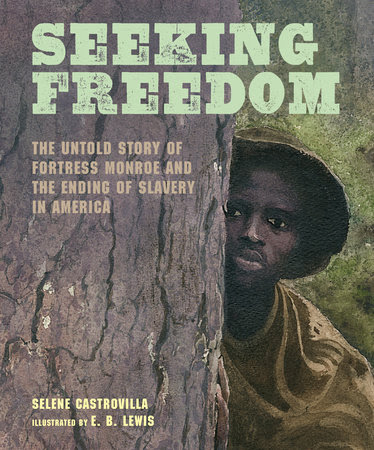
SEEKING FREEDOM: The Untold Story of Fortress Monroe and the Ending of Slavery in America- A Nonfiction Picture Book Review and Giveaway

I'm starting off the new year by joining a blog tour for a new book by award-winning Selene Castrovilla, SEEKING FREEDOM (Calkins Creek, 2022). The expressive watercolor illustrations are by award-winning artistrator, E.B. Lewis.


REVIEW

Although most of this informational picture book for 7-10 year-olds is presented in a journal format, the book opens with a quote from President Abraham Lincoln's First Inaugural Address on March 6, 1981:

I have no purpose, directly or indirectly, to interfere with the institution of slavery in the States where it exists. I believe I have no lawful right to do so, and I have no inclination to do so.

The next page explains how Lincoln was unable to convince the remaining Southern states (seven had already left the United States) to stay. War broke out on April 2, 1861. Five days later, Virginia abandoned the country. Fearful of being separated from their families and forced into hard labor, "The enslaved people...would do anything to be free."

Thus, this true story opens.


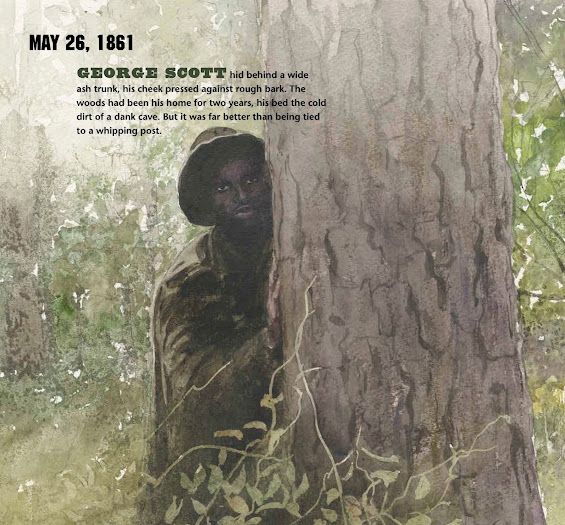
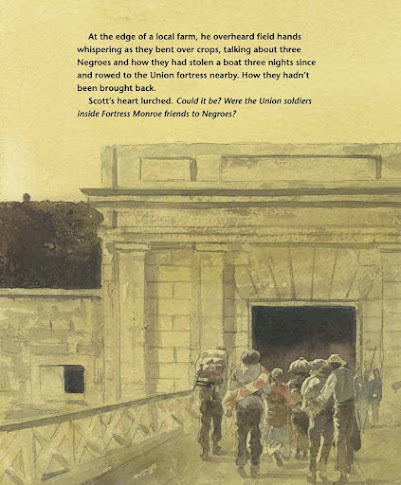
Scott knew the forest and swamps--but he didn't know what was going on the town of Hampton. He overheard field hands talking about how three Negroes had escaped to a Union fortress nearby--and hadn't been returned. Could it be? Were the Union soldiers inside Fortress Monroe friends to Negroes?


Scott watched as eight Negroes headed inside. He waited. But they didn't come out. Was it true? Were these people now among friends?

Despite his fears, he snuck in with another group of Negroes and waited for an interview with the commander of Fortress Monroe--Major General Benjamin Franklin Butler. 

https://www.nps.gov/fomr/learn/historyculture/index.htm

By the time Scott spoke with Butler, the major was frustrated. He had interviewed many Negros but hadn't obtained the information he needed: Where were the Confederates stationed?  The major was also in a difficult position. He was holding every Negro who came to him as contraband of war--"property used for warlike purposes against the government of the United States." 


Library of Congress Prints and Photographs Division Washington, D.C. 20540 USA http://hdl.loc.gov/loc.pnp/pp.print
"A Group of Contrabands"
James Gibson, photographer
When Major Butler spoke with George Scott he realized he'd found the man he was looking for--someone who could track down the Confederates. Even after finding out that his plan to use Negros as spies was approved, Butler was still worried. Could the fortress remain secure against enemy attack? He prayed for Scott's safety.

George Scott wandered for eight days looking for the Confederates. He prayed that the Lord would lead him. Just then, he saw thousands of Confederate soldiers outside a church. His prayers had been answered. 

Scott raced back to the fort with the news he had gleaned--the rebels were preparing to cut off all supplies.


Butler's men had not died in vain. The confederates had fled; the threat to the fortress was over. But how could Butler reward Scott? When Scott asked for freedom, Butler put his legal skills to work.

 Butler implored the President and Congress: 

These human beings must be given the free enjoyment of life, liberty, and the pursuit of happiness.


BACK MATTER

Seeking Freedom includes eight pages of back matter; that's an exceptional amount of pages! But the sections on the Aftermath (including references to the Confiscation Act of 1862 and the Emancipation Proclamation), the Contrabands, Benjamin Butler's Legacy, George Scott, and Fort Monroe in Hampton, Virginia, add a depth of information to this informational picture book that will be appreciated by older students as well as adults. By the way, the last spread is a picture of President Obama signing a proclamation establishing the Fort Monroe National Monument. 

Interestingly, there are no known images of George Scott. William Headly shared Scott's story. He escaped enslavement and became a contraband in North Carolina. His cloak is an old cotton bag. 

https://www.loc.gov/item/2010647919/

For a view behind the scenes of how Selene came to write this story, see her post on Nerdy Book Club.  

Here's a YouTube video of Selene talking to her editor, Carolyn Yoder, about writing picture books which bring alive history.


GIVEAWAY

To enter this giveaway, please leave me a comment by 6PM on January 8th. U.S. postal addresses only. If you decide to follow my blog I'll put your name in for a second chance.Please include your name and email address if you are new to my blog. If you are hesitant to leave your email address, you can reach me directly by clicking here. 

Congratulations to Gail Cartee who won The Dirt Book from last week's blog.

Wednesday, April 28, 2021

Lincoln Clears A Path: A Picture Book Biography

Congratulations to Kathleen Burkinshaw and Carolyn Frazier who won autographed copies of Halli Gomez's book, LIST OF TEN from last week's blog.


                                                                    *******

In Lincoln Clears A Path (Calkins Creek, 2021) a new picture book by talented picture book author Peggy Thomas, our 16th president's accomplishments are presented from a different perspective. Although he is known for his stance against slavery, how many students know about his agricultural legacy?  In a book well-suited for home and classroom libraries, readers from 7-10 years of age are introduced to the many other paths which Lincoln cleared.


The book opens with seven-year old Abe arriving in the middle of the Indiana wilderness. This was not a farm. Not yet.

His family got to work.


Along with his father, Abe felled trees, cleared brush, pulled stumps and plowed fields. At night he studied stars, math and poetry...Abe marveled at how the founding fathers--Thwack! Swish! Thwump Yah!--cleared a path for folks like him.

In New Orleans Abe saw how slaves were auctioned off and he wondered, Could anyone clear a path for them?

Back home in Illinois, his friends urged their talented friend to run for office. He was poor and uneducated. But his friends provided books to read, tutoring in math, and even a suit to wear.

In the Illinois legislature he cleared paths for better schools and more roads. He stood against slavery. "There is no reason in this world why the negro is not entitled to all the natural rights enumerated in the Declaration of Independence, the right to life, liberty, and the pursuit of happiness."

But soon after he was elected president, South Carolina seceded and the Civil War began (see this timeline for more information.)

In the middle of the war, Lincoln did something that was seemingly unrelated to the North-South conflict. He created the United States Department of Agriculture to support the farmers who were supporting the troops.


But that was not all.


With a stroke of his pen, he signed the Homestead Act and cleared a path west. "New free States are the places for poor people to go to and better their condition," he wrote.


Then he signed the Pacific Railway Act and cleared a path across the nation.


In addition, Lincoln created land-grant colleges which cleared a path for students to learn more about agriculture.

He cleared a final path when he signed the Emancipation Proclamation and created a path to freedom for slaves. 


By Lincoln, Abraham, 1809-1865 - http://www.wdl.org/media/2714/service/thumbnail/6000x6000/1/1.jpgGallery: http://www.wdl.org/en/item/2714/, Public Domain, https://commons.wikimedia.org/w/index.php?curid=31578413 

"'Liberty to all'....clears the path for all--gives hope to all." 

The onomatopoeia of the four words--Thwack! Swish! Thwump! and Yah! which repeat throughout the story will keep even younger readers engaged. The simple, yet profound message of what Abraham Lincoln accomplished is communicated through the text, his quotes, and interesting facts distributed throughout the book. 

Nine pages of back matter include highlights from Abraham's childhood and adult years; how the Civil War affected U.S. agriculture; and a bibliography. There is additional information about the four acts; the author made sure to show how Native Americans were unfairly impacted by these acts. 

I was particularly impressed with how Thomas discovered the theme by noticing Lincoln's phrase "clearing the path" in his writing. She writes, "Sometimes he was referring to the removal of rocks and stumps so a wagon could pass, but other times he was thinking about ways to remove much bigger obstacles like poverty, racism, and ignorance so that all Americans could lead a better life." She challenges readers by asking, "How could you clear a path?" 

Illustrator Stacy Innerst's sepia watercolors evoke an "old-timey" feel which lends a distinct flavor to this historical picture book biography. 

No giveaway this week! I'm saving this book for my grandchildren. 

Here is a short video by Carolyn Yoder, Peggy Thomas's editor at Calkins Creek.


Monday, August 27, 2018

Fundamental STEPS to Writing Historical Fiction-- Highlights 2018

Congratulations to Joyce Hostetter who won THE HERO TWO DOORS DOWN and to Clara Gillow Clark who won PACO'S PAINTBRUSH. Clara Gillow Clark is the blogger from whom I won FOOD FIGHT FIESTA. (And no, I didn't rig the contest. Random.org always picks my winners!)

*******
Several weeks ago when I blogged about teaching at Write 2 Ignite, I mentioned that I have another opportunity to teach this fall. I'm thrilled to share that I'll be part of the faculty for Highlights Foundation's Historical Fiction Workshop led by my friend and mentor, Joyce Hostetter


Following the acronym STEPS, this is what Joyce and her team will cover:


STORY: Finding stories embedded in history and embedding history into our stories.

TIME: Allowing the historical era to shape characters, dialogue, actions, and more. Lila Weaver will present a talk on going from an eyewitness to a story teller.

EXPERTS: Seeking insight from archivists, specialists, eyewitnesses, and survivors. This is MY talk!! (I guess Joyce decided that after hearing my excitement over finding each new expert for Half-Truths, she would have me share my experience with others.)

PLACE: Infusing the story with a sense of locality and culture. This talk is by Julie Chibbaro.

SOURCES: Researching history and documenting resources.


Check the schedule and you'll see that besides talks on these subjects, participants will meet one on one with Joyce. They will have time to work on their manuscript and receive input from the faculty and other attendees. Carolyn Yoder, Joyce's editor, will also join the group for a question and answer session. 

 If you don't know Joyce, then here's the link to the Highlights blog where she talks about her journey as an historical fiction novelist. It's always fun to hear how she wrote BLUE without a thought that it would turn into a series. DRIVE is coming out this fall and Joyce is now writing her fifth book in the Bakers Mountain Series!


If you want to make history come alive to middle grade or young adult readers, then this is the workshop for you. To read more about the workshop and enter the great giveaways that Joyce is offering, click here for the special newsletter on the workshop. 

Hurry! The workshop is limited to eight students and is filling up--but Joyce and I would love to see you there too!

Monday, February 19, 2018

Four Writers and Four Writing Stages--Part II

As I mentioned last week, this is the second post in a two-part series on the variety of stages writers go through when producing a book. Thanks to Jean Hall who said that she is "always in the middle of creation or revision of picture books." Julian Daventry said, "I'm about to start editing my trilogy, after getting all three books drafted. There's still much to be done, but reaching the 'all books are drafted' is a nice milestone. I'm ready for the next step!" Gray Marie contributed, "Sadly school has been detaining me, but I hope to speed up my progress this summer. I am currently outlining and writing out a few of the scenes in my attempt to piece together this puzzle of a story in my head." Sheri Levy wrote, "I am writing the my first draft of the third novel in the Trina Ryan series, For Keeps. My ideas are moving in the story, and I'm trying to write to the end before I start restructuring the plot. This part of writing is fun, but a long process."


JOYCE HOSTETTER


My book, DRIVE, (a story of twins, NASCAR, the Cold War, and competition) is in the design phase so it came back to me recently formatted by a typesetter.  At this point my task was to read through in search of typos, misplaced quotation marks, spacing issues, etc.  Of course, we writers are always tweaking so I slipped in quite a few requests for other small changes.

I began writing DRIVE in August 2016 at a Highlights workshop with my editor, Carolyn Yoder. Since it’s part of a series, I submitted a query and received a contract within a few months. I submitted it within seven months but should have allowed more time in my contract because writing two viewpoints is so hard!  I revised and resubmitted in July and it went through another round of revisions after that. All told – about a year and a half.

My first draft was a mess. Someone died who I decided not to kill after all. Also the twin protagonists weren’t attracted to the same boy and in the final version they are. Polio figures into the final version more than it did previously. The final version feels much more cohesive and I think the twins are more differentiated. Hopefully you still won’t know who to pull for.

After the latest changes have been applied by the typesetter I’ll be rereading again for nitpicky formatting issues. I’m quite certain if I ask for other changes my editor will disown me.

Here is the opening of DRIVE:
As terrible as it sounds, I wanted to rip the ribbons right off my twin sister’s drawing. First place in still life and grand prize! 
Ida stood beside me in the hallway at Mountain View School. She wasn’t saying much even if she was thrilled—which of course she was. But I knew she felt guilty about me only winning honorable mention in my category. For some reason I’d thought a portrait of Dwight D. Eisenhower would help me take first place. 
“I’m sorry, Ellie,” whispered Ida. 
“It’s okay,” I said. But I had to bite my lip to keep it from trembling. 
“Maybe you should’ve submitted that drawing of the red high heels. It was really good.” 
“No,” I said. “Because that would have been a still life and I wasn’t about to compete in the same category as you. But of course you beat me anyway.”

In her award winning BLUE, Joyce told the story of her hometown’s compassionate response to a polio epidemic. The characters of this quiet neighborhood took up residence in the hearts of readers so that now Bakers Mountain Stories include AIM, BLUECOMFORT and the forthcoming DRIVE. When Joyce isn’t writing, researching, or speaking about her books she is usually living the quiet friends-and-family lifestyle exemplified in her stories. She does, however, enjoy travel because the world is actually so much bigger than where she is from!  

CAROL BALDWIN 


Last June I switched over to writing Half-Truths from Kate's POV. That required digging deeper into Kate's backstory, re-thinking, moving chapters, writing new ones, and deleting a lot of material. I'm now close to the end of that draft. Next, I'll print the  manuscript and read it out loud. I'll fill in details that I hadn't taken time to research, check character arcs, hunt down cliche's, tighten, and polish. It will then go to a few beta readers, my two critique partners, and Rebecca Petruck, my wonderful writing coach. After that...I hope it'll be time to start querying agents! 

As some of you know, it has taken me over ten years to get to this point. Although the story takes place sixty years ago, I hope the themes of friendship, racism, and generational legacies will inspire introspection and communication among today's readers.

Here is a snippet from one of the ending chapters. This follows Kate's conversation with her grandmother about their family history:
I ache for my grandmother. For the little girl who was ripped away from her mother and grew up with half-truths fencing her in.  
Half-truths like long spindly fingers that reached out from the grave and strangled us all.


Monday, February 29, 2016

Where Are They Now? Joyce Hostetter's Cover Reveal + Giveaway


I am pleased to announce a new series of posts following up on my You Heard it Here First series. In these Where Are They Now? posts I'll share follow-up publication news from authors and illustrators I have featured on my blog. 

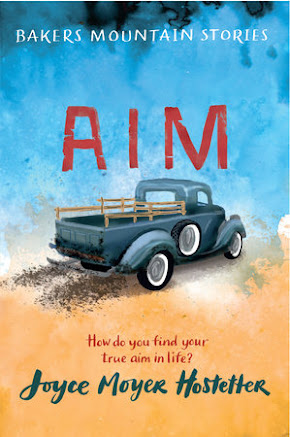
My first success story comes from North Carolina author Joyce Hostetter, who happens to be my extremely talented writing buddy and co-publisher of Talking Story. I'm honored that she's chosen my blog as her cover reveal for her next book, AIM, scheduled to be published by Boyds Mills Press fall, 2016. Since tomorrow, March 1, marks the 10th anniversary of BLUE's publication, this is a very special occasion for Joyce.

I know some of you won't be able to stand the suspense and will scroll down to see AIM's beautiful cover (caught ya!). Just make sure to come back and read the amazing backstory of how this book was conceived and written in under a year.

Take it away, Joyce! 


CAROL: I know Boyds Mills Press (or was it Carolyn Yoder?) approached you about writing a prequel to Blue and Comfort. Can you tell us a little about that process? What did they ask for?

JOYCE: My editor, Carolyn Yoder, suggested the prequel but the idea was generated in committee—a prequel to begin with the letter A - so we’d have an ABC set. I thought that was the oddest idea ever!! (to start with a letter of the alphabet for a title before I had a story concept) I joked with my hubby that I’d call it Annoyed! Or Aggravated!

Carolyn explained. It was a marketing thing and would look good on bookshelves! Oh. Okay. Who was I to argue with people who know marketing? Or to pass up a chance at a book contract?

I was just getting into the story when Carolyn gave me a specific date to submit the proposal. So, I stopped writing chapters and spent two weeks on an outline.  Thanks to you, Carol for being part of my brainstorming process. Did you actually suggest that Junior Bledsoe could steal a car? I guess it was an okay idea. The committee liked my proposal and offered a contract.  

CAROL: How hard was it to come up with an idea for the prequel? How about the title? Did that come to you early on in the process?

JOYCE: I’d had an idea to write about a protagonist whose father was dead and at his funeral everyone made him out to be a saint. (I’ve been to such funerals!) But my story would reveal the father’s true character.

So I took a seed from Blue in which Ann Fay says that Junior Bledsoe’s father’s heart gave out a few years ago. I decided to explore Junior’s relationship with his dysfunctional father.  As it turned out, his father wasn’t actually a scoundrel.  Few people ever are.  Mostly, they/we are just broken. In AIM, I explored that brokenness and Junior’s response. 

For the title, I started collecting A words. Alligator was out. Allspice was too. I made a list of words that had potential for preceding Blue and Comfort—one that suited Junior Bledsoe. I considered Aspire but it sounded more like a word his school teacher would use. AIM became the obvious choice.

CAROL: What were the challenges of writing a prequel? 

Being consistent from one book to the next—in characters, speech, and small details. If I’d known there would be a prequel I’d have set it up in Blue and Comfort. Ann Fay was fairly self-absorbed in those books. But she did have opinions about Junior Bledsoe.  He knew everything and everybody and when it came to helping people he didn’t know how to say no.  It was a fun challenge for me to portray him at fourteen as opposed to how she saw him at seventeen.

CAROL: What was the most thrilling/exciting/fun part about writing this book?

JOYCE: The publisher asked me for a book.  What’s not to love about that?  For them to offer a contract based on my proposal was a tremendous emotional boost when I especially needed it. Having just spent seven years researching and writing on two “failed” speculative projects, I was grateful for the focus that AIM gave me.

CAROL: I know you had a stiff deadline for AIM. How was this different than Blue or Comfort?

JOYCE: I wrote Blue and Comfort on spec.  My editor put me through multiple revisions before offering contracts. I had lots of time for research.

With AIM, I wrote the first draft in six weeks, revised it (multiple times with beta reader feedback) in another six. I submitted and AIM went into intensive care with my editor probing for depth, clarity and history. I used my beach vacation and every spare minute to revise. The book, from idea to Advanced Reader Copy evolved in ten months. 

I don’t recommend writing a book that quickly. I like more time to research, live with ideas and think about many possibilities. Time enriches a story. But my chapter-by-chapter outline enabled me to write fast.  Somehow, with help from Heaven and my insightful and patient editor, I pulled it off and we now have a great story waiting to make friends with readers.

CAROL: Any thought about a “D” book? 

JOYCE: I’m always Dreaming…  And I do have an idea.  I’m working on a WWI story right now, however. So the potential “D book” is on hold for the moment.

CAROL: And last, but not at all least, can you give my readers a brief summary of the book? 

JOYCE: Junior Bledsoe’s father dies, leaving him and Momma to piece together some respect for the family name. Overwhelmed with extra responsibilities and questions about his family’s dysfunction, Junior makes some unfortunate choices. His mistakes get him into trouble but also enable him to discover new aims for his life.

Here is the wonderful cover!


Since I read one of the early drafts, I can authoritatively say that you will love this book!

GIVEAWAY-- 2022


Welcome to all my new readers who came here via Always in the Middle. I'm glad you found me and hope you'll return- I give away lots of books! 

Astra Publishing has agreed to give away a copy of AIM to one fortunate reader. Please leave your name and email address (or send me an email) and I'll put your name into the giveaway. Share this on social media and tell me what you do, and I'll enter your name twice. Librarians and educators--tell me where you work and your name will go in another time! Giveaway ends Feb 2, 2022 at 6 PM. 

Monday, December 7, 2015

You Heard it Here First: Kathy Wiechman's Path to the Grateful American Book Prize- Part II

Congratulations to Monica O' Quinn who won A Handful of Stars by Cynthia Lord. Thanks to so many of you for entering; this was a popular giveaway. And here's another!

Last week you heard how Ohio author Kathy Wiechman, the self-proclaimed "poster child for perseverance" attended workshops and critique groups for years before stepping into the "I'm a published author!" box. Today you'll hear more details about the workshops she's attended, the people who have helped her along the way, and the Grateful American Book Prize.
**********
CAROL: Can you tell us more about the Highlights workshops that helped further your career?

KATHY: Shortly after I attended Chautauqua in 1999, the Highlights Foundation began offering smaller, less expensive, workshops at their Boyds Mills location. I told my family not to give me birthday or Christmas gifts anymore, just donate money toward a workshop. My first one was Joy Cowley’s Writing from the Heart in 2001. I was hooked. I went from going every other year to every year to twice a year. I learned about Voice from Patti Gauch, promoting a book from Peter Jacobi, and about the publishing business from numerous experts. I even learned how to load and fire a muzzleloader, when I was researching LIKE A RIVER.

CAROL: Who helped you the most?

KATHY: I took more than half a dozen workshops with Rich Wallace. Not only was he encouraging, but he always seemed to spot what my writing was missing, and I came away with what I needed to move forward. Carolyn Yoder (Calkins Creek Press) saw the early chapters of LIKE A RIVER at a retreat in 2012. She encouraged me to keep going, told me things I could improve, and requested I send it to her when it was finished. I did, and she has been my editor ever since.

CAROL: What were some of Carolyn's suggestions?

KATHY: Make Leander more likable, flesh out the characters of Crawford and Morgan a bit, and give the two halves of the book more balance.

CAROL: Why have you chosen not to be agented?

KATHY: When I first began, very few children’s writers had agents. But times have changed, and it can be extremely difficult to get a manuscript in an editor’s hands without an agent. I was researching possible agents at the time I was offered my first contract with Boyds Mills Press. I had an agent friend look over the contract before I signed it, but have never sought one to represent me. I am very fortunate to have been published by Boyds Mills Press, who still accepts unagented manuscripts. If I were a younger writer, I might seek an agent, but for the time being, I don’t feel it necessary.

CAROL: What advice do you wish someone had given you when you first started writing?

KATHY: I wish someone had warned me how long the road to publication can be. I would have traveled it anyway, but it would have been good to know. I wish someone had said, "Don't take rejection personally. Think of it as not being chosen yet." (I heard that after I was already published, but it would have been good to hear during all those struggle years.) I wish someone had said, "Don't be afraid to break the rules of grammar and sentence structure. Have a good reason for breaking them, but don't let them hold you back."

CAROL: Tell us about your experience winning the Grateful American Book Prize. How many books did you compete against? How did you find out about the contest?

KATHY: I was told there were "more than 140" books competing for the Prize. Last spring, one of the marketing people at Boyds Mills Press told me they were planning to submit LIKE A RIVER for the prize and asked me to write about my research methodology for the submission form. I am incredibly grateful for the support I have gotten from the folks at Boyds Mills Press.

I never dreamed of winning an award. The Grateful American Book Prize is a new award, the brainchild of David Bruce Smith and Dr. Bruce Cole. This inaugural award was for writing about the past in a way that engages young readers in American history, something I have always tried to do with my historical fiction. The judges for the award are people who honored me just by reading LIKE A RIVER; deciding to award me the prize was beyond words. I received the award (an exquisite medal, a fantastic cash prize, and a lifetime membership to the New York Historical Society) at a cocktail party and dinner at Lincoln’s Cottage in Washington, DC.
Kathy receiving the Grateful American Book Medal from David Bruce Smith
I have always been a devotee of the sixteenth president, and LIKE A RIVER is a Civil War story, so the setting was perfect. Tours of the Cottage are available, and I tried to take one the afternoon of the award ceremony, but I was told the afternoon tours had been cancelled to allow for setting up for “a big event” that evening. My big event! After dinner, I was taken on a personal tour, which ended in the room where Lincoln wrote the Emancipation Proclamation. Heaven indeed for a Lincoln fan and history buff like me! 

CAROL: What’s next?

KATHY: My second novel, EMPTYPLACES, is due out in April, 2016. It takes place during the Great Depression in Harlan County, Kentucky, and has a few elements inspired by my husband's family. I am also working on new novels, writing and researching. I waited a long time to reach this stage of my career, and now I am busier than ever, but I enjoy it all, especially meeting with and hearing from the readers who like my book.


As I promised a week ago, Boyds Mills Press is providing a copy of LIKE A RIVER to one fortunate blog readers. Leave me a comment (make sure you leave your email address if you're new to my blog) and I'll add your name to the list of entries from last week. (If you left me a comment last week, you can enter twice.) Winner will be drawn on Thursday, December 10 so that you will receive your book in time for the holidays.
*******

Thanks, Kathy, for sharing your journey and wonderful news with us. 

Monday, October 14, 2013

I'm On Tour!

Last week Becky Shillington tagged me on her blog tour and as you'll see at the bottom of this post, I'll tag three more writers. I hope you'll enjoy this post and check out my fellow bloggers.


What are you working on right now?
As many of my faithful blog readers know, I'm writing my first work of fiction, Half-Truths. This link will take you to a list of posts about the evolution of my book.

Although I've been working on the story for at least six years--my first blog post about researching the novel was in 2007--the story actually started out as a picture book about Wing Haven.  I fell in love with this bird sanctuary and the history surrounding it when  my youngest daughter and I visited when she was 5. (She will turn 22 soon, so you do the math!!). 

There were too many stories to fit into a 2000-word-picture book (that was before picture books had a 6-800 word count) and the book morphed into a book for boy readers. I spent months devising a book based on a real story of a young boy rescuing a robin and bringing him to Wing Haven. When my son-in-law informed me that no boy would read a story about a robin--I went back to the drawing board.  

This time, I started imagining a young woman (Kate Dinsmore) who moved from Cheraw, South Carolina into the high society of Myers Park. Her world radically changes when she meets the light-skinned granddaughter (Lillie Harris) of her grandmother's cook. After writing the book from Kate's POV, Mary Kate Castellani an editor at the 2011 SCBWI-Carolinas conference, recommended writing it from both girls POV. I completed that draft this summer and have begun the third "major" draft (there were many starts and stops that I haven't counted in that number!). I am deepening the characters and working on both girls' story arcs. 


How does Half-Truths differ from other works in its genre?
As far as I can tell, there isn't another book that is set in Charlotte on the eve of the civil rights movement. In addition, I am hoping that the alternating points-of-view will deepen both white and black readers' perspectives on race, prejudice, and privilege. 

Why do you write what you do?
Initially, I was intrigued with the challenge of finding the story in my own backyard that Carolyn Yoder posed to my friend, Joyce Hostetter. I also love seeing how the actions, thoughts, and decisions of previous generations influence a person's "now." And I think it's pretty cool to visit places that in Charlotte and think, "My story happened here."

How does your writing process work?
Research (reading books about the era, civil rights, Charlotte history, dialect, fashion) and interviewing experts--folks who lived during this time period--are intermingled with my writing. I actually do less research now, but still find libraries I need to visit and people I want to talk to. I like to write for a few hours in the morning, but my days don't always unfold like that.  

Any departing words of wisdom for other authors?
Don't give up, seek and receive input from writers who you trust, and believe in your story. But most of all, 
      PERSEVERE!

A path in Wing Haven that Kate and Lillie probably walked on
as they persevered in their goal of friendship.
Here are three more bloggers who I hope you will visit as they go on tour next:

Janice Green whose blog combines family entertainment with Bible lessons. 
Becky Levine who has a blog full of writing tips. 
Janie Sullivan who is the director of the Center for Writing Excellence, runs writing contests, and sponsors writing classes.  


Monday, March 15, 2010

The A, B, C’s (and D, E, F’s) of Blogging

On March 16th I’m speaking to the Charlotte Writer’s Club about “Targeting Your Blog.” Since I didn’t want to make 80 copies of my notes for the participants, I thought I’d post the notes here. This way they’re accessible to the Charlotte Writer’s Club as well as to anyone else contemplating starting a blog. Here are some easy points to remember when you begin your blog:

A is for Audience. When Kay McSpadden first asked me to speak to the CWC she complimented me on how focused my blog was. I can’t say I did that on purpose. All I knew was that I wanted to share my thoughts about reading and writing. From the beginning I expected that my main audience would be teachers and home school parents. Now I hope it also includes people who are interested in the novel I'm writing. My passion and my audience continue to shape what I post; I try to offer information that benefits these readers.

B is for Blogs. Visit other people’s blogs and think about what you find attractive or unattractive about them. One of my favorite blogs belongs to Joyce Hostetter. She uses pictures and videos well, shares herself, and writes succinctly. When you visit someone else’s blog, leave a comment. If someone visits your blog, check out theirs. It’s an unwritten rule in the blogosphere, but it generates enthusiasm, good will, and readers.

C is for Learning Curve. Be patient with yourself as you play and experiment. It takes time. Rome and blogs weren’t built in a day.

D is for Do’s and Don’ts. Do learn how to include pictures, graphics, and videos. This will make your blog more interesting. Don’t make it too personal unless that’s your purpose. Remember, whatever you post online is available for the world to read.

E Is for make it Easy to find information. Use tags (words or main points in your blog) which people can use to search your blog, or by which they might find your blog. Last summer when I attended the Highlights Writers Workshop I was pleased when Boyds Mills Press editor Carolyn Yoder, told me she had read my blog. She had found it one time by googling “historical fiction.”

F is for Focus and Finish. Make sure each of your blog posts is focused. Don’t ramble. And when you’re finished, print it out and reread it several times before hitting “publish post.”

Go ahead, get started. And when you do, post a comment here and let me know where I can find you online!

Technorati Tags:

THE NIGHT WAR: A MG Historical Novel Review

  By now you should have received an email from my new website about my review of THE NIGHT WAR by Kimberly Brubaker Bradley. (It'll com...