Showing posts with label Virginia. Show all posts

Saturday, February 18, 2023

JEFFERSON'S SONS by Kimberly Brubaker Bradley: A Middle-Grade Review

 When my 13-year-old granddaughter highly recommends an author, I listen. Last year she recommended Kimberly Brubaker Bradley's books, The War that Saved My Life and The War I Finally Won. I loved them both and immediately had to find out what else Bradley wrote. When I discovered Jefferson's Sons, it became a must-read. For those of you who have read my Half-Truths page, you'll see why.


Many years ago I read Sally Hemings: A Novel. The story of Jefferson's hidden romance with his slave has stayed with me. Bradley took the facts about that 38-year relationship and put "meat on the bones." The names of their seven children are historical facts. The author took those names, researched their backgrounds and the time period, and did an amazing job of imagining their stories. The story is so well-written that I had to keep reminding myself that it's a work of historical fiction.

As the Kirkus review points out, this book is told from the third-person point of view of two of the sons, Beverly and Madison, as well as from an enslaved boy. This last perspective provides important insights into the entire Jefferson story--contradictions and all. Bradley transitions so smoothly from one point of view into the next that I had to stop reading to realize what had just happened. 

REVIEW

Sometimes I review books by typing out portions of the book (this is also a good way to learn how to write!). Since Bradley's re-creation is so powerful, I decided to do that this time.

The first perspective is from the oldest boy's POV, Beverly when he is about seven. His mother, Sally Hemmings, is the first speaker.

"There is nothing inside, either one of you, or anyone else--Joe Fossett or Uncle John or me or anyone--that makes you a slave, that says you have to be one, that says you're different from somebody who isn't a slave. This difference is other people--people who make laws and put other people into slavery and work to keep them there."

Mama's eyes blazed. "But you aren't really slaves either," she said. She rocked Maddy back and forth in her arms. "You remember that. You'll never be told and you'll never be beaten and when you turn twenty-one you'll be free...That's a promise. A promise your father made me about all the children we might have. You'll be free."

"How can he promise that?" Beverly asked. "He can't just make us free."

Mama paused, growing. "He can," she said.

"Because he's the president?

"Because he owns us," Mama said. "He owns all of Monticello. The buildings and the farms. The people too."

Harriet asked, "You mean, because he's our daddy?"

Mama shook her head. She said, "Because he's Master Jefferson." (p. 35)

                                                                ****

About two years later, Mama gives Beverly a genealogy lesson. She draws lines to all of Beverly's great-grandparents so he can see he has seven white ancestors and one black ancestor. 

Mama nodded. "The law says that any slave's children are always slaves, but it also says that any person who has seven out of eight white great-grandparents is legally white. So you and Harriet and Maddy are white people. You're slaves, but you're white."

"Nobody acts like I'm white," Beverly said.

"No. They won't, because you're a slave. But think on it, Beverly. Someday you won't be a slave. You'll be a free white man."

Beverly thought of the white people he knew. They got to be bosses, mostly, and they lived in nicer houses than the black people he knew. Still. "I don't want to be white," he said. "White people are mean."

"Not all of them," Mama said..."It's easier to be white," she said. "It's safer."  (P. 82-83)

Two years later Mama sharply reproves him for talking about how Jefferson is his father in public. Family members and visitors often see the family resemblance between the two. She responds to his anger about the situation:

"It's already been in newspapers once, years ago, about me and your father, but he lived it down and it's mostly been forgotten.  Somebody decides to publish the truth about you and your siblings, and guess what? You'd be famous. Thomas Jefferson's half-white son." Mama's eyes blazed. "A famous slave, Beverly. You'd never get away from it. You'd never really be free."
                                                        ....

"If you pass for white you'll be safer and if you're known to be my son by Thomas Jefferson you will never be allowed to pass.  (pp. 113-4).

http://www.mountolivethistory.com/stories-in-stone-blog/the-other-tjs-other-daughter
"First paragraph of James T. Callender's newspaper editorial, titled "The President Again," which first exposed the purported relationship between Thomas Jefferson and Sally Hemings, one of Jefferson's teenaged slaves. (from the Richmond Recorder, Sept 1802)"

In these conversations, Beverly learns powerful lessons about himself, his father, and the world. 

                                                    ****

About a third of the way into the narrative, the story shifts to Beverly's younger brother, James "Maddy" Hemming's. He longs to get his father's attention and when he hears that Master Jefferson's pet mockingbird died, he catches another one and brings it to him. The President pays him fifty cents which is a lot more money than Maddy had ever had before. But that's not what he was looking for. 

The coins were cold in his hand. Inside the cage, the bird made a sudden, wild squawk, and beat its wings against the bars.

Maddy swallowed. The most awful feeling came over him, all at once, like water poured out of a bucket onto his head.

That bird had been free, and now it was a slave. From now on it has to live where Master Jefferson wanted it to live, eat what Master Jefferson gave it to eat, even whistle the songs Master Jefferson wanted it to sing. He, Maddy, had sold that bird into slavery. (p. 144)

                                                                ****      

Like his older brother Beverly, Maddy also struggles to understand the implications of his skin color. In an interchange with his friend, Maddy claims that he needs to learn to read for the time when he's going "to be white." After comparing the color of their hands his friend says. "I already know I'm not white." He paused again. "Neither are you."

                                                ***    

When Master Jefferson sells his friend, Maddy is angry.

Harriet, his older sister, asks him, "What, "she said, "do you think slavery is?"

Maddy glared at her. Harried took no notice. 

"I'll tell you," she said. "It's not having any say. Any choice. Not about you, not about your family, not about anything. Forget not having to work for someone. Forget not being paid. It's the way. The not having any say."

"I know that," Maddy said.

"You act like you don't. You act like you're just now discovering what everyone else understood all along."  (p. 227)


"An interesting miniature portrait sold on eBay in 2012 which was said to be of Harriet Hemings. One of the papers inside the piece indicates the subject as "Harriett Hemings", president Thomas Jefferson had two daughter's with his slave Sally Hemings, named Harriett, one dying shortly after birth, and the other, often known as "Harriet II", was born at Monticello in 1801 and was known to be working in the textile factory by age 14. It was well known that she was very light skinned and could "pass for white". The interesting thing here that the artist truthfully portrayed was that although she had very light skin, she still had African American features."

As you can tell from these quotes, this is a powerful work of historical fiction. Although it is out of print--which I find hard to understand--it can still be bought through used books sites. Teachers, you'll find that is an important resource when your class is studying colonial America, black history, and slavery. 

                                                    ****

Congratulations to Julie Lyon for winning A TAKE CHARGE GIRL from last week's blog.

Don't forget to stop by Greg Pattridge's MMGM blog for more great MG books.


Wednesday, January 5, 2022

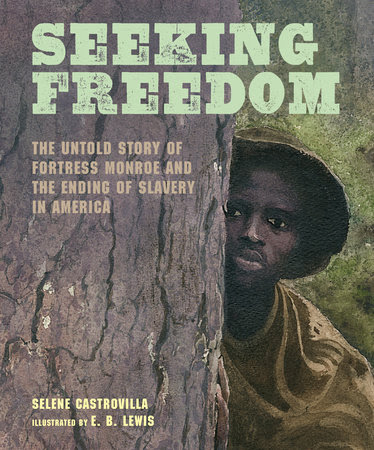
SEEKING FREEDOM: The Untold Story of Fortress Monroe and the Ending of Slavery in America- A Nonfiction Picture Book Review and Giveaway

I'm starting off the new year by joining a blog tour for a new book by award-winning Selene Castrovilla, SEEKING FREEDOM (Calkins Creek, 2022). The expressive watercolor illustrations are by award-winning artistrator, E.B. Lewis.


REVIEW

Although most of this informational picture book for 7-10 year-olds is presented in a journal format, the book opens with a quote from President Abraham Lincoln's First Inaugural Address on March 6, 1981:

I have no purpose, directly or indirectly, to interfere with the institution of slavery in the States where it exists. I believe I have no lawful right to do so, and I have no inclination to do so.

The next page explains how Lincoln was unable to convince the remaining Southern states (seven had already left the United States) to stay. War broke out on April 2, 1861. Five days later, Virginia abandoned the country. Fearful of being separated from their families and forced into hard labor, "The enslaved people...would do anything to be free."

Thus, this true story opens.


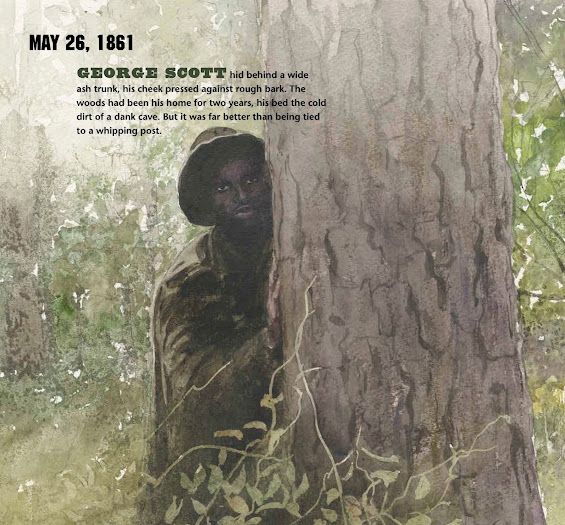
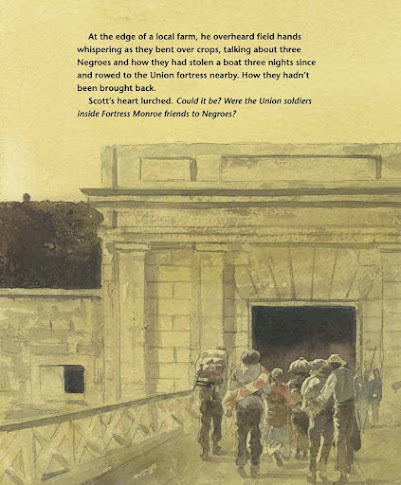
Scott knew the forest and swamps--but he didn't know what was going on the town of Hampton. He overheard field hands talking about how three Negroes had escaped to a Union fortress nearby--and hadn't been returned. Could it be? Were the Union soldiers inside Fortress Monroe friends to Negroes?


Scott watched as eight Negroes headed inside. He waited. But they didn't come out. Was it true? Were these people now among friends?

Despite his fears, he snuck in with another group of Negroes and waited for an interview with the commander of Fortress Monroe--Major General Benjamin Franklin Butler. 

https://www.nps.gov/fomr/learn/historyculture/index.htm

By the time Scott spoke with Butler, the major was frustrated. He had interviewed many Negros but hadn't obtained the information he needed: Where were the Confederates stationed?  The major was also in a difficult position. He was holding every Negro who came to him as contraband of war--"property used for warlike purposes against the government of the United States." 


Library of Congress Prints and Photographs Division Washington, D.C. 20540 USA http://hdl.loc.gov/loc.pnp/pp.print
"A Group of Contrabands"
James Gibson, photographer
When Major Butler spoke with George Scott he realized he'd found the man he was looking for--someone who could track down the Confederates. Even after finding out that his plan to use Negros as spies was approved, Butler was still worried. Could the fortress remain secure against enemy attack? He prayed for Scott's safety.

George Scott wandered for eight days looking for the Confederates. He prayed that the Lord would lead him. Just then, he saw thousands of Confederate soldiers outside a church. His prayers had been answered. 

Scott raced back to the fort with the news he had gleaned--the rebels were preparing to cut off all supplies.


Butler's men had not died in vain. The confederates had fled; the threat to the fortress was over. But how could Butler reward Scott? When Scott asked for freedom, Butler put his legal skills to work.

 Butler implored the President and Congress: 

These human beings must be given the free enjoyment of life, liberty, and the pursuit of happiness.


BACK MATTER

Seeking Freedom includes eight pages of back matter; that's an exceptional amount of pages! But the sections on the Aftermath (including references to the Confiscation Act of 1862 and the Emancipation Proclamation), the Contrabands, Benjamin Butler's Legacy, George Scott, and Fort Monroe in Hampton, Virginia, add a depth of information to this informational picture book that will be appreciated by older students as well as adults. By the way, the last spread is a picture of President Obama signing a proclamation establishing the Fort Monroe National Monument. 

Interestingly, there are no known images of George Scott. William Headly shared Scott's story. He escaped enslavement and became a contraband in North Carolina. His cloak is an old cotton bag. 

https://www.loc.gov/item/2010647919/

For a view behind the scenes of how Selene came to write this story, see her post on Nerdy Book Club.  

Here's a YouTube video of Selene talking to her editor, Carolyn Yoder, about writing picture books which bring alive history.


GIVEAWAY

To enter this giveaway, please leave me a comment by 6PM on January 8th. U.S. postal addresses only. If you decide to follow my blog I'll put your name in for a second chance.Please include your name and email address if you are new to my blog. If you are hesitant to leave your email address, you can reach me directly by clicking here. 

Congratulations to Gail Cartee who won The Dirt Book from last week's blog.

Monday, September 10, 2018

She Started it All- A Review and Giveaway

Some of you may remember my review of Sandra Warren's book, We Bought a WWII Bomber: The Untold Story of a Michigan High School, a B-17 Bomber and The Blue Ridge Parkway. After she wrote and published it, I challenged her to use her research to write an historical novel. She knew the story inside and out--so she had half the work done!

She took my challenge seriously and the result is her first foray into middle grade historical fiction, SHE STARTED IT ALL


REVIEW

Told in two points of view, SHE STARTED IT ALL brings the story of the "forgotten" bomber- a plane purchased with money raised by Michigan students during WWII--into Joe Gerrard and Sandi Howard's eighth grade classroom. 

Of course, when the two students receive their history assignments they don't know what lies in wait for them. All they know is that they receive topics they don't like. Sandi wants to cover the music of the time period and instead is asked to report on WWII aircraft; Joe wants to do a project on the bombers he's passionate about, but instead he's required to research United States War Bonds and War Loan Stamps. Their teacher, Mrs. Bradley, says, "As you work through your projects, maybe you'll discover something that will make history itself." A statement that proves to be true in unexpected ways.

If you add to this set-up the fact that Sandi is a shy "Brainiac" with a secret crush on Joe and that he is the popular jock at school--then you have a recipe for conflict. In fact, their constant misperceptions of each other and the cliff-hanger endings to each chapter make the book a page-turner. 

The author does a good job of including historical facts so that the reader learns about WWII without feeling overwhelmed with information. The contemporary setting of a modern middle school and authentic language also makes the book accessible to today's readers. 

I'm a huge fan of using facts in fiction (including real people when possible) as well as inter-generational stories. Both of these are present in this novel. Both Sandi and Joe receive help from elderly primary sources which adds further authenticity to the story.

As for the ending? Well, let's just say it's perfect.

GIVEAWAY

If you'd like to receive a personally autographed copy of SHE STARTED IT ALL, please enter my giveaway! Leave me a comment by September 13 along with your email address if you are new to my blog. Share this on social media (and tell me what you did) and I'll enter your name twice!


Monday, February 20, 2017

Loving vs. Virginia: A Review and Autographed ARC Giveaway!

Congratulations to Connie Saunders for winning AUDACITY JONES STEALS THE SHOW.

Loving vs. Virginia (Chronicle Books, February 2017)  by Patricia Hruby Powell is more than just a book about the interracial couple who challenged Virginia's anti-miscegenation law. It is a documentary novel, which combines free verse, black and white illustrations by Shadra Strickland in the Visual Journalism style, period photographs, and copies of civil rights documents. The net result is a book which will teach middle and high school students about the black struggle for equal rights. 


As I often do when reviewing free verse novels, here are excerpts from some poems that show Mildred and Richard's love and struggles. These quotes speak for themselves; Powell's poignant verse intimately connects the characters with the reader.

MILDRED
(this is in the middle of a poem about a community gathering at Mildred's house. Fall 1952)

One of the fathers calls
a square dance
and everyone joins in.
Otha dances
Mama dances
Lewis dances
I surely dance.
Some of the big boys dance.
Mr. and Mrs. Loving--
eyes fastened on each other
even when they've been passed
to the next person--
their names are
Twilley and Lola.
I love their names. 
But we call them
Mr. and Mrs. Loving
of course.
And they pretty much are.

If I stop and watch
I see young and old--
Indians, Negroes, Whites--
all mixed together. 
Everyone likes each other 
in our neighborhood.
Everyone dancing
TOGETHER.

Whites and coloreds--
we go to different schools--
to different churches,
drink from different water fountains.
But our section is different.

My world is right here
in Central Point.
That's what it's called.
Central Point,
the center
of my universe.
My family.
My world. (p. 27-28)


RICHARD
(In this poem Richard hitches a ride from his black friend, Ray. The local sheriff pulls them over. Fall 1952)

Me, I'm white, but my daddy,
he drives a truck for P.E. Boyd Byrd--
maybe the richest roundest jolliest "colored" farmer in the section.
In other parts, a white man working for a colored man--
that would be unusual.
But that's how it is here in Central Point.

Sheriff don't like this one lousy bit.
White man puts hisself beneath a colored man?
Workin' for him?
Worse than being colored, right, Sheriff?
'Course I didn't say that.
Just thinkin'.

Sheriff looked like he was chewin' on his teeth,
kept turnin' over that itty-bitty license,
trying to figure out what mean thing he could to us.
We wait quiet
while he walked back to his car.

To Sheriff Brooks there are only two races--
white and colored.
In all of Virginia, just two races--
white and colored.

We know Sheriff ain't done with us,
but he let us of for now. (p. 31-32)

MILDRED
(This poem touched me since Mildred reflects on the two of them being seen in public together. She alludes to how some folks have passed and left their community. This theme is echoed in Half-Truths. July, 1956)

Richard once said,
      "It could be worse, Bean.
       If you was the white one
       and I was the colored one,
       people saw us together?
       They'd lynch me.
       We can do this."

I'm not really dark--
'bout the color of a grocery sack--
and I have good hair,
but I surely
couldn't
pass.
There are plenty of people
from our section,
who are mixed like I am--
and one day,
when they're grown,
they leave home
and never ever
come back.
And we know they
passed
into white society--
away from 
where everyone knows you,
where everyone truly
cares about you.
I feel sorry for them
who pass-
and don't come
home. (p. 82-3)

MILDRED
(after Mildred is denied access to a dance. October, 1956)

The moment they said,
No, you can't go in,
he saw--
I know he really saw--
what it is 
to be colored.
...............
His face folds up
He steps out of the car.
I wail.
He's gone what feels like
forever
in the dark.

I'm in the car whimpering.

He comes back.

Drives me home. (p. 93-94)

RICHARD
(This is after Mildred gets pregnant with their second child. May, 1958)

Ray said, You can't marry a colored girl. Not in Virginia. 
     "You're white, Man. Did you forget that?

I told him, "We'll do the marrying in D.C.

He said, "For godsakes, Man, live next door to her,
        if you have to be big about it.
        Look at Farmer.

In our section
white man named Farmer
set up his colored woman in a little house
and he lived next door.
They have a mess of kids.
Everyone knows, but no one says.
All his kids take her name and when they grow up, they
leave--
pass as white people.
Somewhere.
Away from here.

Farmer didn't want to rock the boat.

Millie deserves better.
I called Ray a pig. I called him worse than that. 
.......
Ray said, You are dreamin'. You been rockin' Sheriff's
      racial hatred
      a long time--
      pretending all y'all ain't no different,
      everyone the same.
      Race mixing?
      That ain't gonna slide in Caroline County. (p. 113-114)

MILDRED
(After their second child is born, October 1958)

I stand before Justice of the Peace
Edward Stehl III
in the Bowling Green courthouse.
I am told I acted
"unlawfully and feloniously"
by marrying a white man.
Our lawyer, Mr. Beazley,
advises me to plead
NOT GUILTY,
just like Richard did
at his hearing in July.

And then I go home
to my baby
and little Sidney.
You'd think that 
they'd want 
us to be married,
what with a child and all.

But it's our beautiful brown baby
that is the problem.
This perfect baby is the result
of race mixing.
This child is the very reason
they don't want us married. (p. 147-148)

RICHARD
(After Mildred wrote to Bobby Kennedy and the ACLU, Mr. Cohen, a lawyer called them. September, 1963)

We went to the lawyer's little office--
nothin' fancy--
and talk and talk and talk.
He said something like,
      I think we can win, but it will be a long process.

     More than a month? Why?
     We just want to live as husband endwise in Virginia.
What is so difficult about that?

Mildred put her hand on my wrist.

Then he said,
      If you were to go back to Virginia together--
     get rearrested-
     that might be a good way
     to get this back in the courts.

This guy is complete nuts.
Mildred grabbed hold of my hand
real tight--
like she thought I'd get up and walk out. (p.188)

********

Nine years after Mildred and Richard were married, in the famous Loving vs. Virginia case, Chief Justice Warren and the eight associate justices ruled unanimously that marriage between members of different races was not unconstitutional, thus ending all race-based legal restrictions on marriage.

Mildred and Richard went home.


Illustration by Shadra Strickland


        ********
I have an autographed ARC to give to one fortunate reader. If you are new to my blog, share this on social media, or are a teacher/home school educator and plan to use this in your classroom, please let me know and I'll put your name in twice. Giveaway ends February 24th. 


Please see this interview with Powell that provides some of the backstory for this book; and an interview with Strickland with glimpses into her studio and this book.

THE NIGHT WAR: A MG Historical Novel Review

  By now you should have received an email from my new website about my review of THE NIGHT WAR by Kimberly Brubaker Bradley. (It'll com...