Showing posts with label historical fiction. Show all posts

Saturday, January 20, 2024

A Benefit to Blogging and How a Book is Born

Last week my friend and fellow NC blogger, Joan Edwards, interviewed me on her blog. She asked questions about writing Half-Truths including how my blog has helped me develop my writing skills. This is what told her:

My blog has helped me in two ways. I read and reviewed lots of mentor texts. Each review has taught me to analyze what makes a novel stand out. I also was able to journal my progress with Half-Truths including reviewing books about the Black experience. The books were crucial to making Half-Truths authentic and the online journal helped me answer your questions!

Yesterday as I was working on my next book, Unbroken Heat (working title) I thought how keeping track of my progress with Half-Truths was helpful to me as well as to anyone who wanted to know the book's backstory. So, here I am with this week's blog post, to tell you about Unbroken and my love for glass.

Over 25 years ago I walked into a glass bead shop and I was hooked. I couldn't believe the intricate, gorgeous beads were glass! I told the owner I wanted to write about her and she replied, "Don't write about me. I'm going to introduce you to people who are bigger than me--you're going to meet some North Carolina glass artists."

As a result of her introductions, I watched hot, molten glass transform into works of art and wrote several articles. I won two awards from Highlights Magazine for my article, "Paul Stankard's Paperweight Magic;" and signed a contract for Discover Glass about the history, art, and science of glass. I thought I was set to become the expert on glass for kids. But the publisher went belly-up and I was left with boxes full of drafts, research notes, and photographs. 

Soon after that, I started Half-Truths. I promised myself that any book I wrote going forward would include glass. I couldn't waste all my research! So, when I created my protagonist's backstory,  her grandfather's (Andrew Dinsmore) history included working in a glass factory when he was a boy.

Meanwhile, somewhere along the line, I purchased KIDS AT WORK: LEWIS HINE AND THE CRUSADE AGAINST CHILD LABOR.

Pictures like these caught my attention:

https://www.loc.gov/resource/nclc.01154/

https://www.loc.gov/item/2018676573/

https://commons.wikimedia.org/wiki/File:Lewis_Hine,_Glass_works,_midnight,_Indiana,_1908.jpg

Who were these boys? How did they end up working in glass factories as young as 10 years old? What were their stories? Those images and questions stuck with me. 

I started researching. I thought I wanted to write about child labor in the glass industry, but as Harold Underdown reminded me when I began Half-Truths, that was only the setting. That wasn't the story itself. 

I started studying a book that Paul Stankard gave me years ago, 


and I watched YouTube videos that Wheaton Arts produced. 

I knew this was Andrew Dinsmore's story and that he had to go to work as a young teen--but I didn't know much else. Slowly, Andrew's life in a New Jersey glass factory in 1893 is getting fleshed out. I'm discovering what he wants and who or what will keep him from his goals. 

As I read about New Jersey's glass industry, I realized that besides the failed attempt at producing glassware in Jamestown, Va., the first successful glass factories were in colonial New Jersey.  Suddenly I had another story besides Andrew's--I had the story of a young indentured servant from England who landed in Philadelphia and must work off his debt in a glass factory in South Jersey. 

I had just finished reading The Blackbird Girls and was intrigued by Anne Blankman's use of two different timelines and multiple points of view. Could I do that with Unbroken? If so, what was the other timeline and how could I connect the two stories? Here's the pitch I came up with:

At the turn of the 20th century, a young factory worker is surrounded by deafening noise, blisteringly hot glass, and mind-numbing exhaustion. There is no end in sight until he finds mysterious notes from a boy who lived this life 100 years earlier.  

And now, I can begin a new page on my blog. And when Joan Edwards interviews me about Out of the Flame--I'll know exactly how it all began. 

                                                    ****

Please go to Greg Pattridge's Marvelous Middle Grade Monday blog for more middle-grade book reviews and news.


Thursday, December 7, 2023

THE DOUBLE CROSSING by Sylvia Patience: A Middle Grade Historical Fiction Review, Author Interview, & Giveaway

 Sylvia Patience, the author of The Double Crossing (Paper Angel Press, 2023), reached out to me with a request to review her historical middle-grade book. She suspected that it was a book that would interest me and she was right.


REVIEW


I first learned about the ocean liner, the St. Louis in Barbara Krasner's picture book, Liesl's Ocean Rescue. One of Alan Gratz's characters in Refugee was a boy on board the luxury ocean liner. This novel is a unique in-depth story of the ocean crossing told from alternating points of view of thirteen-year-olds, Hannah Coen and David Jantzen. Like the other books, it takes place in 1939 and the 937 passengers are escaping Nazi Germany in hopes of finding a safe haven in Cuba. 

Quickly the reader learns that Hannah's father was arrested during Kristallnacht and sent to a concentration camp. Her mother promises to join her as soon as possible but Hannah is distraught over leaving her. She meets David who is traveling with his family. David's father is Jewish and his mother is Aryan.  Although their backgrounds and personalities are different, Hannah and David bond over bird watching.  

Early in the book, there are hints of problems to come. David's father hears a rumor that there might be problems landing in Cuba. Leo, a friend who is a steward for the pro-Jewish Captain Schroeder, tells them that the Nazi propagandists have been trying to get Cubans to change their minds about admitting the Jews. Hannah worries about why they would get sent back; if Hitler is starting a war, and if she'll ever see her parents again.

Hannah and David overhear conversations among the Nazis on board. Specifically, they learn of Gestapo official Otto Schiendick's plan to gather secret documents from Robert Hoffman. Although both kids are nervous about what to do with the information, Hannah is determined to stop Schiendick from carrying out his plan--no matter how dangerous that is. It is at this point in the story, that their different perspectives become very interesting. Hannah concludes that they must do something; David thinks they have no options. The following is from Hannah's POV.

As we descended the stairway from the bridge deck, David whispered, "See? If even Captain Schroeder can't do anything, what can we do?"

"If the captain can't do anything we have to. Whatever he says. Even if we get in trouble. Because we know about it. And it's wrong. It could mean war!"

And from David's POV: 

Since our talk with the captain and my argument with Hannah, I'd been going around and around in my head. If you know something is wrong, do you have to try to stop it? Even if you don't have much of a chance? Even if it's dangerous? And even if the grown-ups in charge tell you not to?

Together, they face the disappointment of not landing in Cuba and the hardships on the return voyage. Although separated once they return to Europe, the ending suggests that are reunited. It's a sweet conclusion that leaves the reader wanting to know more.

                                                ****                                 

I enjoyed the role that birds played in the book. In the beginning, Hannah and David rescue an injured petrel. They hide him in a lifeboat whey they push small bits of food down his throat. When Leo asks what it was like to be Jewish in Germany she answers, "Kind of like what's happening to Peter," she said. "He's trapped and can't get out. He probably feels scared and helpless."  After the ship is prohibited from landing in Cuba David observes, "Like the birds flying over the ocean, rumors flew on board." 

Even if you have read other accounts of the St. Louis, you will find this touching, suspenseful story a worthwhile read. 


MINI-INTERVIEW

Carol: What was the inspiration for this story?

Sylvia: I first saw an article in a news publication that talked about the St. Louis' 1939 voyage. It caught my interest. I'd never heard about it. This was probably around eight years ago. I immediately thought it would make an interesting story to write, started doing research, and read some other books about it and the time period in Germany. The story grew in my mind.  

Carol: What was your path to publication?

Sylvia: As far as publication, as you probably know it's very difficult to find an agent these days, let alone a publisher. I sent out a lot of queries. I was very lucky to hear of Paper Angel Press, as they had published works of another local author. They are an independent publisher and have done an excellent job with the book, and my other book, The Weaver's Daughter

BACK MATTER


I appreciate how Sylvia pulled together so many facts when she wrote The Double Crossing. As soon as I finished it, I read her Author's Note and Glossary. The Author's Note provided all the factual information about the important secondary characters who were real people. I hope you'll take the time to look at the links I provided in this review; you'll see how Sylvia's impeccable research was woven into this fictional story. It almost goes without saying that this would be a great curriculum resource when studying WWII. 

GIVEAWAY 


I'm giving away my copy to one fortunate reader. Please leave a comment by December 13 along with your email address if you are new to my blog. I'll do my best to get it into the mail ASAP so you can give it to your favorite middle-grade reader or add it to your library's shelves. Share this on social media or sign up for my blog and you'll get an extra chance. As usual, if you are a teacher, home-school educator, or librarian, you'll get an extra chance. If you prefer, email me to enter. U.S. addresses only. 

                                                    ***

Congratulations to one of my teen bloggers, Janelle Epko, who won the Ebook of A Study in Terminal. 

Friday, November 10, 2023

ZORA & ME: THE CURSED GROUND by T.R.Simon: A Middle Grade Book Review

I don't know how I missed Zora & Me: The Cursed Ground by T.R. Simon when I was reading books in order to inform Half-Truths, but I did. Fortunately, it's never too late to find a great read! 


Anyone who is familiar with Zora Neale Hurston (1891-1960) will know that she was a renowned storyteller who portrayed racial struggles in the early 1900s. If you google Zora Hurston + children's book, you'll find several story books that she wrote, some picture books by contemporary authors, and a few biographies.  But I didn't find anything close to this captivating fictionalized account of Zora's childhood adventures with her best friend Carrie--the book's narrator. This is a book that Ms. Hurston would be proud of. The dual timelines of Eatonville, Florida 1903 and Westin, Florida, 1855 are captured beautifully and then come together perfectly at the end.

Here is the publisher's summary:

When Zora Neale Hurston and her best friend, Carrie Brown, discover that the town mute can speak after all, they think they’ve uncovered a big secret. But Mr. Polk’s silence is just one piece of a larger puzzle that stretches back half a century to the tragic story of an enslaved girl named Lucia. As Zora’s curiosity leads a reluctant Carrie deeper into the mystery, the story unfolds through alternating narratives. Lucia’s struggle for freedom resonates through the years, threatening the future of America’s first incorporated black township - the hometown of author Zora Neale Hurston (1891-1960). In a riveting coming-of-age tale, award-winning author T. R. Simon champions the strength of a people to stand up for justice.  

I'm going to quote some favorite passages. Although I'm quoting them without any context, I believe you will experience the depth of this story, the evocative sensory writing, and the book's profound meaning for today's readers.

"I do not think a slave who has seen the power of the whip can truly sorrow for someone who owns people, no matter how benevolently he owns them. If there is a kindness that can soften the blow of stolen freedom, I have not seen it." (p. 70)

"Beyond the split-rail fence, Mr. Polk's property turned wild; a forest of tall pines, dense thicket, uncut cane, and rebellious scrub led you into deep shade. Daylight was there, but tall trees had conspired to shrink the sun's power, and the density of the dark was palpable." (p. 78.)

"I shivered. It felt funny standing here on Mr. Polk's land, looking at this hull of a house. Everything about it raised questions, and I wondered if not speaking at all was the only way Mr. Polk could keep so much to himself." (p. 84)

"As long as there are slaves, the free benefit. If it were not for slavery, we would all be merely human. It's our slavery that makes you free."  (p.113)

"These white folks pay for what they do. They just don't know it. They pay with a little bit of their soul every time they put their boot on us. Ain't no man nor woman can bring another soul low without losing they own soul. They might not think they lost, but they are." (p. 126)

I had thought Zora was looking to solve a puzzle for the past two days. What she had really been doing was piecing together a quilt, made from the fleeting scraps of the said and the unsaid. She was starting to unfold and show us a whole cloth of Eatonville's history. (p. 174)

My throat burned and my eyes stung. Our lives mattered just as much as theirs, but the truth of that had been erased by slavery. Slavery itself might be over, but neither the Thirteenth Amendment nor anything that had happened since could make us human in the eyes of these men. That was why our parents had fought so hard to create and sustain a corner of the world where we determined our own value. (p.232)

"Why do they hate us so much?"

Old Lady Bronson reached down and took my chin in her hand, firmly yet gently. "They have to hate because you can't take another person's freedom with love."

It was a simple answer, yet contained a universe of truth. (p.248)

                                                  ***

I've given you some of the bones of this book; I hope you read and discover the entire story. This would be an excellent resource for students who are studying the aftermath of the Civil War.


VIDEOS

For T.R. Simon's thoughts on writing this book, watch this video.


For some background information about T.R. and her co-author, Victoria Bond, watch this short video.

                                                                            ***

Congratulations to Kathy O'Neill who won A MEMORY QUILT by Lori Keating.

On Monday, Greg Pattridge will feature this book and other great middle-grade books on his MMGM blog. Check it out!


Sunday, June 18, 2023

A SKY FULL OF SONG: A Guest Review by Mara and Sophia Scudder PLUS a Giveaway


REVIEW

My cousin, Mara, and I read A Sky Full of Song, by Susan Lynn Meyer, and we both found numerous flaws with both the story and the main character, Shoshanna, a young Jewish pioneer. We didn’t find her to be relatable or likable. The book drowned its own message with too many woke topics like extreme bullying, the injustice of periods, sexism in the family, and mistreated immigrants, none of which were resolved. And, most importantly, there wasn’t any real hope offered, which left both the readers and the protagonist feeling defeated.

Although the author included beautiful descriptions of the North Dakota land surrounding Shoshanna’s home and the title implied that the beauty of midwestern America would become a comfort and resolution to the numerous conflicts the book attempted to juggle, it ultimately resolved none of the conflicts within the work. While the protagonist was upset about how unfair periods are, how her mother never favors her, how hard it is to have a different religion than anyone else, how mean the bullies at school are, how much she misses her home country, how hard it is to live in America, how unfair the government was to the Native American tribe that used to live in their area, and how her brother teases her, the author only resolved the issues between her and her brother. She explained that Shoshanna had merely forgotten how they used to tease each other, and after remembering that he meant no harm when he teased her, she teased him back. After reading this apt resolution, we were hopeful that the other conflicts would be resolved, as well. 

Unfortunately, they were not. Instead, the book ends with the protagonist Shoshanna still wondering whether or not she should offer forgiveness to the bully who apologized for mistreating her. Although she decides not to hide her culture and beliefs from her friends, she mainly does this to appease her sister, Libke, and to smooth over the division between them. Meanwhile, her frustration with the partiality her mother supposedly shows to her brother, the anger she feels on behalf of the Lakota people, her discontent with both her old and new home, and her outrage at discovering that only girls have periods, remain unaddressed. The author drops these issues halfway through the book.

Life was hard, and only going to get harder.

Pioneering at that time and place was very difficult, especially for immigrants who would struggle to cross both cultural and linguistic barriers to set up a permanent home in the West. It is important that we tell stories about individuals growing up in unusually hard settings (as this story did). But the reader was never offered the resolution that hope brings. Not only is this unsatisfying, but it is also inaccurate. The pioneer spirit was a very real, powerful thing that transformed the mostly empty wilderness of midwestern America into a prosperous land. Immigrants were especially poignant displays of such spirit and determination. The depressed spirit of Shoshanna, who consistently complains about the difficulties of her old home while also mourning the challenges she faces in America, is in sharp contrast to the unbeatable optimism of those in her generation. 

Laura Ingalls, for instance, survived three years of locusts destroying her family’s only income, a difficult winter that starved her village for seven months, and being consistently bullied in her school while keeping a pioneer spirit stronger than ever. 

Another example would be the fictional story of Lyddie, who was sold off as a servant to pay her family’s debts. She dreamed of a day when the farm would be paid for, her father would return, and the family could work the farm together. Instead, her family fell apart, her closest friends fell ill, and she lost the only people she could depend on. Yet her final words are filled with hope that she would determine her own destiny and never fear anyone. She would finally be independent, even if it meant letting go of the dreams that she knew now would never come to be. 

Western Americans, immigrant or not, were highly adaptable and strong because of it, and the author showed none of this in either her protagonist or the other characters. Instead, it seemed as though it was Shoshanna’s right to complain about the injustices around her and her injured spirit was never addressed as a flaw. Rather, it was referred to as an inevitable result of the difficulties she faced, rather than a hurdle she had to overcome to achieve happiness.

    Overall, Shoshanna came off as whiny and unrelatable, giving the reader no reason to stick around for the rest of the story. She complained about the myriad of problems in her life but never got around to actually fixing them. And the one quality that could possibly redeem this book, the themes of hope, love, and a hard-working spirit, was missing too. We need children's stories that remind future generations of the strength, hope, and determination that built this country. Unfortunately, A Sky Full of Song is not one of them.

GIVEAWAY

Please leave a comment by June 22 if you are interested in receiving this book. U.S. addresses only. Keep in mind that your comment might not show up immediately; I need to approve it first.

THE REVIEWERS


Hi! My name is Mara, and I’m a Christian artist, violinist, and blogger. I love acting (especially musical theater) and I am the co-founder of a small stage productions group at my church. I’m an adventurous entrepreneur and a fierce negotiator who loves debates. But most of all, I love good stories.

I remember the day that I decided that I would learn something new about what makes a good story from every book I picked up — whether it was good, bad, or a mixture of both. I use my blog as a way of sharing some of the tips and tricks I’ve learned and highlighting which books, cartoons, and movies have taught me the most about writing an awesome story, even if they didn’t do it especially well themselves.


Hello, I’m Sophia! I’m a child of God and I love to write! I’m also a total theater kid and a strong dessert (specifically cupcake) enthusiast. For as long as I can remember, I’ve enjoyed both reading and making my own stories. I’m so glad I get to share with you what I’ve learned from some of my favorite (or sometimes least favorite) stories on my blog. I live in Philadelphia and am in ninth grade.

                                                                        ****

Make sure you check out Greg Pattridge's MMGM blog with other middle-grade reviews.


Saturday, March 11, 2023

What's Next?

 Six weeks ago, I shared my excitement that HALF-TRUTHS was finally on submission. At that point, the answer to the question, "What's Next?" was to query agents and editors. For those of you who are writers, you know that process can take a long time. Agents and editors are backed up and although I've sent the full manuscript in response to a few requests, it can still be months before I hear back from anyone.

Meanwhile, the best antidote to obsessively checking my email is to get busy with a new project. Without further ado, I want to introduce you to my next WIP (Work in Progress) a middle-grade graphic novel that I've tentatively titled ESCAPE FROM NURENBERG. The story is based loosely on my father's and grandfather's experiences in Germany from 1935 to 1938.

When my parents died, I became the keeper of their papers. These included an assortment of documents and photographs. There were several versions of my father's autobiography, personal letters, my grandfather's report cards from medical school in the early part of the 20th century (that a friend translated), and a speech he gave to doctors in Ohio after he immigrated to the United States. 

My father, Henry Federlin, is on the left. He is standing with
 his mother Elsie and his father Sigmund.
Circa 1945
As I looked through these precious documents and pictures I wondered if there was a story that I could write. I usually answered that question with "no" because there are already so many Holocaust stories for kids. But there was one unique event in my grandfather's life that occurred before he left Germany. It wasn't a story by itself. But maybe it was the ending. And when I thought about my father's account of how he was bullied in the public school I thought--that could be the beginning. 

All I needed was the middle.

I made a note to myself in my phone:

  • Learn how to use Scrivener for writing a script.
  • Learn how to write a graphic novel.
  • Learn what was happening in Germany during this time period.
  • Come up with a story arc. 

In the last six weeks, I've done all four.

SCRIVENER

Based on what I read online, Scrivener's scriptwriting program was ideal for writing a graphic novel. The only problem was that I had no idea how to write a script! Fortunately, I found a ton of images and tutorials online and within the Scrivener software itself. Since I learn better by trying my hand at something rather than reading about it, I jumped in and created a project. Like all software there's a learning curve, but I'm getting there. I love keeping track of my research, the story, and images all in one project--with the ability to simultaneously work in two documents:


WHY A GRAPHIC NOVEL?

I spent 16 years writing HALF-TRUTHS and I wanted a break from that form of storytelling. I also asked the KidLit 411 Facebook group how to tell if an idea was better suited for a "regular" novel or for a graphic novel. I tagged Kirsten W. Larson and she responded, "I would think about the visual possibilities for your story. Like picture books, graphic novels are visually driven. You have to ask yourself the same questions about whether you have scenes that are visually interesting and distinct from each other." Since I was already picturing the action in many of the scenes, I thought I was on the right track. 

This blog post describes the process that I stumbled into. A graphic novelist imagines each panel as the reader will encounter it.  Kirsten Larson told me that the process of "paneling" takes time. I believe it. Imagining what will be shown on a page of panels can easily take hours of research. 

I'm also studying graphic novels and seeing how the author employs transitions, and shows dialogue, captions, and narrative information. As I did with HALF-TRUTHS, I'll be reviewing some of these books here

LEARN ABOUT GERMANY

I'm a hands-on learner. Whereas some novelists may choose to research and then write, I prefer to jump in, learn, save new information, and incorporate it into my WIP.

Although my parents were both born in Germany and had family who died in the Holocaust, by the time my brother and sister were born in 1950, my parents were ready to put those events in the past. I came along three years later and my parents rarely talked to any of us about their childhood growing up in Germany. My best friend's mother had a tattoo on her arm from being in a concentration camp--but we never talked about it. I knew the names of the cities where my parents grew up, but it wasn't until I was an adult, that my father started sharing some of his experiences before leaving Nuremberg

Fortunately for my siblings and I, my father composed several short, type-written autobiographies. My mother's memory wasn't as good as my father's, but I interviewed her a few times and have some glimpses of her life as a child in Speyer.

I'm embarrassed to admit it, but I knew only a thimbleful of information about the Holocaust. I am rapidly rectifying that situation through books and amazing websites like the United States Holocaust Museum with information such as this about children. When I enter various museum websites it's like diving into a deep hole. I go from link to link and come back to Scrivener having forgotten what I was looking for. 

When my dad told me he grew up in Nuremberg, I didn't realize how Hitler used that centrally-located city as his propaganda launching pad. Not only did it have a huge park that Hitler transformed into his political Rally grounds, his antisemitic follower Julius Streicher, published the virulent Der Stürmer newspaper there. 

This is what my father had to say about Striecher:

"My public elementary school was right across the street from an anti-Semitic weekly newspaper, Der Stürmer published by one of Hitler's favorite cronies, Julius Streicher, Nazi boss of Franconia, a noted pervert and one of the most unsavory characters in the Third Reich."

As I pictured my father attending school across the street from a widely-read tool of Nazi propaganda--my story became more real. 

A group of young German boys view Der Stürmer, Die Woche, and other propaganda posters that are posted on a fence in Berlin.
A group of young German boys view Der Stürmer, Die Woche, and other propaganda posters that are posted on a fence in Berlin. ——US Holocaust Memorial Museum, courtesy of Julien Bryan Archive

THE STORY

I had story nuggets for the beginning and the end but I didn't know what was going to happen from Point A to Point Z.  My unofficial "research assistant," my sister Barbara Federlin, and I brainstormed possibilities.  The more I read, researched, and imagined what my father's and grandparents' lives were in Nuremberg, the more a story began to take shape.


Fifteen years ago I toured Nuremberg with
my oldest daughter, Lisa, and my husband.
We visited the medieval city and saw the street
where my father grew up. These images help construct my story too.

WHAT'S NEXT?

Kirsten W. Larson is mentoring me as I plunge into the graphic novel world. I took a webinar with her last year which convinced me that the Kidlit publishing world is wide open to this genre. She encouraged me to create a synopsis using this template. You can use it at any step of your writing process. Filling it out even if your WIP is not a graphic novel and even if it might change, will help you imagine your entire story arc.

Thanks for joining me on my next writing journey. I'll be sure to let you know what happens next. 

                                                ****

GIVEAWAY NEWS

Congratulations to Becky Scharnhorst who won THREE CANADIAN PIGS and to Marci Whitehurst who won GOOD MORNING, SUNSHINE. Thanks to everyone who entered. Stay tuned for more contests--I have a stack of books to review and give away!


Saturday, March 19, 2022

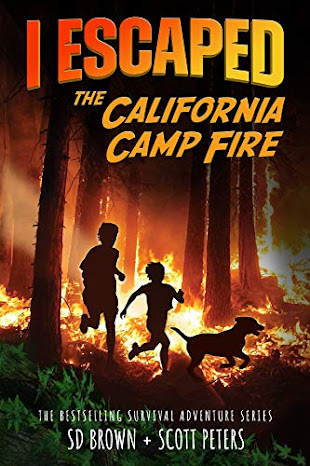
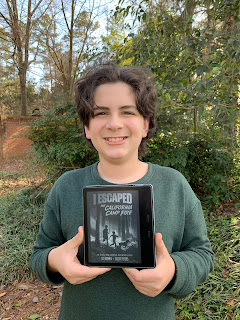
I ESCAPED THE CALIFORNIA CAMP FIRE: A Middle Grade Review by Guest Blogger, Blake Kurta


         I Escaped the California Camp Fire, by Scott Peters and S.D. Brown, is historical fiction, part of the I Escaped Series that is aimed towards 8–13 year-old readers. However, with its clever descriptions, relatable characters, and pop culture references, it can easily appeal to all ages. For instance, on page 8, the book mentions a character “doing her version of Vanna White and sweeping her hand across the spotless kitchen.” 

            I Escaped the California Camp Fire is a captivating book that draws you in right from the start. I was so engrossed that I had a hard time putting it down. In the opening scene, the protagonists are left at home alone because their parents are on a trip for twenty-four hours. While their parents are away, chaos breaks out. The siblings, Emma and Troy, are racing against a monstrous fire. Amidst all of this frenzied excitement, an electrical black-out takes place making it harder for them to escape. 

            The vivid descriptions made the dangers seem life-like and had me clinging to the edge of my seat, rooting for Emma and Troy to make it out alive. For instance, on page 2 the fire is described as accelerating at a rate fast enough to consume “the equivalent of a football field every second.” Further along, the author writes, “It felt like an oven cranked up to broil.” Later, Troy states, “Look at the hill, flames are spilling down it.” This gave me terrifying visual images while creating a phenomenal picture in my mind. I could practically feel the scorching heat right through the pages. And finally, when I read, “The flames hit the ravine and it looked like a movie filmed in Hades” it made me realize how dangerous the California campfire really was.

            Troy and Emma were in a couple of tricky situations, but they fought through the smoke and flames managing to survive. It’s truly remarkable how they were able to live through the sixth most likely devastating fire in the U.S. all by themselves.

This book demonstrates how devastating fires can be and the long-lasting impact on people’s lives and the environment. For example, the California Camp Fire destroyed thousands of buildings, and some people are still financially recovering from the fire. It is estimated that the fire cost people 150 million dollars. 

            For all of the reasons above I would highly recommend this book. Overall, it was thrilling, action-packed and I really enjoyed reading it. While the story itself is fictitious, I learned about a fascinating, albeit scary historical event from reading this book.


Blake Kurta is 12-years-old and lives in Charlotte, NC. He is homeschooled. In his spare time he enjoys constructing 3D Metal Earth rockets, painting, and pickle ball. 

Saturday, February 12, 2022

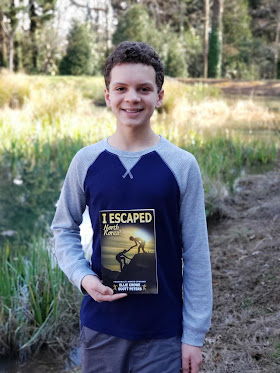
I ESCAPED NORTH KOREA: A Review by Guest Blogger, Elliott Kurta

I'm happy to have Elliott Kurta back for another book review. Since he's enjoying the opportunity to read and review a variety of books, you can look forward to more of his reviews in the future.

REVIEW

            I Escaped North Korea is an informative book about the struggles North Koreans faced during 2007. Dae-hyun, the protagonist, is only fourteen when his father is arrested and his mother journeys to Pyongyang to save her husband. Dae-hyun realizes his mother isn’t coming back, so he tries to survive by stealing coal and food. Soon, Dae-hyun longs to leave his country and journey to China, where there is hot running water and readily available food. He’s offered a job which would pay well and send him to China--at the cost of endangering his life. He accepts the job and is charged with delivering medicine across the frozen Yalu river. Once in China, Dae-hyun finds he doesn’t want to leave, even if he’d be staying as an illegal citizen and an orphan. While looking for other work, Dae-hyun stumbles upon a minister who offers to send him to Mongolia in order to obtain political asylum—thus beginning the journey of  his life and for his life.

            Throughout their first novel together, Ellie Crowe and Scott Peters provide an ideal example of ‘show, don’t tell’. Unlike most middle-school books, information is not presented in a manner that tells readers what they should think. Instead, they will come to their own conclusions about life in North Korea as they read about Dae-hyun going to school and being asked to share a personal failure in a class exercise. However, I Escaped North Korea is not overly graphic, except for two minor expletives in the first twenty pages. While themes such as corrupt governments, violent and cruel police officers, and starving families are present throughout this historical narrative, Dae-hyun also experiences the kindness of strangers. From the kotjebi or orphan Ki-moon who helps Dae-hyun find food and shares his stolen goods to the South Korean minister who brings Dae-hyun on a journey to seek political asylum, Dae-hyun’s journey is spectacular. 

            Seeing North Korea through Dae-hyun’s eyes makes the struggles of citizens in another country personal for the reader. With an average of four pages per chapter, I Escaped North Korea will ensnare reluctant readers from the first page with increasingly high-stakes action.

            Even with all the captivating action present, I Escaped North Korea is still a heartfelt and emotional novel. The brevity of the novel does not take away from its descriptions, like when Dae-hyun describes how his father’s crimes have brought his family ‘low’. Even though most readers will not be able to relate to Dae-hyun as he’s chased across a frozen river, when they read the sentence below they will find themselves running alongside him.


 "With a sickening snap, the ice beneath his feet moved.

            He pictured the water beneath the splitting surface. Black. Cold. Deadly.

            'Dae!' Ki-moon screamed…”

            On top of the facts presented in this book, at the end there is a sheet of additional information and a brief appendix with a study guide and more books to read. After the study guide, there is an afterword that further explains the route to Mongolia and what life is like in North Korea. There’s even a website link at the back of the book that directs to study questions for each chapter and a coloring sheet of North Korea and surrounding countries.

        For 8–12-year-old reluctant readers, this book will serve as a great introduction to the historical fiction genre. The short chapters of this book are both engaging and informative. Be prepared for a barrage of questions after your child, friend, sibling, or students breathlessly finish reading I Escaped North Korea. For another, equally thrilling read, check out the rest of the I Escaped nine-book series, which ranges from surviving the brutal Salem Witch Trials to escaping the ruthless pirates of the Caribbean.   


Elliott is a prolific reader of various genres who is more than happy to share his opinions on books. In his free time, he enjoys writing, reading, and running. He is an 8th grade homeschool student in Charlotte, NC.          

GIVEAWAY

Please leave a comment by 6 PM on February 17 with your email address, or send me an email. If you share this on social media, you will get one extra chance; if you follow my blog you will get another chance. Tell me what you have done and I will enter your name accordingly. U.S. addresses only. 

Congratulations to Tiffany Slack who won Rock and Vole for the Matthews Christian Library and to Rosi Hollenbeck who won Where is My Cow? By the way, Rosi also reviews and gives away lots of children's books!


Friday, February 4, 2022

UNDER THE TANGERINE TREE: Author Interview with Esther Bandy

 Elliott Kurta, who reviewed Under The Tangerine Tree on my last post, decided to follow up with an interview with the author, Esther Bandy. Take it away, Elliott and Esther!

INTERVIEW

ELLIOTT: What inspired you to write Under the Tangerine Tree? Was it a single moment, conversation, or photo, or did it take a larger experience for the ideas in your book to come together? 

ESTHER BRANDY: I began writing Under the Tangerine Tree after my dad died in 2005. I loved my dad, and even though I knew he was in heaven, I still missed him. I’d also met many children who lost their fathers due to death or divorce. I wanted to write a book that would help children deal with their grief and allow me to express my own feelings of missing my dad. In addition, I had a desire to share God’s love and help children understand the gospel. It’s such a blessing to know that when a person receives the Lord Jesus as Savior, he becomes a child of God and has a heavenly father who loves him and will always be there.


ELLIOTT: What does your writing process look like, and how long did it take you to write Under the Tangerine Tree?

ESTHER BANDY: I have many medical problems, and Under the Tangerine Tree is my debut novel, so it took a very long time to write, revise, research, and edit my novel. I started writing it in 2005 after my dad died, but I often set it aside for long periods of time due to personal and family health problems. In addition, we sold our home in Washington state and moved to North Carolina during those years. I was often so busy or sick that I neglected my writing completely. Even when I wasn’t writing, I often thought about my novel. I remembered moments from my life, historical events, and inspirational themes I wanted to include.


ELLIOTT: In ‘Under the Tangerine Tree’, Angie Mangione moves to Florida to start a new life, one that more intimately involves God. Are her experiences in any way reflective of your own?

ESTHER BANDY: Angie’s faith journey is different from mine since I was saved in a Good News Club when I was five. However, several of Angie’s experiences are echoes from my life. I never lived in New York City, but my dad was Italian, and he was born and raised in NYC. Mom was southern born and raised near Tampa, FL. We often visited NYC to see dad’s family, but I was born in Tampa. Dad was in the Air Force, so we lived in several places when I was young. Like Angie, I didn’t like moving and being the new kid at school. I was glad when dad retired, and we moved next door to Granny’s house on a country lake in Florida.


ELLIOTT: Did you have to do any research before or during writing?

ESTHER BANDY: I remembered many of the historical events from my childhood, including President Kennedy’s visit to Tampa and his assassination four days later. I did extensive research to make sure I had the facts right.


ELLIOTT: Did Under the Tangerine Tree start out with the same plot line and characters it has now, or were there unused ideas, and if there were, can you share some of them?

ESTHER BANDY: It had the same general plot line and characters, but some have been added and others have been deleted. I had several more scenes from Angie’s school with a variety of other characters, but I finally deleted about 10,000 words with scenes and characters that seemed to weaken the overall story.


ELLIOTT: What made you choose Under the Tangerine Tree as the title for your first book?

ESTHER BANDY: There was a tangerine tree at the end of my dirt road in Tampa when I was growing up. It had the best tangerines I’ve ever eaten. I walked past that tree on the way to and from my elementary school, and my best friend and I often sat under that tree while we talked and ate tangerines.


ELLIOTT: What message or messages do you want each of your readers to leave your book with?

ESTHER BANDY: I hope my readers will understand that even though this life is filled with challenges, life is good, and they can have hope. Why? Because God loves them, and He has a wonderful plan for their lives. When they understand the gospel and receive Christ, their sins are forgiven, and they become children of God. They also have the Holy Spirit who indwells them and helps them understand the Bible and have victory over sin.


ELLIOTT: What made you decide to start off  Under the Tangerine Tree with the main character’s father dying?

ESTHER BANDY: When I began writing Under the Tangerine Tree, my dad had just died, and I knew children who had lost their fathers due to death or divorce. I wanted to offer people hope while they were grieving, and I needed to express my own feelings of grief. I want my readers to know that even when the challenges of life are difficult to deal with, we can still have hope for a better tomorrow.


ELLIOTT: Have you always wanted to be a writer?

ESTHER BANDY: When I was in second grade, I wanted to be a nurse, a missionary, a teacher, or a writer. My teacher said I had to choose one, but I couldn’t. I wanted to do all of them. Over the years I’ve worked as a nurse, a missionary, and a Spanish teacher. When I became disabled, I realized that it was time to write.


ELLIOTT: How difficult was publishing your first book?

ESTHER BANDY: I submitted it to several traditional publishers who rejected it, so I finally decided to self-publish it. I’m thankful to my wonderful son and to several friends who have encouraged me and helped me publish it.


Thank you Esther and Elliott for this informative interview. You can find Esther  on her website or connect with her on Facebook 


GIVEAWAY

I am giving away a copy of Under the Tangerine Tree. Leave me a comment on this blog and you'll receive one chance; leave another on the review and you'll receive a second chance. U.S. addresses only. If you prefer not to leave a comment, email me and I'll enter your name. PLEASE LEAVE YOUR NAME AND EMAIL ADDRESS IF YOU ARE NEW TO MY BLOG. Giveaway ends on Wednesday, February 9 at 12 PM.

THE NIGHT WAR: A MG Historical Novel Review

  By now you should have received an email from my new website about my review of THE NIGHT WAR by Kimberly Brubaker Bradley. (It'll com...