Showing posts with label difficult childhood. Show all posts

Saturday, February 12, 2022

I ESCAPED NORTH KOREA: A Review by Guest Blogger, Elliott Kurta

I'm happy to have Elliott Kurta back for another book review. Since he's enjoying the opportunity to read and review a variety of books, you can look forward to more of his reviews in the future.

REVIEW

            I Escaped North Korea is an informative book about the struggles North Koreans faced during 2007. Dae-hyun, the protagonist, is only fourteen when his father is arrested and his mother journeys to Pyongyang to save her husband. Dae-hyun realizes his mother isn’t coming back, so he tries to survive by stealing coal and food. Soon, Dae-hyun longs to leave his country and journey to China, where there is hot running water and readily available food. He’s offered a job which would pay well and send him to China--at the cost of endangering his life. He accepts the job and is charged with delivering medicine across the frozen Yalu river. Once in China, Dae-hyun finds he doesn’t want to leave, even if he’d be staying as an illegal citizen and an orphan. While looking for other work, Dae-hyun stumbles upon a minister who offers to send him to Mongolia in order to obtain political asylum—thus beginning the journey of  his life and for his life.

            Throughout their first novel together, Ellie Crowe and Scott Peters provide an ideal example of ‘show, don’t tell’. Unlike most middle-school books, information is not presented in a manner that tells readers what they should think. Instead, they will come to their own conclusions about life in North Korea as they read about Dae-hyun going to school and being asked to share a personal failure in a class exercise. However, I Escaped North Korea is not overly graphic, except for two minor expletives in the first twenty pages. While themes such as corrupt governments, violent and cruel police officers, and starving families are present throughout this historical narrative, Dae-hyun also experiences the kindness of strangers. From the kotjebi or orphan Ki-moon who helps Dae-hyun find food and shares his stolen goods to the South Korean minister who brings Dae-hyun on a journey to seek political asylum, Dae-hyun’s journey is spectacular. 

            Seeing North Korea through Dae-hyun’s eyes makes the struggles of citizens in another country personal for the reader. With an average of four pages per chapter, I Escaped North Korea will ensnare reluctant readers from the first page with increasingly high-stakes action.

            Even with all the captivating action present, I Escaped North Korea is still a heartfelt and emotional novel. The brevity of the novel does not take away from its descriptions, like when Dae-hyun describes how his father’s crimes have brought his family ‘low’. Even though most readers will not be able to relate to Dae-hyun as he’s chased across a frozen river, when they read the sentence below they will find themselves running alongside him.


 "With a sickening snap, the ice beneath his feet moved.

            He pictured the water beneath the splitting surface. Black. Cold. Deadly.

            'Dae!' Ki-moon screamed…”

            On top of the facts presented in this book, at the end there is a sheet of additional information and a brief appendix with a study guide and more books to read. After the study guide, there is an afterword that further explains the route to Mongolia and what life is like in North Korea. There’s even a website link at the back of the book that directs to study questions for each chapter and a coloring sheet of North Korea and surrounding countries.

        For 8–12-year-old reluctant readers, this book will serve as a great introduction to the historical fiction genre. The short chapters of this book are both engaging and informative. Be prepared for a barrage of questions after your child, friend, sibling, or students breathlessly finish reading I Escaped North Korea. For another, equally thrilling read, check out the rest of the I Escaped nine-book series, which ranges from surviving the brutal Salem Witch Trials to escaping the ruthless pirates of the Caribbean.   
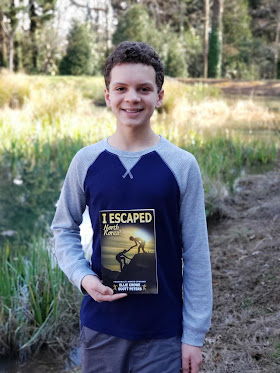

Elliott is a prolific reader of various genres who is more than happy to share his opinions on books. In his free time, he enjoys writing, reading, and running. He is an 8th grade homeschool student in Charlotte, NC.          

GIVEAWAY

Please leave a comment by 6 PM on February 17 with your email address, or send me an email. If you share this on social media, you will get one extra chance; if you follow my blog you will get another chance. Tell me what you have done and I will enter your name accordingly. U.S. addresses only. 

Congratulations to Tiffany Slack who won Rock and Vole for the Matthews Christian Library and to Rosi Hollenbeck who won Where is My Cow? By the way, Rosi also reviews and gives away lots of children's books!


Wednesday, June 24, 2020

FREE LUNCH: An Audiobook Review


Congratulations to Connie Saunders for winning THROUGH THE WARDROBE from last week's blog. Here's a tip to win a book. Whenever Connie enters my giveaway, she ALWAYS shares it on social media. This earns her more chances to win a book--and it works!

"This book is for every kid. Whether they pay for their lunch or not."  FREE LUNCH by Rex Ogle


REVIEW


"Why can’t I get what I want at the grocery store?" Rex asks his mother. Unfortunately, he knows the answer.  It’s been like this all his life. He hates seeing all of the chips, candy, and ice cream that other kids eat that he doesn't; he hates watching his mother try to stretch every dollar and use food stamps; he hates his constantly empty stomach; he hates having cashiers looking at him like he might steal something because his clothes come from the thrift store. 

Told in first person POV, this nonfiction autobiography is Rex's own story growing up in a dysfunctional family. He's angry that his family--including Sam, his mother's stuttering live-in boyfriend; and Ford, his toddler half-brother that Rex takes care of--are all poor. 

And he hates the helplessness and fighting in their home that poverty creates. Rex wants to blame his mother for not working but he also realizes that without a job, "all of the love goes out of Mom." Over and over she tells him how hard it is for her to get a decent job and blames him for being ungrateful.

The ultimate humiliation is when Rex enters middle school and discovers that his mother registered him for the free lunch program. Every day he feels like a beggar while he waits for the lunch lady to check his name off the free lunch checklist.  


Ogle doesn't hold back from painting the realistic but ugly picture of his childhood. The family moves frequently as the adults look for jobs. The lack of money leads to tension, arguing, and fighting. His mother gives him a black eye on more than one occasion. Rex's clothes are stashed in cardboard boxes and he sleeps on the floor--along with the cockroaches. 

The one bright light in his life is his abuela, his Mexican grandmother. She is his cheerleader. "You are smart and handsome. Life is not always fair," she tells him. "I lived in a one-room house without indoor plumbing and dirt floor with my13 brothers and sisters. We made it work. You will too." 


As hungry, poor, and angry Rex is, he tries to control his emotions, to not be rude, and to not hit back. But his own anger makes him feel evil. He has to remind himself that "being poor is not a disease."

In the cauldron of poverty and abuse, Rex experiences problems at school and with his peers. Despite worrying about how he can keep his poverty a secret so that his friends won't turn on him he thinks, "School feels safer than home." 

But things get worse. His friends reject him. He wears a monster costume on Halloween and starts worrying that he is a monster-- just like Sam or his mother. His family moves to public housing which is the last straw. He lashes out and tells his mother, "I hate you." She slaps him. Hard. He is constantly on edge wondering when she will strike back him and how could their lives get worse. Would they be homeless? Would they starve? Would he die? 

He develops a friendship with Ethan, a boy who he sits with at lunch. Ethan's point-of-view -- that his life isn't as perfect as it seems even though he his parents have lots of money--is eye-opening. "Come on, no one has a perfect life!" Ethan says... "Money isn't everything. Trust me."  

Towards the end, his mother gets a good waitressing job and the family takes some steps towards healing. Sam goes out of his way to give Rex an unexpected Christmas gift and the book ends on a hopeful note.  


FREE LUNCH tells it like it was for young Rex Ogle. A few readers might object to some crude language. To me, it was a brutally honest book. As Rex says at one point, "I don’t trust the word free. Look what it’s cost me." 

The audiobook is narrated by Ramon de Ocampo, who performs all of the voices excellently. I was particularly impressed with how well he showed Sam's stuttering. 

In a Facebook exchange, Rex told me this was the hardest book he's ever written--until the one he's writing now which is the sequel. But he's "glad it's helping some kiddos out there."

This is not an easy read; there were times I had to stop listening. I would recommend that middle-grade students read or listen to it with their parents or teacher so they can discuss it together. Although Rex is entering sixth grade in the book, the tough content might indicate it is more for young adults. 

GIVEAWAY 

If you're interested in adding this book to your home or school library, please leave me a comment by 9 AM on June 26. The winner will receive an audio code and instructions on downloading the book. As always, if you decide to follow my blog or share this on social media, let me know what you do in the comments. PLEASE leave your email address if you are new to my blog. This giveaway is courtesy of Recorded Books. 

Wednesday, June 17, 2020

THROUGH THE WARDROBE: How C.S. Lewis Created Narnia

Congratulations to Sarah Maury Swan who won ORDINARY HAZARDS off last week's blog.

****

REVIEW


Last fall I attended the SCBWI-Carolinas panel in which Lina Maslo co-presented "Bringing Your Voice to Non-Fiction."  I heard about her forthcoming book, THROUGH THE WARDROBE which she wrote and illustrated.  Immediately I knew I wanted to share it with all of you--and with my grandchildren.


This non-fiction picture book provides enough details about C.S. Lewis's childhood and adult traumas to help the reader understand how the world of Narnia came into existence. 

"As a boy, Clive Staples Lewis did not like his name. He imagined himself as more of a... Jack. When he was four years old, he changed it."


Since Jack didn't always like his own world, he imagined and wrote about other worlds. That was a precursor of things to come.

Jack lived in Ireland where it rained a lot. He and his older brother spent hours reading about talking animals and knights in armor. They made up a world populated with frogs, mice, and rabbits who argued about politics and went on quests to defeat evil cats. Conquering evil played a part in Jack's early stories.


Jack's pleasant childhood ended when he was nine. His mother died and he and his brother were sent to a boarding school in England--a horrible experience for him. Jack finished his education with a tutor and was on his way to being a teacher when WWI broke out. Jack went into the army but was determined to be a writer. After the war, he "pushed his imagination away." He taught at Oxford University and wrote many books about "pain, faith, love; about medieval times; about people discovering strange planets."

"But in the back of his mind, Jack had characters waiting for a story of their own."


During WWII, Jack took in evacuees. One day, a little girl asked him if there was anything behind [his] old wardrobe.


That started him thinking. He "decided to write a fairy tale...about a land unlike the dreary one they lived in, and about the characters in his imagination."

Jack's publisher, and his good friend, J.R.R. Tolkien, didn't like his first ideas about Narnia, so he put it aside. But when he got sick, he decided he didn't care what others thought. He would write a story about four children who had been sent far from home during the war. "It was raining, and they were stuck inside a house of endless hallways. They found a wardrobe and crawled in. But as they pushed back the old fur coats, they fell into a magical realm..."


Narnia was a place that children learned about characters who stood up to bullies and that "the worst moments of your life were only leading you to become the person you were meant to be."


Children wrote to him and begged for more stories about Narnia. But by the time he wrote the seventh book, he knew he was finished. "This time, it was up to others--to discover a world only they could imagine and to find the door they were destined to open."

SOME FINAL NOTES

Look closely at the clever cover of the book pictured above and notice what Lina incorporated into it. If you get the book for a young reader--as I hope you will--you'll discover that the hardback cover is a wardrobe. Young readers open the doors of this beautifully written book and step inside C.S. Lewis's life.  

Make sure you don't skip over the endpapers. In the front are imagined letters from children to C.S. Lewis. Since he destroyed all of his correspondence, Maslo created these. The back endpapers are actual letters from Jack to children which can be found in C.S. Lewis: Letters to Children. Back matter includes interesting facts about Jack and an extensive bibliography.


A PERSONAL NOTE

I love stories within stories and in fact, this is a picture book about a man who loved reading and writing books. The illustrations are accessible to children; the color pallet which Lina Maslo used is beautiful. Although C.S. Lewis ages in the book, he still has a child-like wonder in his facial expressions. 

I bought this book for my not-quite-five-year-old granddaughter since I knew her father had already read The Lion, The Witch, and the Wardrobe to her. During the Covid quarantine, my daughter suggested that I read books to her via Skype. I happily obliged. After my granddaughter received Through the Wardrobe she asked if I could read it to her. I was glad I had saved the F and G's so I could read the book to her.

GIVEAWAY

I have a special giveaway for you! Lina Maslo is donating a personally autographed copy of THROUGH THE WARDROBE for you or for a young reader in your life. All you have to do is leave me a comment (please include your email address if you are new to my blog) by Friday, June 19 at 5 PM. Want extra chances? Share this on social media and tell me what you did. 


THE NIGHT WAR: A MG Historical Novel Review

  By now you should have received an email from my new website about my review of THE NIGHT WAR by Kimberly Brubaker Bradley. (It'll com...