Showing posts with label middle grade. Show all posts

Saturday, June 10, 2023

Three Mentor Middle-Grade Graphic Novels

When I first started thinking about my WIP, Nightmare in Nuremberg, I envisioned it as historical fiction. 

After a recent trip to Europe, where centuries of hidden inside churches, city streets, bridges, and town walls, I started imagining something different. 

It began like this. I walked by a stone ramp in Belfast, Ireland (not far from where fellow blogger, Valinora Troy lives!) that looked something like this--steps down into the Moselle River in Cochem, Germany.


I started thinking. What would happen if two kids went down a ramp that led them to a mysterious boat that took them back in time? 

That's how my idea for writing my story as time travel began.

I had already signed up for the Children's Book Academy course on Graphic Novels. But I knew NOTHING about time travel books. Or fantasy.

Mentor Texts to The Rescue!

THE WRONG WRIGHTS 

by Chris Kientz and Steve HockensmithIllustrations and Color by Lee Nielson. Original research byAnthony Bellotti.


I was very happy to find my first time travel mentor text at my local library. Four middle-grade students go back in time to prevent evil investors from ruining the Wright brothers famous flying machine. 

Observations:

  • A knowledgeable adult guides them into the past and then disappears.
  • Once the four characters enter the past (which is just shown as an opening in a wall with a different world on the other side), the kids immediately are dressed in period-appropriate clothes. (Later on, this is explained as a hologram).
  • The kids are each given a tool--a Siri-like wristband (this book was published in 2016-- right after Apple watches were released. Who had the idea first?) that answers their questions, tells them where they are in history, and gives them an idea of their mission.
  • The kids discover that history is going to be irrevocably changed by the bad guys unless they intervene. 
  • Interesting twist to the story: the bad guys are also time travelers, although the story doesn't explain where or when they came from.
  • When they arrive back in the Smithsonian Museum after their adventure, the hallway they had been in has disappeared. 
  • Lots of STEM ideas as well as history are included, along with an explanation on the last page as to what was fiction and what was fact. 
  • Very engaging, fun, colorful, and relatively short book. 
  • Five stars as a mentor text.

THE MYSTERIOUS MANUSCRIPT 

by Lars Jakobsen (Time travel)

Like THE WRONG WRIGHTS, this graphic novel is also short (48 pages including several pages of back matter). 

Observations:
  • A "forward" explains that a new technology for time travel--a time gun--has been developed but is falling into the wrong people's hands. Secret agents are fighting a dangerous crime wave as these criminals are taking artifacts out of their own time. 
  • Although it is clear from the header that the story takes place in Denmark in 1929, I had to read the entire book a few times to understand what was going on. 
  • The hero, Mr. Mortensen, is summoned into the past because of his time travel abilities. His mission is to make sure that time doesn't get rearranged and save a young mute woman who is being accused of being a witch.
  • In my mind, there wasn't enough dialogue or clear action to make the story make sense. The transitions from one panel to another weren't very clear. I frequently got confused over what was happening. 
  • Illustrations (a light blue color was used) show the characters shifting into a different time period.
  • Moral of the story for me: make sure that the reader has a clear idea of what is taking place on every page. Time warps must be clearly shown from panel to panel. Dialogue must support action. 
  • Two stars as a mentor text.


THE STORM IN THE BARN 

by Matt Phelan (historical fiction plus fantasy)

I can see why this book won the Notable Children's Book Award in 2010. The simple text and poignant illustrations with limited but perfect use of color made this a five star mentor text. 

Observations:
  • The setting, a dust storm in Kansas in 1937, is a character and an antagonist. 
  • Jack Clark, the young main character, is picked on by the town bullies and  disapproved of by his father. Most of this is seen in action panels without text and by the author/illustrator showing Jack's visceral reactions to how he is treated.
  • secondary character, Jack older sister, is very important to Jack's story. She suffers from "dust pneumonia" and escapes into the world of books which she shares with Jack. The two feed on these stories and their mother's stories of her childhood--which are colored with vivid hews, so different than the grey, black and brown of the dust storm. 
  • Jack's inner conflict over his role in the family and whether or not he has "dust dementia" is acutely portrayed. 
  • The sequencing of events is very clear in text and pictures. 
  • Fantasy is intertwined with the history of dust storms in the midwest. 
  • An excellent middle-grade read.

Do You Use Mentor Texts?

What mentor texts have you used when you are writing? Please share in the comments and let us all know what you have learned from them.

Congratulations to Antoinette Martin who won Linda Phillips' book, BEHIND THESE HANDS. 

Be sure and check out other great middle-grade books on Greg Pattridge's MMGM blog.


Friday, March 31, 2023

GARVEY'S CHOICE: A Middle-Grade Verse Novel and a Giveaway

Long-time readers of my blog may remember that I am one of Nikki Grimes' many fans. In the past, I reviewed Ordinary Hazards, Between the Linesand Words with Wings.  Nikki's poetry sings and she captures the conflicts and emotions of adolescents beautifully.

Garvey's Choice (WordSong, 2016) is no different. Except...it is different. Each of the 100+ poems which tell Garvey's story is written in tanka. WOW. At the back of the book Nikki mentions that she challenged herself to write a novel using this Japanese form of poetry. All I can say is that the result is lyrical, impressive, and AMAZING. 


Review

As I often do when I review a verse novel, I'm going to share a few of my favorite poems. It was hard to narrow my selections down. 

From page one, readers learn that part of Garvey's story is his problems with his dad. The sparse yet evocative language also hints at how he handles his pain.


It Figures

                    When I was seven

                    and crazy for Mr. Spock,

                    a Star Trek lunch box

                    was all I craved. Instead, Dad

bought one blaring the logo.


of some football team

I'd never even heard of

I shoved that thing in

the coal black of my closet,

then celebrated with cake. (p.1)


Garvey's best friend is Joe with whom he shares a love for astronomy, chess, and knock-knock jokes.  

One time after being dissed again by his father for not wanting to play basketball, Joe calls.


Phone Call

All evening long I 

try tucking in my sadness,

but it keeps getting

snagged on my voice when I speak.

Joe catches it when he calls.


"Hey! What's up? Joe asks.

Should I tell him? "Nothing you 

haven't heard before.

I wish my dad could see me.

That sounds crazy, huh?"


"Not really," says Joe.

"I get it. Seriously.

But you've got a dad.

Mine skipped out long time ago."

Why'd I open my big mouth?


Joe shrugs off his hurt.

"Knock, knock!" he says. "Not now, Joe."

"Come on, man! Knock, knock."

I give in. "Who's there?" "Your friend,

Joe, who's always here for you." (p. 19)


At school, Garvey is teased for being overweight. Nikki tucks small references to Garvey finding refuge in music. Listening to his music and his dad's music, and humming (to drown out teasing) are all part of how Garvey copes. 

Along the way, Garvey learns some things about his father's love for music and how his father used football to bring the two of them together. The musical insights and details about his father slip in and foreshadow the climax. 


Morning Classes 

Blue notes, sad as me,

wail their way from a classroom

I've never been in.

"Chorus," says Joe when I ask.

"It's a new club. You should join.


You're always singing,

or at least humming out loud."

"Yeah, but I don't know."

"Look," says Joe, "your voice is choice.

You should let others hear it." (p. 46)


Garvey makes a new friend in chorus. Manny is an albino who wants to be a chef.


Advice

...

"I was wondering 

how you stand kids teasing you."

"I'm honest," he says.

"I've got albinism. Fact.

I look strange. No changing that.


Is there more to me?

Sure. Kids yell 'albino boy.'

I don't turn around.

Choose the name you answer to.

No one can do that but you. (p. 66)


Changes begin to happen.


When I Sing

When I sing, my heart

floats full and light, as if I'm

a balloon of song, 

rising with every lyric,

reaching the edges of space. (p. 75)


Spring Thaw

Peeled myself from bed

for the morning rush to school

(Better beat the bell!)

Belted a blue-jean surprise:

loose weight by nearly one size!


Round still, but that's fine.

Feeling good outside and in.

Maybe I'm not thin

But skinny isn't perfect.

The perfect size is happy. (p. 99)


The climax is Nikki Grimes perfect.


The Talk

"Son, I should tell you,

I used to sing in a band,"

Dad says in the voice

he saves for secrets. I smile,

and pretend that I'm surprised.


"Really? When?" I ask.

"Oh, it was a long while back..."

That's how it began--

the longest conversation

I've ever had with my dad. (p. 104) 


Giveaway


I will be giving this book away through the upcoming issue of Talking Story on CHANGE. Leave me a comment along with your email address, and I will add your name to the list. If you're an educator or librarian let me know and I'll add your name in twice. U.S. addresses only. 

Congratulations to Danielle Hammelef who won DOWN TO EARTH on last week's blog.

And don't forget to check out Greg Pattridge's wonderful collection of middle-grade book reviews every Monday.


Saturday, October 29, 2022

STARFISH: A Teen Review of a Middle-Grade Book


My teen blogger Elliott Kurta is now busy being a freshman in high school and doing his volunteer job at the library. So, we'll enjoy his book reviews whenever he has time to get them to me.

                                                    ****

REVIEW

           Young Elle is constantly shamed for being overweight; at school, in public, and even at home. To make matters worse, her mother obsessively monitors what she eats and her brother and sister poke fun at her. It’s no wonder the only place Elle feels safe is in her pool, where her weight doesn’t matter, and she can take up as much space as she wants. In this middle-grade novel, Elle finally decides to fight back with the support of her father, a new friend, and her therapist.

            Bringing a rarely seen viewpoint to a young audience, Starfish does a commendable job of not only approaching a sensitive topic but relating the perspective of a young, overweight girl to middle-schoolers. Elle’s bullies are painfully realistic, and so is the fatphobia she experiences every day. Additionally, the book is primarily presented in verse, which forces readers to slow down in order to absorb the cadence and message of each sentence. The poetic format also allows for certain dramatic flourishes in word placement which leaves a lasting impact on readers.

            At times, Elle’s narrative style can lead to confusion while reading. For a pre-teen, Elle uses uncharacteristically sophisticated terms to describe her own emotions and has an unusually mature awareness of her feelings. In her afterword, Lisa Fipps mentions that Starfish was originally going to be a YA novel, which explains why the book reads like one. This instance, found on page 34, highlights the discrepancy in Elle’s age and maturity present throughout the book:


            The first Fat Girl Rule

            you learn hurts the most,

            a startling, scorpion-stinging soul slap.


             Aside from the inconsistencies in Elle’s narration, there’s a subtler flaw in the book. Starfish focuses entirely on Elle’s body, her perception of it, and how it affects her life. Each of the one- or two-page long chapters either shows Elle being bullied at school, talking with her friend about her body, or fighting with her mom over her weight. In fact, one of the major sources of tension in the book is that Elle’s mother wants her to undergo bariatric surgery, a reference that would fly over the heads of most middle schoolers. The singular focus of the book is overwhelming and could even be considered in contrast with the novel’s message. By focusing entirely on one aspect of Elle, her weight, Lisa Fipps undermines the idea that Elle is more than her body.

            Regardless, there’s a reason that Starfish won a Printz award. Line for line, Lisa Fipps’ debut novel is nothing short of extraordinary, bringing the issues of a tween who’s more than her body weight front and center. For middle-schoolers everywhere, Starfish will make them reconsider how they see their friends, family, and most importantly, themselves.


A QUESTION FOR OUR READERS

Have you read this book? Elliott and I would like to know what you thought of it.

ALL ABOUT ELLIOTT

Elliott is a prolific reader of various genres who is more than happy to share his opinions on books. In his free time, he enjoys writing, reading, and running. He is a 9th-grade student in Charlotte, NC.                                                

                                                ****

Congratulations to Kathy Wiechman who won TEDDY, LET'S GO! from last week's blog.


Don't forget to check out the other wonderful middle-grade books on Greg Pattridge's MMGM site.


Saturday, August 27, 2022

HURRICAMP A MG Book Review by Guest Blogger, Elliott Kurta

REVIEW

It’s summer, and eleven-year-old Laura Newman, “Noodle” to her friends, is excited to arrive at Camp Hillside, where she’ll stay for four weeks. Unfortunately, the trip goes awry before it even begins. Noodle’s sister, Jill, can’t come to summer camp with her, which means Noodle is going to be left by herself for an entire month. Wallowing in her loneliness, Noodle writes letters and ignores the other girls in her cabin. After two weeks of feeling sorry for herself, a hurricane changes Noodle’s routine. With Hurricane Hilda on the way, Noodle’s cabin, the Sandpipers, is moved into a basement after their cabin nearly collapses. Forced into close confines, Noodle starts to open up to her cabinmates. As the Sandpipers grow closer, they begin to rely on each other and bond over food fights, skunk attacks, and failed pranks. Told through Noodle’s perspective and sprinkled with illustrations, Hurricamp is a tale of one girl’s wacky summer.

Perfect for middle schoolers, Noodle’s adventures are as unpredictable as they are memorable. Noodle’s witty and at times cynical monologue guides readers through her burgeoning relationships with fellow Sandpipers and gives insight into her emotions. But the best part of Noodle’s narration would have to be her clever alliterations and comparisons. Using analogies that won’t fly over the heads of young readers, Hurricamp features all manner of scintillating language. Take, for instance, this short and yet powerful example from page 48, in which Noodle is praised by her cabin counselor:

            “It felt like the sun shone straight down on me.”

Even without a cast of intriguing characters and Noodle’s revealing dialogue, Hurricamp would still be engaging. As the 162 pages of Hurricamp may prove a challenge to elementary-school readers, six illustrations are spread throughout this novel, providing relief without being distracting. And, of course, that’s to say nothing of the mischief that the Sandpipers engage in. Noodle’s adventures serve to add even more fun to Hurricamp, but they’re also a valuable lesson about what happens when rules are broken. For example, the Sandpipers’ food fight results in finding a bear licking up their mess in the morning.

With Noodle’s immersive descriptions leading the way, Hurricamp introduces a theme that many middle-schoolers are beginning to struggle with: self-reliance. While at first Noodle uses all her free time writing letters to her parents to complain, she matures as the story progresses and learns to solve her own problems. For example, after their cabin is soaked by rain after its roof springs a leak, Noodle immediately takes charge and gets help. While Noodle’s self-confidence grows and she becomes more optimistic, her cabinmates take notice. She quickly becomes the leader of her cabin, and gains popularity at camp.

            The other Sandpipers all serve important parts in this book, and the author Steph Katzovi does a great job of introducing them and more importantly distinguishing each one. All of the girls in Noodle’s cabin are introduced in one scene, the stereotypical camp introductory activity in which everyone shares their name, where they’re from, and an interesting fact. While this set-up might seem chaotic, Noodle’s internal monologue eases each introduction. In just three pages, Noodle familiarizes herself and her audience with her cabinmates and counselor. However, each of the Sandpipers’ contrasting personalities make introducing them an easy task. From Noodle’s best-friend, Aries, to her nemeses, Holly and Tara, not a single Sandpiper fades into the background over the course of this story.

In conclusion, this novel teaches kids to problem solve and improvise while taking Noodle and the Sandpipers through a crazy series of adventures. Noodle’s inner monologue, each of her friends’ bold personalities, and the everyday obstacles the Sandpipers face all make this book a realistic and yet engaging tale. With a blend of wit and whimsy, Hurricamp is sure to please anyone who’s gone to camp or wished they could’ve.


Elliott is a prolific reader of various genres 

who is more than happy to share his opinions on books.
 In his free time, he enjoys writing, reading, and running. 
He is a ninth-grade student in Charlotte, NC. 

GIVEAWAY

If you are interested in winning this book, please leave me a comment with your name and email address by Wednesday, August 31. U.S. addresses only. If you prefer, you can enter by sending me an email. Share this post on social media or follow my blog and I'll put your name in twice. 

Congratulations to school librarian, Tammi Truax, who won THE OCEAN CALLS. 

Don't forget to visit Greg Pattridge's blog for more book reviews. 


Wednesday, March 23, 2022

PICTURING A NATION: A Book Review by Guest Blogger, Elliott Kurta

     A front-seat view of America during the Great Depression, Picturing a Nation by Martin Sandler (Candlewick Press, 2021) presents over one hundred and thirty photographs that give life to our past in a way that appeals to anyone, age notwithstanding . Using photos taken by the Historical Records department of the Farm Security Association, this photographical memoir contains the greatest works of Jack Delano, Dorothea Lange, Marion Post Wolcott, Walker Evans, and many more.

            Divided by region, (Midwest, Northeast, South, and West) each of the four sections of Picturing a Nation focus on the people impacted by the Great Depression, not the economics or statistics. Subtitles and text enhance each page, with a caption and perhaps a relevant quote from the photographer besides the photographs. Additionally, a short history of the Farm Security Administration and the people behind it as well as a brief background on the Great Depression introduce the book. These first few pages bring meaning to each of these carefully curated photographs. The only shortcoming of this format is that page numbers have been excluded, making it difficult to revisit favorite photos.

            Each of the photos displayed seems to have at least one out of three purposes; to reveal the humanity of each of the victims of the Great Depression, to show the devastation delt by the Great Depression or finally, to reveal the disparity of the nation’s wealth throughout this challenging time. Below, you can see a photo that serves this last purpose.


 https://www.loc.gov/pictures/collection/fsa/item/2017754300/


Taken by Marion Post Wolcott, this photo was shot at a poolside in Miami, Florida, and illustrates that a small, privileged population of the nation was not aware of the suffering of their neighbors. Picturing a Nation’s candid approach to life during our worst economic depression makes the reality of this event even harsher.


https://www.loc.gov/pictures/item/2017762891/         

          On the other side of the spectrum is this Dorothea Lange photograph, Migrant Mother, which was originally taken for the Historical Section of the FSA and is now widely regarded as the face of the great depression. Migrant Mother represents with unflinching clarity what life was like for the fifteen percent of the U.S. unable to find jobs.

          Don’t open this book if you don’t want to learn about the past. Don’t open this book if you want a timeline or a list of people and places to memorize. Don’t open this book if you’re in a hurry. If you want to look into the eyes of migrants and orphans, aristocrats and struggling families, farmers and their fieldhands, and see their soul staring back… then turn the page.


GIVEAWAY (with a caveat)

Leave me a comment by March 30 if you are interested in entering this giveaway. The copy which Elliott read is an ARC and in black and white, and the binding isn't as secure as the final version of the book. As a result, the Introduction's pages are no longer attached to the binding. In addition, the first few pages are out of order and upside down. But, as Elliott said, this is a tremendous pictorial display that chronicles our nation during a difficult time. U.S. addresses only. 

Saturday, March 19, 2022

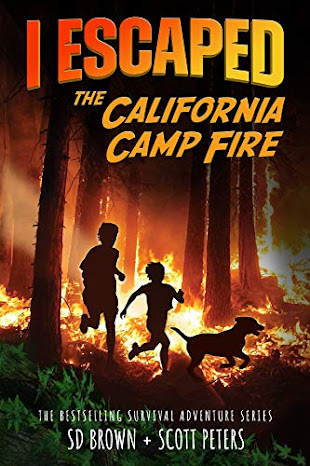
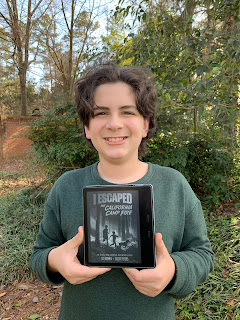
I ESCAPED THE CALIFORNIA CAMP FIRE: A Middle Grade Review by Guest Blogger, Blake Kurta


         I Escaped the California Camp Fire, by Scott Peters and S.D. Brown, is historical fiction, part of the I Escaped Series that is aimed towards 8–13 year-old readers. However, with its clever descriptions, relatable characters, and pop culture references, it can easily appeal to all ages. For instance, on page 8, the book mentions a character “doing her version of Vanna White and sweeping her hand across the spotless kitchen.” 

            I Escaped the California Camp Fire is a captivating book that draws you in right from the start. I was so engrossed that I had a hard time putting it down. In the opening scene, the protagonists are left at home alone because their parents are on a trip for twenty-four hours. While their parents are away, chaos breaks out. The siblings, Emma and Troy, are racing against a monstrous fire. Amidst all of this frenzied excitement, an electrical black-out takes place making it harder for them to escape. 

            The vivid descriptions made the dangers seem life-like and had me clinging to the edge of my seat, rooting for Emma and Troy to make it out alive. For instance, on page 2 the fire is described as accelerating at a rate fast enough to consume “the equivalent of a football field every second.” Further along, the author writes, “It felt like an oven cranked up to broil.” Later, Troy states, “Look at the hill, flames are spilling down it.” This gave me terrifying visual images while creating a phenomenal picture in my mind. I could practically feel the scorching heat right through the pages. And finally, when I read, “The flames hit the ravine and it looked like a movie filmed in Hades” it made me realize how dangerous the California campfire really was.

            Troy and Emma were in a couple of tricky situations, but they fought through the smoke and flames managing to survive. It’s truly remarkable how they were able to live through the sixth most likely devastating fire in the U.S. all by themselves.

This book demonstrates how devastating fires can be and the long-lasting impact on people’s lives and the environment. For example, the California Camp Fire destroyed thousands of buildings, and some people are still financially recovering from the fire. It is estimated that the fire cost people 150 million dollars. 

            For all of the reasons above I would highly recommend this book. Overall, it was thrilling, action-packed and I really enjoyed reading it. While the story itself is fictitious, I learned about a fascinating, albeit scary historical event from reading this book.


Blake Kurta is 12-years-old and lives in Charlotte, NC. He is homeschooled. In his spare time he enjoys constructing 3D Metal Earth rockets, painting, and pickle ball. 

Saturday, February 12, 2022

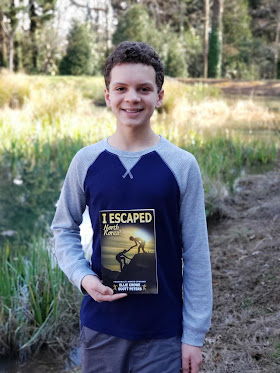
I ESCAPED NORTH KOREA: A Review by Guest Blogger, Elliott Kurta

I'm happy to have Elliott Kurta back for another book review. Since he's enjoying the opportunity to read and review a variety of books, you can look forward to more of his reviews in the future.

REVIEW

            I Escaped North Korea is an informative book about the struggles North Koreans faced during 2007. Dae-hyun, the protagonist, is only fourteen when his father is arrested and his mother journeys to Pyongyang to save her husband. Dae-hyun realizes his mother isn’t coming back, so he tries to survive by stealing coal and food. Soon, Dae-hyun longs to leave his country and journey to China, where there is hot running water and readily available food. He’s offered a job which would pay well and send him to China--at the cost of endangering his life. He accepts the job and is charged with delivering medicine across the frozen Yalu river. Once in China, Dae-hyun finds he doesn’t want to leave, even if he’d be staying as an illegal citizen and an orphan. While looking for other work, Dae-hyun stumbles upon a minister who offers to send him to Mongolia in order to obtain political asylum—thus beginning the journey of  his life and for his life.

            Throughout their first novel together, Ellie Crowe and Scott Peters provide an ideal example of ‘show, don’t tell’. Unlike most middle-school books, information is not presented in a manner that tells readers what they should think. Instead, they will come to their own conclusions about life in North Korea as they read about Dae-hyun going to school and being asked to share a personal failure in a class exercise. However, I Escaped North Korea is not overly graphic, except for two minor expletives in the first twenty pages. While themes such as corrupt governments, violent and cruel police officers, and starving families are present throughout this historical narrative, Dae-hyun also experiences the kindness of strangers. From the kotjebi or orphan Ki-moon who helps Dae-hyun find food and shares his stolen goods to the South Korean minister who brings Dae-hyun on a journey to seek political asylum, Dae-hyun’s journey is spectacular. 

            Seeing North Korea through Dae-hyun’s eyes makes the struggles of citizens in another country personal for the reader. With an average of four pages per chapter, I Escaped North Korea will ensnare reluctant readers from the first page with increasingly high-stakes action.

            Even with all the captivating action present, I Escaped North Korea is still a heartfelt and emotional novel. The brevity of the novel does not take away from its descriptions, like when Dae-hyun describes how his father’s crimes have brought his family ‘low’. Even though most readers will not be able to relate to Dae-hyun as he’s chased across a frozen river, when they read the sentence below they will find themselves running alongside him.


 "With a sickening snap, the ice beneath his feet moved.

            He pictured the water beneath the splitting surface. Black. Cold. Deadly.

            'Dae!' Ki-moon screamed…”

            On top of the facts presented in this book, at the end there is a sheet of additional information and a brief appendix with a study guide and more books to read. After the study guide, there is an afterword that further explains the route to Mongolia and what life is like in North Korea. There’s even a website link at the back of the book that directs to study questions for each chapter and a coloring sheet of North Korea and surrounding countries.

        For 8–12-year-old reluctant readers, this book will serve as a great introduction to the historical fiction genre. The short chapters of this book are both engaging and informative. Be prepared for a barrage of questions after your child, friend, sibling, or students breathlessly finish reading I Escaped North Korea. For another, equally thrilling read, check out the rest of the I Escaped nine-book series, which ranges from surviving the brutal Salem Witch Trials to escaping the ruthless pirates of the Caribbean.   


Elliott is a prolific reader of various genres who is more than happy to share his opinions on books. In his free time, he enjoys writing, reading, and running. He is an 8th grade homeschool student in Charlotte, NC.          

GIVEAWAY

Please leave a comment by 6 PM on February 17 with your email address, or send me an email. If you share this on social media, you will get one extra chance; if you follow my blog you will get another chance. Tell me what you have done and I will enter your name accordingly. U.S. addresses only. 

Congratulations to Tiffany Slack who won Rock and Vole for the Matthews Christian Library and to Rosi Hollenbeck who won Where is My Cow? By the way, Rosi also reviews and gives away lots of children's books!


Friday, February 4, 2022

UNDER THE TANGERINE TREE: Author Interview with Esther Bandy

 Elliott Kurta, who reviewed Under The Tangerine Tree on my last post, decided to follow up with an interview with the author, Esther Bandy. Take it away, Elliott and Esther!

INTERVIEW

ELLIOTT: What inspired you to write Under the Tangerine Tree? Was it a single moment, conversation, or photo, or did it take a larger experience for the ideas in your book to come together? 

ESTHER BRANDY: I began writing Under the Tangerine Tree after my dad died in 2005. I loved my dad, and even though I knew he was in heaven, I still missed him. I’d also met many children who lost their fathers due to death or divorce. I wanted to write a book that would help children deal with their grief and allow me to express my own feelings of missing my dad. In addition, I had a desire to share God’s love and help children understand the gospel. It’s such a blessing to know that when a person receives the Lord Jesus as Savior, he becomes a child of God and has a heavenly father who loves him and will always be there.


ELLIOTT: What does your writing process look like, and how long did it take you to write Under the Tangerine Tree?

ESTHER BANDY: I have many medical problems, and Under the Tangerine Tree is my debut novel, so it took a very long time to write, revise, research, and edit my novel. I started writing it in 2005 after my dad died, but I often set it aside for long periods of time due to personal and family health problems. In addition, we sold our home in Washington state and moved to North Carolina during those years. I was often so busy or sick that I neglected my writing completely. Even when I wasn’t writing, I often thought about my novel. I remembered moments from my life, historical events, and inspirational themes I wanted to include.


ELLIOTT: In ‘Under the Tangerine Tree’, Angie Mangione moves to Florida to start a new life, one that more intimately involves God. Are her experiences in any way reflective of your own?

ESTHER BANDY: Angie’s faith journey is different from mine since I was saved in a Good News Club when I was five. However, several of Angie’s experiences are echoes from my life. I never lived in New York City, but my dad was Italian, and he was born and raised in NYC. Mom was southern born and raised near Tampa, FL. We often visited NYC to see dad’s family, but I was born in Tampa. Dad was in the Air Force, so we lived in several places when I was young. Like Angie, I didn’t like moving and being the new kid at school. I was glad when dad retired, and we moved next door to Granny’s house on a country lake in Florida.


ELLIOTT: Did you have to do any research before or during writing?

ESTHER BANDY: I remembered many of the historical events from my childhood, including President Kennedy’s visit to Tampa and his assassination four days later. I did extensive research to make sure I had the facts right.


ELLIOTT: Did Under the Tangerine Tree start out with the same plot line and characters it has now, or were there unused ideas, and if there were, can you share some of them?

ESTHER BANDY: It had the same general plot line and characters, but some have been added and others have been deleted. I had several more scenes from Angie’s school with a variety of other characters, but I finally deleted about 10,000 words with scenes and characters that seemed to weaken the overall story.


ELLIOTT: What made you choose Under the Tangerine Tree as the title for your first book?

ESTHER BANDY: There was a tangerine tree at the end of my dirt road in Tampa when I was growing up. It had the best tangerines I’ve ever eaten. I walked past that tree on the way to and from my elementary school, and my best friend and I often sat under that tree while we talked and ate tangerines.


ELLIOTT: What message or messages do you want each of your readers to leave your book with?

ESTHER BANDY: I hope my readers will understand that even though this life is filled with challenges, life is good, and they can have hope. Why? Because God loves them, and He has a wonderful plan for their lives. When they understand the gospel and receive Christ, their sins are forgiven, and they become children of God. They also have the Holy Spirit who indwells them and helps them understand the Bible and have victory over sin.


ELLIOTT: What made you decide to start off  Under the Tangerine Tree with the main character’s father dying?

ESTHER BANDY: When I began writing Under the Tangerine Tree, my dad had just died, and I knew children who had lost their fathers due to death or divorce. I wanted to offer people hope while they were grieving, and I needed to express my own feelings of grief. I want my readers to know that even when the challenges of life are difficult to deal with, we can still have hope for a better tomorrow.


ELLIOTT: Have you always wanted to be a writer?

ESTHER BANDY: When I was in second grade, I wanted to be a nurse, a missionary, a teacher, or a writer. My teacher said I had to choose one, but I couldn’t. I wanted to do all of them. Over the years I’ve worked as a nurse, a missionary, and a Spanish teacher. When I became disabled, I realized that it was time to write.


ELLIOTT: How difficult was publishing your first book?

ESTHER BANDY: I submitted it to several traditional publishers who rejected it, so I finally decided to self-publish it. I’m thankful to my wonderful son and to several friends who have encouraged me and helped me publish it.


Thank you Esther and Elliott for this informative interview. You can find Esther  on her website or connect with her on Facebook 


GIVEAWAY

I am giving away a copy of Under the Tangerine Tree. Leave me a comment on this blog and you'll receive one chance; leave another on the review and you'll receive a second chance. U.S. addresses only. If you prefer not to leave a comment, email me and I'll enter your name. PLEASE LEAVE YOUR NAME AND EMAIL ADDRESS IF YOU ARE NEW TO MY BLOG. Giveaway ends on Wednesday, February 9 at 12 PM.

THE NIGHT WAR: A MG Historical Novel Review

  By now you should have received an email from my new website about my review of THE NIGHT WAR by Kimberly Brubaker Bradley. (It'll com...