Showing posts with label book for middle-grade girls and boys. Show all posts

Friday, November 10, 2023

ZORA & ME: THE CURSED GROUND by T.R.Simon: A Middle Grade Book Review

I don't know how I missed Zora & Me: The Cursed Ground by T.R. Simon when I was reading books in order to inform Half-Truths, but I did. Fortunately, it's never too late to find a great read! 


Anyone who is familiar with Zora Neale Hurston (1891-1960) will know that she was a renowned storyteller who portrayed racial struggles in the early 1900s. If you google Zora Hurston + children's book, you'll find several story books that she wrote, some picture books by contemporary authors, and a few biographies.  But I didn't find anything close to this captivating fictionalized account of Zora's childhood adventures with her best friend Carrie--the book's narrator. This is a book that Ms. Hurston would be proud of. The dual timelines of Eatonville, Florida 1903 and Westin, Florida, 1855 are captured beautifully and then come together perfectly at the end.

Here is the publisher's summary:

When Zora Neale Hurston and her best friend, Carrie Brown, discover that the town mute can speak after all, they think they’ve uncovered a big secret. But Mr. Polk’s silence is just one piece of a larger puzzle that stretches back half a century to the tragic story of an enslaved girl named Lucia. As Zora’s curiosity leads a reluctant Carrie deeper into the mystery, the story unfolds through alternating narratives. Lucia’s struggle for freedom resonates through the years, threatening the future of America’s first incorporated black township - the hometown of author Zora Neale Hurston (1891-1960). In a riveting coming-of-age tale, award-winning author T. R. Simon champions the strength of a people to stand up for justice.  

I'm going to quote some favorite passages. Although I'm quoting them without any context, I believe you will experience the depth of this story, the evocative sensory writing, and the book's profound meaning for today's readers.

"I do not think a slave who has seen the power of the whip can truly sorrow for someone who owns people, no matter how benevolently he owns them. If there is a kindness that can soften the blow of stolen freedom, I have not seen it." (p. 70)

"Beyond the split-rail fence, Mr. Polk's property turned wild; a forest of tall pines, dense thicket, uncut cane, and rebellious scrub led you into deep shade. Daylight was there, but tall trees had conspired to shrink the sun's power, and the density of the dark was palpable." (p. 78.)

"I shivered. It felt funny standing here on Mr. Polk's land, looking at this hull of a house. Everything about it raised questions, and I wondered if not speaking at all was the only way Mr. Polk could keep so much to himself." (p. 84)

"As long as there are slaves, the free benefit. If it were not for slavery, we would all be merely human. It's our slavery that makes you free."  (p.113)

"These white folks pay for what they do. They just don't know it. They pay with a little bit of their soul every time they put their boot on us. Ain't no man nor woman can bring another soul low without losing they own soul. They might not think they lost, but they are." (p. 126)

I had thought Zora was looking to solve a puzzle for the past two days. What she had really been doing was piecing together a quilt, made from the fleeting scraps of the said and the unsaid. She was starting to unfold and show us a whole cloth of Eatonville's history. (p. 174)

My throat burned and my eyes stung. Our lives mattered just as much as theirs, but the truth of that had been erased by slavery. Slavery itself might be over, but neither the Thirteenth Amendment nor anything that had happened since could make us human in the eyes of these men. That was why our parents had fought so hard to create and sustain a corner of the world where we determined our own value. (p.232)

"Why do they hate us so much?"

Old Lady Bronson reached down and took my chin in her hand, firmly yet gently. "They have to hate because you can't take another person's freedom with love."

It was a simple answer, yet contained a universe of truth. (p.248)

                                                  ***

I've given you some of the bones of this book; I hope you read and discover the entire story. This would be an excellent resource for students who are studying the aftermath of the Civil War.


VIDEOS

For T.R. Simon's thoughts on writing this book, watch this video.


For some background information about T.R. and her co-author, Victoria Bond, watch this short video.

                                                                            ***

Congratulations to Kathy O'Neill who won A MEMORY QUILT by Lori Keating.

On Monday, Greg Pattridge will feature this book and other great middle-grade books on his MMGM blog. Check it out!


Saturday, October 21, 2023

HOW BENJAMIN FRANKLIN BECAME a REVOLUTIONARY in SEVEN (Not-So-Easy) STEPS : Review & Interview by Guest Blogger Janelle Ekpo

Today it is my pleasure to introduce a new teen blogger, Janelle Ekpo. The last time I saw Janelle she was about eight--but now she's in high school and a fantastic writer. I trust you'll enjoy her debut book review and her interview with the author, Gretchen Woelfle -- no stranger to my blog

REVIEW


If there were more books like How Benjamin Franklin Became a Revolutionary in Seven Steps by Gretchen Woelfle we would all be historians. This book is accessible for all ages and would work especially well for any middle school students studying American history and finding it a little dull. It’s a fun way to bring life to a history book.


Fun illustrations are by the talented illustrator, John O' Brien.

The first step Franklin learns is to not give too much for a whistle. As a child, Franklin met a boy with a whistle. He wanted it, and he used all the coins in his pocket to buy it. When Franklin’s family found out how he got the whistle, they laughed at him and told him the whistle was worth much less than he paid. Though this is a simple lesson, it is one of the cornerstones of what caused Franklin’s shift from Loyalist to Revolutionary. He waited for the British Empire to redeem itself, but it didn’t. He refused to pay for what he thought the Empire wasn’t worth.


The second lesson he learned was to push back when he felt that his rights and liberties were violated. He learned this as a young adult when he worked for his older brother’s newspaper. Franklin started writing snappy articles under the name Mrs. Silence Dogwood. In the articles, he questioned the British government and the way of life in general in the colonies. This, of course, is one of the defining characteristics of Franklin: when others were unhappy with the violation of their rights, he acted.


Thirdly, he mastered the art of writing to entertain and inform the public. As his career moved forward, Franklin worked hard to be the best printer in the colonies. He worked as an apprentice and then he opened his own shop. He continued to write. He began Poor Richard’s Almanack, which was full of farming advice, recipes, and, of course, amusing articles featuring the life of a poor man named Richard. These stories entertained the public and made Benjamin Franklin a well-known name. Writing was as important a skill then as it is now. Writing in its plainest form is to persuade, inform or entertain. From this it is clear that Franklin was not a Revolutionary simply because he spoke out against Great Britain - rather, he knew how to frame his words, how to draw the public to him, and how to win an argument.


These are the first three steps that led Benjamin Franklin from obscurity to fame, from being a Loyalist to being a Revolutionary. But these are not the only steps. There are four more. They aren’t listed here simply to encourage you to read the book for yourself and learn about the other four steps Franklin took to be a Revolutionary success. After all, if he could do it, couldn’t you too?


                                                    ****

Janelle hiding behind
a favorite book.

I’m a sophomore from South Carolina who is passionate about Christian fantasy, realistic fiction, and writing. I often help students with their papers and write book reviews to encourage people to read quality books. I’m working on growing my personal library!


INTERVIEW


Janelle: If you were to write another book like this one, who would you write about, and why?


Gretchen: I intend to write another book like this one – an illustrated biography, but of someone who is unknown in children’s literature. All my past biographies have featured such people, usually women and/or people of color. Benjamin Franklin, a very famous white man, is an aberration for me. I’ve got two new subjects in mind. Both took action against what they believed was a serious flaw in our society. I’ve done some research on both people, and am tempted to do more, but I’m in the midst of writing a much longer book and must finish that one first. Finishing a book is much harder and less exciting than starting a new one, but I must persevere!


Janelle: You worked at The Franklin Papers Project, and thus have interacted with many of his works. Which is your favorite?


Gretchen: My favorite: Franklin’s Autobiography, is the only book he wrote. He wrote it in four stages and never finished it. It presents his life up to 1757 when he first traveled to England as a lobbyist for Pennsylvania. His account of his family background, childhood, and young adulthood is especially appealing. He doesn’t hesitate to poke fun at himself and his youthful follies. We get a sense of Franklin’s boundless energy, curiosity, and love of life. Franklin’s letters and satiric essays are brilliant reads as well, and can be found in books like Benjamin Franklin: Selected Writings (NY: Fall River Press, 2010) His letters to his friends and family give us a glimpse of the private Franklin.


Janelle: What do you think is America’s biggest misconception about Franklin?


Gretchen: Many people who have only read or heard about the Autobiography, consider Franklin a self-serving, rather priggish materialist whose main goal in life was to work hard and become rich and famous. Mark Twain humorously laments that the book "brought affliction to millions of boys since whose fathers had read Franklin's pernicious biography".  Biographies of Franklin which draw on his letters and essays give us a fuller understanding of him. His voluminous correspondence to his many friends and family shows his deep affection for them. His essays display his brilliant wit and humor, as well as his passionate commitment to social and political justice. Young Benjamin Franklin: The Birth of Ingenuity by Nick Bunker; The Private Franklin: The Man and His Family by Claude-Anne Lopez and Eugenia W. Herbert; and Book of Ages: The Life and Opinions of Jane Franklin by Jill Lepore, all describe the compassionate, generous side of Benjamin Franklin.


Janelle: Do you think that if people were to apply these seven steps to their lives, we would have modern-day revolutionaries, and heralds of change?


Gretchen: How Benjamin Franklin Became A Revolutionary in Seven (Not-So-Easy) Steps is my interpretation of his responses to what life offered him. Through the steps I’ve chosen, we see him seizing opportunities to grow and expand his spheres of influence. We see him join with others for the common good. We see him learning from his mistakes, and adapting to changing times. All these qualities are important for everyone, wherever their talents lead them. 


Gretchen shared her book with her friend, Benjamin Franklin.
This sculpture by George Wayne Lundeen is in Glendale, CA


GIVEAWAY

To enter the giveaway, please leave a comment by October 24 with your email address if you are new to my blog. Please be aware that I will approve your post before it goes live. If you are a teacher or home school educator, I'll enter your name twice. You can also email me to enter. U.S. addresses only. 

For the fun backstory behind this book, please visit Beth Anderson's blog and another chance to win this book. 

Thursday, March 23, 2023

DOWN TO EARTH: A Middle Grade Book Review by Guest Blogger, Elliot Kurta and a Giveaway

As a freshman in high school, Elliott Kurta, one of my first student guest bloggers, is pretty busy with his academic workload and volunteer work at the library. But he returns to my blog today with a book he genuinely enjoyed, Down to Earth by Betty Culley


REVIEW

In Down to Earth, Henry Bower, an aspiring scientist, and water dowser, witnesses a meteorite fall from the sky and land in his backyard. Henry, his sister Birdie, and his best friend, James, are at first in awe of the gigantic, space-borne stone. But soon, as the meteorite draws attention around his rural Maine town from the press and the scientific community alike, the meteorite is cast in a negative light. A gushing river has spouted near where the meteorite has landed, forcing the Bower family to evacuate their home, and all of the wells in town have begun to run dry. As the community begins to turn on the Bowers, Henry finds his voice to stand up to what he knows to be right. Aided by his sister, parents, best friend, and a genteel museum curator, the meteorite inspires Henry to find his place in the world.

Henry, the intrepid protagonist of the novel, is without a doubt the heart of the story. His curiosity and earnestness serve to heighten the story; this novel is worth reading for his narration alone. One example of Henry’s simultaneously warm and analytical voice is his use of percentages to measure his emotions as he tries to work through his conflicting feelings. Henry’s narration is light-hearted but realistic, even as the townspeople become disgruntled that Henry’s family happened to recover the meteorite, for which a large reward has been offered. Despite the optimism expressed by the Bowers throughout the novel, the arrival of the meteorite is foreshadowed by tragedy, as the Bowers lose their home early in the story due to flooding caused by the meteorite’s landing.

            An important, recurring element in Down to Earth is the connection Henry and his family share with nature. Henry has grown up watching his mother forage for food in the nearby forest, collecting fiddleheads and cattails. His father is a dowser, and works alongside his brother, Henry’s uncle, to drill wells for the townspeople. The deep respect Henry feels for the natural world can be seen when he first greets the meteorite, on page 24.

            I want to say something to the big rock myself, to welcome it the way my parents make visitors, or even strangers, feel at home. Then I remember what my mother says when she finds a mushroom or fern she can’t identify.

            “I don’t know your name, but I’m glad to meet you,” I say to the big rock.  

            Down to Earth is written for the natural scientist in each of us, and recaptures the wonders of childhood while at the same time showing Henry’s journey as he finds his place in the world. Henry’s optimism and respect for the natural world around him serve to root the story, and his narration makes even the most prosaic of things—such as a seemingly ordinary rock—take on a new life. The novel, through Henry’s exuberant narration and the coincidences that lead Henry to discover his voice, makes a powerful case for living life down to earth. 

Elliott is a prolific reader of various genres who is more than happy to share his opinions on books. In his free time, he enjoys writing, reading, and running. He is a 9th-grade student in Charlotte, NC.    


GIVEAWAY

If you are interested in winning this book, please leave a comment by March 28. Make sure to include your name and email address if you are new to my blog. U.S. addresses only. Please note that your comment will not show up until I approve it. 

Don't forget to check out the other wonderful middle-grade books on Greg Pattridge's MMGM site. 


Saturday, January 14, 2023

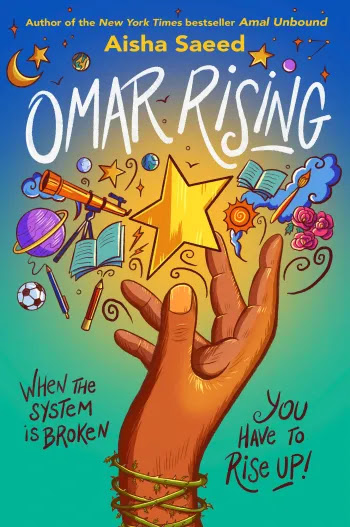
OMAR RISING: A MG Review by Teen Guest Blogger, Elliott Kurta


Omar Rising is the latest middle-school book from Aisha Saeed, featuring twelve-year-old Omar as he fights for justice at Ghalib Academy, an elite boarding school in Pakistan.


Despite having stayed at Ghalib over the previous summer, Omar is overwhelmed by the opulent campus. There’s a dining hall, soccer field, library, rec room, and walking paths. But Omar quickly realizes that he won’t be able to enjoy any of the luxuries in the Ghalib campus. As a scholarship student, he’s not only expected to maintain an A+ average in every subject, but is also required to complete five service hours a week while doing so. Worst of all, he’s not allowed to join the soccer or astronomy club, which he’s been waiting to join since the summer. As Omar struggles to keep up, he notices that none of his peers are held to the same standards that he is. Inspired by the artist and female rights activist Shehzil Malik, Omar decides to stand up for himself and rebel against the system that put him in Ghalib but is now doing its best to throw him out.

Omar Rising features a primarily Arabic characters and a corrupt school system as well as teachers that, frankly, have it out for their students. While this combination may seem too mature or complicated for middle schoolers, this novel perfectly packages real-world themes into digestible, easy-to-understand portions. Readers won’t just find themselves sympathizing with Omar, they’ll find themselves empathizing with him. It’s pretty easy to see yourself in Omar; he’s smart, a soccer-fanatic, sanguine, into science, and artistic. The poster child for childhood.

The rest of the characters are similarly likable. Kareen and Naveed, Omar’s roommates, add levity to each chapter. Similarly, Omar’s peers and soccer buddies, Humza, Jibril, and Marwan, give a more detailed glimpse into what the rest of the school looks like; carefree and preppy. Meanwhile, Omar struggles to keep up with his studies and manage his five weekly hours of chores, as he points out on pp. 80-81:

            “There are so many people who keep this school running. Gardeners. Cooks. Maintenance people. … They don’t need us to do this work. They just want to make sure we remember our place.”

Without delving too deep into the fact that he’s at the bottom of the hierarchy, Omar still delivers a poignant, impactful statement. This is only a small example of Omar’s emotional narration. Keeping pace with a fast-paced story, the middle-schooler’s monologues effortlessly switch from discussing soccer practice to elaborating on the pressure to succeed at Ghalib academy.

Omar Rising is an impactful and realistic novel, a call to action for any middle-schooler who has ever felt like an outsider. Through Omar, readers are educated about life in Pakistan and are inspired to make a difference in their own communities, just like the protagonist. The book is a reminder of how powerful resistance can be, even in the face of a system designed to create and widen inequalities. Overall, Omar Rising is a novel rooted in change and justice but still easily relatable to kids, perfect for young activists and innovators.

                                                ***

Congratulations to Connie Saunders who won DAISY AND THE MONA LISA. 

Don't forget to check out other great Middle-Grade books on Greg Pattridge's MMGM blog.


Wednesday, June 8, 2022

JENNIFER CHAN IS NOT ALONE-- A Book Review by Guest Blogger, Elliot Kurta

When I read Greg Pattridge's review of Jennifer Chan Is Not Alone, I recognized a book that Elliott, my teen guest blogger, would probably enjoy. As you'll see in his review, I was correct.


Combining aliens, middle school, and bullying, Jennifer Chan Is Not Alone by Tae Keller is an insightful book with an important message for tweens. Overall, the book handles uncharacteristically mature themes, such as bullying, being true to yourself, and making up for past misdeeds. However, this isn’t to say that the target audience won’t be able to understand or acknowledge them. Instead, Jennifer Chan is refreshingly honest while still relatable.

Mallory is the first student at Gibbons Academy to meet the new girl, Jennifer Chan. Over the summer, Mallory is drawn to Jennifer’s self-confidence and earnestness, and the two of them become friends. But once school starts, Mallory is reminded that just being yourself isn’t cool, and if she wants to stay popular she’s going to need to start acting the part. Jennifer, on the other hand, is having even more trouble fitting in. She’s made fun of for believing in aliens, copying the other girls’ haircuts, and being… well, different. As the school year is ending, Mallory and her friends decide that Jennifer needs to be put in her place, for once and for all. The next day, Jennifer has disappeared, and Mallory knows that there are only two possible explanations. Either she was abducted by aliens, or she ran away because of Mallory.

With each chapter, and alternating between the past and the present, Mallory unravels the truth. Using help from two old friends, she reads Jennifer’s journals and retraces Jennifer’s path the day she disappeared. However, finding Jennifer leads to a revelation that Mallory doesn’t want to accept. Unless Mallory can make amends and acknowledge her mistakes, the only lead as to where Jennifer might be will disappear.

Bringing to light what it’s like to be a bully—and what it’s like to be bullied—in middle school, Jennifer Chan Is Not Alone is packed with emotion. Mallory, both the hero and villain of this story, is unsettlingly relatable, even as she balances peer pressure and her conflicting emotions. Unlike many young protagonists, Mallory’s age is apparent, even as she struggles to bear the guilt of her actions and tries to repair her mistakes. Although the entire book is narrated from Mallory’s point of view, each chapter ends with one of Jennifer Chan’s journal entries, giving a better perspective on the eponymous character’s life and personality. Additionally, Mallory is just one of many remarkable characters, including WASPish Reagan, analytical Ingrid, and arrogant yet persuasive Pete.

Even though this middle-school novel might seem unrealistic, Tae Keller stays well within the realm of possibility. Although aliens and their existence, or lack thereof, are a central part of the book, they’re not presented in a polarizing way, but instead with a “maybe” and a shrug. By the final page, however, the surprise ending is revealed, with a conclusion that’s equally informative and open-ended. With a message of accepting and being kind to others, Jennifer Chan Is Not Alone is perfect for today’s modern society; especially since peer pressure and cyberbullying can make kids feel lonelier than ever.

One of the reasons why Tae Keller was able to write such a compelling story has to do with her background. Despite the scenes throughout the book, the most touching pages have to be the afterword. Tae Keller reveals that she was bullied during middle school and that this book is the cumulation of her journey of self-healing.

In conclusion, Jennifer Chan Is Not Alone is a stunning, multilayered book with an important message for pre-teens everywhere. Every aspect of this book is soaked with meaning—even the title—which hints at Jennifer Chan’s belief in aliens and her own subsequent alienation. Written for anyone who’s ever felt conflicted between the right or wrong thing, or for anyone who’s ever been bullied, Jennifer Chan will take you on a tumultuous, heart-wrenching journey.


If you're not familiar with Greg's great blog, please check out his Marvelous Middle Grade Monday posts.


THE NIGHT WAR: A MG Historical Novel Review

  By now you should have received an email from my new website about my review of THE NIGHT WAR by Kimberly Brubaker Bradley. (It'll com...