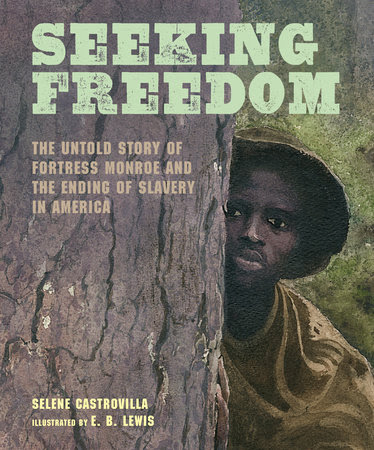
I'm starting off the new year by joining a blog tour for a new book by award-winning Selene Castrovilla, SEEKING FREEDOM(Calkins Creek, 2022). The expressive watercolor illustrations are by award-winning artistrator, E.B. Lewis.
REVIEW
Although most of this informational picture book for 7-10 year-olds is presented in a journal format, the book opens with a quote from President Abraham Lincoln's First Inaugural Address on March 6, 1981:
I have no purpose, directly or indirectly, to interfere with the institution of slavery in the States where it exists. I believe I have no lawful right to do so, and I have no inclination to do so.
The next page explains how Lincoln was unable to convince the remaining Southern states (seven had already left the United States) to stay. War broke out on April 2, 1861. Five days later, Virginia abandoned the country. Fearful of being separated from their families and forced into hard labor, "The enslaved people...would do anything to be free."
Thus, this true story opens.
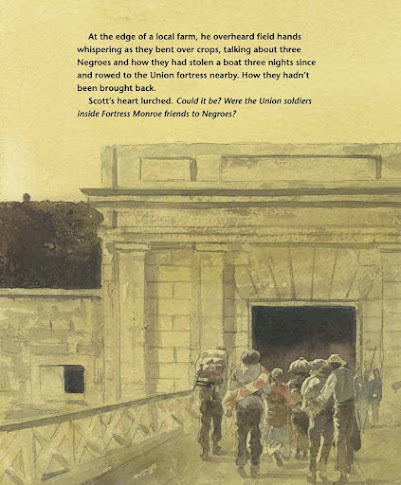
Scott knew the forest and swamps--but he didn't know what was going on the town of Hampton. He overheard field hands talking about how three Negroes had escaped to a Union fortress nearby--and hadn't been returned. Could it be? Were the Union soldiers inside Fortress Monroe friends to Negroes?
Scott watched as eight Negroes headed inside. He waited. But they didn't come out. Was it true? Were these people now among friends?
By the time Scott spoke with Butler, the major was frustrated. He had interviewed many Negros but hadn't obtained the information he needed: Where were the Confederates stationed? The major was also in a difficult position. He was holding every Negro who came to him as contraband of war--"property used for warlike purposes against the government of the United States."
When Major Butler spoke with George Scott he realized he'd found the man he was looking for--someone who could track down the Confederates. Even after finding out that his plan to use Negros as spies was approved, Butler was still worried. Could the fortress remain secure against enemy attack? He prayed for Scott's safety.
George Scott wandered for eight days looking for the Confederates. He prayed that the Lord would lead him. Just then, he saw thousands of Confederate soldiers outside a church. His prayers had been answered.
Scott raced back to the fort with the news he had gleaned--the rebels were preparing to cut off all supplies.
Butler's men had not died in vain. The confederates had fled; the threat to the fortress was over. But how could Butler reward Scott? When Scott asked for freedom, Butler put his legal skills to work.
Butler implored the President and Congress:
These human beings must be given the free enjoyment of life, liberty, and the pursuit of happiness.
BACK MATTER
Seeking Freedom includes eight pages of back matter; that's an exceptional amount of pages! But the sections on the Aftermath (including references to the Confiscation Act of 1862 and the Emancipation Proclamation), the Contrabands, Benjamin Butler's Legacy, George Scott, and Fort Monroe in Hampton, Virginia, add a depth of information to this informational picture book that will be appreciated by older students as well as adults. By the way, the last spread is a picture of President Obama signing a proclamation establishing the Fort Monroe National Monument.
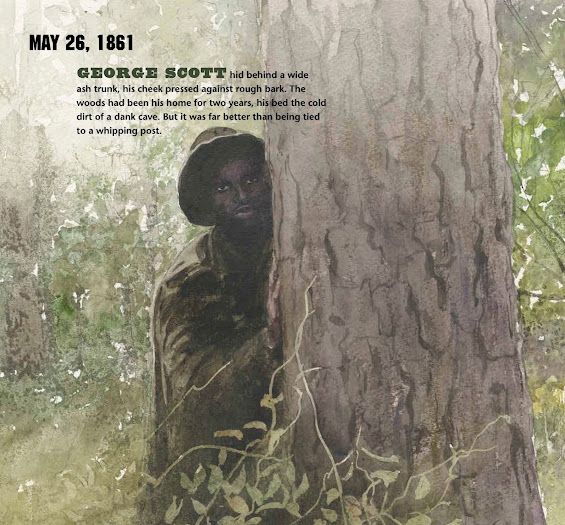
Interestingly, there are no known images of George Scott. William Headly shared Scott's story. He escaped enslavement and became a contraband in North Carolina. His cloak is an old cotton bag.
https://www.loc.gov/item/2010647919/
For a view behind the scenes of how Selene came to write this story, see her post on Nerdy Book Club.
Here's a YouTube video of Selene talking to her editor, Carolyn Yoder, about writing picture books which bring alive history.
GIVEAWAY
To enter this giveaway, please leave me a comment by 6PM on January 8th. U.S. postal addresses only. If you decide to follow my blog I'll put your name in for a second chance.Please include your name and email address if you are new to my blog. If you are hesitant to leave your email address, you can reach me directly by clicking here.
Congratulations to Gail Cartee who won The Dirt Book from last week's blog.
I heard Bettye speak at a webinar sponsored by the Charlotte chapter of the Women's National Book Association. After I heard Bettye's compelling talk I reached out to her and we met virtually and have exchanged emails and phone calls. I am thrilled to share her book with you, as well as a few thoughts about her writing journey. Let's just stay that I'm not alone in investing over fifteen years into a project I love.
REVIEW
Few of us can trace our ancestry as Bettye Kearse has. She is a eighth-generation griotte and her mother said to her from the time she was a child, "Always remember--you are a Madison. You come from African slaves and a president."
Bettye unpacks the full implication of this family credo when her mother passes on to her a box full of ancestral documents, priceless mementoes, and photographs. At the time, Bettye was a successful pediatrician in Boston. Her life was about to change.
Bettye (around four or five) standing with her mother .
This rich, sensory memoir begins and ends with the voice of Mandy, Bettye's enslaved ancestor stolen from Ghana. Kidnapped from her home, Mandy is crammed into a slave ship. The reader feels the splinters in her hands in the hold of the ship, smells the reek of urine and feces, and feels the horrific chains binding her.
When she gets to Montpelier, James Madison's Virginia plantation, Mandy's agonies have only just begun. Sexually assaulted by James Madison senior, she gives birth to their daughter Coreen. James Madison's son, James junior, is attracted to Coreen and he takes her for himself--despite the fact that she is his half-sister. (Bettye explains these complicated relationships in this interview.)
Having grown up in the sixties, Bettye is uncomfortable with her mother's unflinching pride in being a descendent of the Madisons. President James Madison had owned and abused her ancestors! How could she be proud of that?
Knowing that she was challenging parts of her family history that her mother hadn't, Bettye wonders what she can contribute to the family legacy. Though hesitant, Bettye determines to uncover the truths about her ancestors and becomes the first person to write the family history down.
An 1860 slave census listing Bettye's great-great-grandparents and their children.
Bettye was very close to her grandfather, and the book is full of their relationship. He frequently told her mother, "Our white ancestors laid the foundation of this country, but our dark-skinned ancestors built it." Another time he commented, "Racism is just another challenge, and challenges make us strong."
Bettye's research into her past takes her to Lagos, Portugal. What she finds rocks her to the core. The people who live in this tourist town are oblivious to the slave trade that had begun there in 1441. "There wasn't one morsel of information about slave stockades. The erasure was complete."
Bettye visits the Elmina Castle in Ghana and imagines what it was like for the enslaved men and women who were stolen, separated from their families, and kept in bondage. Her description of these atrocious events is complete. 150-300 women stood pressed together in "rooms of deep sorrow." They were marched through a "gate of no return" to a slave ship. "The ocean wiped away their footprints."
When Bettye comes back to the states, she visits the National Black Wax Museum in Baltimore. On board a replica of a slave ship, Bettye puts herself into Mandy's horrific experiences of possibly being raped, sick, and close to death. She wonders if she would have made it to the New World.
There is much more to this book: Bettye's conversations with her mother over the nature of the sexual relationships between owners and slaves (her mother called it "visiting"), Bettye's first encounter with Jim Crow when she was five-years-old, the racism she still experiences, Bettye's pride for her family and other enslaved Blacks, how she feels holding the picture of her great-great-great grandmother--the first ancestor she could see.
This is an important book and one you won't quickly forget.
IN HER OWN WORDS
In one of our conversations, Bettye told me that the hardest part of writing this memoir was what to do with the "rich material" she had received from her mother. Initially, Bettye wrote the book the way her mother wanted, as a record of their family stories. Then, she realized that her story wasn't unique to her and a mentor recommended that she write it as fiction; but that came out "flat." Her mentor then suggested Bettye write a memoir. Inserting her own feelings was difficult, but that process breathed life into the narrative. "It was very rewarding to discover my purpose by writing this as a memoir and realizing that I had a message for others."
AUDIO and VIDEOS
The narrator, Karen Chilton, has a beautiful reading voice and immersed me in the memoir. Sometimes I forgot that it wasn't Bettye speaking. Here is an audio snippet to show you how well Chilton reads the book:
Here is a video sequence narrated by Bettye and other historians.
A VIRTUAL SCREENING
Join Bettye for a virtual screening of the Eduardo Montes-Bradley documentary, The Other Madisons. There are several opportunities to view the film over the next few weeks.
GIVEAWAY
Leave me a comment by March 20 at 6 PM if you would like to enter this giveaway. PLEASE leave me your email address if you are new to my blog.
DISCUSSION GUIDE
This book is a great book club selection. Download the discussion guide here.